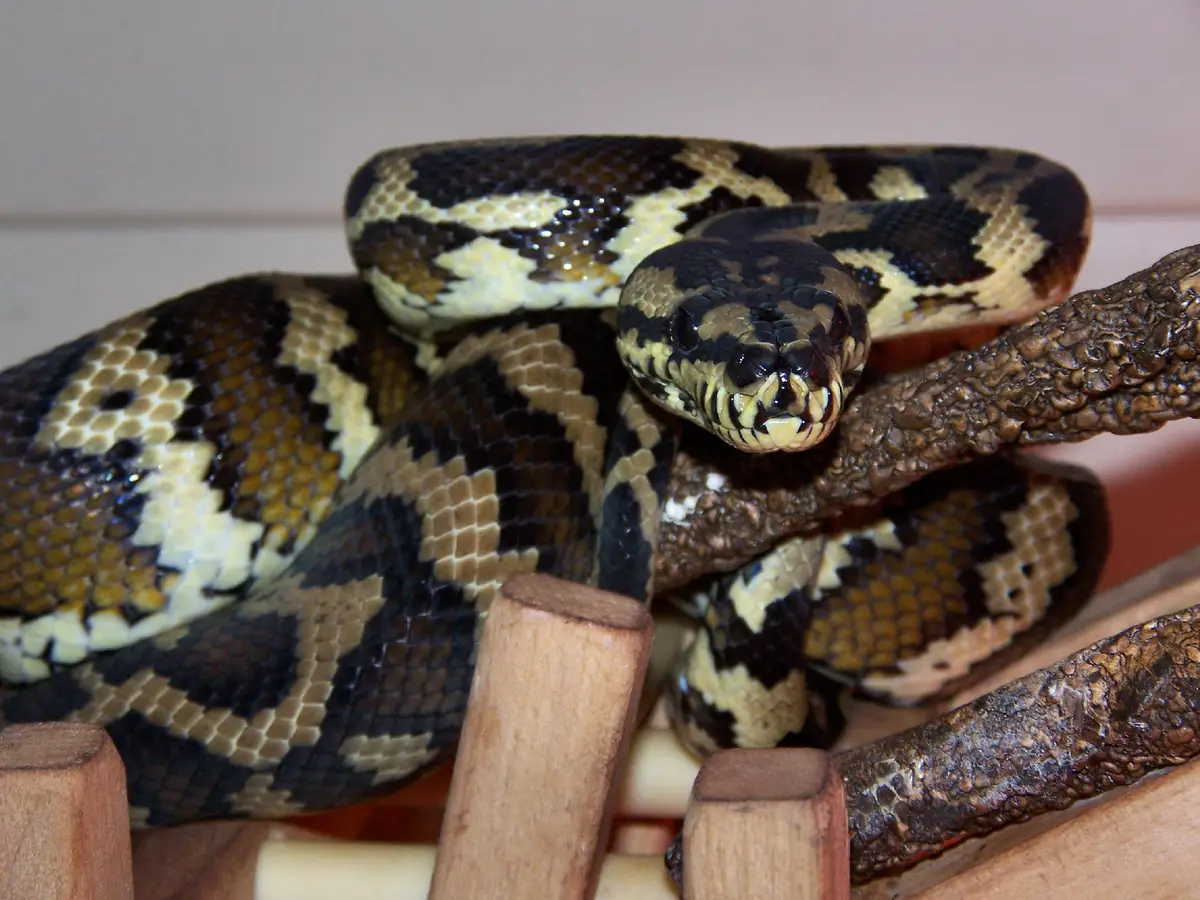
NORTHWESTERN CARPETPYTHON
Morelia spilota variegata · Family Pythonidae
KEY TAKEAWAYS
The northwestern carpet python (Morelia spilota variegata) is a non-venomous python of tropical northern Australia, found from the Kimberley in Western Australia across the Top End of the Northern Territory. It is also called the Darwin carpet python and the Torresian carpet python. It has no venom and is no danger to people, though a big one can give a painful bite if grabbed.
- It has no venom. It kills prey by constriction, and a bite needs cleaning, not antivenom.
- Adults are usually about 6.5 ft (2 m) long; Climatewatch gives an average of about 8 ft (2.5 m) for the Northern Territory form.
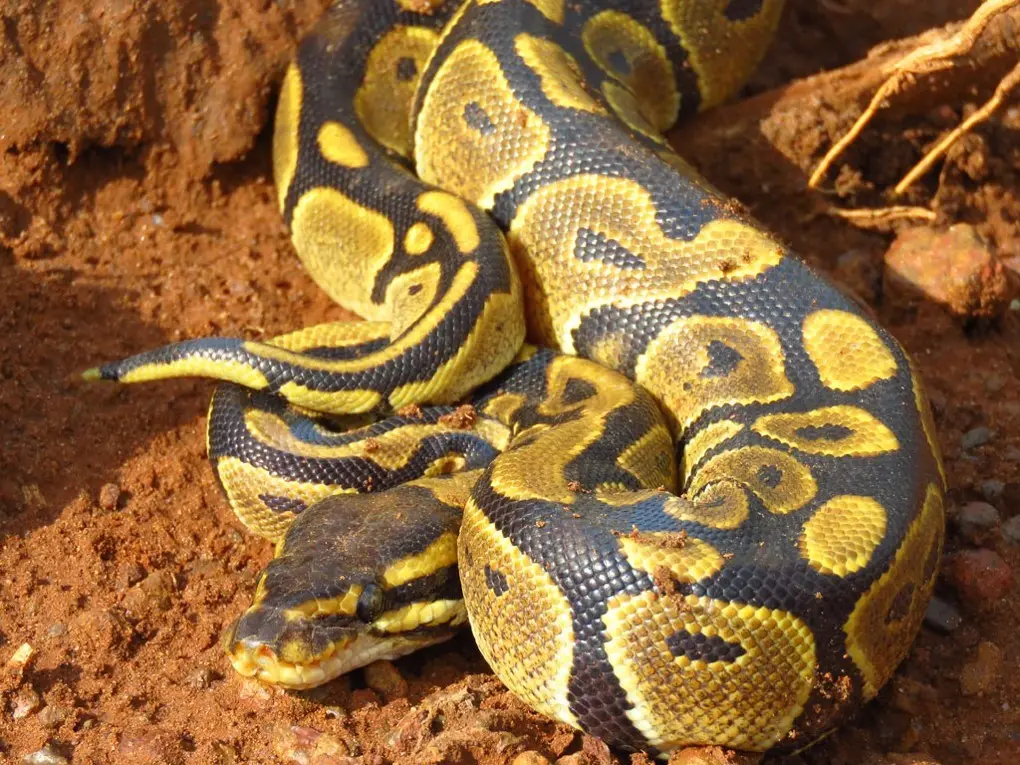
- It is beige to dark brown with darker blotches and pale zigzag bands, and its colors vary from region to region.
- The carpet python species is rated Least Concern by the IUCN. Near Darwin, carpet pythons doubled in number after cane toads arrived, according to a 2021 study.
Northwestern carpet python quick facts
| Common name | Northwestern carpet python (also Darwin carpet python, Torresian carpet python) |
|---|---|
| Scientific name | Morelia spilota variegata Gray, 1842; a subspecies of the carpet python, Morelia spilota (Lacepede, 1804) |
| Family | Pythonidae (pythons) |
| Venomous | No, a constrictor |
| Adult length | Usually about 6.5-8 ft (2-2.5 m) |
| Range | Northern Australia: the Kimberley of Western Australia and the Top End of the Northern Territory; some authorities extend it east to Cape York |
| Habitat | Dry forest and woodland, often near rivers, rocky outcrops and escarpments; also farms and suburbs |
| Diet | Mammals, birds, lizards and frogs |
| Reproduction | Lays eggs; carpet python clutches average about 21 eggs |
| Conservation | Species: IUCN Least Concern; CITES Appendix II |
How to identify a northwestern carpet python
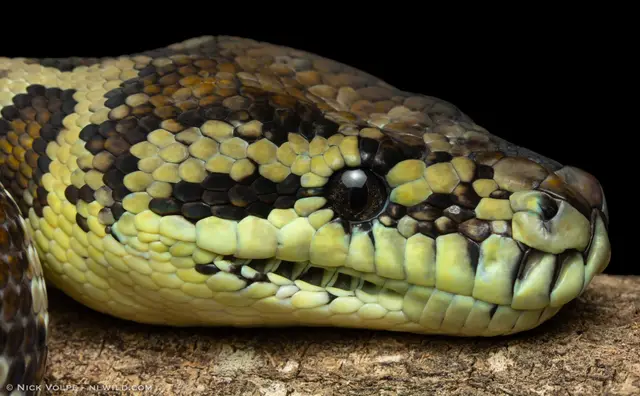
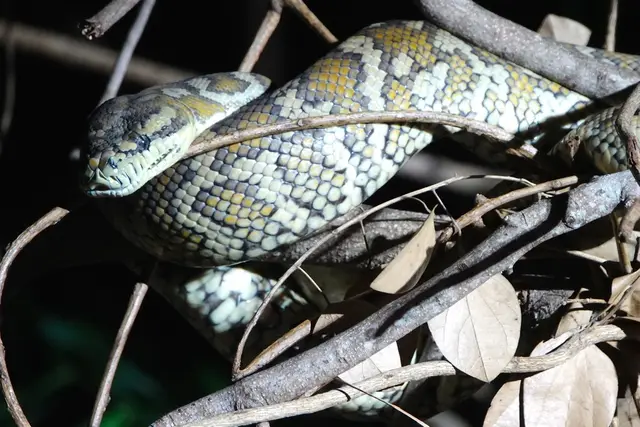
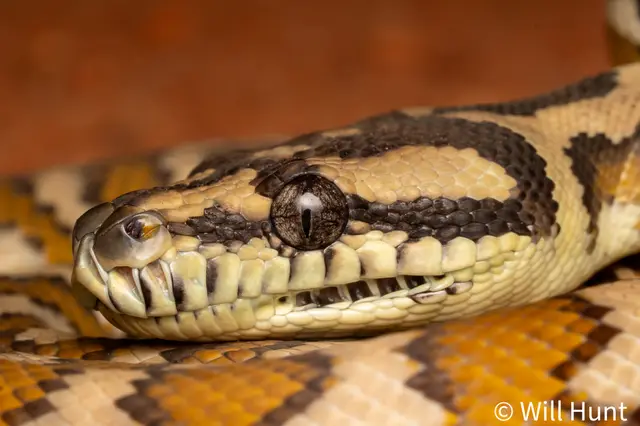
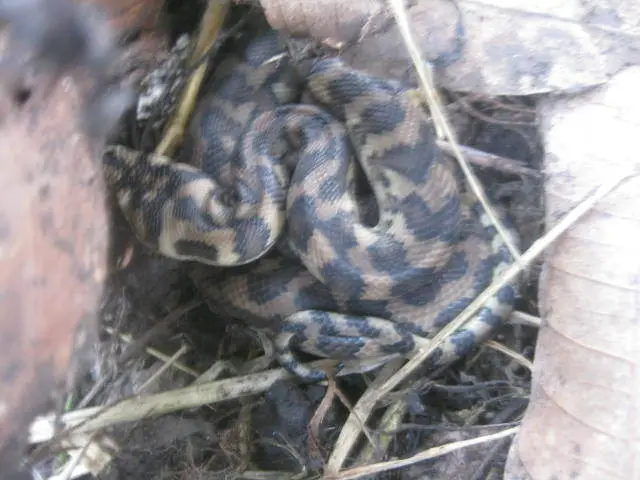
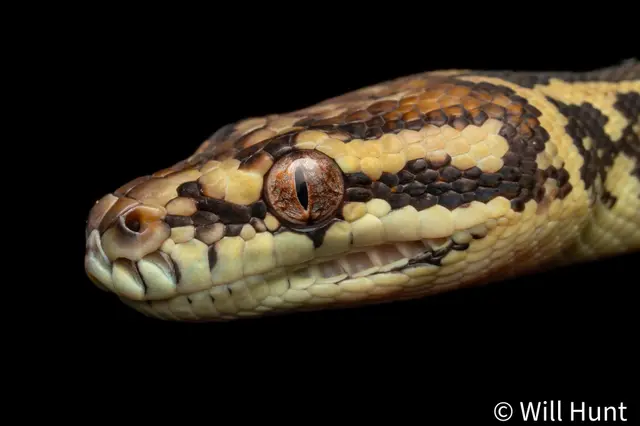
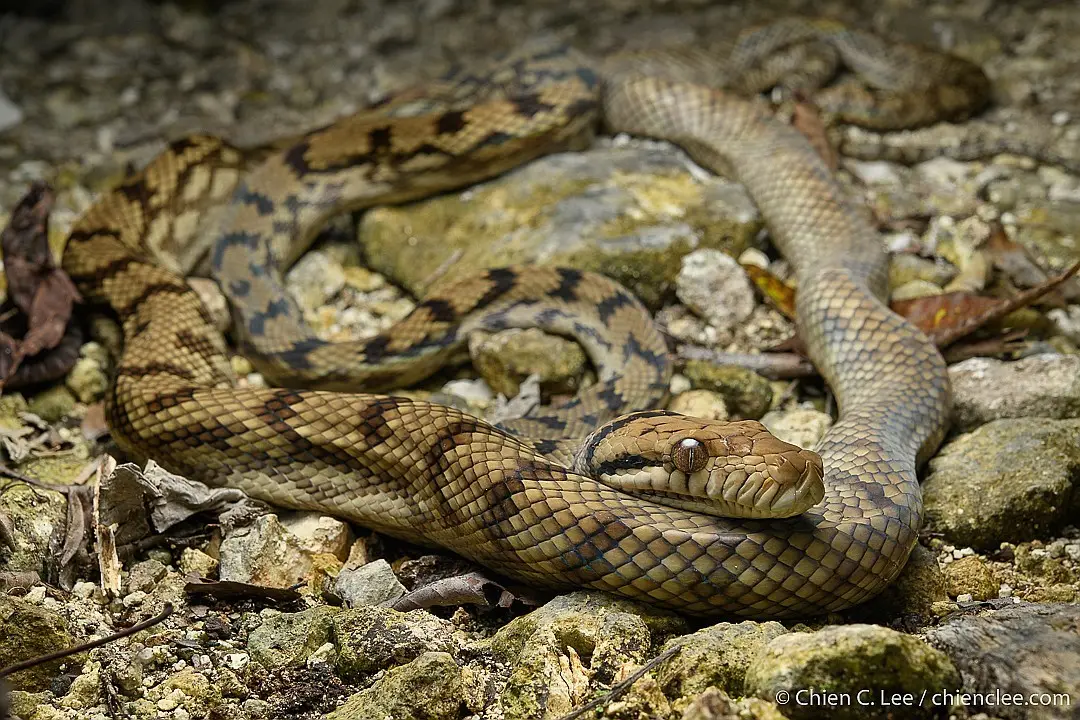
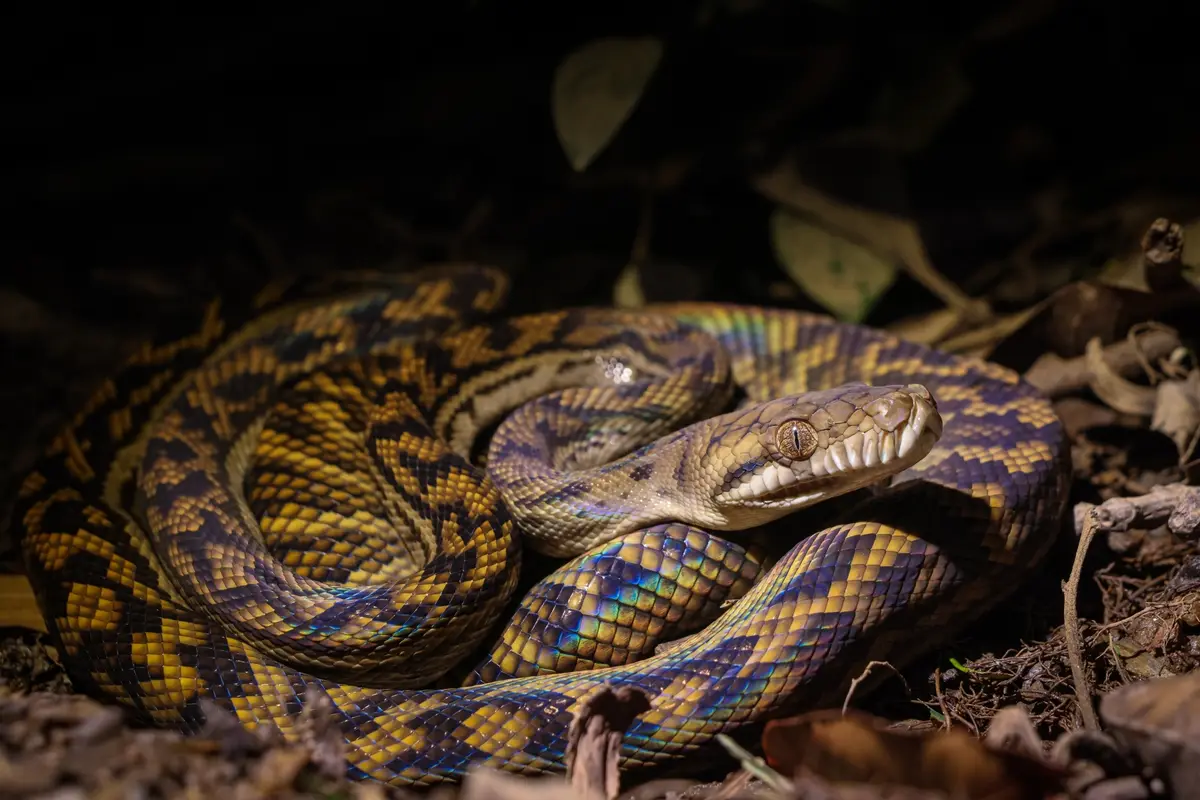
A northwestern carpet python is a medium to large python with a broad, triangular head and a blotched pattern. The Pierre Wildlife database describes it as dark brown to black with beige to yellowish crossbands that often join into a network of blotches and zigzags. Climatewatch says the Northern Territory form is beige or brown with blackish or grey blotches, and that regional forms can be gold, yellow or rust.
- 1Blotches and zigzags: pale bands or blotches edged in black on a brown, beige or near-black body. A large plain brown python in the same country is more likely an olive python.
- 2Broad head, thin neck: the head is much wider than the neck and covered in many small scales, not the large plates of a black-headed python.
- 3Heat pits on the lower jaw: a row of deep pits along the lips that sense the body heat of prey. Venomous Australian elapids, such as brown snakes, have none.
- 4Pale or blotched belly: the WA wildlife department describes the belly of carpet pythons in Western Australia as white, cream or yellow, either plain or with bold black blotches.
- 5Location: a carpet python seen in the Kimberley or around Darwin, Kakadu or Katherine is almost certainly this subspecies.
Scale counts help experts confirm a carpet python. The Australian Reptile Online Database gives 40-65 rows of scales around the middle of the body, 240-310 belly scales and 60-95 divided scales under the tail for the species as a whole.
How big do northwestern carpet pythons get?
Most adults are about 6.5 ft (2 m) long. The Pierre Wildlife database gives a usual length of about 2 m, and Climatewatch puts the average for the Northern Territory form at about 2.5 m (8 ft). That puts it at about the same size as the coastal carpet python of eastern Queensland, and far shorter than an olive python.
| Measure | Figure | Source |
|---|---|---|
| Usual adult length | About 6.5 ft (2 m) | Pierre Wildlife database |
| Average, Northern Territory form | About 8 ft (2.5 m) | Climatewatch |
| Average, carpet python species | About 7.9 ft (2.4 m) | Australian Reptile Online Database |
| Longest reported, carpet python species | About 13 ft (4 m) | WA Department of Environment and Conservation |
The 4 m figure is for carpet pythons in general, not this subspecies. No verified record length has been published for a wild northwestern carpet python. Carpet python populations also differ in which sex is bigger: in the southwest of Western Australia females grow up to four times larger than males, while in northeastern New South Wales, where males fight for mates, males are the larger sex, according to Shine and Fitzgerald (1995).
Where do northwestern carpet pythons live?
Short answer: across the tropical north of Australia, from the Kimberley region of Western Australia through the Top End of the Northern Territory. The Reptile Database gives the range of the subspecies simply as northern Australia.
Where the range ends in the east is less settled. The Australian Reptile Online Database includes Cape York Peninsula and New Guinea, while the Reptile Database now treats New Guinea snakes as a separate subspecies, the New Guinea carpet python. A 2026 paper by Natusch, Lyons and Shine notes that carpet pythons at the tip of Cape York are closely related genetically to those further west in the Northern Territory.
South of its range, in the rocky ranges around Alice Springs, lives a different carpet python, Bredl's python. In the eastern rainforests of Queensland the local form is the jungle carpet python.
Habitat
Northwestern carpet pythons live in open tropical country. The Pierre Wildlife database lists dry forest, often near rivers and running water, along with rocky outcrops and dry woodland, mostly in the lowlands. The WA wildlife department also describes carpet pythons as rock-dwelling, so the sandstone gorges of the Kimberley and Arnhem Land suit them.
They also do well around people. Climatewatch notes that carpet pythons turn up in parklands, rural land and suburban gardens, and are often found near chicken pens and barns.
Behavior
Carpet pythons are ambush hunters that climb well but also travel on the ground. The WA wildlife department fauna profile describes the species as arboreal, terrestrial and rock-dwelling, sheltering in hollow limbs, rock crevices and the burrows of other animals. In hot months it is mostly active at night or at dawn and dusk.
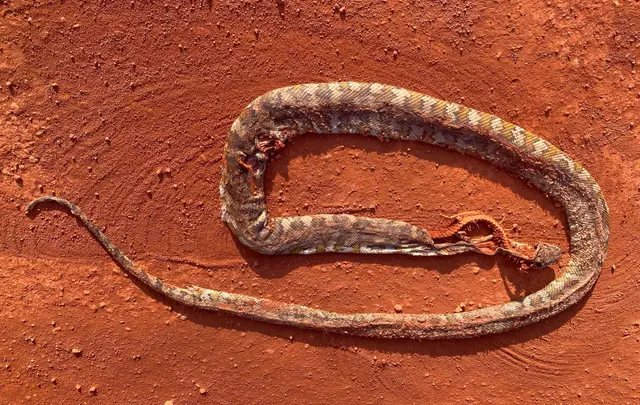
In the Top End, the wet season brings them out. Climatewatch reports that carpet pythons are often seen on roads at night in the wet season, from October to May, which is when many people meet one. Slow down on wet-season nights; a python stretched across a warm road is easy to run over.
In the breeding season, males may fight. Natusch, Lyons and Shine (2026) note that male-male combat has been recorded in Northern Territory carpet pythons. Earlier work by Shine and Fitzgerald (1995) showed that where male carpet pythons fight, they tend to be larger than females, and where they do not, females are larger.
What do northwestern carpet pythons eat?
They eat warm-blooded animals, lizards and frogs. The Australian Reptile Online Database lists lizards, frogs, birds and mammals for carpet pythons, and Climatewatch says they are often found near chicken pens, which tells you what they come for.
| Prey | Notes | Source |
|---|---|---|
| Mammals | Rodents and other small mammals | AROD, WA fauna profile |
| Birds | Wild birds and poultry, including chickens | Climatewatch |
| Lizards and frogs | Part of the diet, especially of young snakes | AROD |
| Cane toads | Eaten by mistake and usually fatal | Brown, Hemphill and Shine (2021) |
The python finds warm prey in the dark with the heat pits along its jaws, strikes, coils around it and squeezes until it stops breathing. It then swallows the animal whole.
Is the northwestern carpet python venomous or dangerous?
No. The northwestern carpet python has no venom and is not dangerous to people. The Australian Reptile Online Database lists the carpet python as non-venomous and not considered dangerous. It kills its prey by squeezing, and even a large adult is far too small to be a threat to a grown person.
It can still bite. Carpet pythons have many sharp, backward-curving teeth, and a defensive bite from a big one can bleed freely. Wash the wound with soap and water, check your tetanus protection, and see a doctor if it turns red or swollen. Keep pets and chickens secure at night if pythons live nearby.
The bigger risk is getting the snake wrong. The Top End and the Kimberley are also home to highly venomous elapids, such as brown snakes. If you are not sure a snake is a python, leave it alone and call a licensed snake catcher. Treat any bite from an unidentified snake in northern Australia as venomous and call 000. Our snake venom FAQ explains why color alone is a poor guide to danger.
Northwestern carpet python vs other northern pythons
Rough-scaled python
Morelia carinata · Harmless
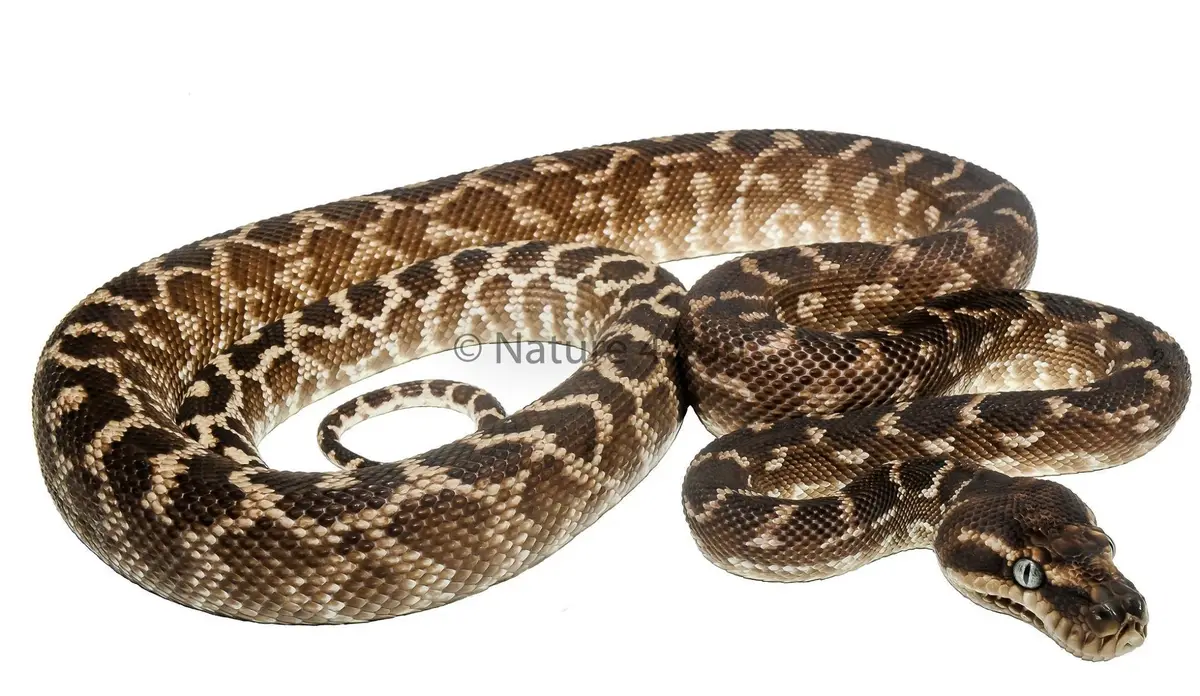
A very rare python of the northern Kimberley coast, known from only about 10 specimens between 1981 and 2007, according to the Reptile Database. Its back scales are strongly keeled, so the skin looks rough, while a carpet python's scales are smooth.
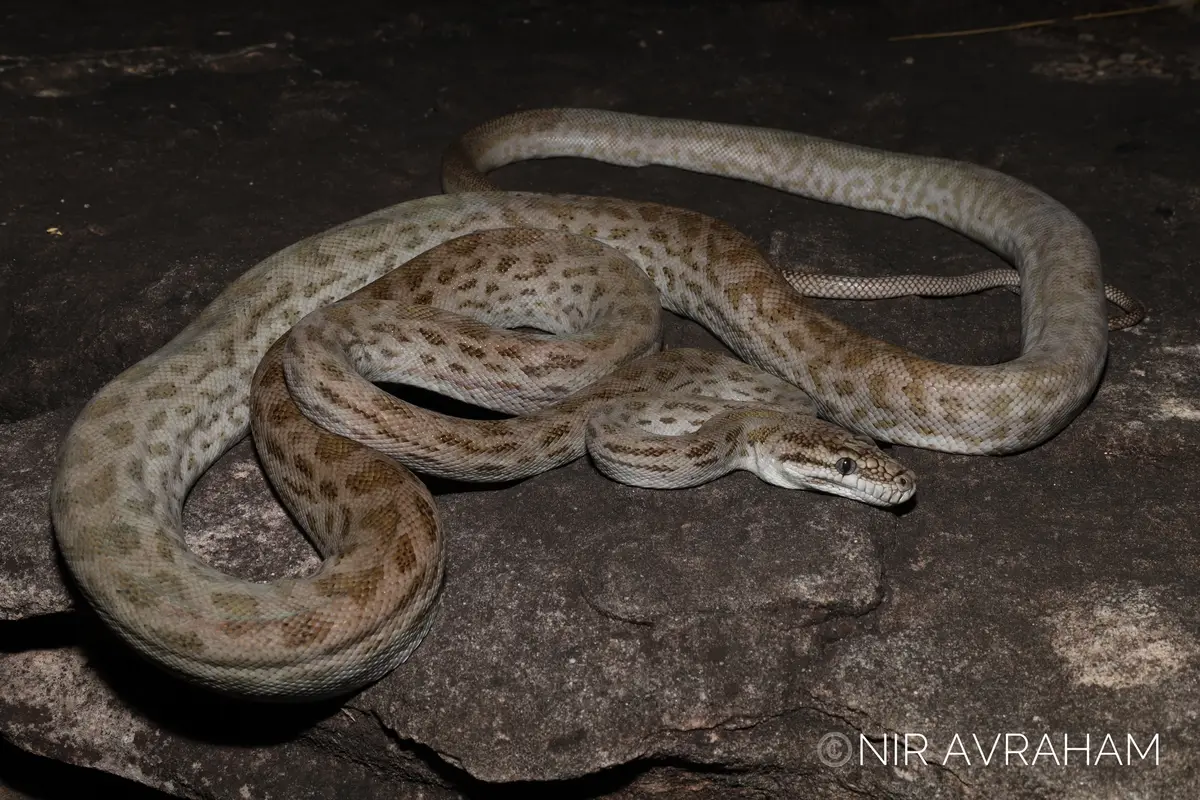
Oenpelli python
Simalia oenpelliensis · Harmless
A long, thin python found only in the sandstone country of western Arnhem Land. The Oenpelli python has rows of darker blotches on an olive-brown body and is much slimmer than a carpet python.
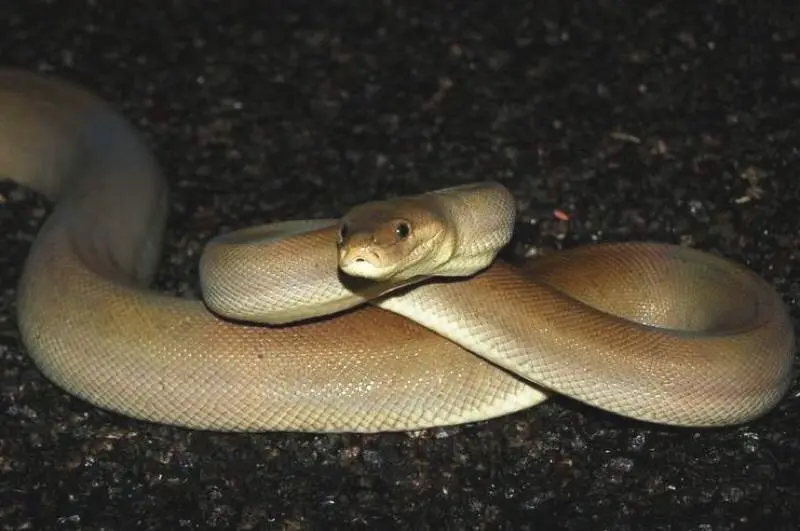
Olive python
Liasis olivaceus · Harmless
A huge, plain olive to brown python of gorges and waterholes. The olive python has no blotches or bands at all.
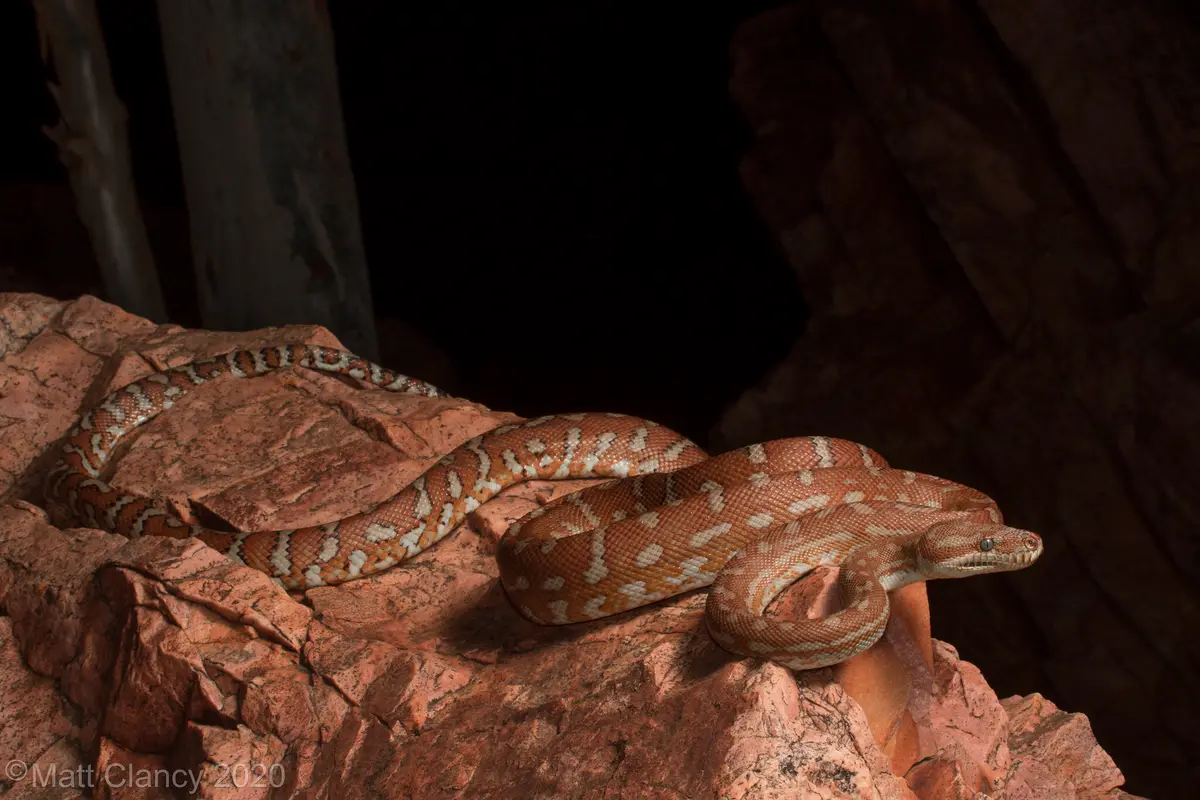
Bredl's python
Morelia bredli · Harmless
The carpet python of central Australia. Bredl's python is rusty red with cream bands and lives in the ranges around Alice Springs, well south of the Top End.
Reproduction and lifespan
Northwestern carpet pythons lay eggs. For the species, the Australian Reptile Online Database gives an average clutch of 21 eggs, with a range of 7 to 54. Climatewatch reports 10-47 eggs laid in early summer in sheltered spots such as hollow stumps or hollows in the ground.
The female stays with her eggs. The WA wildlife department profile says she coils around the clutch for up to 60 days and shivers to warm the eggs when the temperature drops, and that carpet python eggs hatch 63-71 days after laying. The young are on their own as soon as they hatch. These figures come from carpet pythons in general; few breeding records have been published for wild northwestern carpet pythons.
No reliable lifespan figure has been published for this subspecies in the wild.
Is the northwestern carpet python endangered?
No. The carpet python species, Morelia spilota, is rated Least Concern on the IUCN Red List, and Climatewatch lists the Northern Territory form as common. The northwestern subspecies has no separate IUCN assessment.
| Authority | Status |
|---|---|
| IUCN Red List | Least Concern (species Morelia spilota) |
| CITES | Appendix II, as are nearly all pythons; international trade needs permits |
| Northern Territory | Listed as common by Climatewatch; native reptiles are protected |
The Pierre Wildlife database notes that some populations are declining, mostly because of habitat damage from overgrazing.
Do cane toads kill northwestern carpet pythons?
Some, yes, but the population has held up. Brown, Hemphill and Shine (2021) described a wild carpet python that died after eating a cane toad at a site near Darwin, where toads had been present for 15 years. Yet surveys at the same site showed carpet pythons had doubled in number since the toads arrived. The authors think toads killed many large monitor lizards, which prey on pythons and compete with them for food, and that this benefit outweighs the occasional poisoned python.
The first Morelia
John Edward Gray described this snake as Morelia variegata in 1842. The Reptile Database notes that McDowell (1975) designated it the type species of the genus Morelia, though another view holds that the carpet python itself is the type. Today it is treated as one of several carpet python subspecies, alongside the diamond python, the inland carpet python and others. The southwestern carpet python of Western Australia has been raised to a full species.
Northwestern carpet python FAQ
Is the northwestern carpet python venomous?
No. The northwestern carpet python has no venom and kills its prey by constriction. The Australian Reptile Online Database lists carpet pythons as non-venomous and not dangerous. A bite from its sharp teeth can still bleed, so wash it well and check your tetanus protection. If you cannot identify a snake in northern Australia, treat any bite as venomous and call 000.
How big does a northwestern carpet python get?
Most adults are about 6.5 feet (2 m) long. The Pierre Wildlife database gives a usual length of about 2 m, and Climatewatch puts the average for the Northern Territory form at about 2.5 m (8 ft). Carpet pythons as a species have been reported up to about 4 m (13 ft), but no verified record exists for this subspecies.
Is the Darwin carpet python the same as the northwestern carpet python?
Yes. Darwin carpet python, northwestern carpet python and Torresian carpet python are all common names for Morelia spilota variegata, according to the Reptile Database. The name Darwin carpet python comes from the Top End, where the snake is common in and around the city of Darwin.
Where is the northwestern carpet python found?
It lives in tropical northern Australia, from the Kimberley region of Western Australia across the Top End of the Northern Territory. Some sources extend the range east to Cape York Peninsula. Snakes from southern New Guinea, once placed in this subspecies, are now listed by the Reptile Database as the New Guinea carpet python.
What do northwestern carpet pythons eat?
They eat mammals, birds, lizards and frogs. Climatewatch notes they are often found near chicken pens. They find warm-blooded prey at night using heat-sensing pits along the lower jaw.
Are northwestern carpet pythons kept as pets?
Yes. The Northern Territory and Kimberley form has been kept and bred in captivity for decades; a 1994 paper by Kortlang, cited by Natusch, Lyons and Shine (2026), describes its husbandry and breeding. In Australia, keeping a native python needs a state or territory wildlife license, and wild snakes are protected, so a pet should come from a licensed captive breeder.
Related snakes
Sources
- Reptile Database: Morelia spilota, including subspecies variegata
- Australian Reptile Online Database: Carpet python, Morelia spilota
- WA Department of Environment and Conservation: Fauna profile, Carpet python Morelia spilota
- Climatewatch (Earthwatch Australia): Carpet python
- Pierre Wildlife database: Morelia spilota variegata
- Brown, Hemphill and Shine (2021). The uneasy coexistence between carpet pythons and cane toads. Australian Zoologist 41(2): 214-219
- Natusch, Lyons and Shine (2026). Notes on the natural history of the carpet python (Morelia spilota) at the northern tip of Australia. Australian Journal of Zoology 74(5)
- Shine and Fitzgerald (1995). Variation in mating systems and sexual size dimorphism between populations of the Australian python Morelia spilota. Oecologia 103: 490-498
- Reptile Database: Morelia carinata, rough-scaled python