OLIVEPYTHON
Liasis olivaceus · Family Pythonidae
KEY TAKEAWAYS
The olive python (Liasis olivaceus) is a very large, non-venomous python that lives in rocky gorges and around waterholes across the drier parts of northern Australia. It is one of the biggest snakes in the country, but it has no venom and is not considered dangerous to people. Its worst enemy is often a person who mistakes it for a king brown snake.
- It has no venom. It kills by constriction, and a bite needs wound care, not antivenom.
- Adults often reach 6.5-16 ft (2-5 m). The Australian Reptile Online Database lists a maximum of 21 ft (6.5 m).
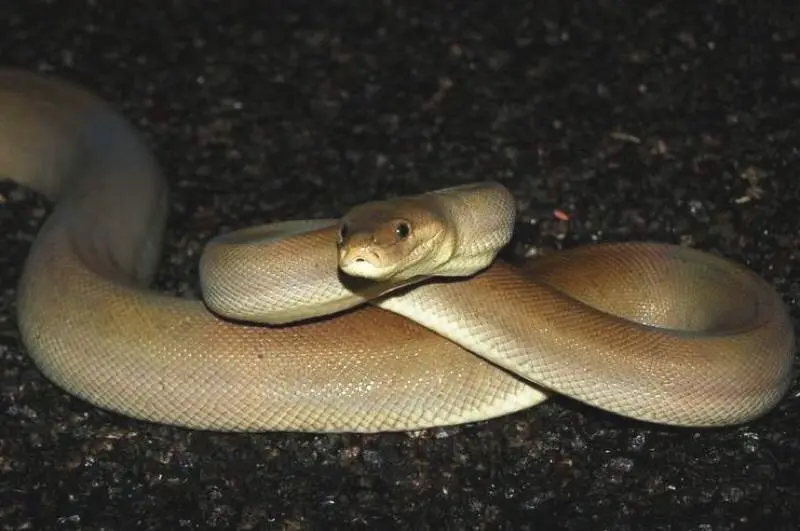
- It is a plain olive to chocolate-brown snake with no bold pattern, a pale belly and smooth, glossy scales.
- The Pilbara olive python of Western Australia is a separate subspecies listed as Vulnerable under Australian law.
Olive python quick facts
| Common name | Olive python; the western form is the Pilbara olive python |
|---|---|
| Scientific name | Liasis olivaceus Gray, 1842 |
| Subspecies | L. o. olivaceus (northern Australia) and L. o. barroni Smith, 1981 (Pilbara) |
| Family | Pythonidae (pythons) |
| Venomous | No, a constrictor |
| Adult length | Often 6.5-16 ft (2-5 m); listed maximum 21 ft (6.5 m) |
| Weight | About 22-44 lb (10-20 kg), according to Perth Zoo |
| Coloring | Plain olive, greenish-brown, reddish-brown or chocolate; whitish belly |
| Range | Northern Australia: Western Australia, Northern Territory and Queensland |
| Habitat | Rocky ranges, gorges and outcrops, usually near waterholes and creeks |
| Diet | Mostly mammals such as rock-wallabies and fruit bats; also birds and reptiles |
| Reproduction | Lays eggs; clutches of about 11-21 eggs, sometimes more |
| Conservation | IUCN Least Concern; Pilbara subspecies Vulnerable (national and Western Australia) |
How to identify an olive python
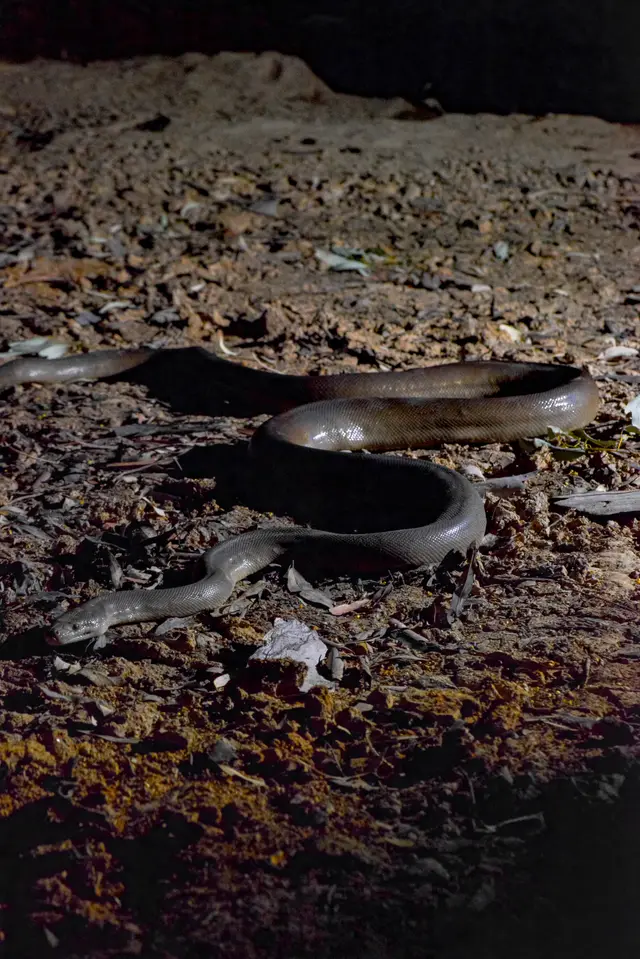
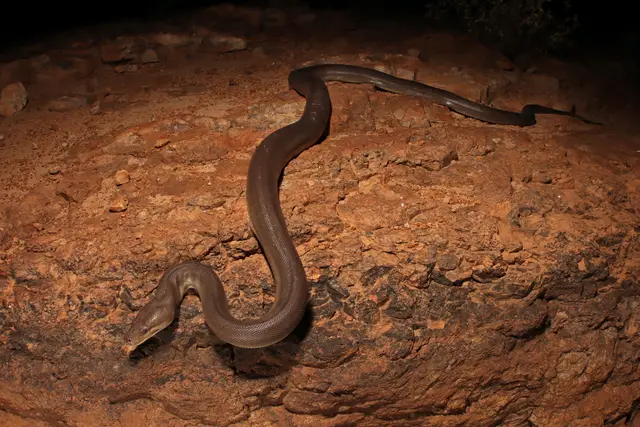
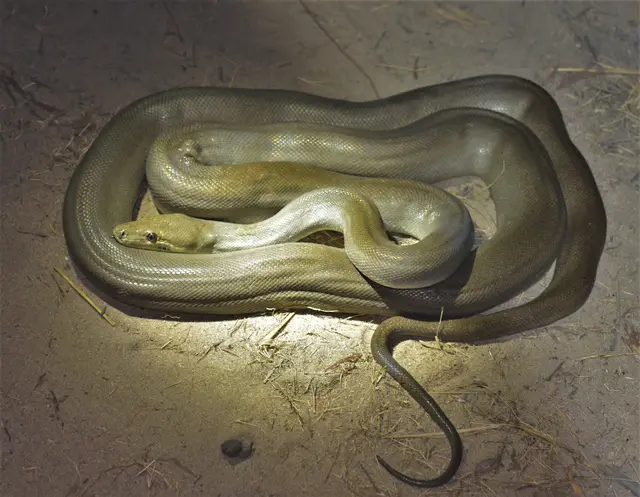
An olive python is a very long, heavy python with no real pattern. Perth Zoo describes it as usually one color, from olive or greenish-brown to reddish-brown or off-white, with a whitish belly. Its body scales are small and numerous, so the skin looks smooth and almost glassy. If you see a huge, plain brown snake beside a waterhole in a northern gorge, an olive python is a good first guess, but check the head before you get closer.
- 1Plain color, no blotches: olive, greenish-brown, reddish-brown or a deep chocolate, with no bands or diamonds. Most other large Australian pythons, such as the carpet pythons, are boldly patterned.
- 2Pale, speckled lips: the lips are pale and finely dotted with gray or brown, according to the Australian Government's 2008 Conservation Advice and Perth Zoo.
- 3Heat pits on the lower lip: the Australian Reptile Online Database (AROD) notes heat-sensing pits in the lower lip scales. Australia's venomous snakes have no lip pits.
- 4Large head shields: AROD notes that the scales on top of the head are enlarged and symmetrical, so the head looks neatly plated rather than finely scaled.
- 5Smooth, glossy skin: Perth Zoo gives 61-72 scale rows around the middle of the body, which is why the skin looks so smooth. AROD counts 321-411 belly scales and 90-119 paired scales under the tail.
How big do olive pythons get?
Olive pythons often reach 6.5-16 ft (2-5 m), and the biggest are reported at more than 20 ft (6 m). Perth Zoo gives a body length of 2-5 m and calls it one of Australia's largest snakes. AROD lists an average of about 6.5 ft (2 m) and a maximum of 21 ft (6.5 m). That puts it among the giants of Australia, alongside the Australian scrub python and the Oenpelli python.
| Measure | Size | Source |
|---|---|---|
| Average length | About 6.5 ft (2 m) | AROD |
| Typical body length | 6.5-16 ft (2-5 m) | Perth Zoo |
| Large adults | Can exceed 20 ft (6 m) | Moonlit Sanctuary |
| Listed maximum | 21 ft (6.5 m) | AROD |
| Weight | 22-44 lb (10-20 kg) | Perth Zoo |
The Pilbara subspecies is harder to pin down. The 2008 federal Conservation Advice, citing Cogger (2000), describes it as growing to about 8 ft (2.5 m). A 2013 genetic report for the Western Australian parks department by Pearson and colleagues, citing Shine (1981), says it can reach 21 ft (6.5 m). Few Pilbara snakes have been measured, so both figures should be treated with care.
Where do olive pythons live?
Short answer: across the drier parts of northern Australia, from the Pilbara of Western Australia through the Kimberley and the Top End of the Northern Territory into northwest Queensland. The Reptile Database records it from Western Australia, the Northern Territory and Queensland, and nowhere outside Australia. The type specimen came from Port Essington on the Cobourg Peninsula in the Northern Territory.
The range has a big gap in it. The Pilbara population is cut off from the northern olive pythons by the Great Sandy Desert, which is too dry for these water-loving snakes, according to the 2013 genetic survey of the Pilbara olive python by Pearson, Spencer, Hillyer and How. In the Pilbara it is known from Yinnietharra Station in the northern Ashburton region north to near Port Hedland, east to the Ragged Hills and the Oakover River, with an isolated population on Dolphin Island and the Burrup Peninsula. See how its range compares with other snakes on the world snake map.
Habitat
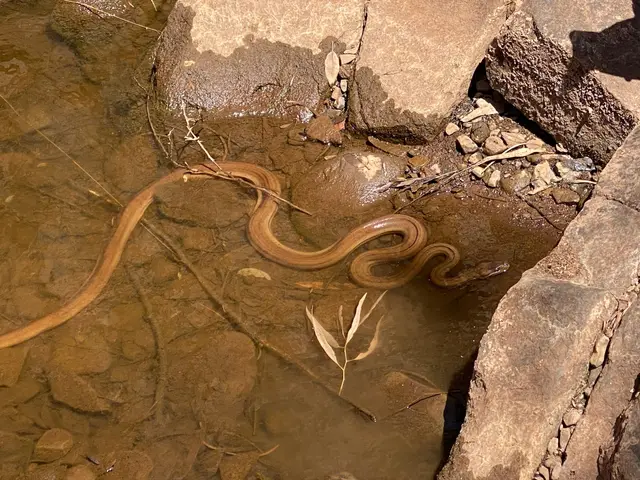
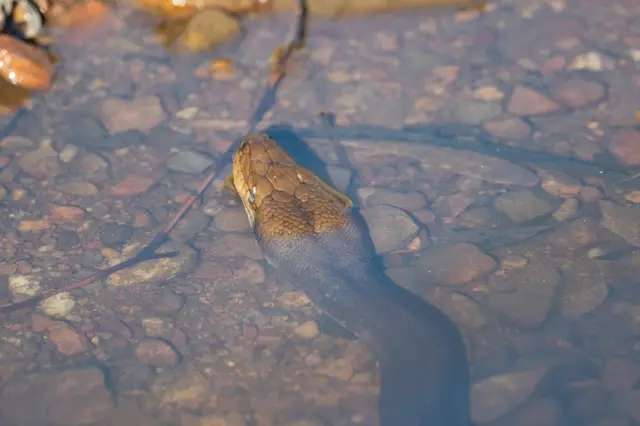
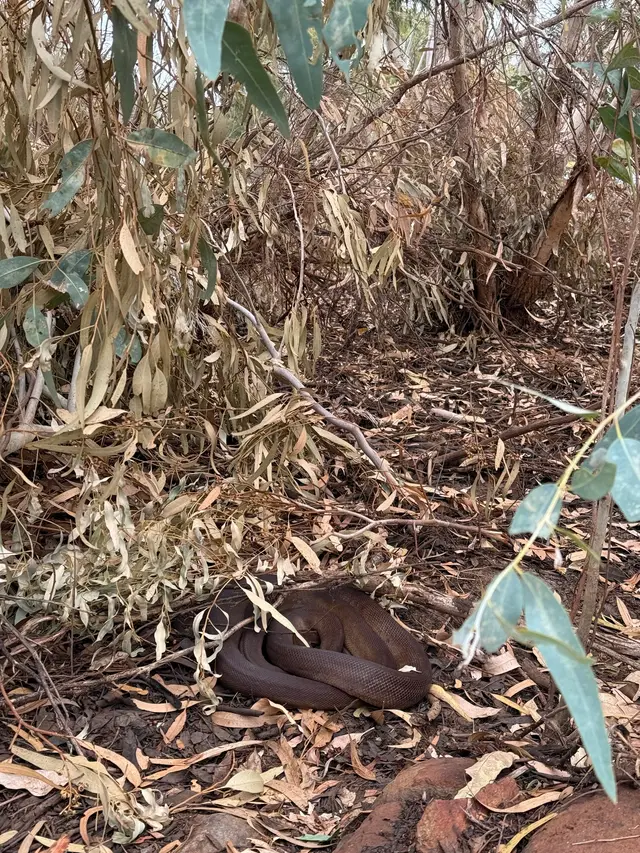
Olive pythons live in rocky country with water. AROD says they are often found near water at the bottom of gorges, and Perth Zoo describes arid to sub-humid areas, usually rocky ranges and gorges near watercourses. They shelter in caves, rock crevices and hollow logs.
In the Pilbara, the 2008 Conservation Advice says the subspecies prefers deep gorges and waterholes in the ranges, such as the Hamersley Range. Part of its habitat is protected in Karijini National Park, and it has been recorded at Millstream, Tom Price, Pannawonica and the Burrup Peninsula.
Behavior
The olive python is a mainly nocturnal ground snake and a strong swimmer. Moonlit Sanctuary says it hides in rock crevices and hollows during the hottest part of the day and either waits for prey or stalks it.
Its movements change with the seasons. Radio-tracking work summarized in the 2008 Conservation Advice found that Pilbara pythons spend the cooler winter months hidden in caves and rock crevices away from water. In the warmer summer months they move around widely, usually close to water and rock outcrops.
They are hard to study. The Conservation Advice notes there are no reliable trapping or census methods for the Pilbara subspecies, and the 2013 genetic report says very little is known about its biology.
What do olive pythons eat?
Olive pythons eat mostly mammals, along with birds and reptiles. AROD lists mammals as the main food. Perth Zoo says adults can eat mammals as large as rock-wallabies. Many of their meals come to them: they wait beside animal trails, or lie submerged in a waterhole and strike at animals that come to drink, according to the Conservation Advice.
| Prey | Notes | Source |
|---|---|---|
| Rock-wallabies | The largest regular prey for big adults | Conservation Advice; Perth Zoo |
| Fruit bats | Taken around gorges and waterholes | Conservation Advice |
| Ducks, spinifex pigeons and coucals | Birds caught at water or on the ground | Conservation Advice |
| Freshwater crocodiles | A python ate one at Lake Moondarra, Queensland, in 2014 | Australian Geographic |
| Other reptiles | Listed in general terms | Perth Zoo; Moonlit Sanctuary |
The most famous olive python meal was a freshwater crocodile. In March 2014, Australian Geographic published photos taken by Mount Isa resident Tiffany Corlis of an olive python that wrestled a freshwater crocodile at Lake Moondarra, near Mount Isa, then swallowed it whole. After a big meal like that, Moonlit Sanctuary says an olive python may not need to eat again for about six months.
Is the olive python venomous or dangerous?
No. The olive python has no venom and is not considered dangerous to people. AROD rates it non-venomous and not dangerous, though it can bite. It kills prey by wrapping around it and squeezing, like the reticulated python and other pythons.
A big olive python has many sharp, backward-curving teeth, so a bite can leave deep punctures. Wash any python bite well with soap and water and check your tetanus protection. See a doctor if the wound is deep or turns red and swollen.
The real danger is to the snake. Perth Zoo and the federal Conservation Advice both say people often kill olive pythons after mistaking them for the venomous king brown snake. Northern Australia does have dangerously venomous brown snakes, so if you are not sure what you are looking at, back away and leave it alone. The SnakesWiki snake venom FAQ explains why size and color are poor guides to danger.
Olive python vs king brown snake and other look-alikes
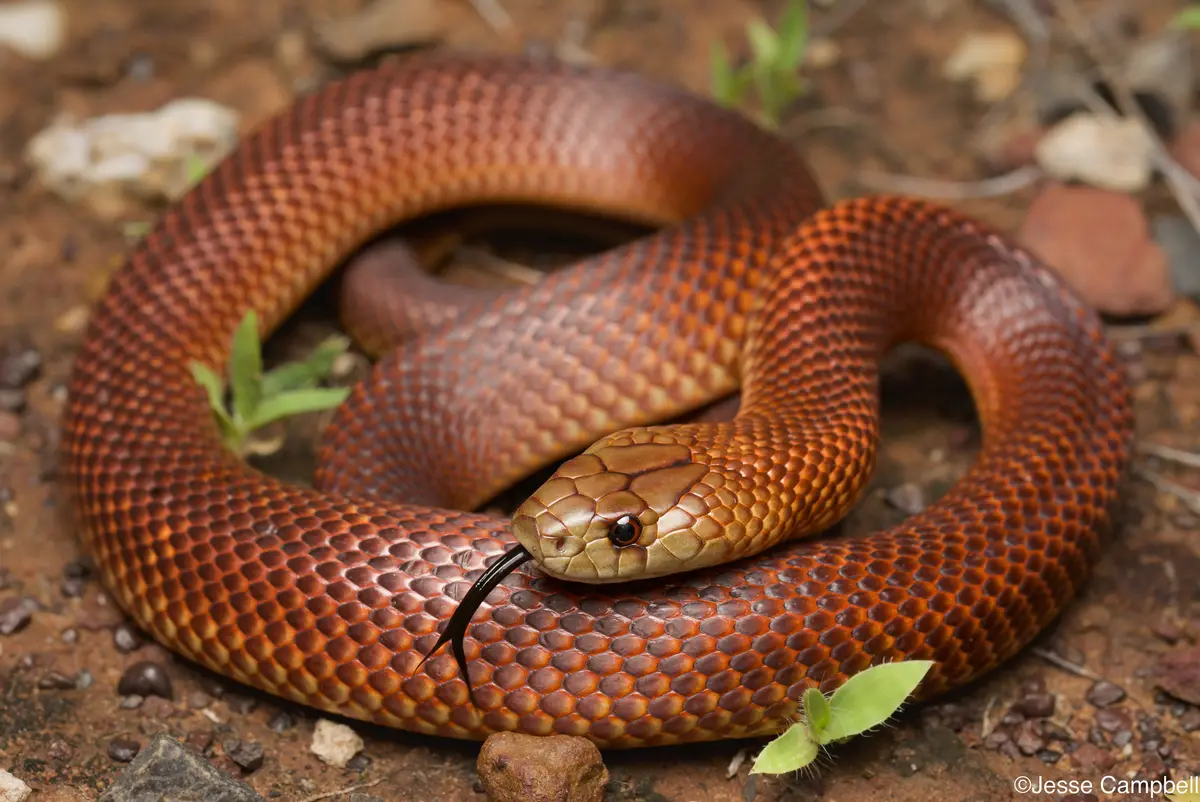
King brown snake (mulga snake)
Pseudechis australis · Highly venomous
The look-alike that matters. The Australian Museum describes a robust snake with a broad head, bulging cheeks and two-toned scales that give a net-like pattern, often with a darker tail. Adults average about 6.5 ft (2 m), and the largest reliably measured was 10.8 ft (3.3 m). It has no heat pits on its lips. Its venom is highly toxic, and a bite needs immediate medical care.
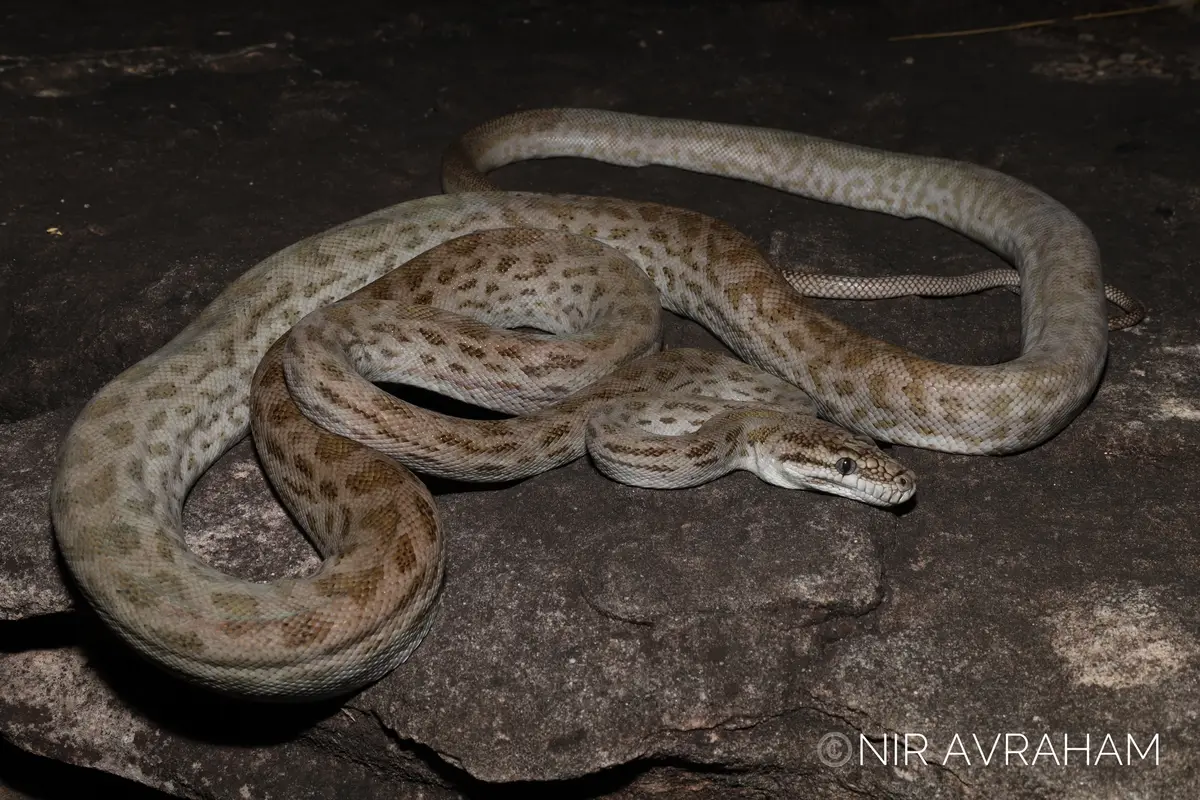
Oenpelli python
Simalia oenpelliensis · Harmless
Another very long python of Top End gorges, found only in western Arnhem Land. The Oenpelli python has rows of large darker blotches, while the olive python is plain. AROD counts 429-455 belly scales on the Oenpelli python, more than the olive python's 321-411.
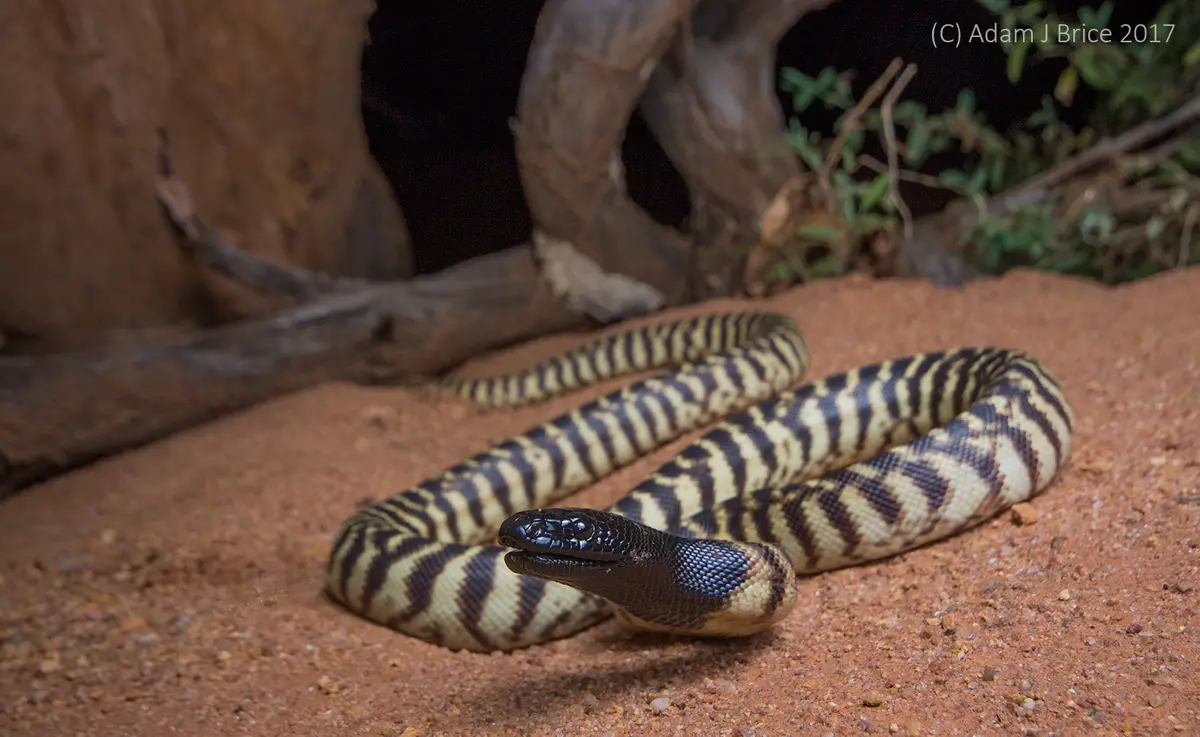
Black-headed python
Aspidites melanocephalus · Harmless
Also lives in northern Australia, but the black-headed python has a jet-black head and neck that end sharply against a pale, patterned body. It is also much smaller, averaging about 5 ft (1.55 m) according to AROD.
Reproduction
Olive pythons lay eggs. AROD gives an average clutch of 16 eggs, with a range of 11-21, and Perth Zoo gives an average of 19. Moonlit Sanctuary reports clutches of 12-40 eggs laid near the end of spring, which in Australia is around November.
The eggs take about seven weeks to hatch, according to Perth Zoo, and Moonlit Sanctuary gives about 50 days. Hatchlings often rest for a few days with only their heads poking out of the egg before they leave it, Moonlit Sanctuary notes.
No reliable lifespan figure for wild olive pythons has been published.
Is the olive python endangered?
No, the species as a whole is not endangered. The IUCN Red List rates the olive python Least Concern, as the Reptile Database and iNaturalist record. The Pilbara subspecies is less secure. It is listed as Vulnerable under Australia's Environment Protection and Biodiversity Conservation Act 1999 and as threatened in Western Australia.
| Authority | Status |
|---|---|
| IUCN Red List (species) | Least Concern |
| Australia, EPBC Act (Pilbara olive python, L. o. barroni) | Vulnerable |
| Western Australia (Pilbara olive python) | Threatened under state law, as fauna rare or likely to become extinct |
| CITES | Appendix II, as are nearly all pythons |
The 2008 Conservation Advice names the main threats to the Pilbara snakes. Feral cats and foxes eat young pythons, and foxes also eat the quolls and rock-wallabies the pythons depend on. Gas and mining development has destroyed habitat, especially on the Burrup Peninsula. Other risks are road deaths as traffic grows, and people killing the snakes because they think they are brown snakes.
Is the Pilbara olive python a separate species?
It may be. L. A. Smith described the Pilbara form as the subspecies barroni in 1981. In the 2013 genetic survey, Pearson and colleagues compared DNA from 47 olive pythons and found that the Pilbara and Kimberley snakes form two distinct groups. They concluded the two are different enough to be considered different species and called for the taxonomy to be reviewed. They also found that the Pilbara population has low genetic diversity, but no sign of a past population crash. For now, both the Reptile Database and AROD keep it as a subspecies.
Olive python FAQ
Is the olive python venomous?
No. The olive python has no venom and kills its prey by constriction. The Australian Reptile Online Database rates it non-venomous and not dangerous to people, though it can bite. A bite from a large python can leave deep punctures, so wash it well, check your tetanus protection and see a doctor if it becomes infected.
How big do olive pythons get?
Olive pythons often reach 6.5-16 feet (2-5 m) and weigh about 22-44 pounds (10-20 kg), according to Perth Zoo. The Australian Reptile Online Database lists a maximum of 21 feet (6.5 m), and Moonlit Sanctuary says adults can exceed 20 feet (6 m). It is one of the largest snakes in Australia.
Where do olive pythons live?
Olive pythons live across the drier parts of northern Australia, in Western Australia, the Northern Territory and Queensland. They prefer rocky ranges and gorges near waterholes and creeks. A separate population, the Pilbara olive python, lives in the Pilbara region of Western Australia and is cut off from the others by the Great Sandy Desert.
What do olive pythons eat?
They eat mostly mammals, such as rock-wallabies and fruit bats, plus birds like ducks, spinifex pigeons and coucals, and other reptiles. Olive pythons ambush prey beside animal trails or strike from under the water at waterholes. In 2014 one was photographed swallowing a freshwater crocodile at Lake Moondarra near Mount Isa, Queensland.
How do you tell an olive python from a king brown snake?
Look at the head and lips. The olive python has heat pits along its lower lip, pale lips speckled with gray, and very smooth, glossy skin. The venomous king brown snake has no lip pits, a broad head with bulging cheeks, and scales with darker tips that form a net-like pattern. If in doubt, keep your distance.
Is the olive python endangered?
The species is not endangered. The IUCN Red List rates the olive python Least Concern. The Pilbara olive python of Western Australia is listed as Vulnerable under national law and threatened under state law. Feral cats and foxes, habitat loss to mining and gas projects, road deaths and deliberate killing are the main threats.
Related snakes
Sources
- Reptile Database: Liasis olivaceus Gray, 1842
- Australian Reptile Online Database: Olive python (Liasis olivaceus)
- Australian Government (2008). Approved Conservation Advice for Liasis olivaceus barroni (Olive Python, Pilbara subspecies)
- Pearson, Spencer, Hillyer and How (2013). Genetic survey of the Pilbara olive python (Liasis olivaceus barroni). Final report, Department of Parks and Wildlife, Western Australia
- Perth Zoo: Olive python
- Moonlit Sanctuary: Olive python
- Australian Geographic (2014): Gallery: Snake eats a crocodile
- Australian Museum: Mulga snake (king brown snake)