OENPELLIPYTHON
Simalia oenpelliensis · Family Pythonidae
KEY TAKEAWAYS
The Oenpelli python (Simalia oenpelliensis) is a long, slender, non-venomous python that lives only in the sandstone country of western Arnhem Land in Australia's Northern Territory. It is Australia's second-longest snake and one of the least studied pythons in the world. It is not dangerous to people, and it is listed as Vulnerable.
- It has no venom. It kills prey by constriction, and a bite needs wound care, not antivenom.
- Adults often reach 6.5-11.5 ft (2-3.5 m), and a wild-caught female measured more than 16 ft (5 m).
- Its whole range is western Arnhem Land, where it is tied to monsoon rainforest, sandstone outcrops and permanent streams.
- Scientists first described it in 1977, but Bininj people of the region have long known it as nawaran.
Oenpelli python quick facts
| Common name | Oenpelli python (also Oenpelli rock python); nawaran in Bininj Kunwok |
|---|---|
| Scientific name | Simalia oenpelliensis (Gow, 1977); listed as Nyctophilopython oenpelliensis by the Reptile Database and formerly Morelia oenpelliensis |
| Family | Pythonidae (pythons) |
| Venomous | No, a constrictor |
| Adult length | Often 6.5-11.5 ft (2-3.5 m); reported to more than 16 ft (5 m) |
| Coloring | Light brown to olive-brown with rows of large darker blotches; paler belly |
| Range | Western Arnhem Land, Northern Territory, Australia |
| Habitat | Sandstone escarpments and gorges, monsoon rainforest patches, nearby woodland |
| Diet | Mostly mammals, such as rock rats, possums, bats and small wallabies; also birds |
| Reproduction | Lays eggs; very large eggs, about 4.4 x 2.4 in (110.5 x 60 mm) |
| Conservation | IUCN Vulnerable; Vulnerable in the Northern Territory |
How to identify an Oenpelli python
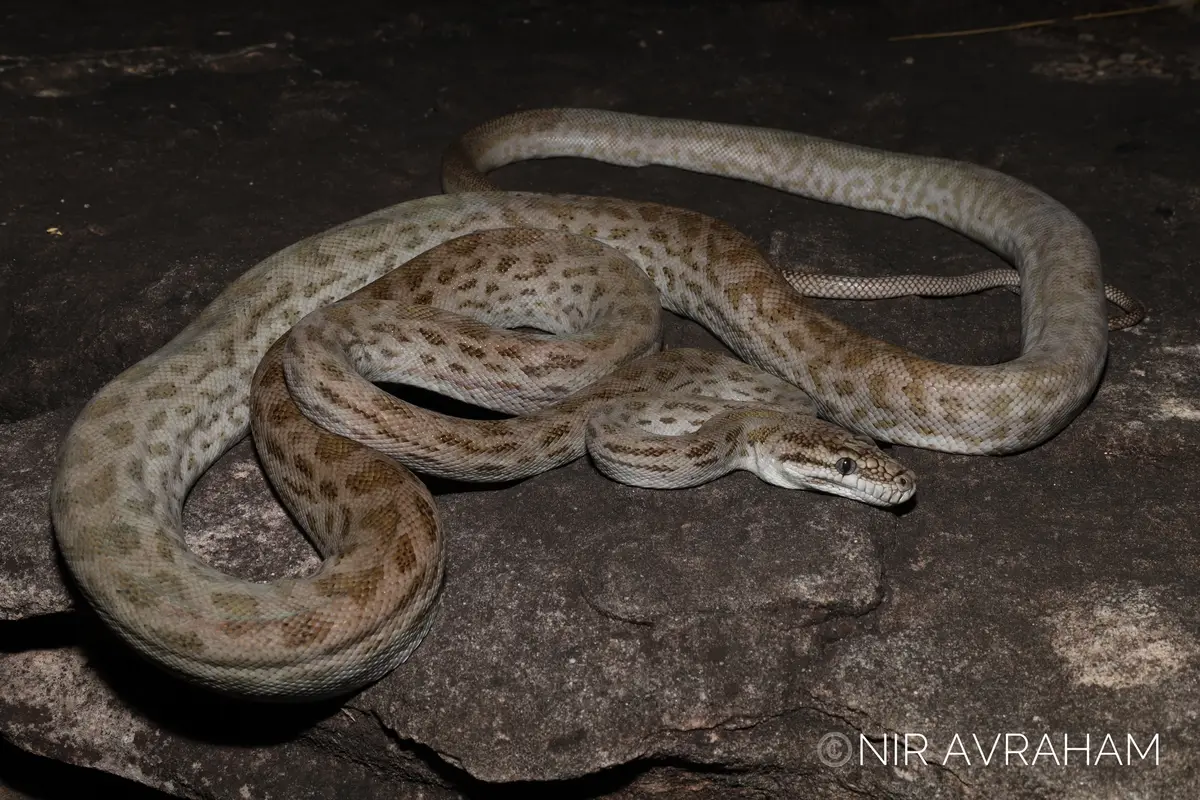
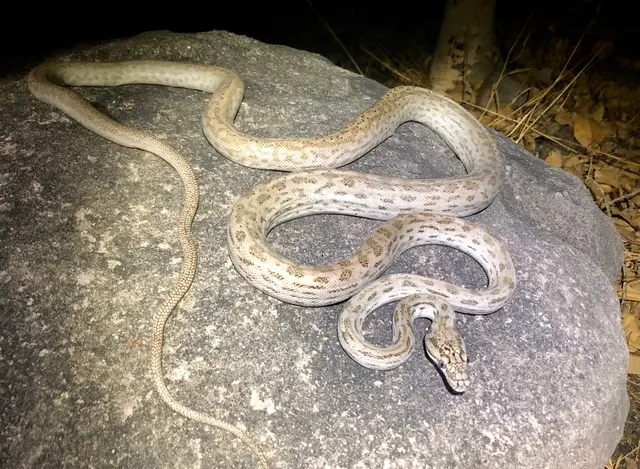
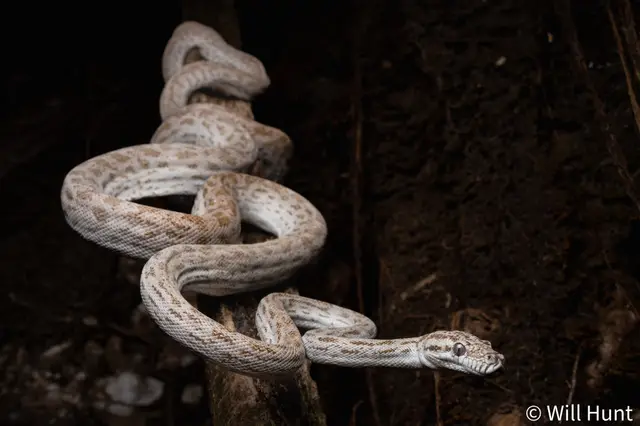
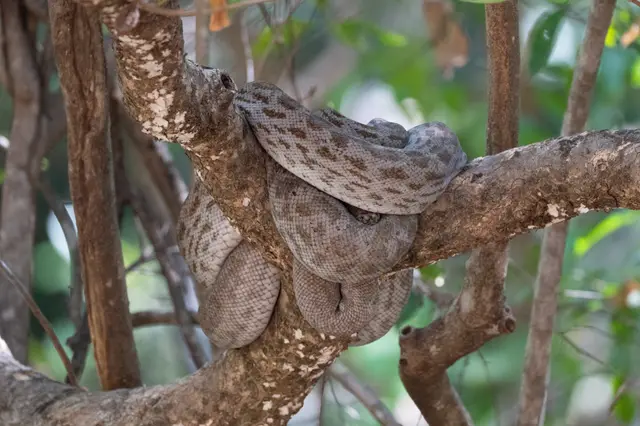
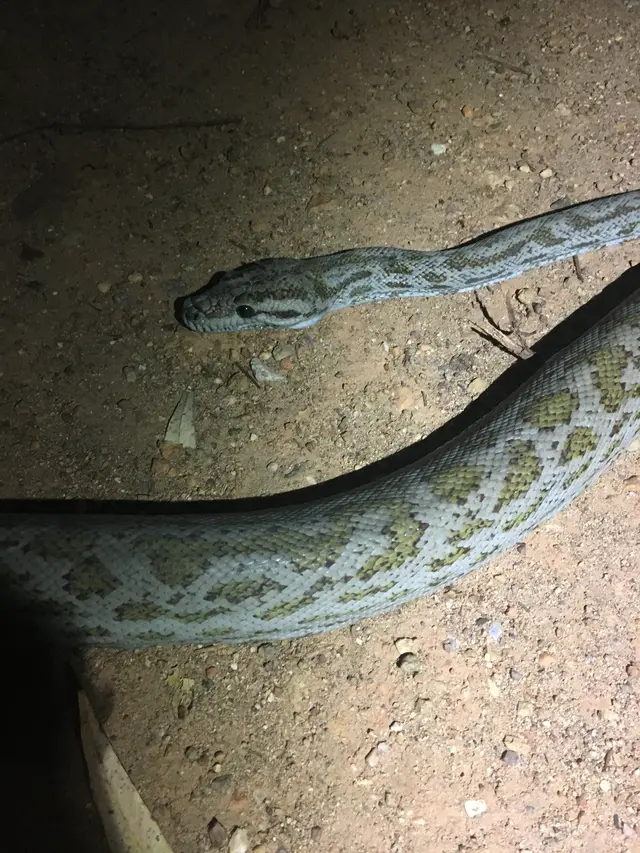
An Oenpelli python is a very long, thin python with a brown or olive body marked by rows of darker blotches. The Australian Reptile Online Database (AROD) describes it as light brown to fawn on top and paler on the sides. Australian Geographic describes it as dark olive-brown with darker blotches and an iridescent sheen that looks silver-gray at night. In the field, the best clues are its length, its slim build and the place you see it: rocky escarpment country in western Arnhem Land.
- 1Long and slim: it is unusually thin for such a long snake. Reptiles Magazine describes it as slender for its length, unlike the heavy-bodied giant pythons of Asia and Africa.
- 2Blotched olive-brown pattern: pale brown to olive with longitudinal rows of large dark blotches, as the Reptile Database describes it. The belly is paler.
- 3Color shifts from day to night: it tends to look lighter olive-brown at night and darker during the day, according to Reptiles Magazine.
- 4Heat pits on the lips: like other pythons it has heat-sensing pits along the lip scales, which venomous Australian snakes do not have.
- 5A huge number of belly scales: AROD counts 429-455 belly scales, more than other Australian pythons such as the olive python (321-411). It is a useful check on museum specimens.
Other scale counts from AROD: 69-70 rows of scales at midbody, a single anal scale and 145-163 divided scales under the tail.
How big do Oenpelli pythons get?
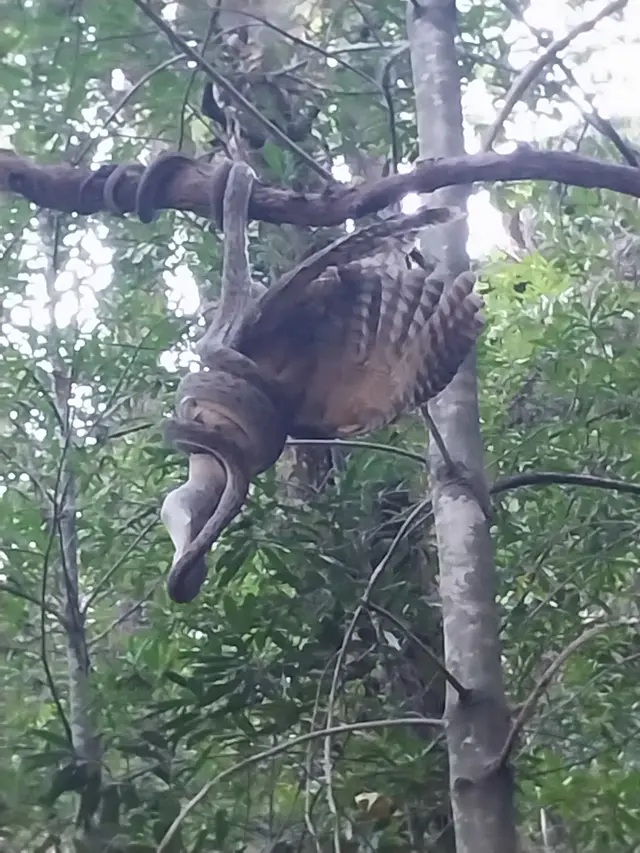
Oenpelli pythons often reach 6.5-11.5 ft (2-3.5 m), and the biggest exceed 13 ft (4 m). Gillespie, Fukuda and McDonald (2020, Wildlife Research) call it Australia's second-longest snake species, behind the Australian scrub python. The Reptile Database gives adults as reaching more than 13 ft (4 m) in total length.
| Measure | Size | Source |
|---|---|---|
| Average total length | About 11.5 ft (3.5 m) | AROD |
| Typical specimens found | About 6.5 ft (2 m) | AROD |
| Listed maximum | About 14 ft (4.3 m) | AROD |
| Adults | Over 13 ft (4 m) | Reptile Database |
| Large wild-caught female | More than 16 ft (5 m) | Australian Geographic (2014) |
The figures do not line up neatly. AROD lists an average length of 11.5 ft (3.5 m) but also notes that most specimens average around 6.5 ft (2 m). So few Oenpelli pythons have been measured that nobody has a solid average. The longest well-documented one is a female caught by Top End herpetologist Gavin Bedford for a breeding program, which Australian Geographic reported in 2014 as more than 16 ft (5 m) long. No reliable weight figures have been published.
Where do Oenpelli pythons live?
Short answer: only in western Arnhem Land, in the Top End of Australia's Northern Territory. AROD and the Reptile Database both record it from the Northern Territory and nowhere else. The type specimen came from 6.5 km (4 miles) southwest of Oenpelli, the community now called Gunbalanya, which gave the snake its name.
Within that region it is patchy. Gillespie and colleagues pooled every record they could find and estimated the total area of occupancy at 19,252 sq km (about 7,430 sq mi). They describe the distribution as highly fragmented, because the snake keeps close to patches of monsoon rainforest within the wider savanna. Compare its small range with other pythons on the world snake map.
Habitat
Oenpelli pythons live in the sandstone stone country of the Arnhem Land plateau. In the 2020 study by Gillespie, Fukuda and McDonald, records were strongly associated with monsoon rainforest, sandstone outcrops and perennial streams, and that link held even after the authors corrected for where people tend to look. They suggest the rainforest offers more food and a refuge from the heat of the surrounding savanna woodland.
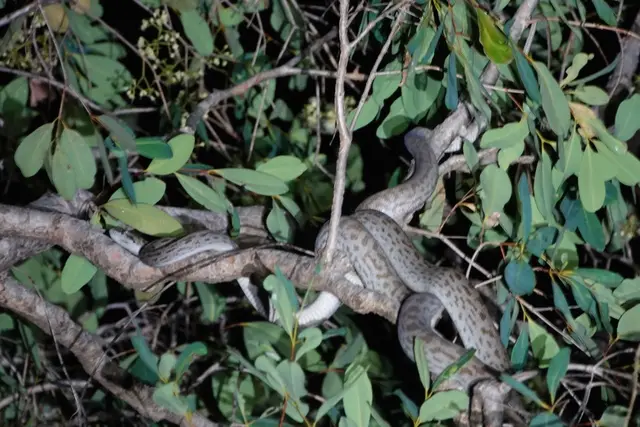
AROD lists tropical woodland, sandstone gorges and escarpments as habitat. Australian Geographic adds that the snake lives among sandstone outcrops and sometimes hunts in tropical woodland, often climbing trees. In Bininj Kunwok knowledge recorded by Warddeken Land Management, it returns to a crevice or cave to rest after it feeds.
Behavior
The Oenpelli python is a secretive ambush hunter that can stay still for long periods while it waits for prey, according to Australian Geographic. Herpetologists have spent whole expeditions looking for one. A 10-person, week-long search led by Australian Reptile Park general manager Tim Faulkner failed to find a single wild snake, the Newcastle Herald reported.
It seems to be mainly a night snake. The genus name Nyctophilopython is thought to come from Greek words for night and love, a reference to its nocturnal habits, the Reptile Database notes. Gillespie and colleagues found that sightings were strongly seasonal and more likely on dark nights with little moonlight. They recommend that surveys run in September on moonless nights.
What do Oenpelli pythons eat?
Oenpelli pythons eat mostly mammals. Australian Geographic names rock rats, possums and bats, and Reptiles Magazine adds birds and medium to large mammals. Bininj knowledge recorded by Warddeken Land Management says the snake takes kangaroos and wallabies, sometimes flying foxes, and the nabarlek, a small rock-wallaby.
| Prey | Notes | Source |
|---|---|---|
| Rock rats | Small rodents of rocky country | Australian Geographic |
| Possums | Named by both sources | Australian Geographic; Reptiles Magazine |
| Bats and flying foxes | Taken at times | Australian Geographic; Warddeken Land Management |
| Wallabies, including the nabarlek | Larger prey for big adults | Warddeken Land Management |
| Birds | Listed for wild and captive snakes | Reptiles Magazine |
That reliance on mammals is a worry. Gavin Bedford told Australian Geographic that studies of small mammals in the Top End show a wave of extinctions, and Faulkner told the Newcastle Herald that mammals in Kakadu are being lost at an increasing rate, which could take the python's food with them.
Is the Oenpelli python venomous or dangerous?
No. The Oenpelli python has no venom and is not considered dangerous to people. AROD rates it non-venomous and notes only that it can bite. Like all pythons it kills by constriction.
It is a big snake with many sharp, backward-curving teeth, so a bite can leave deep punctures. Wash any python bite well with soap and water and check your tetanus protection. See a doctor if the wound is deep or becomes red and swollen. Bites are very unlikely, because few people ever meet this snake.
The Top End also has dangerously venomous snakes. If you are not sure what you are looking at, back away and let it go. Our snake venom FAQ explains why size and color are poor guides to danger.
Oenpelli python vs olive python, carpet python and black-headed python
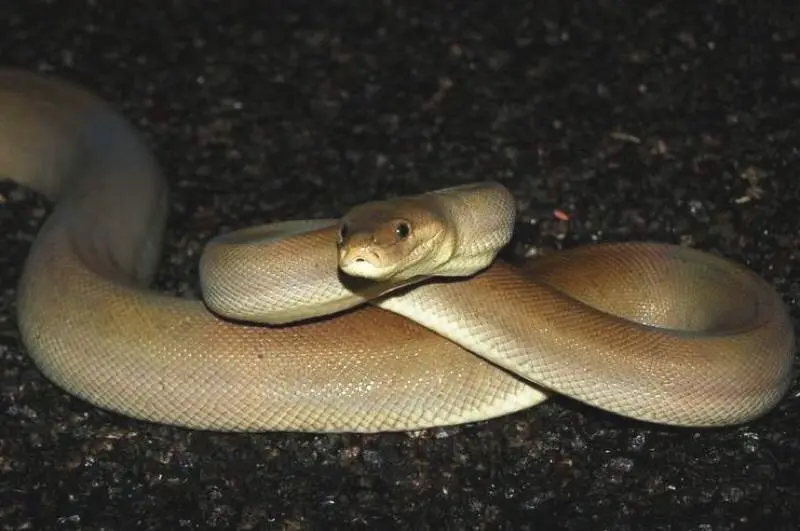
Olive python
Liasis olivaceus · Harmless
The most likely mix-up: another very long python of Top End gorges, often found near water. AROD says its name means olive-colored, and it has large symmetrical head scales. It has 321-411 belly scales, fewer than the Oenpelli python's 429-455, and it is much more widespread across northern Australia.
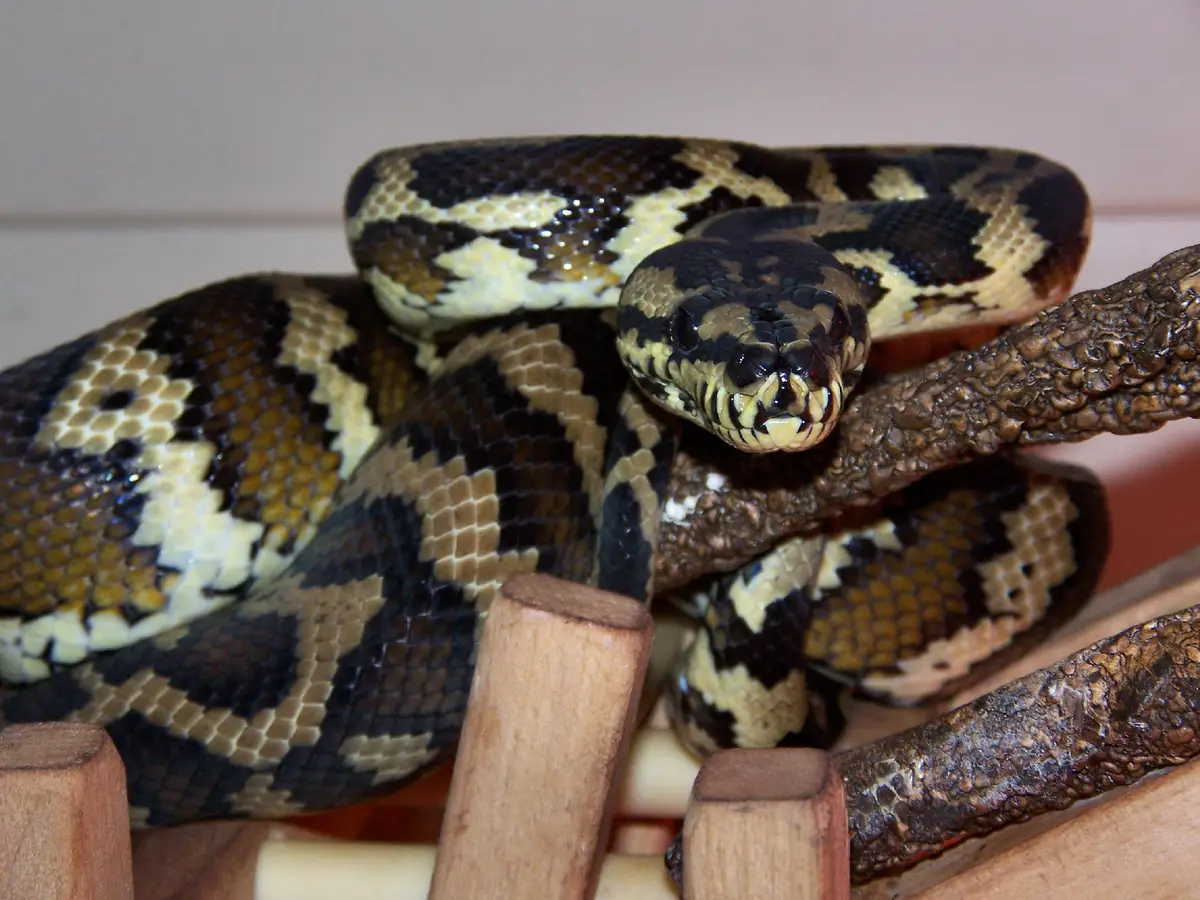
Northwestern carpet python
Morelia spilota variegata · Harmless
The carpet python form of the Top End, the Kimberley and Cape York, according to AROD. It is a much shorter snake: AROD gives carpet pythons an average length of about 8 ft (2.4 m), and its subspecies all have distinct patterns. The coastal carpet python is a related form from eastern Australia.
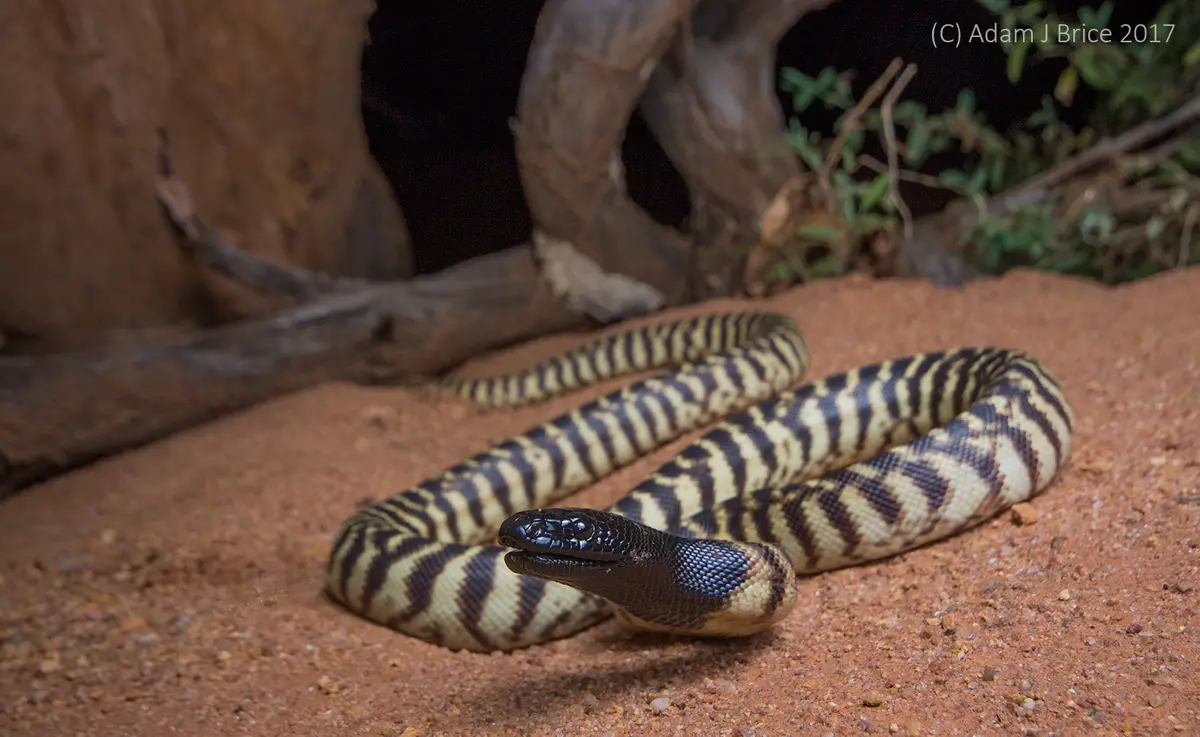
Black-headed python
Aspidites melanocephalus · Harmless
Also lives in Top End rocky country, but the black-headed python is easy to tell apart: its head, neck and throat are jet black, and the black ends sharply against a pale, patterned body. AROD gives an average length of about 5 ft (1.55 m).
Reproduction and captive breeding
Oenpelli pythons lay eggs, and the eggs are very large. Reptiles Magazine gives a size of about 4.4 by 2.4 in (110.5 by 60 mm), nearly twice the size of eggs laid by the amethystine python, a close relative. AROD gives an average clutch of 10 eggs.
Breeding them has been hard. In a 1985 Herpetological Review paper, Charles, Field and Shine reported that none of the 10 eggs produced by an Oenpelli python hatched successfully. In 2011 the Northern Territory government allowed Gavin Bedford to collect eight wild pythons for a breeding program, with royalties going to traditional owners. The first two captive-bred young were produced in 2015, according to Reptiles Magazine, and the Australian Reptile Park later joined the program with three snakes.
No reliable lifespan figure for wild Oenpelli pythons has been published.
Is the Oenpelli python endangered?
It is not listed as Endangered, but it is Vulnerable. The IUCN Red List rates it Vulnerable, as the Reptile Database records, and the Northern Territory lists it as Vulnerable too. Gillespie and colleagues (2020) reviewed the evidence and concluded that, taking a precautionary approach, the species qualifies as Vulnerable under IUCN criteria.
| Authority | Status |
|---|---|
| IUCN Red List | Vulnerable |
| Northern Territory | Vulnerable |
| CITES | Appendix II, as are nearly all pythons |
Some estimates put the population below 10,000 snakes, Reptiles Magazine reports, though no one has counted them. The main concerns are its small, broken-up range and the decline of the small mammals it eats. AROD notes the other side: its remote country probably keeps it fairly secure.
Why does the Oenpelli python have so many scientific names?
Its relationships to other pythons are still unclear. Graeme Gow described it in 1977 as Python oenpelliensis. Wells and Wellington gave it its own genus, Nyctophilopython, in 1985. Kluge moved it to Morelia in 1993, and Reynolds and colleagues placed it in Simalia in 2014. In 2020 Esquerre and colleagues proposed the genus name Nawaran, after the snake's Bininj Kunwok name, but Kaiser, Thomson and Shea (2020) argued Nyctophilopython has priority. AROD calls the Simalia placement tentative. This guide uses Simalia oenpelliensis, the name used by AROD and the 2020 conservation study.
The name nawaran is used across the Kunwinjku, Kundjeyhmi, Kuninjku, Kune and Kundedjnjenghmi varieties of Bininj Kunwok, according to Warddeken Land Management. Australian Geographic reports that the snake has long been an important totemic animal for the Bininj people of western Arnhem Land, and that some believe it inspired the Rainbow Serpent.
Oenpelli python FAQ
Is the Oenpelli python venomous?
No. The Oenpelli python has no venom and kills its prey by constriction. The Australian Reptile Online Database rates it non-venomous and not dangerous, though it can bite. A bite from a large python can leave deep punctures, so wash it well, check your tetanus protection and see a doctor if it gets infected.
How big does an Oenpelli python get?
Adults often reach 6.5-11.5 feet (2-3.5 m), and the Reptile Database says adults can exceed 13 feet (4 m). A wild female caught for a breeding program measured more than 16 feet (5 m), Australian Geographic reported in 2014. It is Australia's second-longest snake after the scrub python, but it is slim for its length.
Where does the Oenpelli python live?
It lives only in western Arnhem Land in the Northern Territory of Australia. It keeps to sandstone escarpments, gorges and outcrops, especially near monsoon rainforest and permanent streams. A 2020 study in Wildlife Research estimated its total area of occupancy at 19,252 square kilometers and found its range highly fragmented.
What does the Oenpelli python eat?
It eats mostly mammals. Australian Geographic lists rock rats, possums and bats, and Reptiles Magazine adds birds and larger mammals. Bininj knowledge recorded by Warddeken Land Management says it also takes wallabies, including the nabarlek, and flying foxes. It is an ambush hunter that waits motionless for prey to come close.
Why is the Oenpelli python so rare?
Its range is small and broken into patches, and it lives in remote, rugged country that few people visit. It is also secretive and mostly active at night. Scientists did not describe it until 1977, and a week-long expedition by the Australian Reptile Park failed to find one. Some estimates put the wild population below 10,000.
Is the Oenpelli python endangered?
It is listed as Vulnerable, one step below Endangered. Both the IUCN Red List and the Northern Territory government rate it Vulnerable, and a 2020 study by Gillespie, Fukuda and McDonald supported that rating. The main concerns are its fragmented range and the decline of small mammals in northern Australia.
Related snakes
Sources
- Reptile Database: Nyctophilopython oenpelliensis (Gow, 1977)
- Australian Reptile Online Database: Oenpelli python (Simalia oenpelliensis)
- Gillespie, Fukuda and McDonald (2020). Using non-systematically collected data to evaluate the conservation status of elusive species: a case study on Australia's Oenpelli python. Wildlife Research 47: 146-157
- Australian Geographic (2014): Saving the Oenpelli python
- Warddeken Land Management, Bininj Kunwok field guide: Oenpelli python (nawaran)
- Reptiles Magazine (2018): Oenpelli pythons at the Australian Reptile Park
- Newcastle Herald: This rare Australian snake has just arrived
- Charles, Field and Shine (1985). Notes on the reproductive biology of Australian pythons. Herpetological Review 16: 45-48 (Conservation Evidence summary)