DIAMONDPYTHON
Morelia spilota spilota · Family Pythonidae
KEY TAKEAWAYS
The diamond python (Morelia spilota spilota) is a non-venomous python of coastal New South Wales and far eastern Victoria, and the southern subspecies of the carpet python. It is mostly black with a yellow or cream spot on each scale. It can give a painful bite, but it has no venom and is not dangerous to adults.
- It has no venom. It kills prey by constriction, and a bite needs cleaning and a tetanus check, not antivenom.
- Most adults are about 6.5 ft (2 m) long; the largest reach about 10 ft (3 m).
- It lives from around Gosford in New South Wales south to far East Gippsland in Victoria, including the bushland around Sydney.
- It is still found around Sydney but rated Critically Endangered in Victoria, where most of its range burned in 2019/20.
Diamond python quick facts
| Common name | Diamond python |
|---|---|
| Scientific name | Morelia spilota spilota (Lacepede, 1804); the nominate subspecies of the carpet python, Morelia spilota |
| Family | Pythonidae (pythons) |
| Venomous | No, a constrictor |
| Adult length | Usually about 6.5 ft (2 m); up to about 10 ft (3 m) |
| Weight | About 9-22 lb (4-10 kg), per Sydney Zoo |
| Range | Coastal New South Wales from about Gosford south to far East Gippsland, Victoria |
| Habitat | Dry eucalypt forest, heath, banksia woodland, coastal scrub, sandstone country and suburbs |
| Diet | Mainly small to medium mammals such as possums and rats; also birds, lizards and frogs |
| Reproduction | Lays eggs; clutches of 9-54, usually fewer than 30; the female broods them |
| Conservation | Species rated IUCN Least Concern; Critically Endangered in Victoria |
How to identify a diamond python
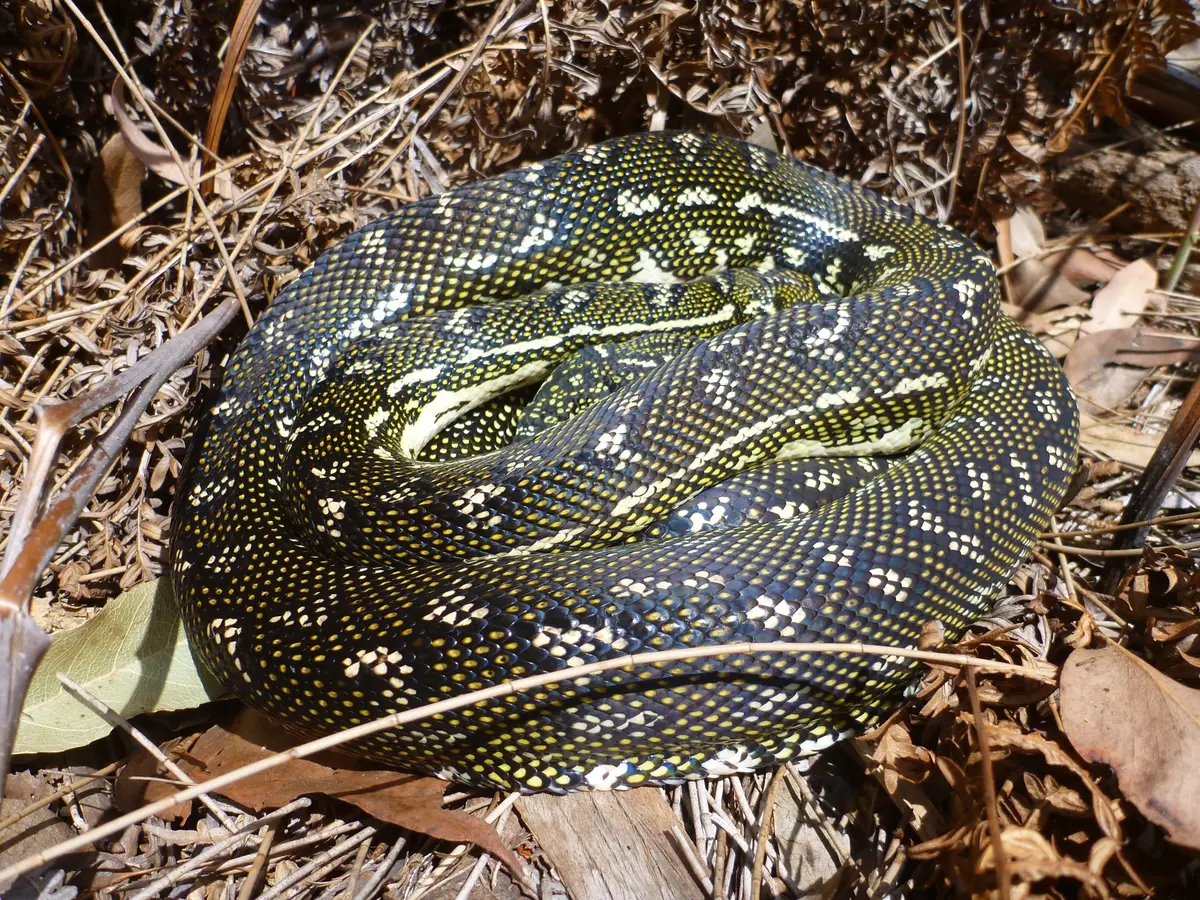
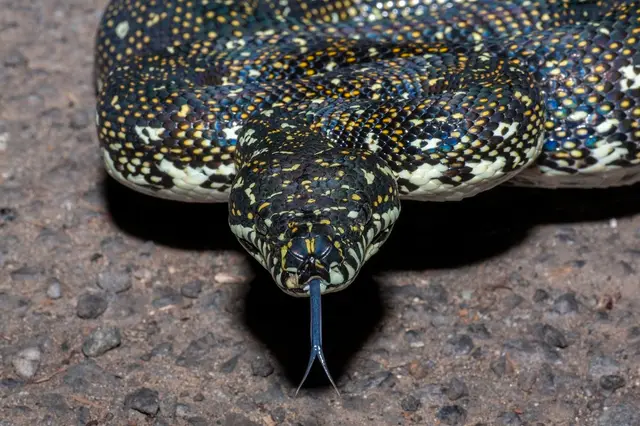
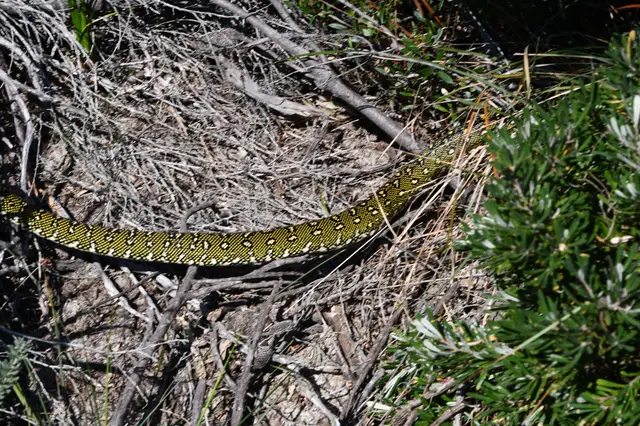
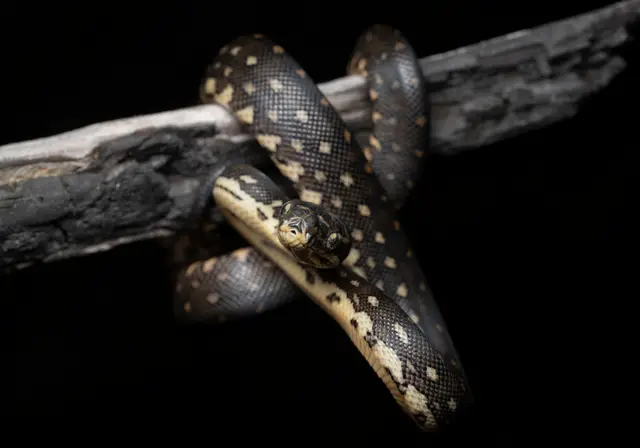
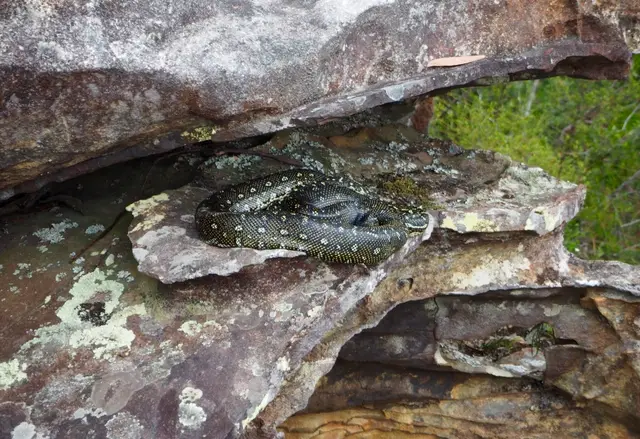
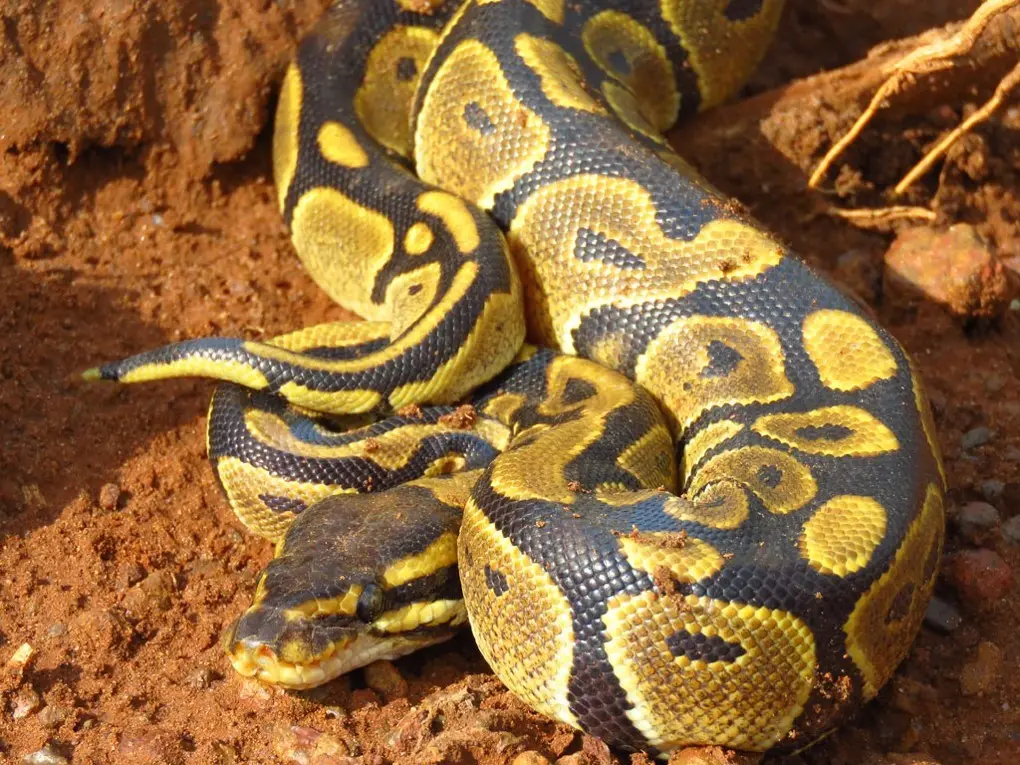
A diamond python is a heavy, glossy black or very dark olive snake speckled with yellow. The Victorian Government's 2021 threatened species assessment, quoting the field guide Reptiles of Victoria, describes it as black above with a yellow or cream dot on each scale, and rows of small, dark-edged yellow or cream patches along the back. Those clusters of pale scales look like diamonds or rosettes, which gives the snake its name.
- 1Black with yellow spots: almost every dark scale on the back carries a small yellow or cream center, so the snake looks finely speckled up close.
- 2Rosettes along the back: small groups of yellow scales, edged in black, form diamond-shaped clusters, sometimes in fairly regular rows down the body.
- 3Yellow belly with black marks: the underside is yellow or cream with many small black patches.
- 4Wide head and lip pits: the head is broader than the neck and covered in small scales, with a row of heat-sensing pits along the lips. Venomous Australian snakes lack these pits.
- 5Spurs by the vent: a small claw-like spur sits on each side of the vent. These are the last traces of hind legs.
Pattern is less reliable in the north. Snakes from the mid-north coast of New South Wales, where diamond and coastal carpet pythons interbreed, can show any mix of the two patterns.
How big do diamond pythons get?
Most adult diamond pythons are about 6.5 ft (2 m) long, and the biggest reach about 10 ft (3 m). The Australian Museum gives a size range of 2-3 m, and the Victorian assessment says the subspecies grows to about three meters.
| Measure | Size | Source |
|---|---|---|
| Typical adult length | About 6.5 ft (2 m) | Australian Museum; Sydney Zoo |
| Maximum length | About 10 ft (3 m) | Victorian Government (2021); Australian Museum |
| Adult weight | About 9-22 lb (4-10 kg) | Sydney Zoo |
| Size at maturity | Snout-vent length of about 5 ft (150 cm) | Slip and Shine (1988), cited by the Victorian Government |
Growth is slow. The Victorian assessment estimates that a diamond python reaches maturity at perhaps 5 or 6 years old, and notes reports of individuals living longer than 17 years. Sydney Zoo gives a lifespan of 15-20 years.
Where do diamond pythons live?
Short answer: along the coast and nearby ranges of southeastern Australia, from about Gosford in New South Wales south to far East Gippsland in Victoria. The Australian Reptile Online Database gives that Gosford-to-northeastern-Victoria range, and the Reptile Database lists the subspecies for coastal New South Wales.
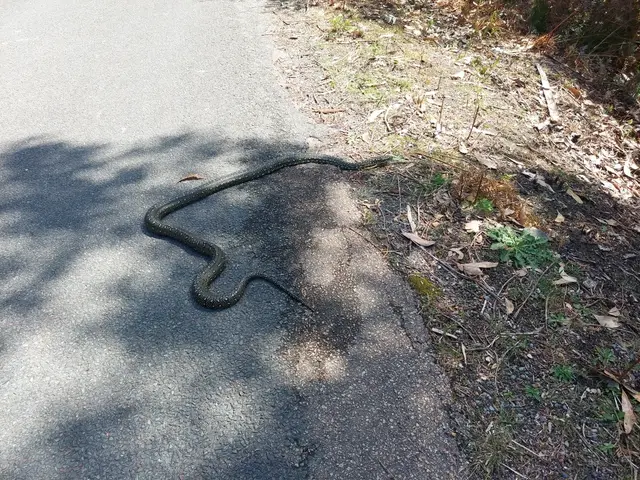
Sydney sits near the middle of the range. The Australian Museum says diamond pythons still live in the larger bushland areas and national parks around the city, where they often go unseen. In Victoria the snake is much rarer: the state's assessment confines it to the warm temperate zone south of the Great Dividing Range in far East Gippsland, with an area of occupancy of only about 44 square miles (113 square km).
North of its range, it meets the coastal carpet python, and the two interbreed where they overlap. Compare it with other pythons on the world snake map.
Habitat
Diamond pythons live in dry eucalypt forest, heath, banksia woodland and coastal scrub, the habitat types listed in the Victorian assessment. Around Sydney, sandstone country matters. In a radio-tracking study of 15 adults from two sites near Sydney, Slip and Shine (1988, Wildlife Research) found the snakes moved into rocky habitat in winter and sheltered in sandstone crevices.
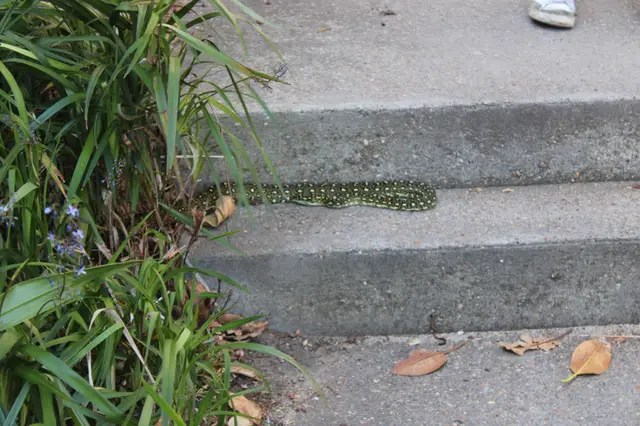
In summer and autumn the same snakes spent most time in disturbed habitat, such as the land around houses, where prey was easier to find. That fits what Sydney residents see. The Australian Museum notes that diamond pythons sometimes live in roofs and rafters, where they help keep rats and possums down.
Behavior
Diamond pythons are slow, patient ambush hunters that can sit in one spot for long stretches. Slip and Shine found tracked snakes were mostly sedentary in summer and autumn, made occasional long moves to new sites, and were most often found coiled under vegetation that gave filtered cover (34% of locations). Home ranges reached about 306 acres (124 ha) and overlapped between neighbors.
Sources differ on when they are active. The Australian Museum describes them as nocturnal and says they bask in trees by day, while the Sydney tracking study found them generally active by day and on the ground rather than up trees. They also tolerate cold better than most pythons. The Victorian assessment notes they are sometimes seen basking on sunny winter days.
In spring, males go looking for mates. In the Sydney study, males moved long distances, often every day, during the mating season. A later study of 12 diamond pythons in a reserve in eastern Australia by Michael and colleagues (2014, Austral Ecology) found male home ranges averaged 41 ha against 23 ha for females, and were largest in heathland, where mammal prey was less varied.
What do diamond pythons eat?
Adults eat mostly warm-blooded prey. The Victorian assessment says the diet is mainly small to medium mammals, with possums, bandicoots and water rats recorded in Victoria, plus some reptiles and frogs. The Australian Museum lists small mammals and lizards.
| Prey | Examples | Source |
|---|---|---|
| Mammals | Possums, bandicoots, water rats and other rats | Victorian Government (2021); Australian Museum |
| Birds | Taken as part of a mixed diet | Sydney Zoo |
| Reptiles | Lizards | Australian Museum; Victorian Government (2021) |
| Frogs | Eaten occasionally | Victorian Government (2021) |
After a big meal, a diamond python looks for heat. In a laboratory study of 18 adults, Slip and Shine (1988)90847-X) found unfed snakes chose body temperatures of about 79-91 F (26-33 C), and fed snakes moved 2-5 C (4-9 F) warmer. Snakes without a heat source did not warm up after eating, so the rise comes from basking, not from the meal itself.
Is the diamond python venomous or dangerous?
No. The diamond python has no venom and is not dangerous to adults. It kills prey by coiling around it and squeezing until the animal suffocates, according to the Australian Museum. AROD rates it non-venomous and not considered dangerous, though it can still bite.
Most diamond pythons are calm and bite only when handled or cornered. A bite can hurt, and the Australian Museum warns that python teeth can break off and stay in the wound. Wash the bite with soap and water, check for broken teeth and keep your tetanus protection up to date. See a doctor if the wound is deep or becomes red and swollen.
The same bushland also holds venomous snakes. If you are not sure a snake is a python, keep your distance and call a licensed snake catcher or wildlife rescue group. Our snake venom FAQ explains why color is a poor guide to danger.
Diamond python vs carpet pythons and black snakes
Coastal carpet python
Morelia spilota mcdowelli · Harmless
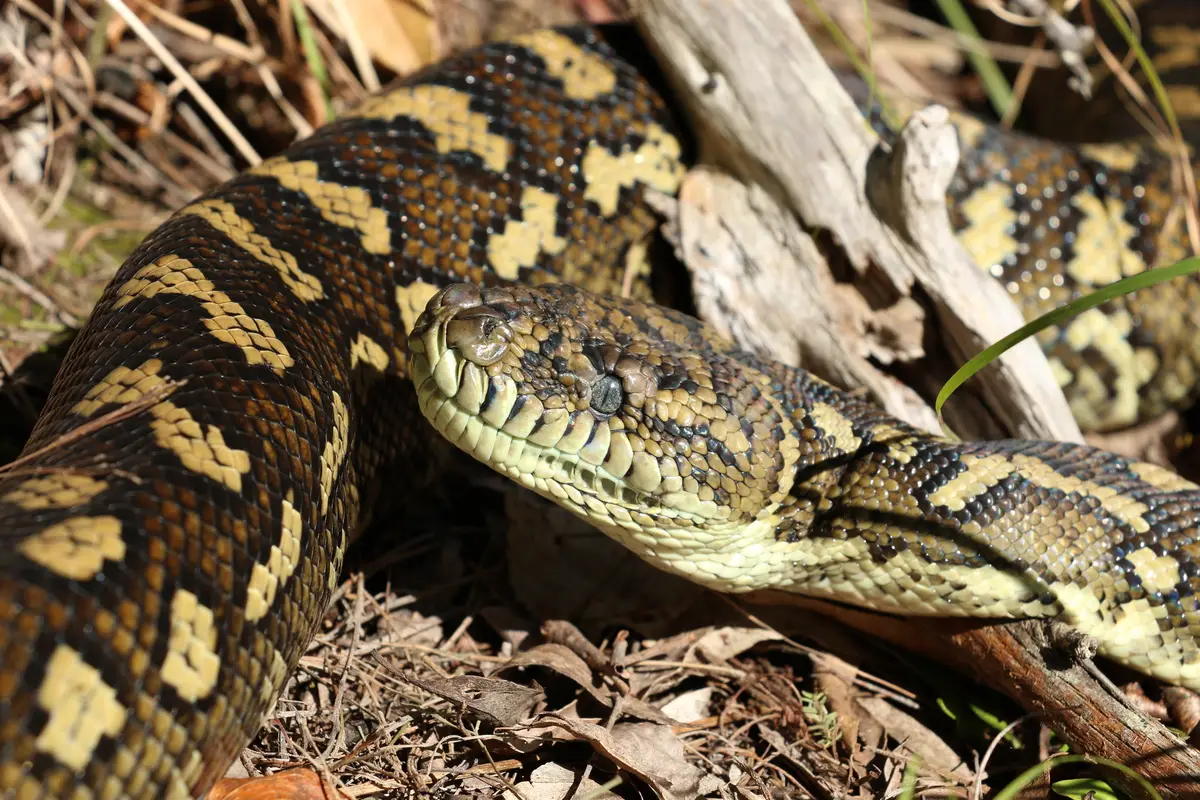
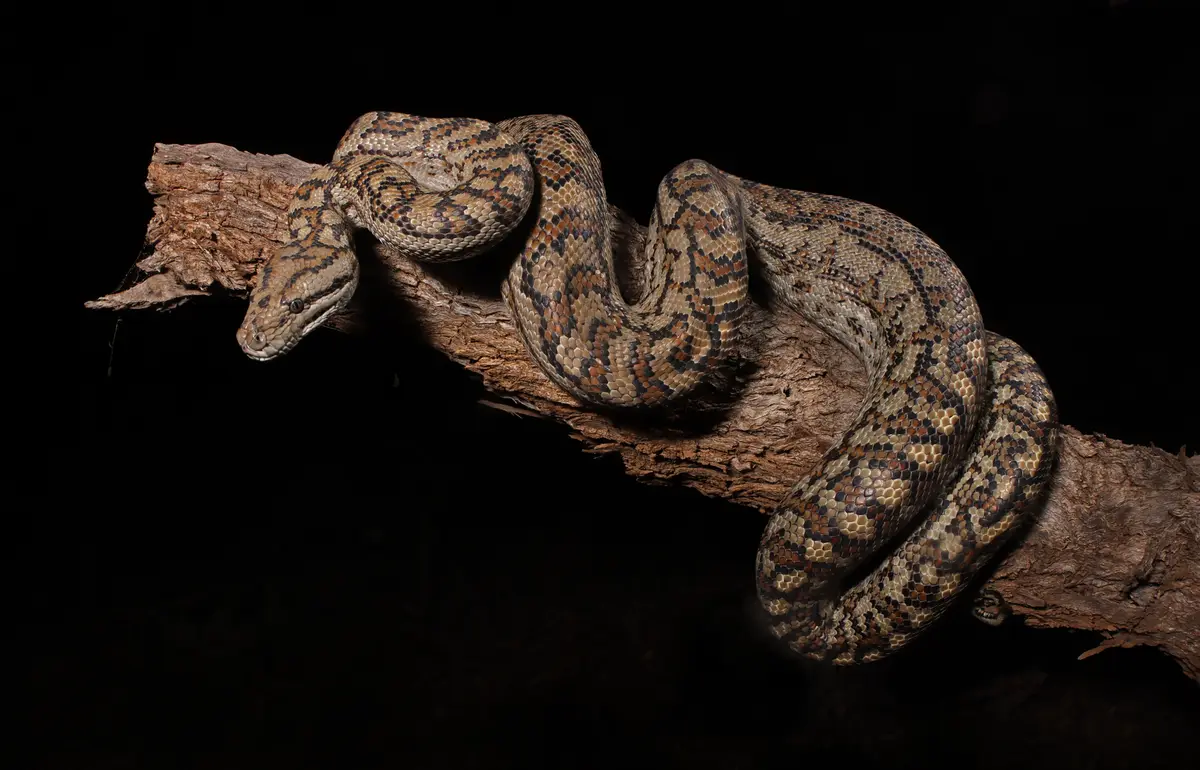
The coastal carpet python is the subspecies to the north, from northern New South Wales into Queensland. It is olive, brown or gray with large pale, dark-edged blotches instead of fine yellow speckles. On the mid-north coast of New South Wales the two interbreed, and snakes with a mix of both patterns occur.
Inland carpet python
Morelia spilota metcalfei · Harmless
Lives west of the Great Dividing Range, from southern Queensland and New South Wales into northern Victoria and South Australia, per the Reptile Database. Range is the best clue: a carpet python found well inland, west of the Great Dividing Range, is far more likely to be this subspecies.
Red-bellied black snake
Pseudechis porphyriacus · Venomous
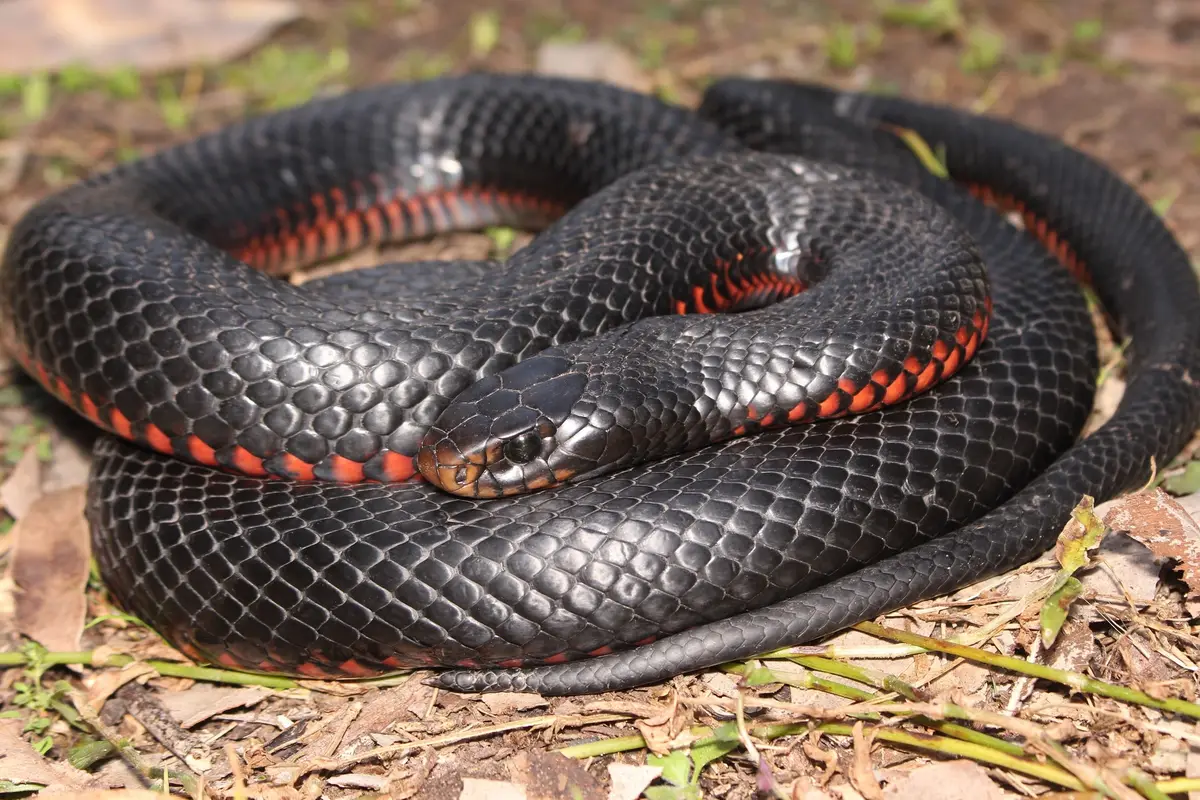
A dark snake of the same coastal forests, but usually smaller, at about 5-6.5 ft (1.5-2 m). The Australian Museum describes it as plain black on top with crimson or pink lower sides and belly, and no yellow spots. It has a narrow head and no lip pits. Any bite needs urgent medical care.
Bredl's python
Morelia bredli · Harmless
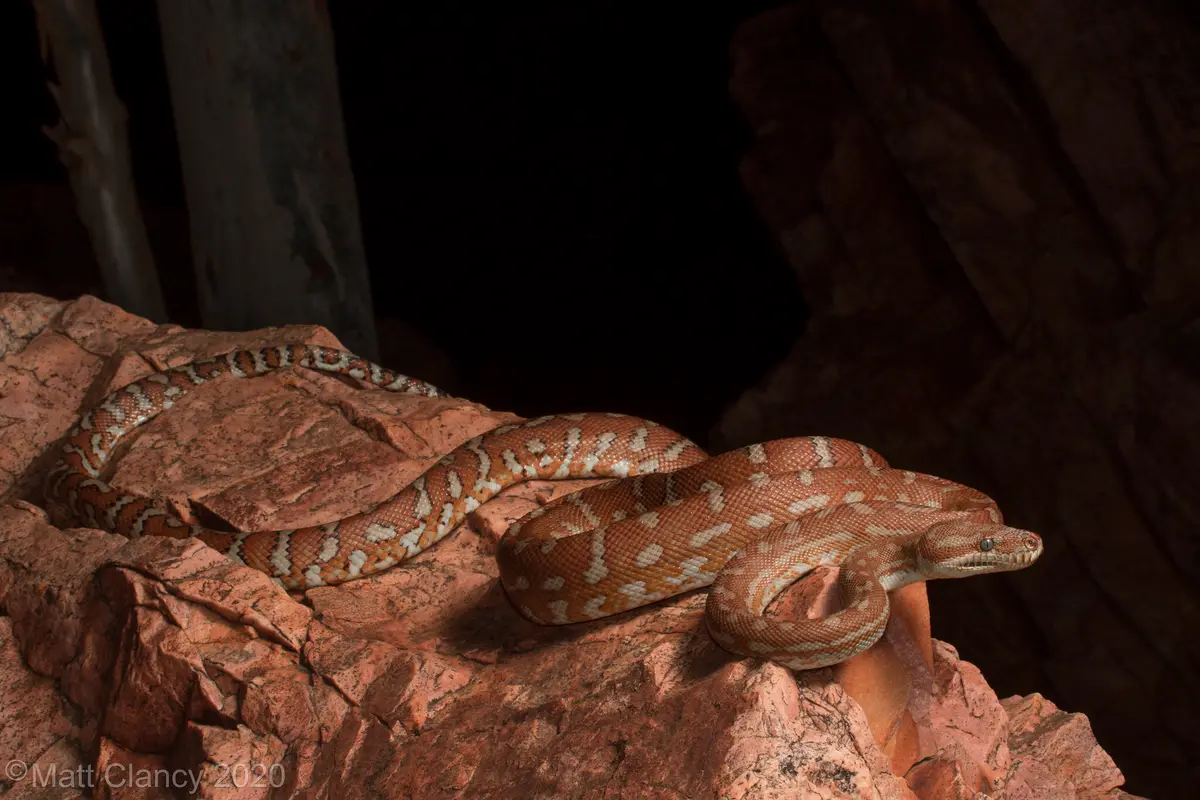
A close relative with the same build, but rusty red with pale blotches and found only in central Australia. Bredl's python never meets the diamond python in the wild.
Reproduction and lifespan
Diamond pythons mate in early spring and lay eggs in late spring or summer. The Victorian assessment gives clutches of 9-54 eggs, though usually fewer than 30. Unlike coastal carpet pythons, male diamond pythons do not fight each other, the assessment notes, though groups of several snakes have been seen together at mating time.
The mother keeps her eggs warm by shivering. In a field study near Sydney, Slip and Shine (1988, Journal of Zoology) tracked four females that laid eggs in incubation mounds. Each coiled around her clutch and held her body near 88 F (31 C) for the roughly two months of incubation, mostly by twitching her muscles to make heat, with short basking spells most mornings. Brooding females ran about 16 F (9 C) above the air around them.
Eggs hatch after six to ten weeks, according to the Victorian assessment. The mother leaves once they hatch, and the young are on their own from the start. Diamond pythons have been reported living longer than 17 years, and Sydney Zoo gives a lifespan of 15-20 years.
Is the diamond python endangered?
Not across its whole range, but it is in Victoria. The carpet python species, Morelia spilota, is rated Least Concern by the IUCN, and the Australian Museum says the diamond python is not considered endangered, though it is less widespread around Sydney than it used to be. In Victoria, the Atlas of Living Australia records it as Critically Endangered.
| Authority | Status |
|---|---|
| IUCN Red List | Least Concern (species Morelia spilota) |
| Victoria | Critically Endangered (Flora and Fauna Guarantee Act 1988; assessed 2021) |
| CITES | Appendix II, as are nearly all pythons |
The Victorian assessment names frequent fire, fox predation, timber harvesting and deer damage as the main threats. It estimates that perhaps 90% of the snake's known Victorian range burned in the 2019/20 bushfires, and that the fires likely destroyed the logs these pythons shelter in. Nobody knows how many mature diamond pythons remain in Victoria, because the population has never been the subject of a targeted study.
In New South Wales the main pressure is habitat loss around growing towns, per the Australian Museum. Fallen logs and rock outcrops are its shelter, so leaving them in place helps.
Diamond python FAQ
Is the diamond python venomous?
No. The diamond python has no venom and kills its prey by constriction. The Australian Museum and the Australian Reptile Online Database both list it as non-venomous. A bite can still be painful and teeth may break off in the wound, so wash it well, check your tetanus protection and see a doctor if it becomes infected.
How big does a diamond python get?
Most adults are about 6.5 feet (2 m) long, and the largest reach about 10 feet (3 m). The Australian Museum gives a range of 2-3 m, and Sydney Zoo lists adult weights of about 9-22 pounds (4-10 kg). Growth is slow, and the Victorian Government estimates maturity at about 5 or 6 years.
Where do diamond pythons live?
Diamond pythons live along the coast and nearby ranges of southeastern Australia, from about Gosford in New South Wales south to far East Gippsland in Victoria. Sydney is near the middle of the range, and the snakes still live in the city's larger bushland areas and national parks. North of Gosford they interbreed with coastal carpet pythons.
Is a diamond python the same as a carpet python?
Yes and no. The diamond python is one subspecies of the carpet python, Morelia spilota, and is the nominate form the species was first described from in 1804. Other subspecies, such as the coastal carpet python of Queensland, are blotched rather than finely speckled. The diamond python is the black-and-yellow southern form.
Is the diamond python endangered?
Only in Victoria. The species is rated Least Concern by the IUCN and is still found around Sydney. In Victoria, where it lives only in far East Gippsland, it is listed as Critically Endangered. A 2021 state assessment estimated that about 90% of its Victorian range burned in the 2019/20 bushfires.
Why is there a diamond python in my roof?
Roof spaces are warm and often full of rats and possums, which are favorite prey. The Australian Museum notes diamond pythons sometimes live in roofs and rafters for exactly that reason. The snake is harmless to people. Trim branches touching the house, seal gaps, and call a licensed snake catcher if it needs moving.
Related snakes
Sources
- Reptile Database: Morelia spilota, including subspecies spilota
- Australian Museum: Diamond python
- Victorian Government (DELWP): Threatened Species Assessment, Morelia spilota spilota, Diamond Python (9 June 2021)
- Australian Reptile Online Database: Carpet python (Morelia spilota) and subspecies
- Atlas of Living Australia: Morelia spilota spilota, Diamond Python
- Slip and Shine (1988). Habitat use, movements and activity patterns of free-ranging diamond pythons, Morelia spilota spilota. Wildlife Research 15: 515-531
- Slip and Shine (1988). Reptilian endothermy: a field study of thermoregulation by brooding diamond pythons. Journal of Zoology 216: 367-378
- Michael, Cunningham, Macgregor, Brown and Lindenmayer (2014). The effects of prey, habitat heterogeneity and fire on the spatial ecology of peninsular diamond pythons. Austral Ecology 39: 181-189