AMETHYSTINEPYTHON
Simalia amethistina · Family Pythonidae
KEY TAKEAWAYS
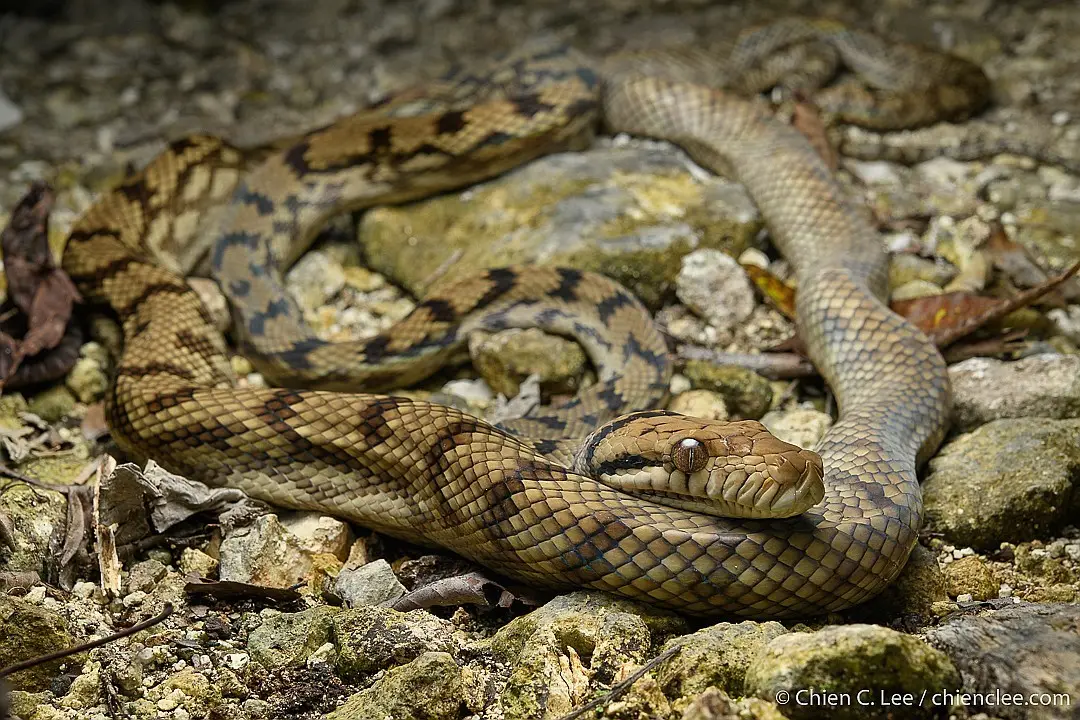
The amethystine python (Simalia amethistina) is a large, non-venomous python from New Guinea, the Moluccas and the island chains east of New Guinea. It kills by constriction and is not a danger to adults, though a big one can bite hard. Its name comes from the milky, purple-blue sheen its smooth scales give off in sunlight.
- Most adults are about 10-12 ft (3-3.7 m) long. A 2026 review found that snakes over 15 ft (4.5 m) are known, and that no reliable record passes about 20 ft (6 m).
- It is not venomous. Like the reticulated python, it seizes prey with its teeth and squeezes it to death.
- Since 2000 the snakes of northeastern Australia have been treated as a separate species, the Australian scrub python (Simalia kinghorni). Older books and many websites still lump them together.
- It eats birds and mammals, including bats, rats and possums, and large adults can take small wallabies.
Amethystine python quick facts
| Common name | Amethystine python (also scrub python, amethyst python) |
|---|---|
| Scientific name | Simalia amethistina (Schneider, 1801) |
| Family | Pythonidae (pythons) |
| Venomous | No, a constrictor |
| Adult length | Usually 10-12 ft (3-3.7 m); reliable maximum about 20 ft (6 m) |
| Hatchling size | About 2.3 ft (0.7 m) and 1.8 oz (50 g) |
| Range | New Guinea, the Moluccas, Aru and Kai islands, and the Bismarck, Trobriand and Louisiade islands |
| Habitat | Rainforest, forest edges and scrub, often near water |
| Diet | Birds and mammals: bats, rats, possums and, for large snakes, small wallabies |
| Reproduction | Lays eggs |
| Activity | Mostly at night; a sit-and-wait hunter |
| Conservation | IUCN Least Concern; CITES Appendix II |
How to identify an amethystine python
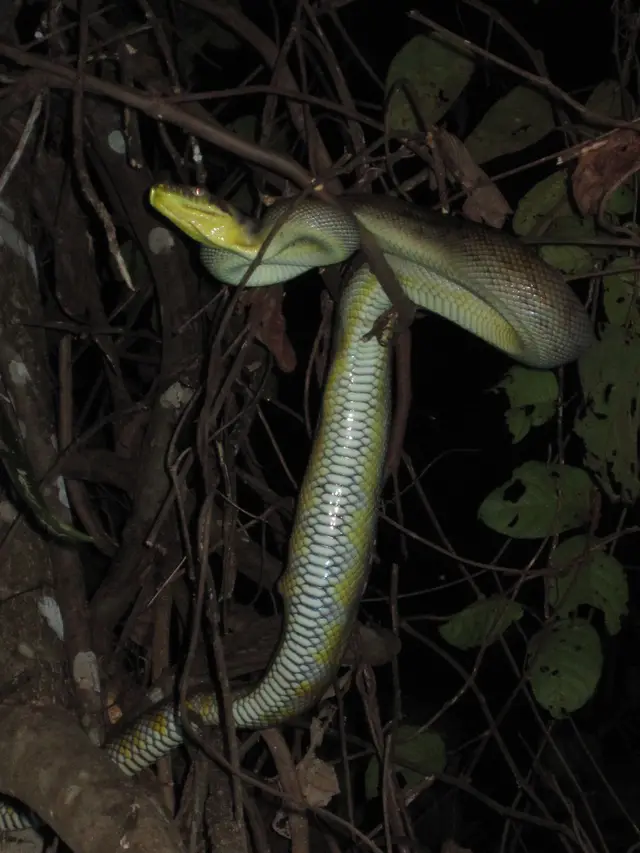
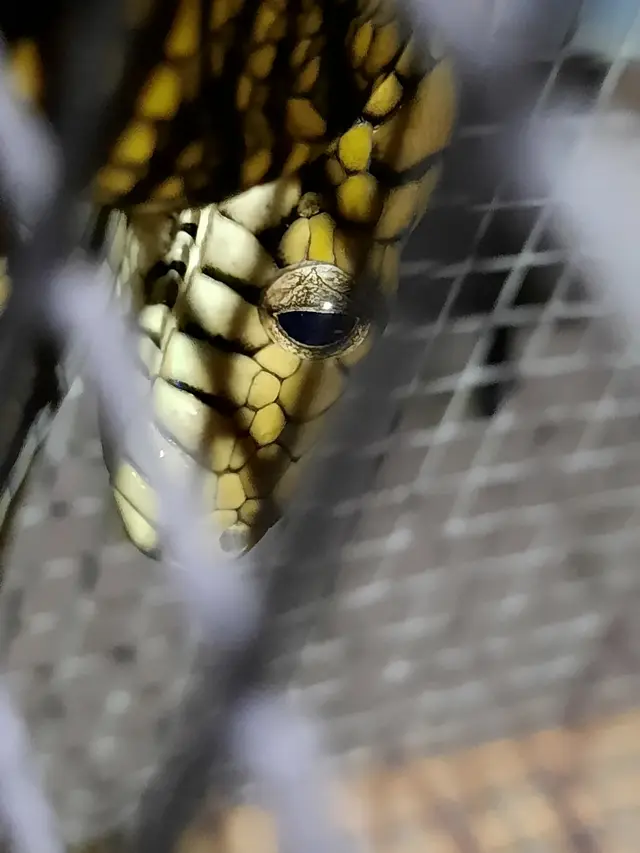
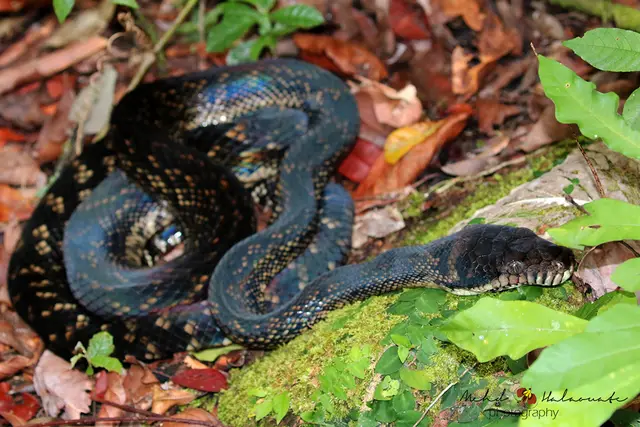
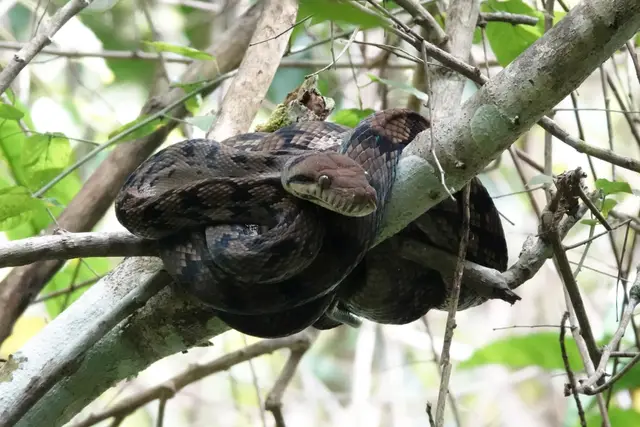
Length and shine are the first clues. An amethystine python is a very long, fairly slim snake with smooth, glossy scales, and in sunlight the scales flash a purple-blue iridescence. The ground color is pale yellowish gray to olive brown, crossed by darker bands or blotches that are often broken up into irregular patches.
- 1Very long, slim body: adults of 10 ft (3 m) or more that look thin for their length, with a long tail.
- 2Purple sheen: smooth scales that shine blue-purple in bright light. The species name amethistina refers to this.
- 3Olive or brown with dark bands: a pale yellowish to olive-brown body with dark crossbands or broken blotches. Pattern and color vary between islands and change as the snake grows, according to Harvey and colleagues (2000).
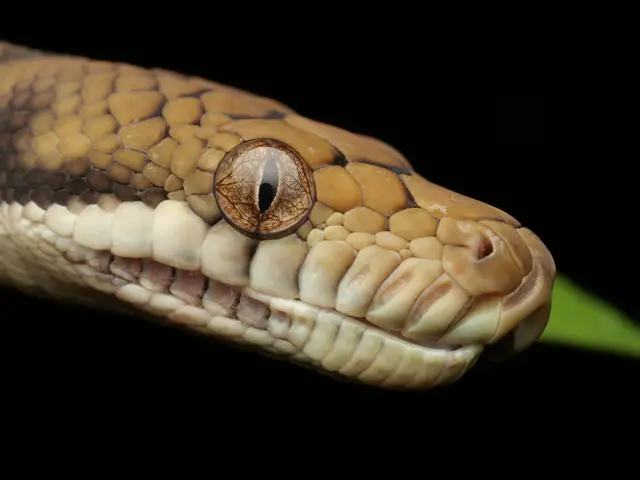
- 4Big scales on the head: the top of the head is covered with large, symmetrical scales, not the small granular scales of a carpet python.
- 5Heat pits on the lips: deep heat-sensing pits along the lower lip, used to find warm-blooded prey at night.
How big do amethystine pythons get?
Most adults are 10-12 ft (3-3.7 m) long. That puts it among the longest snakes in New Guinea. It is still well short of the giant figures that circulate online.
The biggest claim comes from Papua New Guinea. In a 1962 book, the French missionary André Dupeyrat described a snake said to be 10.45 m (about 34 ft) long. Ivan Ineich, Michel Robin and Mark O'Shea studied his photographs and published the results in Bibliotheca Herpetologica in 2026. They agreed the snake was a large amethystine python, but estimated from the size of its eye and head that it was unlikely to be more than 6 m (about 20 ft). That would still be a record for the species. The same paper notes that several snakes over 4.5 m (about 15 ft) are known.
Much of the hard size data comes from Australian scrub pythons, which were counted as amethystine pythons until 2000. In a radio-tracking study on Cape York, Natusch, Lyons and Shine (2022) measured 27 snakes with body lengths of 2.02-3.70 m, not counting the tail, and weights of about 1-8.7 kg. They note that adults sometimes pass 5.5 m (18 ft) and 20 kg (44 lb).
| Measure | Size | Source |
|---|---|---|
| Hatchling | About 2.3 ft (0.7 m), 1.8 oz (50 g) | Natusch et al. (2022) |
| Typical adult | 10-12 ft (3-3.7 m) | Britannica |
| Tracked adults, body only | 6.6-12.1 ft (2.02-3.70 m), 2.3-19.1 lb (1.03-8.69 kg) | Natusch et al. (2022), Cape York |
| Large adults | Over 18 ft (5.5 m) and 44 lb (20 kg) | Natusch et al. (2022) |
| Reported giant, 1962 | Claimed 10.45 m (34 ft); reassessed at under 6 m (20 ft) | Ineich, Robin and O'Shea (2026) |
For comparison, the Burmese python is much heavier at the same length, and the green tree python, which shares New Guinea's forests, rarely reaches 7 ft.
Where do amethystine pythons live?
Short answer: in New Guinea and the islands around it, from the Moluccas in eastern Indonesia to the Louisiade Archipelago off Papua New Guinea. The Reptile Database lists records from Indonesian Papua, Misool, Salawati, the Aru and Kai islands and Banda, and in Papua New Guinea from New Britain, New Ireland, the Trobriand Islands, Ferguson Island and the Louisiades. A record from the southern Philippines is marked as doubtful.
Where the line falls depends on which taxonomy you follow. In 2000, Michael Harvey and colleagues split the old amethystine python into five species: Simalia amethistina, S. kinghorni of Australia, S. clastolepis of Seram and nearby islands, S. tracyae of Halmahera and S. nauta of the Tanimbar Islands. A DNA study by Reynolds and colleagues (2014) supported tracyae and clastolepis as separate species but was less sure about kinghorni and nauta.
Australia is the main source of confusion. The Reptile Database entry for Simalia kinghorni gives that species the rainforests of northeastern Queensland, Cape York and several Torres Strait islands, and Queensland's wildlife database calls it the "amethystine python (Australian form)". Some researchers still use the name amethistina for the Australian snakes. See how its range sits next to other pythons on the world snake map.
Habitat
Amethystine pythons live mainly in tropical forest and scrub, usually not far from water. The Reptile Database describes the species as partly arboreal: it climbs well and hunts in trees, but also moves and rests on the ground.
The Cape York study shows how flexible these snakes are. Every tracked snake used rainforest, but many moved into open woodland, swamp or sand plains at some point, and six of 11 snakes followed through both seasons switched habitats between the wet and dry seasons (Natusch et al. 2022).
Behavior
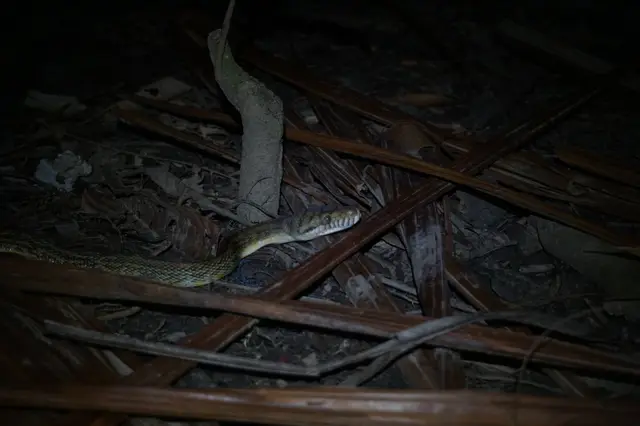
The amethystine python is an ambush hunter that waits far more than it moves. In the Cape York study, the average daily move was less than 10 m (33 ft), usually a short trip from a daytime hiding spot to a night-time ambush site. Snakes were mostly active at night, and they hunted more in the wet season (December to April) than in the dry season.
Home ranges were small for such a big snake. Males used an average of 0.60 sq km (about 150 acres) and females 0.28 sq km (about 70 acres), and neighbors' ranges overlapped widely. Larger snakes hunted less often overall, but more of their hunting happened in daylight.
What do amethystine pythons eat?
Amethystine pythons eat warm-blooded prey, mostly birds and mammals. Big adults can swallow animals the size of a small wallaby.
| Prey | Examples | Source |
|---|---|---|
| Birds | Nestling metallic starlings that fall from colony trees | Natusch et al. (2022) |
| Bats and small mammals | Bats, rats and possums | Rainforest Rescue |
| Large mammals | Agile wallabies and other small kangaroos | Natusch et al. (2022) |
One habit stands out. On Cape York, scrub pythons gather under trees holding metallic starling colonies and eat the chicks that drop to the ground. Most of these diet notes come from the Australian population; prey records from New Guinea itself are scarce.
Is the amethystine python venomous or dangerous?
No. The amethystine python has no venom. It is a constrictor, so it kills by squeezing, and it does not treat adult people as prey.
It can still bite. A large python has rows of sharp, backward-curving teeth, and a defensive bite from a 10 ft snake can leave deep, bleeding cuts. Wash any bite with soap and water and see a doctor if it is deep or shows signs of infection. In places where big pythons live, keep chickens and small pets in secure enclosures at night, since these snakes hunt after dark.
New Guinea also has some of the world's most dangerous venomous snakes, including taipans and death adders, so leave any snake you cannot identify alone. Our snake venom FAQ explains why color and head shape are poor guides to whether a snake is venomous.
Amethystine python vs scrub python and other look-alikes
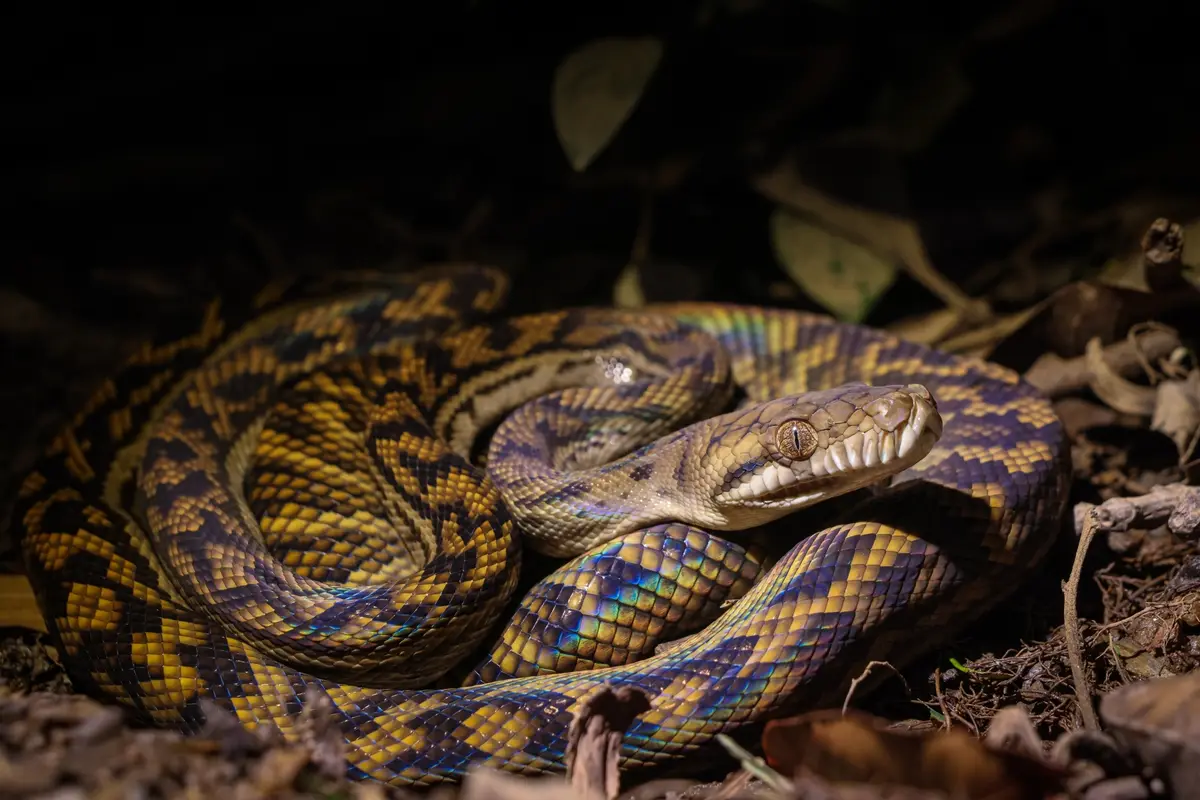
Australian scrub python
Simalia kinghorni · Harmless
Very similar in shape, color and sheen, and treated as the same species until Harvey et al. (2000). Location is the easiest test: scrub pythons live in northeastern Queensland and on Torres Strait islands, while amethystine pythons live in New Guinea and eastern Indonesia.
Carpet python
Morelia spilota · Harmless
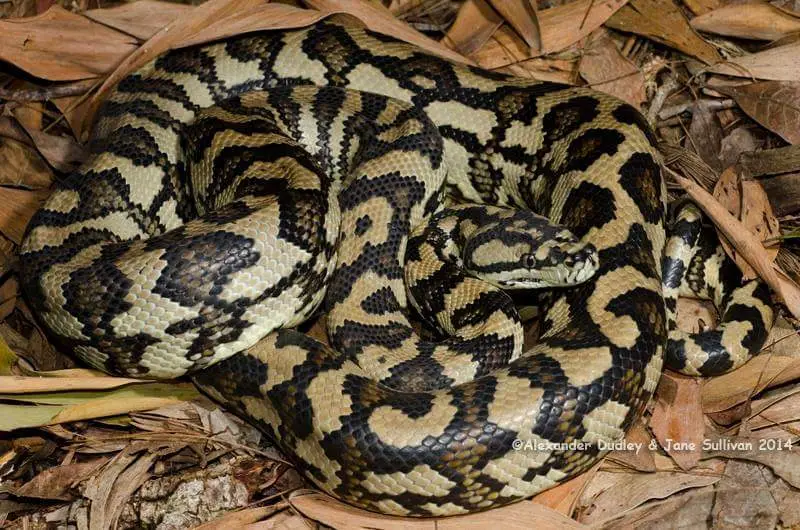
Shorter and heavier, with a busier pattern of blotches and bands. The top of its head is covered in small, fine scales, while the amethystine python has large head shields and a stronger purple sheen.
Boelen's python
Simalia boeleni · Harmless
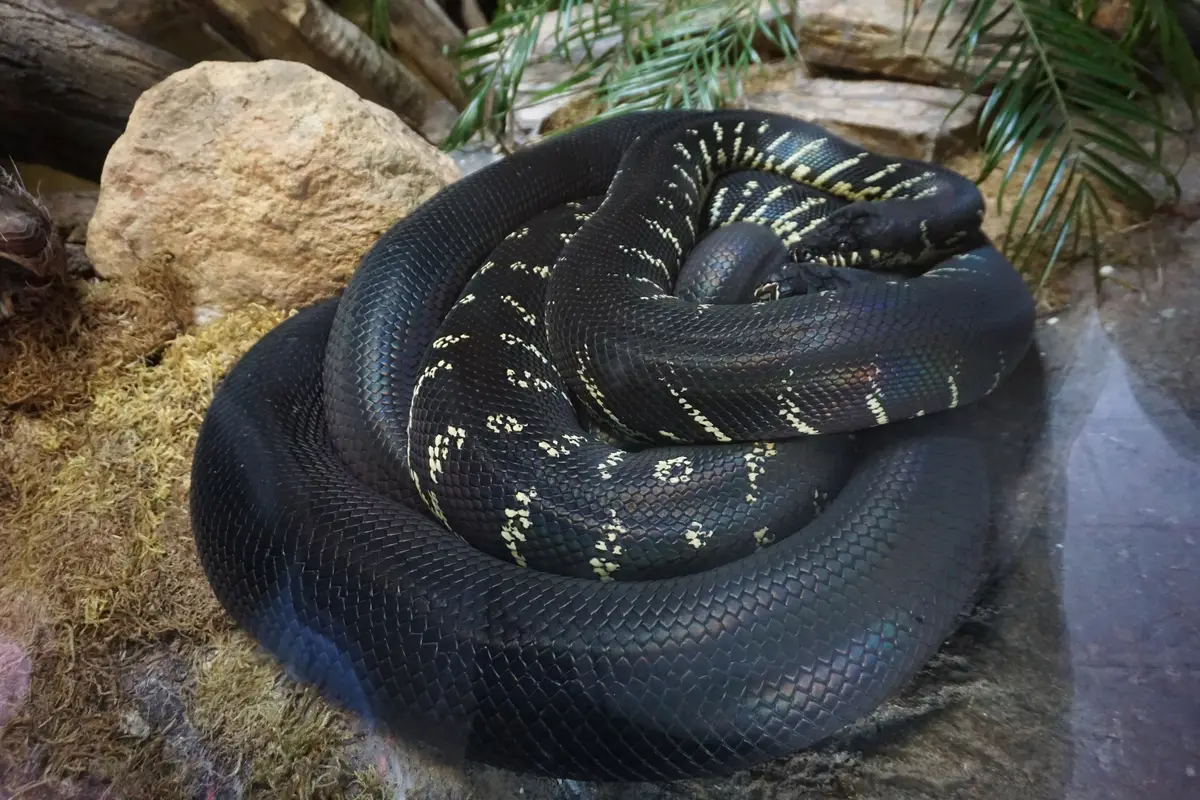
The closest relative of the amethystine python complex according to Harvey et al. (2000). It is glossy black above with pale yellow bars on the lower sides and chin, and lives in the mountains of New Guinea.
Reproduction and life cycle
Amethystine pythons lay eggs. As in other pythons, the female coils around her clutch and stays with it while the eggs develop. Hatchlings measure about 70 cm (2.3 ft) and weigh about 50 g (1.8 oz), according to Natusch and colleagues (2022).
Little is known about breeding in the wild. No field study gives clutch size, age at maturity or lifespan for New Guinea snakes. Harvey et al. (2000) noted that young snakes can look different from adults, with color and pattern changing as they grow.
Is the amethystine python endangered?
No. The IUCN Red List rates the amethystine python Least Concern, with a stable population trend. Like nearly all pythons, it is on CITES Appendix II, so international trade needs export permits.
| Authority | Status |
|---|---|
| IUCN Red List | Least Concern (population stable) |
| CITES | Appendix II (trade by permit) |
| Queensland, Australia (as S. kinghorni) | Least Concern under the Nature Conservation Act 1992 |
It has a large range spread across many islands. Pythons from Indonesian New Guinea are collected for the pet trade: a survey of traders by Daniel Natusch and Jessica Lyons, published in Biodiversity and Conservation in 2012, recorded 5,370 reptiles and amphibians of 52 species taken from the region for pets, many of them without legal quotas. The Australian form is listed as Least Concern by the Queensland Government.
Amethystine python FAQ
Is the amethystine python venomous?
No. The amethystine python has no venom and kills its prey by constriction. It can bite in self-defense, and a large snake's many sharp, curved teeth can cause deep, bleeding cuts. Clean any bite with soap and water and get medical care if it is deep or becomes infected. It is not a danger to the life of an adult.
How big do amethystine pythons get?
Most adults are 10-12 feet (3-3.7 m) long. Snakes over 15 feet (4.5 m) are known, and a 2026 review by Ineich, Robin and O'Shea concluded that even the largest reliably reported snake, from Papua New Guinea, was probably under 20 feet (6 m). Claims of 28-34 foot amethystine pythons have not held up.
What is the difference between an amethystine python and a scrub python?
Scrub python is another common name for the same group of snakes. Since a revision by Harvey and colleagues in 2000, the Australian population has usually been treated as its own species, the Australian scrub python (Simalia kinghorni). The amethystine python in the strict sense, Simalia amethistina, lives in New Guinea and eastern Indonesia.
Why is it called the amethystine python?
The name comes from its scales. They are smooth and glossy, and in sunlight they shine with a milky purple-blue iridescence that reminded early naturalists of amethyst. The scientific name amethistina, given by Schneider in 1801, means the same thing. The base color underneath is olive brown to yellowish gray with darker bands.
Where does the amethystine python live?
It lives in New Guinea and the islands around it: the Moluccas, Misool, Salawati and the Aru and Kai islands in Indonesia, and New Britain, New Ireland, the Trobriand Islands and the Louisiade Archipelago in Papua New Guinea. It favors rainforest and scrub near water. The Australian population is now usually classed as a separate species.
What do amethystine pythons eat?
They eat birds and mammals. Recorded prey includes bats, rats, possums and bird nestlings, and large adults can take small wallabies. They hunt mostly at night by waiting in ambush beside creeks and animal trails or under trees full of nesting birds, then striking and coiling around the prey.
Related snakes
Sources
- Reptile Database: Simalia amethistina
- Reptile Database: Simalia kinghorni
- Natusch, Lyons and Shine (2022). Spatial ecology, activity patterns, and habitat use by giant pythons (Simalia amethistina) in tropical Australia. Scientific Reports 12: 5274
- Harvey, Barker, Ammerman and Chippindale (2000). Systematics of pythons of the Morelia amethistina complex. Herpetological Monographs 14: 139-185
- Ineich, Robin and O'Shea (2026). Was the world's largest snake measured by a French missionary? Bibliotheca Herpetologica 20(5): 53-60
- IUCN Red List: Simalia amethistina
- Queensland Government WildNet: Simalia kinghorni (amethystine python, Australian form)
- Rainforest Rescue: Critter Corner, Australian scrub python