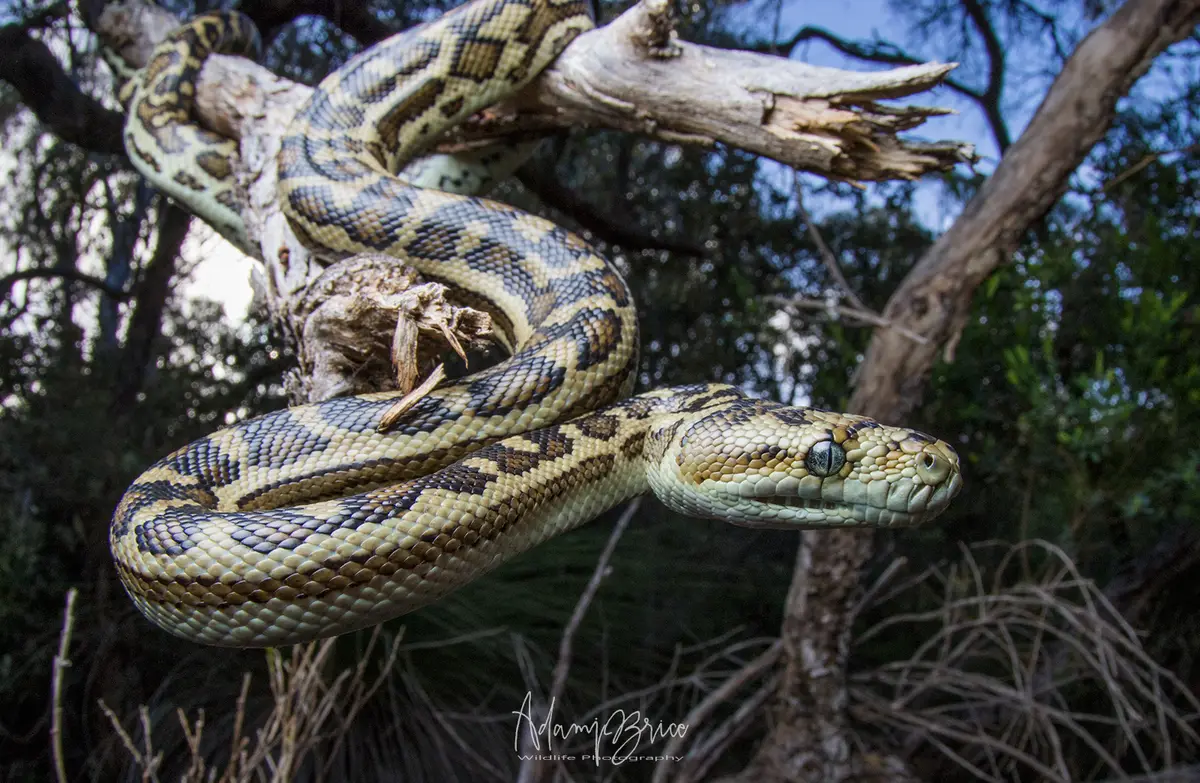
SOUTHWESTERN CARPETPYTHON
Morelia imbricata · Family Pythonidae
KEY TAKEAWAYS
The southwestern carpet python (Morelia imbricata) is a non-venomous python from the southern part of Western Australia. It is the western relative of the inland carpet python and the diamond python, and many authors now treat it as its own species. It kills by constriction and is not dangerous to people who leave it alone.
- It has no venom. A bite from a big one hurts and needs cleaning, but not antivenom.
- Adults average about 6.6 ft (2 m). Females can grow up to four times larger than males, according to the WA Department of Biodiversity, Conservation and Attractions (DBCA).
- It lives from about Shark Bay south through the southwest and east along the south coast into South Australia, including several islands.
- Large females eat mammals up to the size of tammar wallabies, including threatened numbats and woylies.
Southwestern carpet python quick facts
| Common name | Southwestern carpet python (also south-west carpet python, southern carpet python) |
|---|---|
| Scientific name | Morelia imbricata (Smith, 1981); often listed as the subspecies Morelia spilota imbricata |
| Family | Pythonidae (pythons) |
| Venomous | No, a constrictor |
| Adult length | Averages about 6.6 ft (2 m); Perth Zoo gives 8.2-9.8 ft (2.5-3 m) for large adults |
| Weight | About 2.2-9.9 lb (1-4.5 kg); females much heavier than males |
| Coloring | Greenish-brown to blackish-brown with irregular cream, yellow or pale brown blotches |
| Range | Southern Western Australia, from around Shark Bay to the south coast and into western South Australia |
| Habitat | Eucalypt and banksia woodland, coastal heath, rocky outcrops, semi-arid shrubland |
| Diet | Lizards, mice and small birds when young; mammals up to wallaby size as adults |
| Reproduction | Lays 14-35 eggs; the female coils around them until they hatch after 63-71 days |
| Conservation | Species Morelia spilota: IUCN Least Concern. In WA: specially protected fauna |
How to identify a southwestern carpet python
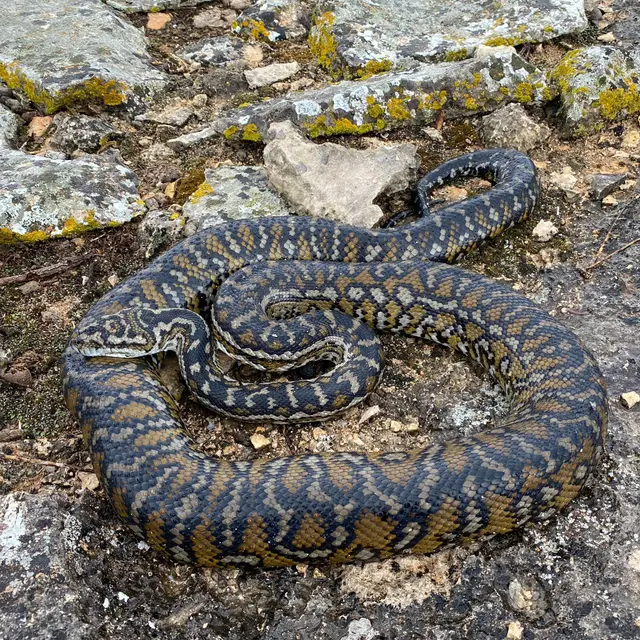
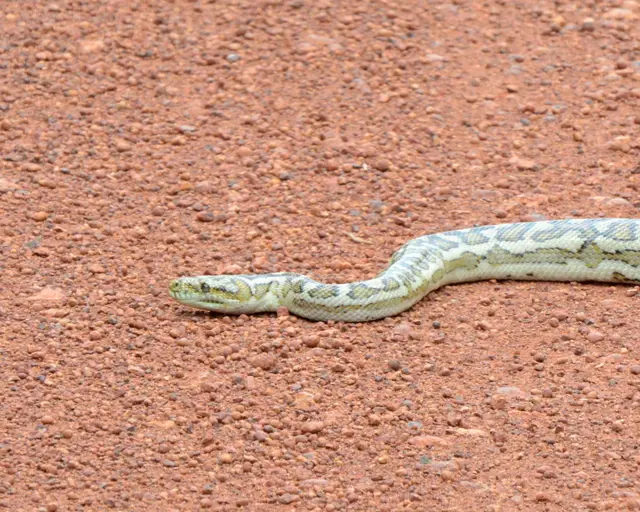
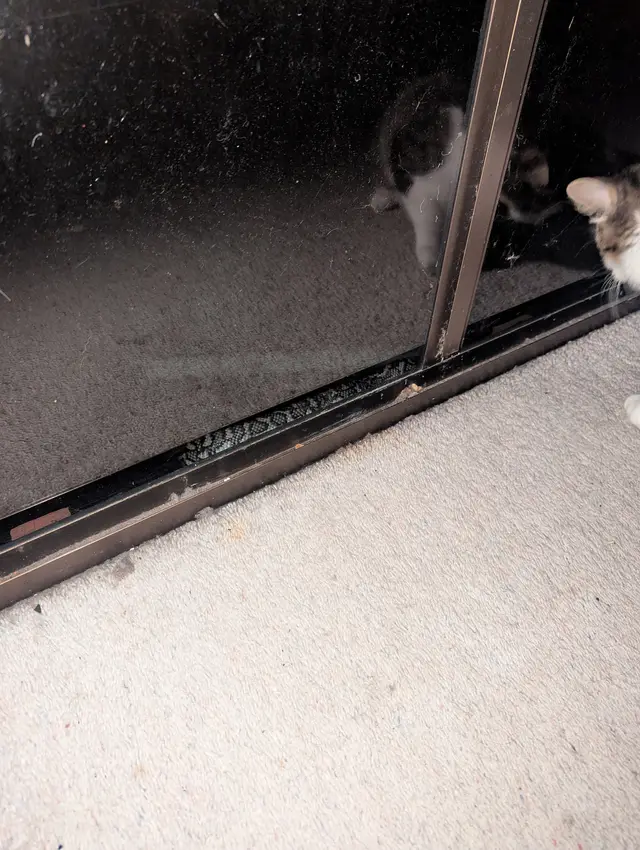
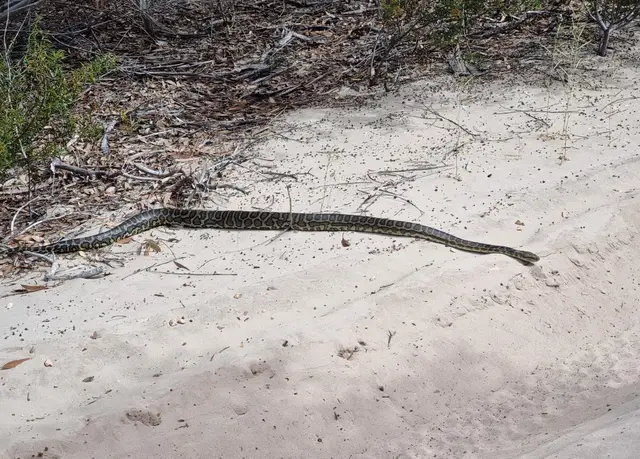
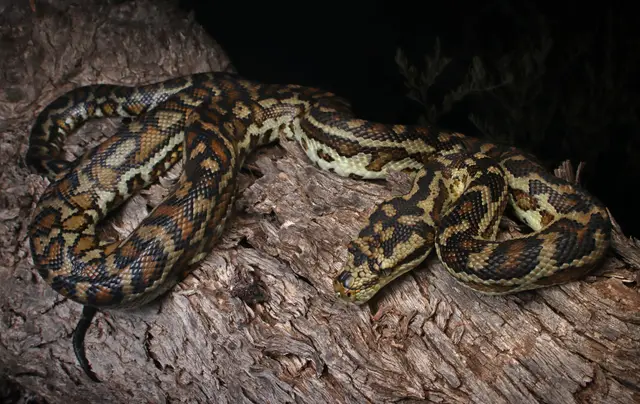
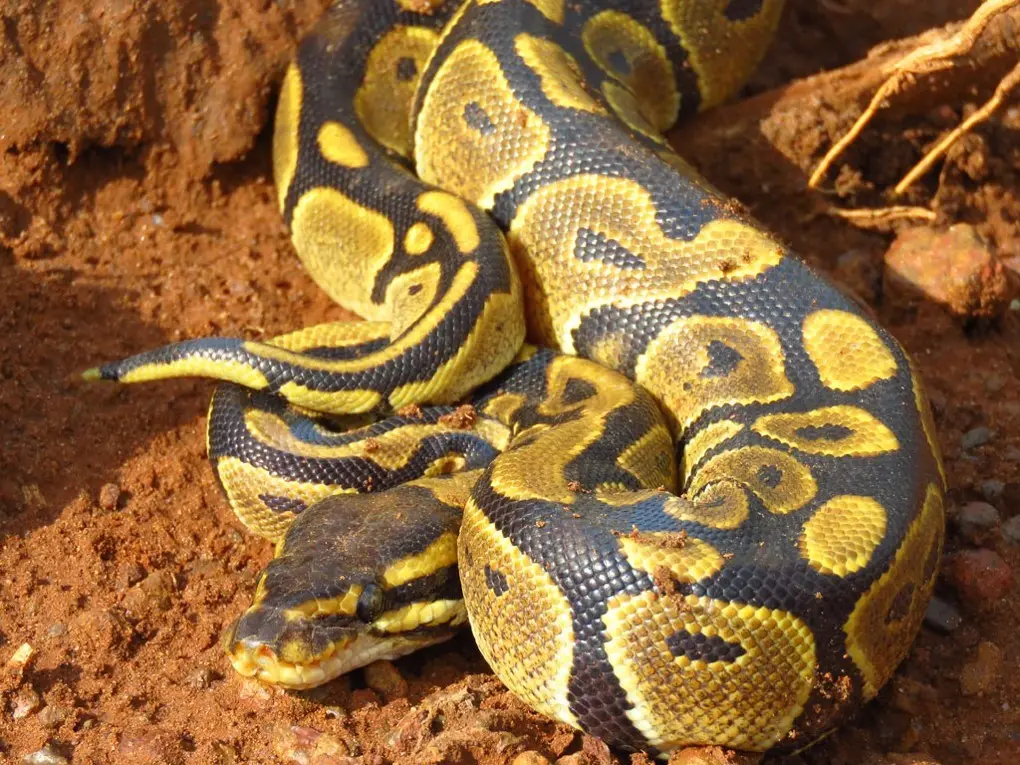
A southwestern carpet python is a heavy-bodied snake with a broad head on a slimmer neck and a busy, blotched pattern. Perth Zoo describes the color as greenish-brown to blackish-brown with irregular cream, yellow or pale brown blotches, and a white to cream belly that is sometimes boldly marked with black. The name comes from the pattern, which looks a little like an oriental rug.
- 1Blotched carpet pattern: irregular pale blotches on a dark olive or brown back. No two snakes look quite the same.
- 2Broad head, clear neck: the head is much wider than the neck and covered in many small scales rather than a few large plates.
- 3Heat pits on the lips: like other carpet pythons, it has small pits along the lip scales that sense the body heat of prey. The dangerous dugite has none.
- 4Overlapping rear scales: the scales toward the tail are narrow, pointed and overlap like roof tiles. That is where the name imbricata comes from.
- 5Location: any wild carpet python in southern Western Australia is this one. No other carpet python lives there.
Scale counts set it apart from northern carpet pythons. In the original description, L. A. Smith (1981, Records of the Western Australian Museum) separated it from the northern form by its lance-shaped, strongly overlapping rear body scales, its 239-276 belly scales (against 259-294) and its 63-82 scales under the tail (against 75-89), as summarized by the Reptile Database.
How big do southwestern carpet pythons get?
Southwestern carpet pythons average about 6.6 ft (2 m) long. The DBCA fauna profile gives that average and notes reports of snakes up to 13 ft (4 m), a figure that is unconfirmed and far above the norm. Perth Zoo lists large adults at 8.2-9.8 ft (2.5-3 m) and 2.2-9.9 lb (1-4.5 kg).
| Measure | Size | Source |
|---|---|---|
| Average total length | About 6.6 ft (2 m) | DBCA fauna profile |
| Large adults | 8.2-9.8 ft (2.5-3 m) | Perth Zoo |
| Weight range | 2.2-9.9 lb (1-4.5 kg) | Perth Zoo |
| Reported maximum | About 13 ft (4 m), unconfirmed | DBCA fauna profile |
Why are the females so much bigger?
Females in southwestern Australia grow up to four times larger than males at maturity, the DBCA profile says, probably because they need large fat stores to breed. Diet plays a part too. Pearson, Shine and How (2002, Biological Journal of the Linnean Society) compared one mainland and four island populations in Western Australia. In all five, females were larger and had relatively bigger heads, and they ate bigger prey, such as possums and wallabies, while males mostly took lizards, mice and small birds. Where large mammals were scarce, females stayed smaller.
Where do southwestern carpet pythons live?
Short answer: in the southern part of Western Australia, spilling over into South Australia. David Pearson of DBCA describes a range from around Shark Bay to the eastern Wheatbelt, through the whole southwest and along the southern coastline into South Australia. It also lives on several offshore islands, including Garden Island off Perth.
It is the only carpet python in the west. The nearest relatives are Bredl's python in central Australia and the inland carpet python of the Murray-Darling Basin. Compare the ranges of Australia's pythons on the world snake map.
Habitat
Southwestern carpet pythons live in almost any kind of bush that offers shelter and prey. That includes coastal heath, banksia and eucalypt woodland, tall forest, granite outcrops and semi-arid shrubland. Perth Zoo lists bushland patches, water catchment areas and rocky outcrops, with snakes hiding in hollow tree limbs, rock crevices and the burrows of other animals.
Shelter matters more than vegetation type. In the radio-tracking study by Pearson, Shine and Williams (2005, Austral Ecology), pythons at Dryandra Woodland in the Wheatbelt depended on hollow logs, and many of those logs came from trees felled more than 70 years earlier when plantations were set up. On Garden Island, where the bush is low, the snakes mostly sheltered under dense shrubs.
Behavior
Southwestern carpet pythons are mostly nocturnal ambush hunters, though Perth Zoo notes they are sometimes seen basking and moving about by day. They spend long periods coiled in one spot, waiting for prey to pass.
The 2005 Austral Ecology study fitted 91 pythons with radio transmitters and followed them for between one month and four years. Home ranges averaged about 15-20 hectares (37-49 acres), and the snakes moved about 330-490 ft (100-150 m) a week on average. At Dryandra they spent the cool months, May to September, inactive inside tree hollows. On milder Garden Island, some pythons, especially smaller ones, kept moving and feeding through winter. Young snakes climbed more than adults.
Dryandra pythons often came back to the same logs after long absences and reused the same hollows each winter. Males there had larger home ranges than females, while on Garden Island the sexes did not differ.
Mating is unusually peaceful. Male carpet pythons in eastern Australia often fight over females, the DBCA profile notes. On Garden Island, however, Pearson, Shine and Williams (2002) saw no open fighting between males in the mating season, and bigger males did not have better mating success.
What do southwestern carpet pythons eat?
Young southwestern carpet pythons eat mice, geckos and small birds, and large ones eat mostly mammals up to the size of tammar wallabies. That is the summary from David Pearson in a 2021 DBCA note. He adds that their prey includes threatened species such as numbats, woylies and Gilbert's potoroo, to the dismay of colleagues whose radio-collared study animals end up inside a python.
| Prey | Where recorded | Source |
|---|---|---|
| Geckos, house mice | Garden Island; general diet of young snakes | DBCA fauna profile; Pearson (2021) |
| Doves, purple-crowned lorikeets | Garden Island; Dryandra | DBCA fauna profile |
| Tammar wallabies (small) | Garden Island | DBCA fauna profile |
| Woylies, numbats | Dryandra Woodland | DBCA fauna profile |
| Ringtail possums, Gilbert's potoroo | Southwest WA | Pearson (2021) |
In January 2024 a photographer surveying numbats at Dryandra Woodland National Park caught a southwestern carpet python eating one, ABC News reported. Herpetologist Mike Bamford told the ABC that these pythons eat rarely, but when they do, they usually take something large.
Like other pythons, it grabs prey with its teeth, coils around it and squeezes, then swallows it whole. Females in a breeding year may go without food for up to eight months, according to DBCA.
Is the southwestern carpet python venomous or dangerous?
No. The southwestern carpet python has no venom and is not dangerous to people. It is a python, and pythons kill by constriction, as the DBCA fauna profile describes. A big one coiled across a bush track can look alarming. It is not. Given the chance, it stays still or slides away.
A large one can still bite if grabbed or cornered. Python teeth are sharp and curve backward, so a bite can bleed. Wash it with soap and water, check that your tetanus protection is current, and see a doctor if it becomes red or swollen.
The real risk is mistaking a venomous snake for a python. Southwest Western Australia is dugite country, and the Australian Museum says the dugite accounts for about 70% of snakebites reported to Perth hospitals. If you are not completely sure a snake is a python, keep your distance. If someone is bitten by an unidentified snake, call 000, apply a pressure-immobilisation bandage and keep the person still. The snake venom FAQ explains why color is a poor guide to danger.
Southwestern carpet python vs dugite, woma and Stimson's python
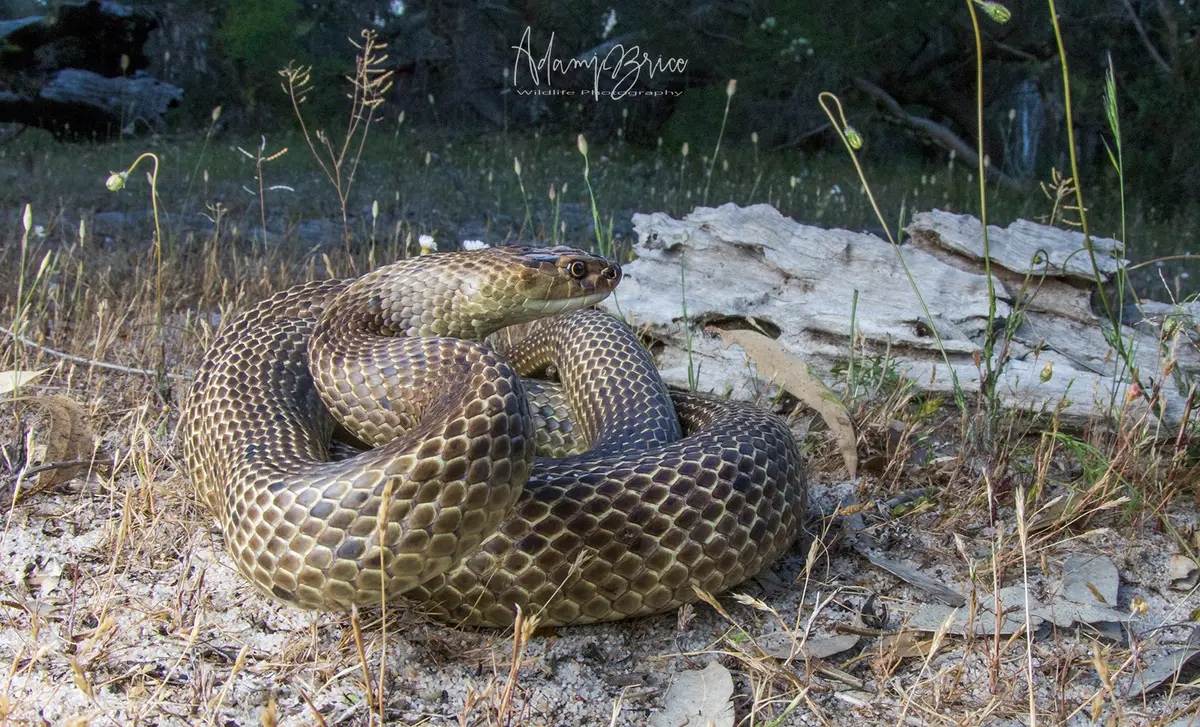
Dugite
Pseudonaja affinis · Dangerously venomous
The look-alike that matters. The Australian Museum describes a long, slender snake with a small head barely distinct from the neck, semi-glossy scales, and brown to olive coloring with scattered black spots. It averages about 4.9 ft (1.5 m). It has no heat pits and no large pale blotches.
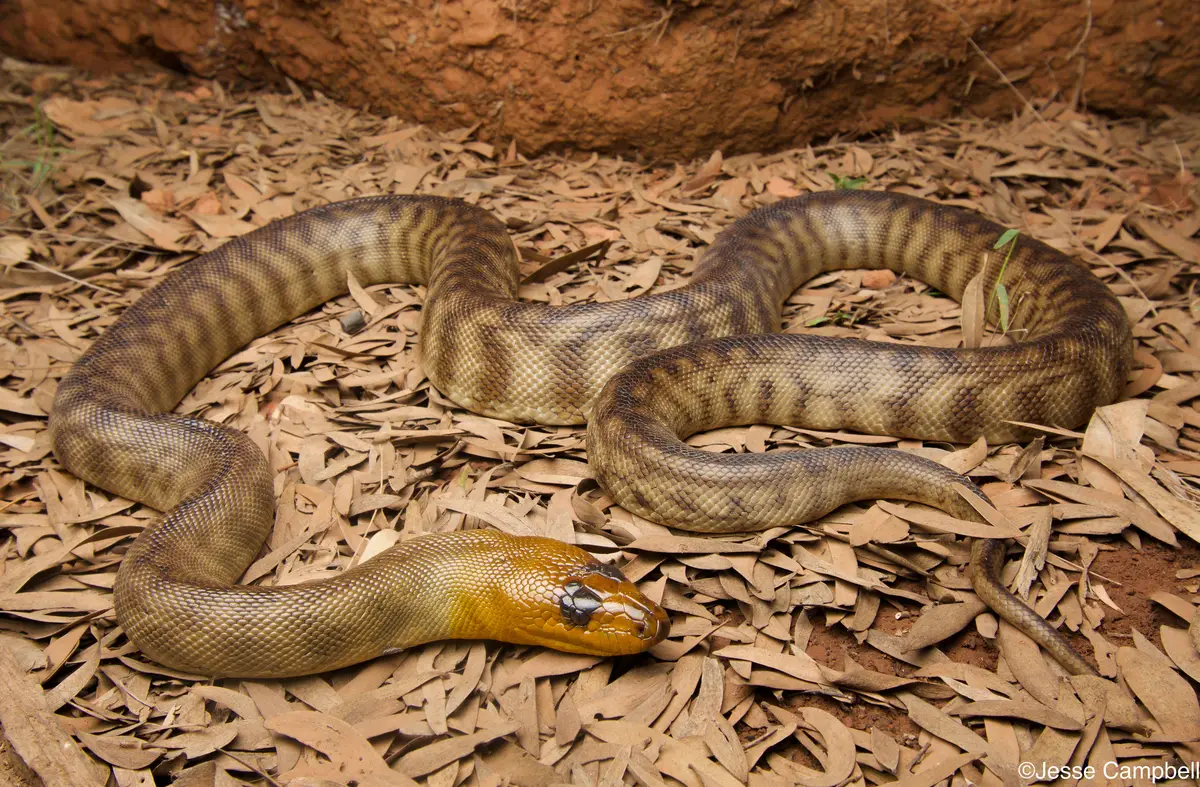
Woma
Aspidites ramsayi · Harmless
A python of inland Australia that also occurs in parts of Western Australia. The woma has a narrow head that barely stands out from the neck, no heat pits, and a pattern of brown or orange bands rather than pale blotches.
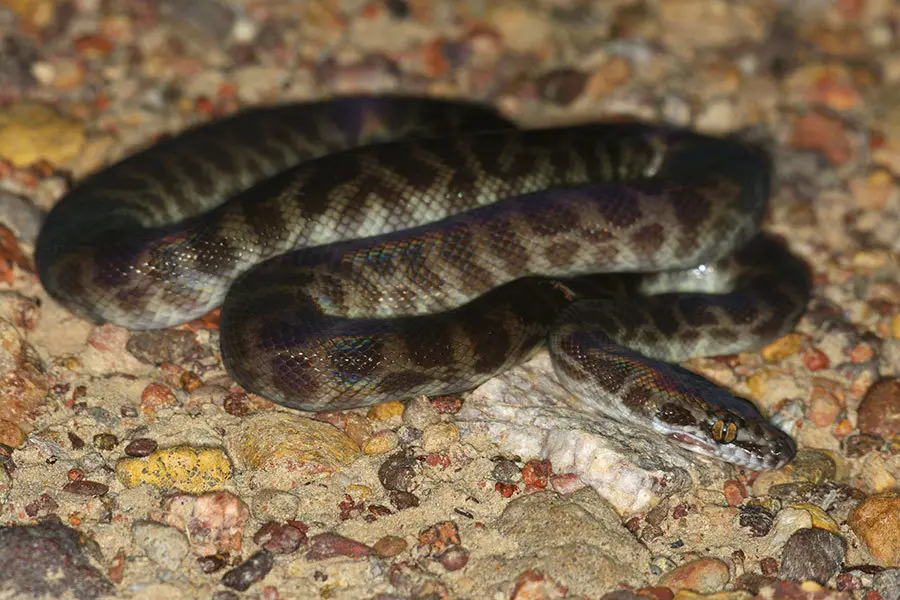
Stimson's python
Antaresia stimsoni · Harmless
A small python of arid inland Australia, including the north and east of Western Australia. Stimson's python averages about 30-35 in (75-90 cm), far smaller than an adult carpet python.
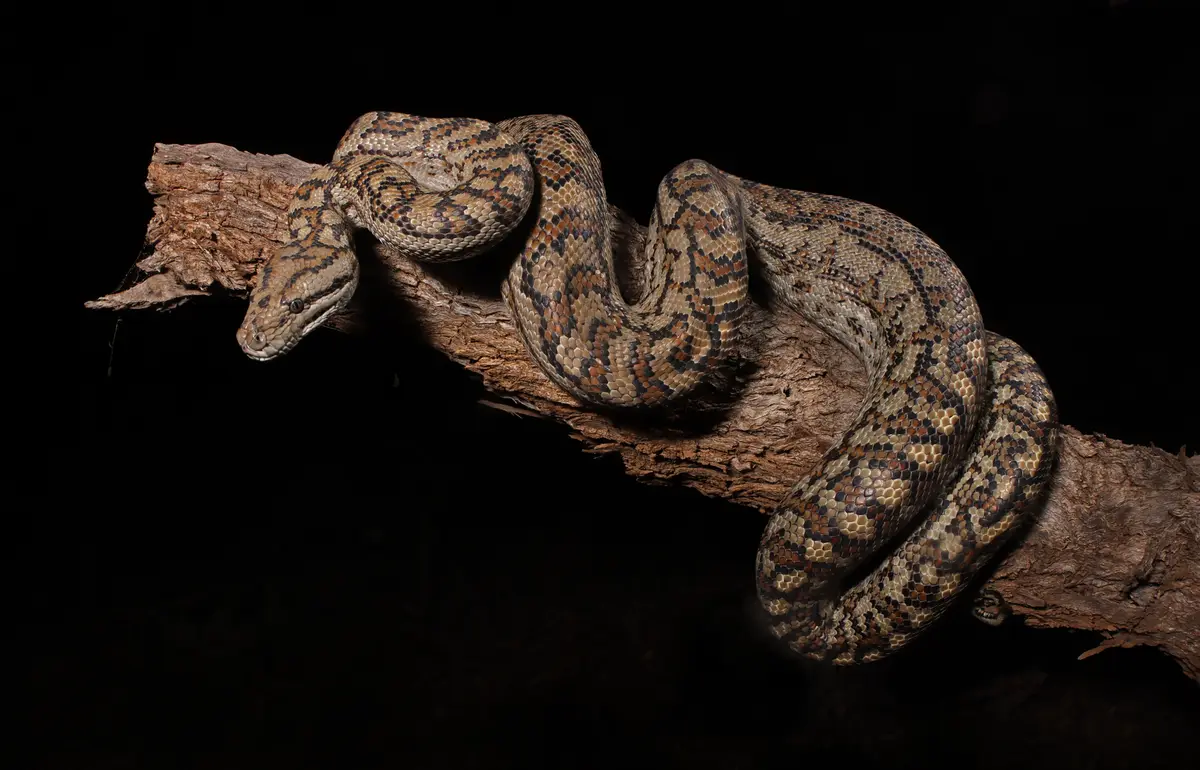
Inland carpet python
Morelia spilota metcalfei · Harmless
Its closest eastern relative, found along the Murray River system in South Australia and further east. The inland carpet python is mostly gray, silver and black, and the two do not share the same country.
Reproduction
Southwestern carpet pythons lay eggs. Females ovulate once, in late spring or early summer, and lay between 14 and 35 eggs in a sheltered spot, according to the DBCA profile; Perth Zoo gives 14-20. A clutch can weigh up to a quarter of the female's body weight.
The female coils around her eggs and stays there until they hatch, 63-71 days after laying. If the eggs get too cool, she shivers to produce heat. The 2005 tracking study found that breeding females barely moved in summer while incubating. Hatchlings get no further care. They disperse to find food and set up their own home ranges.
Little is known about breeding in the wild, DBCA notes, and no reliable lifespan figure for wild southwestern carpet pythons has been published.
Is the southwestern carpet python endangered?
Not globally, but it has declined in parts of its range. The carpet python species, Morelia spilota, is rated Least Concern by the IUCN. In Western Australia the DBCA fauna profile listed it as other specially protected fauna, under Schedule 4 of the Wildlife Conservation Act 1950. That act has since been replaced by the Biodiversity Conservation Act 2016.
| Authority | Status |
|---|---|
| IUCN Red List | Least Concern (species Morelia spilota) |
| Western Australia | Schedule 4, other specially protected fauna (Wildlife Conservation Act 1950, per DBCA) |
| CITES | Appendix II, as are all pythons |
Pearson writes that the python has declined through the Wheatbelt, which led to its threatened listing, though it can still be locally common where native bush and its prey survive. DBCA links the losses to clearing for farming and housing and to changed fire regimes, and notes a decline around Esperance. Perth Zoo points to development on the Swan Coastal Plain.
Introduced foxes and cats are a possible factor. Their direct impact is uncertain, but DBCA notes that python densities tend to be higher where foxes are controlled. Fire is complicated: at Dryandra, cool burns remove ground logs without regrowing the shrub thickets that prey species need, so the 2005 study recommends occasional fire to create new logs and cover.
Is it a species or a subspecies?
That depends on the source. Smith described it in 1981 as a subspecies of the carpet python, Python spilotus imbricatus. The Reptile Database now lists it as a full species, Morelia imbricata, following Barker and colleagues (2015) and the python study of Esquerre and colleagues (2020, Systematic Biology). DBCA still used the subspecies name, Morelia spilota imbricata, in 2021. Either way, it is a close cousin of the coastal carpet python and the jungle carpet python of the east coast.
Southwestern carpet python FAQ
Is the southwestern carpet python venomous?
No. The southwestern carpet python has no venom and kills its prey by constriction. A large one can bite if handled, and its sharp teeth can draw blood, so wash any bite well and check your tetanus protection. If you are not certain the snake was a python, treat the bite as venomous, apply a pressure bandage and call 000.
How big does a southwestern carpet python get?
Most adults are about 6.6 feet (2 m) long, according to the WA Department of Biodiversity, Conservation and Attractions. Perth Zoo gives 2.5-3 m (8.2-9.8 ft) and 1-4.5 kg (2.2-9.9 lb) for large adults. Females are much bigger than males, growing up to four times larger at maturity.
Where do southwestern carpet pythons live?
They live in southern Western Australia, from around Shark Bay through the southwest and east along the south coast into South Australia. They also live on islands such as Garden Island off Perth. They use woodland, coastal heath, granite outcrops and semi-arid shrubland, sheltering in hollow logs, tree hollows, rock crevices and burrows.
Do southwestern carpet pythons eat numbats?
Yes, sometimes. DBCA records numbats and woylies in the diet of pythons at Dryandra Woodland, and in January 2024 a photographer recorded a carpet python eating a numbat there. Large females eat mammals up to the size of tammar wallabies, while young snakes and males mostly take mice, geckos and small birds.
How can you tell a carpet python from a dugite?
A carpet python has a broad head on a clearly narrower neck, heat pits along its lips, and a pattern of pale blotches on a dark body. The venomous dugite is slender, with a small head barely wider than its neck, semi-glossy scales and brown or olive coloring with scattered black spots. If in doubt, keep away.
Is the southwestern carpet python endangered?
Not globally. The carpet python species is rated Least Concern by the IUCN. In Western Australia the southwestern form is specially protected, and DBCA reports declines in the Wheatbelt and around Esperance from land clearing and changed fire regimes. It can still be common where native bush and prey remain.
Related snakes
Sources
- Reptile Database: Morelia imbricata (Smith, 1981)
- WA Department of Environment and Conservation (now DBCA): Carpet Python fauna profile (2012)
- Pearson, D. (2021). An ambush predator with a predilection for threatened species: carpet pythons unmasked. DBCA
- Perth Zoo: South-west Carpet Python
- Pearson, Shine and Williams (2005). Spatial ecology of a threatened python (Morelia spilota imbricata). Austral Ecology 30: 261-274
- Pearson, Shine and How (2002). Sex-specific niche partitioning and sexual size dimorphism in Australian pythons. Biological Journal of the Linnean Society 77: 113-125
- ABC News (16 January 2024): Python eats endangered numbat in Dryandra Woodland National Park
- Australian Museum: Dugite