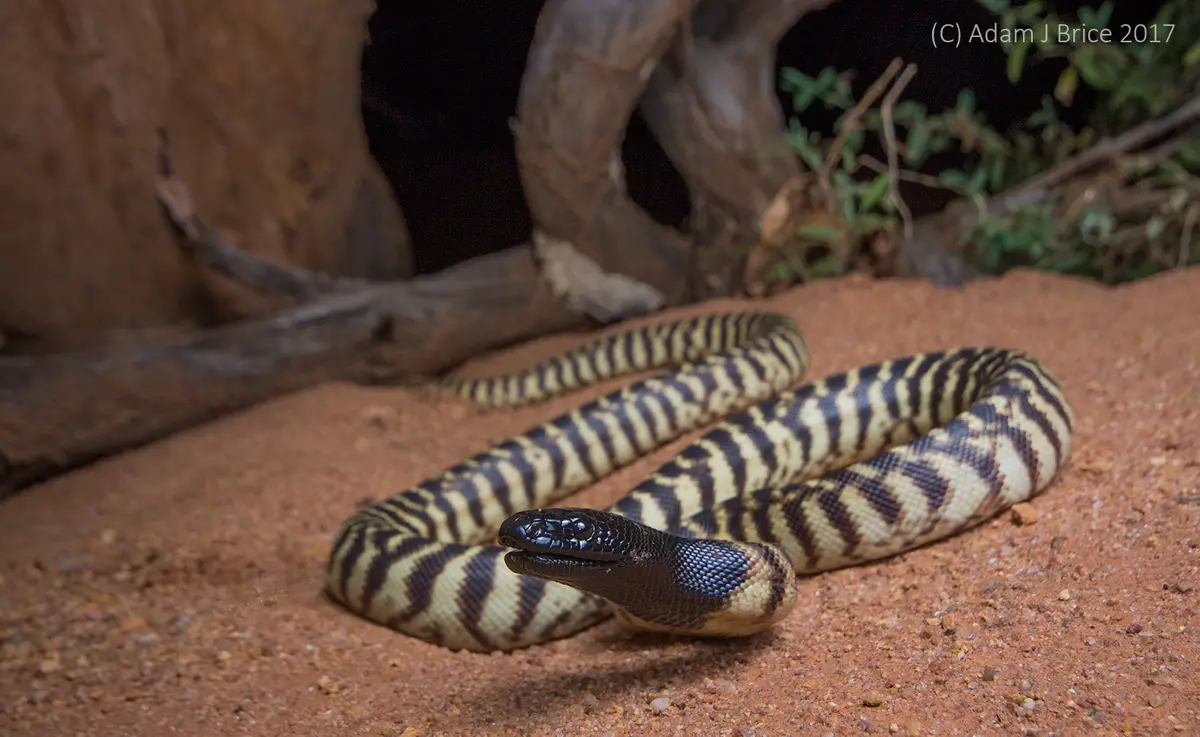
BLACK-HEADEDPYTHON
Aspidites melanocephalus · Family Pythonidae
KEY TAKEAWAYS
The black-headed python is a non-venomous Australian python with a glossy black head and neck and a banded body of cream, tan and dark brown. It lives across the northern half of Australia and eats mostly other reptiles, including venomous snakes. It is harmless to people, though it will hiss loudly and can bite if handled roughly.
- Adults are usually 5-6.5 ft (1.5-2 m) long. A few grow larger, with zoo sources giving maximums of 10-11.5 ft (3-3.5 m).
- It is not venomous. It kills by constriction, like the ball python and other pythons.
- Its diet is mostly lizards and snakes. A sanctuary manager in Queensland has watched wild ones eat an eastern brown snake, one of the most venomous snakes in Australia.
- It has no heat-sensing pits on its lips, which most other pythons use to find warm-blooded prey.
Black-headed python quick facts
| Common name | Black-headed python |
|---|---|
| Scientific name | Aspidites melanocephalus (Krefft, 1864) |
| Family | Pythonidae (pythons) |
| Venomous | No, a constrictor |
| Adult length | Usually 5-6.5 ft (1.5-2 m); rare large snakes to about 10-11.5 ft (3-3.5 m) |
| Weight | About 6.6-15 lb (3-7 kg) |
| Range | Northern Australia: Western Australia, Northern Territory, Queensland |
| Habitat | Tropical woodland, rocky outcrops, shrubland, grassland and coastal forest |
| Diet | Mainly reptiles, including venomous snakes; some mammals and birds |
| Reproduction | Lays eggs, about 5-12 per clutch |
| Lifespan | 20-30 years |
| Conservation | IUCN Least Concern |
How to identify a black-headed python
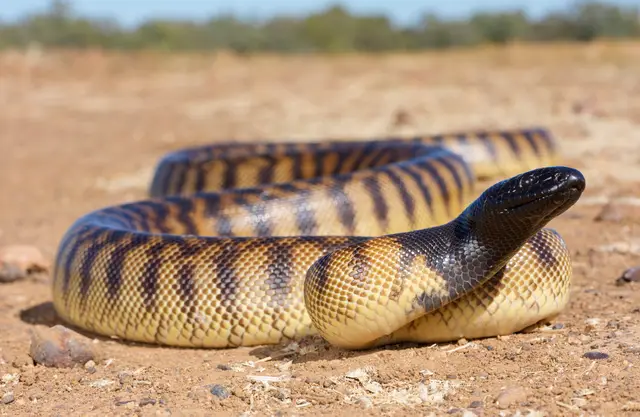
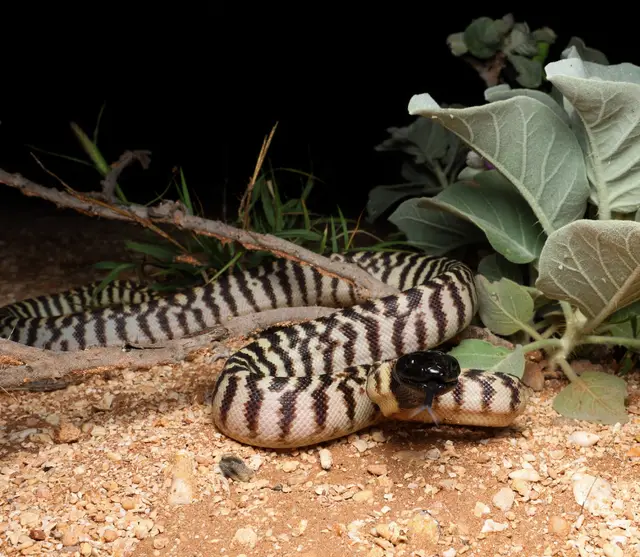
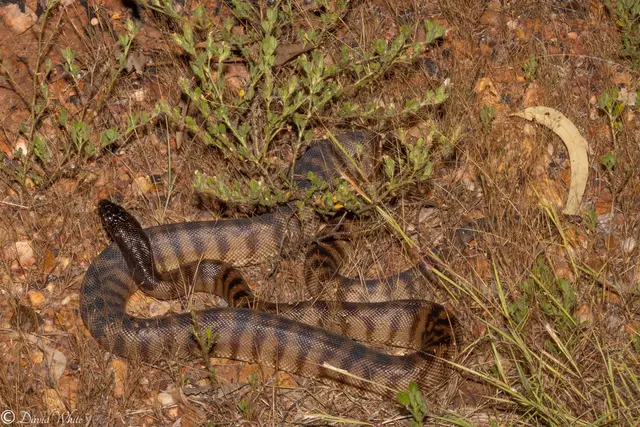
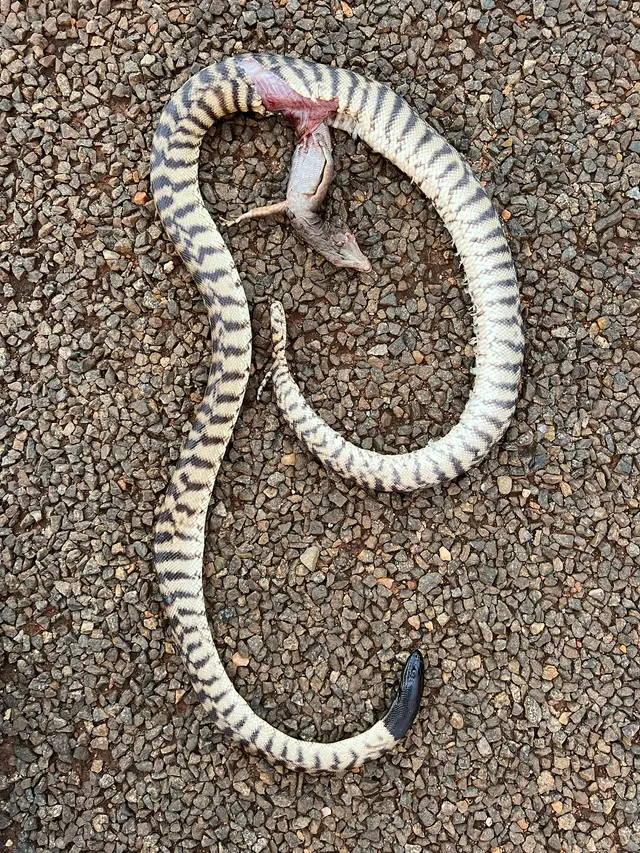
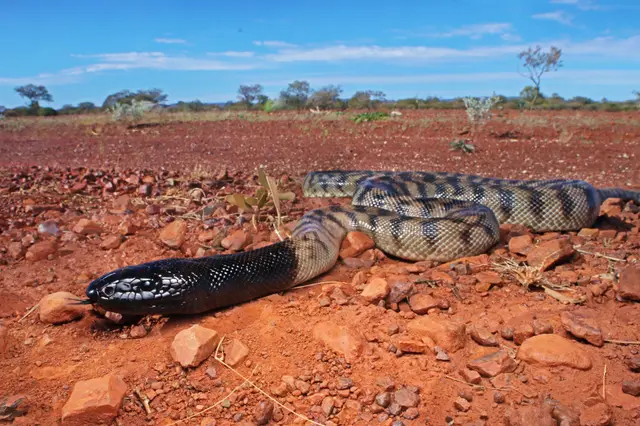
The black-headed python is easy to name once you see the head. The head, neck and throat are shiny jet black, and the black stops sharply a short way down the body. Behind it, the body is cream, tan or gold crossed by darker brown to black bands. The Australian Reptile Online Database describes the black as ending abruptly, which is the best single clue.
- 1Black head and neck: glossy black from the snout down the neck and throat, with a sharp edge where the banded body starts.
- 2Banded body: pale cream to gold background with many narrow dark bands or brindled stripes. The belly is cream, sometimes with darker blotches.
- 3Head shape: small and barely wider than the neck, with large, symmetrical scales on top.
- 4No lip pits: the lips are smooth. Most pythons, including the Burmese python, have a row of heat pits along the jaw.
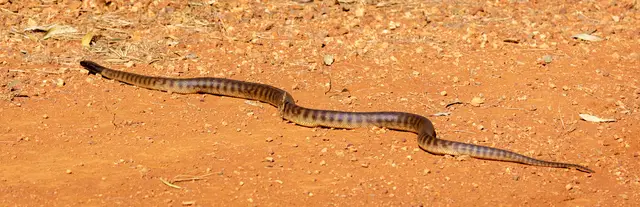
- 5Body and tail: thick and muscular, with smooth glossy scales and a tail that tapers to a thin point.
How big do black-headed pythons get?
Most adult black-headed pythons are 5 to 6.5 feet (1.5 to 2 m) long. Animal Diversity Web gives 1.5 to 2 m and notes that females can be close to a foot longer than males. The Australian Reptile Online Database puts the average at about 5 ft (155 cm) and the maximum at about 8 ft (250 cm).
Some zoo sources give larger figures. The National Zoo & Aquarium in Canberra lists a maximum of 3.5 m (about 11.5 ft) and a weight of 3 to 7 kg (6.6 to 15 lb). Snakes that size are rare. For comparison, the African rock python regularly passes 13 ft (4 m).
| Life stage | Length | Source |
|---|---|---|
| Hatchling | About 2 ft (0.6 m) | Animal Diversity Web |
| Typical adult | 5-6.5 ft (1.5-2 m) | Animal Diversity Web, National Zoo & Aquarium |
| Large adults | About 8-11.5 ft (2.5-3.5 m) | Australian Reptile Online Database; National Zoo & Aquarium |
Where do black-headed pythons live?
Short answer: only in Australia, across the northern half of the continent. The Reptile Database lists it from Western Australia, the Northern Territory and Queensland. Its southern limits are roughly North West Cape in Western Australia and Gladstone on the Queensland coast, and it avoids the driest desert country.
The species was first described in 1864 by Gerard Krefft from a snake collected at Port Denison, now Bowen, in Queensland. It does not occur in New Guinea or anywhere outside Australia. See how its range compares with other pythons on the world snake map.
Habitat
Black-headed pythons live in many kinds of country, from humid coastal forest to seasonally dry tropical woodland and the edges of the arid interior. They are common around rocky outcrops, in open woodland and shrubland, and in grassland. By day they shelter in burrows, rock crevices, hollow logs and sometimes termite mounds.
They are ground snakes. Animal Diversity Web describes them as nocturnal and partly burrowing, using burrows to keep their body temperature steady through hot days and cool dry-season nights.
Why does the black-headed python have a black head?
The black head probably helps the snake warm up. The Australian Reptile Online Database explains that the snake can keep its body hidden in a burrow while it pushes out only its head, and the dark skin soaks up sunlight and heats its blood quickly. The National Zoo & Aquarium and Caversham Wildlife Park describe the same habit of poking the head out of cover to bask.
Black-headed pythons are mostly active at night but sometimes move about by day. They live alone. When disturbed, a black-headed python usually hisses loudly rather than strikes. Keepers describe it as a calm snake, but it can still bite.
In the breeding season, from late winter into spring, males fight each other and may bite during these contests, according to the Australian Reptile Online Database.
What do black-headed pythons eat?
Black-headed pythons eat mostly reptiles. Skinks are the main prey, followed by geckos, bearded dragons, legless lizards and goannas as large as the perentie, according to Animal Diversity Web. Mammals and birds are taken now and then.
They also eat snakes, including venomous ones. Nick Stock, manager of the Australian Wildlife Conservancy's Piccaninny Plains sanctuary in Far North Queensland, told Australian Geographic in 2023 that he had watched black-headed pythons eat an eastern brown snake and a yellow-spotted monitor. In the same report he filmed one black-headed python killing and swallowing another, which took about 15 minutes.
| Prey group | Examples | How often |
|---|---|---|
| Lizards | Skinks, geckos, bearded dragons, legless lizards, monitors | Main prey |
| Snakes | Eastern brown snake, other black-headed pythons | Regular, includes venomous species |
| Mammals and birds | Small mammals, ground birds | Occasional |
A diet of cold-blooded prey may explain why the genus has lost the heat pits other pythons rely on. Lizards and snakes give off little body heat, so pits that detect warm prey would help less. The Australian Reptile Online Database suggests this link, and Animal Diversity Web notes that the genus Aspidites has lost both upper and lower lip pits.
Is the black-headed python venomous or dangerous?
No. The black-headed python has no venom and is not dangerous to people. It kills prey by wrapping coils around it and squeezing, and an adult is far too small to harm a person that way. A bite causes a row of small punctures that should be washed with soap and water, like any scratch.
The confusion comes from its look. A dark-headed, banded snake in northern Australia can resemble some venomous species, and young eastern brown snakes have a black patch on the head and neck. Our snake venom FAQ explains how venomous snakes differ from constrictors. If you are not sure what a snake is in Australia, keep your distance and treat it as venomous until someone identifies it.
Snakes confused with the black-headed python
Only a few Australian snakes share the black head. If you see one and are unsure, photograph it from a safe distance and post it on iNaturalist for an ID.
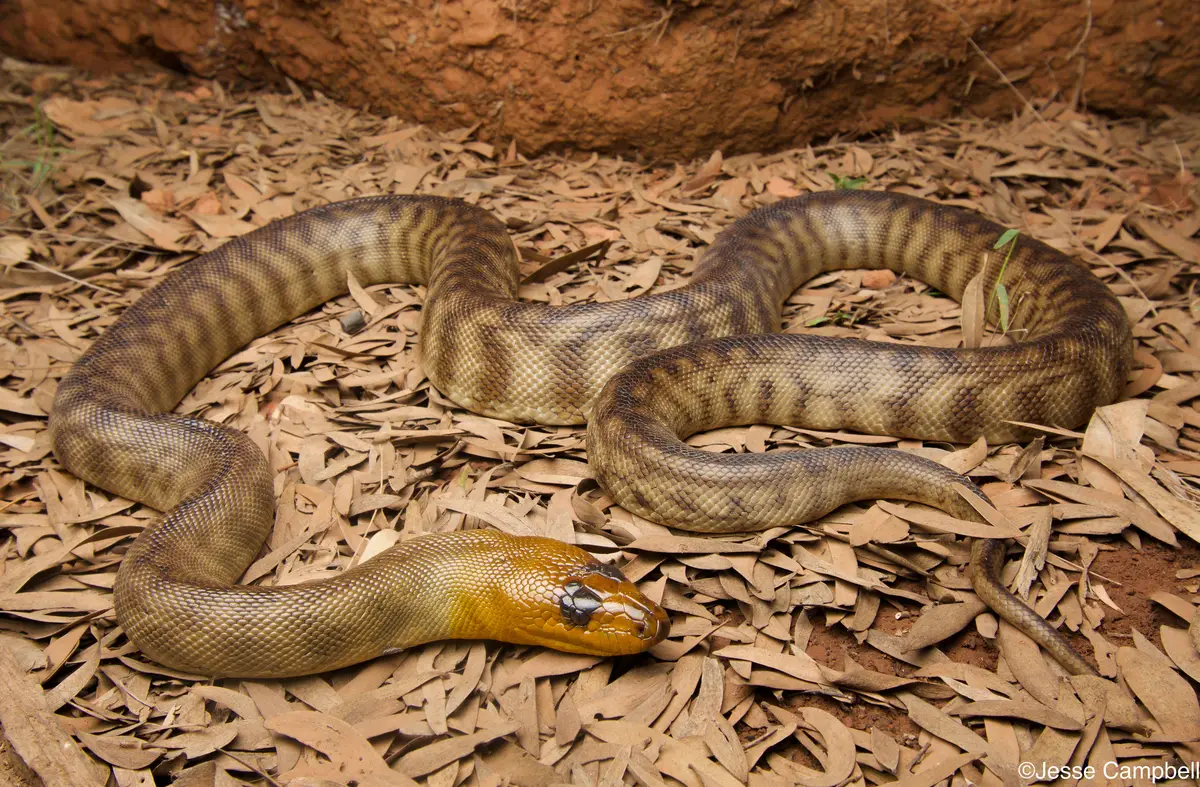
Woma python
Aspidites ramsayi · Harmless
The black-headed python's closest relative, found in the dry interior farther south. It has the same banded body and smooth lips but an orange to tan head with dark scales only around the eyes. The San Diego Zoo gives an average length of about 4.5 ft (1.5 m).
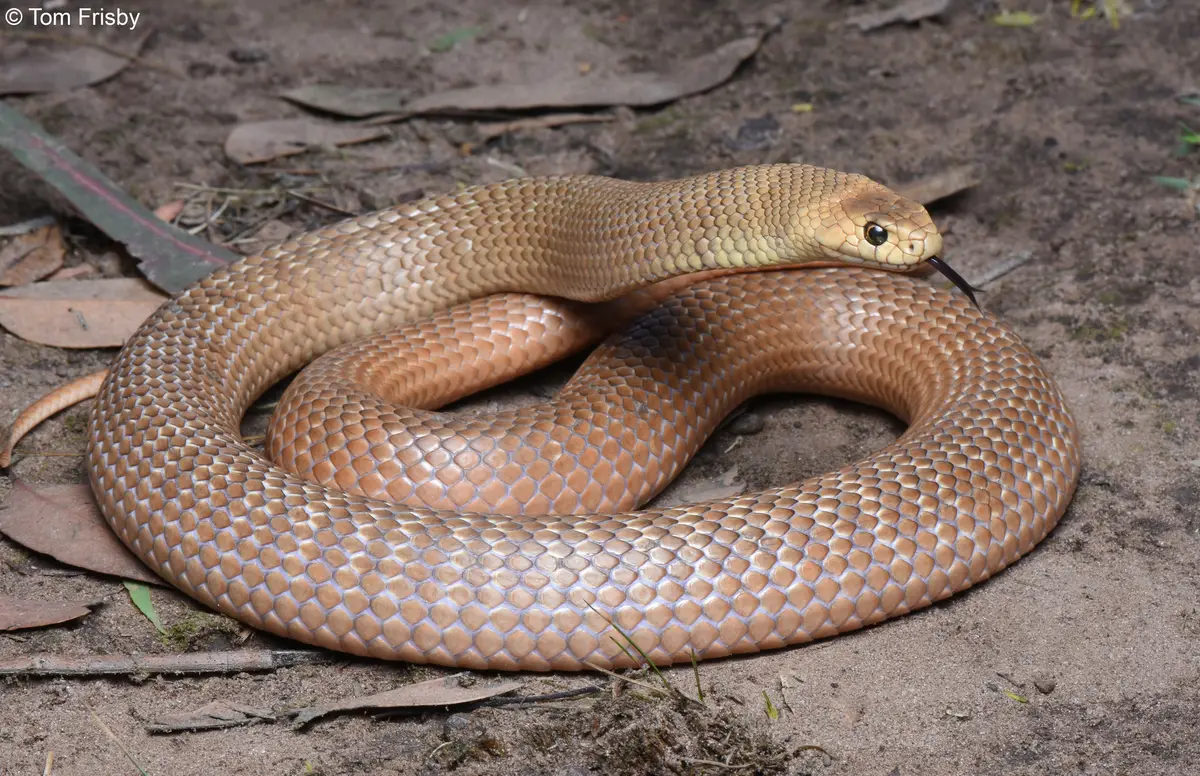
Eastern brown snake (juvenile)
Pseudonaja textilis · Highly venomous
Hatchlings have a dark patch on the head and across the nape, and some have dark bands along the body. The Australian Museum notes that it causes more snakebite deaths in Australia than any other snake. Brown snakes are slender with a small head, while a black-headed python is thick and the black covers the whole head and throat.
Reproduction and lifespan
Black-headed pythons lay eggs. They mate from late winter into early spring, and females lay their eggs in October or November. The Australian Reptile Online Database gives an average clutch of 8 eggs, with a range of 5 to 12. The female coils around the eggs for the roughly two months they take to hatch.
The young are on their own from hatching and may take their first meal within two days, according to the National Zoo & Aquarium. Animal Diversity Web says wild snakes reach breeding age at 4 to 5 years, though captive snakes have bred at 2.5 years.
How long do black-headed pythons live?
Animal Diversity Web gives a lifespan of 20 to 30 years. Young snakes have more predators. Animal Diversity Web lists dingoes and humans as the main threats to adults.
Is the black-headed python endangered?
No. The IUCN Red List lists the black-headed python as Least Concern (2017 assessment). It is widespread and can be locally common, though it is hard to find because it is active at night and hides by day.
| Authority | Status |
|---|---|
| IUCN Red List | Least Concern (2017) |
| Queensland Nature Conservation Act 1992 | Least concern |
Animal Diversity Web notes that most black-headed pythons in the pet trade are captive bred. The Queensland government species profile lists it as least concern under state law.
Several subspecies were named by Raymond Hoser in 2001 and 2009. The Reptile Database calls them poorly diagnosed and notes that other herpetologists have rejected the names, so most sources treat the black-headed python as a single species with no subspecies.
Black-headed python FAQ
Is the black-headed python venomous?
No. The black-headed python has no venom. It is a constrictor that kills prey by squeezing it. A bite can draw blood and should be washed with soap and water, but it is not medically dangerous. Most black-headed pythons hiss loudly as a warning before they would bite.
Do black-headed pythons eat venomous snakes?
Yes. Black-headed pythons eat mostly reptiles, and that includes venomous snakes. The manager of an Australian Wildlife Conservancy sanctuary in Far North Queensland reported in 2023 that he had seen black-headed pythons eat an eastern brown snake, one of the most venomous snakes in Australia. They also eat lizards, monitors and occasionally each other.
How big do black-headed pythons get?
Most adults are 5 to 6.5 feet (1.5 to 2 m) long, with females a little longer than males. The Australian Reptile Online Database gives a maximum of about 8 feet (2.5 m), and some zoo sources give up to 11.5 feet (3.5 m). Adults weigh about 6.6 to 15 pounds (3 to 7 kg).
Where do black-headed pythons live?
Black-headed pythons live only in northern Australia: the northern parts of Western Australia, most of the Northern Territory and northern Queensland. They range roughly from North West Cape in Western Australia to Gladstone in Queensland, in woodland, rocky country, grassland and coastal forest, and avoid the driest deserts.
Why is the black-headed python's head black?
The black head most likely helps the snake warm up. A black-headed python can lie in its burrow with only its head showing, and the dark skin absorbs sunlight and warms the blood quickly. This lets it heat up while the rest of its body stays hidden from predators.
Is the black-headed python related to the woma?
Yes. The woma python (Aspidites ramsayi) is the only other species in the genus Aspidites. Both are Australian, both lack heat pits on the lips and both eat many reptiles. The woma lives farther south in the dry interior and has an orange to tan head instead of a black one.
Related snakes
Sources
- Reptile Database: Aspidites melanocephalus
- Animal Diversity Web (University of Michigan): Aspidites melanocephalus
- Australian Reptile Online Database: Black-headed python
- National Zoo & Aquarium (Canberra): Black-headed python
- Australian Geographic (2023): Snake cannibalism caught on camera
- Australian Museum: Eastern brown snake
- San Diego Zoo: Woma python
- iNaturalist: Aspidites melanocephalus (photos, observations)