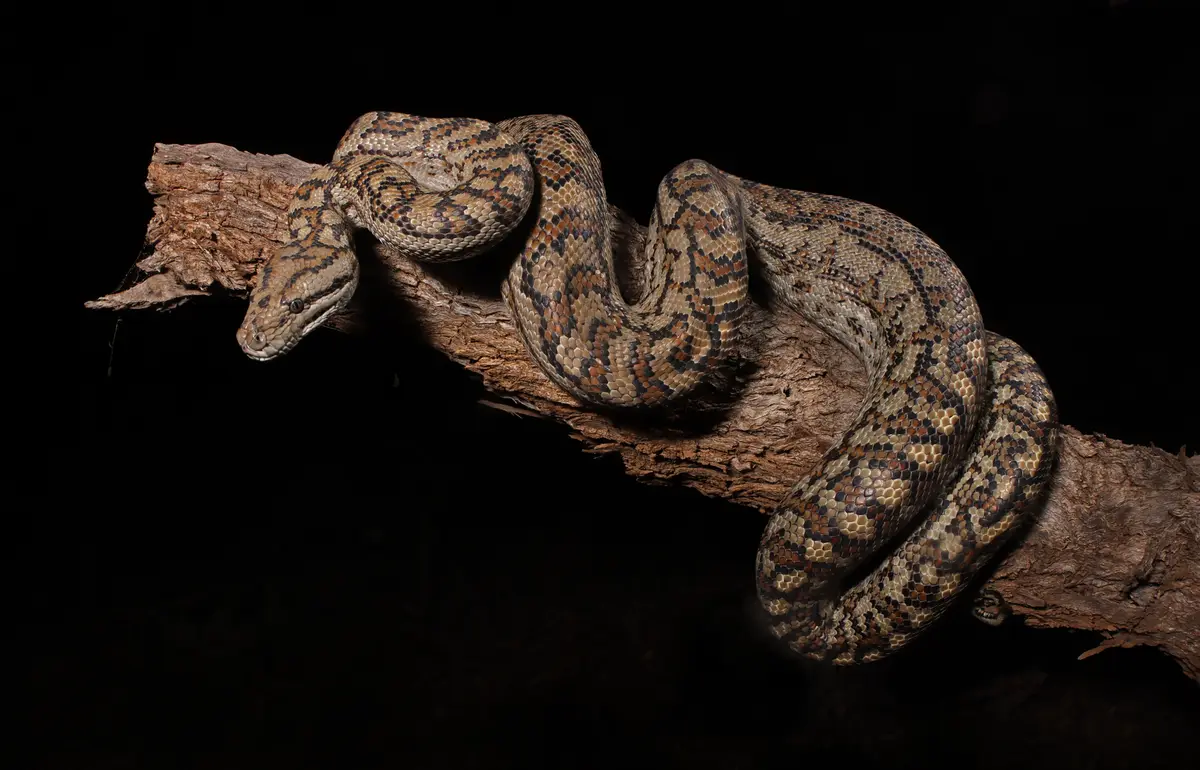
INLAND CARPETPYTHON
Morelia spilota metcalfei · Family Pythonidae
KEY TAKEAWAYS
The inland carpet python (Morelia spilota metcalfei) is a non-venomous python of the Murray-Darling Basin in southeastern Australia. It is the inland form of the carpet python, found west of the Great Dividing Range from Queensland to South Australia. It has no venom and is no danger to people who leave it alone, but it has become rare in the south of its range.
- It has no venom. It kills prey by constriction, and a bite needs cleaning, not antivenom.
- Adults reach about 6-8 ft (1.9-2.4 m); South Australia's Murraylands and Riverland board reports a few close to 8.9 ft (2.7 m).
- It lives in river red gum forest along the Murray and its tributaries, and on rocky granite hills.
- Victoria rates it Endangered, and South Australia lists it as rare, even though the carpet python species as a whole is Least Concern.
Inland carpet python quick facts
| Common name | Inland carpet python (also Murray-Darling carpet python, riverine carpet python) |
|---|---|
| Scientific name | Morelia spilota metcalfei Wells and Wellington, 1985; a subspecies of the carpet python, Morelia spilota (Lacepede, 1804) |
| Family | Pythonidae (pythons) |
| Venomous | No, a constrictor |
| Adult length | Up to about 6.2 ft (1.9 m) in Victoria; up to about 7.9 ft (2.4 m) in South Australia, a few near 8.9 ft (2.7 m) |
| Coloring | Black and shades of gray, sometimes with brown or maroon; dark back with pale markings |
| Range | Murray-Darling Basin of inland Queensland, New South Wales, northern Victoria and South Australia |
| Habitat | River red gum forest and black box woodland along rivers; rocky hills and granite outcrops |
| Diet | Mammals such as rabbits and rodents, birds; lizards when young |
| Reproduction | Lays eggs, about 20 per clutch on average; the female coils around them for 50-60 days |
| Conservation | Species: IUCN Least Concern. This subspecies: Endangered in Victoria, rare in South Australia |
How to identify an inland carpet python
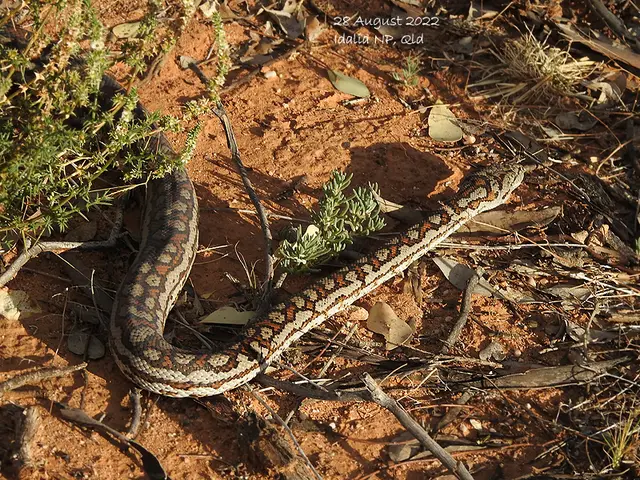
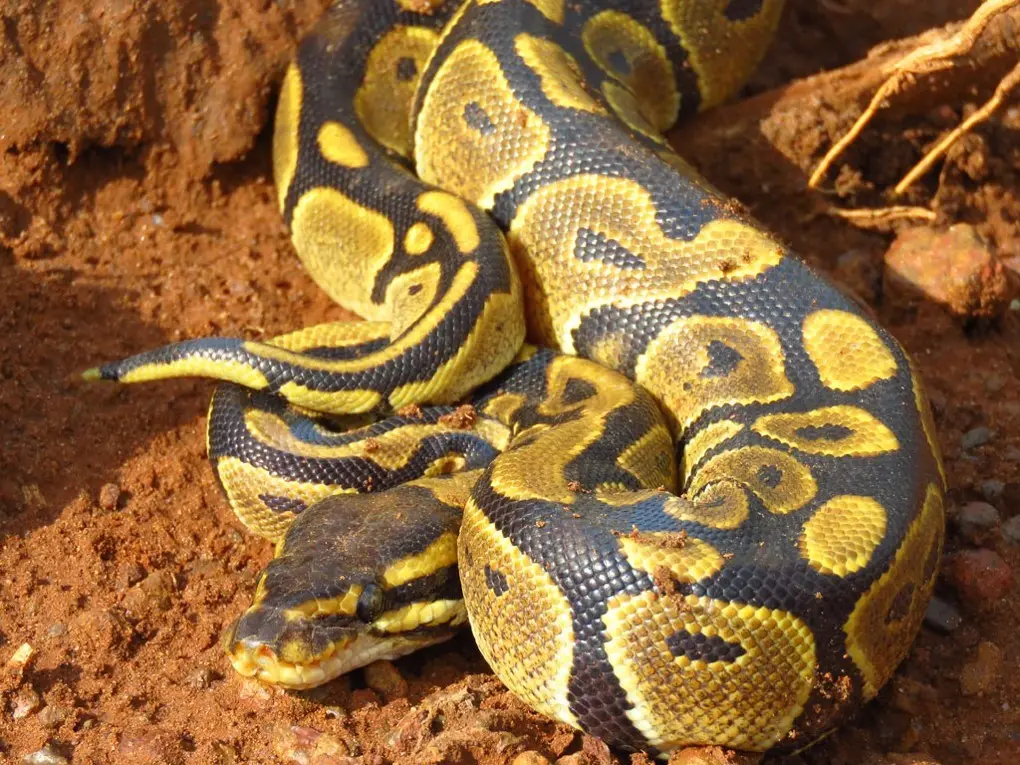
An inland carpet python is a thick-bodied snake with a broad head and a busy black, gray and silver pattern. The Victorian Government's 2021 threatened species assessment describes a dark back with pale blotches and pale sides with a dark stripe along the body. South Australian snakes can also show brown and maroon, and no two look exactly alike.
- 1Gray and black blotched pattern: pale gray or silver blotches on a dark back, often with a dark stripe along pale sides. Coastal carpet pythons tend to be olive or brown, and diamond pythons black with yellow spots.
- 2Wide head on a narrow neck: the head is clearly broader than the neck and covered in many small scales, not a few large plates.
- 3Heat pits on the lips: a row of pits along the lower jaw senses the body heat of prey. Brown snakes and other venomous snakes of the region have no such pits.
- 4Heavy, slow-moving body: the Victorian assessment calls it a slow-moving snake.
- 5Location: any carpet python found west of the Great Dividing Range in the Murray-Darling Basin is almost certainly this subspecies.
Scale counts are the same as for other carpet pythons. The Australian Reptile Online Database (AROD) gives the species 40-65 rows of scales at midbody, 240-310 belly scales, a single anal scale and 60-95 divided scales under the tail.
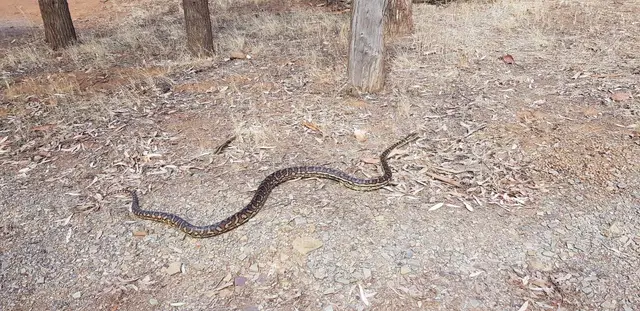
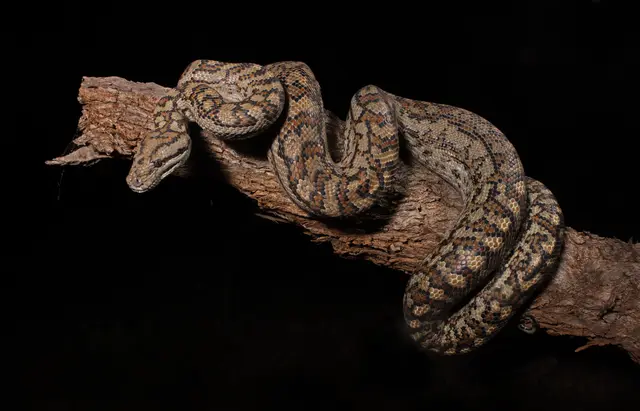
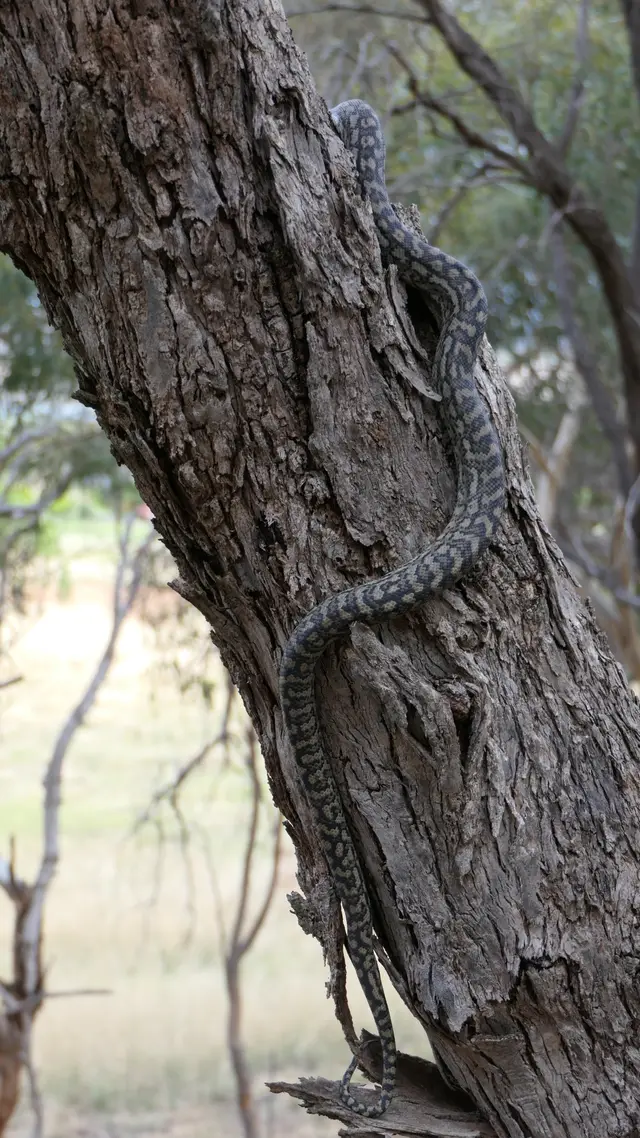
How big do inland carpet pythons get?
Inland carpet pythons grow to about 6-8 ft (1.9-2.4 m). The Victorian assessment gives up to 190 cm (6.2 ft) for snakes in that state. The South Australian board puts the usual maximum at about 2.4 m (7.9 ft), with some close to 2.7 m (8.9 ft), which makes it one of South Australia's largest snakes.
| Measure | Size | Source |
|---|---|---|
| Maximum length, Victoria | About 6.2 ft (1.9 m) | Victorian Government assessment (2021) |
| Usual maximum, South Australia | About 7.9 ft (2.4 m) | Murraylands and Riverland board (SA) |
| Largest reported, South Australia | Almost 8.9 ft (2.7 m) | Murraylands and Riverland board (SA) |
No published weight figures exist for wild inland carpet pythons.
Where do inland carpet pythons live?
Short answer: in the Murray-Darling Basin of southeastern Australia, west of the Great Dividing Range. The Reptile Database gives the range as southern Queensland, New South Wales and northern Victoria to South Australia. AROD extends it north into the Channel Country of central-western Queensland.
In Victoria it lives only north of the Great Dividing Range, mostly on the Murray River floodplain and a few rocky hills, with outlying records from the Wimmera. A 2010-2011 survey by Michael and Alexander (2015, The Victorian Naturalist) added records from granite country in the northeast, including Mount Pilot and the Warby Ranges. In South Australia it follows the River Murray.
East of the ranges live other carpet pythons: the diamond python on the New South Wales coast and the coastal carpet python farther north. Compare the ranges of Australian pythons on the world snake map.
Habitat
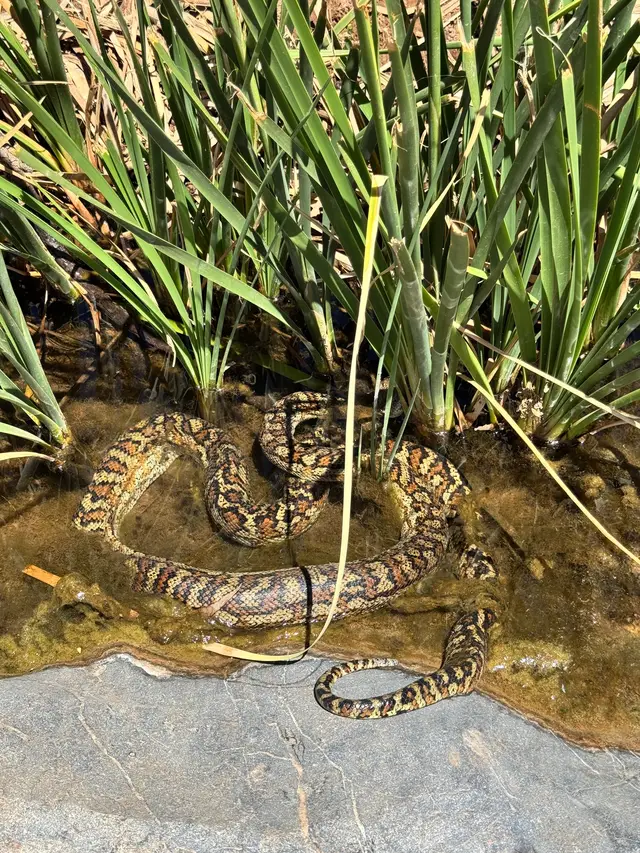
Inland carpet pythons need old trees, logs or rocks to hide in. In Victoria they live in two very different places, the assessment says: river red gum forest with black box woodland along the big rivers, and rocky hills often wooded with Blakely's red gum. A few records come from mallee.
Hollow-bearing trees and logs, large rock outcrops and thick leaf litter give the snakes places to hide, hunt and control their body temperature. They also use rabbit burrows. In South Australia, the Murraylands and Riverland board lists hollow river red gums, rocky cliffs, fallen logs and old sheds, and a state government profile notes pythons in pump sheds and roof spaces, where they eat rats and mice.
Behavior
Inland carpet pythons are mainly nocturnal ambush hunters that spend winter tucked away. The South Australian board describes a winter dormancy, called brumation, spent in rock crevices, deep burrows or tree hollows. The board also calls the snake generally timid and keen to avoid people.
Radio tracking shows how they use the land. Heard, Black and Robertson (2004, Austral Ecology) followed nine pythons around the Mount Meg Flora and Fauna Reserve in northeastern Victoria and tied their seasonal habitat use to cover and to prey, including rabbits. In a semi-arid farming area, Corey and Doody (2010, Journal of Zoology) found that inland carpet pythons had home ranges nearly five times smaller than coastal ones but moved more than three times as far each day. A healthy population lived around a homestead next to intact woodland.
What do inland carpet pythons eat?
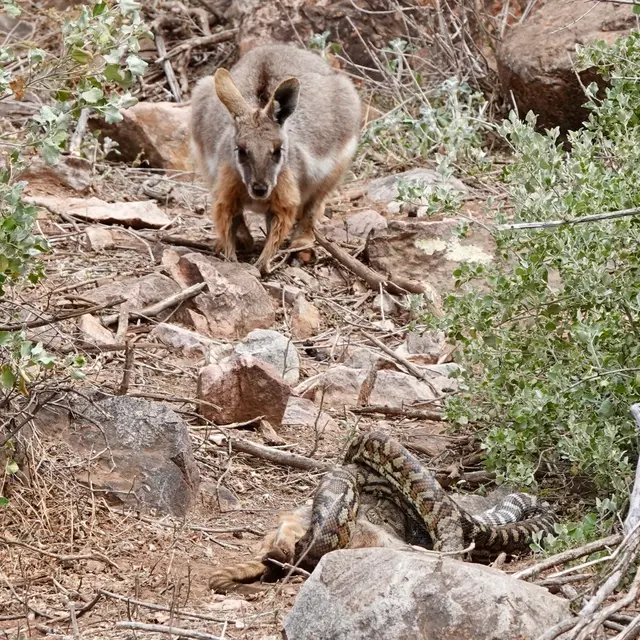
Inland carpet pythons eat mammals and birds as adults and lizards when young. The Victorian assessment says adults take small to medium-sized mammals and birds, especially birds roosting in tree hollows, and that rabbits are a major food source. Near houses they eat introduced rats and mice.
| Prey | Notes | Source |
|---|---|---|
| Rabbits | A major food source; pythons also shelter in rabbit burrows | Victorian Government assessment |
| Rats and mice | Introduced rodents, often around sheds and houses | Victorian assessment; Murraylands and Riverland board |
| Birds | Especially birds roosting in tree hollows | Victorian Government assessment |
| Lizards | Thought to be the main prey of young pythons | Victorian Government assessment |
It finds warm-blooded prey with the heat-sensing pits along its lower jaw, even in the dark, then coils around it and squeezes. Because so much of its food is introduced rabbits and rodents, the Victorian assessment notes that pest control can cut its food supply.
Is the inland carpet python venomous or dangerous?
No. The inland carpet python has no venom and is not dangerous to people. The Victorian assessment and the South Australian board both describe it as non-venomous. It kills by constriction and poses very little threat when left alone.
A defensive bite can still hurt, because pythons have many sharp, backward-curving teeth. Wash the bite with soap and water, check your tetanus protection, and see a doctor if it turns red or swollen.
The bigger risk is a wrong identification. The Murray-Darling Basin is also home to the eastern brown snake, which the Australian Museum says causes more snakebite deaths in Australia than any other species. If you are not sure a snake is a python, keep well back. If anyone is bitten by an unknown snake, call 000. Our snake venom FAQ explains why pattern is a poor guide to danger.
Inland carpet pythons are protected native wildlife. Killing one is illegal, and deliberate killing is one of the threats listed in the Victorian assessment.
Inland carpet python vs diamond python, Stimson's python and brown snakes
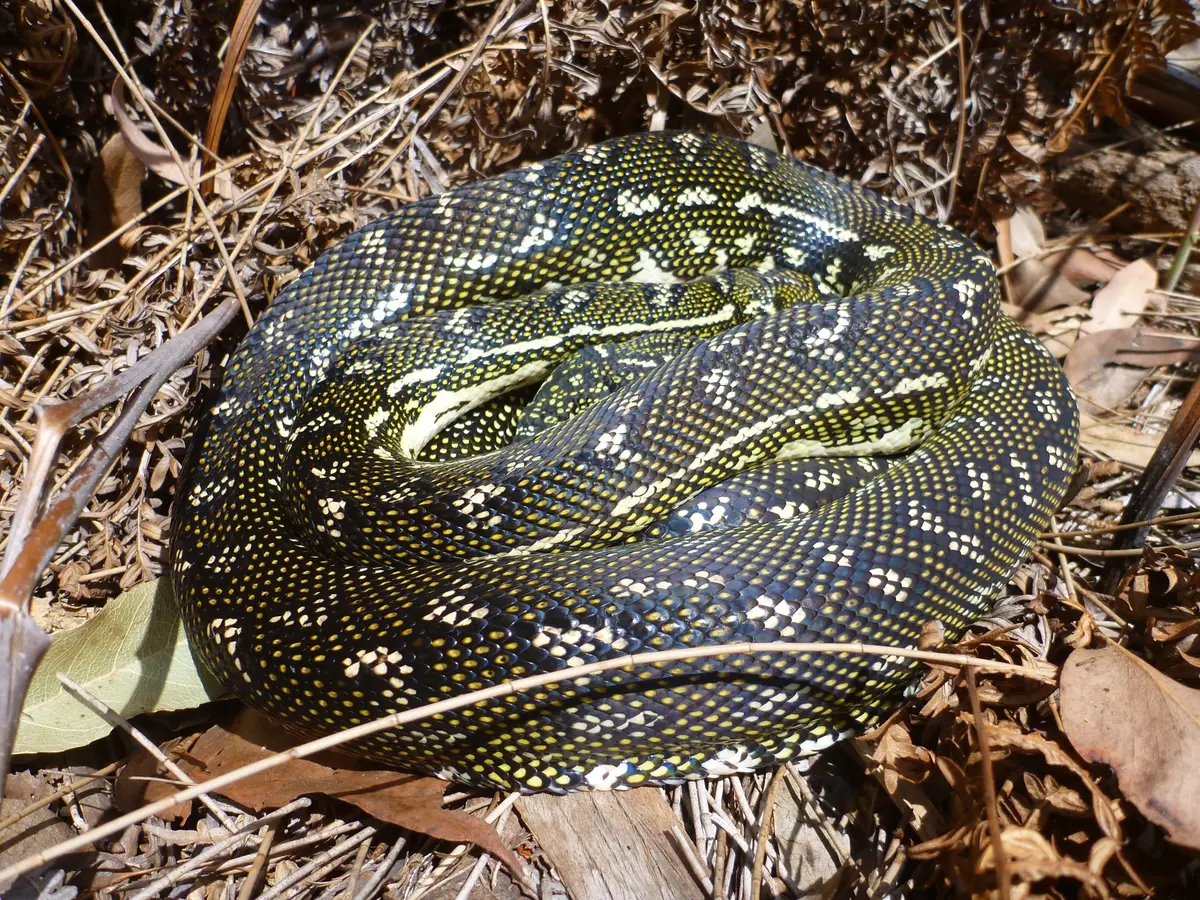
Diamond python
Morelia spilota spilota · Harmless
The carpet python subspecies of the New South Wales coast and far eastern Victoria, east of the Great Dividing Range. The diamond python is black or dark olive with cream or yellow spots grouped into diamond-like rosettes, not gray and silver blotches.
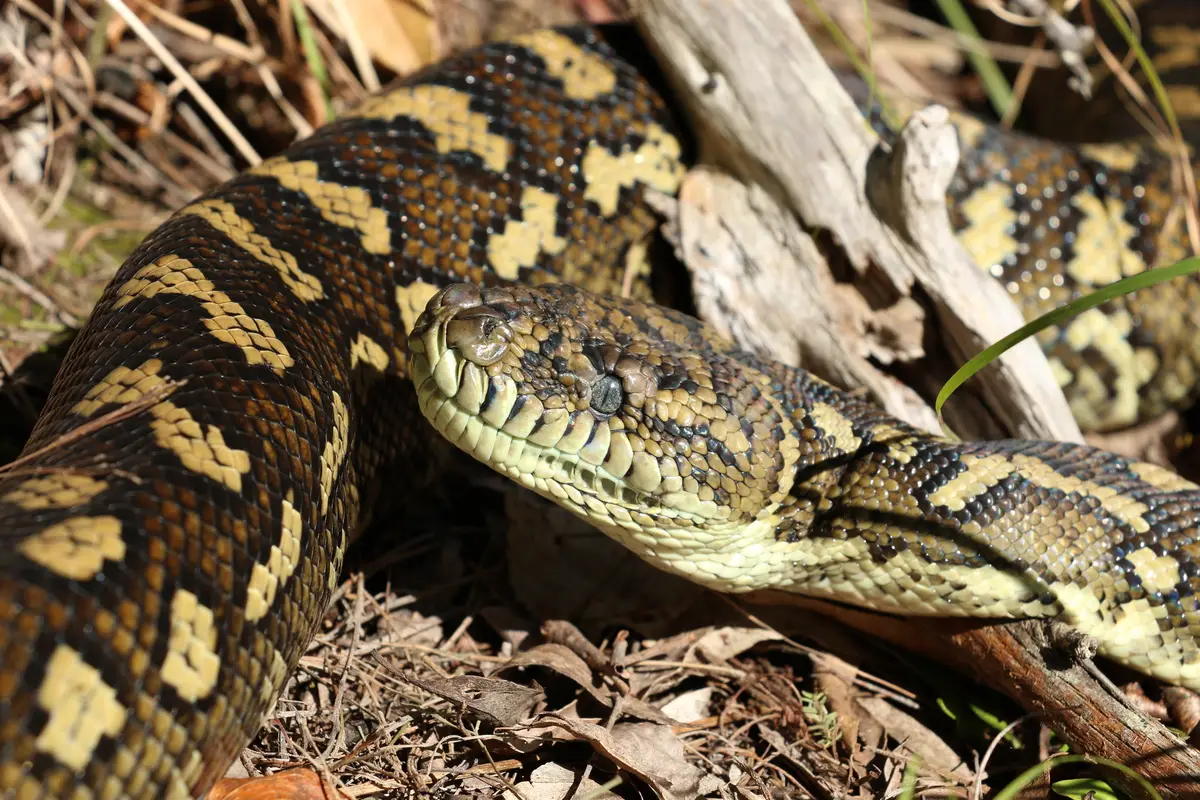
Coastal carpet python
Morelia spilota mcdowelli · Harmless
The subspecies of eastern Queensland and northeastern New South Wales. The coastal carpet python is usually olive or brown with large pale blotches and lives on the coastal side of the ranges.
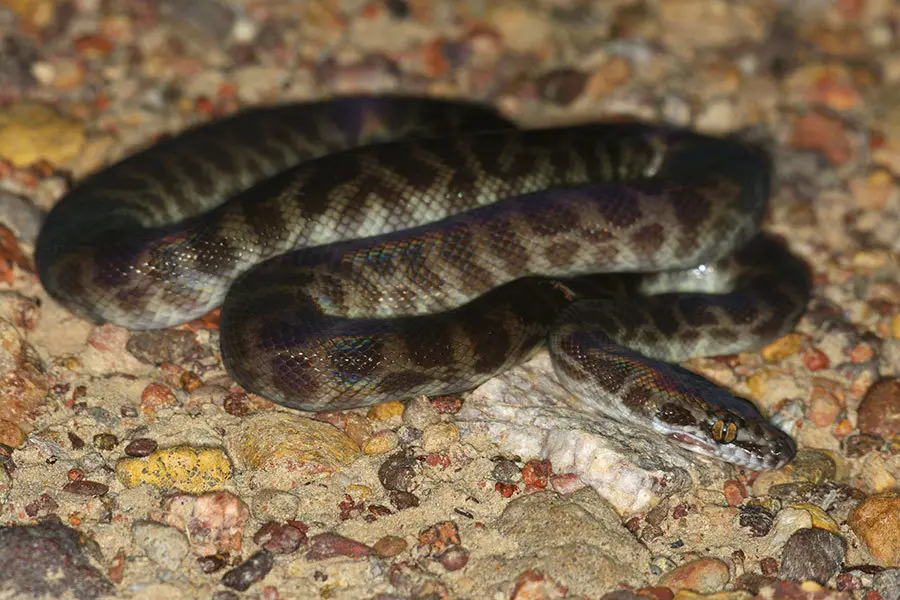
Stimson's python
Antaresia stimsoni · Harmless
A small python of arid inland Australia that reaches western New South Wales. Stimson's python averages about 30-35 in (75-90 cm), far smaller than an adult inland carpet python.
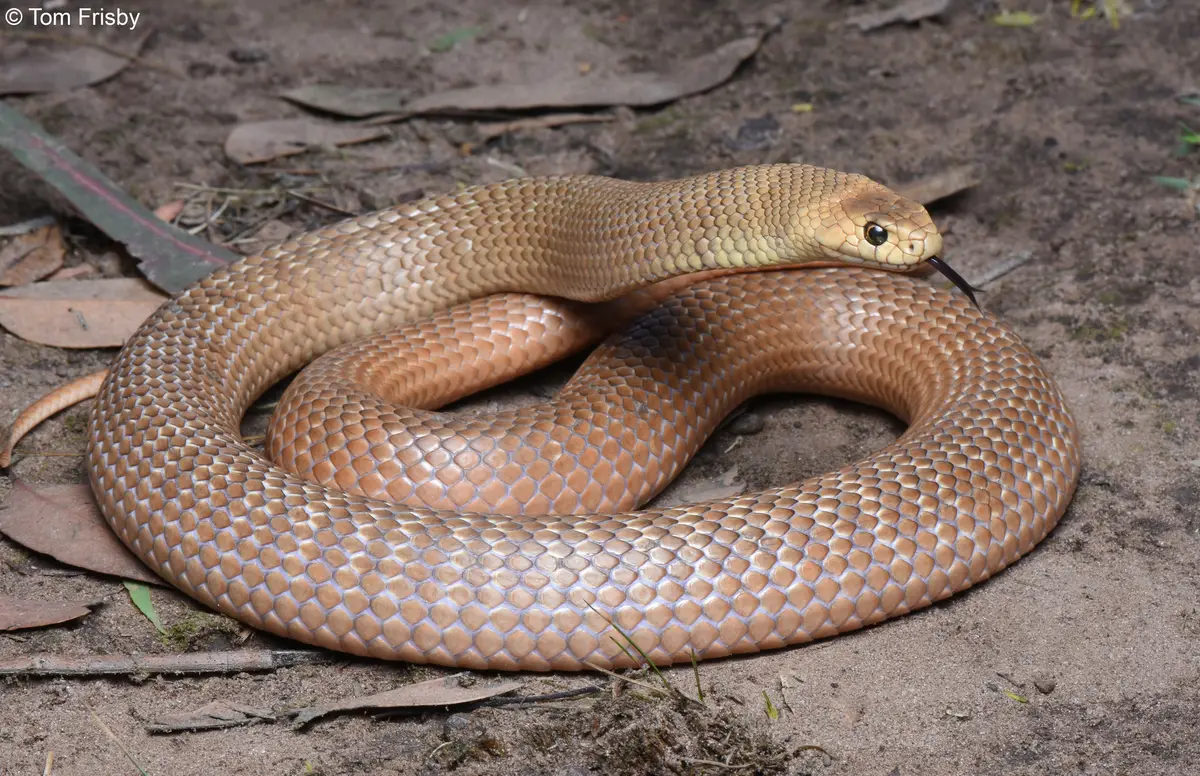
Eastern brown snake
Pseudonaja textilis · Dangerously venomous
The look-alike that matters. The Australian Museum describes a slender snake with a small head barely wider than its neck, fairly plain coloring from tan to near black, and an average length of about 5 ft (1.5 m). It has no heat pits and no blotched pattern.
Reproduction and lifespan
Inland carpet pythons breed slowly. The Victorian assessment says females in that state may breed only every third or fourth year, because it takes that long to build up the reserves needed for a clutch. Mating takes place in spring, and the eggs, about 20 on average, are laid in December or January.
The female coils around her eggs for 50-60 days, basking briefly and then shivering her muscles to keep them warm. The Victorian assessment notes that it is the only snake in Victoria that cares for its eggs. The South Australian board gives clutches of about 20-50 eggs.
The Victorian assessment assumes maturity at about 5-6 years and estimates a generation length of 10-15 years. No reliable lifespan figure for wild inland carpet pythons has been published.
Is the inland carpet python endangered?
In Victoria, yes. It is listed as threatened under the Flora and Fauna Guarantee Act 1988 and rated Endangered in the state's 2013 advisory list and 2021 assessment. South Australia lists it as rare. The carpet python species as a whole, Morelia spilota, is rated Least Concern by the IUCN, as the Reptile Database records.
| Authority | Status |
|---|---|
| IUCN Red List | Least Concern (species Morelia spilota) |
| Victoria | Threatened under the Flora and Fauna Guarantee Act 1988; Endangered (2013 advisory list, 2021 assessment) |
| South Australia | Rare |
| CITES | Appendix II, as are nearly all pythons |
The numbers in Victoria are small. The 2021 assessment estimates 500 to 1,500 mature snakes, an area of occupancy of about 431 square km (166 square miles), and a 40-70% decline over the past 30-45 years, with small, isolated populations.
The assessment lists land clearing, heavy grazing, firewood collection, fires that strip the understory, changed river flooding, road deaths, illegal killing and collecting, and predation by foxes, feral cats and pigs. Heard and colleagues (2006, The Victorian Naturalist) flagged fox and dog predation as a possibly serious threat. For northeastern Victoria, Michael and Alexander (2015) recommend small, low-intensity burns in late autumn.
In South Australia, the iSPYthon citizen science project collects sightings, and landholders are asked to leave fallen logs and dead hollow trees in place.
Is the inland carpet python a real subspecies?
It is accepted as one for now. Wells and Wellington described it in 1985 as a full species, Morelia metcalfei, named for Sydney herpetologist Dean Carlyle Metcalfe, according to AROD. The Reptile Database lists it as a carpet python subspecies, and AROD notes that the status of all the subspecies is unsettled. Relatives include the jungle carpet python of north Queensland and the separate species Bredl's python of central Australia.
Inland carpet python FAQ
Is the inland carpet python venomous?
No. The inland carpet python has no venom and kills its prey by constriction. The Victorian Government and South Australia's Murraylands and Riverland board both describe it as non-venomous. A bite from its sharp teeth can still draw blood, so wash it well and check your tetanus protection. If you cannot identify the snake, treat the bite as venomous and call 000.
How big does an inland carpet python get?
Most adults grow to about 6-8 feet (1.9-2.4 m). The Victorian Government gives up to 190 cm (6.2 ft) for snakes in that state, while the South Australian Murraylands and Riverland board gives about 2.4 m (7.9 ft) and says a few reach almost 2.7 m (8.9 ft). That makes it one of South Australia's largest snakes.
Where does the inland carpet python live?
It lives in the Murray-Darling Basin of southeastern Australia, west of the Great Dividing Range. The Reptile Database gives its range as southern Queensland, New South Wales and northern Victoria to South Australia. It favors river red gum forest along the Murray and its tributaries, and rocky granite hills with hollow trees, logs or crevices for shelter.
What is the difference between an inland carpet python and a diamond python?
They are subspecies of the same species, Morelia spilota, separated by the Great Dividing Range. The diamond python lives on the New South Wales coast and far eastern Victoria and is black with yellow spots in diamond-like clusters. The inland carpet python lives west of the ranges in the Murray-Darling Basin and is mostly gray, silver and black.
Is the inland carpet python endangered?
In Victoria, yes. It is listed as threatened under the Flora and Fauna Guarantee Act 1988 and rated Endangered, with an estimated 500 to 1,500 mature snakes left in the state. South Australia lists it as rare. The carpet python species as a whole is rated Least Concern by the IUCN, so the decline is regional.
What does an inland carpet python eat?
Adults eat small to medium-sized mammals and birds, and young snakes are thought to eat mostly lizards. The Victorian Government lists rabbits as a major food source, and around homes the pythons eat introduced rats and mice. They find warm prey in the dark with heat-sensing pits on the lower jaw.
Related snakes
Sources
- Victorian Government (DELWP) Threatened Species Assessment: Morelia spilota metcalfei, Carpet Python (9 June 2021)
- Reptile Database: Morelia spilota, including subspecies metcalfei
- Australian Reptile Online Database: Carpet python (Morelia spilota) and subspecies
- South Australian Government, Murraylands and Riverland board: 10 things you might not know about the Murray-Darling carpet python
- Corey and Doody (2010). Anthropogenic influences on the spatial ecology of a semi-arid python. Journal of Zoology 281: 293-302
- Michael and Alexander (2015). Records of the inland carpet python in north-east Victoria. The Victorian Naturalist 132(2): 36-43
- Australian Museum: Eastern brown snake