ANGOLANPYTHON
Python anchietae · Family Pythonidae
KEY TAKEAWAYS
The Angolan python is a small, non-venomous python that lives among rocky hills and dry bush in southern Angola and northern Namibia. It is also called Anchieta's dwarf python. It is harmless to people, calm by python standards, and rarely seen in the wild.
- Adults average about 4 ft (1.2 m) and reach roughly 6 ft (1.8 m), so it is one of Africa's smallest pythons.
- It is not venomous. It kills rodents and birds by constriction, like its close relative the ball python.
- It is the only python with small, bead-like scales covering the top of its head.
- The IUCN lists it as Least Concern, but it is legally protected in Namibia and still poached for the pet trade.
Angolan python quick facts
| Common name | Angolan python (also Anchieta's dwarf python, escarpment python) |
|---|---|
| Scientific name | Python anchietae Bocage, 1887 |
| Family | Pythonidae (pythons) |
| Venomous | No, a constrictor |
| Adult length | Average about 4 ft (1.2 m); maximum about 6 ft (1.8 m) |
| Weight | About 1.9-5.4 lb (0.85-2.5 kg) in adults measured by Jauch (2009) |
| Range | Southern Angola and northern Namibia |
| Habitat | Rocky outcrops, rugged hills and riverine bush in dry country |
| Diet | Rodents and birds |
| Reproduction | Lays eggs, usually 3-6 per clutch |
| Lifespan | Over 17 years; zoos give 20-30 years |
| Conservation | IUCN Least Concern (2021); CITES Appendix II; protected in Namibia |
How to identify an Angolan python
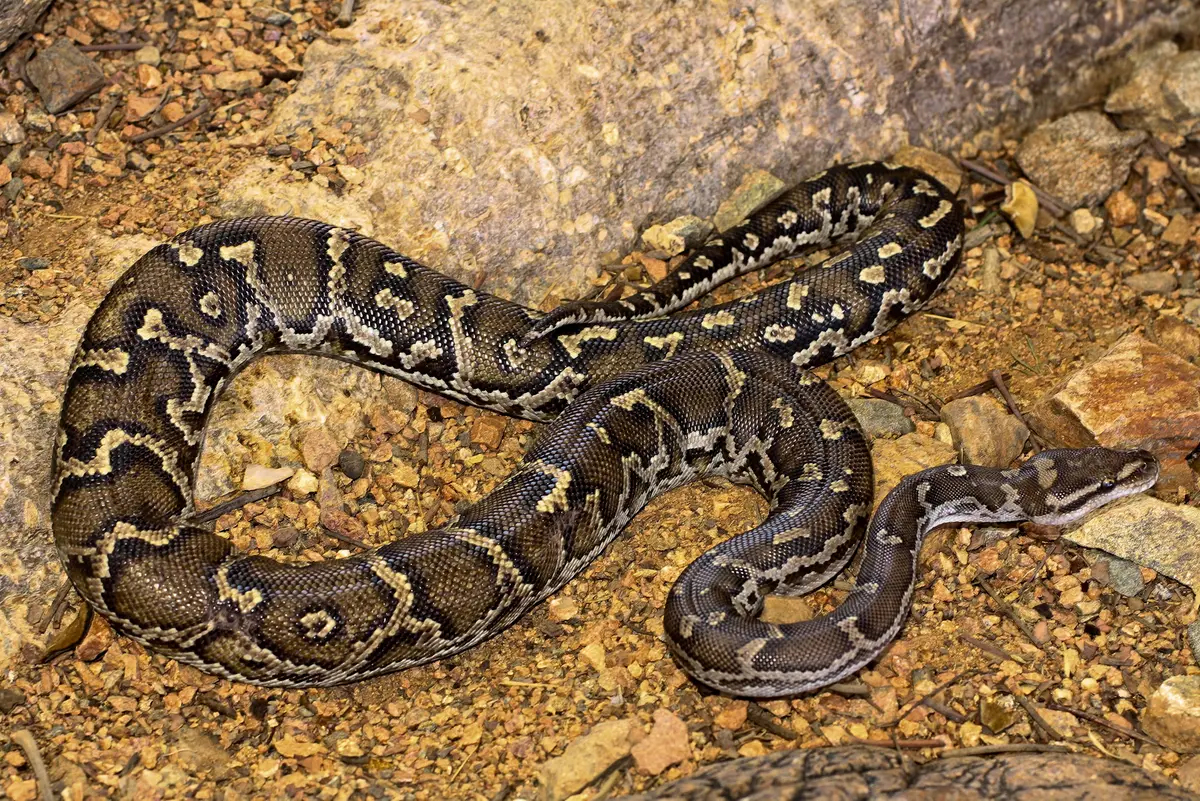
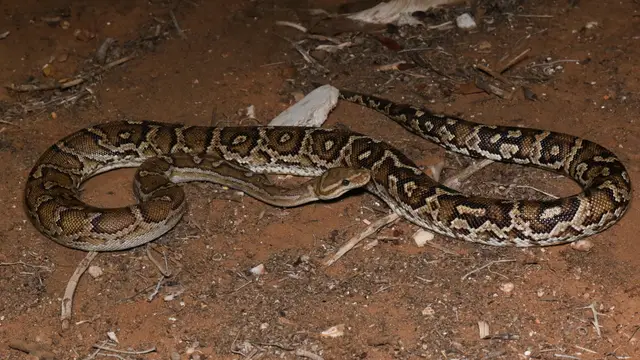
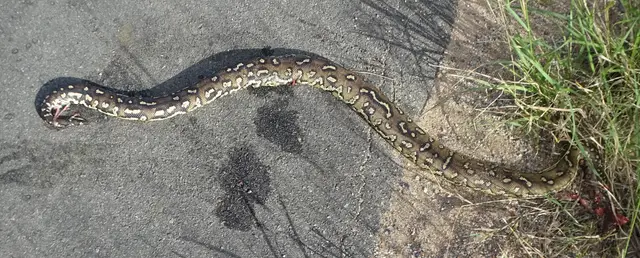
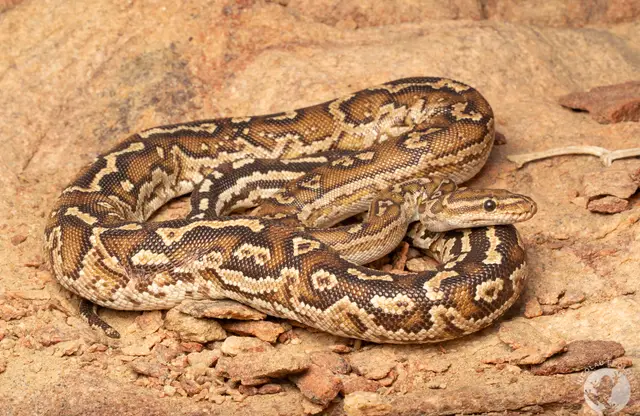
Look at the head first. The Angolan python is the only python whose crown is covered in small, rounded, bead-like scales instead of large plates, a feature noted by J. M. Mehrtens in Living Snakes of the World (1987). The body is reddish brown, brown or nearly black, broken by irregular white or cream bands and spots, and the belly is yellowish.
- 1Beaded head scales: fine, granular scales on top of the head, unlike the larger head shields of other African pythons.
- 2Reddish-brown to dark body: a ground color from rusty red-brown to almost black, darker in some snakes than others.
- 3Ragged cream bands: irregular pale bands and spots, often edged with dark scales, that do not form a neat repeating pattern.
- 4Heat pits on the lips: five heat-sensing pits along each side of the upper lip, used to find warm-blooded prey.
- 5Small and stocky: a short, solid python, rarely over 5 ft, with smooth body scales in 57-61 rows (Branch, 2004).
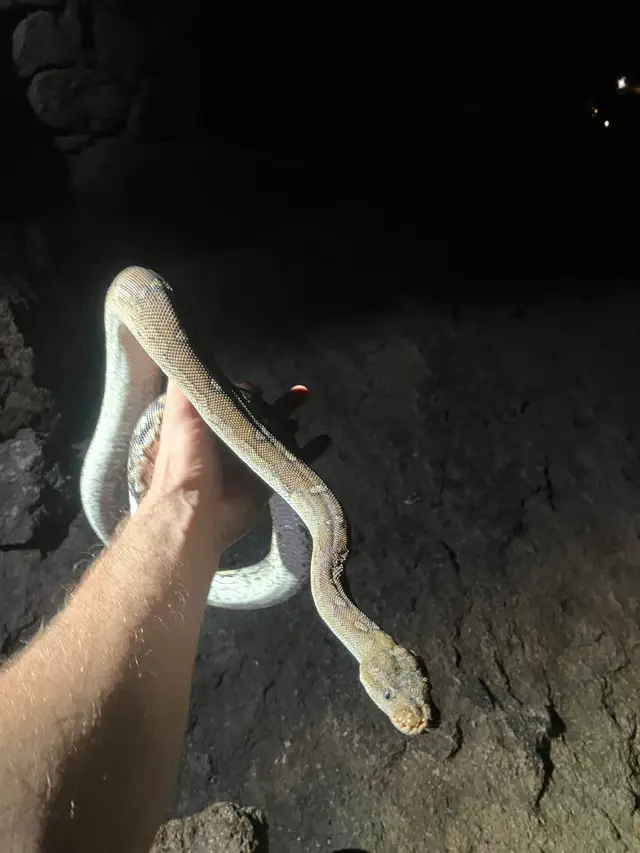
Hatchlings are boldly marked. A photo of a hatchling in Herbert Jauch's 2009 paper in African Herp News shows a dark head with pale stripes and strong contrast, and young snakes are about 17-20 in (43-51 cm) long when they leave the egg.
How big do Angolan pythons get?
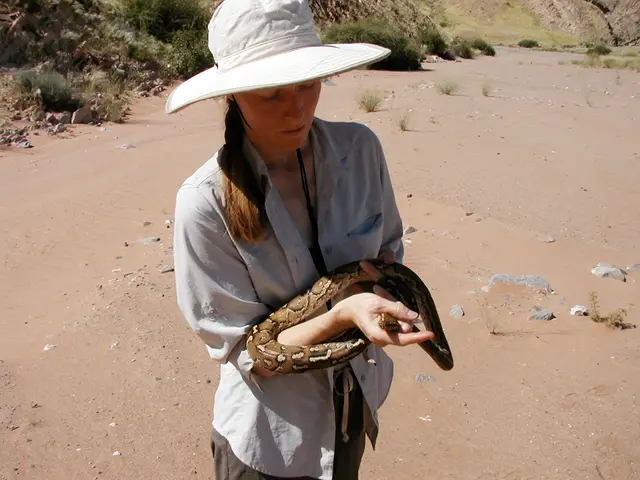
Most Angolan pythons are about 4 ft (1.2 m) long. The African Snakebite Institute gives an average of 1.2 m and a maximum of around 1.8 m (6 ft). That makes it far smaller than the African rock python, which is usually 10-16 ft (3-5 m) long.
The best weights come from a captive group in Windhoek described by Jauch (2009). The wild-caught snakes, collected in 1996 and 1997, included a male of 110 cm (3.6 ft) weighing 850 g (1.9 lb) and four females of 130-150 cm (4.3-4.9 ft) weighing 1,180-1,300 g (2.6-2.9 lb). After ten years in captivity the females had grown to 155-160 cm and 2,190-2,463 g (4.8-5.4 lb), while the males reached 130-140 cm and 1,356-1,944 g. Females are the larger sex.
| Life stage | Length | Weight | Source |
|---|---|---|---|
| Hatchling | 17-20 in (43-51 cm) | About 2.4 oz (67-69 g) | Patterson and Erasmus (1978); Jauch (2009) |
| Three years old (captive) | 3.2-3.5 ft (98-108 cm) | 0.9-1.3 lb (419-608 g) | Jauch (2009) |
| Typical adult | About 4 ft (1.2 m) | About 2-3 lb (0.85-1.3 kg) | African Snakebite Institute; Jauch (2009) |
| Large adult | Up to about 6 ft (1.8 m) | Up to about 5.4 lb (2.5 kg) | Mehrtens (1987); Jauch (2009) |
Where do Angolan pythons live?
Short answer: only in southern Angola and northern Namibia. The Reptile Database gives the range as southern Angola and northern Namibia, and lists the type locality as Catumbela, near Lobito on the Angolan coast.
In Namibia the range reaches south to the Windhoek area, which Jauch (2009) describes as the southern edge of the species' range. The Virginia Zoo puts it at elevations of roughly 2,460-5,250 ft (750-1,600 m). Winters are cold: in Windhoek, nights from June to August occasionally fall to freezing (Jauch, 2009). See how its range compares with other pythons on the world snake map.
Habitat
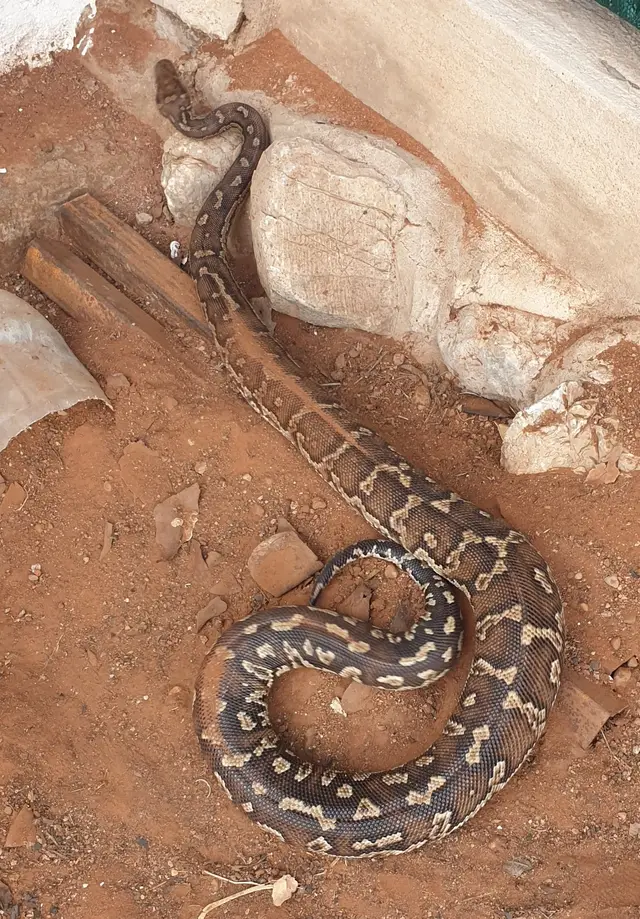
The Angolan python is a snake of rocks. A 2002 account by P. L. Cunningham and S. Hebbard in African Herp News, citing Bill Branch's field guide, describes its habitat as rugged, dry, rocky sandveld and riverine vegetation. The African Snakebite Institute lists riverine bush and rugged rocky ground in Namibia.
It lives on rocky outcrops and rock-strewn slopes in open bush or grassland, and it shelters in small caves, overhangs and crevices. In captivity it chooses the same kind of spot: one of Jauch's females ignored a prepared nest box and laid her eggs under a flat rock.
Are Angolan pythons aggressive?
No. The African Snakebite Institute calls it a placid snake, and Jauch (2009) describes it as fairly docile and easy to keep. A disturbed snake may hiss loudly, but that hiss is mostly bluff. The main exception is a female guarding eggs: Jauch reports that a brooding female was ready to strike at anything that came near.
Its daily rhythm follows the weather. Jauch's snakes, kept in an outdoor enclosure in Windhoek, became active after sunset in hot summer months, when days reached 35 C (95 F). After heavy summer rain they basked in daylight, and on cloudy days they came out in the late afternoon. On very hot days some lay in their water bowl, apparently to cool off.
In winter Jauch kept his snakes at 14-24 C (57-75 F). The group tolerated night temperatures as low as 12 C (54 F), and Jauch found that a cool winter followed by warming in August was needed before the snakes would breed.
What do Angolan pythons eat?
Angolan pythons eat warm-blooded prey, mainly rodents and birds, according to the African Snakebite Institute. Like other pythons, they strike, grab the prey with backward-curving teeth, then coil around it and squeeze until it stops breathing. The heat pits on the lips let them sense warm prey in the dark.
| Prey group | Examples | How often |
|---|---|---|
| Rodents | Mice, rats and other small rodents of rocky hills | Main prey |
| Birds | Small birds | Regular |
In captivity they take mice and rats readily, alive or dead. Hatchlings can be fussy: the young from a 2001 clutch at Swakopmund Snake Park had to be force-fed at first, while Jauch's 2005 hatchlings took small mice soon after their first shed.
Is the Angolan python venomous or dangerous?
No. The Angolan python has no venom and is harmless to people. The African Snakebite Institute classes it as harmless because of its small size and calm nature. A bite from a cornered snake can break the skin, so clean any bite with soap and water.
Where it lives, it shares rocky hills with venomous snakes, and a brown snake under a rock is not always a python. Do not handle wild snakes in Angola or Namibia unless you are sure what they are. Our snake venom FAQ explains why body shape alone is a poor guide.
Angolan python vs ball python and other look-alikes
Donald Broadley (1990) considered the Angolan python's closest relative to be the ball python of West and Central Africa. The two are similar in size and shape, but they live thousands of miles apart. In the wild, the snake most likely to be mistaken for an Angolan python is a young Southern African python.
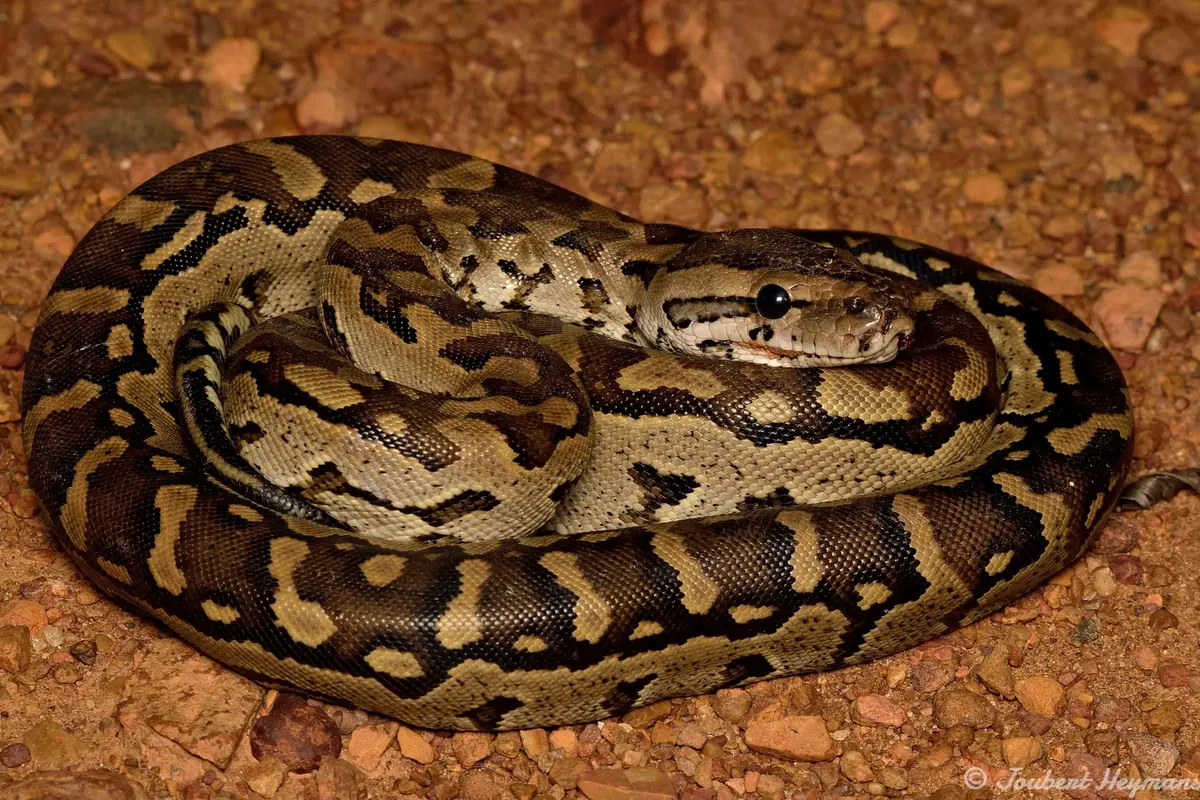
Southern African python
Python natalensis · Harmless
Shares parts of the range in Namibia and Angola. It grows far larger as an adult, and it lacks the fine, bead-like scales that cover the Angolan python's crown. A small one is best left for an expert to identify.
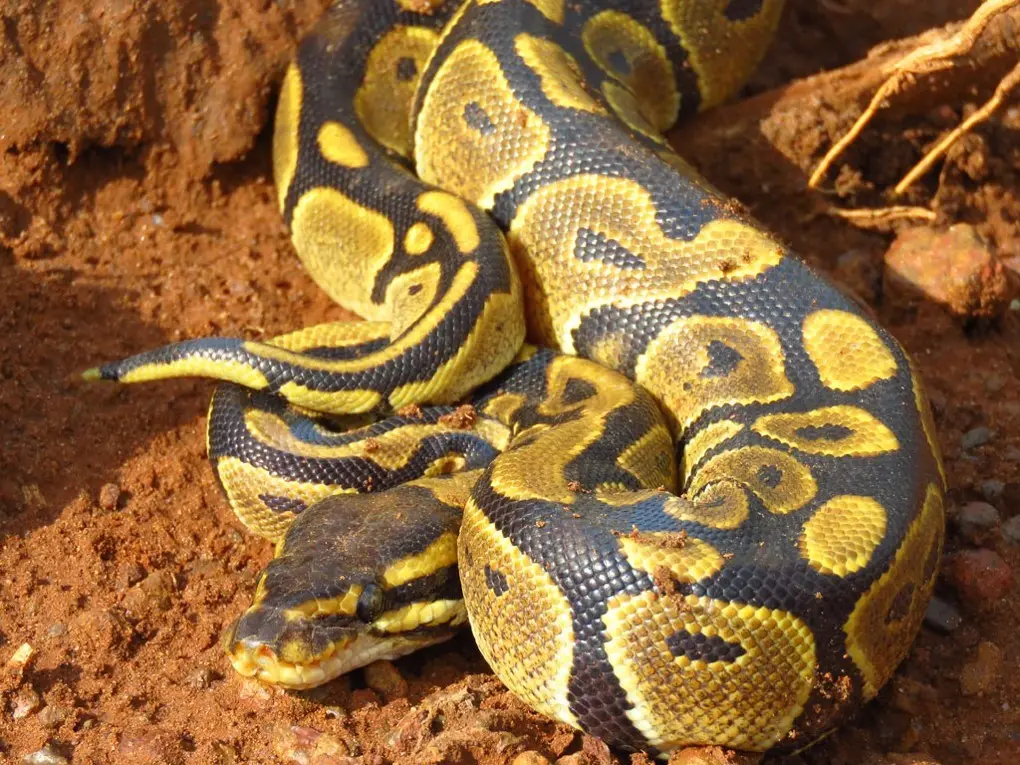
Ball python
Python regius · Harmless
A close relative from West and Central Africa, not found in Angola or Namibia. The ball python has normal head plates and a black or dark brown body with rounded tan blotches.
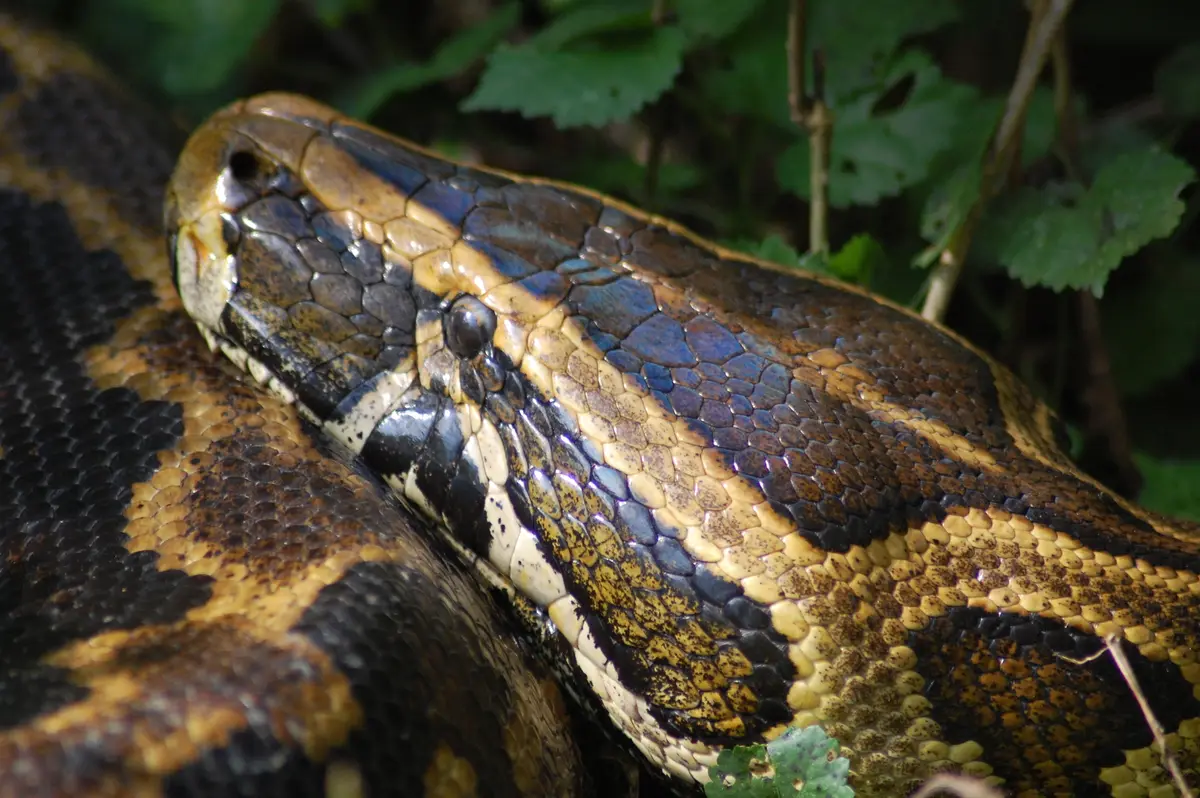
African rock python
Python sebae · Harmless
A giant from West and Central Africa. The African rock python has a dark spearhead mark on top of the head and is usually 10-16 ft long, several times the length of an Angolan python.
Reproduction and lifespan
Angolan pythons lay eggs in early summer. In Jauch's captive group, mating took place between August and October and eggs were laid from November to January. Clutches were small, with three to six eggs. The African Snakebite Institute gives a wider range of 3-10 eggs, and a wild-caught female collected in northwestern Namibia in 1971 laid five eggs in December (Patterson and Erasmus, 1978).
The eggs are large for such a small snake. Jauch measured eggs from 55 to 98 mm long, about 2-4 in. The female coils around them, and one female kept returning to her empty nest spot after her eggs were moved to an incubator.
| Clutch | Eggs | Incubation | Hatchlings |
|---|---|---|---|
| Wild-caught female, 1971 | 5 | 68-70 days at 28-30 C | 4, 428-465 mm |
| Swakopmund Snake Park, 2001 | 4 | 92-94 days at about 28 C | 2, 490 and 510 mm |
| Jauch, Windhoek, 2004 | 6 | 57-59 days at 30-33 C | 4, 48-51 cm |
Breeding in captivity is hard. A program at the Transvaal Snake Park in South Africa started in 1986 produced no young despite several matings, and Jauch's group took until 2004 to produce live hatchlings. Jauch found that eggs did best at a steady 30-33 C (86-91 F).
How long do Angolan pythons live?
The Virginia Zoo gives a lifespan of 20 to 30 years. Jauch's breeding adults were caught as adults and kept for 10 to 12 years, so they were likely well over 17 years old when they stopped producing fertile eggs.
Is the Angolan python endangered?
No. The IUCN Red List rates the Angolan python Least Concern in a 2021 assessment by Ninda Baptista and colleagues. Like all pythons, it is on CITES Appendix II, so international trade needs permits.
| Authority | Status |
|---|---|
| IUCN Red List | Least Concern (2021) |
| CITES | Appendix II (trade regulated by permit) |
| Namibia | Legally protected |
Rarity makes it valuable. Jauch (2009) reports that captive-bred Angolan pythons sold for about US$10,000 in the late 1990s and about US$2,000 by 2009, as more captive-bred snakes became available. Because of strict protection in Namibia, the species is not bred commercially there. The African Snakebite Institute notes that it is still poached and smuggled out of the country for the pet trade, which the Virginia Zoo names as the species' main threat.
Angolan python FAQ
Is the Angolan python venomous?
No. The Angolan python has no venom and kills its prey by constriction. The African Snakebite Institute classes it as harmless to people because it is small and placid. A cornered snake may hiss and could bite, but the bite is only a minor wound. Clean it with soap and water and watch for infection.
How big do Angolan pythons get?
Most Angolan pythons are about 4 feet (1.2 m) long, and the largest reach about 6 feet (1.8 m). Females are bigger than males. Adults in one Namibian captive group weighed 1.9 to 5.4 pounds (0.85 to 2.5 kg), with females at the top of that range after ten years in captivity.
Where do Angolan pythons live?
Angolan pythons live only in southern Angola and northern Namibia. They are found on rocky outcrops, rugged hills and in riverine bush, at roughly 2,460 to 5,250 feet (750 to 1,600 m) above sea level. In Namibia the range reaches south to around Windhoek. They shelter in caves, crevices and under overhanging rocks.
Why is it called Anchieta's dwarf python?
The species was named Python anchietae by the Portuguese zoologist José Vicente Barbosa du Bocage in 1887, after José de Anchieta, a Portuguese naturalist who collected animals in Angola. "Dwarf" refers to its small size: at about 4 feet, it is one of the smallest pythons in Africa.
Is the Angolan python related to the ball python?
Yes. The herpetologist Donald Broadley considered the ball python of West and Central Africa its closest relative. The two snakes are similar in size and build, but the Angolan python has bead-like head scales and lives far to the south, in Angola and Namibia, while ball pythons never occur there.
Why are Angolan pythons so rare?
They have a small range in remote, rocky parts of Angola and Namibia, they are seldom seen in the wild, and they are hard to breed in captivity. Namibia protects the species strictly, so few legal snakes reach the trade. Captive-bred snakes sold for about US$10,000 in the late 1990s and about US$2,000 in 2009.
How many eggs does an Angolan python lay?
Usually three to six eggs, laid between November and January. The African Snakebite Institute gives a range of 3 to 10. The eggs are large, up to about 4 inches long, and hatch after roughly 57 to 94 days depending on temperature. Hatchlings are about 17 to 20 inches (43 to 51 cm) long.
Related snakes
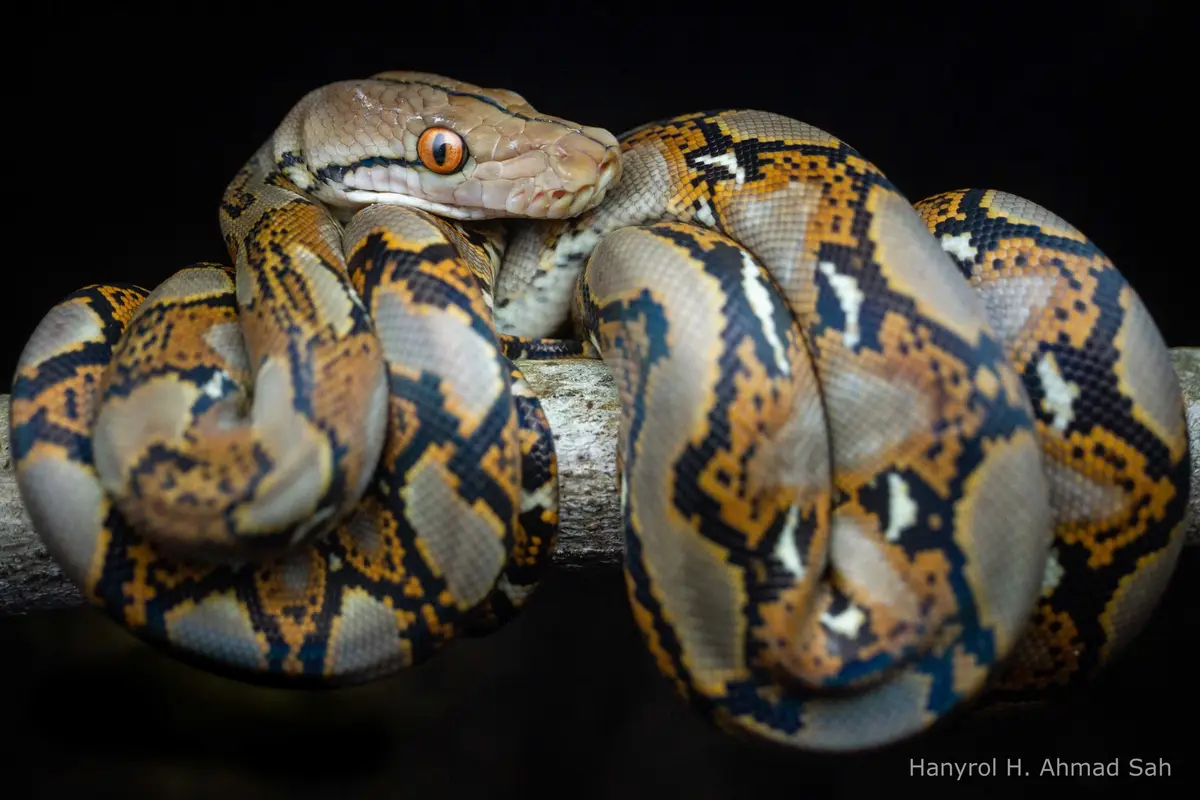
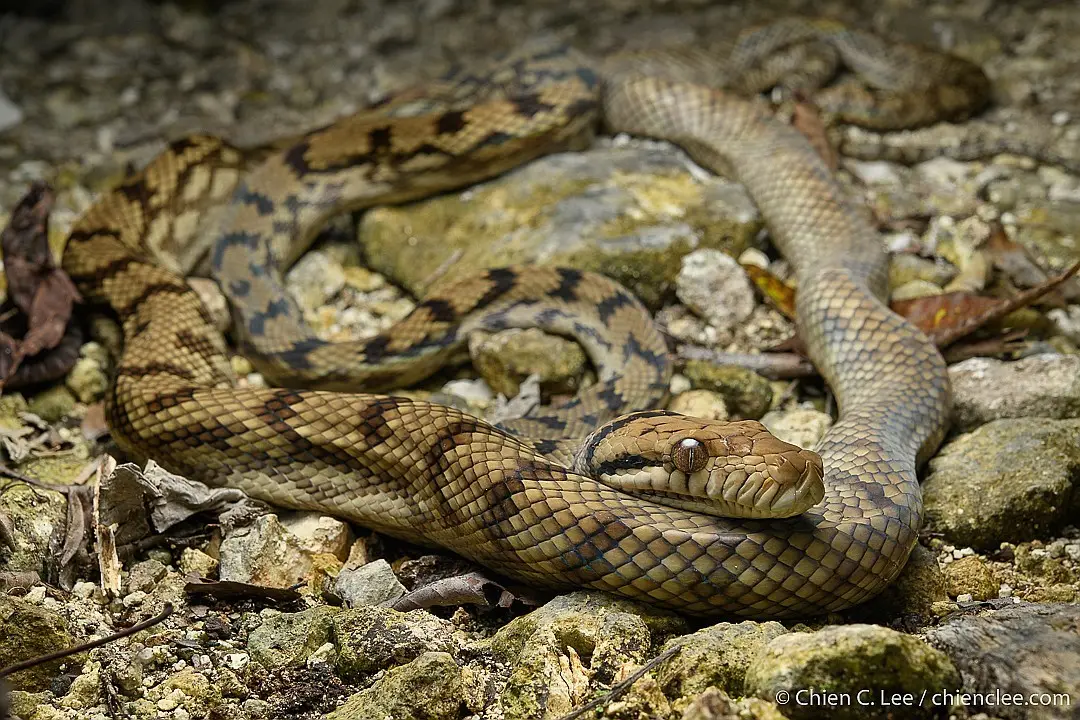
Sources
- Reptile Database: Python anchietae
- Baptista, N. et al. (2021). Python anchietae. The IUCN Red List of Threatened Species 2021: e.T177539A120594491
- Jauch, H. (2009). Captive propagation of Python anchietae in Namibia. African Herp News 48: 8-14
- Cunningham, P. L. and Hebbard, S. (2002). Python anchietae, Angola or Anchieta's dwarf python. African Herp News 35: 8-9
- African Snakebite Institute: Anchieta's dwarf python
- Virginia Zoo: Angolan python
- Wikipedia: Python anchietae (for Mehrtens 1987, Branch 2004 and Broadley 1990 citations)
- iNaturalist: Python anchietae (photos, observations)