BALLPYTHON
Python regius · Family Pythonidae
KEY TAKEAWAYS
The ball python is a small, harmless constrictor from the grasslands and open woodland of West and Central Africa, and the smallest of Africa's pythons. It has no venom, it rarely bites, and when frightened it rolls into a tight ball with its head hidden in the middle, which is how it got its name.
- Adults are usually 3-5 ft (1-1.5 m) long; the largest wild records reach about 6 ft (1.8 m).
- It is not venomous and kills prey by constriction. A bite from a pet ball python is a row of small pinpricks.
- Captive ball pythons often live 20 years or more. A female at the Saint Louis Zoo laid eggs at 62 years old.
- The IUCN Red List moved it to Near Threatened in 2021, mainly because of collection for the pet trade.
Ball python quick facts
| Common names | Ball python, royal python |
|---|---|
| Scientific name | Python regius (Shaw, 1802) |
| Family | Pythonidae (pythons) |
| Venomous | No, a constrictor |
| Adult length | 3-5 ft (1-1.5 m); wild record about 6 ft (1.8 m) |
| Weight | Wild adults up to about 3.5 lb (1.6 kg) |
| Range | West and Central Africa, Senegal east to South Sudan and Uganda |
| Habitat | Savanna, grassland, open forest and farmland |
| Diet | Rodents for adults; birds for many young snakes |
| Reproduction | Lays eggs, 1-11 per clutch (average about 7) |
| Lifespan | About 10 years wild; 20+ years in captivity |
| Conservation | IUCN Near Threatened; CITES Appendix II |
How to identify a ball python
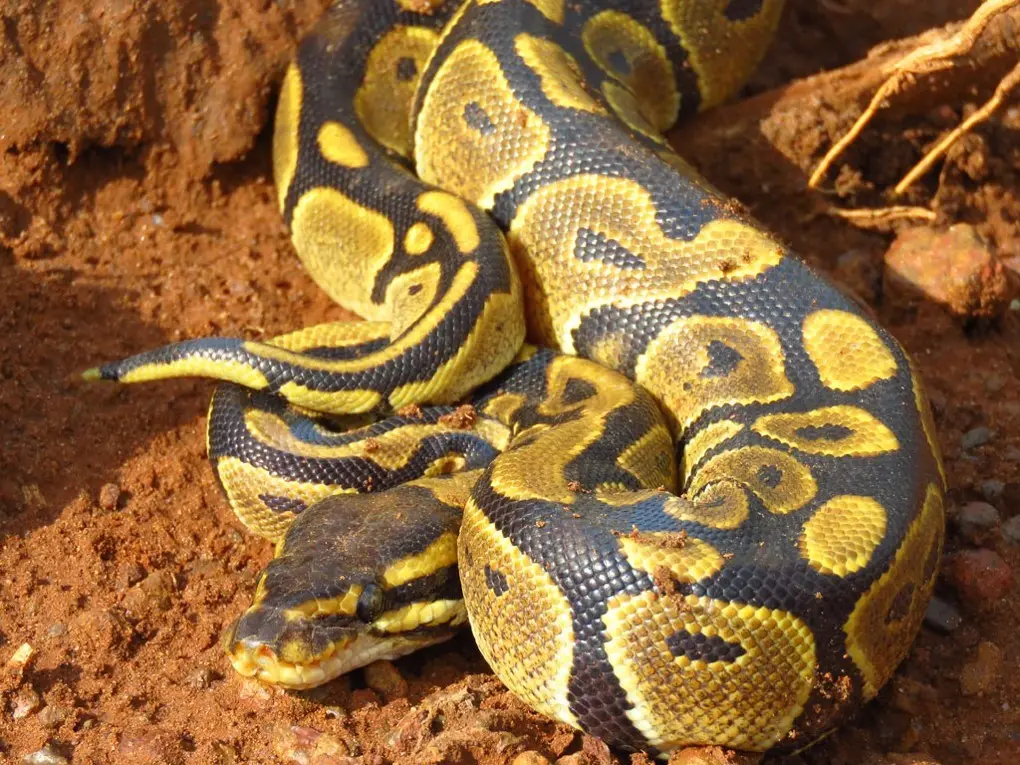
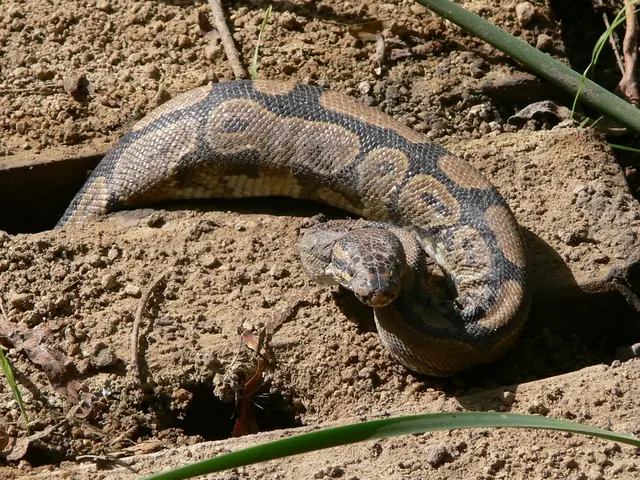
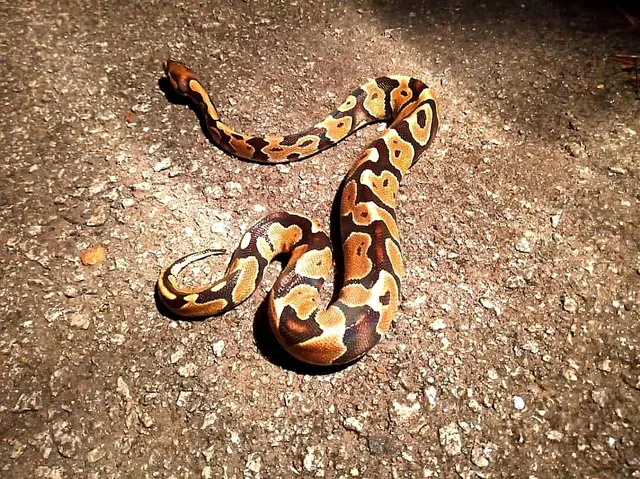
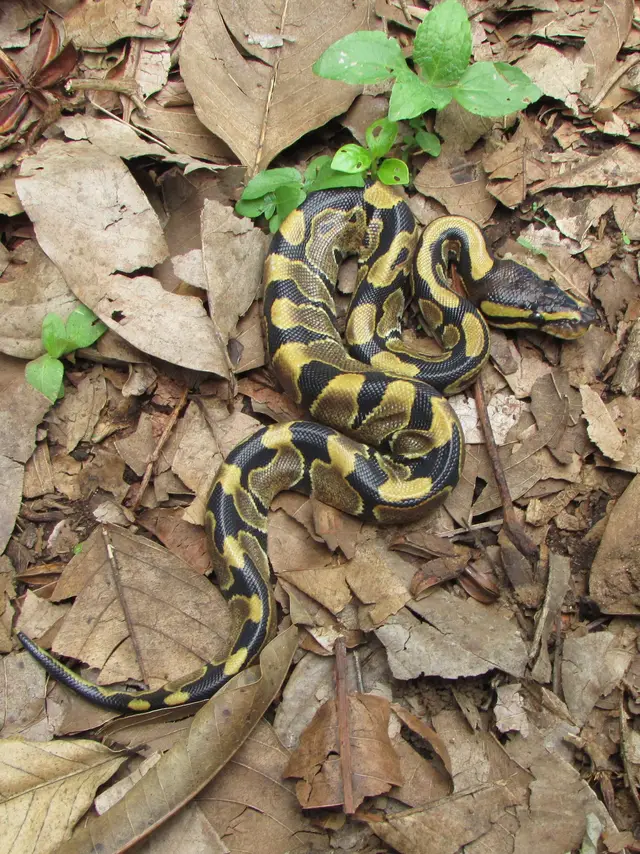
A wild-type ball python is a short, thick snake with a small head and a dark brown or black body covered in rounded tan to golden-brown blotches. It looks stocky for its length. Pet snakes come in thousands of color forms, so the shape and behavior are often better clues than the pattern.
- 1Body shape: heavy and muscular, with a short tail. Even a 3 ft (0.9 m) adult feels solid in the hand.
- 2Pattern: dark brown to black background with irregular, light-edged tan blotches along the back and sides, and a pale, mostly unmarked belly.
- 3Head: small and rounded, only slightly wider than the neck.
- 4Heat pits: a row of small pits in the scales along the lips. These sense the body heat of warm prey.
- 5Defensive ball: when grabbed or cornered it coils into a tight ball and tucks its head inside instead of striking.
How big do ball pythons get?
Most adult ball pythons are 3 to 5 feet (1 to 1.5 m) long, and very few pass 6 feet (1.8 m). Animal Diversity Web gives 1 to 1.5 m for adults, with wild reports of 1.83 m. Zoo New England gives a typical range of 36 to 48 inches and calls it the smallest of the African pythons. Compare that with the boa constrictor, which often reaches 6.5 to 10 feet.
Females grow a little larger than males. In a study of wild-caught snakes published in the Journal of Herpetology (Aubret and colleagues, 2005), the heaviest female weighed about 3.6 lb (1.64 kg) and the heaviest male about 3.4 lb (1.56 kg). Captive snakes that are fed heavily can weigh more than wild ones.
| Life stage | Length | Weight |
|---|---|---|
| Hatchling | 10-17 in (25-43 cm) | 2.3-3.6 oz (65-103 g) |
| Typical adult | 3-5 ft (1-1.5 m) | Up to about 3.5 lb (1.6 kg) in the wild |
| Largest wild records | About 6 ft (1.83 m) | Not reliably recorded |
Where do ball pythons live in the wild?
Short answer: ball pythons live in a broad band across West and Central Africa, south of the Sahara and mostly north of the Congo rainforest. The Reptile Database lists records from Senegal and Gambia east through Guinea, Sierra Leone, Ivory Coast, Mali, Burkina Faso, Ghana, Togo, Benin, southwestern Niger, Nigeria, Cameroon and the Central African Republic to northern Democratic Republic of the Congo, South Sudan and Uganda.
Its presence in Liberia is uncertain: the Reptile Database lists the country but also notes a 2014 source that excludes it. Ghana, Togo and Benin supply almost all of the wild-sourced snakes exported for the pet trade, mostly to the United States and Europe. See how this range compares with other snakes on the world snake map.
Habitat
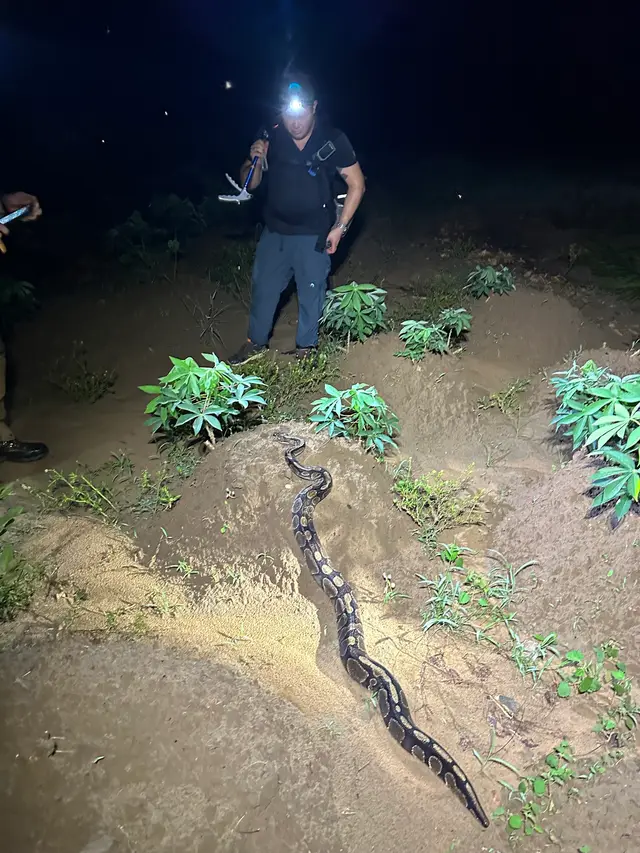
Ball pythons live in savanna, grassland, open and dry forest, and cleared farmland. They avoid dense rainforest and true desert. Animal Diversity Web notes that they spend most of their time on or under the ground, and they often shelter in rodent burrows and termite mounds during the day.
Farmland suits them because fields hold plenty of rats and mice. That also puts them close to people: in southern Togo, rural hunters collect ball pythons and their eggs for the export trade, as a 2020 study in Nature Conservation describes.
Behavior: why do ball pythons roll into a ball?
Rolling into a ball is a defense. A frightened ball python coils its body into a tight sphere with its head tucked in the center, which protects the head from predators. This habit is why English speakers call it the ball python.
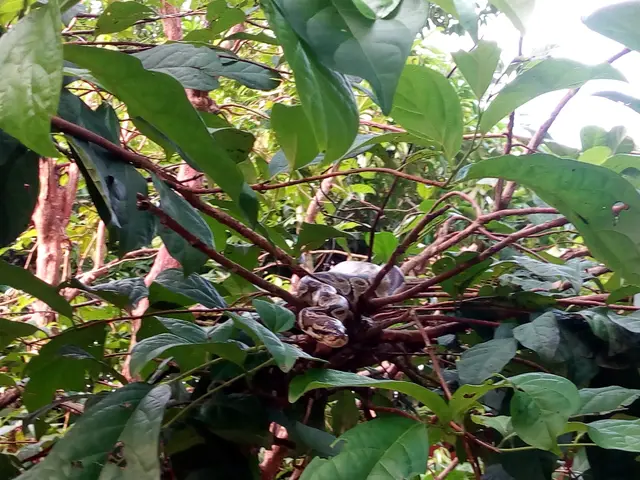
Ball pythons are solitary and slow-moving. They are active mainly at night and around dusk and dawn, and spend the day hidden underground. Young snakes and males climb more than adult females do. In a two-year field study in southeastern Nigeria, Luiselli and Angelici (1998) found that males often hunted in trees and took more birds, while females stayed mostly on the ground.
Like other pythons, it finds warm prey partly by heat. A University of Bonn study tested blindfolded ball pythons with a moving warm target and found they detected it from up to about 1 ft (30 cm) away, a much shorter range than the pit-equipped western diamondback rattlesnake tested in the same work (Ebert, University of Bonn).
What do ball pythons eat?
Adult ball pythons eat mostly rodents, while many young snakes eat birds. The snake grabs prey with its teeth, wraps several coils around it and squeezes until it stops breathing, then swallows it whole. Animal Diversity Web notes that they feed infrequently, and a single large rat can last an adult a long time.
| Prey group | Examples | Who eats it |
|---|---|---|
| Rodents | African giant (Gambian pouched) rats, black rats, grass mice | Main prey of adults, especially females |
| Birds | Doves, weaver birds, bee-eaters, young grey parrots | Snakes under about 28 in (70 cm), and males |
| Other mammals | Bats such as Woermann's fruit bat, taken occasionally | Mostly adults |
In the Nigerian study, snakes shorter than 28 in (70 cm) ate mainly birds and snakes longer than 39 in (100 cm) ate mainly small mammals. Rats are the bulk of what a grown ball python eats, which makes it a useful snake to have around crop fields.
Are ball pythons venomous or dangerous?
No. Ball pythons have no venom and are not dangerous to people. They kill prey by constriction, and an adult is far too small to hurt a person that way. A bite feels like a sharp pinch and leaves a horseshoe of small punctures. Wash it with soap and water as you would any scratch; there is nothing to neutralize.
Most ball pythons would rather hide their head than use it. Bites usually happen at feeding time, when a hungry snake mistakes a hand that smells of mice for food. Our snake venom FAQ explains the difference between venomous snakes and harmless constrictors like this one. The real danger from large pythons comes from much bigger species such as the African rock python, which averages 10 to 16 ft (3 to 5 m).
Snakes confused with the ball python
In the wild, the ball python is most often confused with young African rock pythons. As pets, people mix it up with other small, chunky constrictors. If you find a snake and are not sure, photograph it from a distance and post it on iNaturalist for an ID.
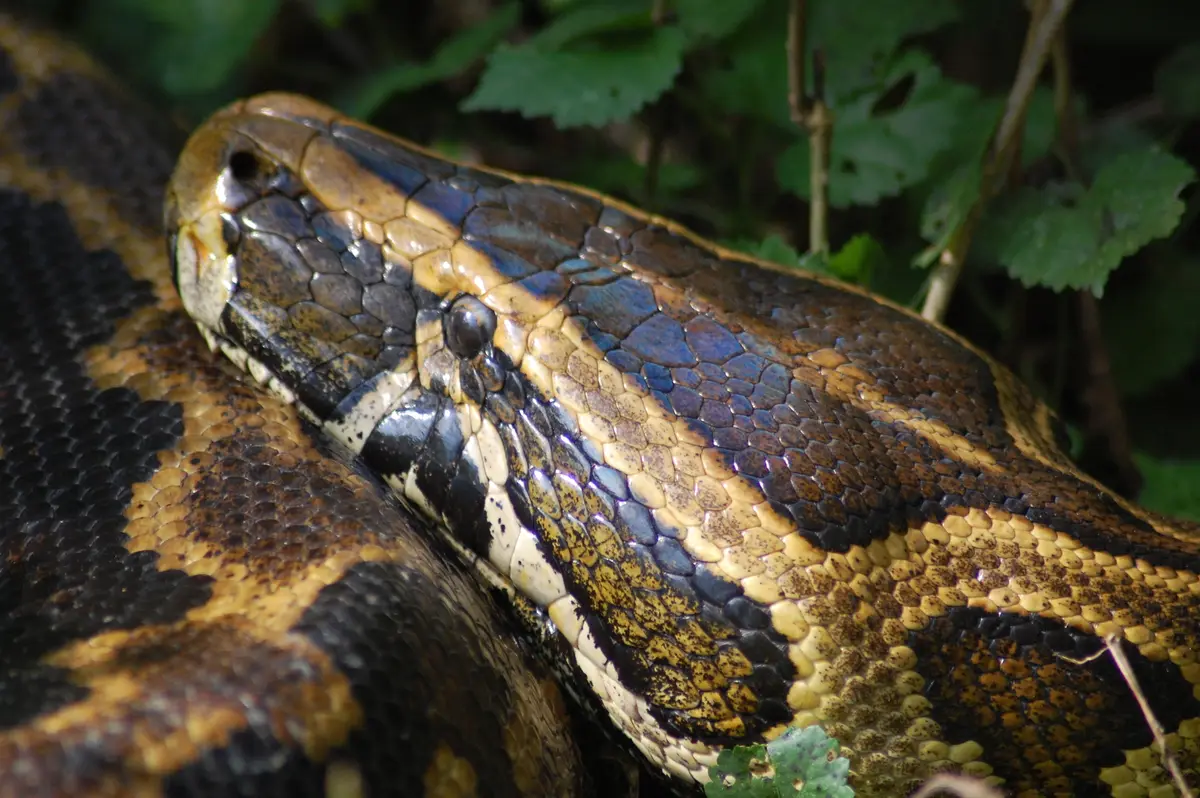
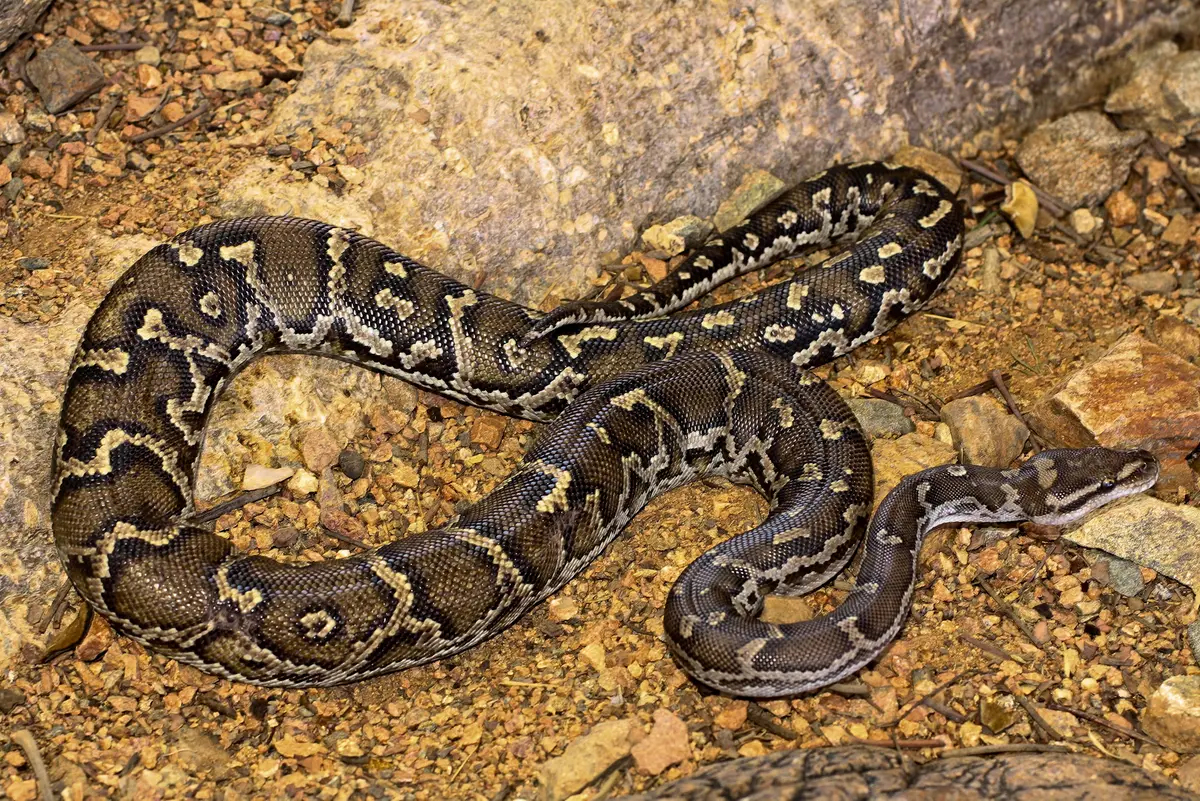
African rock python
Python sebae · Non-venomous, but large and can bite hard
Shares much of the ball python's range but grows far larger, usually 10 to 16 ft. It has a staircase-like row of dark blotches, a pale spearhead shape on top of the head and a salt-and-pepper belly. It bites readily and does not roll into a ball.
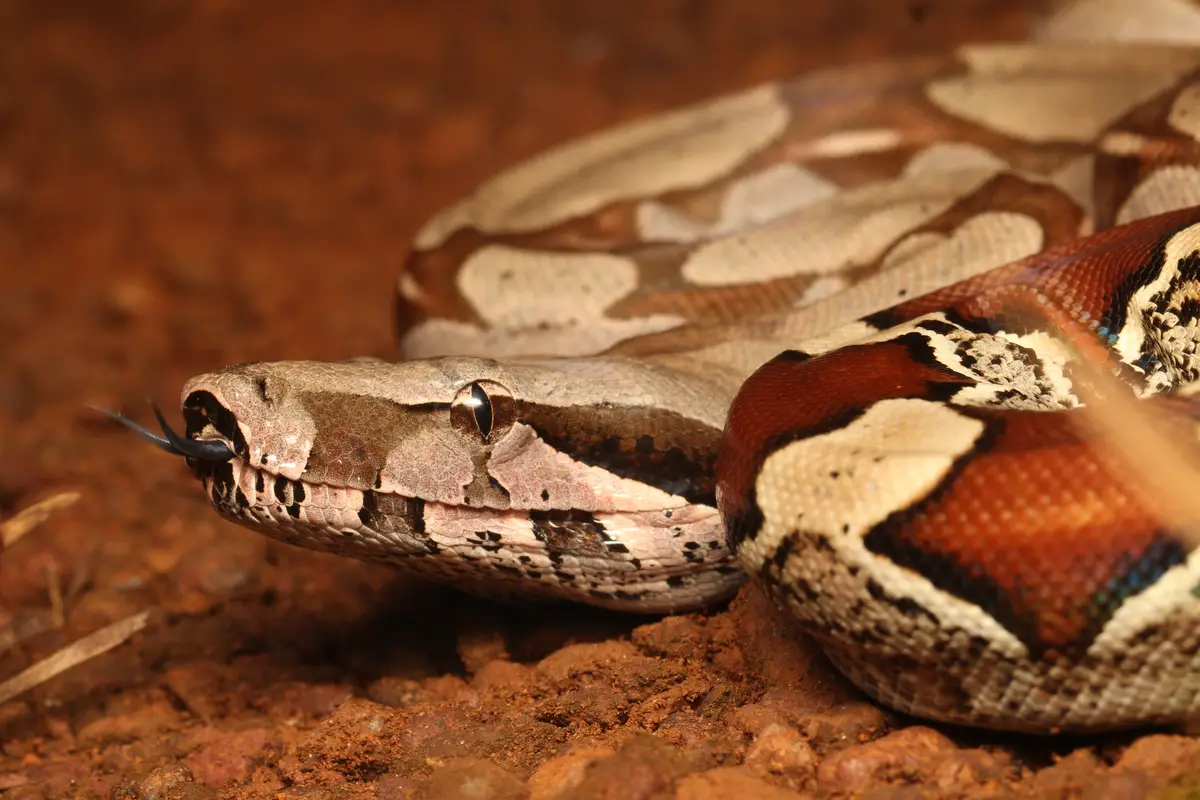
Boa constrictor
Boa constrictor · Harmless
A South American snake, also common as a pet. Much longer as an adult, with saddle-shaped markings and a reddish tail. See our boa constrictor guide.
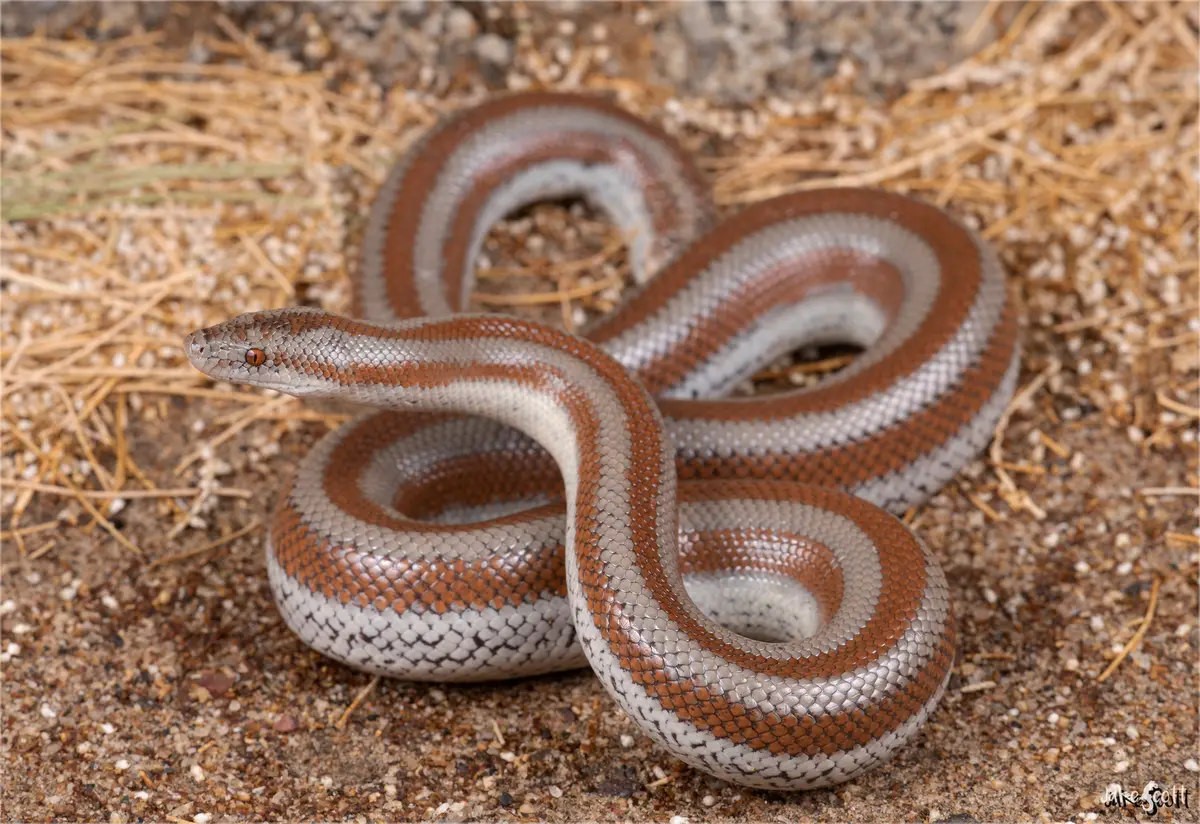
Rosy boa
Lichanura trivirgata · Harmless
A small desert boa from the southwestern United States and Mexico that may also ball up when handled. It has three long stripes instead of blotches. See our rosy boa guide.
Reproduction and lifespan
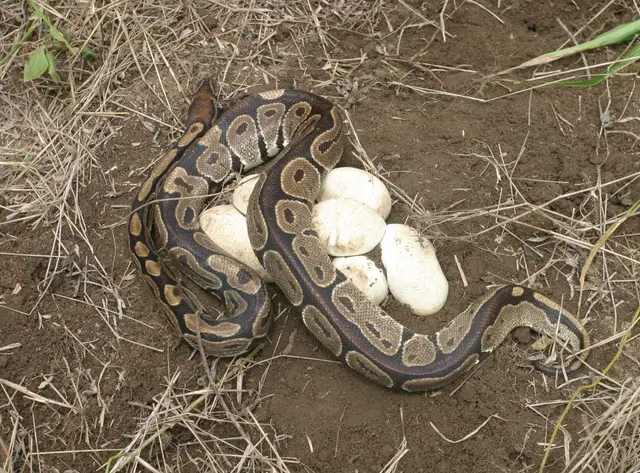
Ball pythons lay eggs. In the wild they mate from about mid-September to mid-November, during the rainy season, and females lay clutches of 1 to 11 eggs, about 7 on average, according to Animal Diversity Web. The mother coils around the clutch and stays with it for the two months or more it takes the eggs to hatch. Hatchlings measure 10 to 17 inches (25 to 43 cm).
Males can breed at 16 to 18 months old, and females at about 27 to 31 months.
Females can also lay eggs without a male. A 2023 study in Genes confirmed parthenogenesis (reproduction without mating) in a pet ball python that had never been kept with a male. Genetic tests showed her embryos carried only her DNA.
How long do ball pythons live?
Wild ball pythons are estimated to live about 10 years. In captivity, 20 years is common and 30 years is not unusual. The oldest known is a female at the Saint Louis Zoo, which arrived from a private owner in 1961. In July 2020, at about 62 years old, she laid seven eggs despite having no contact with a male for many years, as CBS News reported. Zoo staff described her as the oldest snake documented in a zoo.
Is the ball python endangered?
Not endangered, but it is declining. The IUCN Red List moved the ball python from Least Concern to Near Threatened in a 2021 reassessment, citing collection for the international pet trade.
| Authority | Status |
|---|---|
| IUCN Red List | Near Threatened (2021 reassessment) |
| CITES | Appendix II (trade allowed under permits) |
| US Endangered Species Act | Not listed |
The ball python is the most popular pet snake in the world and the second most popular pet reptile after the bearded dragon, according to a 2021 study in Animals. The same paper reports that nearly 3 million were imported worldwide between 1996 and 2012. Most come from Ghana, Togo and Benin, many as hatchlings from wild-caught pregnant females or wild-collected eggs.
In the 2020 Nature Conservation study, hunters in southern Togo said they were finding fewer wild ball pythons than five years earlier, a sign that the harvest may not be sustainable. In parts of its range the snake also has cultural protection. The Igbo people of southeastern Nigeria revere the royal python, and the Reptile Database notes the name regius ("kingly") may come from African rulers who kept it.
Ball python morphs and health
Captive breeders have produced thousands of color and pattern forms, called morphs, from the brown wild type. Some carry health problems. A 2022 study in PLOS ONE found malformed inner-ear organs in all four spider morph ball pythons it examined, a likely cause of the head wobble and poor balance seen in that morph.
Ball python FAQ
Are ball pythons venomous?
No. Ball pythons have no venom at all. They are constrictors that kill rodents and birds by squeezing them. A bite from a ball python causes small puncture wounds that should be washed with soap and water, but it is not medically dangerous. Most ball pythons roll into a ball rather than bite when they feel threatened.
How big do ball pythons get?
Adult ball pythons are usually 3 to 5 feet (1 to 1.5 m) long, with females slightly larger than males. The largest wild records reach about 6 feet (1.8 m). Wild adults weigh up to about 3.5 pounds (1.6 kg). It is the smallest python species in Africa, much smaller than the African rock python.
How long do ball pythons live?
Wild ball pythons are thought to live about 10 years. In captivity they often live 20 to 30 years. The oldest on record is a female at the Saint Louis Zoo who was about 62 years old in 2020, when she laid a clutch of seven eggs. She had lived at the zoo since 1961.
What is the difference between a ball python and a royal python?
There is no difference. Ball python and royal python are two names for the same species, Python regius. Ball python is the usual name in North America and refers to its defensive ball. Royal python is more common in Europe and comes from the scientific name regius, which means kingly.
Where do ball pythons come from?
Ball pythons are native to West and Central Africa, from Senegal and Gambia east to South Sudan and Uganda. They live in savanna, grassland, open woodland and farmland, and hide in rodent burrows and termite mounds by day. Most ball pythons in the pet trade come from Ghana, Togo and Benin or from captive breeders.
Do ball pythons bite?
Yes, they can, but it is uncommon and not dangerous. A frightened ball python usually curls into a ball instead. Most bites happen during feeding, when the snake mistakes a hand for prey. The bite feels like a pinch and leaves small punctures. Clean it with soap and water and watch for signs of infection.
Why is the ball python Near Threatened?
The IUCN listed it as Near Threatened in 2021 because huge numbers are taken from the wild for the pet trade. Nearly 3 million were imported worldwide between 1996 and 2012, and hunters in Togo report finding fewer snakes than in the past.
Related snakes
Sources
- Reptile Database: Python regius
- Animal Diversity Web (University of Michigan): Python regius
- Zoo New England: Ball python
- SeaWorld: Royal python facts
- D'Cruze et al. 2020, Searching for snakes: ball python hunting in southern Togo (Nature Conservation)
- Valdez 2021, Trends in the reptile pet trade (Animals)
- Starck et al. 2022, Inner-ear malformations in spider morph pythons (PLOS ONE)
- iNaturalist: Python regius (photos, observations)