AFRICAN ROCKPYTHON
Python sebae · Family Pythonidae
KEY TAKEAWAYS
The African rock python (Python sebae) is the largest snake in Africa, a heavy, non-venomous constrictor that lives across the savannas and forests south of the Sahara. It is one of the world's biggest pythons and can kill prey as large as antelope. Wild rock pythons rarely attack people, but a big one is strong enough to kill a child, and a few deaths are on record.
- Adults are usually 10-16 ft (3-5 m) long. The Reptile Database gives a maximum of about 25 ft (7.6 m).
- It is not venomous. It kills by constriction, and its bite is painful and easily infected.
- It eats mammals up to the size of small antelope, and in 2017 one was filmed swallowing a 150 lb spotted hyena in Kenya.
- The IUCN lists it as Near Threatened (2021). A small invasive population lives in western Miami-Dade County, Florida.
African rock python quick facts
| Common names | African rock python, northern African python, Central African rock python |
|---|---|
| Scientific name | Python sebae (Gmelin, 1789) |
| Family | Pythonidae (pythons) |
| Venomous | No, a constrictor |
| Adult length | Usually 10-16 ft (3-5 m); maximum about 25 ft (7.6 m) |
| Weight | Average about 121 lb (55 kg); big adults 97-200 lb (44-91 kg) or more |
| Range | Sub-Saharan Africa, from Senegal and Mauritania east to Ethiopia and Somalia, south to Angola and Tanzania |
| Habitat | Moist savanna, grassland and forest edges, nearly always near water |
| Diet | Rodents, monkeys, hyraxes, antelope, birds, monitor lizards and sometimes crocodiles |
| Reproduction | Lays eggs; clutches of about 20-100, guarded by the female |
| Lifespan | Up to about 30 years in human care |
| Conservation | IUCN Near Threatened (2021); CITES Appendix II |
How to identify an African rock python
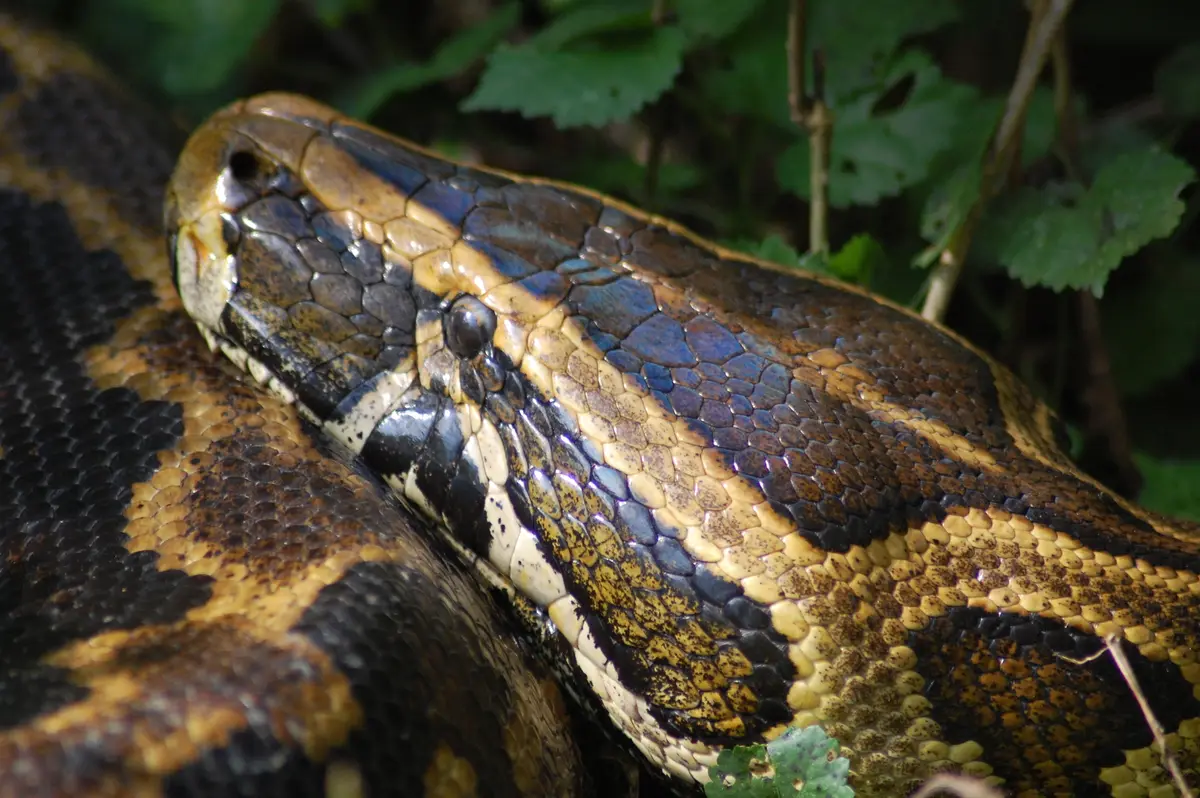
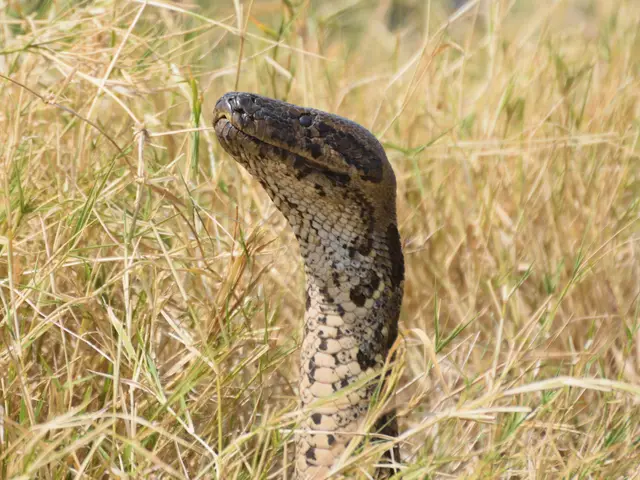
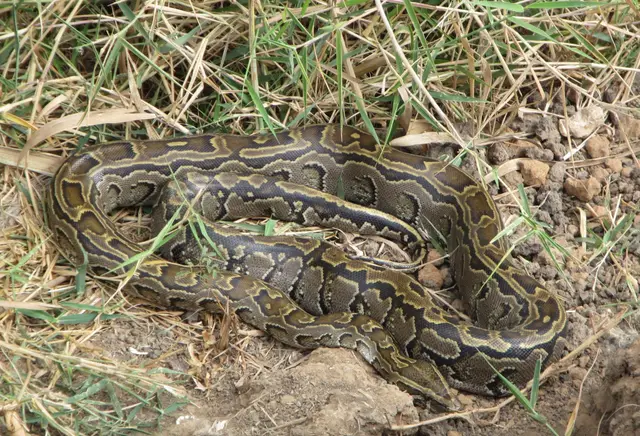
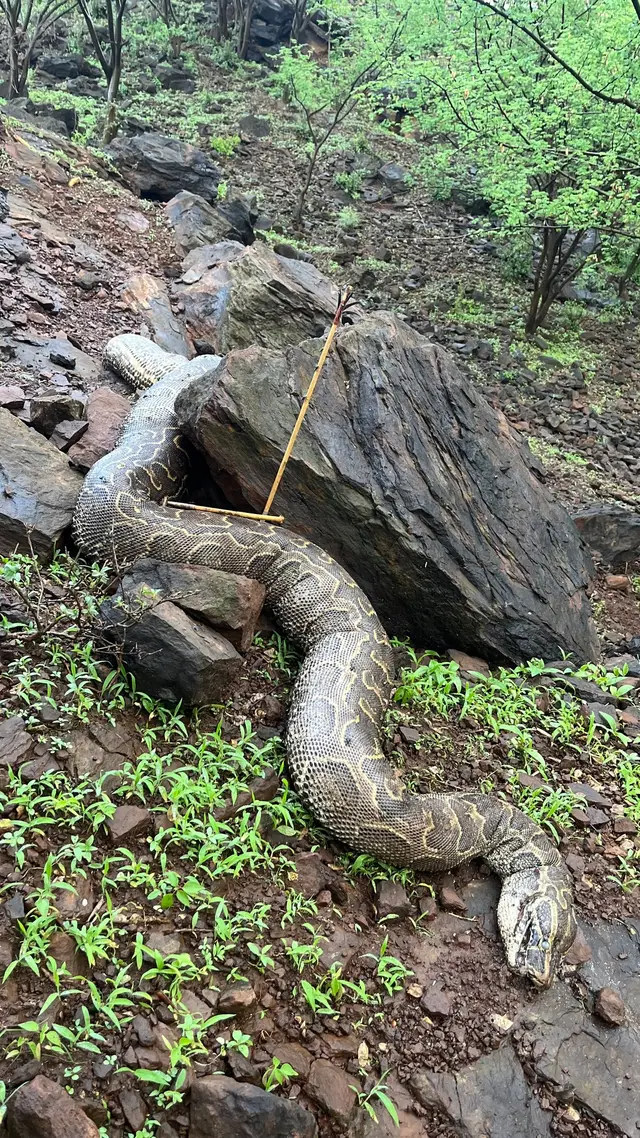
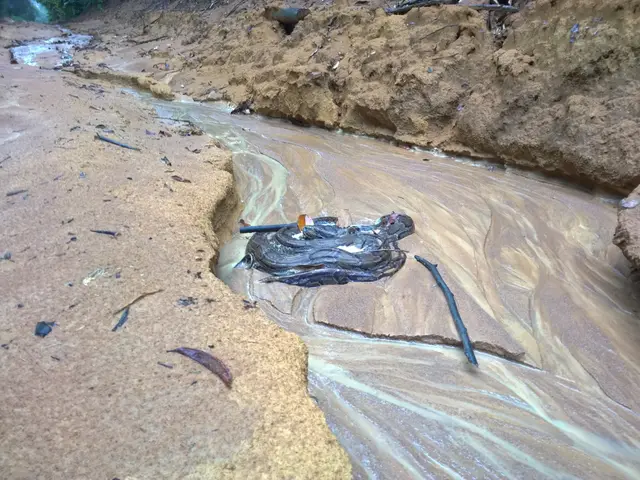
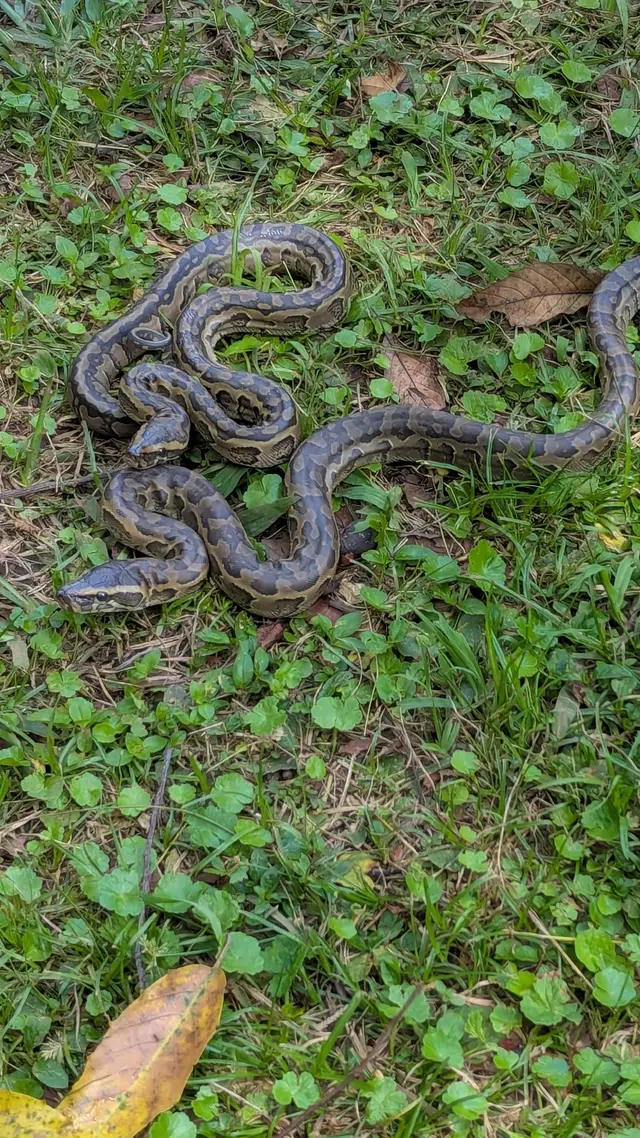
An African rock python is a very large, thick-bodied snake patterned in brown, olive or chestnut blotches that often join into a broad, ragged band along the back. The head is triangular with a dark spearhead mark on top. In most of Africa, any snake longer than about 10 ft with this pattern is a python.
- 1Size and build: heavy and muscular, much thicker than the long, slim snakes such as mambas that share its range. Hatchlings are already 20-28 in (50-70 cm) long, according to the African Snakebite Institute.
- 2Body pattern: dark-edged brown or olive blotches on a paler tan, yellowish or gray background, fading to whitish on the lower sides.
- 3Head markings: a dark brown spearhead on the crown, pale lines running from the snout over each eye, and a dark triangle below the eye.
- 4Lip pits: a row of heat-sensing pits along the lips, which pythons use to find warm-blooded prey in the dark, as Animal Diversity Web describes.
- 5Belly: whitish with scattered black markings.
In southern and eastern Africa it overlaps with its close relative, the Southern African python. The quickest check is the top of the head: the African rock python has large, orderly head scales, while the Southern African python has small, scattered ones and a drabber pattern.
How big do African rock pythons get?
Most adult African rock pythons are 10 to 16 feet (3 to 5 m) long, and the Reptile Database calls it the largest African snake, with a total length of up to 7.6 m (25 ft). Only the reticulated python, the Burmese python and the green anaconda regularly reach similar sizes.
Weight varies a lot with sex and condition. Animal Diversity Web gives an adult average of about 121 lb (55 kg) and a usual range of 97 to 200 lb (44 to 91 kg), with a few snakes well over 200 lb. Females are larger than males. Huge pythons were once more common; hunting has made very large individuals rare outside parks and reserves.
| Life stage or record | Length | Notes |
|---|---|---|
| Hatchling | 20-28 in (50-70 cm) | Independent from hatching |
| Male begins breeding | About 6 ft (1.8 m) | Usually at 3-5 years old |
| Female begins breeding | About 9 ft (2.7 m) or more | Usually at 3-5 years old |
| Typical adult | 10-16 ft (3-5 m) | About 121 lb (55 kg) on average |
| Maximum accepted length | About 25 ft (7.5-7.6 m) | Reptile Database; Animal Diversity Web |
| Unconfirmed claim | About 32 ft (9.8 m) | Report from Cote d'Ivoire, never verified |
| Florida record | 14.4 ft (4.4 m) | Florida Museum of Natural History |
Where do African rock pythons live?
Short answer: African rock pythons live across tropical Africa south of the Sahara, from West Africa to the Horn of Africa and south to Angola and Tanzania. The Reptile Database lists more than 30 countries, from Senegal, Gambia and Mauritania in the west to Ethiopia, Eritrea and Somalia in the east, and south through the Congo Basin to Angola, Burundi and Tanzania.
Further south, from Kenya and Tanzania to South Africa, the big python is the Southern African python (Python natalensis). It was treated as a subspecies of the African rock python until Donald Broadley raised it to a full species in 1999. Older books and many news stories still call both snakes "African rock pythons". Compare their ranges with other giant snakes on the world snake map.
African rock pythons in Florida
African rock pythons have also turned up in southern Florida, almost certainly from the pet trade. Several were found in western Miami-Dade County in 2009, which led USGS and Florida Museum biologists to ask whether the species had become established there (Reed et al. 2010). Later work on females caught in the area found evidence of breeding (Mendyk et al. 2016).
The Florida Fish and Wildlife Conservation Commission (FWC) says the population is limited to about 6 square miles around the Bird Drive Recharge Area, at the edge of the Everglades, and believes it can still be wiped out. It is a far smaller problem than the Burmese python, which covers thousands of square miles of the state.
Habitat
African rock pythons live in moist, open savanna, grassland and the edges of evergreen forest, from sea level to about 7,500 ft (2,300 m). They avoid the driest deserts and the cold high mountains. Animal Diversity Web notes a close link to water: they are usually found near rivers, lakes and swamps.
By day they hide in rocky outcrops, which gave the snake its name, or in old mammal burrows where rocks are scarce. They also turn up in farmland and on the edges of towns, where they find poultry and rats.
Behavior
African rock pythons are solitary ambush hunters that are active mostly at night, though adults often bask in the sun during the day. Young pythons are most active around dawn and dusk. They spend most of their time on the ground but climb well and swim strongly, and the African Snakebite Institute says they can stay under water for long periods.
This python has a reputation for a bad temper. When cornered it hisses and bites hard, and its many long, backward-curved teeth leave deep cuts. After a large meal it may lie still for days or weeks while it digests.
What do African rock pythons eat?
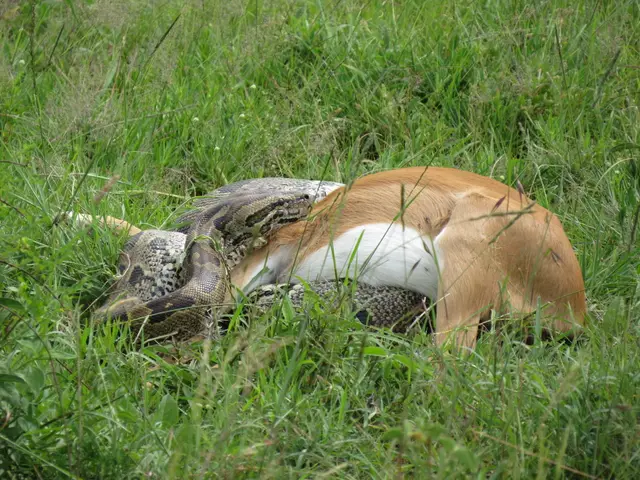
African rock pythons eat mostly warm-blooded animals, from rats to small antelope. A python waits beside a trail or at the water's edge, grabs prey with its teeth, wraps it in coils and squeezes until it dies, then swallows it whole, head first.
| Prey group | Examples | Notes |
|---|---|---|
| Small mammals | Rats and other rodents, rock hyraxes (dassies) | Main food of young pythons |
| Large mammals | Monkeys, small antelope, goats, dogs | Animal Diversity Web cites antelope up to about 130 lb (59 kg) |
| Birds | Game birds, waterbirds, poultry | Taken near water and around farms |
| Reptiles | Monitor lizards, crocodiles | Crocodiles only occasionally |
| Fish | Various | Rarely |
Its most famous recorded meal is a spotted hyena. In 2017 researchers in Kenya's Masai Mara found a 13 ft (4 m) rock python with a 150 lb (68 kg) hyena inside it, and a tourist had filmed the snake swallowing it, National Geographic reported. It was the first time a rock python had been filmed eating a hyena.
Is the African rock python venomous or dangerous to humans?
No, the African rock python is not venomous. It has no venom glands and kills only by constriction. It can still hurt people: the bite is very painful, the wounds often become infected, and a large python is strong enough to kill a child or a small adult.
Attacks are rare. The African Snakebite Institute describes deaths from the region's big pythons as "virtually unheard of". A 1980 note in the Journal of Herpetology by Bill Branch and Wulf Haacke described a fatal attack on a young boy in South Africa and noted that unprovoked attacks on people by large pythons are exceptionally rare. CBC News reported another case in Durban in 2002. Both South African cases fall within what is now the Southern African python's range.
Captive snakes have also killed people. In August 2013, an escaped pet African rock python about 14 ft (4.3 m) long killed two young brothers, aged 4 and 6, in Campbellton, New Brunswick, Canada, CBC News reported. Wild pythons that are left alone do not seek out people.
If a python bites you, clean the wound well and see a doctor, since the teeth can leave deep, dirty cuts. Nobody should try to handle or capture a large python alone. Our snake venom FAQ explains how venomous snakes differ from constrictors like this one.
African rock python vs other pythons
Few African snakes look much like an adult rock python, but it is often mixed up with other large pythons, especially in the pet trade and in Florida. If you are not sure, take a photo from a safe distance and post it to iNaturalist.
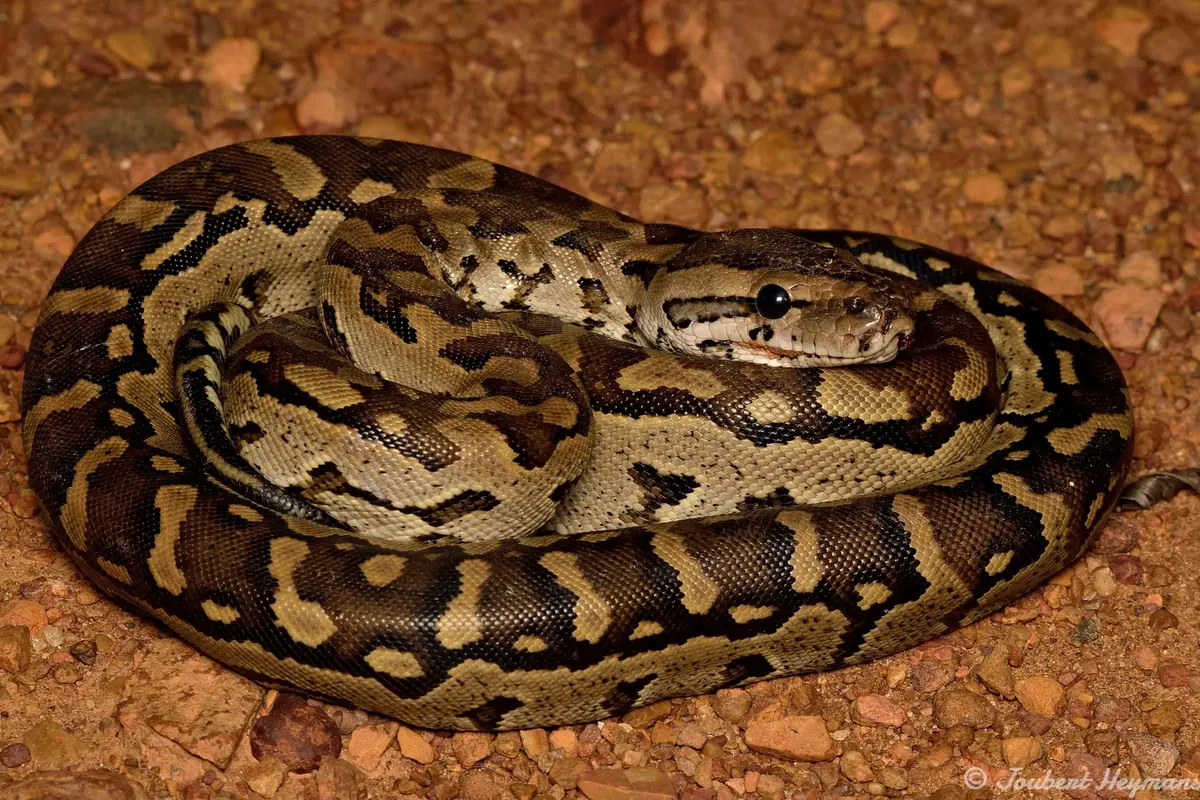
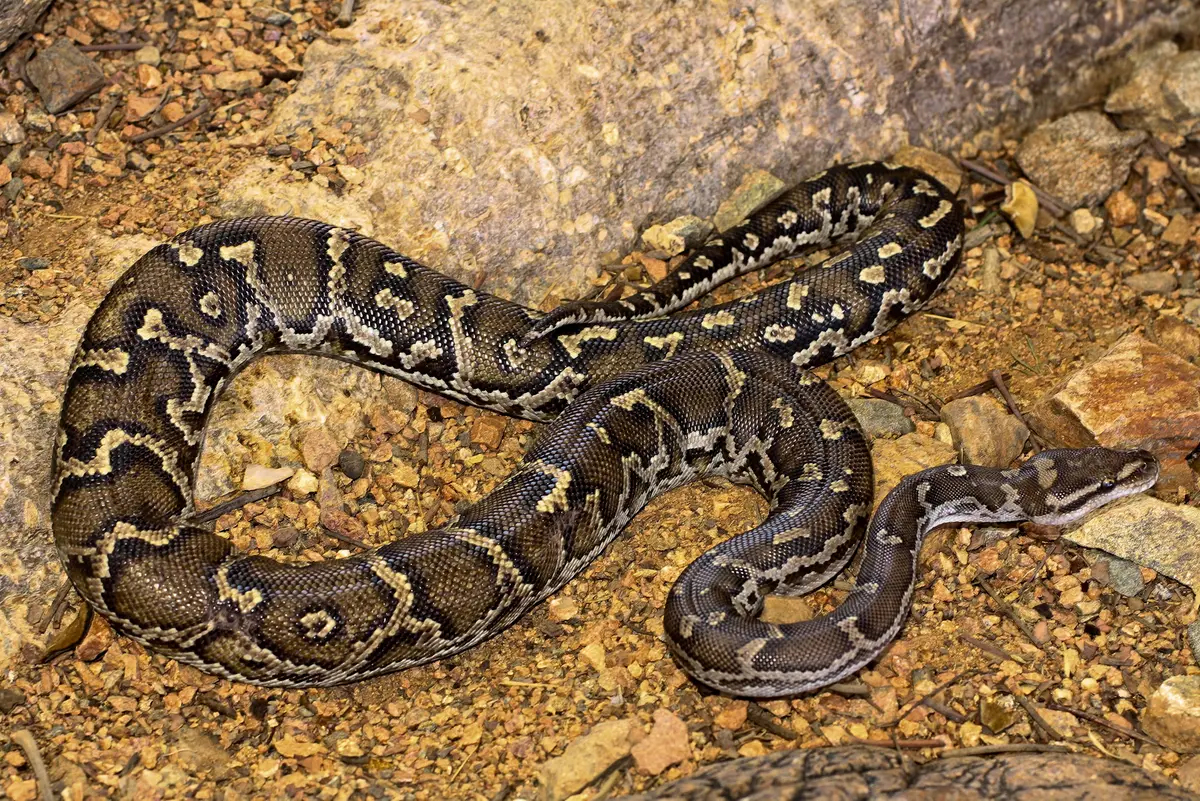
Southern African python
Python natalensis · Non-venomous
Its closest relative, found from Kenya and Tanzania south to South Africa. It has small, scattered scales on top of the head instead of large ordered ones, paler and narrower marks beside the eye and a duller pattern. The Reptile Database lists it as Least Concern.
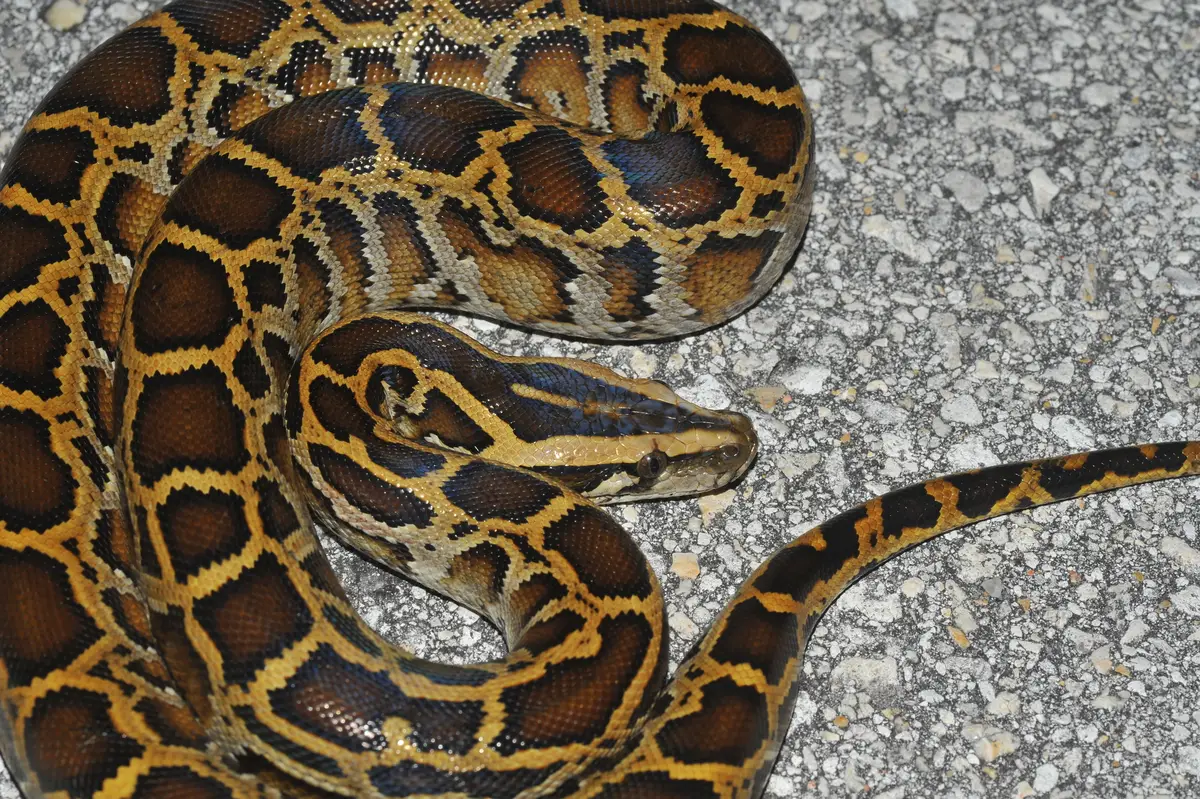 Photo: (c) Wayne Fidler, some rights reserved (CC BY-NC), uploaded by Wayne Fidler · via iNaturalist
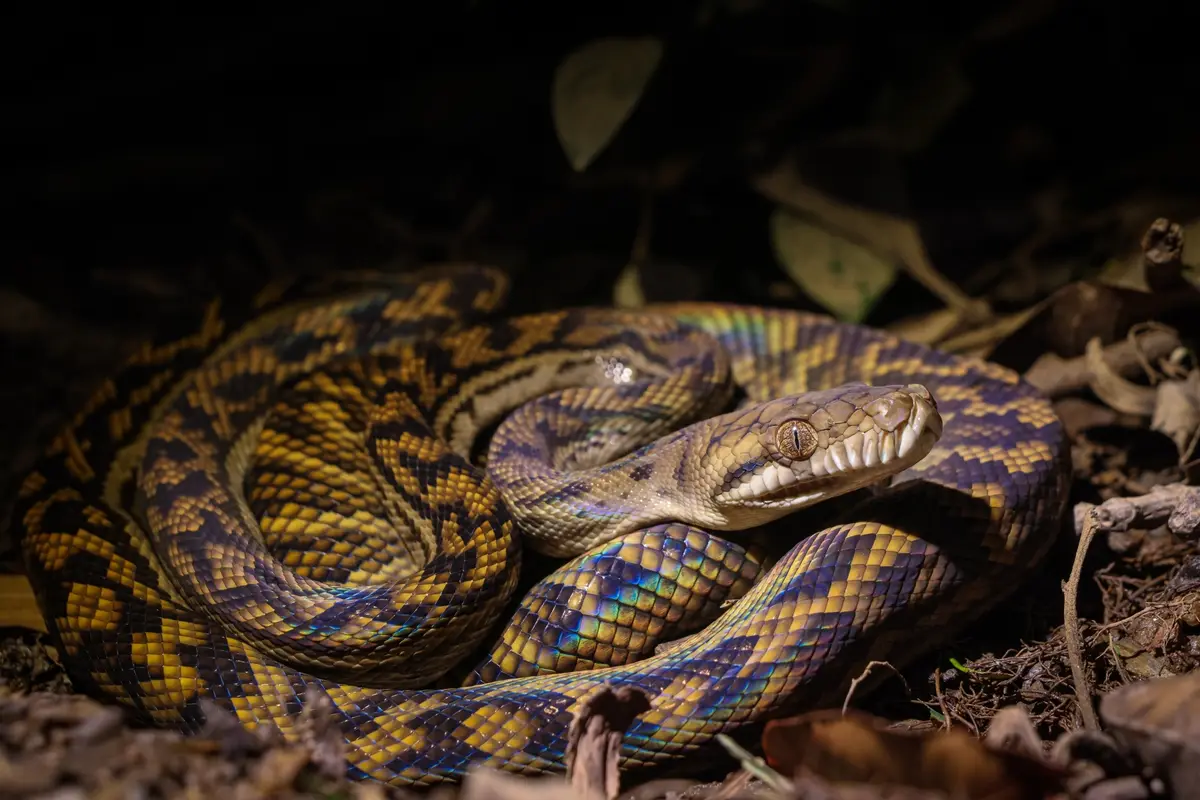
Burmese python
Python bivittatus · Non-venomous
An Asian giant with large, crisp giraffe-like blotches. In Florida the African rock python's pattern looks more broken and less clearly outlined, and its belly has black and white markings. See our Burmese python guide.
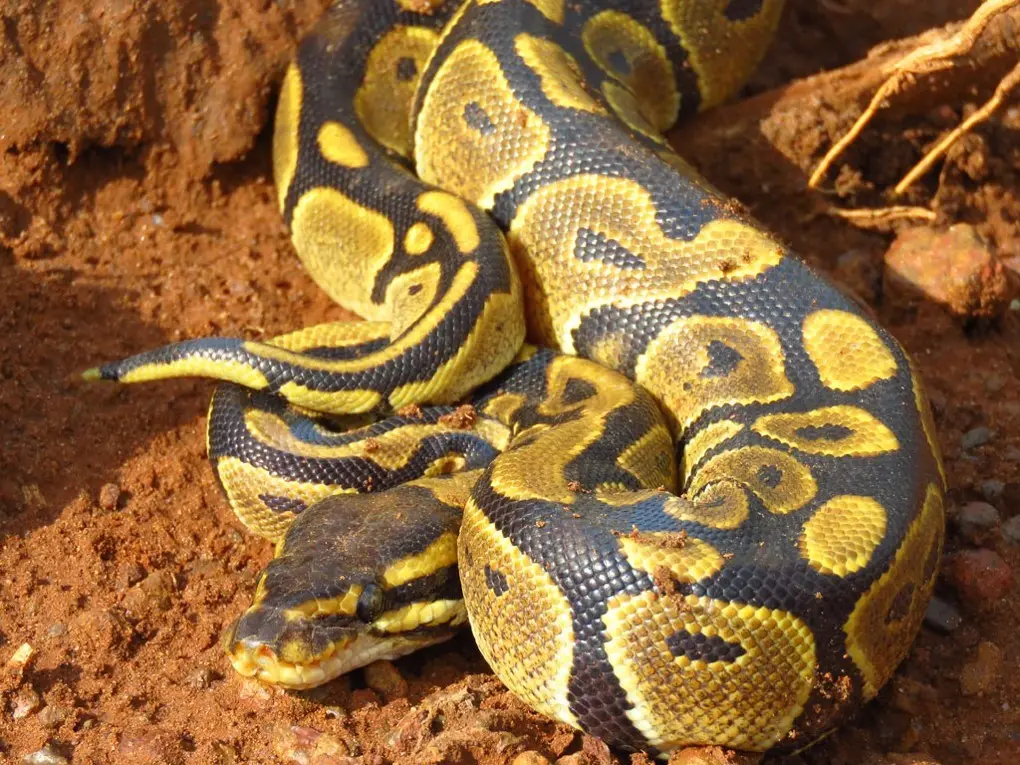
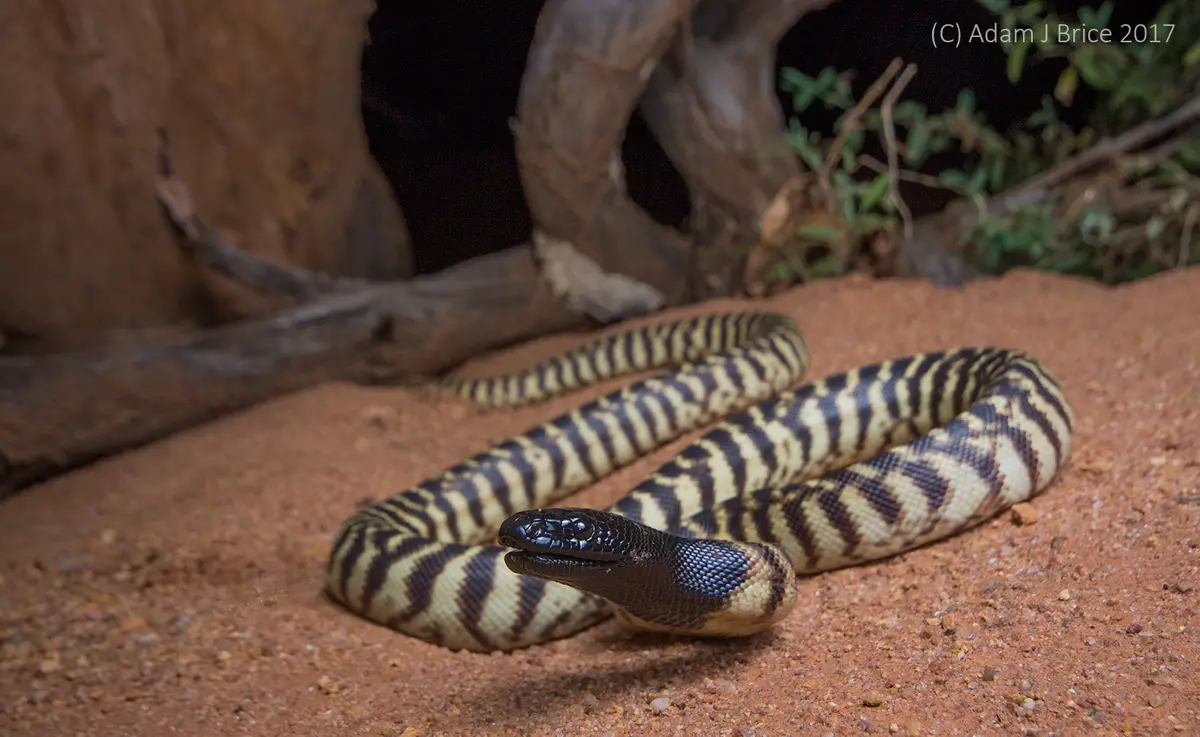
Ball python
Python regius · Harmless
A West African relative with a similar brown pattern but a fraction of the size, usually 3-5 ft. It curls into a ball when scared. See our ball python guide.
Reproduction and lifespan
African rock pythons lay eggs. They mate from November to March, and the female lays about three months later, usually in an old burrow, a termite mound or a hollow tree. Animal Diversity Web gives clutches of 20 to 50 eggs on average and up to 100. The eggs are about the size of tennis balls and weigh 4.6 to 6 oz (130 to 170 g) each.
The mother coils around her eggs and stays with them, without feeding, until they hatch after 65 to 80 days. Unlike the Burmese python, she does not shiver to warm the clutch; her role is mainly guarding. Once the young hatch, they are on their own.
How long do African rock pythons live?
Wild lifespan is not well known. In human care African rock pythons have lived up to about 30 years, according to Animal Diversity Web.
Is the African rock python endangered?
It is not endangered, but it is declining. The IUCN Red List assesses the African rock python as Near Threatened (2021 assessment). It is hunted for meat and skins, and many of the animals it eats are declining too. Animal Diversity Web notes that it now survives mostly in parks, hunting reserves and remote savanna. The Southern African python is listed as Least Concern and is protected in most of South Africa's provinces.
| Authority | Status |
|---|---|
| IUCN Red List | Near Threatened (2021 assessment) |
| CITES | Appendix II; international trade regulated |
| US Lacey Act | Injurious wildlife since 2012; imports and interstate transport banned |
| Florida (FWC) | Prohibited species since April 29, 2021 |
In the United States, the 2012 Fish and Wildlife Service rule listed the northern African python (Python sebae) and the southern African python as injurious wildlife, together with the Burmese python and the yellow anaconda. In Florida, report any sighting to FWC's Exotic Species Hotline, 888-IVE-GOT1 (888-483-4681), or at IveGot1.org.
African rock python FAQ
Is the African rock python venomous?
No. The African rock python has no venom. It kills by biting to get a grip, then squeezing its prey with its coils until it dies. Its bite is still painful and the wounds easily become infected, so any bite from a large python should be cleaned well and checked by a doctor. Large adults are strong enough to injure or even kill a person.
How big do African rock pythons get?
Adults usually measure 10 to 16 feet (3 to 5 m) and weigh about 121 lb (55 kg) on average. The Reptile Database gives a maximum of about 25 feet (7.6 m), which makes it the largest snake in Africa. Claims of snakes over 30 feet have never been confirmed, and very large pythons are now rare because of hunting.
Has an African rock python ever killed a person?
Yes, but very rarely. A 1980 paper in the Journal of Herpetology described a python killing a young boy in South Africa, and CBC News reported a fatal attack on a boy in Durban in 2002. In 2013 an escaped pet python about 14 ft long killed two young brothers in New Brunswick, Canada. Wild pythons left alone almost never attack people.
Are there African rock pythons in Florida?
Yes, in one small area. A population lives around the Bird Drive Recharge Area in western Miami-Dade County, roughly 6 square miles at the edge of the Everglades. FWC lists the species as prohibited and is trying to remove every one. The Florida record is a 14.4 ft (4.4 m) snake. Report sightings to 888-IVE-GOT1.
What is the difference between the African rock python and the Southern African python?
They are two closely related species that were once treated as one. The African rock python (Python sebae) lives in West, Central and East Africa. The Southern African python (Python natalensis) lives from Kenya and Tanzania south to South Africa. The Southern African python has small, scattered head scales and a duller pattern, while the African rock python has large, ordered head scales.
What eats an African rock python?
Adults have few predators. Hyenas and African wild dogs may attack a python while it is sluggish from digesting a large meal, according to Animal Diversity Web. Young pythons face many more predators. People are the biggest threat, hunting pythons for meat and skins.
Related snakes
Sources
- Reptile Database: Python sebae
- Reptile Database: Python natalensis
- Animal Diversity Web (University of Michigan): Python sebae
- African Snakebite Institute: Southern African Python
- Reed et al. 2010, Is the northern African python (Python sebae) established in southern Florida? (USGS)
- Mendyk et al. 2016, Reproductive biology of female northern African rock pythons in southern Florida (Reptiles & Amphibians)
- Federal Register 2012: Listing three python species and one anaconda species as injurious reptiles
- National Geographic: Watch first-ever video of python swallowing hyena
- iNaturalist: Python sebae (photos, observations)