NEW GUINEA CARPETPYTHON
Morelia spilota harrisoni · Family Pythonidae
KEY TAKEAWAYS
The New Guinea carpet python (Morelia spilota harrisoni) is a non-venomous python of the southern lowlands of New Guinea, from the Port Moresby area of Papua New Guinea west to Merauke in Indonesian Papua. It is the only carpet python that lives outside Australia. It has no venom and is no danger to people, but little is known about it in the wild, and its name is still debated.
- It has no venom. It kills prey by constriction, and a bite needs cleaning, not antivenom.
- Adults are often about 5-6 ft (1.5-1.8 m) long; in this population, unusually, males grow larger than females.
- It lives in open savanna and woodland, not closed rainforest, according to studies by Daniel Natusch and colleagues.
- The carpet python species is rated Least Concern by the IUCN, but Indonesian traders took New Guinea carpet pythons above the legal quota every year from 2000 to 2009.
New Guinea carpet python quick facts
| Common name | New Guinea carpet python (also Papuan or Irian Jaya carpet python) |
|---|---|
| Scientific name | Morelia spilota harrisoni Hoser, 2000; a population of the carpet python, Morelia spilota (Lacepede, 1804) |
| Family | Pythonidae (pythons) |
| Venomous | No, a constrictor |
| Adult length | Often about 5-6 ft (1.5-1.8 m) |
| Range | Southern New Guinea, south of 7 degrees S: Port Moresby area, Yule Island and Western Province in Papua New Guinea; Merauke Regency in Indonesian Papua |
| Habitat | Lowland savanna, open woodland and dry forest, often near rivers and rocky outcrops |
| Diet | Small mammals, birds and lizards |
| Reproduction | Lays eggs, about 17 per clutch on average; hatchlings appear in December and January |
| Conservation | Species: IUCN Least Concern; CITES Appendix II. Harvested for the pet trade in Indonesia |
How to identify a New Guinea carpet python
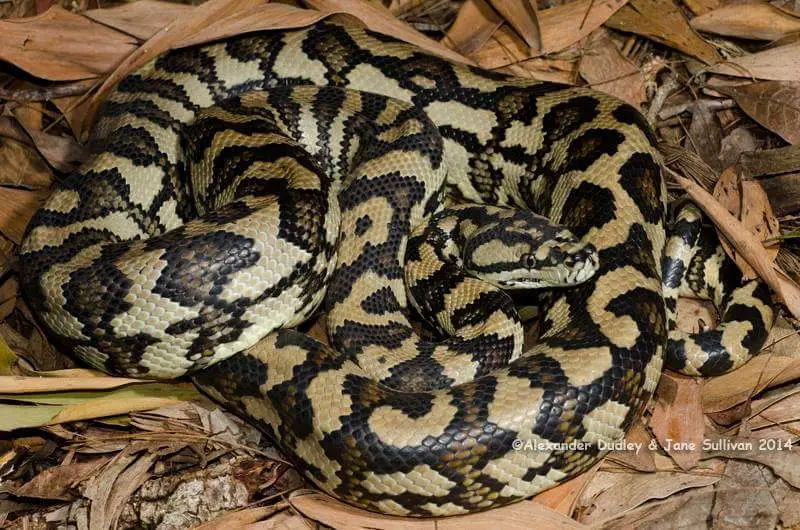
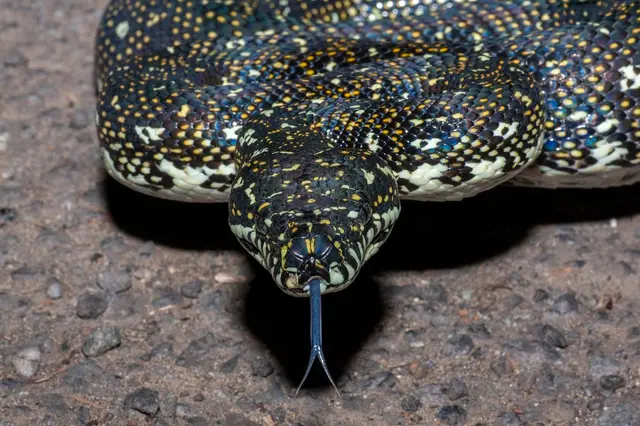
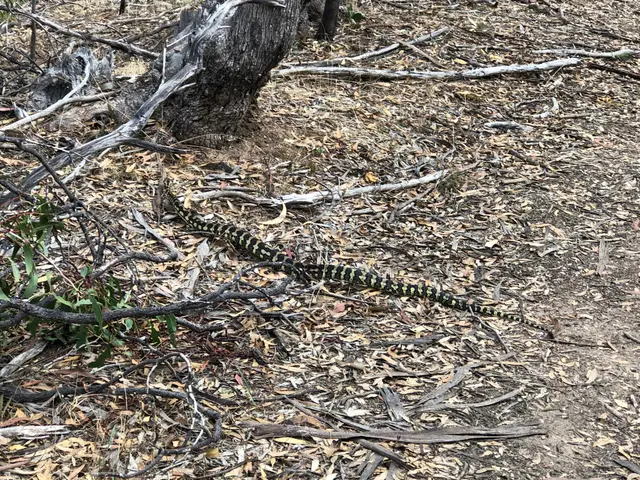
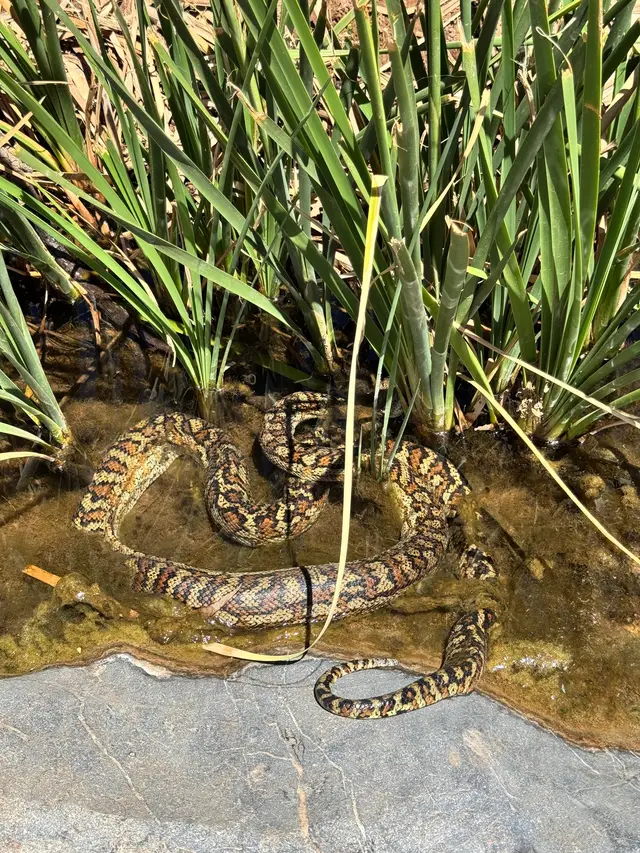
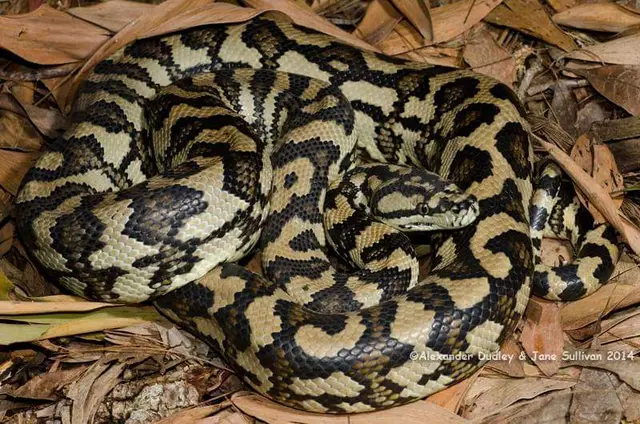
A New Guinea carpet python is a medium-sized, fairly heavy python with a broad head and a banded or blotched pattern of pale markings on a brown or dark body. The Pierre Wildlife database describes it as brown to brownish-black with bright yellow crossbands edged in black, which sometimes join up, and paler spots low on the sides. Carpet pythons vary a lot. The Reptile Database calls Morelia spilota a "quite variable species" with brown, red, green, yellow and blue forms known.
- 1Pale bands on a dark body: yellowish crossbands or blotches on a brown to blackish background. Plain, unmarked pythons in the same area are more likely to be brown water pythons.
- 2Wide head on a narrow neck: the head is clearly broader than the neck and covered with many small scales, unlike the large head plates of an amethystine python.
- 3Heat pits on the lips: a row of heat-sensing pits along the jaw, which carpet pythons use to find warm-blooded prey. Venomous elapid snakes such as taipans have none.
- 4Medium size: most adults are about 5-6 ft (1.5-1.8 m), much shorter than a grown amethystine python.
- 5Location: any carpet python found in the southern lowlands of New Guinea belongs to this population; all known records come from the south of the island.
Its markings overlap with those of Australian carpet pythons, especially the forms across the Torres Strait in northern Queensland, so the origin of a captive snake matters as much as its pattern.
How big do New Guinea carpet pythons get?
New Guinea carpet pythons are medium-sized. The Pierre Wildlife database gives a usual length of about 1.8 m (5.9 ft), often less. That is small next to the coastal carpet python of eastern Australia.
The best field data come from Natusch and Lyons (2012), who measured 174 carpet pythons from Indonesian New Guinea. They found little difference between the sexes, but males appeared to grow larger than females, even though females matured at greater lengths. Buffalo Zoo notes that in carpet pythons males are typically smaller than females, so this is unusual.
A 2026 study of the closely related carpet pythons at the tip of Cape York, Australia, by Natusch, Lyons and Shine found that size at maturity and maximum size there were similar to those of New Guinea populations. The figures from Cape York give a sense of scale:
| Measure (Cape York sample) | Females (15) | Males (22) |
|---|---|---|
| Snout-vent length range | 49-142 cm (1.6-4.7 ft) | 50-180 cm (1.6-5.9 ft) |
| Weight range | 23-392 g (0.05-0.9 lb) | 25-1,962 g (0.06-4.3 lb) |
Snout-vent length leaves out the tail, so total lengths are somewhat longer. No verified record size has been published for a wild New Guinea carpet python.
Where do New Guinea carpet pythons live?
Short answer: in the southern lowlands of New Guinea, on both sides of the border between Papua New Guinea and Indonesia. The Reptile Database gives the range as the southern coast of Papua New Guinea west into Indonesian Papua as far as Merauke. The type specimen came from Port Moresby.
Buffalo Zoo lists New Guinea localities in Merauke Regency in Indonesia, and in southern Western Province, the Port Moresby area of Central Province, and Yule Island in Papua New Guinea. Natusch and Lyons (2012) compiled 281 locality records and found two separate populations, both south of latitude 7 degrees S.
They also noted that half of Indonesia's national harvest quota had been allocated to the province of West Papua, where the species has not been recorded at all. Treat any claim of carpet pythons from northern or western New Guinea with caution.
Across the Torres Strait live the Australian carpet pythons. Natusch, Lyons and Shine (2026) point out that the carpet pythons at the northern tip of Cape York are genetically more closely related to New Guinea carpet pythons than to Australian populations further south. Further south in Queensland live the jungle carpet python and the coastal carpet python.
Habitat
New Guinea carpet pythons live in open country, not rainforest. Natusch, Lyons and Shine (2026) write that carpet pythons in southern New Guinea inhabit open savanna and woodland rather than closed-canopy forest, and that carpet pythons have rarely been found in rainforest there. In their Cape York study, all 23 snakes found on road surveys were in woodland, none in the rainforest the road also crossed.
The Pierre Wildlife database describes the habitat as dry forest, often near rivers and running water, plus rocky outcrops and dry woodland, mostly in the lowlands. Taipans and brown water pythons share this country.
Behavior
Very little has been published on how New Guinea carpet pythons behave in the wild. Like other carpet pythons, they are ambush hunters that can climb but also travel on the ground; Buffalo Zoo describes the species as arboreal but not fully tied to trees.
Night road surveys in neighboring Cape York, which began around 7:30 pm, found carpet pythons crossing roads in the dark, and most were small, young snakes. One male recaptured there after 848 days had grown 33.5 cm (13 in) in snout-vent length, about 14.4 cm (5.7 in) a year. Whether New Guinea snakes grow at the same rate has not been measured.
What do New Guinea carpet pythons eat?
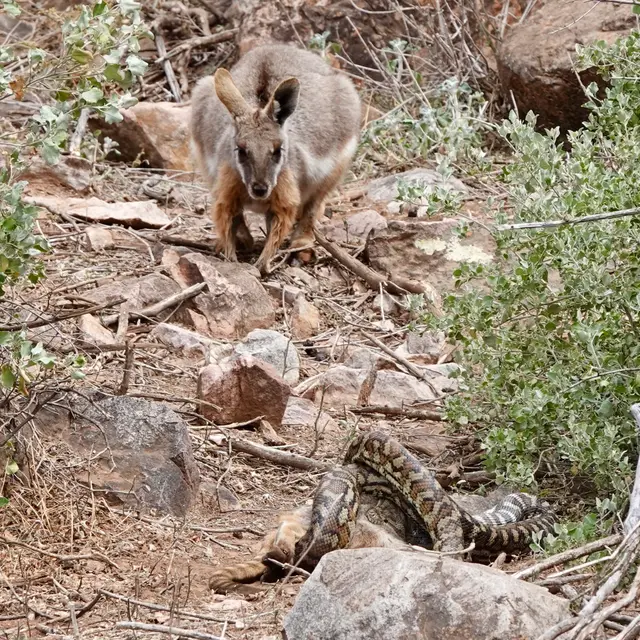
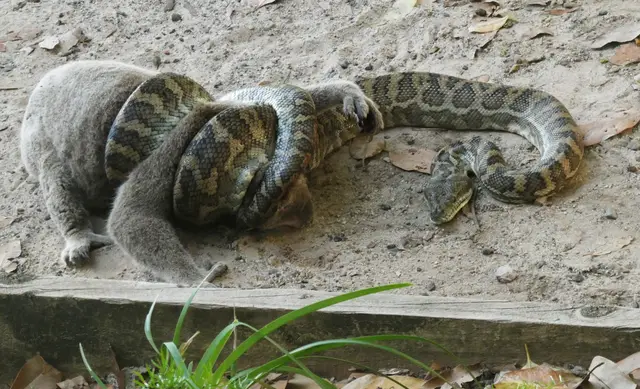
New Guinea carpet pythons eat small warm-blooded animals and lizards. For the carpet python species as a whole, Buffalo Zoo lists small mammals, bats, birds and lizards, all killed by constriction. No detailed diet study exists for the New Guinea population.
| Prey | Notes | Source |
|---|---|---|
| Small mammals | Rodents and other small mammals are the main prey of carpet pythons | Buffalo Zoo |
| Bats and birds | Taken by carpet pythons in general | Buffalo Zoo |
| Lizards | Part of the carpet python diet | Buffalo Zoo |
| Cape York melomys | A native rodent found in a male python at the tip of Cape York | Natusch, Lyons and Shine (2026) |
The heat pits along the jaws let the snake find mammals and birds in the dark. It strikes, coils around the prey and squeezes until the prey stops breathing.
Is the New Guinea carpet python venomous or dangerous?
No. The New Guinea carpet python has no venom and is not dangerous to people. Natusch and Lyons (2012) describe carpet pythons as medium-sized non-venomous snakes. It kills by constriction and is far too small to be a threat to an adult.
A defensive bite can still hurt, because pythons have many sharp, backward-curving teeth. Wash the bite with soap and water, check your tetanus protection, and see a doctor if it turns red or swollen.
The real risk in southern New Guinea is mistaking a dangerous snake for a python. The Port Moresby area is also home to the Papuan taipan. The Reptile Database lists the Papuan taipan from southern Papua New Guinea, with its type locality near Port Moresby, and ranks the taipan species among the most venomous snakes in the world. If you are not sure a snake is a python, keep well back. Anyone bitten by an unidentified snake in New Guinea should get to a hospital at once. Our snake venom FAQ explains why color is a poor guide to danger.
New Guinea carpet python vs other snakes of southern New Guinea
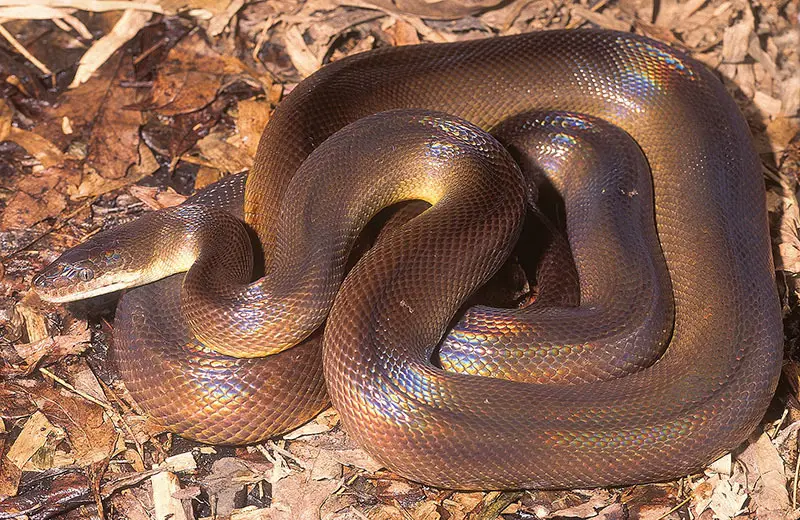
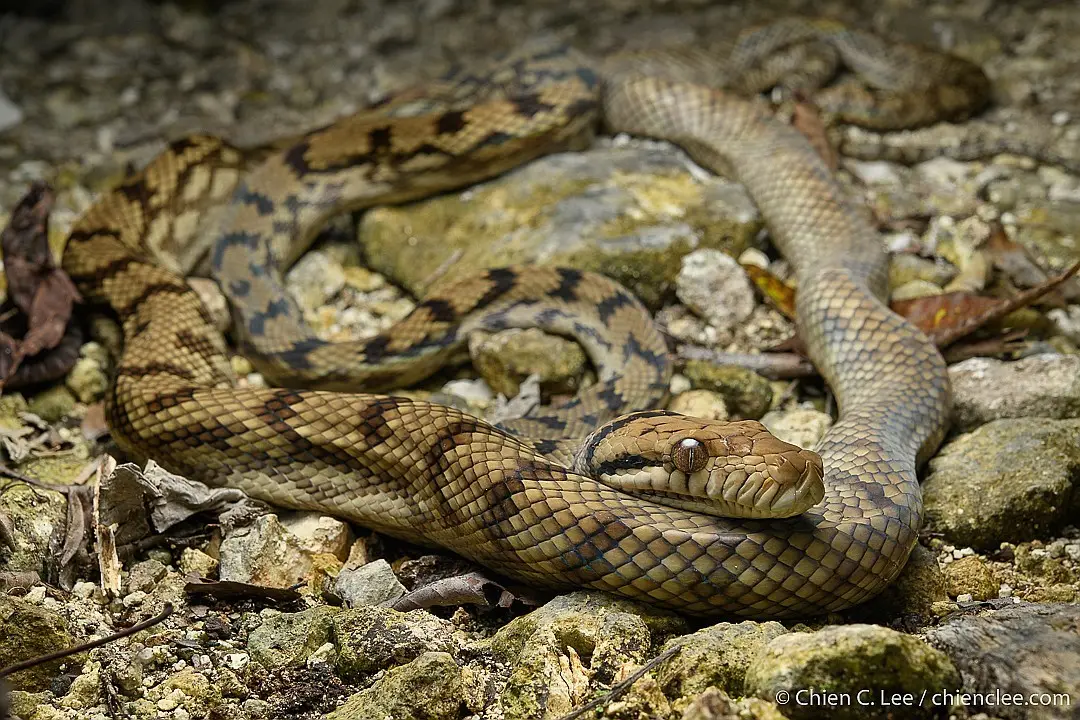
Brown water python
Liasis fuscus · Harmless
A river and floodplain python of southern New Guinea and northern Australia. The brown water python has a plain dark back with no bands or blotches, a yellow belly and a strong rainbow sheen.
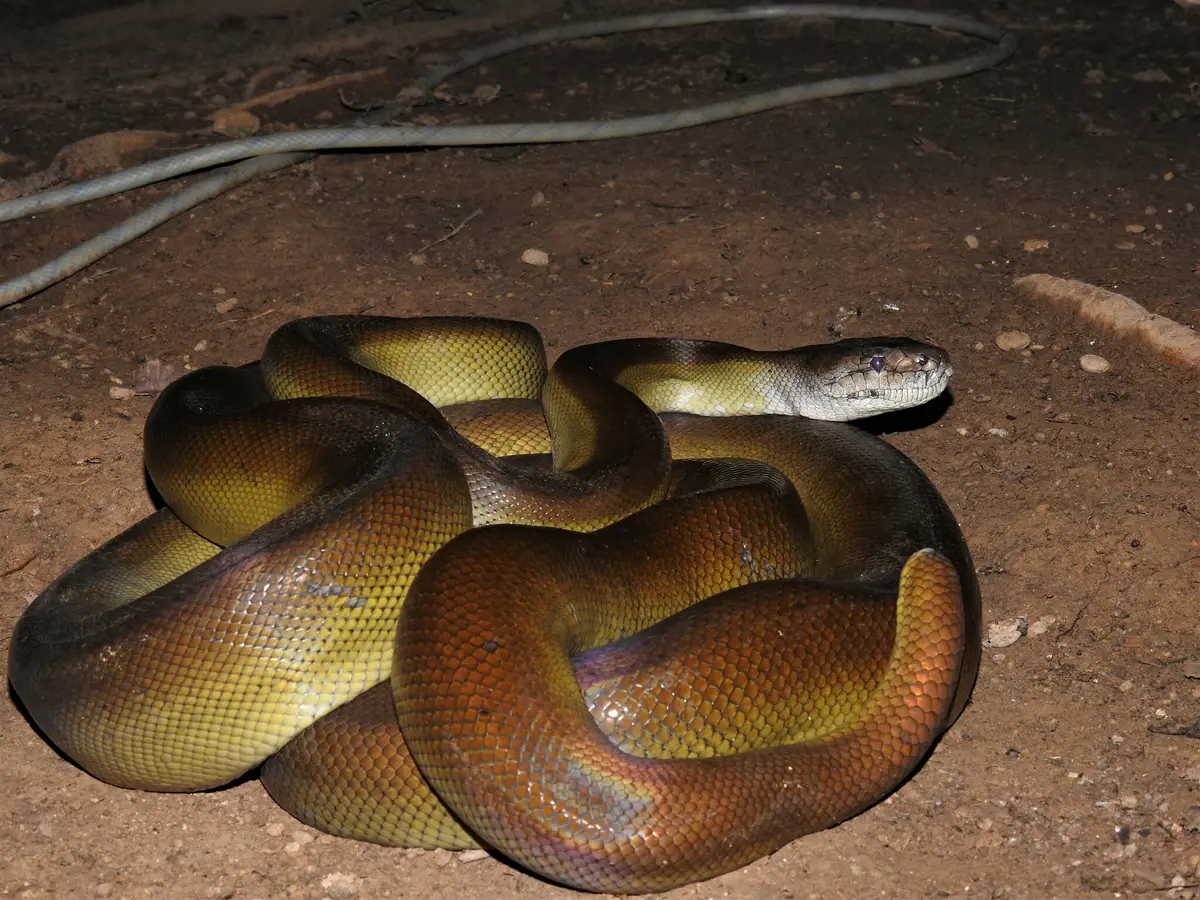
Amethystine python
Simalia amethistina · Harmless
A much longer, slimmer python of New Guinea that often reaches 10 ft (3 m) or more. The amethystine python has large plates on top of its head and a purple sheen on smooth scales.
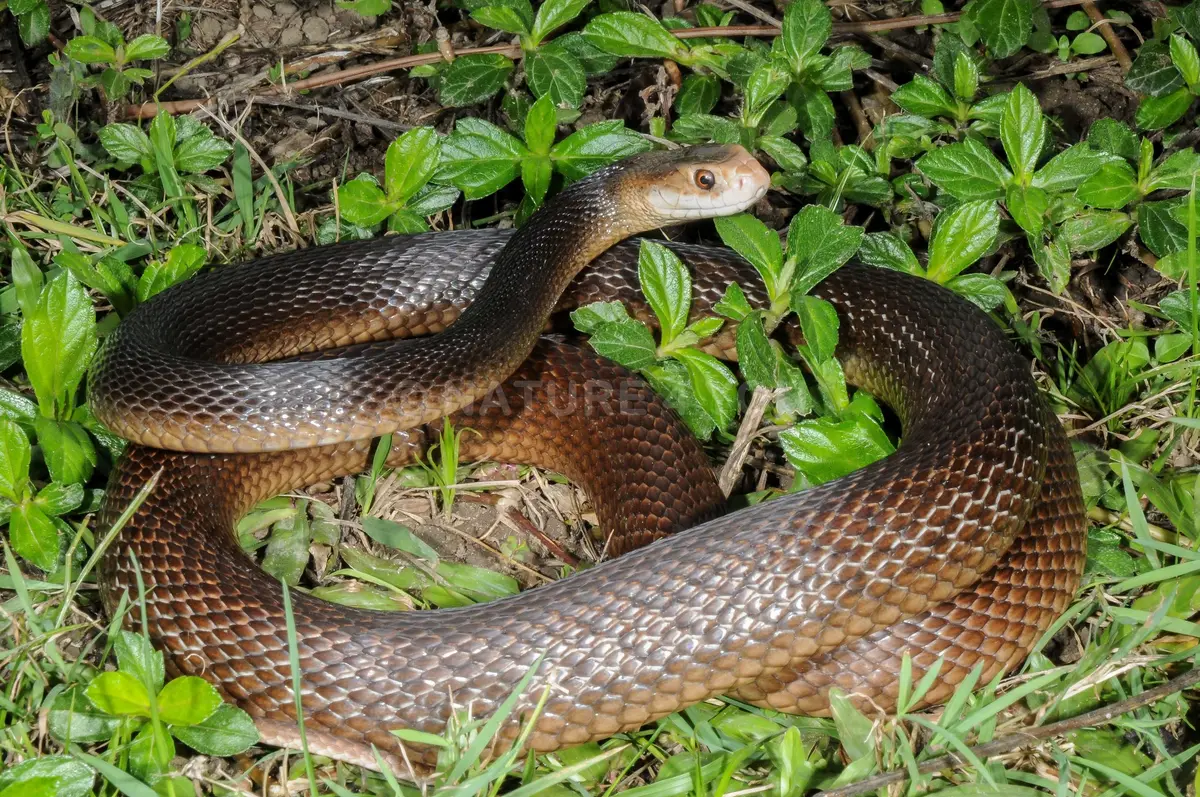
Papuan python
Apodora papuana · Harmless
A very large python of New Guinea that is olive to brown and nearly patternless as an adult. The Papuan python grows far bigger than a carpet python and lacks its pale bands.
Papuan taipan
Oxyuranus scutellatus · Dangerously venomous
The look-alike that matters around Port Moresby. A taipan is a slender snake without heat pits on its lips and without a banded or blotched carpet pattern. Do not go near it.
Reproduction and lifespan
New Guinea carpet pythons lay eggs, and they lay a lot of them. Natusch and Lyons (2012) recorded a high fecundity, with clutches averaging 17 eggs, and found that breeding is strongly seasonal: hatchlings appear in December and January.
Females mature at greater lengths than males. As in other carpet pythons, such as the inland carpet python, the female coils around her clutch until it hatches.
No lifespan figure for wild New Guinea carpet pythons has been published.
Is the New Guinea carpet python endangered?
Not as far as anyone knows, but it is under pressure from collecting. The carpet python species, Morelia spilota, is rated Least Concern on the IUCN Red List, and the Pierre Wildlife database gives the same status for this population. The New Guinea snakes have no separate IUCN assessment.
| Authority | Status |
|---|---|
| IUCN Red List | Least Concern (species Morelia spilota) |
| CITES | Appendix II, as are nearly all pythons; international trade needs permits |
| Indonesia | Harvested under a national export quota |
The pet trade is the main concern. Natusch and Lyons (2012) found that traders in Indonesian Papua had collected 274 carpet pythons, most of them recently hatched young, and that harvest quotas for Papua province were exceeded in every year from 2000 to 2009. The authors published their distribution, trade and ecology data to guide how Indonesia manages the harvest.
Is the New Guinea carpet python a real subspecies?
That question is still open. Raymond Hoser named Morelia harrisoni in 2000 from a female specimen held at the American Museum of Natural History (AMNH 82433), collected at Port Moresby. The Reptile Database now lists it as the subspecies Morelia spilota harrisoni, while some keepers and older works place New Guinea snakes in the northern Australian subspecies, Morelia spilota variegata.
Natusch and Lyons (2012) still refer to the animals simply as the New Guinea carpet python, Morelia spilota. The genetic work cited by Natusch, Lyons and Shine (2026) shows that the pythons at the tip of Cape York are closer to New Guinea carpet pythons than to those further south in Australia, so the line between the two sides of the Torres Strait may not follow the national border. The southwestern carpet python of Western Australia is another carpet python whose rank has been reassessed.
New Guinea carpet python FAQ
Is the New Guinea carpet python venomous?
No. The New Guinea carpet python has no venom and kills its prey by constriction. Natusch and Lyons (2012) describe carpet pythons as medium-sized non-venomous snakes. A bite from its sharp teeth can still draw blood, so wash it well and check your tetanus protection. In southern New Guinea, if you cannot identify a snake, treat a bite as venomous and go to a hospital.
How big does a New Guinea carpet python get?
Most adults are about 5-6 feet (1.5-1.8 m) long. The Pierre Wildlife database gives a usual length of about 1.8 m (5.9 ft), often less. In a sample of 174 snakes from Indonesian New Guinea, Natusch and Lyons (2012) found that males grew larger than females, which is the opposite of most carpet python populations.
Where is the New Guinea carpet python found?
It lives only in the southern lowlands of New Guinea. The Reptile Database gives its range as the southern coast of Papua New Guinea west to Merauke in Indonesian Papua. Known localities include the Port Moresby area, Yule Island, southern Western Province and Merauke Regency. All records compiled by Natusch and Lyons (2012) lie south of latitude 7 degrees S.
What is the scientific name of the New Guinea carpet python?
The Reptile Database lists it as Morelia spilota harrisoni, a subspecies of the carpet python named by Raymond Hoser in 2000 from a Port Moresby specimen. The name is debated: some authors treat New Guinea snakes as part of Morelia spilota variegata, and researchers studying them often just call them Morelia spilota, the carpet python.
Are New Guinea carpet pythons kept as pets?
Yes. Natusch and Lyons (2012) report that New Guinea carpet pythons are collected in Indonesian Papua for the international pet trade, mostly as recently hatched young. They found that traders took 274 snakes and that Papua's harvest quotas were exceeded every year from 2000 to 2009. All trade needs CITES Appendix II permits.
What do New Guinea carpet pythons eat?
They eat small mammals, birds and lizards. No full diet study exists for the New Guinea population, but Buffalo Zoo lists small mammals, bats, birds and lizards for carpet pythons in general. They find warm-blooded prey in the dark with the heat-sensing pits along their jaws.
Related snakes
Sources
- Reptile Database: Morelia spilota, including subspecies harrisoni
- Natusch and Lyons (2012). Distribution, ecological attributes and trade of the New Guinea carpet python (Morelia spilota) in Indonesia. Australian Journal of Zoology 59: 236-241
- Natusch, Lyons and Shine (2026). Notes on the natural history of the carpet python (Morelia spilota) at the northern tip of Australia. Australian Journal of Zoology 74(5)
- Buffalo Zoo: Carpet python
- Pierre Wildlife database: Morelia spilota harrisoni
- Reptile Database: Oxyuranus scutellatus, including the Papuan taipan