BREDL'SPYTHON
Morelia bredli · Family Pythonidae
KEY TAKEAWAYS
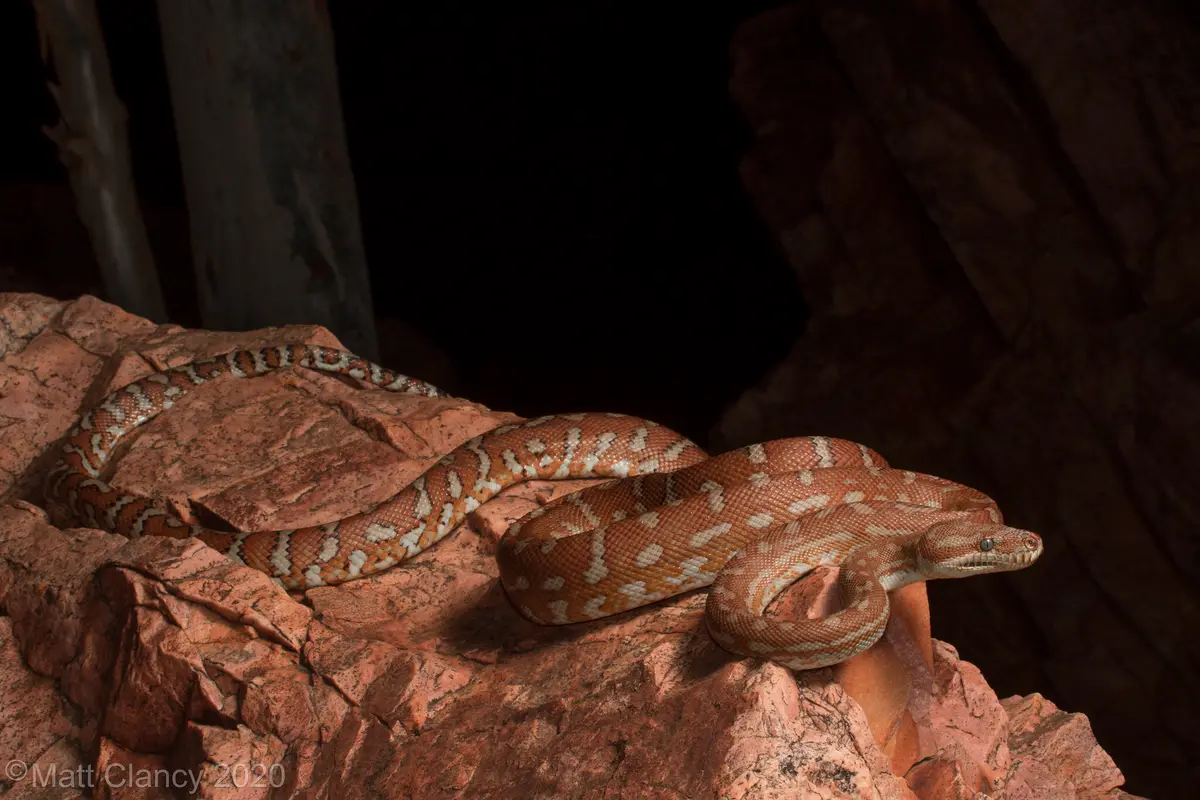
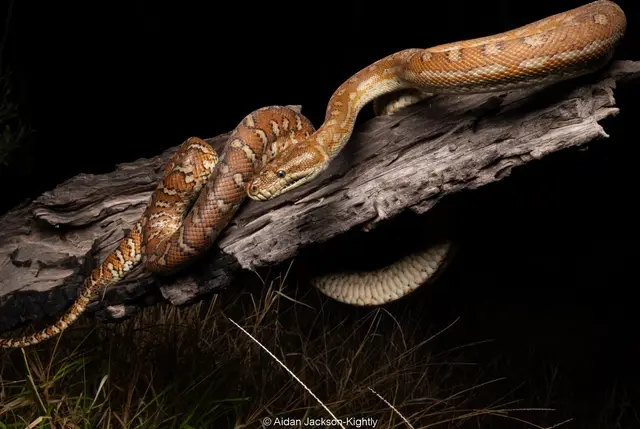
Bredl's python (Morelia bredli), also called the Centralian carpet python, is a non-venomous python found only in the rocky ranges of central Australia, mostly within about 125 miles (200 km) of Alice Springs. It is harmless to people. Adults are reddish brown with black-edged cream blotches and usually grow to about 6.5 ft (2 m).
- It has no venom. It holds prey with its teeth and kills by constriction.
- Most adults are around 6.5 ft (2 m) long; rare snakes reach about 10 ft (3 m).
- It lives in gorges, rocky hills and river red gum woodland, centered on the MacDonnell Ranges in the Northern Territory.
- It is a close relative of the carpet python and was once treated as one of its subspecies, Morelia spilota bredli.
Bredl's python quick facts
| Common name | Bredl's python (also Centralian carpet python, central carpet python) |
|---|---|
| Scientific name | Morelia bredli (Gow, 1981); described as Python bredli, sometimes listed as Morelia spilota bredli |
| Family | Pythonidae (pythons) |
| Venomous | No, a constrictor |
| Adult length | Average about 6.5 ft (2 m); rarely up to about 10 ft (3 m) |
| Weight | No reliable published figures for wild adults |
| Range | Southern Northern Territory, Australia, mainly the MacDonnell Ranges around Alice Springs |
| Habitat | Rocky hills, gorges and eucalypt woodland, especially along rivers |
| Diet | Mammals and birds as adults; lizards and frogs also recorded |
| Reproduction | Lays eggs; clutches of 13-47 reported; female coils around the eggs |
| Lifespan | Thought to be 20-30 years |
| Conservation | IUCN Least Concern (2017); CITES Appendix II |
How to identify a Bredl's python
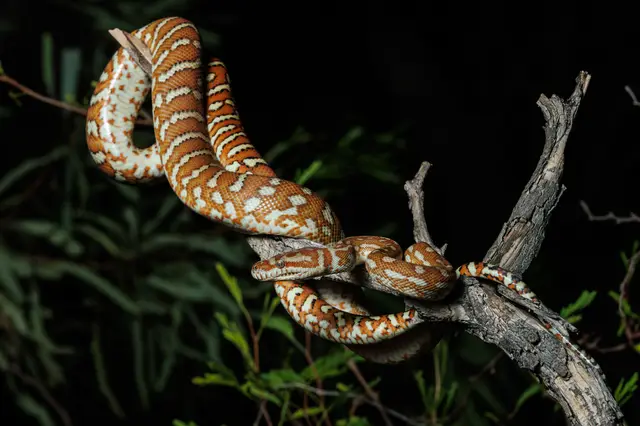
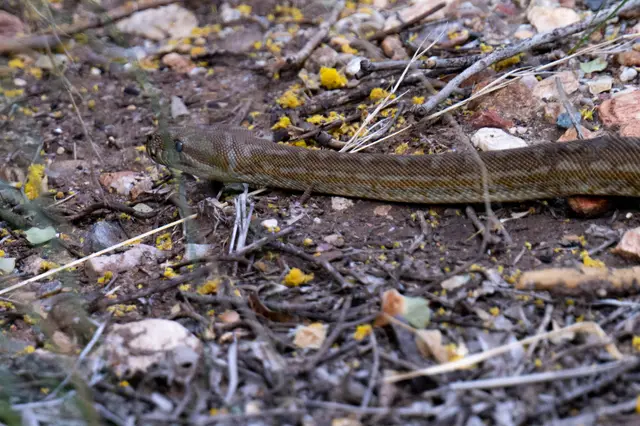
A Bredl's python is a solid, medium-sized python with a broad head and a rusty color that matches the red rock of central Australia. The Australian Reptile Online Database describes the body as dark orange-red to rusty brown, with irregular cream bands and blotches edged in black scales. The belly is white to pale yellow.
- 1Red to rust-brown body: the ground color runs from terracotta and orange-red to dark brown, redder than most carpet pythons.
- 2Black-edged cream blotches: irregular pale bands and patches, each outlined in black. The black edging spreads and gets heavier toward the tail.
- 3Head wider than the neck: a broad, distinct head covered in many small scales, not the large, neat plates of some other Australian pythons.
- 4Heat-sensing pits: small pits along the lips that detect the body heat of warm-blooded prey, a feature Niabi Zoo points out.
- 5Location: a large patterned python in the ranges near Alice Springs is very likely this species. AROD notes that no other Morelia python lives in its range.
For those who count scales, AROD gives 50-55 rows of dorsal scales at midbody, 280-310 belly scales, a single anal scale and 85-95 divided scales under the tail.
How big do Bredl's pythons get?
Most adult Bredl's pythons are about 6.5 ft (2 m) long. AROD gives an average total length of 200 cm, and Oakvale Wildlife gives the same figure. A few snakes grow larger. Rare individuals, mostly large captive males, are reported to approach 10 ft (3 m).
| Measure | Size | Source |
|---|---|---|
| Average adult length | About 6.5 ft (2 m) | AROD; Oakvale Wildlife |
| Rare maximum | About 10 ft (3 m) | Wikipedia; StarPythons summary of Mutton and Julander (2022) |
| Weight | Not published for wild snakes | None found |
It is a big snake by local standards. The other python that shares its rocky ranges, Stimson's python, averages about 3 ft (90 cm).
Where do Bredl's pythons live?
Short answer: only in central Australia, in the southern Northern Territory. Its range is centered on Alice Springs and the MacDonnell Ranges, and Oakvale Wildlife describes it as covering an area within about 125 miles (200 km) of the town.
The species was named from a snake caught at Pitchie Ritchie Park in Alice Springs, according to the Reptile Database. Wild sightings logged on iNaturalist come from the same area: Simpsons Gap, Standley Chasm, Ormiston Gorge and the rest of the West MacDonnell (Tjoritja) National Park to the west, and Trephina Gorge in the East MacDonnell Ranges.
AROD notes that Bredl's python is the only Morelia python in central Australia; carpet pythons do not occur there. See how its small range compares with other pythons on the world snake map.
Habitat
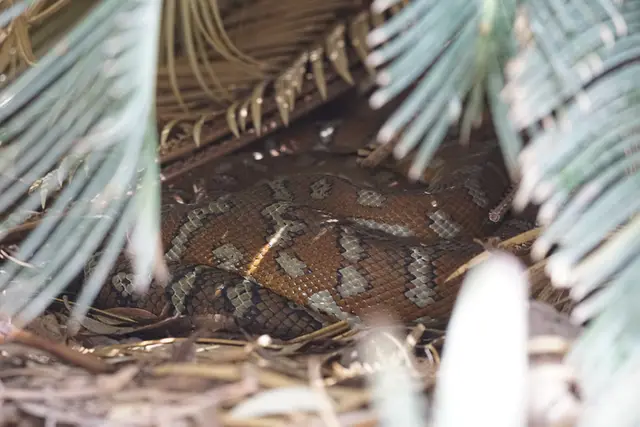
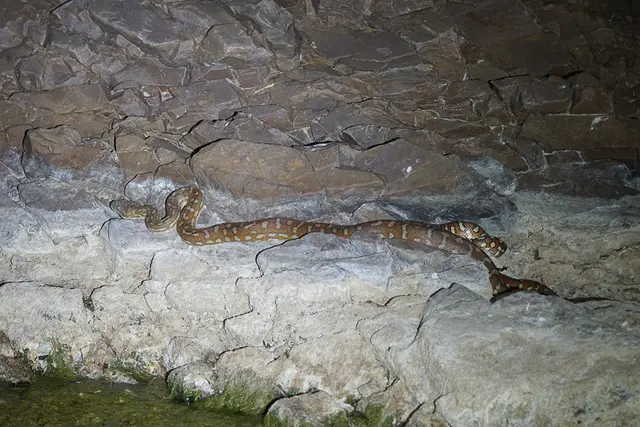
Bredl's pythons live among rocky hills and gorges and in the eucalypt woodland around them, especially along rivers, according to AROD. The big river red gums along dry creek beds give them hollows to climb into. Oakvale Wildlife lists caves, rabbit warrens and hollow trees as shelter.
Central Australia has summer days above 104 F (40 C) and winter nights that drop to around 41 F (5 C). Rock crevices, caves and tree hollows give the snake shelter from both.
Behavior
Bredl's python changes its daily routine with the seasons. Niabi Zoo notes it is mostly nocturnal in summer and active by day in spring and autumn, when nights get cold. In winter it basks in the warmest part of the day.
It moves easily on the ground and in trees. The Reptile Database lists it as partly arboreal, based on Harrington and colleagues (2018). Like other Australian pythons it is a sit-and-wait hunter. Bedford and Christian (1998, Australian Journal of Zoology) found that Australian pythons have very low metabolic rates, which lets them wait a long time between meals.
What do Bredl's pythons eat?
Adult Bredl's pythons eat mostly mammals and birds. AROD also lists lizards and frogs. Larger snakes can manage prey up to the size of a small wallaby.
| Prey | Examples | Source |
|---|---|---|
| Mammals | Small mammals, rabbits, introduced rodents, small rock wallabies | Niabi Zoo; Fyfe (1990) as summarized by StarPythons |
| Birds | Including hollow-nesting parrots | AROD; Fyfe (1990) as summarized by StarPythons |
| Reptiles and frogs | Lizards, frogs | AROD; Niabi Zoo |
| Near towns | Domestic cats | Niabi Zoo |
European rabbits are an introduced pest in central Australia, so this native python eats some of the animals that damage local habitat.
Is Bredl's python venomous or dangerous?
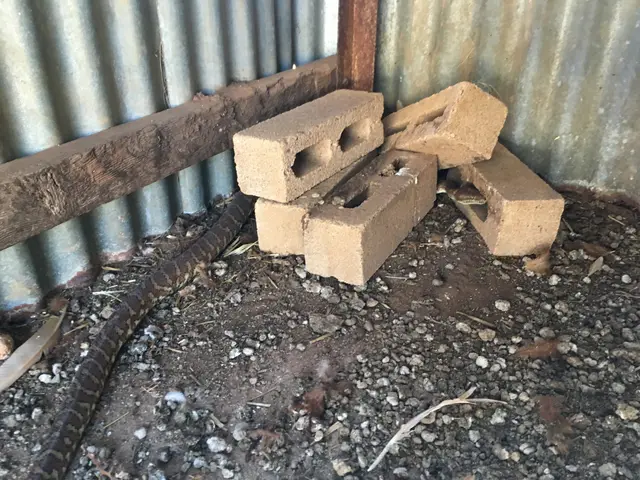
No. Bredl's python has no venom and is not dangerous to people. It kills prey by constriction, wrapping around an animal and squeezing until it dies. A 6.5 ft (2 m) python cannot overpower an adult person. It can look intimidating when it strikes. It is not a threat.
It can still bite. Pythons have rows of sharp, backward-curved teeth, and a defensive bite can leave several small cuts. AROD warns that bites from any reptile can become infected. Wash the bite with soap and water and see a doctor if it is deep or turns red and swollen.
Central Australia is also home to venomous snakes, including brown snakes and the mulga snake. Leave any snake alone unless you are certain of its identity. Our snake venom FAQ explains why color is a poor guide to whether a snake is dangerous.
Bredl's python vs Stimson's python, woma and carpet python
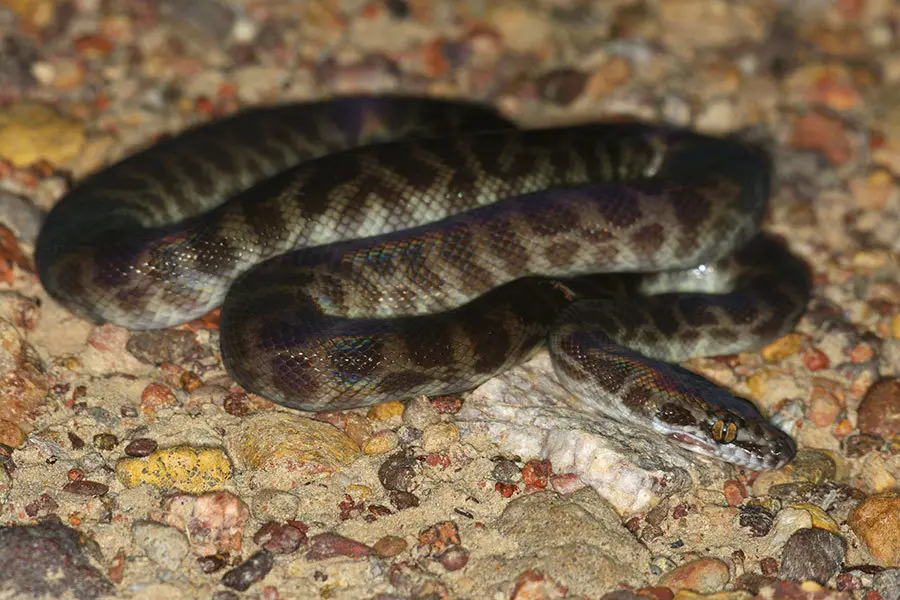
Stimson's python
Antaresia stimsoni · Harmless
Shares the MacDonnell Ranges but is far smaller, averaging about 3 ft (90 cm) according to AROD. Its dark blotches lack the black-edged cream markings, and a pale line often shows on the side of the neck where the blotches stop.
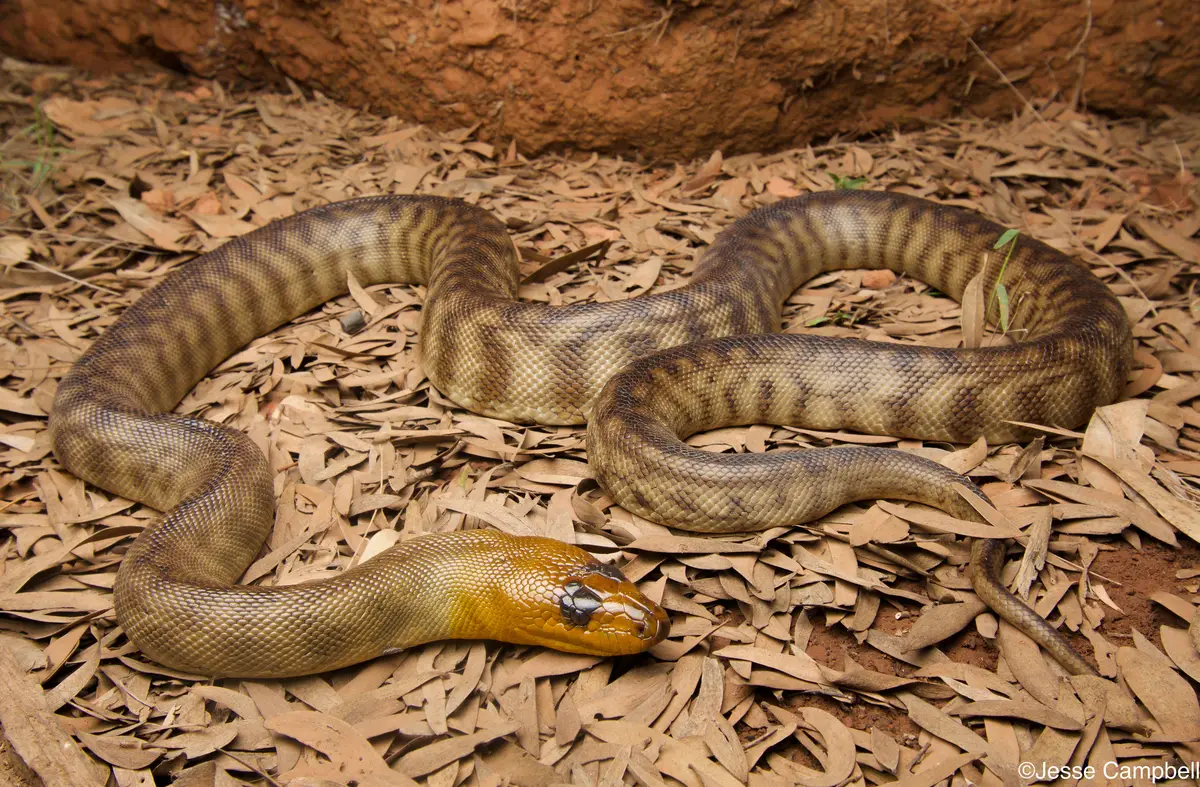
Woma
Aspidites ramsayi · Harmless
A desert python of the same region, found in sandy spinifex country, woodland and shrubland. AROD describes it as pale yellow or reddish brown with many darker crossbands, without black-edged cream blotches. It is a close relative of the black-headed python.
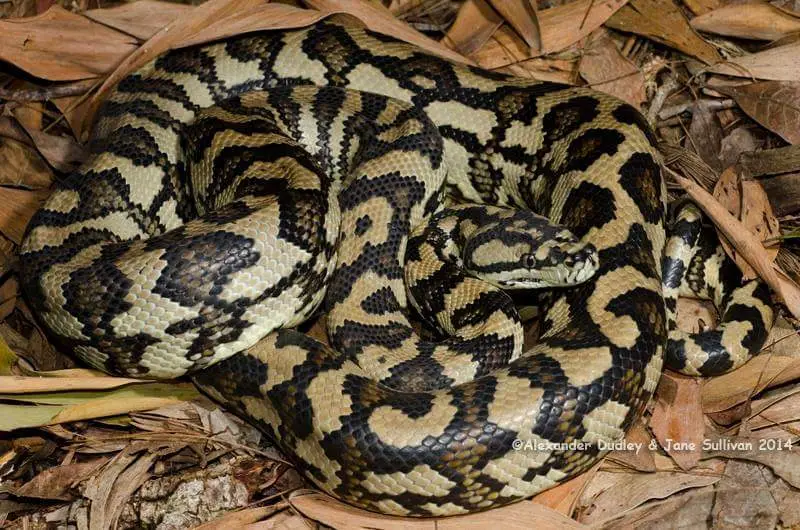
Carpet python
Morelia spilota · Harmless
Its closest relative, with a similar build and blotched pattern, but usually brown, olive or black and yellow rather than rust red. AROD notes that carpet pythons do not occur in central Australia, so location settles most cases.
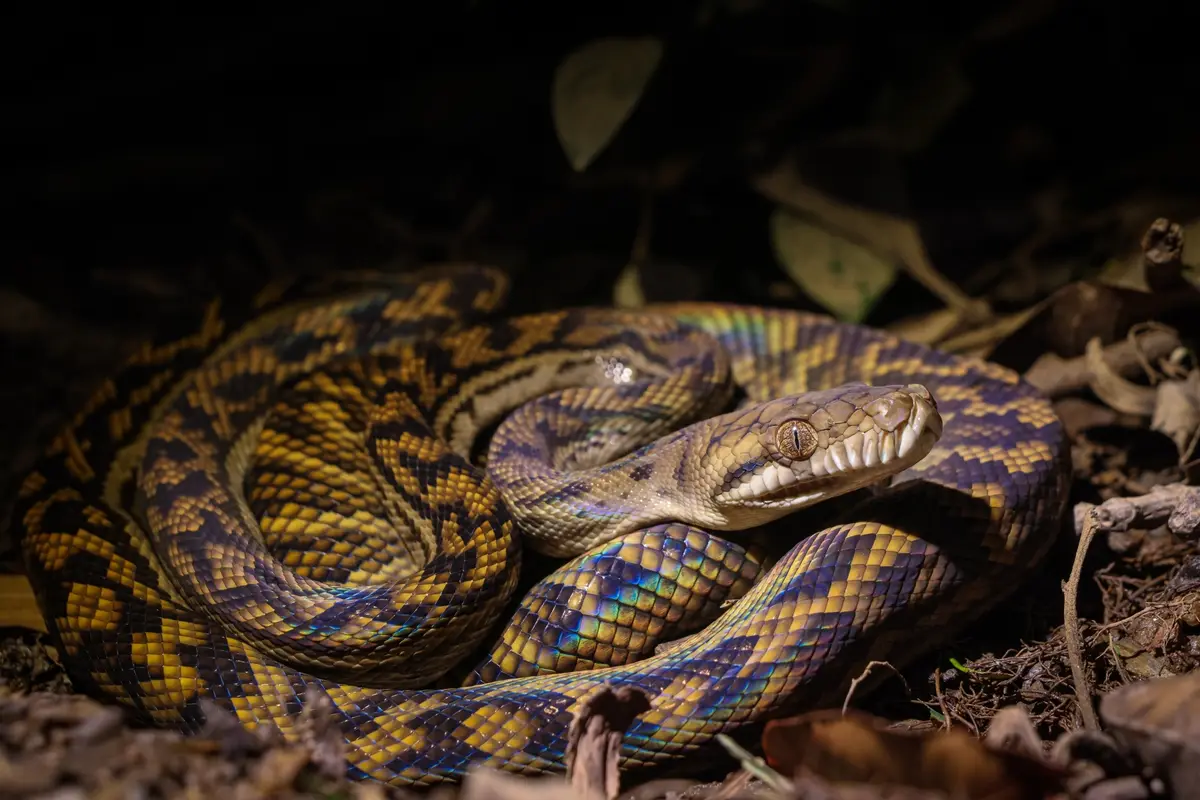
Australian scrub python
Simalia kinghorni · Harmless
Lives in rainforest in northeastern Queensland, nowhere near Bredl's range. The Australian scrub python has large, symmetrical scales on top of its head, while Bredl's python has many small, broken-up head scales.
Reproduction and lifespan
Bredl's pythons lay eggs. Oakvale Wildlife reports clutches of 13-47 eggs, laid in a tree hollow. The female coils around the clutch to keep it warm and protect it from predators until the eggs hatch.
Their lifespan has not been studied in detail. Oakvale Wildlife gives a general estimate of 20-30 years.
Is Bredl's python endangered?
No. The IUCN Red List rates Bredl's python Least Concern (2017 assessment by Cogger, Fenner, Hutchinson and McDonald), as shown on its GBIF species page. Its range is small, but within it the snake is familiar: the Discover Central Australia tourism site calls it one of the best-known snakes in the Northern Territory.
| Authority | Status |
|---|---|
| IUCN Red List | Least Concern (2017) |
| CITES | Appendix II, as are nearly all pythons |
Its name honors Josef "Joe" Bredl (1948-2007), a German-born Australian herpetologist who founded the Edward River Crocodile Farm in Queensland and ran Renmark Reptile Park in South Australia. Graeme Gow described the species in 1981. Some researchers, starting with Kluge in 1993, have treated it as part of the carpet python species, and the question is not fully settled. Most current checklists, including the Reptile Database, list it as its own species.
Bredl's python FAQ
Is Bredl's python venomous?
No. Bredl's python has no venom and kills its prey by constriction. It is not a danger to people. A defensive bite from its many sharp teeth can cut the skin, so clean any bite with soap and water and see a doctor if it is deep or looks infected. Central Australia does have venomous snakes, so do not handle any snake you cannot identify.
How big does a Bredl's python get?
Most adults are about 6.5 feet (2 m) long, the average length given by the Australian Reptile Online Database. A few individuals reach about 10 feet (3 m), but that is rare. No reliable weights for wild adults have been published.
Where do Bredl's pythons live in the wild?
Bredl's pythons live only in the southern Northern Territory of Australia, mainly in the MacDonnell Ranges within about 125 miles (200 km) of Alice Springs. They use rocky hills, gorges and eucalypt woodland along rivers, and shelter in caves, rock crevices, rabbit warrens and tree hollows.
Is Bredl's python the same as a carpet python?
It is a close relative. Bredl's python was described as its own species in 1981, and later some authors treated it as a carpet python subspecies, Morelia spilota bredli. The Reptile Database and most current checklists list it as a separate species, Morelia bredli, though its status is still debated.
What does a Bredl's python eat?
Adults eat mostly mammals and birds, including rabbits, rodents, hollow-nesting parrots and small rock wallabies. Near towns they have taken domestic cats. Lizards and frogs are also recorded. Like other pythons, they ambush prey and kill it by constriction.
Why is it called Bredl's python?
It is named after Josef "Joe" Bredl (1948-2007), a German-born Australian herpetologist who founded a crocodile farm and ran Renmark Reptile Park in South Australia. Graeme Gow named the species Python bredli in 1981 from a snake collected in Alice Springs.
Related snakes
Sources
- Reptile Database: Morelia bredli
- Australian Reptile Online Database: Centralian carpet python (Morelia bredli)
- GBIF: Morelia bredli (Gow, 1981)
- Oakvale Wildlife: Centralian carpet python
- Niabi Zoo: Bredl's python
- StarPythons: Morelia bredli, Centralian carpet python
- Bedford and Christian (1998). Standard metabolic rate and preferred body temperatures in some Australian pythons. Australian Journal of Zoology 46: 317-328
- Australian Reptile Online Database: Stimson's python (Antaresia stimsoni)