COASTAL CARPETPYTHON
Morelia spilota mcdowelli · Family Pythonidae
KEY TAKEAWAYS
The coastal carpet python (Morelia spilota mcdowelli) is a large, non-venomous python of eastern Queensland and northeastern New South Wales, and the snake people in Brisbane most often find in their roof. It is a subspecies of the carpet python. It can bite hard, but it has no venom and is not dangerous to adults.
- It has no venom. It kills prey by constriction, and a bite needs only cleaning and a tetanus check.
- Most adults are 6.5-8 ft (2-2.5 m) long; a few reach about 13 ft (4 m).
- It lives from Cape York down the coast to northern New South Wales, in rainforest, eucalypt forest, farms and suburbs.
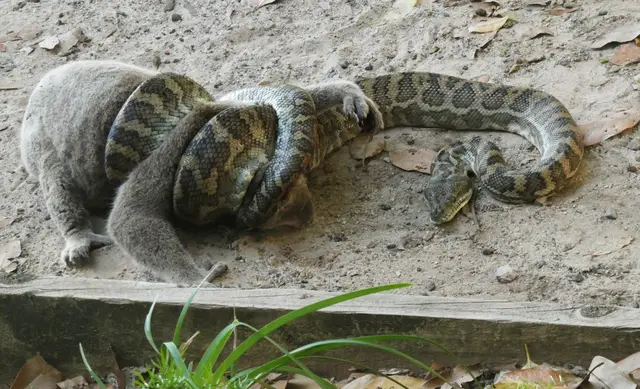
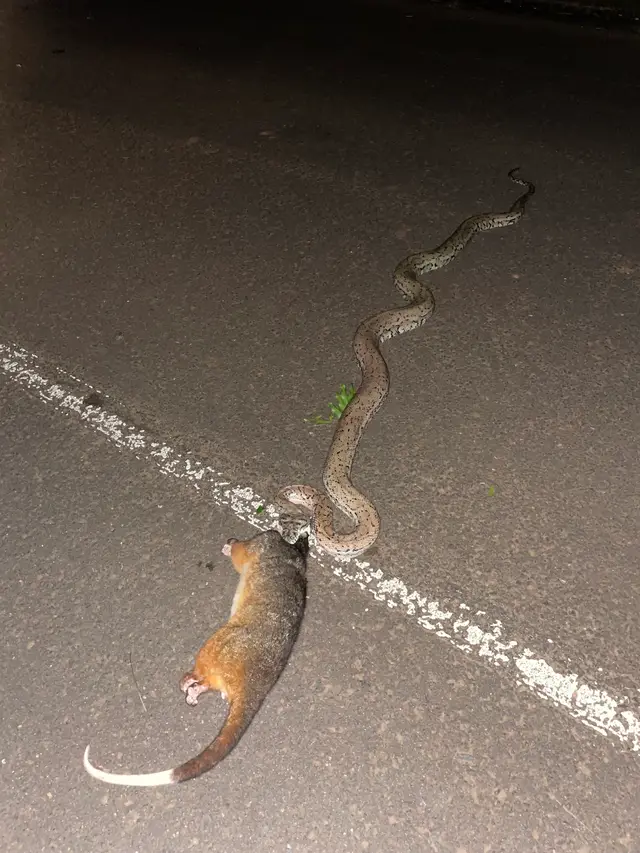
- It eats rats, possums, birds and sometimes pet cats and poultry, which is why many end up in backyards and ceilings.
Coastal carpet python quick facts
| Common name | Coastal carpet python (also McDowell's carpet python, eastern carpet python, carpet snake) |
|---|---|
| Scientific name | Morelia spilota mcdowelli Wells and Wellington, 1984; a subspecies of the carpet python, Morelia spilota (Lacepede, 1804) |
| Family | Pythonidae (pythons) |
| Venomous | No, a constrictor |
| Adult length | Usually 6.5-8 ft (2-2.5 m); rarely up to about 13 ft (4 m) |
| Weight | Large Brisbane carpet pythons reach about 24 lb (11 kg) |
| Range | From northern Cape York through eastern Queensland to northeastern New South Wales |
| Habitat | Rainforest, open forest, coastal heath, farmland, parks and suburbs |
| Diet | Mainly mammals and birds; lizards and frogs, mostly when young |
| Reproduction | Lays eggs; clutches of about 10-50; the female coils around them |
| Conservation | Species rated IUCN Least Concern; Least Concern in Queensland |
How to identify a coastal carpet python
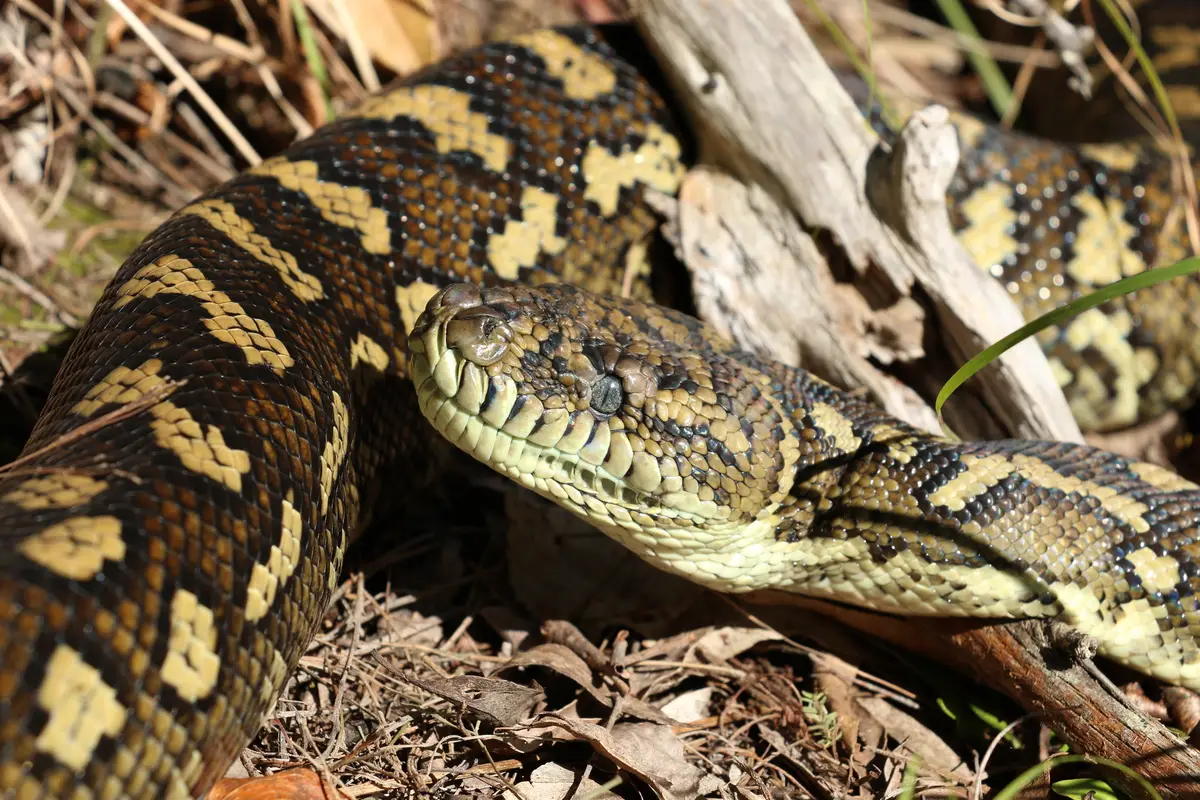
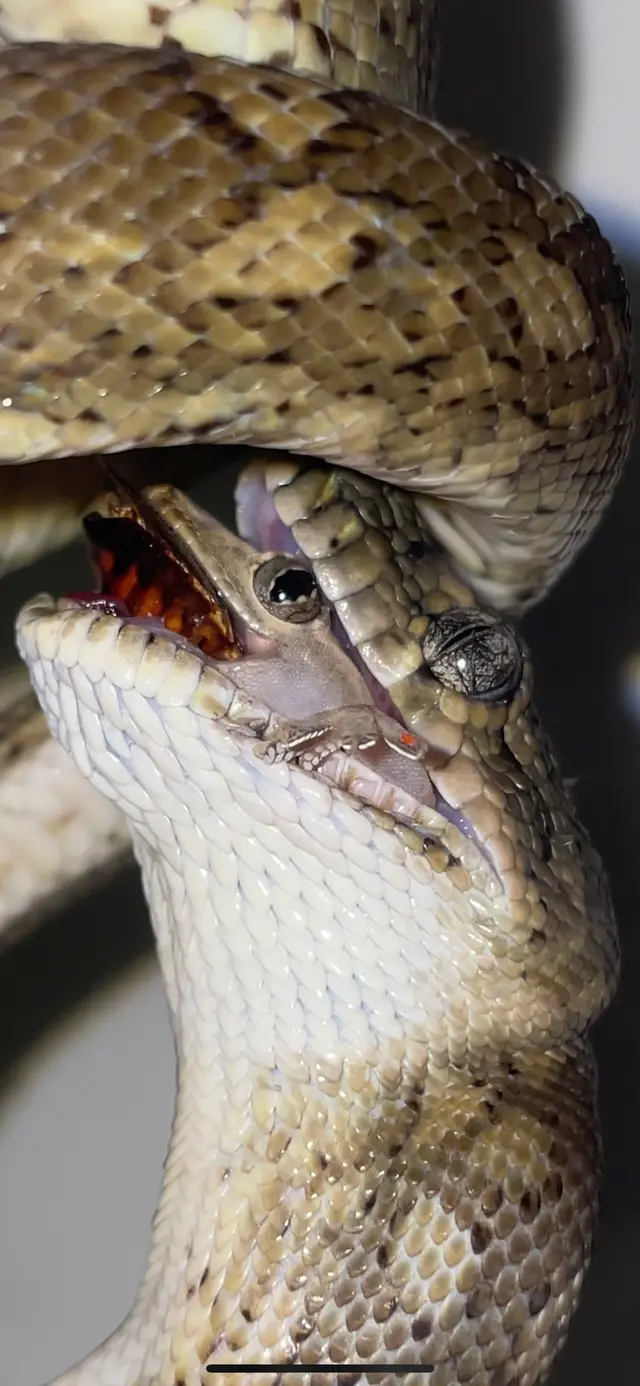
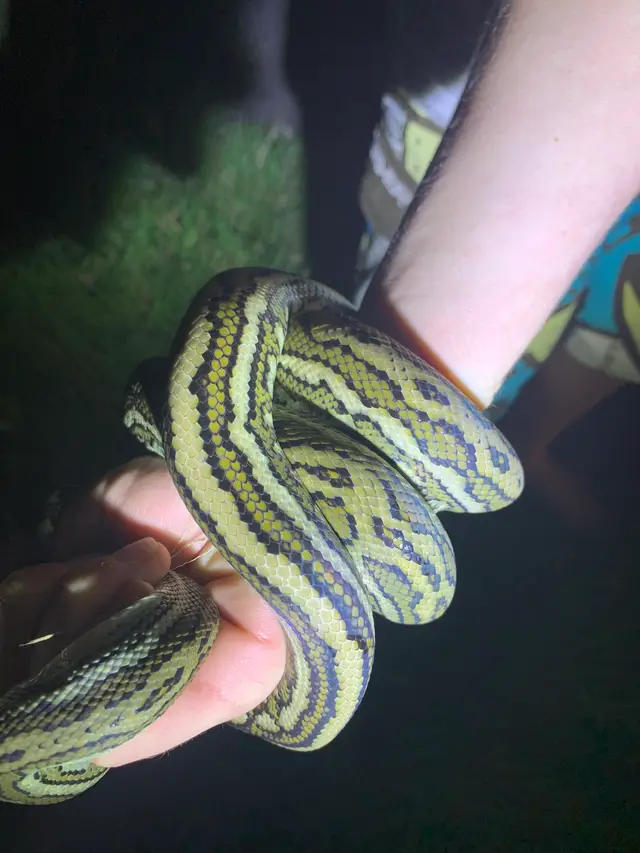
A coastal carpet python is a heavy, patterned snake with a broad head and a body covered in pale, dark-edged blotches. Color varies a lot. The Queensland Museum calls carpet snakes extremely variable and says most are olive green with pale blotches, stripes or cross-bands edged in black. Young snakes tend to be brown rather than olive.
- 1Blotched carpet pattern: pale cream to yellow blotches and bands, each outlined in darker scales, over an olive, brown or gray background. The pattern looks like an old patterned rug, which is where the name comes from.
- 2Wide head on a slim neck: the head is clearly broader than the neck and topped with many small, irregular scales rather than a few big plates.
- 3Pits along the lips: a row of deep heat-sensing pits runs along the lower jaw. Venomous Australian snakes do not have these.
- 4Size and bulk: most adults are 6.5-8 ft (2-2.5 m) and thick-bodied. Few other snakes in coastal Queensland get this big.
- 5Where it turns up: in roof spaces, chicken pens, sheds and trees around houses. A large, slow, patterned snake in a Brisbane ceiling is almost always this python.
For those who count scales, the Queensland Museum gives the carpet python 40-65 rows of scales at midbody, 240-310 narrow belly scales, a single anal scale and 60-95 divided scales under the tail.
How big do coastal carpet pythons get?
Most adult coastal carpet pythons are 6.5-8 ft (2-2.5 m) long. The Queensland Government says carpet pythons can reach 13 ft (4 m) but most do not exceed 8 ft (2.5 m). Land for Wildlife South East Queensland calls this the largest carpet python subspecies, and gives a typical adult length of 2-2.5 m.
| Measure | Size | Source |
|---|---|---|
| Typical adult length | 6.5-8 ft (2-2.5 m) | Queensland Government; Land for Wildlife SEQ |
| Maximum length | About 13 ft (4 m) | Queensland Government; Fearn et al. (2001) |
| Maximum weight | About 24 lb (11 kg) | Fearn et al. (2001), Brisbane and Ipswich |
| Hatchling | About 12 in (30 cm) | Land for Wildlife SEQ |
Males are the bigger sex. In a six-year study of 258 pythons collected from Brisbane and Ipswich, Fearn and colleagues (2001, Wildlife Research) found adult males were larger and heavier-bodied than females. They linked this to the wrestling contests males fight in the breeding season, where weight helps.
Where do coastal carpet pythons live?
Short answer: along Australia's east coast, from Cape York Peninsula through eastern Queensland to northeastern New South Wales. The Reptile Database gives the range as northern Cape York through Queensland to northern New South Wales.
It is one of several carpet python subspecies. The jungle carpet python holds the Wet Tropics of northeastern Queensland, and the diamond python lives south of it in eastern New South Wales and northeastern Victoria. The Australian Reptile Online Database notes that the coastal form interbreeds with the diamond python where they meet, so snakes from that zone can look like a mix of both. Compare its range with other pythons on the world snake map.
Habitat
Coastal carpet pythons live almost anywhere with cover and prey. The Queensland Museum lists open forest, rainforest, coastal heath, farmland, parks and suburban gardens. Land for Wildlife SEQ notes that the subspecies copes well with land people have changed and often lives in heavily built-up areas.
Houses suit them. A roof space is warm and full of rats and possums. The Queensland Government advises looking for carpet pythons in undergrowth, in tree branches and on house and shed roofs, and the Queensland Museum says they turn up in chicken pens, barns and attics.
Behavior
Coastal carpet pythons are active by day and night, climb well and spend a lot of time sitting still. They are ambush hunters. The Queensland Government notes they wait for prey to pass, then track it with the heat-sensing pits on their jaw.
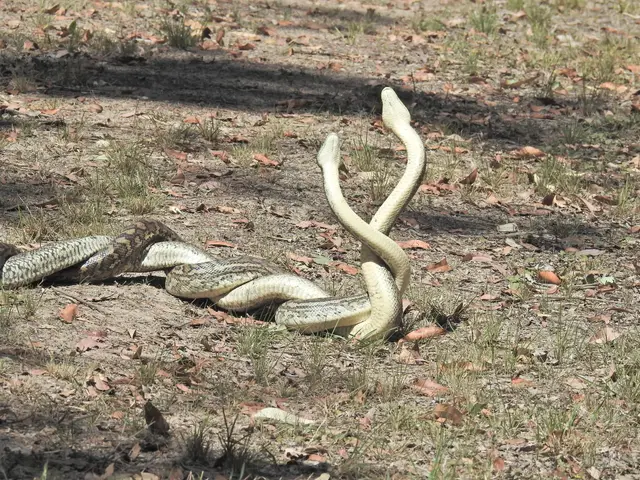
They do not shut down for winter in the subtropics. In the Brisbane and Ipswich study by Fearn and colleagues, pythons were active and feeding all year. Activity still climbs in spring, when males go looking for females and fight each other. Land for Wildlife SEQ describes rival males twisting and pushing each other to the ground until one gives up, a contest people often mistake for mating.
Most are calm if left alone. A cornered snake, or one disturbed while digesting a meal, will strike.
What do coastal carpet pythons eat?
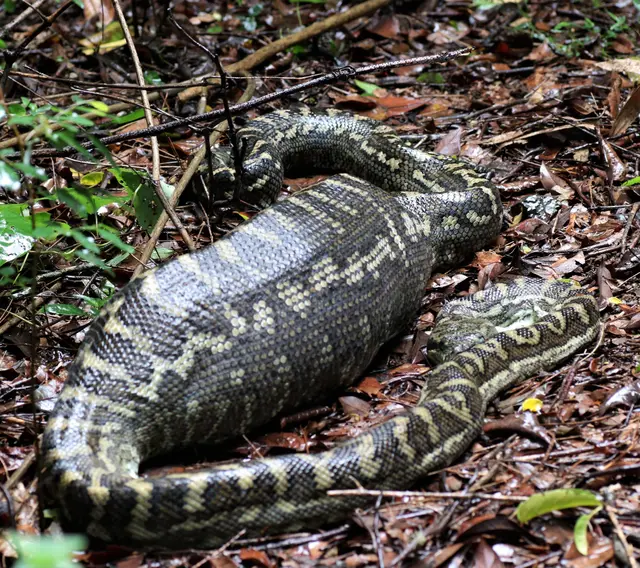
Adults eat mostly warm-blooded animals: rats, possums and birds. What a python eats depends on its size. In the Brisbane study, one small snake had eaten a lizard, medium snakes ate mostly mice, rats and parrots, and the biggest took cats, brushtail possums and poultry.
| Prey | Examples | Source |
|---|---|---|
| Rodents | Mice and rats, including introduced species around houses | Fearn et al. (2001); Queensland Government |
| Possums | Common brushtail possums | Fearn et al. (2001) |
| Birds | Parrots, cage birds and poultry | Fearn et al. (2001) |
| Pets | Domestic cats, taken by large snakes | Fearn et al. (2001) |
| Lizards and frogs | Mostly eaten by young snakes | Queensland Government; Land for Wildlife SEQ |
Cane toads are a problem. The Queensland Museum notes that carpet pythons sometimes eat them and die from the toxin. Brown, Hemphill and Shine (2021, Australian Zoologist) recorded one such death near Darwin, but they also found that python numbers at that site had doubled since toads arrived, probably because toads killed off the large monitor lizards that eat and compete with pythons.
Is the coastal carpet python venomous or dangerous?
No. The coastal carpet python has no venom and is not dangerous to adults. It kills by constriction, coiling around prey and squeezing. The Queensland Government lists carpet pythons as non-venomous, and the Queensland Museum agrees.
The bite still hurts. Land for Wildlife SEQ says a carpet python has around 100 sharp, backward-curving teeth, and a big snake can leave deep cuts. Wash the bite with soap and water, and check your tetanus protection. The Queensland Museum recommends tetanus cover after a bite. See a doctor if the wound is deep or becomes red and swollen.
Eastern Australia also has dangerously venomous snakes, including the eastern brown snake. If you are not certain a snake is a python, keep away and call a licensed snake catcher. Our snake venom FAQ explains why color and pattern are a poor guide to danger.
Do not kill a python in your roof. Carpet pythons are protected native wildlife in Queensland, and a python that eats rats is doing you a favor. If it has to go, a licensed catcher can move it.
Coastal carpet python vs diamond python, spotted python and scrub python
Diamond python
Morelia spilota spilota · Harmless
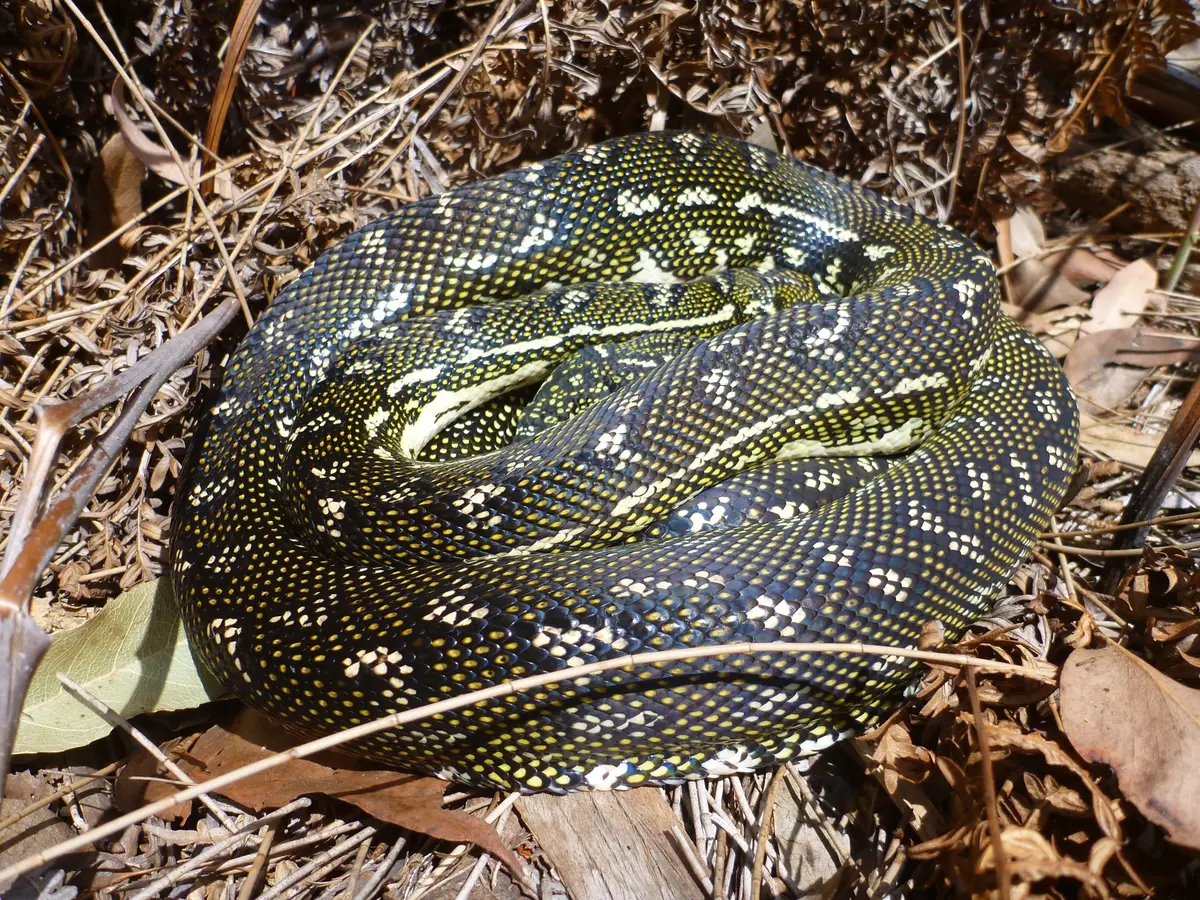
The southern subspecies, which AROD places from about Gosford in New South Wales to northeastern Victoria. It is usually much darker, black or dark olive with cream or yellow spots that cluster into diamond-like rosettes. Where the two meet in New South Wales, the subspecies interbreed and intermediate snakes occur.
Spotted python
Antaresia maculosa · Harmless
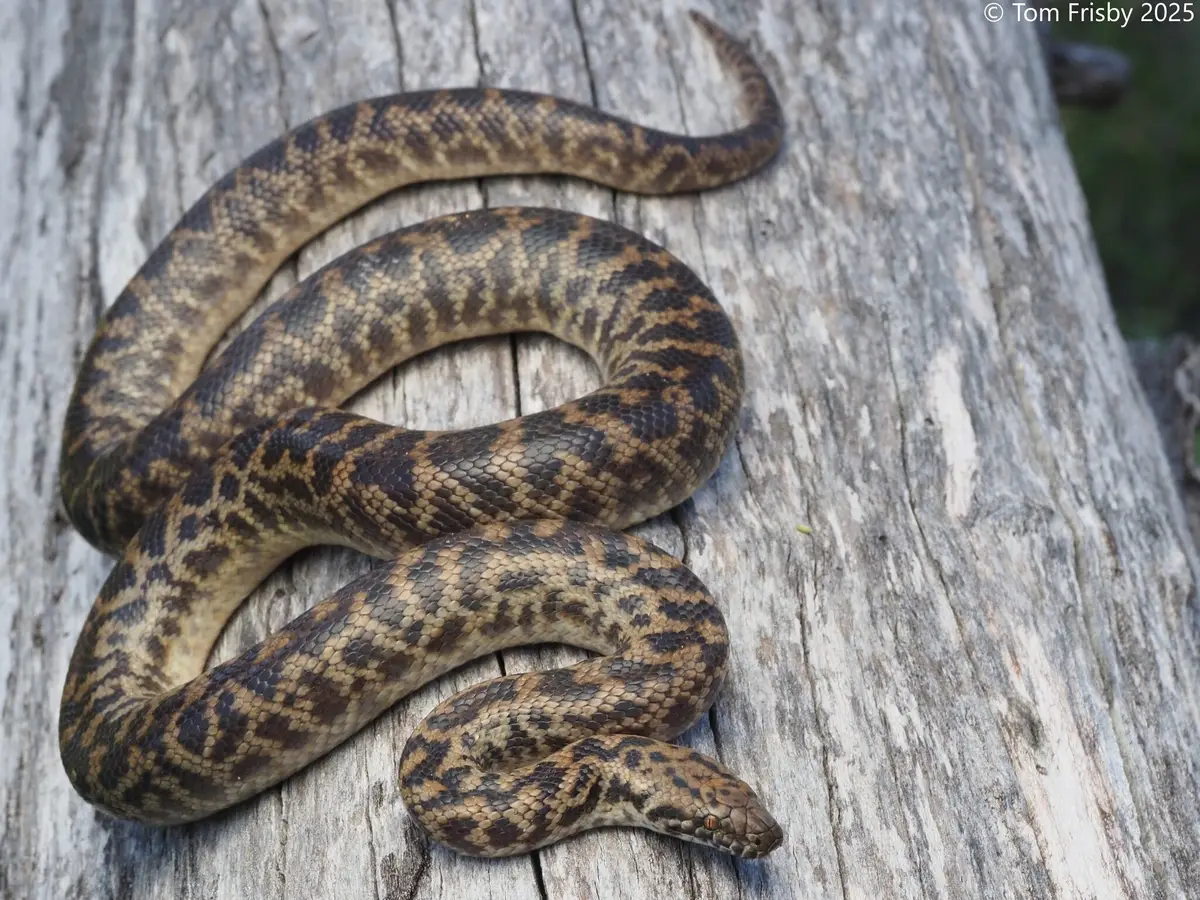
The Queensland Museum names it as the snake most like the carpet python. It is fawn to brown with many dark purplish-brown blotches, much smaller as an adult, and has three scales in a straight line across the top of the head between the eyes.
Australian scrub python
Simalia kinghorni · Harmless
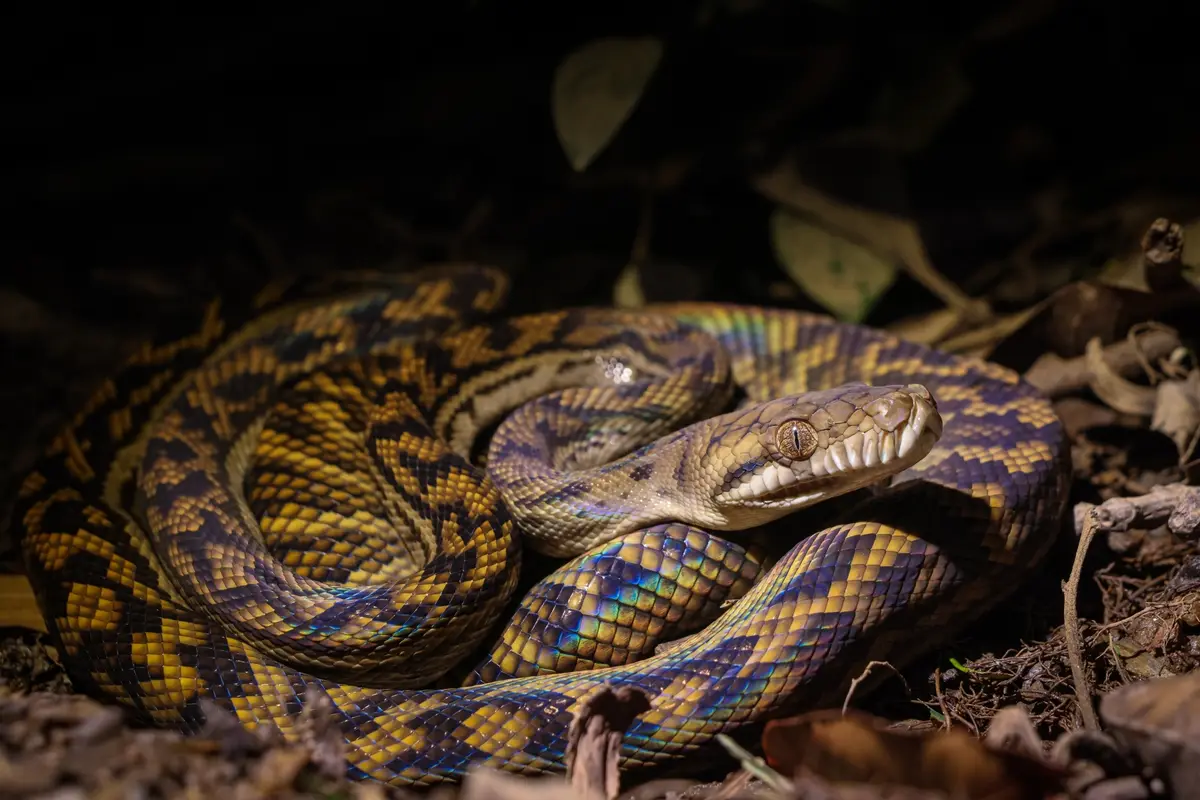
Shares rainforest with carpet pythons in northeastern Queensland. The Australian scrub python is slimmer, and AROD notes it has large scales on top of the head, where a carpet python has many small ones. It is the Australian relative of the amethystine python.
Bredl's python
Morelia bredli · Harmless
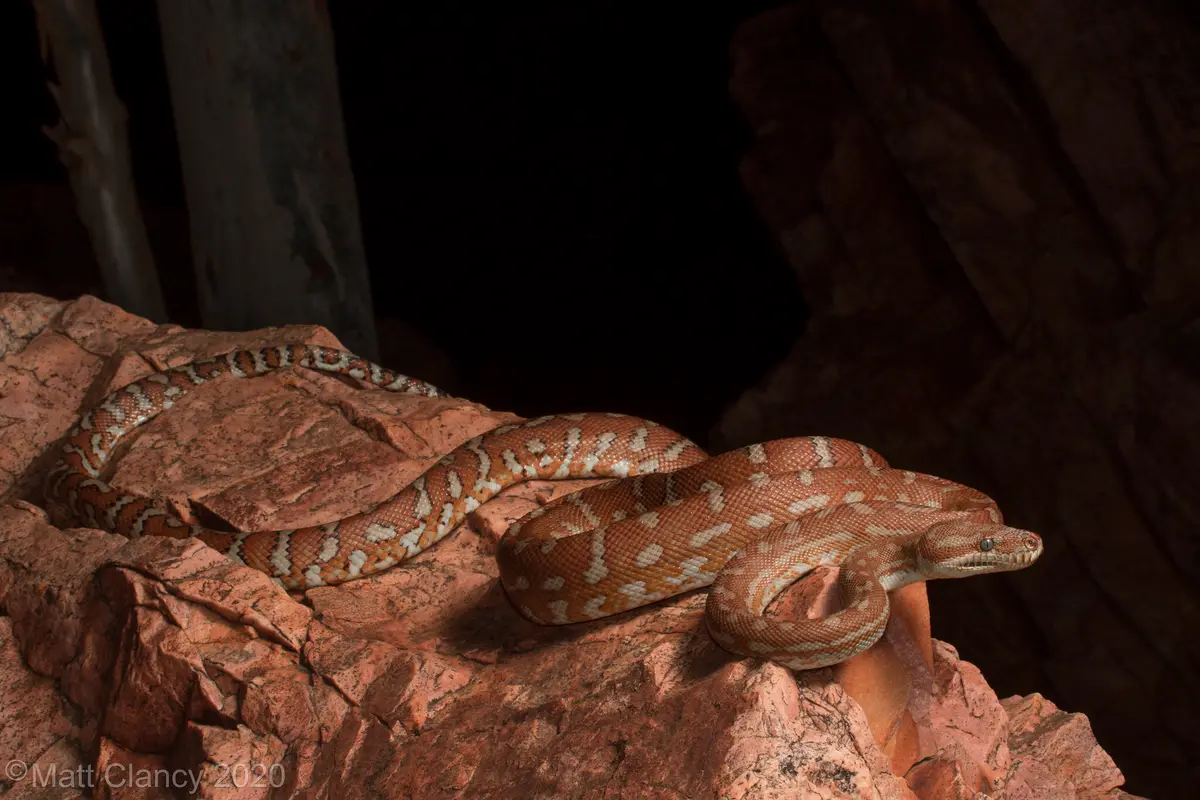
A close relative with a similar build and blotched pattern, but rust red and found only in central Australia around Alice Springs. Bredl's python never meets the coastal carpet python in the wild.
Reproduction and lifespan
Coastal carpet pythons mate from late winter into spring, and females lay eggs in late spring or early summer. Land for Wildlife SEQ reports clutches of 10-50 leathery eggs; the Queensland Museum gives 10-47 for carpet pythons in general, laid under building materials, between hay bales or in a hollow stump.
The female coils around her eggs and keeps them warm. She leaves to bask in the morning sun, comes back hot, and shivers her muscles to make more heat, according to the Queensland Museum. Land for Wildlife SEQ notes she does not eat during this time and can lose up to a quarter of her body weight.
Eggs usually hatch after about 8 weeks, though cool weather slows them down; Land for Wildlife SEQ cites one female on Mt Glorious that sat on her eggs for 111 days. The hatchlings are on their own from the start. Garden compost heaps and mulch piles make good nest sites, so check them before you spread them in summer.
No reliable lifespan figure for wild coastal carpet pythons has been published.
Is the coastal carpet python endangered?
No. The carpet python, Morelia spilota, is rated Least Concern by the IUCN, and the Queensland Government lists it as Least Concern under the state's Nature Conservation Act 1992. The coastal subspecies does well even in cities, as the Brisbane studies show.
| Authority | Status |
|---|---|
| IUCN Red List | Least Concern (species Morelia spilota) |
| Queensland | Least Concern, Nature Conservation Act 1992 |
| CITES | Appendix II, as are nearly all pythons |
Its main threats are cars, clearing of habitat and cane toads, according to Land for Wildlife SEQ. Adults have few natural predators.
The name honors herpetologist Dr Samuel B. McDowell. Wells and Wellington described it in 1984 as a full species, Morelia mcdowelli. The Reptile Database and GBIF now treat it as a carpet python subspecies, though AROD notes the status of all the subspecies is still unsettled.
Coastal carpet python FAQ
Is the coastal carpet python venomous?
No. The coastal carpet python has no venom and kills prey by constriction. The Queensland Government and the Queensland Museum both list carpet pythons as non-venomous. A bite from a large snake can still cause deep cuts, so wash it well, check your tetanus protection and see a doctor if it becomes infected.
How big does a coastal carpet python get?
Most adults are 6.5-8 feet (2-2.5 m) long. The Queensland Government says carpet pythons can reach about 13 feet (4 m), though that is rare. Large Brisbane carpet pythons studied by Fearn and colleagues in 2001 reached about 24 pounds (11 kg). Males are usually larger and heavier than females.
Why is there a python in my roof?
Roof spaces are warm, and rats and possums live in them. Pythons follow that food in, often by climbing trees that touch the house. The snake is harmless to people. Trim overhanging branches and seal gaps to keep them out, and call a licensed snake catcher if one needs to be moved.
Will a coastal carpet python eat my cat or dog?
It can eat a cat or a very small dog, but only a large python manages it. In the Brisbane and Ipswich study, the biggest snakes ate cats, possums and poultry, and many were reported after taking a pet or cage bird. Keep small pets, birds and chickens in secure, snake-proof enclosures at night.
What is the difference between a coastal carpet python and a diamond python?
They are two subspecies of the same species, Morelia spilota. The diamond python lives further south, in eastern New South Wales and northeastern Victoria, and is mostly black with yellow or cream spots. The coastal carpet python is olive, brown or gray with larger pale blotches. Snakes where the ranges meet can look like both.
Related snakes
Sources
- Reptile Database: Morelia spilota, including subspecies mcdowelli
- Queensland Museum: Carpet snake or carpet python (Morelia spilota)
- Queensland Government: Carpet python
- Australian Reptile Online Database: Carpet python (Morelia spilota) and subspecies
- Land for Wildlife South East Queensland: Coastal carpet pythons (2026)
- Fearn, Robinson, Sambono and Shine (2001). Pythons in the pergola: the ecology of 'nuisance' carpet pythons from suburban habitats in south-eastern Queensland. Wildlife Research 28: 573-579
- Brown, Hemphill and Shine (2021). The uneasy coexistence between carpet pythons and cane toads. Australian Zoologist 41: 214-219
- GBIF: Morelia spilota mcdowelli Wells and Wellington, 1984