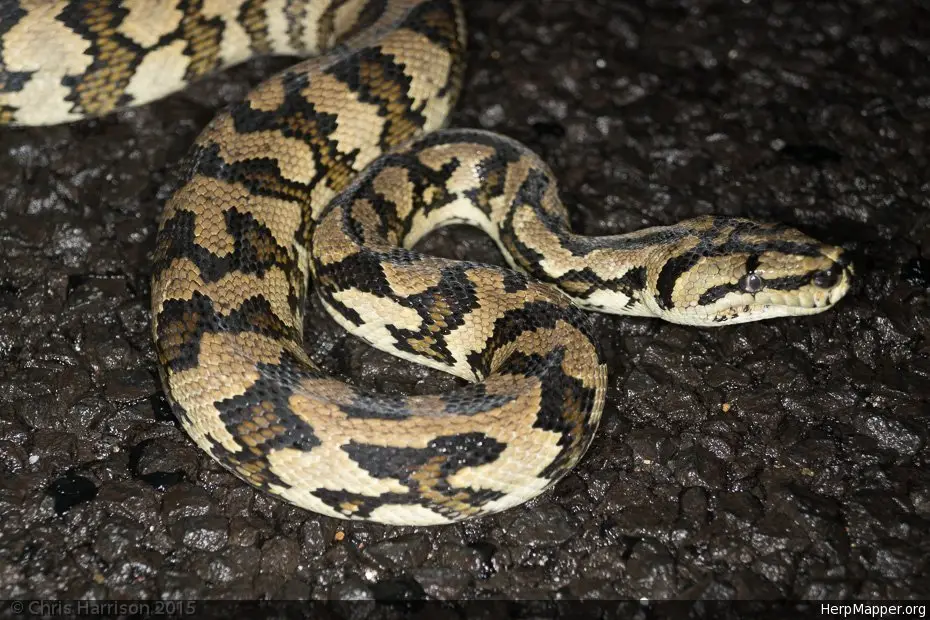
JUNGLE CARPETPYTHON
Morelia spilota cheynei · Family Pythonidae
KEY TAKEAWAYS
The jungle carpet python (Morelia spilota cheynei) is a medium-sized, non-venomous python from the Wet Tropics rainforests of northeastern Queensland, Australia. It is the rainforest form of the carpet python, famous for its black and yellow coloring. It can bite, but it has no venom and is not dangerous to adults.
- It has no venom. It kills prey by constriction, and a bite needs cleaning and a tetanus check, not antivenom.
- Most adults are 5-7 ft (1.5-2.1 m) long; some females reach about 8.5 ft (2.6 m).
- In the wild it lives only in a small area of north Queensland, from the Atherton Tableland into southeastern Cape York Peninsula.
- A 2026 study argues it is a color form rather than a true subspecies, so its name may change.
Jungle carpet python quick facts
| Common name | Jungle carpet python (also jungle python) |
|---|---|
| Scientific name | Morelia spilota cheynei Wells and Wellington, 1984; a subspecies of the carpet python, Morelia spilota (Lacepede, 1804) |
| Family | Pythonidae (pythons) |
| Venomous | No, a constrictor |
| Adult length | Usually 5-7 ft (1.5-2.1 m); some females reach about 8.5 ft (2.6 m) |
| Coloring | Black with bright yellow bands and blotches, or tan and black; white belly |
| Range | Wet Tropics of northeastern Queensland, from the Atherton Tableland to southeastern Cape York Peninsula |
| Habitat | Tropical rainforest and forest edges, often near creeks and rivers |
| Diet | Small mammals, birds, frogs and lizards |
| Reproduction | Lays eggs; clutches of about 10-25; the female coils around them |
| Conservation | Species rated IUCN Least Concern; Least Concern in Queensland |
How to identify a jungle carpet python
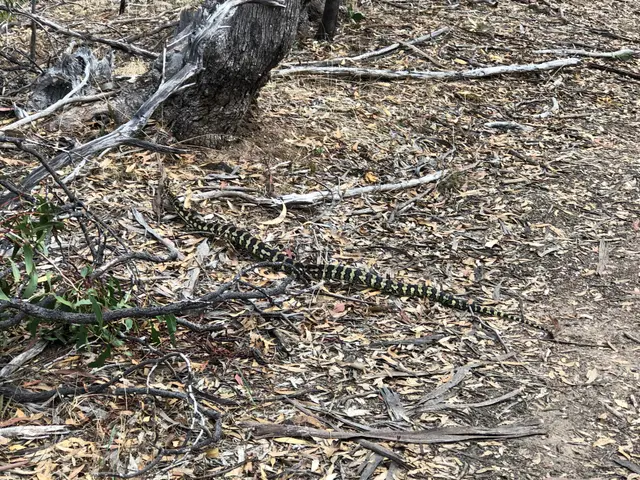
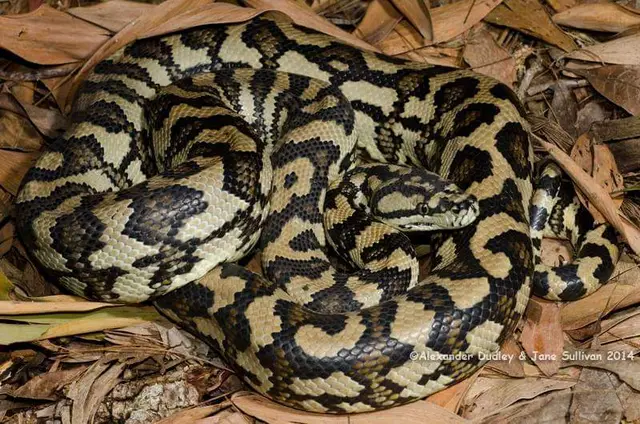
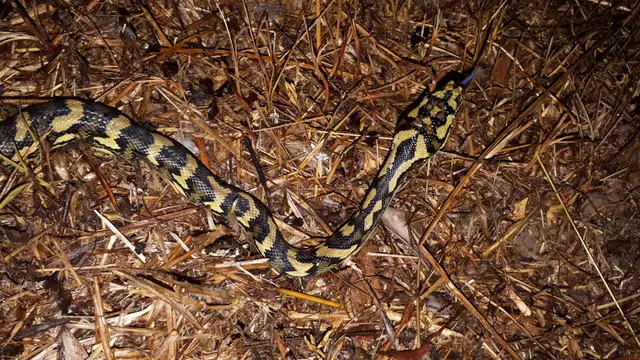
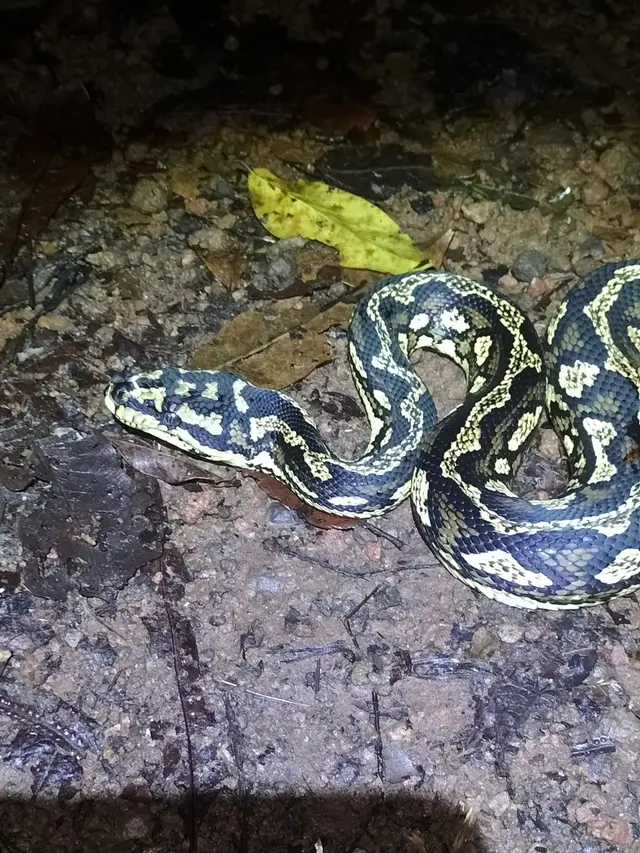
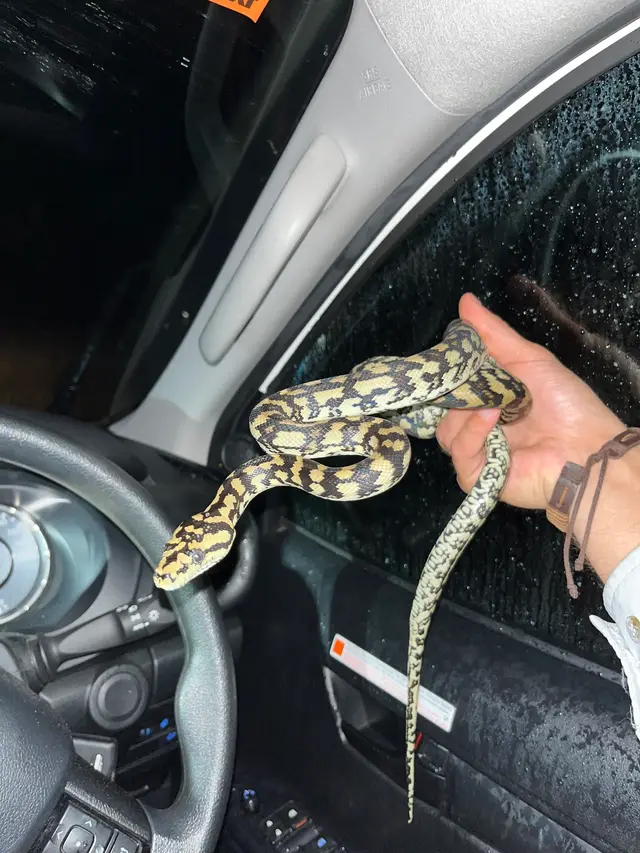
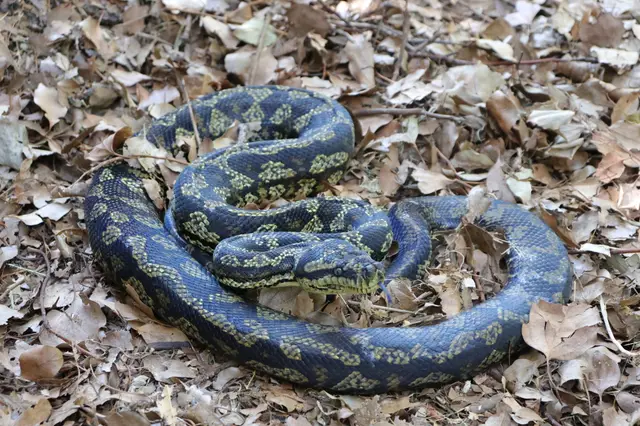
A jungle carpet python is a slim-necked, broad-headed python with a sharp black and yellow pattern. The Australian Reptile Park describes the best examples as brilliant yellow and black, and notes that some are tan and black instead. The belly is normally white. Other carpet pythons in Queensland are mostly olive or brown with pale blotches, so a strongly contrasting black and yellow snake in the Wet Tropics is a good sign you are looking at this form.
- 1Black and yellow pattern: bold yellow or golden bands, stripes and blotches on a black background. Some snakes are tan and black. The pattern breaks up the body outline among leaves and branches.
- 2Wide head on a slim neck: the head is clearly broader than the neck. The Queensland Museum notes that carpet pythons have many small scales on top of the head rather than a few big plates.
- 3Pits along the lower jaw: a row of deep heat-sensing pits runs along the lower lip. Venomous Australian snakes do not have them.
- 4Medium size: most adults are 5-7 ft (1.5-2.1 m), smaller than many other carpet pythons. Females are usually the bigger sex.
- 5Rainforest setting: it climbs well and is often found in trees along creeks and rivers in north Queensland rainforest.
Scale counts are the same as for other carpet pythons. The Queensland Museum gives the species 40-65 rows of scales at midbody, 240-310 narrow belly scales, a single anal scale and 60-95 divided scales under the tail.
How big do jungle carpet pythons get?
Most adult jungle carpet pythons are 5-7 ft (1.5-2.1 m) long. The Australian Reptile Park and the Queensland Government's Toohey Forest Environmental Education Centre both give that range, and Toohey Forest adds that some females reach 8.5 ft (2.6 m). That makes it one of the smaller carpet pythons. The Queensland Government says the species as a whole can reach 13 ft (4 m), though most do not exceed 8 ft (2.5 m).
| Measure | Size | Source |
|---|---|---|
| Typical adult length | 5-7 ft (1.5-2.1 m) | Australian Reptile Park; Toohey Forest EEC |
| Largest females | About 8.5 ft (2.6 m) | Toohey Forest EEC |
| Hatchling | About 15 in (39 cm) snout to vent, for carpet pythons in general | Queensland Museum |
| Carpet python maximum | About 13 ft (4 m), for the species as a whole | Queensland Government |
Small adult size is one of the two features used to set the jungle form apart as a subspecies, the other being its color, according to Natusch, Lyons and Shine (2026, Australian Journal of Zoology). No reliable weight figures for wild jungle carpet pythons have been published.
Where do jungle carpet pythons live?
Short answer: only in the Wet Tropics of northeastern Queensland, Australia. The Queensland Museum and the Australian Reptile Online Database both place the subspecies in the Wet Tropics, and the Reptile Database lists it simply as northeastern Queensland.
The Australian Reptile Park describes the range as very small, following the waterways that run off the Atherton Tableland and into the southeastern part of Cape York Peninsula. South and west of this area live other carpet pythons, including the coastal carpet python of eastern Queensland. Outside Australia, jungle carpet pythons turn up only as pets. See how its range compares with other pythons on the world snake map.
Habitat
Jungle carpet pythons live in tropical rainforest, mostly close to water. Toohey Forest EEC describes them as semi-arboreal snakes of tropical and subtropical forest along creeks and rivers. Natusch and colleagues (2026) note that carpet pythons in the Wet Tropics are closely tied to rainforest and forest edges, and that most published field data come from the rainforest and woodland mosaic of the Atherton Tableland.
Not every northern carpet python lives in rainforest, though. In the same paper, the authors surveyed carpet pythons in the Lockerbie Scrub at the tip of Cape York from 2013 to 2016 and found all 37 snakes in woodland, none in rainforest.
Behavior
Jungle carpet pythons are climbers that hunt by ambush. Like other carpet pythons, they sit still and wait for prey to pass, then use the heat-sensing pits on their lower jaw to find warm-bodied animals, as the Queensland Government explains. The Queensland Museum says carpet pythons are active by day and by night, on the ground and in trees.
Males fight in spring. The Queensland Museum records male carpet pythons wrestling at that time of year, a contest over females that people often mistake for mating.
Owls, eagles and large monitor lizards prey on them, according to Toohey Forest EEC. A cornered python will strike, but most move off or freeze if left alone.
What do jungle carpet pythons eat?
Jungle carpet pythons eat small mammals, birds, frogs and lizards, according to the Australian Reptile Park and Toohey Forest EEC. They coil around prey and squeeze until it stops breathing, then swallow it whole.
| Prey | Notes | Source |
|---|---|---|
| Small mammals | Rats and other rodents are the main prey of adults | Australian Reptile Park; Queensland Government |
| Birds | Listed by both sources | Australian Reptile Park; Toohey Forest EEC |
| Lizards | Favored by young snakes | Queensland Government |
| Frogs | Listed by both sources | Australian Reptile Park; Toohey Forest EEC |
| Cane toads | Sometimes eaten, and fatal to the snake | Queensland Museum |
Fill and colleagues (2012, Herpetological Review) examined road-killed carpet and scrub pythons in north Queensland for what they had eaten, one of the few diet studies from this region. Natusch and colleagues (2026) found only two prey items in their Cape York pythons, both rodents, including an adult Cape York melomys.
Is the jungle carpet python venomous or dangerous?
No. The jungle carpet python has no venom and is not dangerous to adults. It kills by constriction. The Australian Reptile Park, Toohey Forest EEC, the Queensland Museum and the Queensland Government all list carpet pythons as non-venomous.
A bite still hurts. Pythons have many sharp, backward-curving teeth, and even a medium-sized snake can leave a row of bleeding punctures. Wash the bite with soap and water and check your tetanus protection, as the Queensland Museum recommends. See a doctor if the wound is deep or turns red and swollen.
North Queensland also has dangerously venomous snakes. If you are not sure a snake is a python, keep your distance and call a licensed snake catcher. Our snake venom FAQ explains why color is a poor guide to danger.
Carpet pythons are protected native wildlife in Queensland. Do not kill one; a licensed catcher can move it if it has to go.
Jungle carpet python vs coastal carpet python, scrub python and spotted python
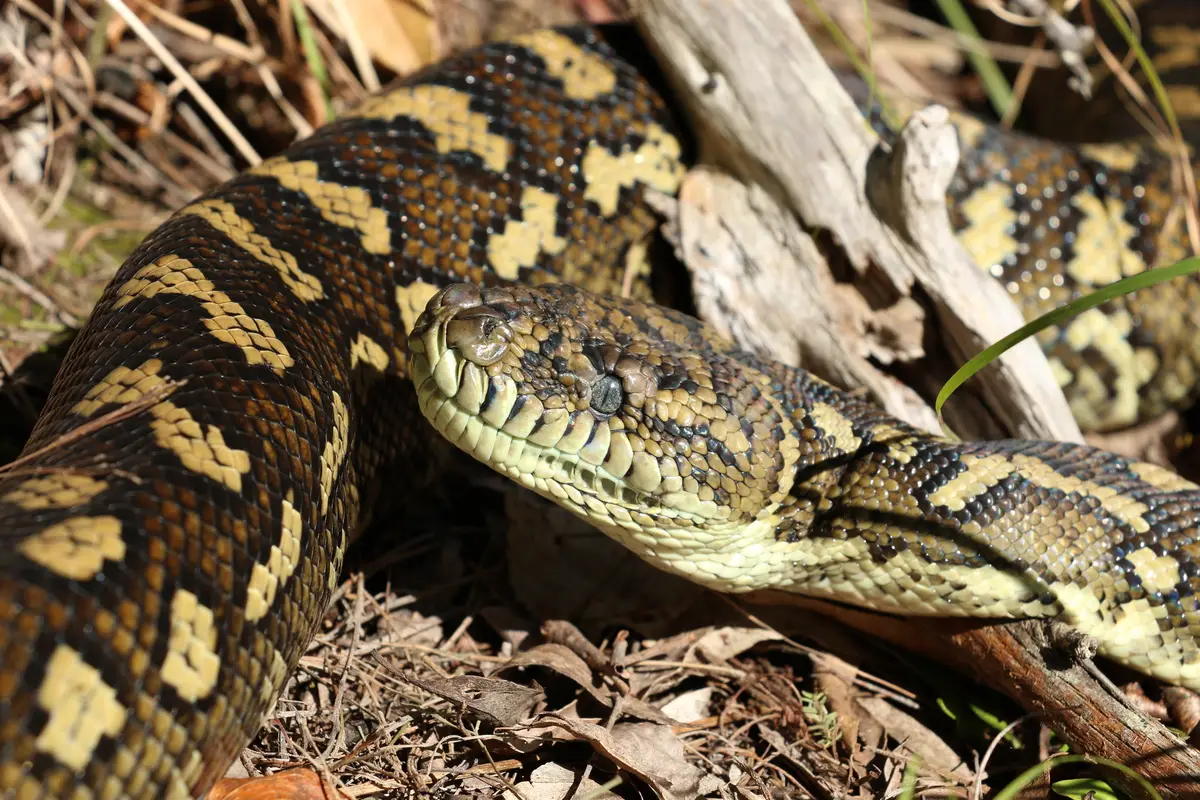
Coastal carpet python
Morelia spilota mcdowelli · Harmless
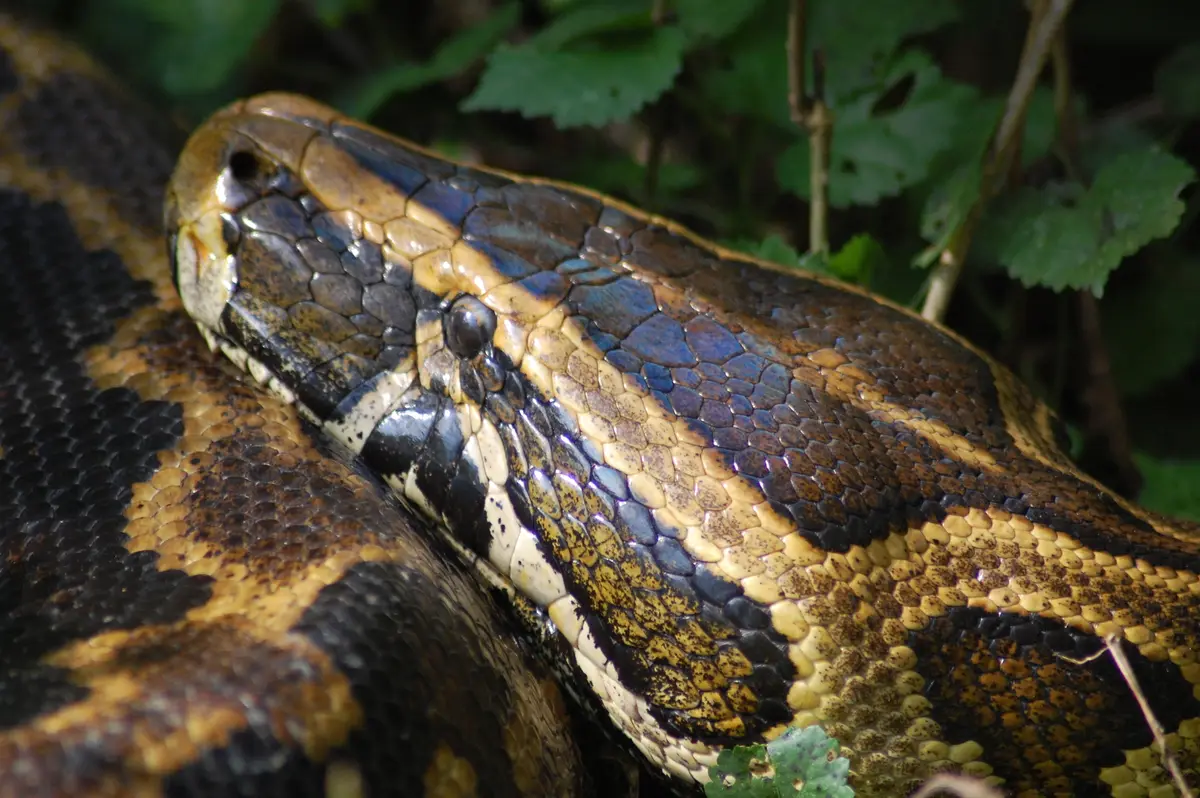
The neighboring subspecies, which the Queensland Museum places in eastern Queensland and northeastern New South Wales. The coastal carpet python is larger, often 6.5-8 ft (2-2.5 m), and usually olive, brown or gray with pale blotches rather than black and yellow.
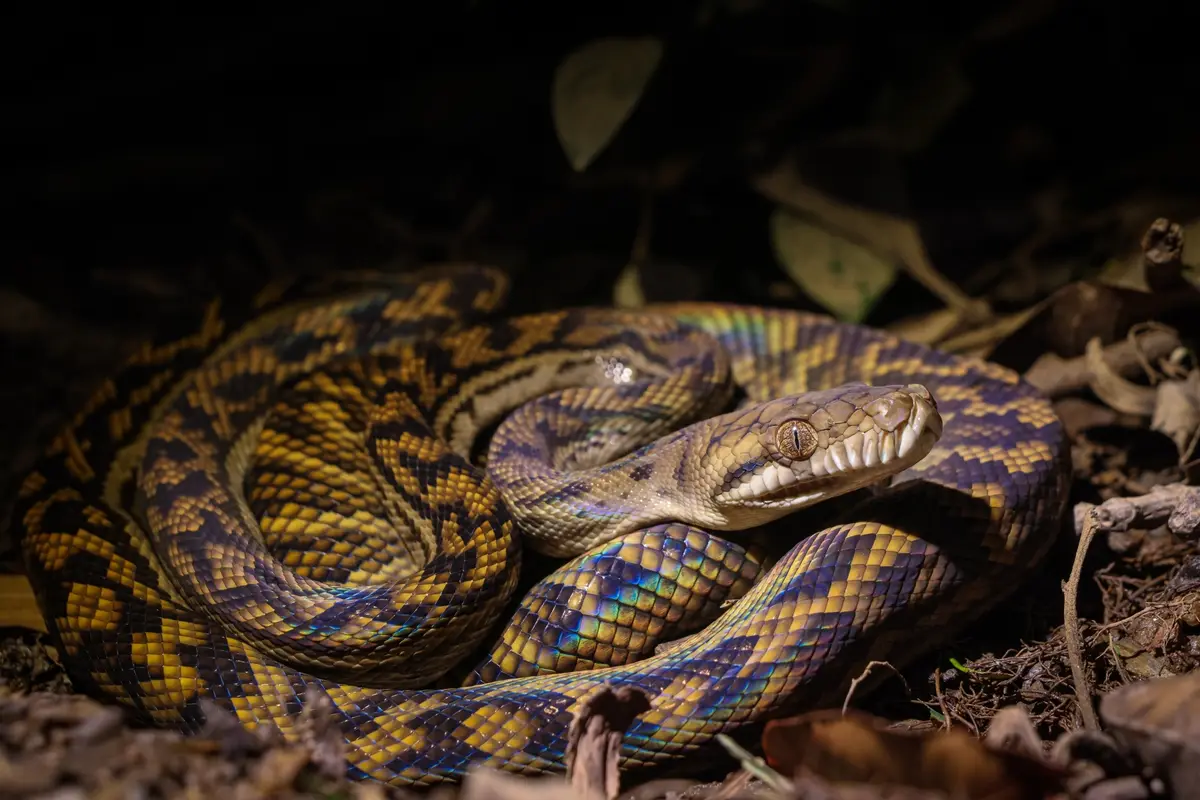
Australian scrub python
Simalia kinghorni · Harmless
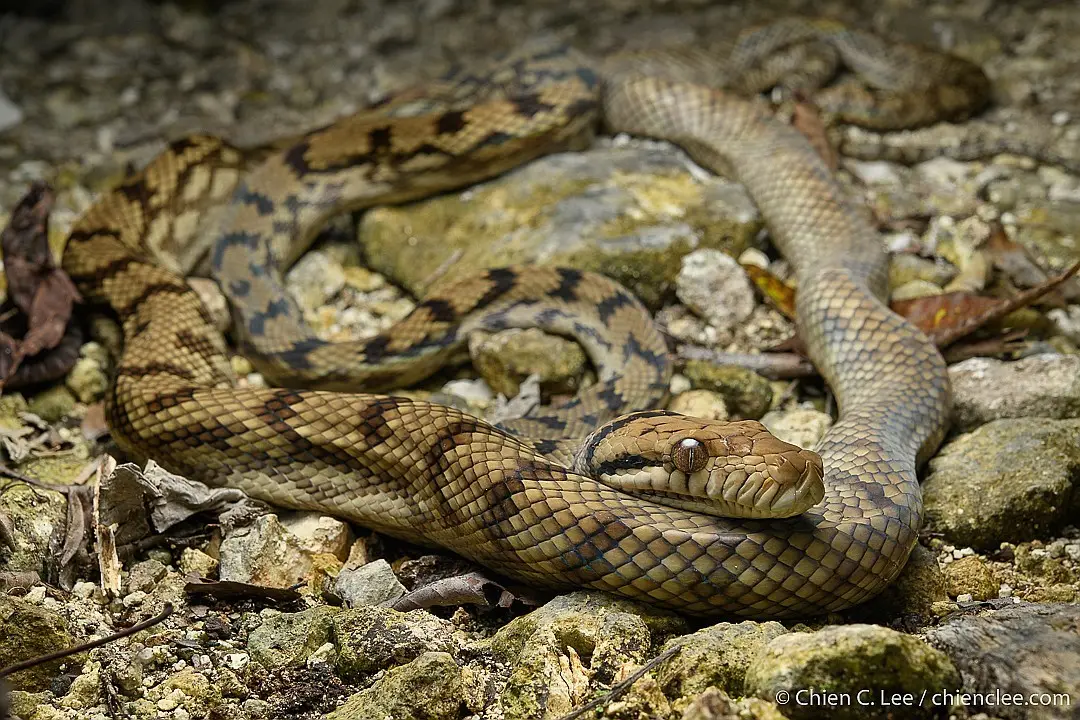
Shares Wet Tropics rainforest with the jungle carpet python and grows much longer. The Australian scrub python is slimmer, has large, symmetrical scales on top of the head where a carpet python has many small ones, and lacks the bold black and yellow pattern.
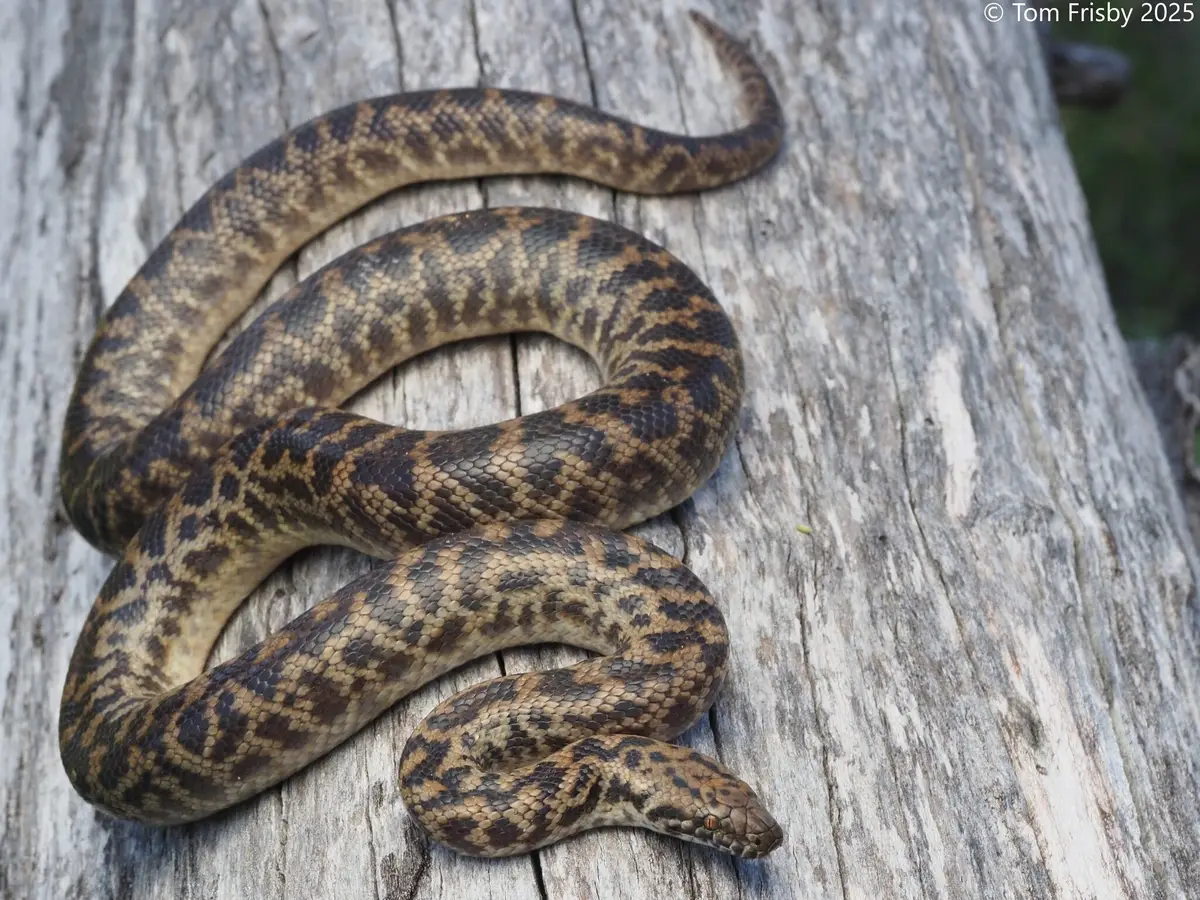
Spotted python
Antaresia maculosa · Harmless
The Queensland Museum names it as the snake most like the carpet python. It is fawn to brown with many dark purplish-brown blotches, much smaller as an adult, and has three scales in a straight line across the top of the head between the eyes.
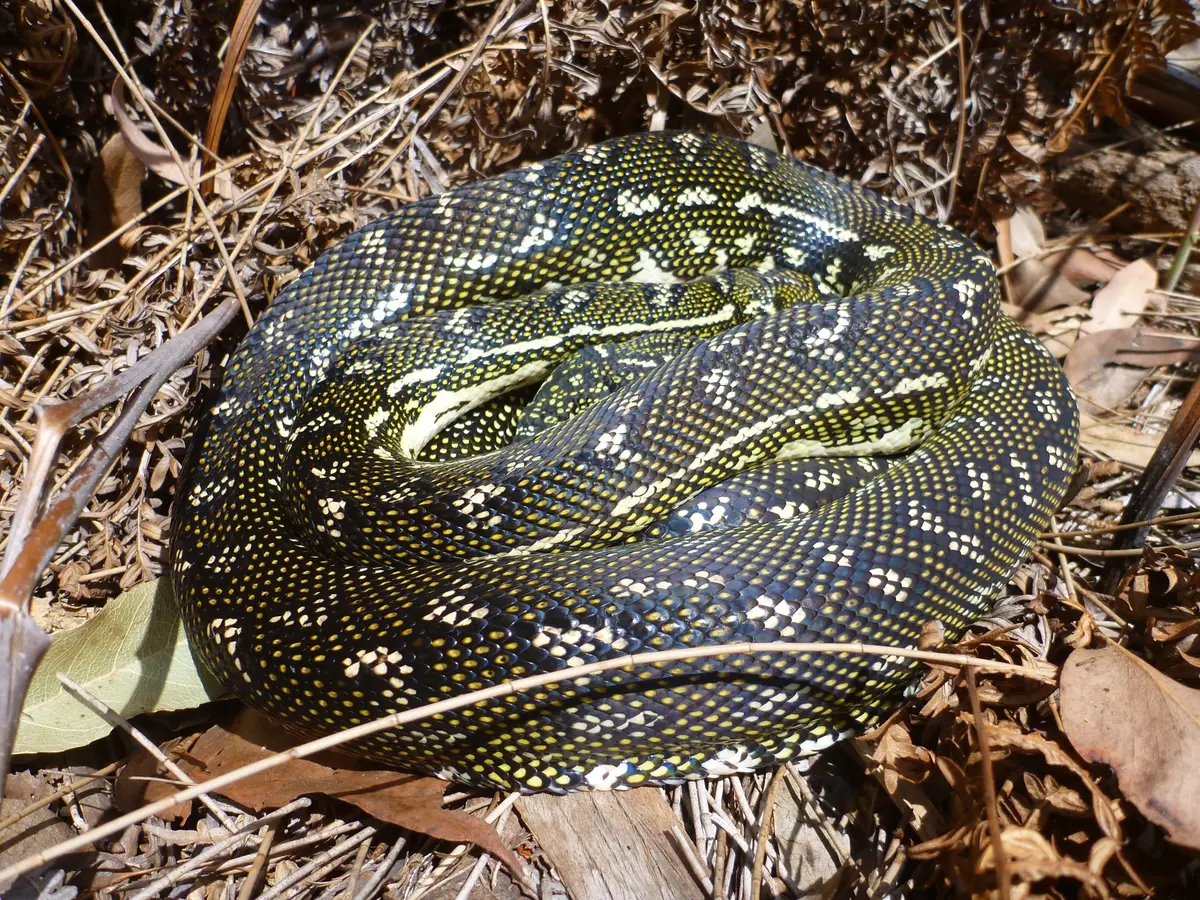
Diamond python
Morelia spilota spilota · Harmless
Another dark carpet python with yellow markings. The diamond python lives far to the south in New South Wales and Victoria, and its yellow forms small spots grouped into diamond-shaped rosettes rather than broad bands.
Reproduction and lifespan
Jungle carpet pythons lay eggs. The Australian Reptile Park gives a clutch of 10-25 eggs that hatch after about 50 days. The Queensland Museum reports that carpet pythons lay in early summer and hide the eggs in a sheltered spot such as a hollow stump or a hollow in the ground.
The female coils around the eggs and shivers her muscles to warm them. The Queensland Museum notes that she leaves the nest to bask in the morning sun, returns already warm, and will defend the clutch. Once they hatch, the young are on their own, according to the Queensland Government.
No reliable lifespan figure for wild jungle carpet pythons has been published.
Is the jungle carpet python endangered?
No. The carpet python, Morelia spilota, is rated Least Concern by the IUCN, as the Reptile Database records, and the Queensland Government lists it as Least Concern under the state's Nature Conservation Act 1992. The jungle form has no separate rating.
| Authority | Status |
|---|---|
| IUCN Red List | Least Concern (species Morelia spilota) |
| Queensland | Least Concern, Nature Conservation Act 1992 |
| CITES | Appendix II, as are nearly all pythons |
Its small range is its weak point. The Australian Reptile Park and Toohey Forest EEC both report that wild numbers are falling because of rainforest clearing.
Is the jungle carpet python a real subspecies?
Possibly not. Wells and Wellington described it in 1984 as a full species, Morelia cheynei, named after Cheyne Wellington, according to AROD. It was later treated as a carpet python subspecies, as the Reptile Database and GBIF list it today. In their 2026 paper, Natusch, Lyons and Shine argue that the jungle form does not deserve subspecies status, because genetic data suggest its color pattern evolved separately in several rainforest patches. AROD notes that the status of every carpet python subspecies is still unsettled.
Jungle carpet pythons are also kept and bred as pets. The Reptile Database cites a report of a captive hybrid between this python and the green tree python (Kivit and Wiseman 2005).
Jungle carpet python FAQ
Is the jungle carpet python venomous?
No. The jungle carpet python has no venom and kills its prey by constriction. The Queensland Museum, the Queensland Government and the Australian Reptile Park all list carpet pythons as non-venomous. A bite can still break the skin, so wash it well, check your tetanus protection and see a doctor if it becomes infected.
How big does a jungle carpet python get?
Most adults are 5-7 feet (1.5-2.1 m) long, according to the Australian Reptile Park and Toohey Forest Environmental Education Centre. Some females reach about 8.5 feet (2.6 m). Females are usually larger than males. Its small size is one reason it was named a separate subspecies of the carpet python.
Where does the jungle carpet python live?
It lives only in the Wet Tropics of northeastern Queensland, Australia. The Australian Reptile Park describes a very small range along waterways running off the Atherton Tableland and into southeastern Cape York Peninsula. It prefers rainforest and forest edges near creeks and rivers, and spends much of its time in trees.
What does a jungle carpet python eat?
It eats small mammals, birds, frogs and lizards. Adults take mostly rats and other rodents, while young snakes eat more lizards, according to the Queensland Government. It ambushes prey, finds it with heat-sensing pits on its lower jaw, and kills it by constriction. Cane toads are sometimes eaten and can kill the snake.
What is the difference between a jungle carpet python and a coastal carpet python?
They are neighboring subspecies of the same species, Morelia spilota. The jungle carpet python lives in the Wet Tropics of north Queensland, is smaller at 5-7 feet, and is usually black and yellow. The coastal carpet python lives farther south in eastern Queensland and northern New South Wales, grows larger and is mostly olive or brown.
Is the jungle carpet python endangered?
No. The carpet python species is rated Least Concern by the IUCN and is Least Concern under Queensland's Nature Conservation Act 1992. The jungle form has no separate rating. Its range is small, though, and the Australian Reptile Park reports that wild numbers are falling as rainforest is cleared.
Related snakes
Sources
- Reptile Database: Morelia spilota, including subspecies cheynei
- Queensland Museum: Carpet snake or carpet python (Morelia spilota)
- Queensland Government: Carpet python
- Australian Reptile Online Database: Carpet python (Morelia spilota) and subspecies
- Natusch, Lyons and Shine (2026). Notes on the natural history of the carpet python (Morelia spilota) at the northern tip of Australia. Australian Journal of Zoology 74: ZO26034
- Australian Reptile Park: Jungle python
- Toohey Forest Environmental Education Centre (Queensland Department of Education): Jungle carpet python
- GBIF: Morelia spilota cheynei Wells and Wellington, 1984