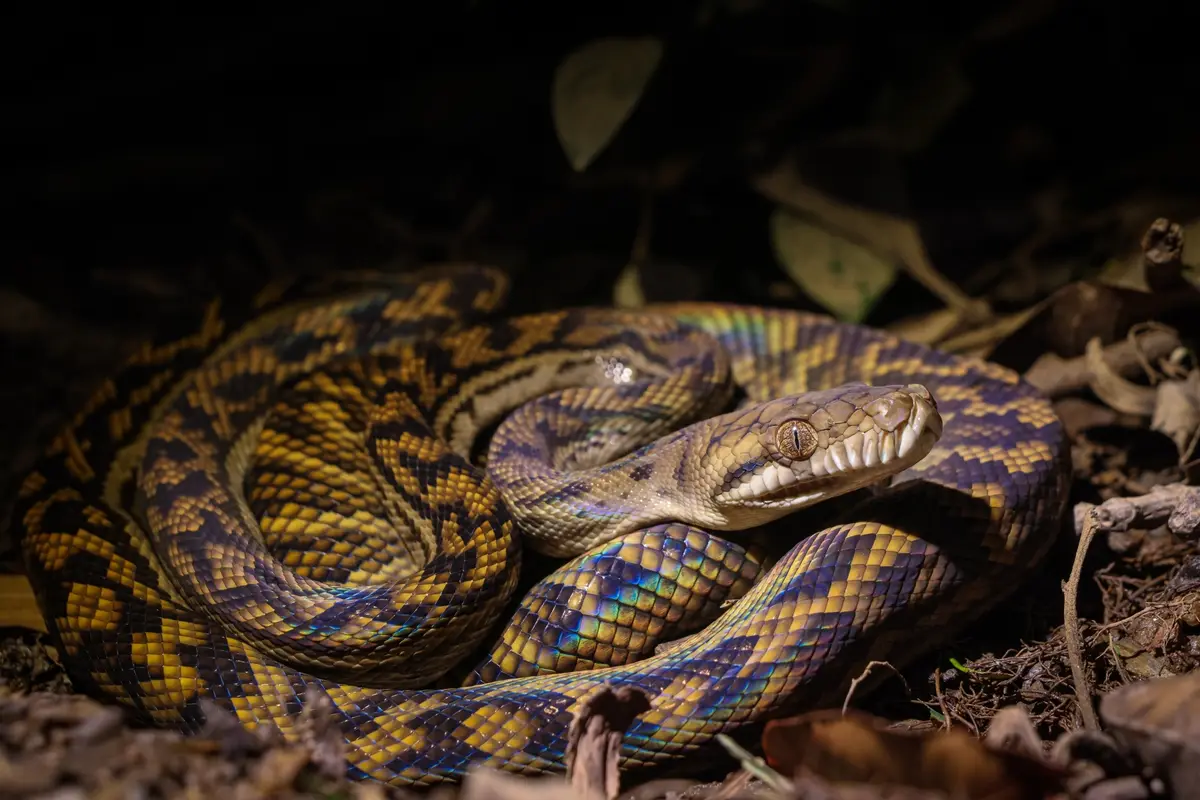
AUSTRALIAN SCRUBPYTHON
Simalia kinghorni · Family Pythonidae
KEY TAKEAWAYS
The Australian scrub python (Simalia kinghorni) is Australia's longest snake, a non-venomous python of the rainforests of northeastern Queensland and Cape York. It kills by constriction and does not treat adult people as prey, though a big one can give a deep, bleeding bite. Until 2000 it was counted as the same species as the amethystine python of New Guinea.
- Most adults are about 7-13 ft (2-4 m) long. Field researchers report that some pass 18 ft (5.5 m) and 44 lb (20 kg); claims of 25 ft or more have never been verified.
- It is not venomous. It grabs prey with its teeth, coils around it and squeezes.
- Males grow larger than females, the reverse of most big pythons. In the Tully River Gorge, males reached 3.76 m (12.3 ft) from snout to vent and 11 kg (24 lb).
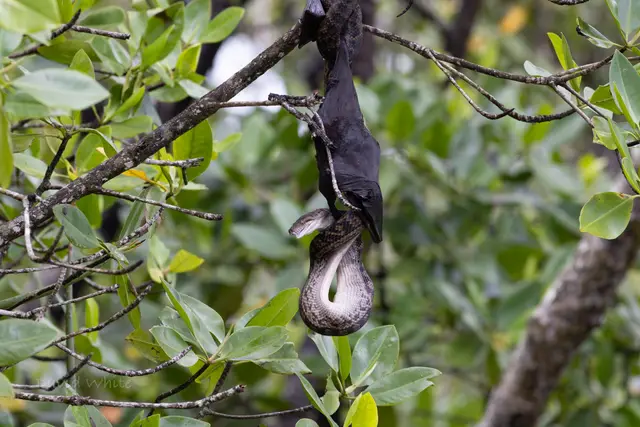
- It eats birds and mammals, from rats and bats to agile wallabies, and sometimes takes chickens and cats near houses.
Australian scrub python quick facts
| Common name | Australian scrub python (also scrub python, amethystine python) |
|---|---|
| Scientific name | Simalia kinghorni (Stull, 1933) |
| Family | Pythonidae (pythons) |
| Venomous | No, a constrictor |
| Adult length | Usually 7-13 ft (2-4 m); some pass 18 ft (5.5 m) |
| Weight | Tracked adults 2-24 lb (1-11 kg); large adults over 44 lb (20 kg) |
| Hatchling size | About 2.3 ft (0.7 m) and 1.8 oz (50 g) |
| Range | Northeastern Queensland and Cape York Peninsula, Australia, plus Hinchinbrook Island and several Torres Strait islands |
| Habitat | Rainforest, vine thicket and nearby woodland; sometimes suburbs |
| Diet | Birds and mammals, including rats, bats, possums and wallabies |
| Reproduction | Lays eggs, about 12 per clutch; the female guards them |
| Conservation | Least Concern in Queensland; CITES Appendix II |
How to identify an Australian scrub python
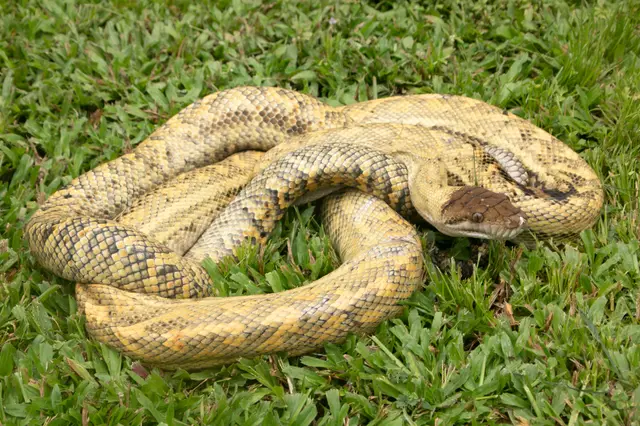
Look for a very long, slim python with a glossy, almost oily shine. The body is pale yellow-brown to olive, covered in darker brown blotches and bands that often join into a net-like pattern. In sunlight the smooth scales flash purple and blue, which is where the old name amethystine python comes from.
- 1Long, slender body: adults of 10 ft (3 m) or more that look thin for their length, with a long, tapering tail for climbing.
- 2Large scales on top of the head: big, symmetrical head shields. This is the quickest way to tell it from a carpet python, which has small, grainy head scales, according to Augusteyn (2004) in the Memoirs of the Queensland Museum.
- 3Iridescent sheen: smooth scales that shine blue-purple in bright light, over a tan, olive or yellow-brown base.
- 4Dark blotches and bands: irregular dark markings that may merge into a mesh. The pattern varies a lot between snakes.
- 5Heat pits on the lips: a row of deep pits along the jaws that sense warm-blooded prey in the dark.
How big do Australian scrub pythons get?
Most adults are 7-13 ft (2-4 m) long, and a few grow far bigger. That makes it the longest snake in Australia and one of the longest pythons anywhere. It is lighter than its length suggests, because the body is slim.
The best measured sample comes from a three-year field study in the Tully River Gorge by Fearn, Schwarzkopf and Shine (2005), published in Wildlife Research. Adult males there ranged from 1.3 to 3.76 m (4.3-12.3 ft) in snout-vent length, which leaves out the tail, and from 0.3 to 11 kg (0.7-24 lb). The authors found that males reach much larger sizes than females, probably because big males win more fights and mate more often.
On Cape York, Natusch, Lyons and Shine (2022) radio-tracked 27 scrub pythons with snout-vent lengths of 2.02-3.70 m. The largest, a male, weighed 8.7 kg (19 lb). They note that adults can exceed about 5.5 m (18 ft) total length and 20 kg (44 lb). Rainforest Rescue reports exceptional snakes of more than 30 kg (66 lb).
| Measure | Size | Source |
|---|---|---|
| Hatchling | About 2.3 ft (0.7 m), 1.8 oz (50 g) | Natusch et al. (2022) |
| Typical adult | 7-13 ft (2-4 m) | Rainforest Rescue |
| Adult males, Tully River | 4.3-12.3 ft (1.3-3.76 m) snout to vent; 0.7-24 lb (0.3-11 kg) | Fearn et al. (2005) |
| Tracked adults, Cape York | 6.6-12.1 ft (2.02-3.70 m) snout to vent; up to 19 lb (8.7 kg) | Natusch et al. (2022) |
| Large adults | Over 18 ft (5.5 m) and 44 lb (20 kg) | Natusch et al. (2022) |
Popular articles often give 7-8 m (23-26 ft). No snake that size has been measured in a way scientists accept.
Where do Australian scrub pythons live?
Short answer: only in far northeastern Australia. The Reptile Database gives its range as northeastern Queensland, the Cape York Peninsula and several islands, including Hinchinbrook Island and islands of the Torres Strait. The type specimen came from Lake Barrine on the Atherton Tableland.
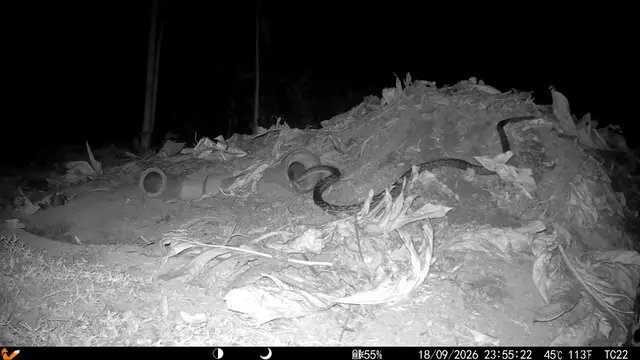
On the mainland it runs from the tip of Cape York south through the Wet Tropics rainforests around Cooktown, Cairns, Kuranda and Tully, to around Townsville. Scrub pythons also live around towns such as Kuranda, where they take poultry, rats and other animals that follow people, and sometimes end up inside houses.
There is also an outlying population much farther south. In 2004 John Augusteyn reported scrub pythons from the Conway area near Airlie Beach, about 300 km south of the accepted range. Some sources link that population to snakes that escaped from a local reptile park, though this has never been confirmed. See how the range compares with other pythons on the world snake map.
Habitat
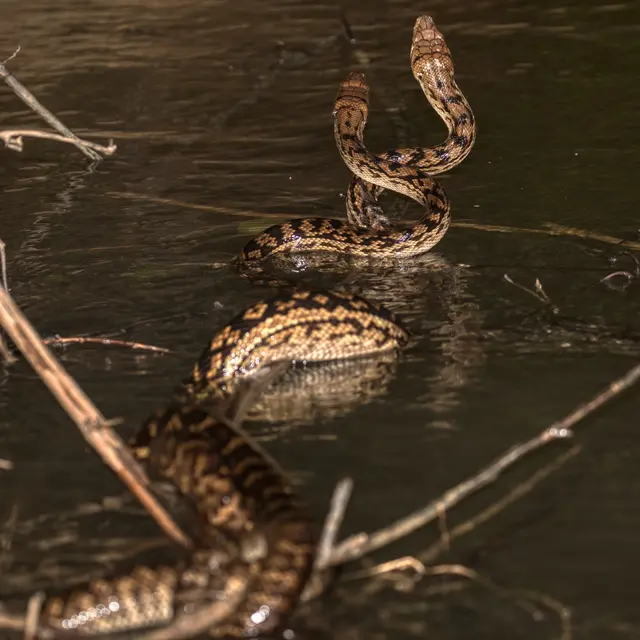
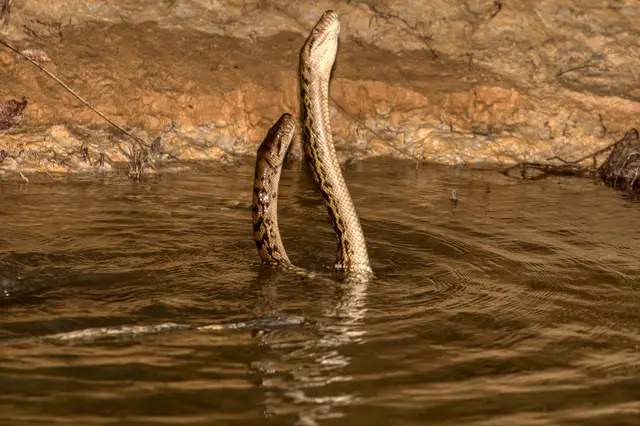
Scrub pythons live mainly in rainforest and other closed forest, usually near water. In the Wet Tropics they are tied to rainforest and its edges. Farther north on Cape York they also use drier vine thickets, and they cross into open woodland, swamp and sand plain.
The Cape York tracking study shows how flexible they are. Every tagged snake used rainforest, but six of 11 snakes followed through both seasons switched between rainforest and open habitats as the seasons changed (Natusch et al. 2022). The species climbs well and the Reptile Database lists it as partly arboreal, but it also spends a lot of time on the ground.
Behavior
The scrub python is a patient ambush hunter that hardly moves. On Cape York the average distance between daily fixes was just 9.8 m (32 ft), and the longest move in a single day was 364 m (about 1,200 ft). Snakes rested by day and hunted at night, and they hunted more in the wet season, December to April.
Home ranges were small for an animal this size. Males used an average of 0.60 sq km (about 150 acres) and females 0.28 sq km (about 70 acres). In the Tully River Gorge, Fearn and colleagues recaptured most pythons within 100 m of where they were first caught, though a few moved at least 1.5 km.
In the cooler dry season, large males gather to fight over females. Rivals wrestle and bite, and the Tully study found that bigger males were more likely to carry combat wounds and more likely to be seen mating.
What do Australian scrub pythons eat?
Scrub pythons eat warm-blooded prey: mostly birds and mammals. Young snakes take rats and small birds; big adults can swallow a wallaby.
| Prey | Examples | Source |
|---|---|---|
| Birds | Nestling metallic starlings under colony trees; poultry near houses | Natusch et al. (2022) |
| Small and mid-sized mammals | Rats, bats, possums | Rainforest Rescue |
| Large mammals | Agile wallabies and other macropods | Natusch et al. (2022) |
| Pets | A family cat, in a 2018 case in Queensland | Australian Geographic |
Each year on Cape York, metallic starlings nest in noisy colonies in tall trees. Scrub pythons wait below and eat the chicks that fall. Around towns, the same snakes live on chickens, rats and other animals that follow people. Australian Geographic reported a scrub python that swallowed a family cat under a Queensland house in 2018, and another near Kuranda that needed surgery after eating a child's stuffed toy.
Is the Australian scrub python venomous or dangerous?
No. The Australian scrub python has no venom and is not a danger to the life of an adult. It is a constrictor, and people are far too large to be prey. Long, yes. A threat to people, no.
It can still bite. A large scrub python has rows of long, sharp, backward-curving teeth, and a cornered snake can leave deep cuts that bleed heavily. Do not grab or pin one. Wash any bite well with soap and water and see a doctor if it is deep or shows signs of infection. Small pets and poultry are at real risk, so keep them in snake-proof enclosures at night.
Northern Queensland also has dangerous venomous snakes, including the coastal taipan and the eastern brown snake. If you are not sure what a snake is, keep your distance and call a licensed snake catcher. Our snake venom FAQ explains why color and head shape are poor guides to whether a snake is venomous.
Scrub python vs carpet python and other look-alikes
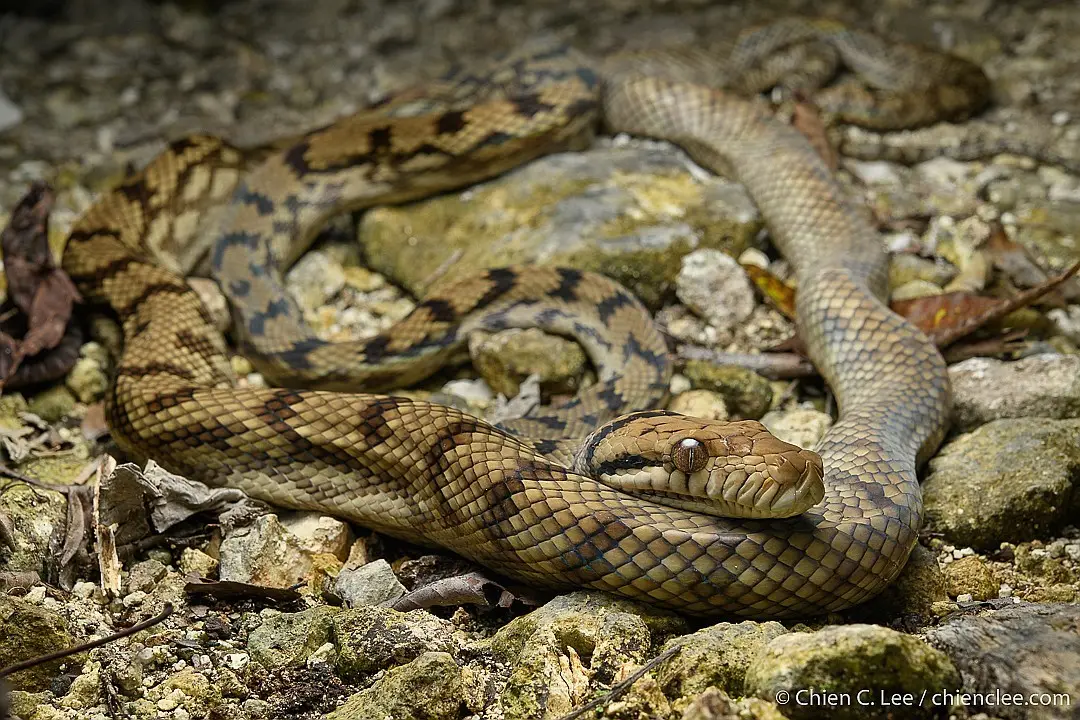
Amethystine python
Simalia amethistina · Harmless
Almost identical in shape and sheen, and treated as the same species until 2000. The amethystine python lives in New Guinea and eastern Indonesia, so location is the easiest test.
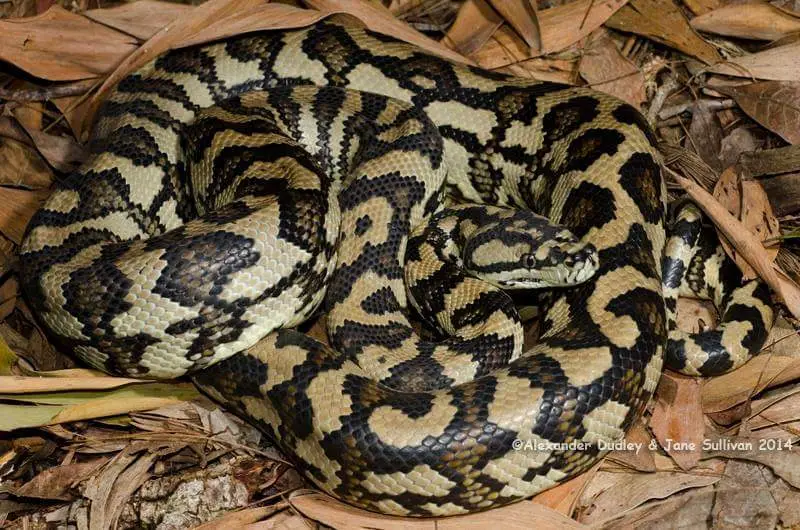
Carpet python
Morelia spilota · Harmless
Shorter and heavier-bodied, with a busier pattern of cream and dark bands. The top of its head is covered in small, grainy scales, while the scrub python has large head shields.
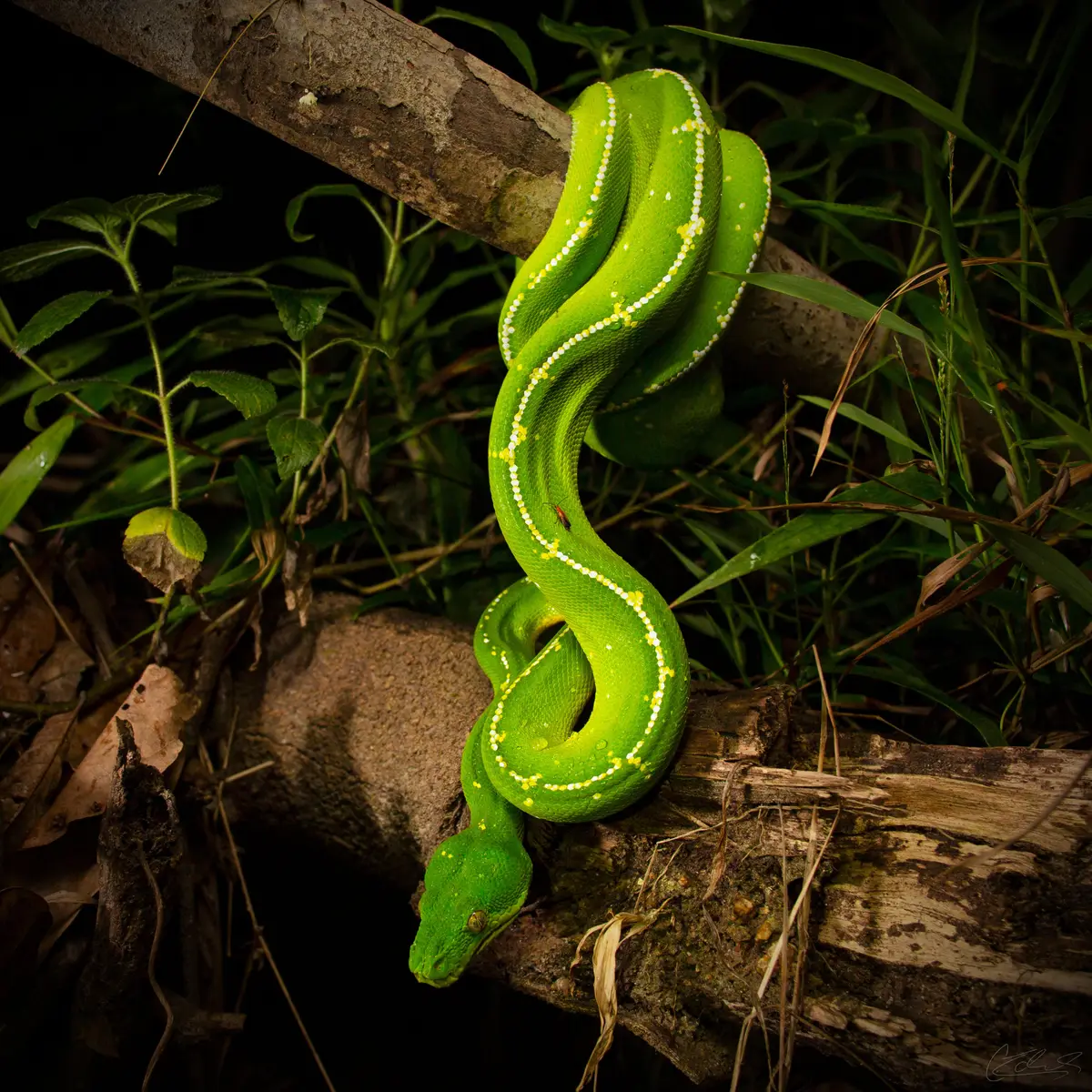
Green tree python
Morelia viridis · Harmless
Shares the rainforests of the McIlwraith and Iron Range area on Cape York. Adult green tree pythons are bright green and rarely pass 7 ft, but their young are yellow or red.
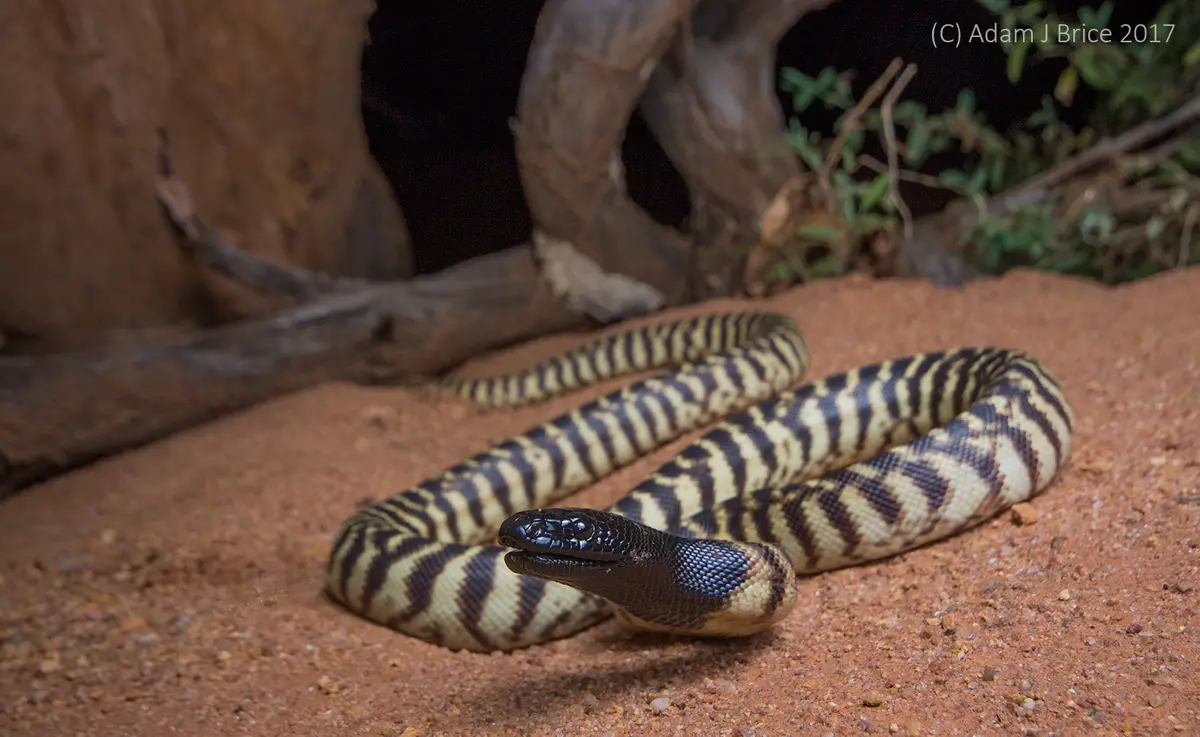
Black-headed python
Aspidites melanocephalus · Harmless
Lives in drier country across northern Australia. The black-headed python has a glossy black head and neck and banded brown body, with no heat pits on its lips.
Reproduction and life cycle
Australian scrub pythons lay eggs. Mating happens in the cooler months of the dry season, after males have fought for access to females. Natusch and colleagues (2022) report that females lay about 12 eggs in the late dry season and coil around them until they hatch.
Three radio-tracked females on Cape York laid their eggs in rainforest. The young are big at birth: about 70 cm (2.3 ft) and 50 g (1.8 oz), longer than the adults of many other snake species.
Is the Australian scrub python endangered?
No. The Queensland Government's WildNet database lists the species, as the amethystine python (Australian form), as Least Concern under the Nature Conservation Act 1992. Like nearly all pythons, it is on CITES Appendix II, so international trade needs permits.
| Authority | Status |
|---|---|
| Queensland Nature Conservation Act 1992 | Least Concern |
| CITES | Appendix II (trade by permit) |
| IUCN Red List | No separate assessment; the wider amethystine python is Least Concern |
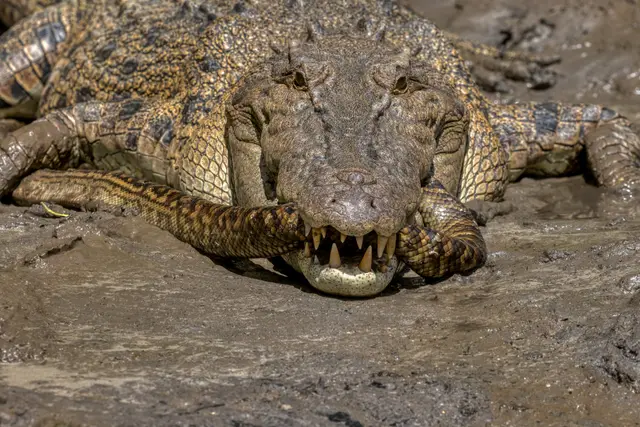
Its range is small, but the snake is not limited to untouched forest: Natusch and colleagues (2022) note that scrub pythons in towns live on birds and mammals that follow people. Roads are one known hazard: Fearn and colleagues collected many of their wet-season samples, mostly females and juveniles, from a road beside the Tully River Gorge. Natusch and colleagues (2022) note reports of large Australian pythons being killed and eaten by dingoes.
Australian scrub python FAQ
Is the Australian scrub python venomous?
No. The Australian scrub python has no venom and kills prey by constriction. It can bite if it is grabbed or cornered, and a big snake's long, curved teeth can cause deep, bleeding cuts. Clean any bite with soap and water and get medical care if it is deep or becomes infected. It is not a threat to the life of an adult person.
How big do scrub pythons get?
Most adults are 7-13 feet (2-4 m) long. Researchers on Cape York report that some exceed 18 feet (5.5 m) and 44 pounds (20 kg), and it is Australia's longest snake. Reports of 23-26 foot (7-8 m) scrub pythons appear online, but none has been measured in a way scientists accept.
What is the largest snake in Australia?
The Australian scrub python is the longest snake in Australia. Most adults are 7-13 feet (2-4 m), and the largest reach more than 18 feet (5.5 m). Unusually for a giant python, males grow larger than females.
Is a scrub python the same as an amethystine python?
They are close relatives, and older books treat them as one species. Since a 2000 study by Harvey and colleagues, the Australian snakes are usually classed as their own species, Simalia kinghorni, while the amethystine python, Simalia amethistina, lives in New Guinea and eastern Indonesia. Many Australians still call the scrub python an amethystine python.
Can a scrub python eat a dog or cat?
Yes, a large one can. Scrub pythons have eaten cats in Queensland, and they regularly take chickens, possums and wallabies. Small dogs and cats left outside at night in python country are at risk. Keep pets indoors at night and house poultry in a fully enclosed, snake-proof run.
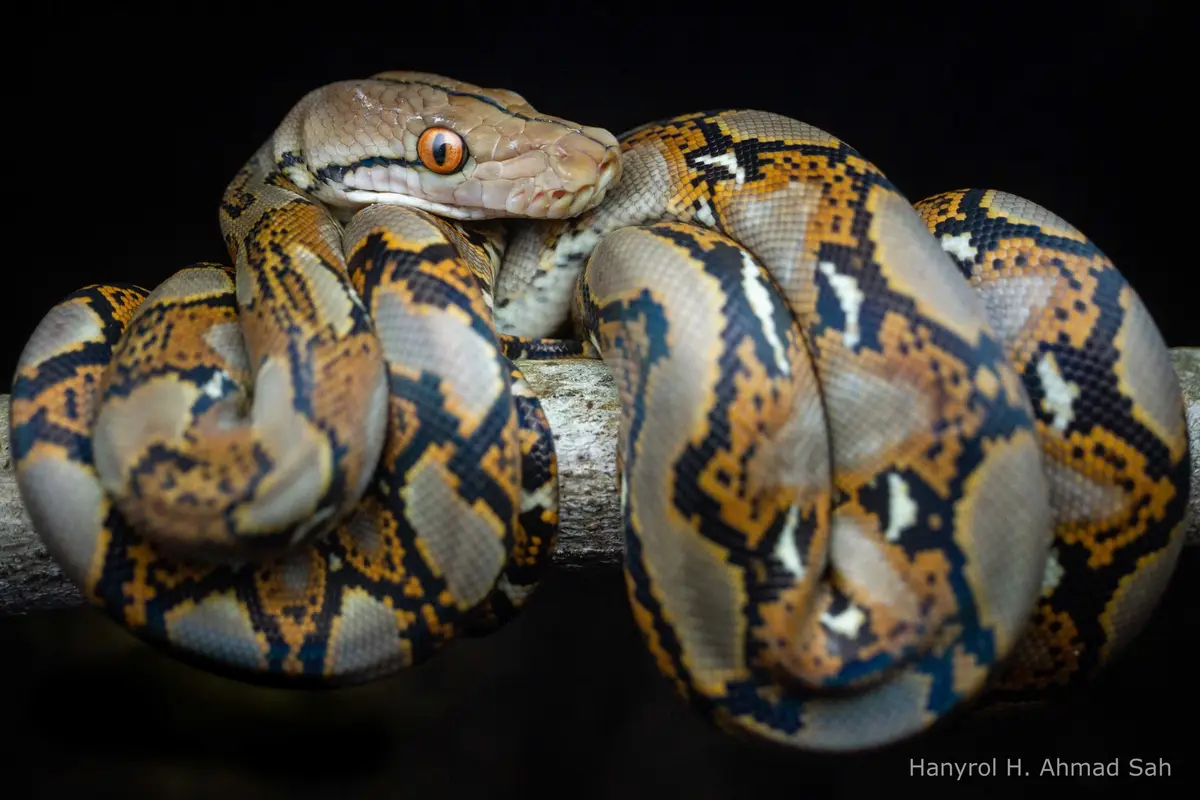
Related snakes
Sources
- Reptile Database: Simalia kinghorni
- Fearn, Schwarzkopf and Shine (2005). Giant snakes in tropical forests: a field study of the Australian scrub python, Morelia kinghorni. Wildlife Research 32: 193-201
- Natusch, Lyons and Shine (2022). Spatial ecology, activity patterns, and habitat use by giant pythons (Simalia amethistina) in tropical Australia. Scientific Reports 12: 5274
- Augusteyn (2004). Southerly range extension for the amethystine python Morelia kinghorni in Queensland. Memoirs of the Queensland Museum 49: 602
- Queensland Government WildNet: Simalia kinghorni (amethystine python, Australian form)
- Rainforest Rescue: Critter Corner, Australian scrub python
- Australian Geographic: Never a dull moment with Australia's longest python