WOMAPYTHON
Aspidites ramsayi · Family Pythonidae
KEY TAKEAWAYS
The woma python is a non-venomous Australian python of the dry inland, with a narrow head and a body banded in shades of tan, orange and brown. It hunts mostly lizards and snakes, often inside burrows. It is harmless to people and is widely kept as a pet, though wild populations in parts of its range have declined badly.
- Adults average about 5 ft (1.5 m) long. The largest reach about 9 ft (2.7 m), according to the NSW threatened species profile.
- It is not venomous. It kills by squeezing, and in tight burrows it pins prey against the wall with a loop of its body.
- Like its only close relative, the black-headed python, it has no heat-sensing pits on its lips.
- The IUCN lists it as Least Concern, but it is Vulnerable in New South Wales and the south-west Western Australian population has almost vanished.
Woma python quick facts
| Common name | Woma python, woma, Ramsay's python |
|---|---|
| Scientific name | Aspidites ramsayi (Macleay, 1882) |
| Family | Pythonidae (pythons) |
| Venomous | No, a constrictor |
| Adult length | Average about 5 ft (1.5 m); maximum about 9 ft (2.7 m) |
| Weight | About 2.2-11 lb (1-5 kg) |
| Range | Central and western Australia, from the Western Australian coast to south-west Queensland and north-west New South Wales |
| Habitat | Sandy deserts, dunefields, spinifex grassland, shrubland, heath and semi-arid woodland |
| Diet | Mainly lizards and snakes; also small mammals and ground birds |
| Reproduction | Lays eggs, about 5-20 per clutch |
| Lifespan | 20 years or more |
| Conservation | IUCN Least Concern (2017); Vulnerable in NSW; Near threatened in Queensland |
How to identify a woma python
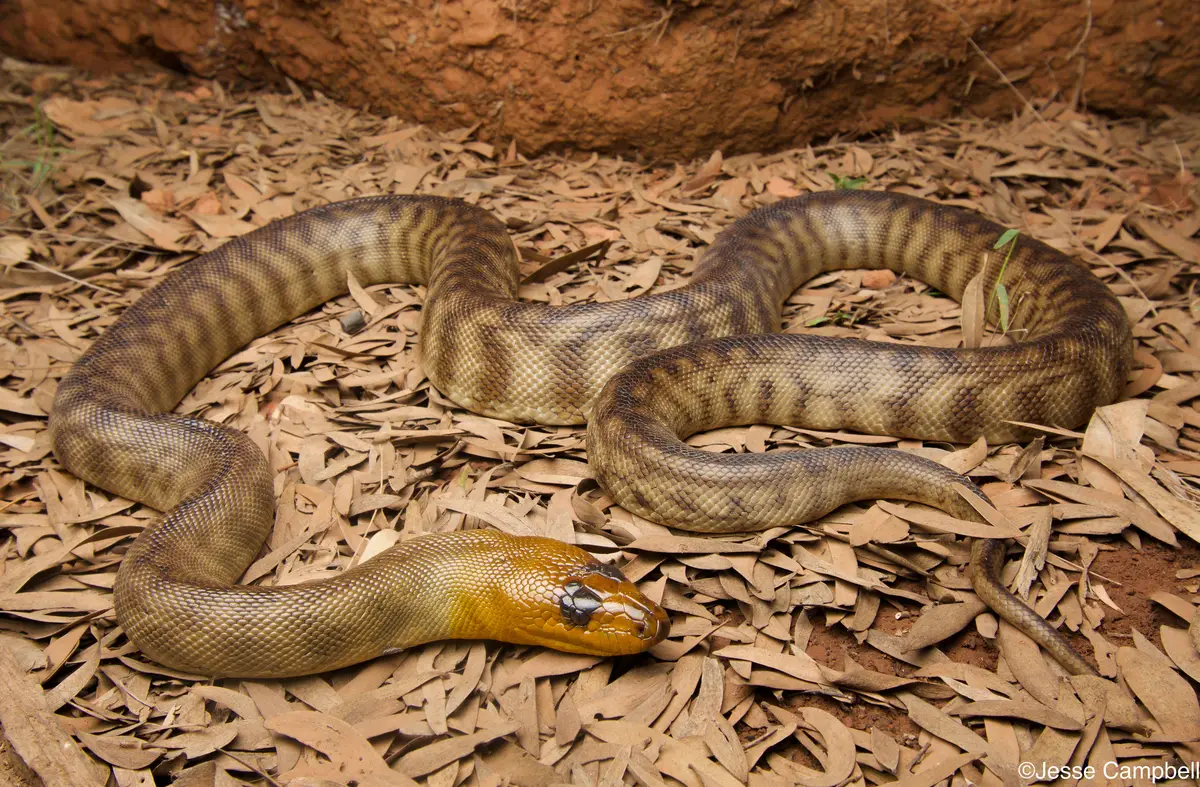
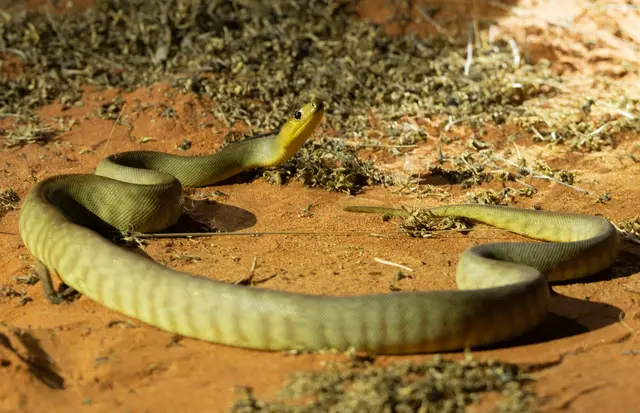
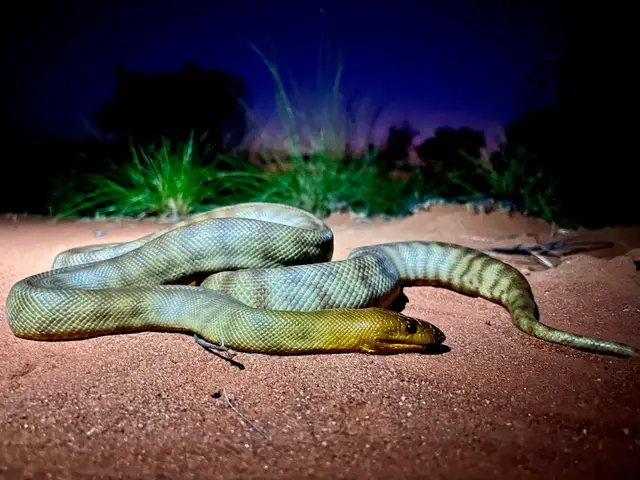
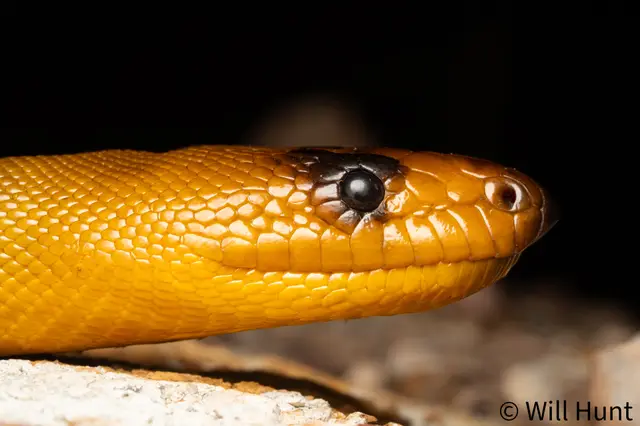
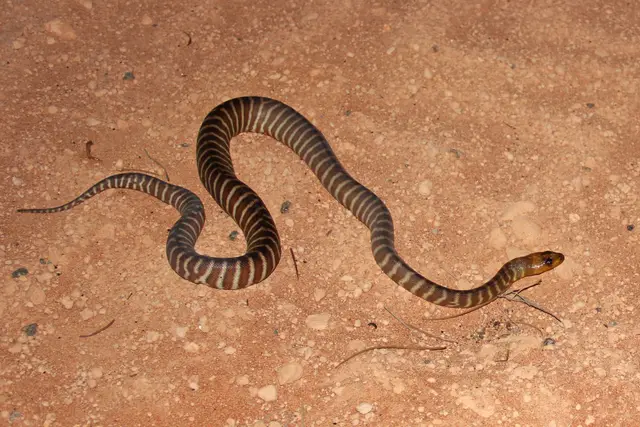
A woma is a mid-sized python with a narrow head, small eyes and a body striped across with darker bands. The NSW government's BioNet species profile describes the upper side as olive-brown to reddish-brown with darker cross-bands, and the belly as yellow to cream with pink or brown blotches. Snakes from red desert sand often look orange.
- 1Banded body: a pale yellow, tan or reddish-brown base crossed by many darker brown bands from neck to tail.
- 2Plain head: the head is the same tan or orange as the body, not black. Young womas have a dark patch above each eye, which usually fades with age, according to the Australian Reptile Online Database.
- 3Narrow head and small eyes: the head is barely wider than the neck, which helps the snake push into burrows.
- 4No lip pits: the lip scales are smooth. Most pythons, including the ball python, have a row of heat pits along the jaw.
- 5Body shape: thick and slightly triangular in cross-section, ending in a short, thin tail.
How big do woma pythons get?
Most adult womas are about 5 feet (1.5 m) long. The Australian Reptile Online Database and the NSW BioNet profile both give an average of 1.5 m and a maximum of 2.7 m (about 9 ft). The San Diego Zoo Wildlife Alliance gives a maximum of 8.5 ft (2.6 m) and a weight of 2.2 to 11 pounds (1 to 5 kg).
That makes the woma a moderate python by world standards. It is a little smaller than the black-headed python and far smaller than the Burmese python, which usually measures 10-16 ft (3-4.9 m).
| Measure | Figure | Source |
|---|---|---|
| Average adult length | About 5 ft (1.5 m) | Australian Reptile Online Database, NSW BioNet |
| Maximum length | 8.5-9 ft (2.6-2.7 m) | San Diego Zoo, NSW BioNet |
| Adult weight | 2.2-11 lb (1-5 kg) | San Diego Zoo |
Where do woma pythons live?
Short answer: only in Australia, mainly in the arid and semi-arid interior. The Reptile Database lists it from Western Australia, the Northern Territory, South Australia, Queensland and New South Wales. The Australian Reptile Online Database describes a range from the north-west coast of Western Australia east to the Moonie and Tara district of south-west Queensland, plus a separate population in south-west Western Australia.
In New South Wales it lives only in the far north-west, east to about Louth and Bourke. The type specimen came from Fort Bourke. NSW BioNet notes that the species was last recorded in the state's eastern districts in the late 1890s, and that its range and numbers in south-eastern Australia are in serious decline. Compare its range with other snakes on the world snake map.
Habitat
Womas live in dry, open country. NSW BioNet lists sandy plains, dunefields and deep cracking black-soil plains, with hummock grassland, shrubland and woodland on top. Spinifex is common where they occur. During the day they shelter in animal burrows, hollow logs and under grass hummocks.
The south-west population once lived on sandplains in the Wheatbelt and Goldfields of Western Australia. Much of the Wheatbelt has since been cleared for farming, and the Australian Reptile Online Database names land clearing as a main threat.
How does the woma python hunt?
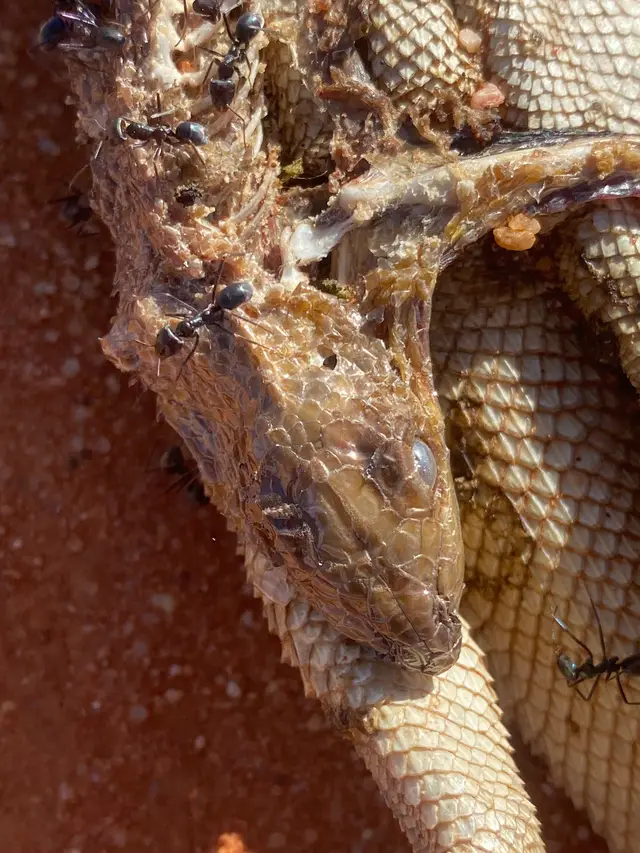
Womas hunt mostly at night, and they often hunt underground. A woma will push into a burrow after a lizard or small mammal. There is no room to throw coils around prey in a narrow tunnel, so the snake presses a loop of its body against the animal and crushes it against the burrow wall. The San Diego Zoo notes that this gives prey a chance to bite back, which explains the scars many wild womas carry.
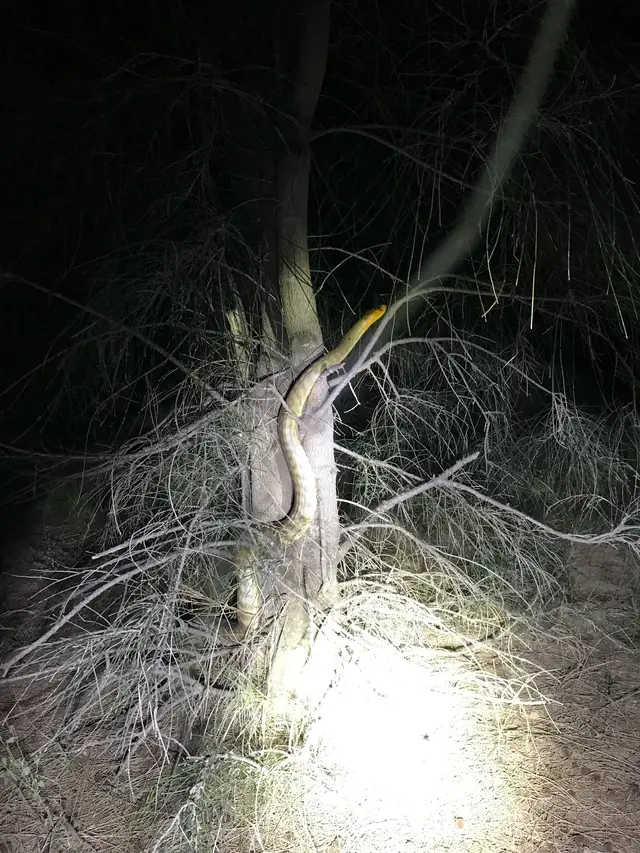
They also ambush. A woma can lie still and wriggle the thin tip of its tail to tempt a lizard within reach. NSW BioNet compares this to the tail-luring of death adders. Womas also hunt on open ground and sometimes climb into low trees.
In mild weather they may bask by day, according to the San Diego Zoo. Captive-bred womas are popular pets because they are usually calm and easy to handle. Like any snake, a frightened woma can still bite.
What do woma pythons eat?
Woma pythons eat mostly reptiles. NSW BioNet lists lizards, snakes, birds and small mammals, and the San Diego Zoo adds bird eggs and says womas will take venomous snakes. Perth Zoo lists small mammals, ground birds and reptiles.
| Prey group | Examples | How often |
|---|---|---|
| Lizards | Desert lizards | Main prey |
| Snakes | Other snakes, including venomous species | Regular |
| Mammals | Small mammals, often caught in burrows | Occasional |
| Birds | Ground birds and eggs | Occasional |
Most pythons find warm-blooded prey with the heat pits on their lips. The genus Aspidites has lost those pits, which fits a diet built on cold-blooded lizards and snakes.
Is the woma python venomous or dangerous?
No. The woma python has no venom and is not dangerous to people. It kills prey by squeezing, and a 5 ft snake has no way to harm an adult person like that. A bite leaves a few small punctures that should be washed with soap and water.
The risk in the field is mistaking a venomous snake for a woma. Inland Australia is home to the mulga snake and several brown snakes, and some of them are tan or reddish like a woma. Our snake venom FAQ explains how constrictors differ from venomous snakes. Unless you are sure of the ID, keep your distance from any snake in Australia and let it move off.
Snakes confused with the woma python
If you find a snake and are unsure, photograph it from a safe distance and post it on iNaturalist for an ID.
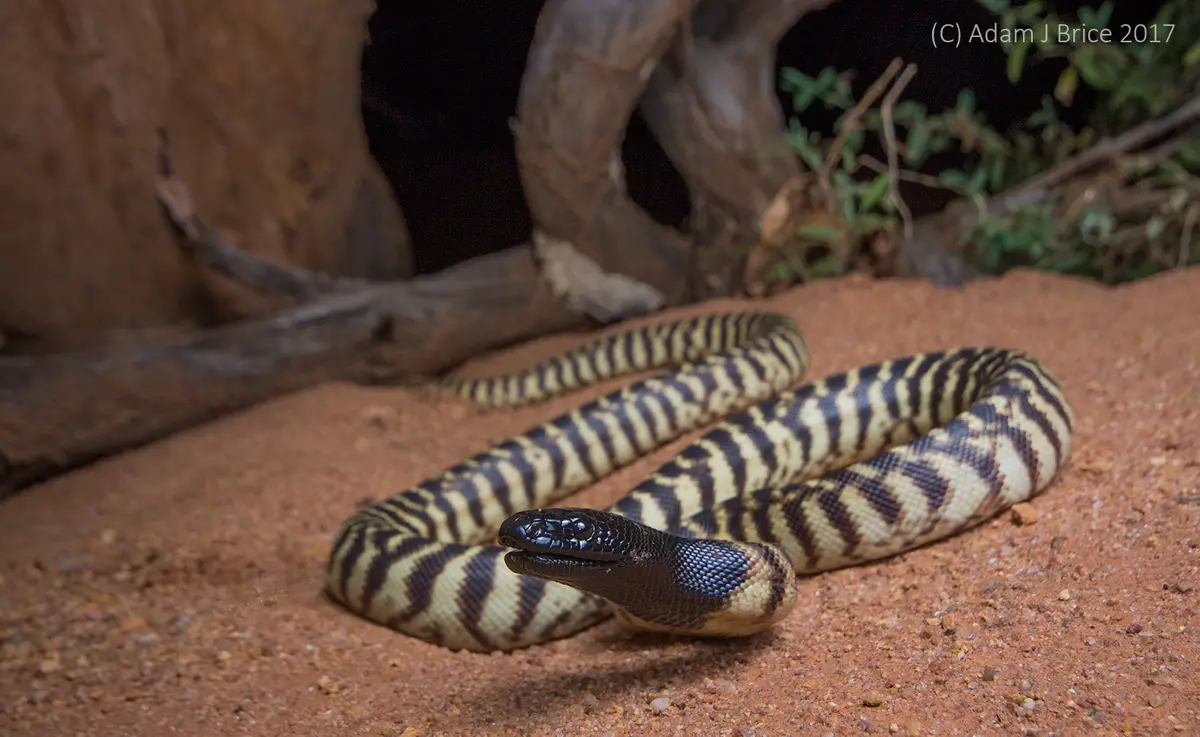
Black-headed python
Aspidites melanocephalus · Harmless
The woma's only close relative. It has the same banded body and smooth lips, but its head, neck and throat are glossy black. The Reptile Database separates the two species by that dark hood. The black-headed python lives mostly farther north.
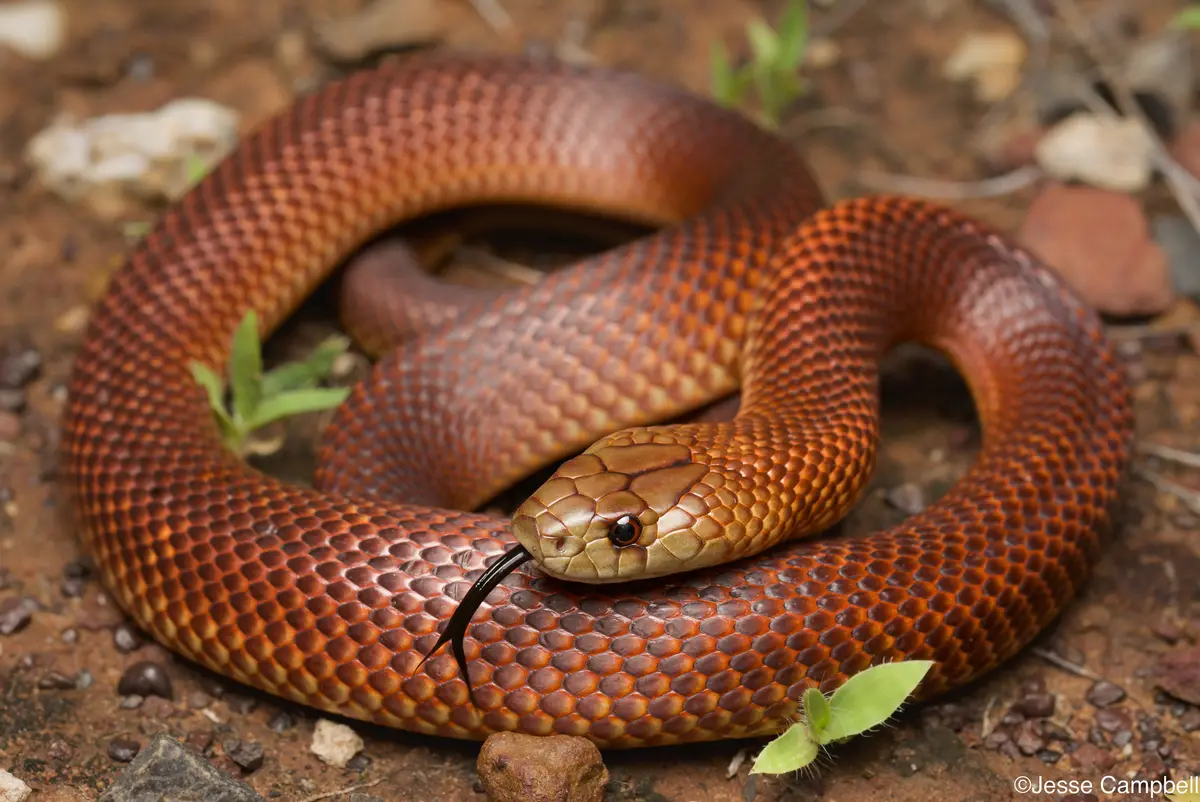
Mulga snake (king brown)
Pseudechis australis · Highly venomous
A large, heavy snake of the same dry country. Its scales are two-toned, giving a net-like pattern, and it has no bands. The Australian Museum describes its venom as highly toxic and delivered in large amounts. Mulga snakes also eat young womas.
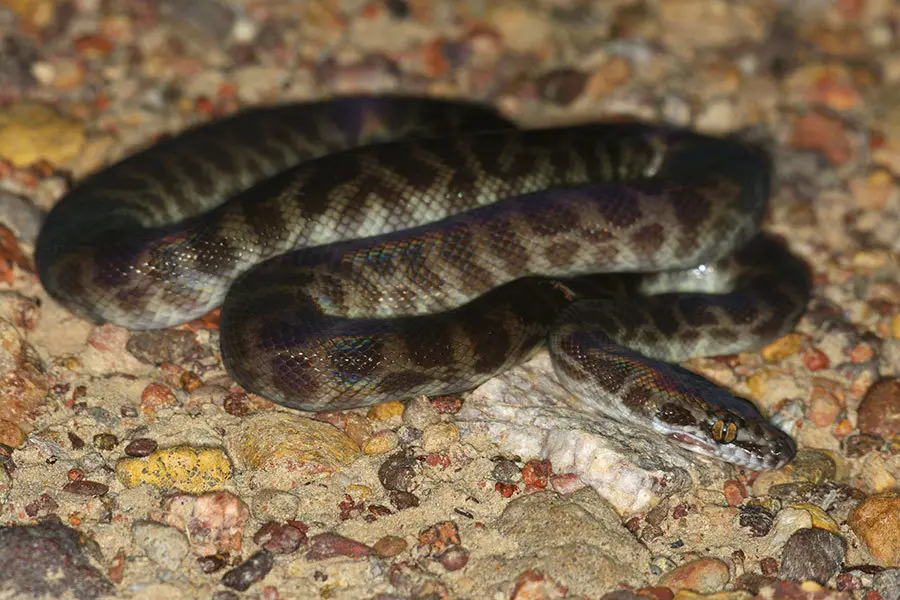
Stimson's python
Antaresia stimsoni · Harmless
A smaller python of the same inland regions, usually under 3.3 ft (1 m). It has large dark blotches rather than bands and heat pits on the lower lip. See the Stimson's python page.
Reproduction and lifespan
Woma pythons lay eggs. The San Diego Zoo says they breed from May to August, the Australian winter. The female lays her clutch in a burrow and coils around it, shivering her muscles to make heat if the night gets cold. Clutch size varies widely: the San Diego Zoo gives 5 to 20 eggs and Perth Zoo gives 14 to 19.
Perth Zoo gives an incubation period of 57 days, close to the two months cited by the San Diego Zoo. The young are on their own from hatching. Perth Zoo and the San Diego Zoo name foxes, cats and mulga snakes as predators of young womas.
How long do woma pythons live?
The San Diego Zoo gives a lifespan of 20 years or more.
Is the woma python endangered?
Not worldwide, but it is threatened in parts of Australia. The IUCN Red List moved the woma to Least Concern in its 2017 assessment because of its wide range; it was listed as Endangered before that. State lists are less reassuring.
| Authority | Status |
|---|---|
| IUCN Red List | Least Concern (2017) |
| New South Wales (Biodiversity Conservation Act) | Vulnerable |
| Queensland (Nature Conservation Act 1992) | Near threatened |
| South Australia | Rare |
| Western Australia | South-west population listed as Priority 1 |
| Australian Government (EPBC Act) | Not listed |
The south-west Western Australian population has fared worst. The San Diego Zoo notes that many of those populations have not been seen since the late 1980s. Perth Zoo says the south-west and desert womas may turn out to be separate types, with the south-west form highly endangered. NSW BioNet lists land clearing, overgrazing, fire, foxes and cats, and illegal collecting as the main threats.
Why did the woma reintroduction fail?
In September 2007, nine captive-bred womas were released into the Arid Recovery Reserve in northern South Australia, a fenced area cleared of cats, foxes and rabbits. According to the IUCN reintroduction case study by Greg Johnston, John Read and Terry Morley, all nine were dead within four months, most likely killed by mulga snakes. The fence kept out feral predators but not native ones.
Woma python FAQ
Is the woma python venomous?
No. The woma python has no venom. It is a constrictor that kills prey by squeezing it, often by pinning it against a burrow wall. A bite can sting and draw a little blood, so wash it with soap and water, but it is not medically dangerous. Captive-bred womas are usually calm.
How big do woma pythons get?
Most adult woma pythons are about 5 feet (1.5 m) long. The NSW government and the Australian Reptile Online Database give a maximum of about 9 feet (2.7 m), and the San Diego Zoo gives 8.5 feet (2.6 m). Adults weigh roughly 2.2 to 11 pounds (1 to 5 kg).
Where do woma pythons live?
Woma pythons live only in Australia, mostly in the arid and semi-arid interior. Their range runs from the north-west coast of Western Australia through the Northern Territory and South Australia to south-west Queensland and north-west New South Wales. A separate, much reduced population lives in south-west Western Australia.
What is the difference between a woma and a black-headed python?
The head. A black-headed python has a glossy black head, neck and throat, while a woma's head is the same tan, orange or brown as its body. Both belong to the genus Aspidites, both have banded bodies and neither has heat pits on its lips. The woma also lives farther south, in the dry interior.
Do woma pythons eat other snakes?
Yes. Reptiles are the woma's main food, and that includes snakes. NSW BioNet lists snakes among its prey, and the San Diego Zoo says womas will take venomous species. They also eat lizards, small mammals, ground birds and bird eggs.
Is the woma python endangered?
Not globally. The IUCN listed the woma python as Least Concern in 2017. It is listed as Vulnerable in New South Wales, Near threatened in Queensland and Rare in South Australia. The south-west Western Australian population has declined sharply, and many of its sites have had no sightings since the late 1980s.
Related snakes
Sources
- Reptile Database: Aspidites ramsayi
- Australian Reptile Online Database: Woma
- NSW BioNet threatened species profile: Woma
- San Diego Zoo Wildlife Alliance: Woma python
- Perth Zoo: Woma
- IUCN Conservation Translocation Specialist Group: Trial re-introduction of the woma python in northern South Australia
- Australian Museum: Mulga snake
- iNaturalist: Aspidites ramsayi (photos, observations)