STIMSON'SPYTHON
Antaresia stimsoni · Family Pythonidae
KEY TAKEAWAYS
Stimson's python (Antaresia stimsoni) is a small, non-venomous member of the python family that lives across the dry interior of Australia, from the Pilbara in Western Australia to western New South Wales. Adults reach about 3 ft (1 m) at most and are harmless to people. A 2021 genetic study found it blends into Children's python, so many authorities now list it under that name.
- It has no venom. It kills small animals by constriction and is not considered dangerous to people.
- Most adults are 30-35 in (75-90 cm) long, with a maximum of about 3.3 ft (1 m).
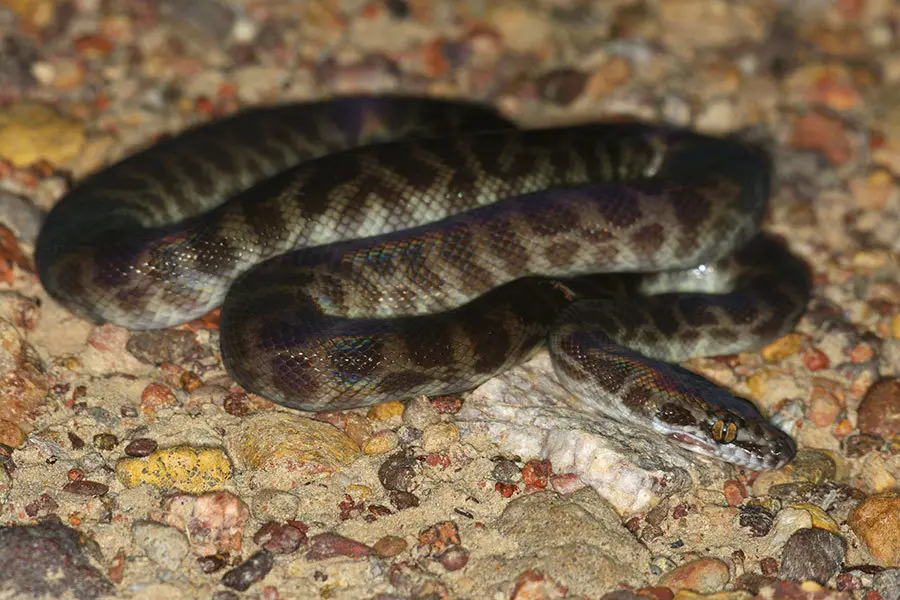
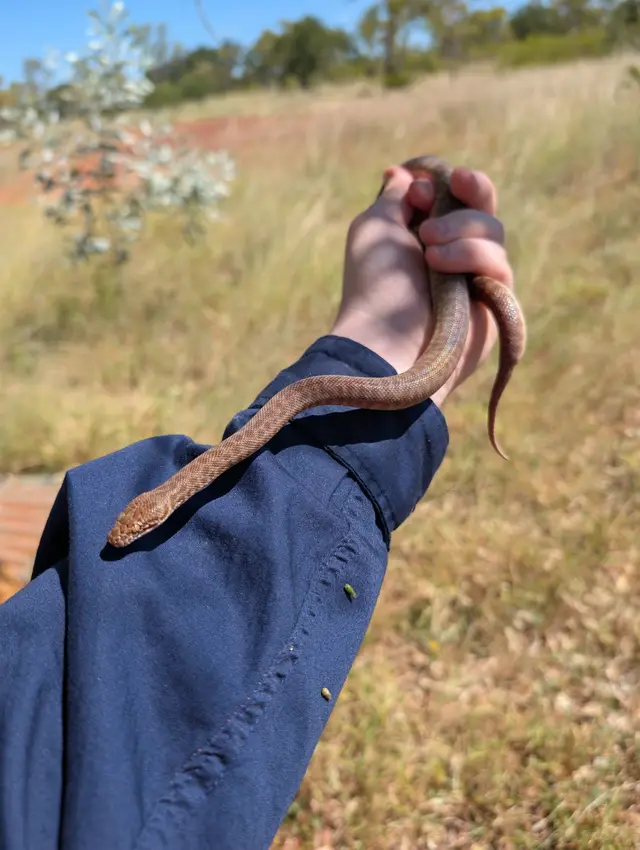
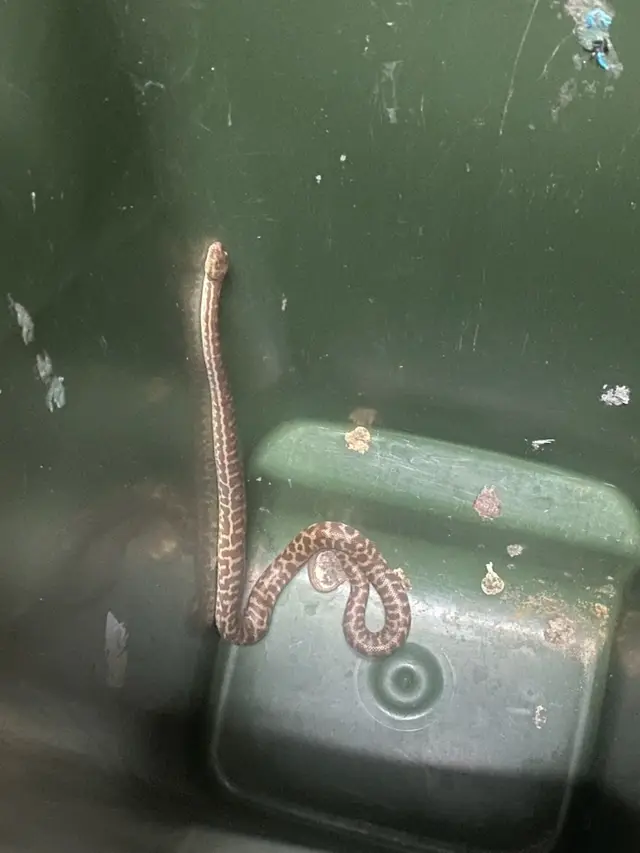
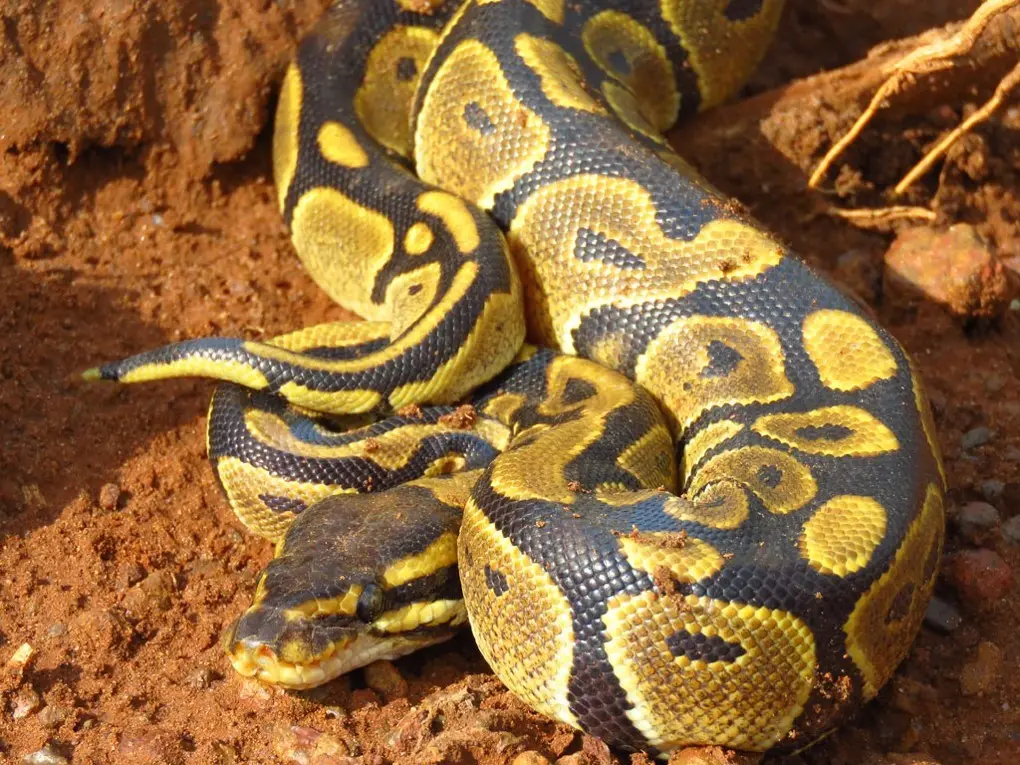
- Look for large dark blotches on a pale tan or yellow body and a blotch-free pale stripe along each side of the neck.
- Queensland rates it Least Concern, but New South Wales lists it as Vulnerable, now under the name Children's python.
Stimson's python quick facts
| Common name | Stimson's python; also large-blotched python |
|---|---|
| Scientific name | Antaresia stimsoni (Smith, 1985); treated as a synonym of Antaresia childreni since Esquerré et al. (2021) |
| Family | Pythonidae (pythons) |
| Venomous | No, a constrictor |
| Adult length | Average about 30-35 in (75-90 cm); maximum about 3.3 ft (1 m) |
| Coloring | Light tan to yellow, with golden, red-brown or chocolate blotches |
| Range | Arid inland Australia: WA, NT, SA, Queensland and NSW |
| Habitat | Rocky ranges and outcrops, riverside woodland, shrubland, spinifex and sandy deserts |
| Diet | Small mammals, lizards, frogs and birds |
| Reproduction | Lays eggs; usually 5-15 per clutch, guarded by the female for about 55 days |
| Subspecies | A. s. stimsoni (western) and A. s. orientalis (eastern), both named by Smith in 1985 |
| Conservation | Not threatened overall; Least Concern in Queensland; Vulnerable in New South Wales |
How to identify a Stimson's python
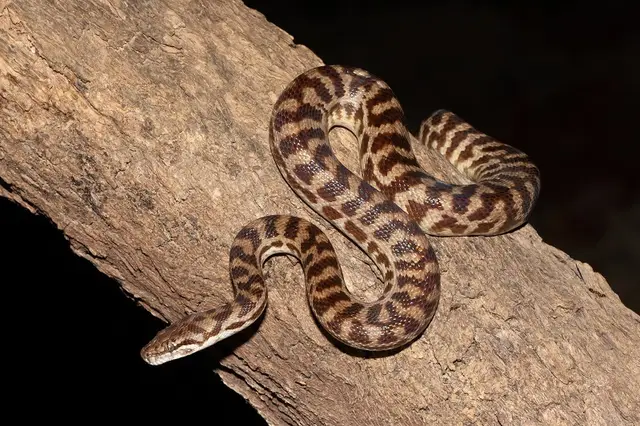
A Stimson's python is a small python with large, dark blotches on a much paler body and a plain pale stripe on each side of the neck. The Australian Reptile Park describes the blotches as golden, red-brown or chocolate brown on a light tan to yellow background. The Australian Museum notes that color and pattern vary a lot across its huge range, but the usual look is large reddish-brown blotches on a paler ground color.
- 1Pale neck stripe: the most useful mark. The Australian Reptile Online Database (AROD) describes a pale line on the side of the neck formed where the dark blotches are missing. The Reptile Park says this stripe can run for almost a third of the body.
- 2Bold, high-contrast blotches: the dark blotches stand out sharply against the light background. This is where the name large-blotched python comes from.
- 3Heat pits on the lower lip: AROD records heat-sensing pits on the lower lip scales and none on the snout scale. Australia's venomous snakes have no lip pits.
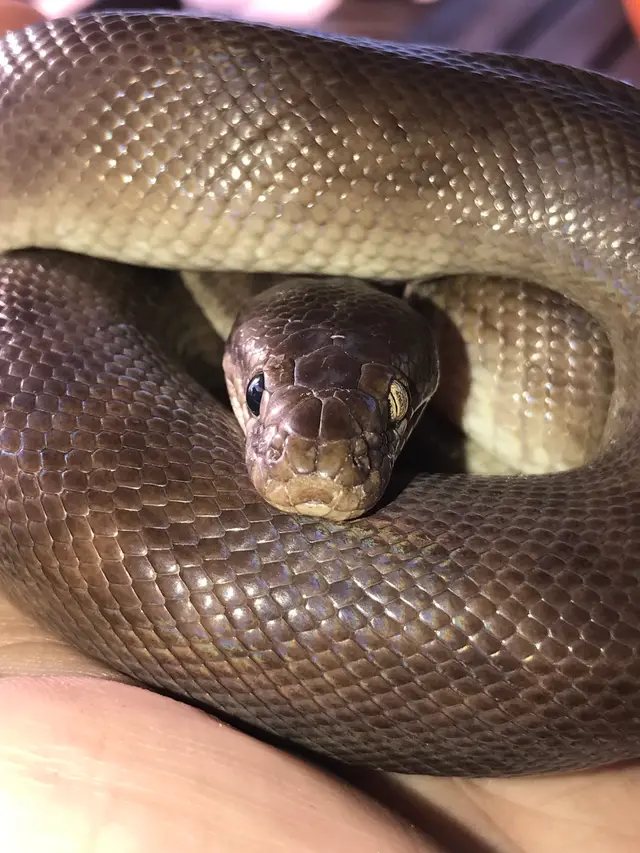
- 4Plated head, wider than the neck: the top of the head is covered in large, symmetrical scales, and the Reptile Park notes that the head is distinctly larger than the neck.
- 5Scale counts: for specialists, AROD gives 35-49 scale rows at midbody, 240-305 belly scales, a single anal scale and 30-45 divided scales under the tail.
How big do Stimson's pythons get?
Stimson's pythons grow to about 3.3 ft (1 m) at most, and most adults are 30-35 in (75-90 cm) long. The sources agree closely on the upper limit. AROD gives an average total length of 90 cm and a maximum of 100 cm, while the Australian Museum gives an average of about 75 cm and a maximum of roughly 1 m.
| Measure | Size | Source |
|---|---|---|
| Average length | About 30 in (75 cm) | Australian Museum |
| Average length | About 35 in (90 cm) | AROD |
| Maximum length | About 3.3 ft (1 m) | AROD; Australian Museum; Australian Reptile Park |
| Maximum length, western subspecies | 3.3 ft (100 cm) | WA Society of Amateur Herpetologists |
Males and females are about the same size. A 2011 field study in the Australian Journal of Zoology by McDonald and colleagues found the species is not sexually dimorphic, which matched earlier work on museum specimens. No reliable adult weight was found in the sources used here. For scale, its close relative the spotted python of eastern Queensland is a similar size, and the pygmy python of the Pilbara averages only 16 in (40 cm).
Where do Stimson's pythons live?
Short answer: across most of arid and semi-arid inland Australia, in Western Australia, the Northern Territory, South Australia, Queensland and New South Wales. The Australian Museum says it has the largest range of any Australian python. The Reptile Database lists the same five states and territories and gives the type locality as about 15 km southeast of Nullagine in the Pilbara of Western Australia.
In Western Australia, the WA Society of Amateur Herpetologists keeping advice sheet says the western form occurs over much of the state, south to Waroona, the central wheatbelt and the goldfields. In New South Wales it reaches only the far west. You can compare its range with other snakes on the world snake map.
Laurie A. Smith described the species in 1985 and named two subspecies at the same time: the western Stimson's python, A. s. stimsoni, and the eastern Stimson's python, A. s. orientalis. The sources used here do not give a firm boundary between them.
Habitat
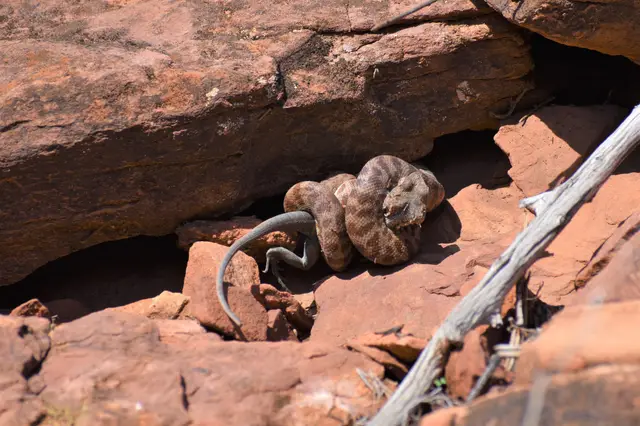
Stimson's pythons live in dry country, and rocks are the best place to find them. The Australian Museum lists rock outcrops and stony ranges. On sandy plains and dunefields, it says the snake is most likely near isolated large trees, the edges of dry creek beds, big termite mounds or clumps of spinifex. The Reptile Park adds arid grassland, shrubland and woodland, and says the snake shelters in crevices, holes, hollows and termite mounds.
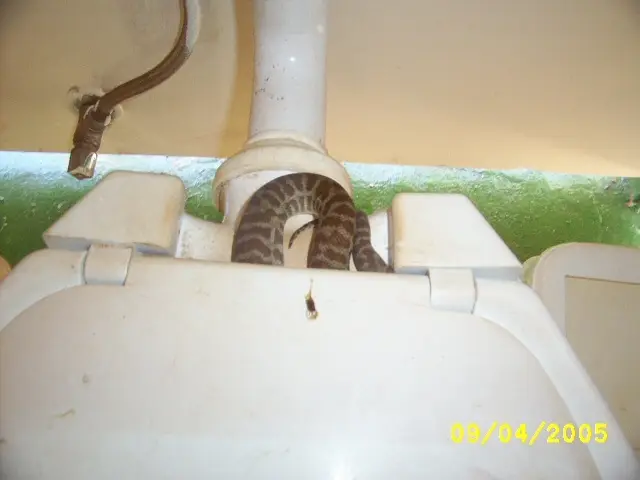
The western form also turns up around people. The WA Society of Amateur Herpetologists lists stony cliffs, hills, outcrops, eucalypt-lined creeks and old buildings. In the MacDonnell Ranges near Alice Springs, the 2011 McDonald study found Stimson's pythons in several vegetation types, with an apparent preference for riverside woodland, and suggested that rock outcrops used as shelter may help explain their success there.
Behavior
Stimson's pythons are mainly active at night, and rain brings them out. The 2011 McDonald study is the first field study of the species. The team drove a sealed road through the MacDonnell Ranges at night for 12 straight months, recording every python they found. The snakes stayed active over a wide range of air temperatures and were most active after rainfall, when humid nights bring out ground-dwelling frogs, an important prey. They stopped moving only in the coldest months of the year.
Most of the time it is a quiet snake that sits in a crevice or burrow and waits. The Australian Museum says it can go months without food and finds prey by sensing body heat, tasting the air with its tongue and using its eyes. Birds of prey and large reptiles eat it. Males are less peaceful with each other: the WA Society of Amateur Herpetologists notes that breeding males fight by biting and thrashing and can badly injure one another.
What do Stimson's pythons eat?
Stimson's pythons eat small mammals, lizards, frogs and birds, according to the Australian Museum, the Reptile Park and AROD. Like all pythons, it seizes prey in its jaws and wraps it in coils until the animal cannot breathe.
| Prey | Notes | Source |
|---|---|---|
| Small mammals | Listed by every source; mice and similar-sized animals | AROD; Australian Museum |
| Lizards | A regular part of the diet | Australian Museum; Australian Reptile Park |
| Frogs | Probably important after rain in the MacDonnell Ranges | McDonald et al. (2011) |
| Birds | Small birds | AROD; Australian Museum |
The McDonald study found a diet of many kinds of ground-dwelling vertebrates, in line with earlier studies of museum specimens. The table shows what is eaten, not how often; the prey counts sit in the full paper.
Is Stimson's python venomous or dangerous?
No. Stimson's python has no venom and is not considered dangerous to people. AROD rates it non-venomous and not dangerous, and the Reptile Park and the Australian Museum also describe it as non-venomous. A python that tops out at about 3 ft cannot constrict anything close to the size of a person. It looks bold. It is harmless.
It can still bite. The Australian Museum says a bite can be painful and that bites are more often about food than defense, which mostly matters to people who keep these snakes and feed them by hand. The WA Society of Amateur Herpetologists notes that young pythons may be nervous and bite. Wash any bite with soap and water and see a doctor if it becomes red or swollen, since AROD warns that any reptile bite can lead to infection.
The real danger is a mix-up. Inland Australia is home to dangerously venomous snakes, including the brown snakes, and a small blotched snake should never be picked up unless you know exactly what it is. If you are not sure, leave it alone or call a licensed snake catcher. The SnakesWiki snake venom FAQ explains why color and pattern are poor guides to danger.
Stimson's python vs Children's python and other look-alikes
Children's python
Antaresia childreni · Harmless
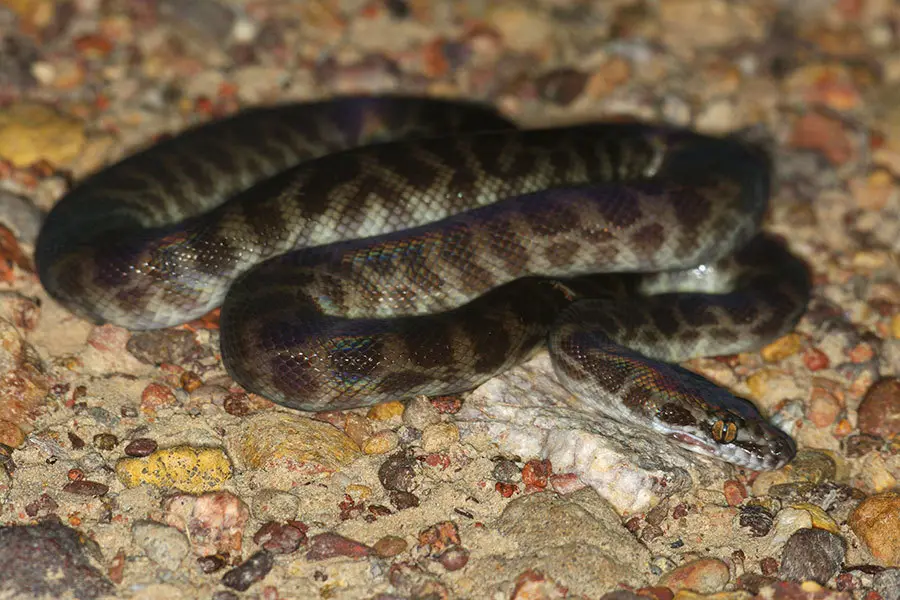
The closest relative, and now often treated as the same species. AROD says Children's python has a weaker pattern of smooth-edged, round blotches that fades with age, and gives an average length of about 28 in (70 cm). Classic Children's pythons live in the tropical north, in the Top End, the Kimberley and northwest Queensland, while Stimson's python lives in the dry interior. Where the two meet, snakes look intermediate.
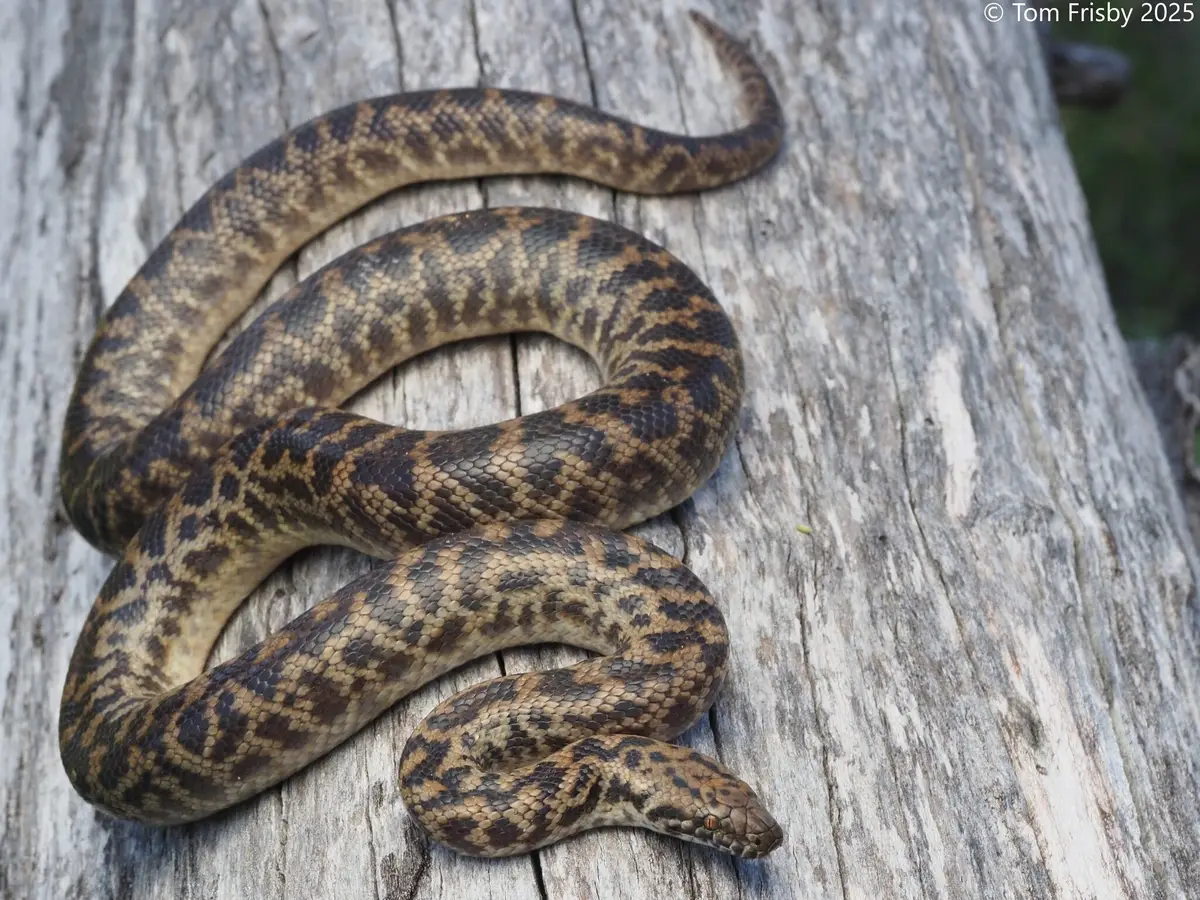
Spotted python
Antaresia maculosa · Harmless
AROD describes the spotted python as having a darker, more distinct pattern of ragged-edged blotches and no pale neck stripe. It lives along the east coast of Queensland and northern New South Wales, so the two rarely share ground.
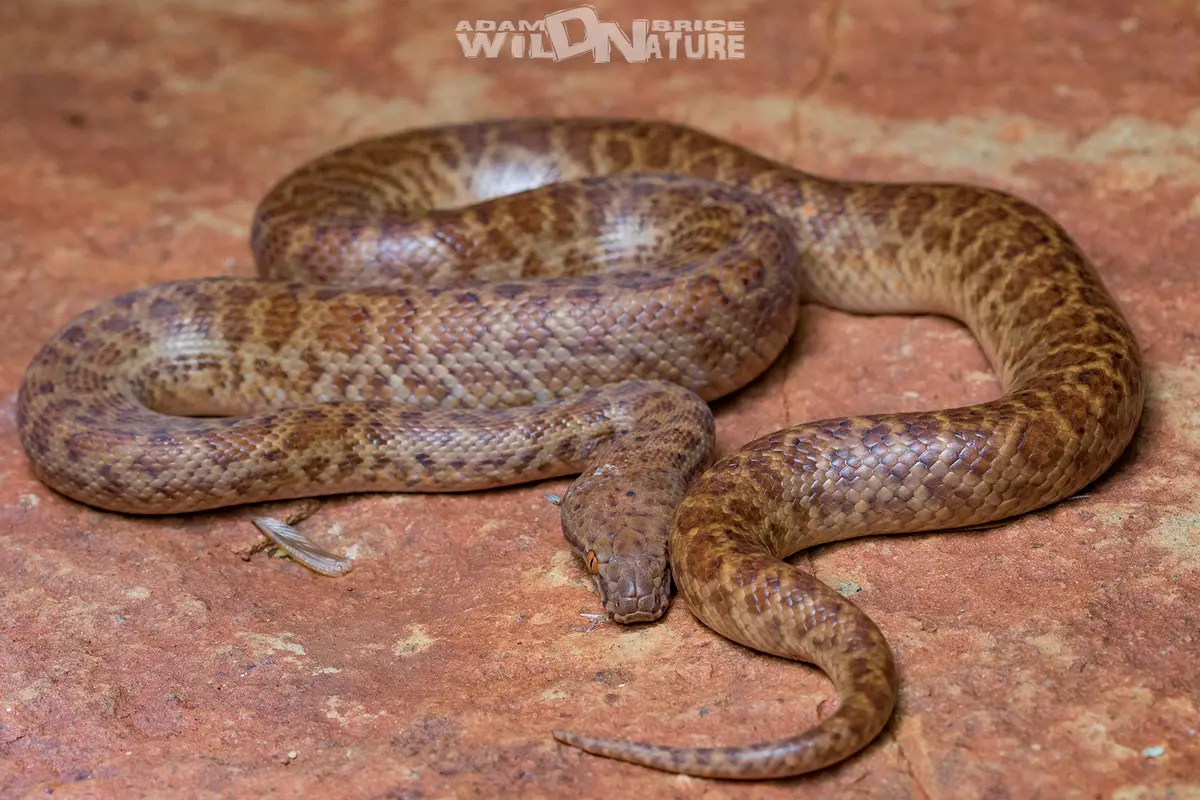
Pygmy python
Antaresia perthensis · Harmless
The pygmy python shares the Pilbara with western Stimson's pythons but is far smaller, averaging about 16 in (40 cm). It is the smallest python in the world and usually reddish-brown.
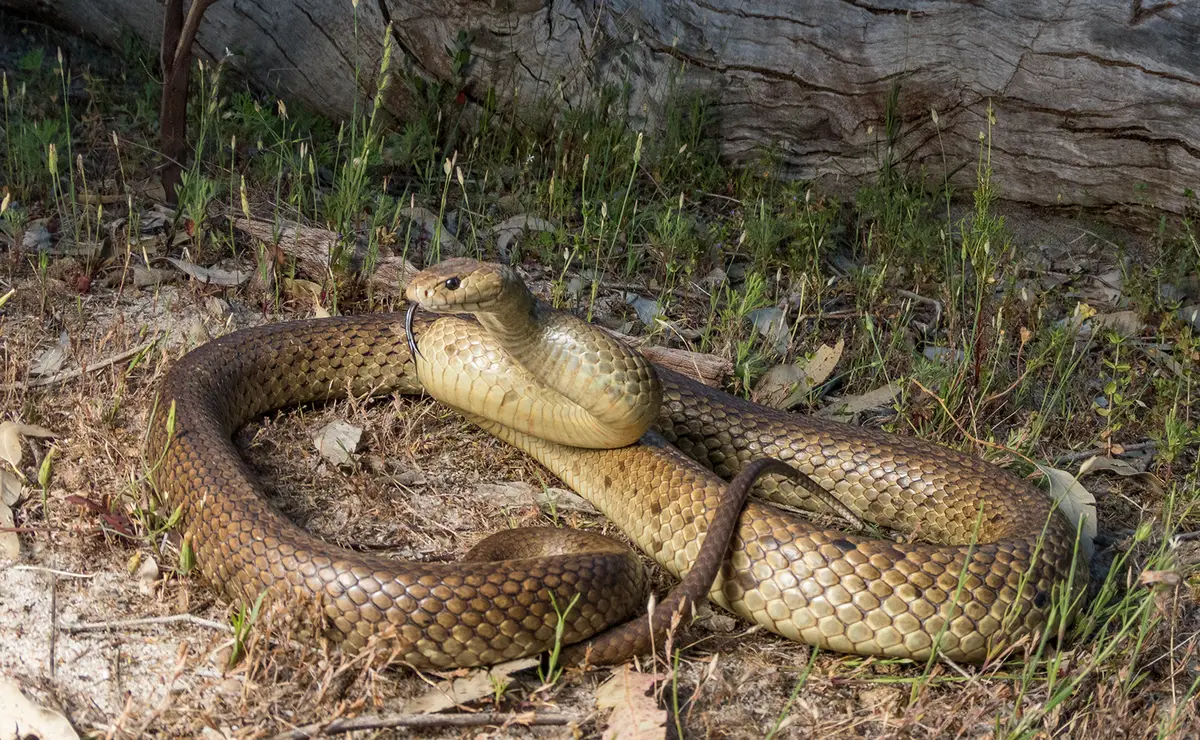
Brown snakes
Pseudonaja spp. · Highly venomous
The look-alikes that matter. AROD gives the western brown snake, or gwardar, a range across western and central Australia that overlaps much of Stimson's python's, and an average length of about 3.3 ft (1 m). Brown snakes are slim, fast elapids with no heat pits on the lips. Treat any small patterned snake you cannot identify as dangerous.
Reproduction
Stimson's pythons lay eggs, and the mother guards them. The Australian Museum and the Reptile Park both give clutches of 5-15 eggs and say the female coils around them for about 55 days until they hatch. AROD gives an average clutch of 6 and a range of 6-19. The young are on their own from the moment they hatch.
In captivity in Western Australia, the WA Society of Amateur Herpetologists says pythons mate from midwinter to early spring and lay eggs in early to late summer, which in Australia means roughly July to September for mating and December to February for eggs. No reliable lifespan figure for wild snakes was found in the sources used here.
Is Stimson's python endangered?
No, not across its range, but it is listed as Vulnerable in New South Wales. The Reptile Park rates Stimson's python Least Concern, and the Reptile Database lists Children's python, which now includes it, as Least Concern on the IUCN Red List. Queensland's WildNet profile gives it Least Concern status under the Nature Conservation Act 1992.
| Authority | Status |
|---|---|
| IUCN Red List (as Antaresia childreni) | Least Concern |
| Queensland (Nature Conservation Act 1992) | Least Concern |
| New South Wales (Biodiversity Conservation Act 2016) | Vulnerable, listed as Antaresia childreni since February 2025 |
In February 2025 the NSW Threatened Species Scientific Committee published a final determination that removed Antaresia stimsoni from the state's list of vulnerable species and put Antaresia childreni, Children's python, in its place. The snakes did not change; only the name did. AROD lists general threats faced by Australian reptiles, such as land clearing, feral predators and cane toads, while noting that these may not all apply to this species.
Is Stimson's python still a species?
It depends on which authority you follow. A 2021 study by Esquerré and colleagues in Molecular Phylogenetics and Evolution compared mitochondrial DNA, genome-wide markers and body measurements across the genus Antaresia. It found that Children's python and Stimson's python form one widespread network of populations linked by gene flow, with no sign of species-level splits. The Reptile Database says the two form a genetic gradient across their range and now lists stimsoni as a synonym of Antaresia childreni, as do iNaturalist, Queensland and New South Wales.
The old name has not gone away. AROD, the Australian Museum and the Reptile Park still use Antaresia stimsoni, and the Reptile Database records a 2024 book that treats it as a subspecies, Antaresia childreni stimsoni. Keepers and field guides still call these snakes Stimson's pythons, and they are easy to recognize by their bold blotches. It belongs with the other small Antaresia pythons, the spotted python and the pygmy python, and shares parts of Western Australia with much larger relatives such as the black-headed python.
Stimson's python FAQ
Is Stimson's python venomous?
No. Stimson's python has no venom and kills its prey by constriction. The Australian Reptile Online Database rates it non-venomous and not dangerous to people. It can give a painful bite if handled or mistaken for food, so wash any bite with soap and water and see a doctor if it becomes red or swollen.
How big do Stimson's pythons get?
Stimson's pythons grow to about 3.3 feet (1 m) at most. The Australian Museum gives an average length of about 30 inches (75 cm), and the Australian Reptile Online Database gives about 35 inches (90 cm). Males and females are about the same size, according to a 2011 field study in central Australia.
Where do Stimson's pythons live?
Stimson's pythons live across the dry interior of Australia, in Western Australia, the Northern Territory, South Australia, Queensland and far western New South Wales. The Australian Museum says it has the largest range of any Australian python. It favors rocky ranges and outcrops, riverside woodland, termite mounds and spinifex.
What is the difference between Stimson's python and Children's python?
Stimson's python has bold, high-contrast blotches and a pale stripe on each side of the neck, while Children's python has a weaker pattern of round blotches that fades with age. Children's python lives in the tropical north and Stimson's in the arid interior. A 2021 genetic study found they grade into each other, so many authorities now treat them as one species.
Is Stimson's python the same as the large-blotched python?
Yes. Large-blotched python is another common name for Stimson's python, used by the Australian Museum, the Australian Reptile Park and the Reptile Database. It refers to the large dark blotches on the snake's pale body, which separate it from the smaller-spotted pygmy python and the weakly patterned Children's python.
Do Stimson's pythons make good pets?
Stimson's pythons are popular pets in Australia because they stay small, and the Australian Museum calls them a popular captive species. Young snakes can be nervous and bite, and breeding males fight, so adults are usually kept apart. Rules on keeping native reptiles differ between Australian states and between countries, so check with the local wildlife agency first.
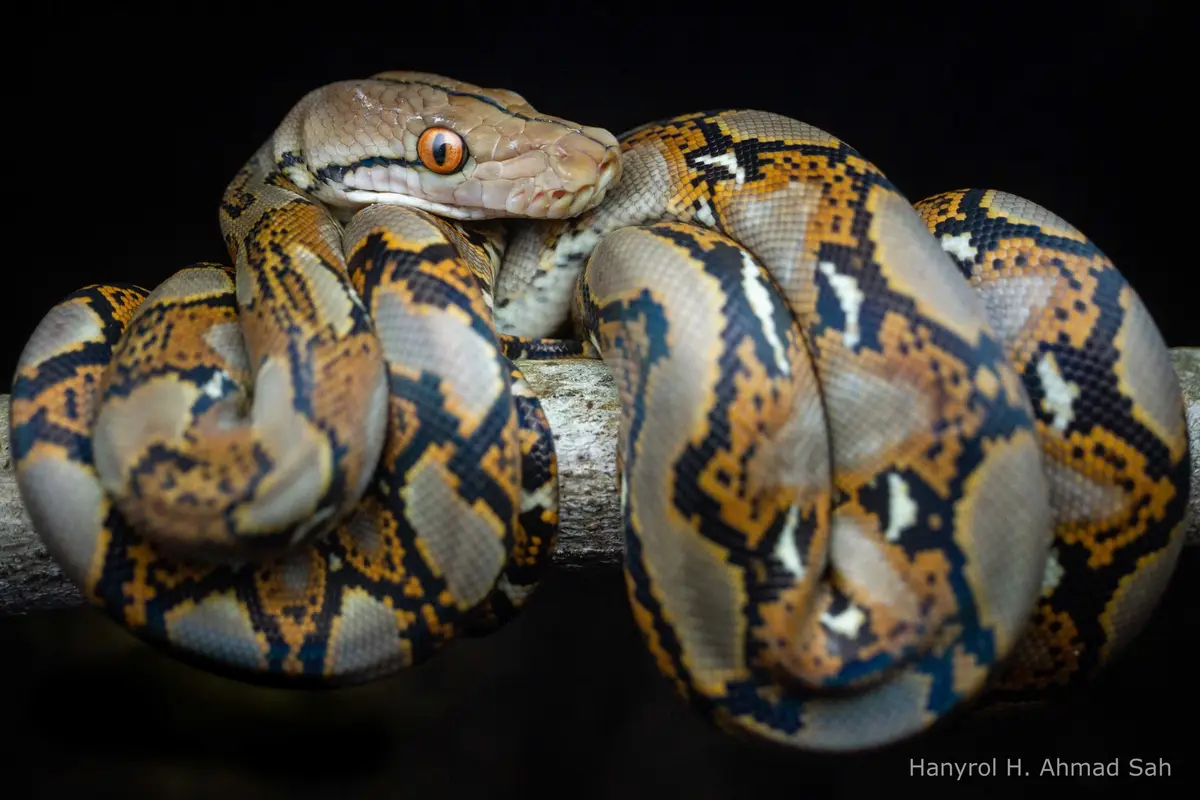
Related snakes
Sources
- Reptile Database: Antaresia childreni (Gray, 1842), including synonym Antaresia stimsoni (Smith, 1985)
- Australian Reptile Online Database: Stimson's python (Antaresia stimsoni)
- Australian Museum: Stimson's python
- Australian Reptile Park: Stimson's python
- McDonald et al. (2011). Ecology of Stimson's python (Antaresia stimsoni) in the MacDonnell Ranges of central Australia. Australian Journal of Zoology 59: 95-102
- Esquerré et al. (2021). Phylogeography, historical demography and systematics of the world's smallest pythons (Pythonidae, Antaresia). Molecular Phylogenetics and Evolution 161: 107181
- NSW Threatened Species Scientific Committee (2025). Final determination: minor amendments to the Schedules of the Biodiversity Conservation Act 2016
- Australian Reptile Online Database: Children's python (Antaresia childreni)
- WA Society of Amateur Herpetologists: Keeping advice sheet, pythons (Western Stimson's python)