PAPUANPYTHON
Apodora papuana · Family Pythonidae
KEY TAKEAWAYS
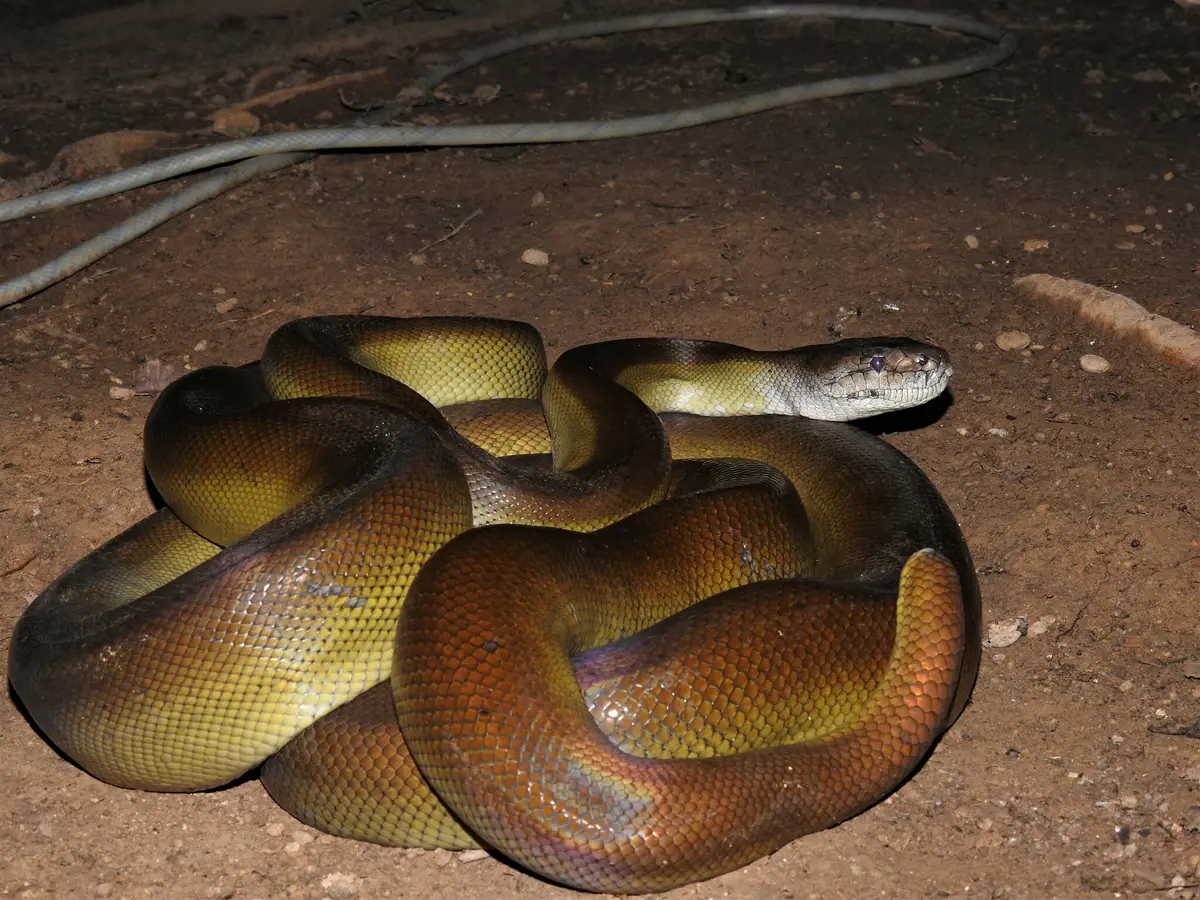
The Papuan python (Apodora papuana) is a large, non-venomous python found across the lowlands of New Guinea and a few nearby islands. It usually grows to about 13 ft (4 m), which makes it one of the biggest snakes on the island. It kills by constriction and is not a danger to people who leave it alone.
- It has no venom. Like all pythons, it squeezes its prey.
- Adults average about 13 ft (4 m), and the largest recorded snake was about 14 ft (4.3 m).
- Its color can shift from olive-brown toward black or mustard yellow, apparently when the snake is stressed.
- The IUCN Red List rates it Least Concern (2018 assessment).
Papuan python quick facts
| Common names | Papuan python, Papuan olive python, Irian python |
|---|---|
| Scientific name | Apodora papuana (Peters and Doria, 1878); also placed in Liasis as Liasis papuanus |
| Family | Pythonidae (pythons) |
| Venomous | No, a constrictor |
| Adult length | About 13 ft (4 m); largest record about 14 ft (4.3 m) |
| Coloring | Olive, brown or gray-brown above, paler on the lower sides, lips and belly; can turn darker or yellowish |
| Range | New Guinea: Papua New Guinea and the Indonesian provinces of Papua, plus islands such as Misool, Biak, Yapen, Karkar and Fergusson |
| Habitat | Lowland rainforest and savanna, mostly below about 2,300 ft (700 m) |
| Diet | Mainly mammals such as rodents and marsupials, plus ground birds |
| Reproduction | Lays eggs |
| Conservation | IUCN Least Concern (2018) |
How to identify a Papuan python
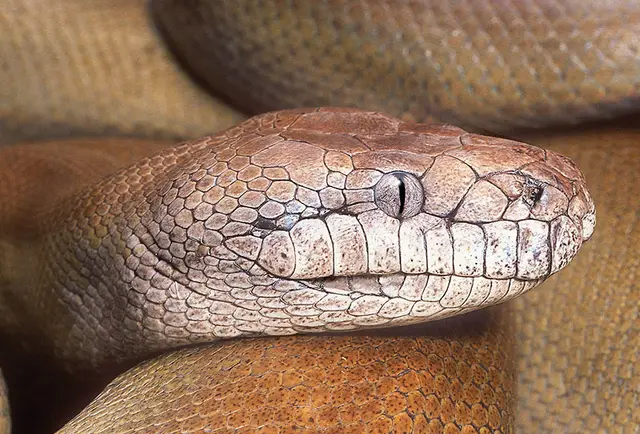
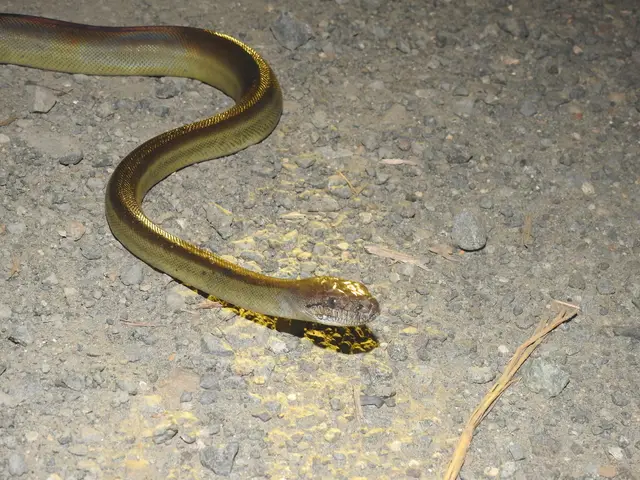
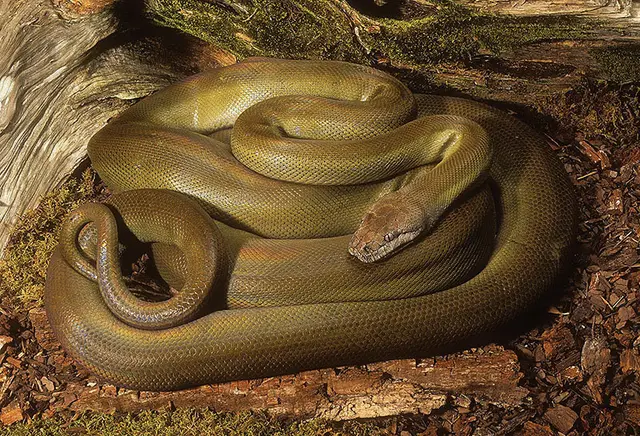
A Papuan python is a big, thick-bodied python with no bold pattern. Ecology Asia's species account describes the back as brown to gray-brown, darker along the spine and upper sides and lighter on the lower sides, with a pale chin, throat, lips and belly. In lowland New Guinea, a plain olive-brown snake well over 10 ft long is most likely this species.
- 1Plain olive or brown body: no blotches, bands or net pattern. The upper body is darker and the lower sides fade to a lighter shade.
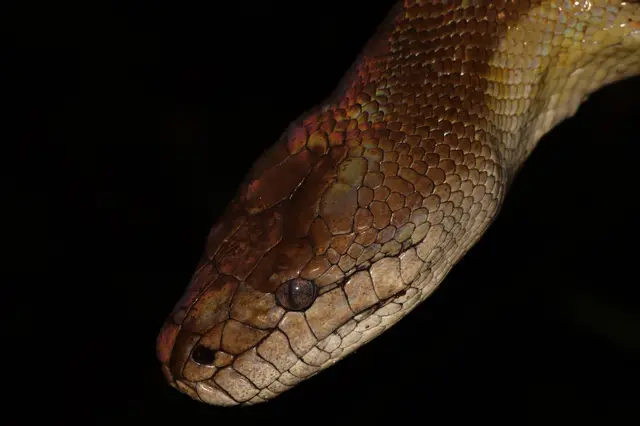
- 2Short, blunt head: the head is short and only a little wider than the heavy neck. Some snakes have a dark stripe behind the eye.
- 3Pale lips and throat: the lip scales, chin and throat are noticeably lighter than the back, and the belly is pale.
- 4Vertical pupils: medium-sized eyes with vertical pupils, the usual python eye for a snake that hunts at night.
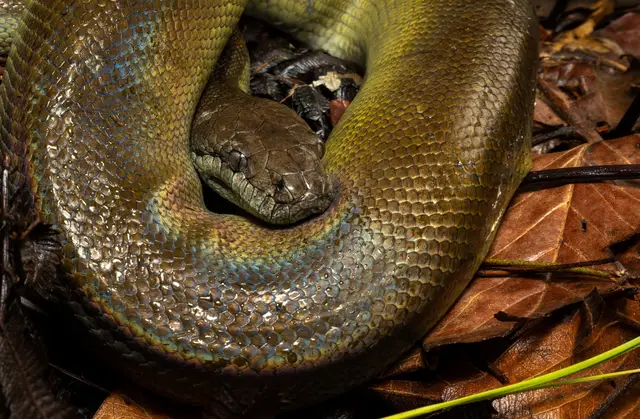
- 5Loose, thin skin: herpetologist Mark O'Shea told the Reptile Database that this snake has looser skin than its relatives, with black skin showing between the scales, and a chunkier head.
A python that changes color
The Papuan python is known for shifting color. A July 2025 report by Mongabay Indonesia says the usual greenish-gray to dark olive can move toward yellow or near-black, sometimes with two tones on one snake, and that the change is thought to be linked to stress or agitation. How the snake does this, and why, has not been worked out. So a black or mustard-yellow python in New Guinea may still be this species.
How big do Papuan pythons get?
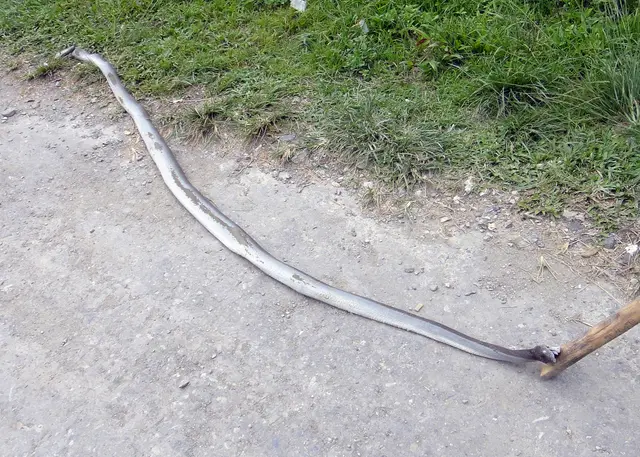
Adult Papuan pythons average about 13 ft (4 m). Ecology Asia gives a maximum of 4.3 m (about 14 ft), and Mongabay Indonesia also reports 4.3 m as the largest recorded snake. Ecology Asia's photographed specimen from Southern Highlands Province measured 4 m.
| Measure | Figure | Source |
|---|---|---|
| Typical adult length | About 13 ft (4 m) | Mongabay Indonesia (2025) |
| Largest reliable record | About 14 ft (4.3 m) | Ecology Asia; Mongabay Indonesia |
| Claims over 16 ft (5 m) | Not verified | Repeated online without a named source |
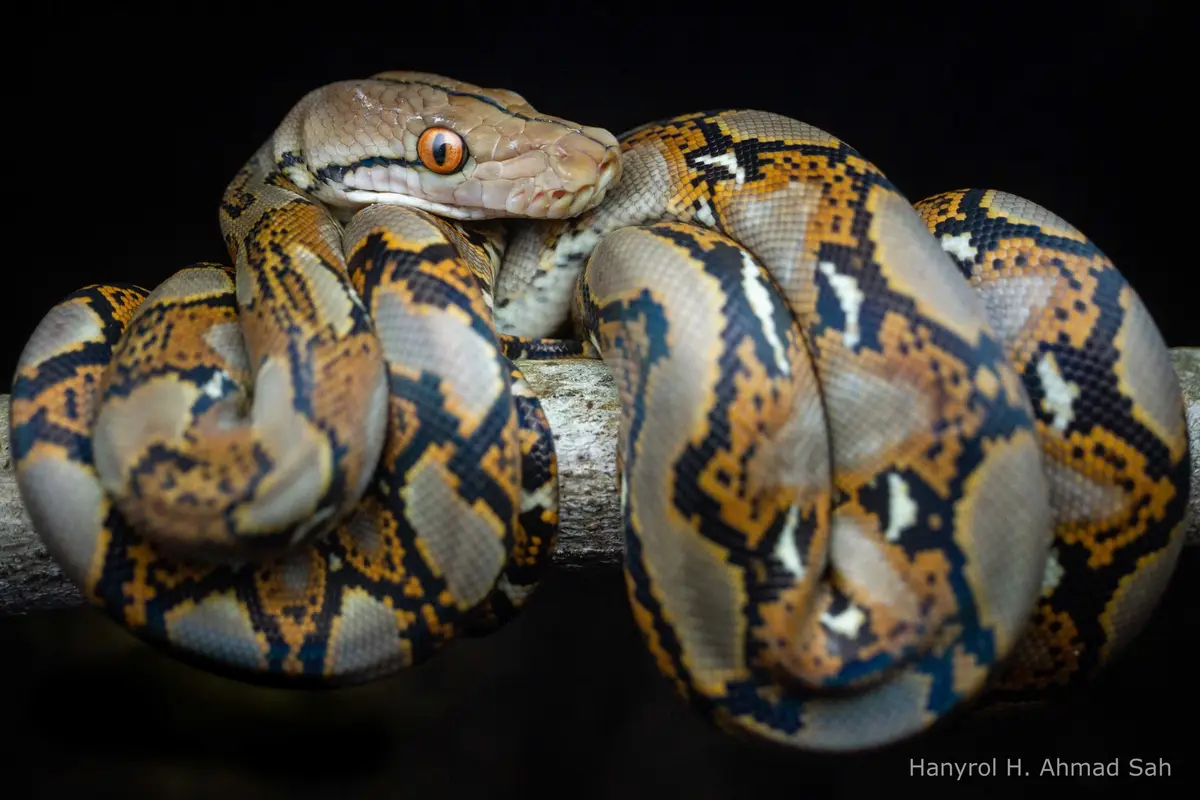
Some websites say Papuan pythons pass 16 ft (5 m). None of those claims names a measured snake, so treat them with caution. Even at 13-14 ft, this is a big snake. It is still well short of the reticulated python, the longest snake in the world.
Where do Papuan pythons live?
Short answer: only on New Guinea and a handful of islands close to it. The Reptile Database lists Papua New Guinea and Indonesia (Misool and the former Irian Jaya, now the Papua provinces). The type specimen, collected by the Italian explorer L. M. D'Albertis in 1872, came from Romoi near Sorong, at the western tip of the island.
Ecology Asia describes it as widespread across mainland Papua New Guinea, reaching a few offshore islands. Mongabay Indonesia names Misool, Biak, Yapen and Numfor on the Indonesian side, and Karkar and Fergusson islands in Papua New Guinea. The species is endemic to the New Guinea region; it does not occur in Australia. See how this range sits next to other pythons on the world snake map.
Habitat
Papuan pythons live in lowland rainforest and savanna. Mongabay Indonesia, quoting archaeologist Hari Suroto of Indonesia's National Research and Innovation Agency (BRIN), says they are found from sea level up to about 2,300 ft (700 m) and are closely tied to the tropical rainforest that covers most of the island.
It hunts on the forest floor, according to Ecology Asia. That sets it apart from New Guinea's climbing pythons, such as the green tree python, which spends much of its life coiled on branches.
Behavior
The Papuan python is a night hunter that stays mostly on the ground and waits for prey. Ecology Asia notes that pythons like this one find the regular trails of forest-floor mammals by scent, then lie in ambush beside them. Mongabay Indonesia adds that it finds warm-blooded prey with the heat-sensing pits around its mouth, strikes fast and then constricts.
No radio-tracking study of wild Papuan pythons has been published, and the species is rarely seen. iNaturalist holds only about two dozen observations of it. For a 13 ft snake, that says a lot about how quietly it lives.
Toward people it is calm. Mongabay Indonesia describes it as not aggressive unless provoked. Like any large python, it will bite if grabbed or cornered.
What do Papuan pythons eat?
Papuan pythons eat mostly mammals. Mongabay Indonesia lists small to medium mammals such as rodents and marsupials, along with ground-dwelling birds. No detailed diet study based on stomach contents has been published.
| Prey | Notes |
|---|---|
| Rats and other rodents | Listed first by Mongabay Indonesia |
| Marsupials | Named as prey by Mongabay Indonesia |
| Ground birds | Taken from the forest floor |
Mongabay Indonesia points out that a python that eats rodents may also move seeds. Seeds inside a swallowed rat can pass through the snake intact and be dropped far from where the rat found them. Like other big pythons, it can go for weeks between large meals.
Is the Papuan python venomous or dangerous?
No. The Papuan python has no venom. It kills by wrapping around prey and squeezing. There are no reliable reports of one killing a person, and its prey is far smaller than an adult human.
A 13 ft python is strong, though, and its many sharp, backward-curved teeth can leave deep cuts. Clean any python bite well with soap and water and make sure your tetanus protection is current. See a doctor if the wound turns red, hot or swollen.
New Guinea also has highly venomous snakes, some of them plain brown or black. Do not assume a large dark snake is a python. If you cannot identify it, back away. The SnakesWiki snake venom FAQ explains why size and color are poor clues to danger.
Papuan python vs other New Guinea pythons
Amethystine python
Simalia amethistina · Harmless
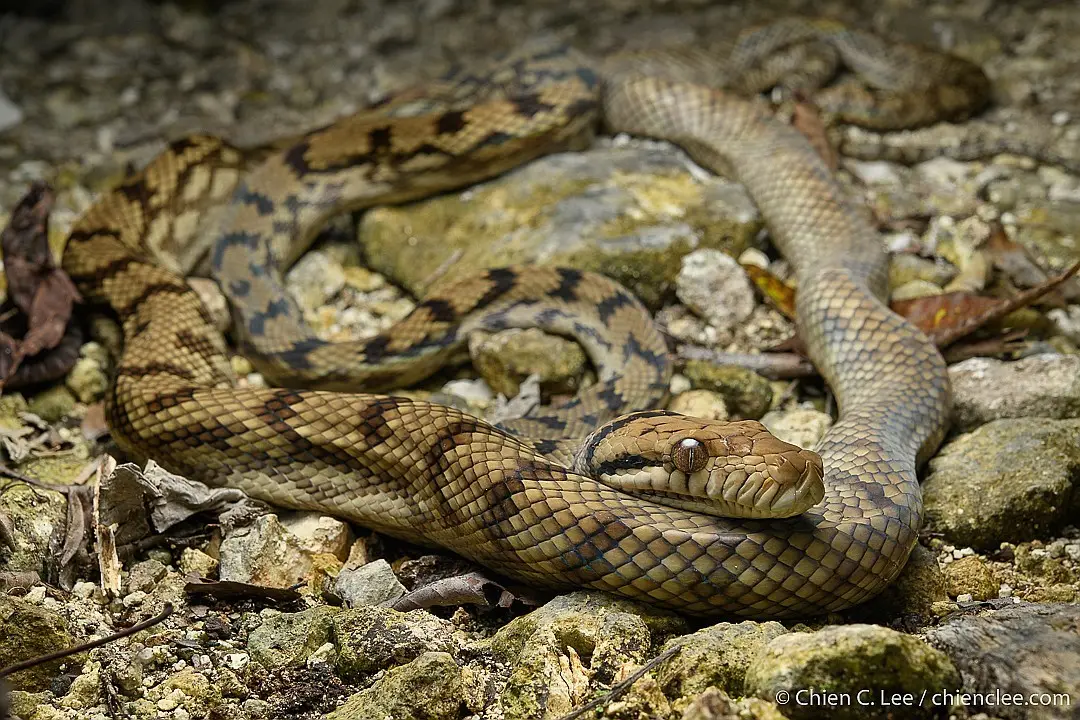
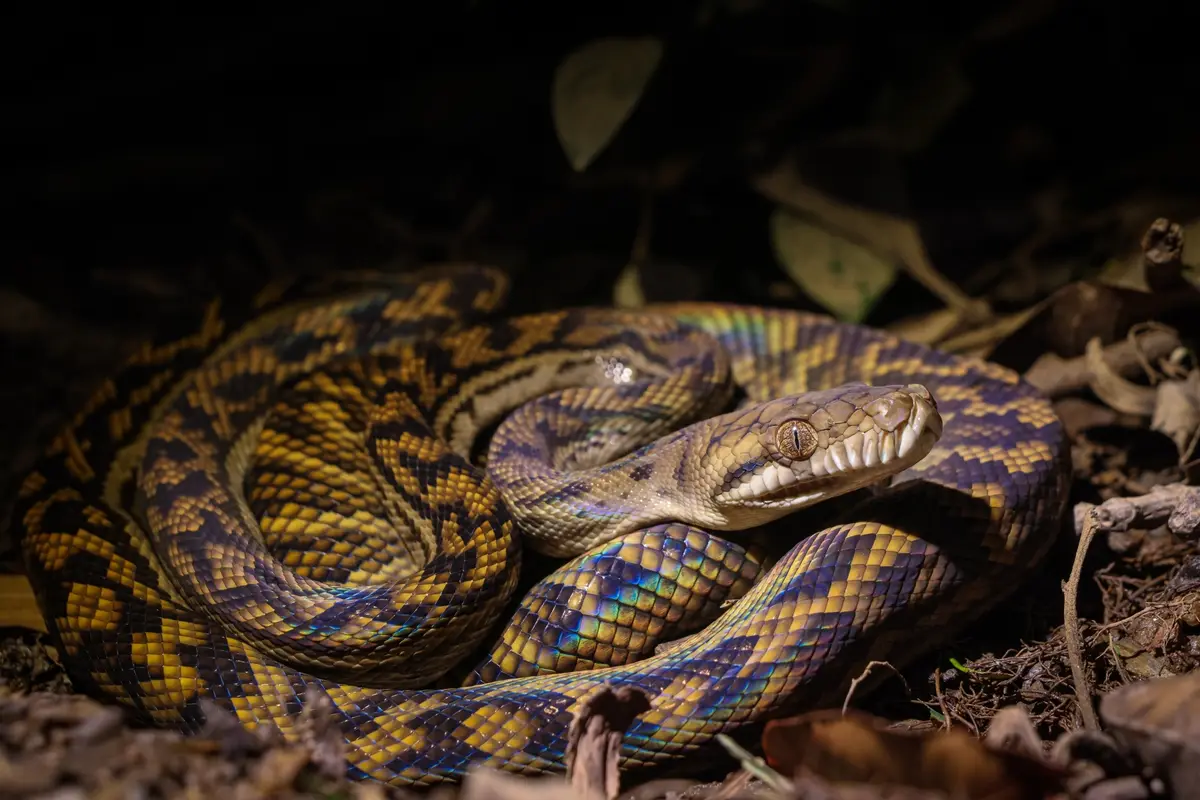
Found in New Guinea, the Moluccas and northeastern Australia. The amethystine python is slimmer, with a longer head and a pattern of dark bands or zigzags over a pale, often iridescent body. The Papuan python is plain and much stockier.
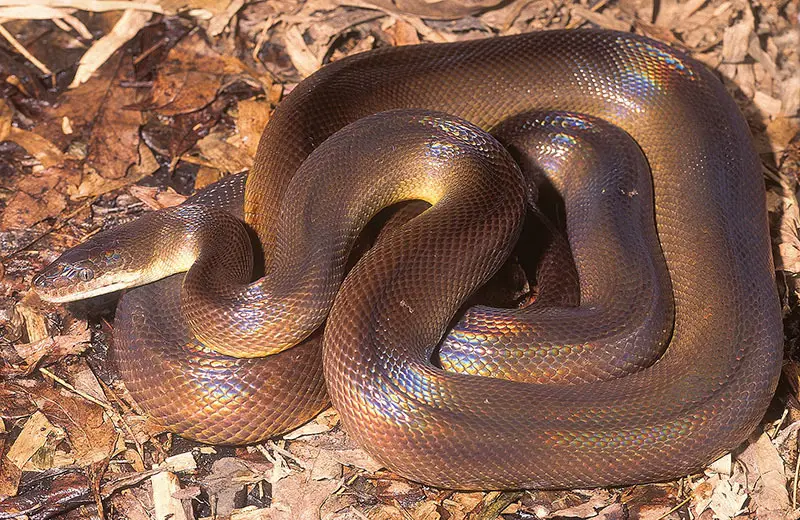
Water python
Liasis fuscus · Harmless
Lives in southern Papua New Guinea and northern Australia. It is also plain and dark, but it is a smaller python. Outside southern Papua New Guinea, range alone separates the two.
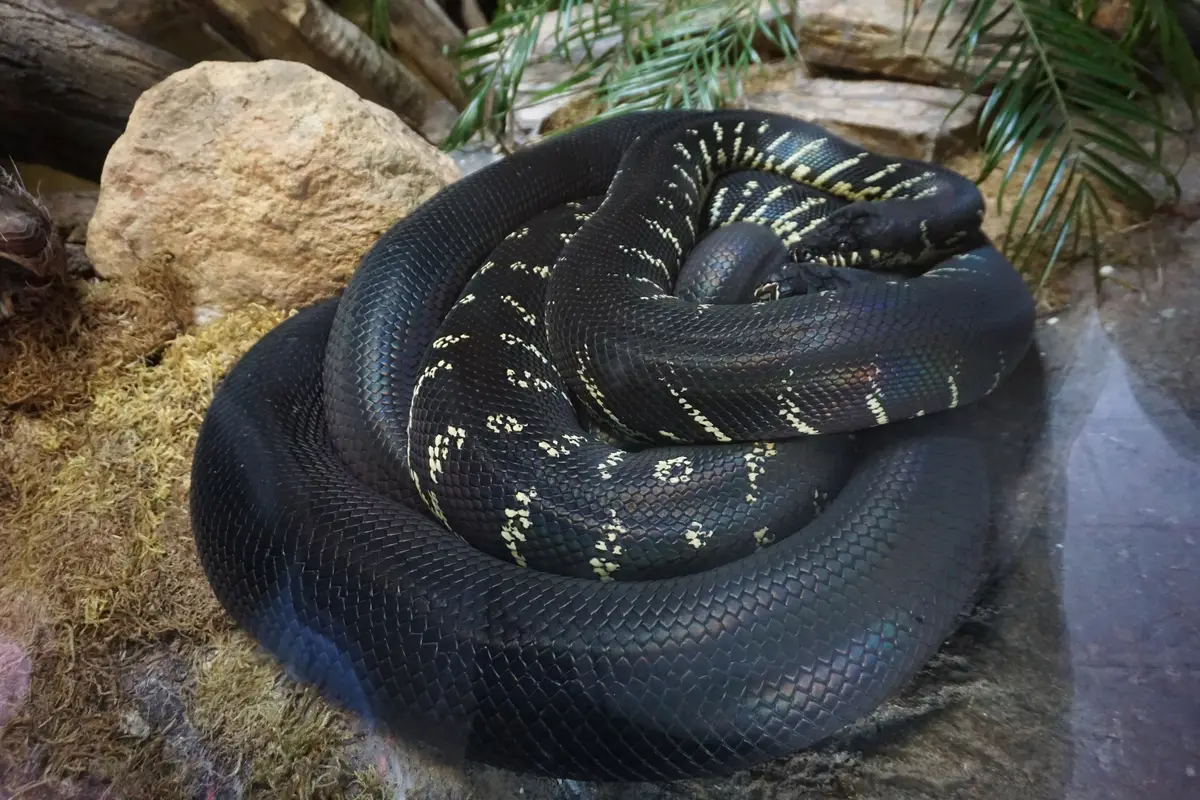
Boelen's python
Simalia boeleni · Harmless
A mountain python found at around 5,600 ft (1,700 m) and higher. Boelen's python is glossy black with yellow or white bars on the chin and lower sides. Papuan pythons live in the lowlands and have no bars.
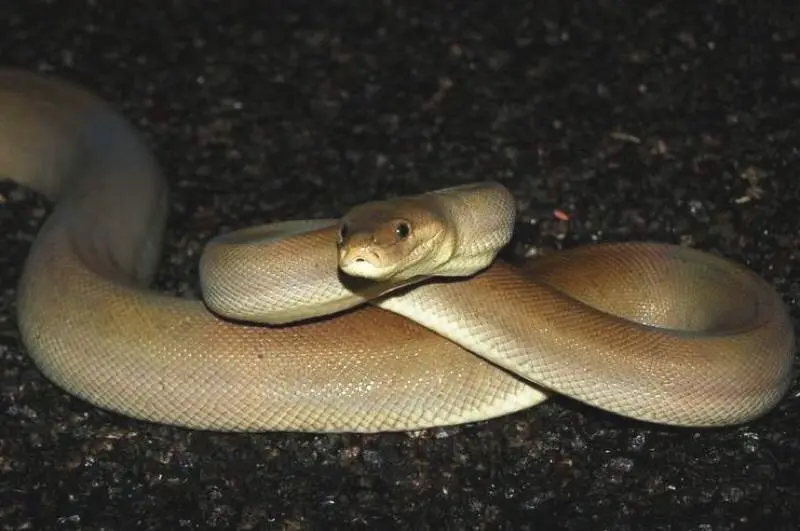
Olive python
Liasis olivaceus · Harmless
The closest look-alike in color and shape, but it lives only in Australia. A plain olive python in New Guinea is a Papuan python; one in northern Australia is an olive python.
Reproduction
Papuan pythons lay eggs, as all pythons do. Wild clutch sizes, nesting sites and breeding seasons have not been described in the scientific literature. Breeding records come from captivity, where the species is kept only rarely.
Is the Papuan python endangered?
No. The IUCN Red List rated the Papuan python Least Concern in 2018, in an assessment by Tallowin, O'Shea and Parker. It is widespread across a large, still heavily forested island.
| Authority | Status |
|---|---|
| IUCN Red List (2018) | Least Concern |
| CITES | Appendix II, like nearly all pythons |
Mongabay Indonesia names clearing for plantations, mines and settlements as the main threat, with some collecting for the pet trade. Because it depends on lowland forest, a falling number of Papuan pythons in an area would point to wider forest loss there.
Apodora or Liasis?
The scientific name is still debated. Peters and Doria described the snake as Liasis papuanus in 1878, and Arnold Kluge moved it to its own genus, Apodora, in 1993. The name comes from Greek for "a peeling of the skin", a reference to its thin, fragile skin. The annotated checklist of pythons by Schleip and O'Shea (2010) notes that DNA studies by Rawlings and colleagues placed it close to Liasis, possibly near the olive python, but with weak support. Reynolds and colleagues merged Apodora into Liasis in 2014. Most checklists, including the Reptile Database and the IUCN, still use Apodora papuana.
Papuan python FAQ
Is the Papuan python venomous?
No. The Papuan python has no venom and kills its prey by constriction. It is not dangerous to people who leave it alone. A large adult can still give a deep, painful bite, so clean any bite well with soap and water, check that your tetanus protection is current and see a doctor if the wound becomes infected.
How big does a Papuan python get?
Papuan pythons average about 13 feet (4 m) as adults. The largest reliable record is about 14 feet (4.3 m), according to Ecology Asia and Mongabay Indonesia. Claims of snakes over 16 feet (5 m) appear online but do not cite a measured specimen, so they should be treated with caution.
Where does the Papuan python live?
The Papuan python lives only on New Guinea and nearby islands. It is found across mainland Papua New Guinea and the Indonesian Papua provinces, and on islands such as Misool, Biak, Yapen, Numfor, Karkar and Fergusson. It prefers lowland rainforest and savanna below about 2,300 feet (700 m).
Why does the Papuan python change color?
The reason is not fully known. The Papuan python can shift from its usual olive-brown toward yellow or near-black, sometimes showing two tones at once. Mongabay Indonesia reports that the change is thought to be linked to stress or agitation, but the mechanism has not been studied in detail.
Is the Papuan python the same as the olive python?
No. They are separate species. The Papuan python (Apodora papuana) lives in New Guinea, and the olive python (Liasis olivaceus) lives only in Australia. The two look alike and may be close relatives, which is why the Papuan python is often called the Papuan olive python.
What does a Papuan python eat?
Papuan pythons eat mainly mammals, especially rodents and marsupials, plus birds that feed on the ground. They hunt at night, often waiting in ambush beside the trails that small mammals use, and find warm-blooded prey with heat-sensing pits around the mouth.
Related snakes
Sources
- Reptile Database: Apodora papuana (Peters and Doria, 1878)
- Schleip and O'Shea (2010). Annotated checklist of the recent and extinct pythons (Serpentes, Pythonidae). ZooKeys 66: 29-79
- Ecology Asia: Papuan olive python, Vertebrate fauna of Papua New Guinea
- Mongabay Indonesia (2025). Piton zaitun, ular penguasa hutan Papua
- IUCN Red List: Apodora papuana (Tallowin, O'Shea and Parker, 2018)
- Reptile Database: Simalia boeleni (Boelen's python)
- Reptile Database: Liasis fuscus (water python)
- iNaturalist: Papuan python (Apodora papuana)