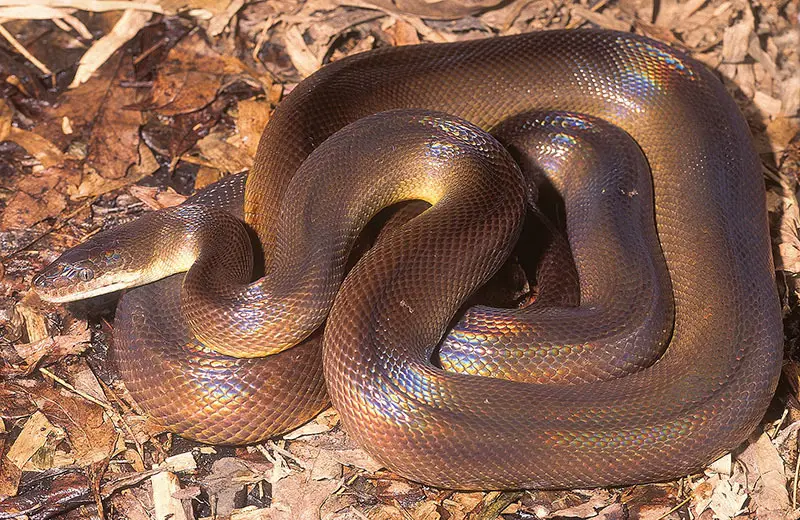
BROWN WATERPYTHON
Liasis fuscus · Family Pythonidae
KEY TAKEAWAYS
The brown water python (Liasis fuscus), usually just called the water python in Australia, is a non-venomous python of the rivers and floodplains of northern Australia and southern New Guinea. It is harmless to people. Its closest relatives are Macklot's python of Timor and the olive python.
- It has no venom and kills its prey by constriction.
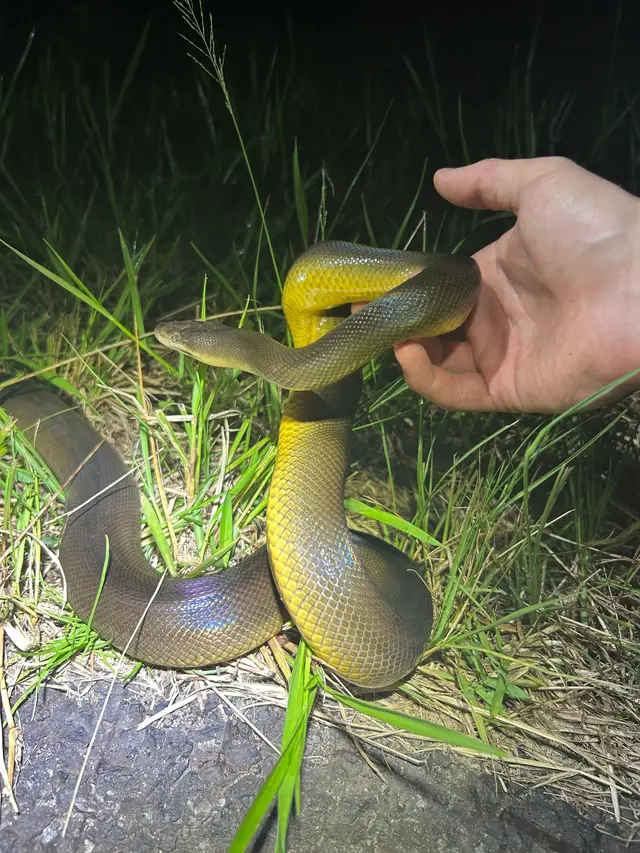
- Adults are usually 6.5-8 ft (2-2.5 m) long, with a plain, iridescent dark brown back and a yellow belly.
- On the Adelaide River floodplain near Darwin it lives mostly on dusky rats and migrates up to 12 km (7.5 miles) each wet season to follow them.
- The IUCN Red List rates it Least Concern.
Brown water python quick facts
| Common names | Water python, brown water python, yellow-bellied python |
|---|---|
| Scientific name | Liasis fuscus Peters, 1873 |
| Family | Pythonidae (pythons) |
| Venomous | No, a constrictor |
| Adult length | Usually 6.5-8 ft (2-2.5 m); up to about 10 ft (3 m) |
| Coloring | Plain dark brown to blackish back with a rainbow sheen; yellow belly; cream throat |
| Range | Northern Western Australia, the Northern Territory, coastal Queensland, Torres Strait islands and southern Papua New Guinea |
| Habitat | Rivers, billabongs, swamps and seasonally flooded plains |
| Diet | Mainly rats, especially the dusky rat; also birds, eggs and reptiles |
| Reproduction | Lays eggs, usually about 10-19 per clutch; many females brood them |
| Conservation | IUCN Least Concern; CITES Appendix II |
How to identify a brown water python
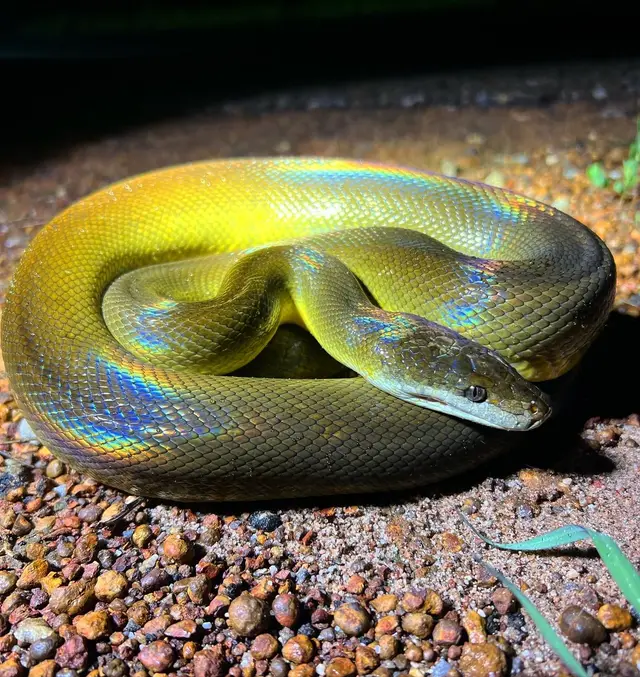
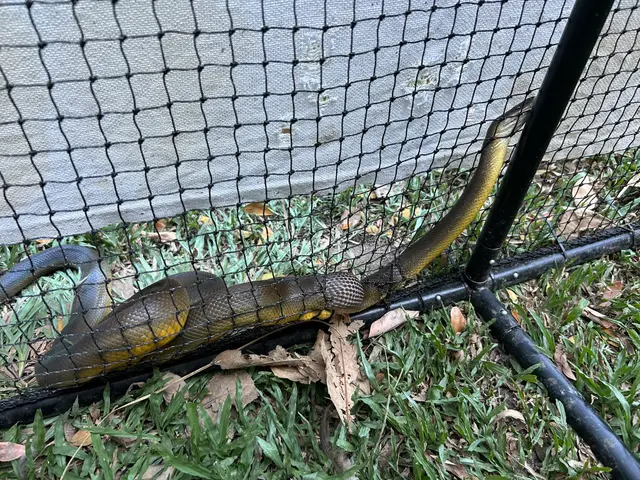
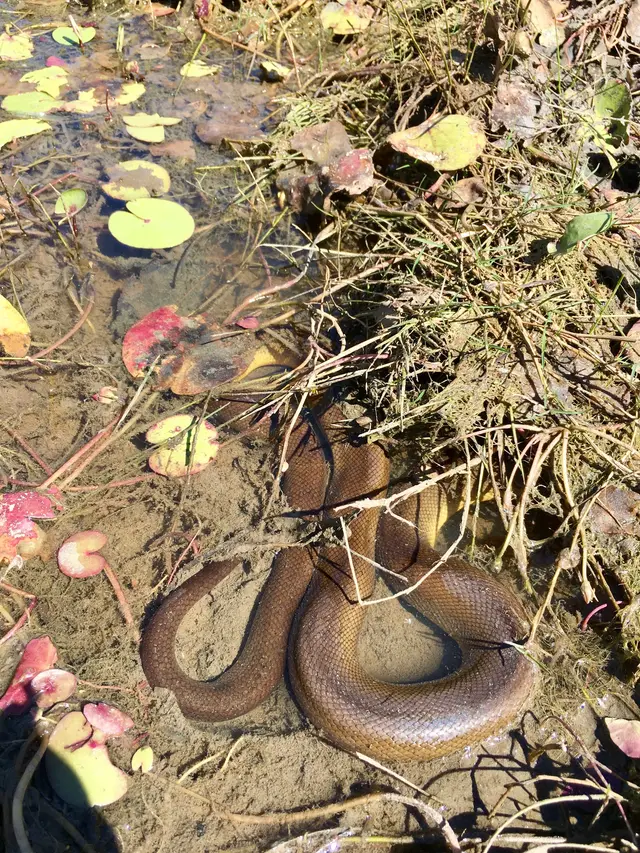
A brown water python is a long, smooth, plain-colored python with no pattern at all on its back. In sunlight the dark scales throw off an oily rainbow sheen, the easiest field mark. The belly is bright to dull yellow. Near water in the Top End or the Kimberley, a patternless dark snake of 6-8 ft with a yellow belly and a rainbow gloss is most likely this species, but read the look-alike section below before going any closer.
- 1Plain dark back: dark olive-brown to almost black, with no blotches, bands or net pattern.
- 2Rainbow sheen: the smooth scales are strongly iridescent in sunlight. The Australian Reptile Online Database uses this sheen, together with the yellow belly, to separate it from the olive python.
- 3Yellow belly, pale throat: the underside is yellow, which is where the name yellow-bellied python comes from. The throat is cream.
- 4Heat pits on the lips: a row of small heat-sensing pits sits in the lip scales. Australia's venomous elapid snakes, such as the mulga snake, have no pits.
- 5Scale counts: for anyone handling a dead specimen: 40-55 rows of scales around the middle of the body, 270-300 belly scales, a single anal scale and 60-80 paired scales under the tail.
How big do brown water pythons get?
Most adult brown water pythons are 6.5-8 ft (2-2.5 m) long, and the largest reach about 10 ft (3 m). The Australian Reptile Online Database gives an average of 250 cm (8.2 ft) and a maximum of 300 cm (9.8 ft). That makes it a medium-to-large python: much bigger than a spotted python, much smaller than an olive python, which shares the same rivers.
| Measure | Figure | Source |
|---|---|---|
| Typical adult length | 6.5-8 ft (2-2.5 m) | Cogger, Reptiles and Amphibians of Australia |
| Average length | 250 cm (8.2 ft) | Australian Reptile Online Database |
| Maximum length | About 300 cm (9.8 ft) | Australian Reptile Online Database |
Food decides how big each snake gets. In a 13-year field study published in the Journal of Animal Ecology, Thomas Madsen and Richard Shine found that young pythons hatched in years with plenty of rats grew faster, and kept growing faster for the rest of the study. The effect was strongest in females, the faster-growing sex. The authors called it a "silver spoon" effect: a good first year shapes adult size.
Where do brown water pythons live?
Short answer: across the tropical north of Australia and in southern New Guinea. The Reptile Database lists Western Australia, the Northern Territory, Queensland and Papua New Guinea. In Australia the range runs from the Kimberley, east through the Top End of the Northern Territory, then down the Queensland coast. The type locality, "Port Bowen", is Port Clinton on the central Queensland coast.
DNA splits the range in two. Rawlings and colleagues (2004), as summarized in the annotated checklist of pythons by Schleip and O'Shea (2010), found that snakes from Queensland, the Torres Strait island of Saibai and New Guinea form one group, and snakes from the Northern Territory form a sister group. No subspecies are formally recognized. Compare this range with other snakes on the world snake map.
Habitat
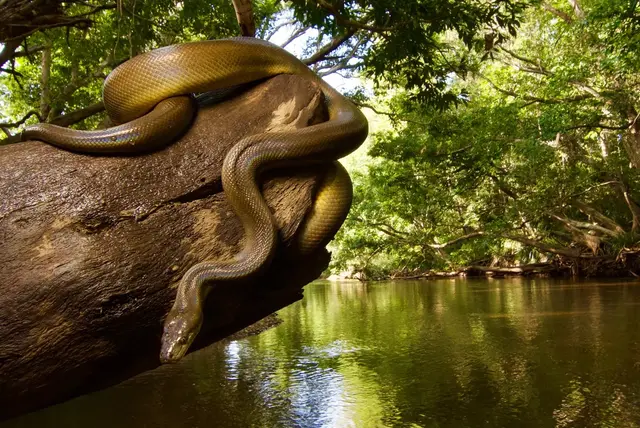
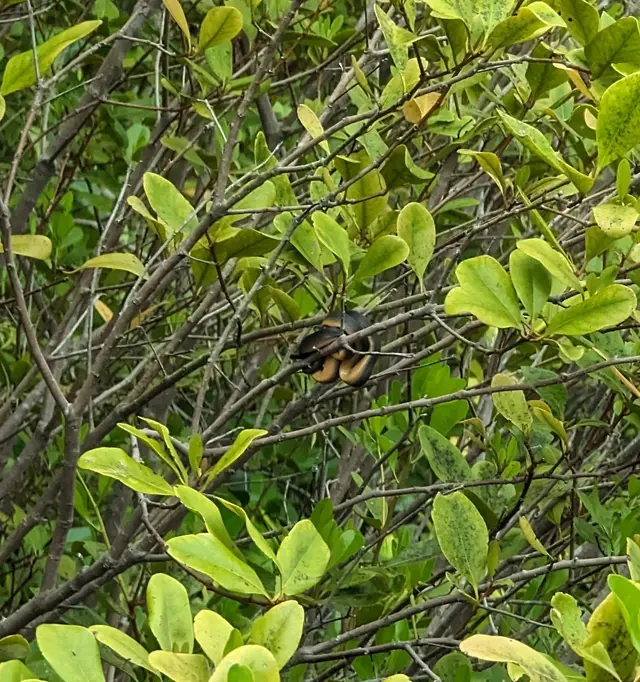
Brown water pythons live around fresh water: rivers, creeks, billabongs, swamps and the wide floodplains of the Top End that fill each wet season and bake hard each dry season. They shelter in hollow logs, riverbank dens, thick vegetation and the deep cracks that open in floodplain clay as it dries.
The best-known population lives on the Adelaide River floodplain at Fogg Dam, in the Northern Territory near Darwin. Water pythons are the most common snake there, and Thomas Madsen, Richard Shine and colleagues have marked and recaptured them in studies running for more than 17 years. Hatchlings radio-tracked by Pizzatto, Madsen, Brown and Shine (2009) headed for the floodplain, avoided pasture, and hid at the base of grass clumps or down soil cracks, especially where cracks were deep and wide.
Behavior: the python that migrates with its prey
Brown water pythons hunt mostly at night and spend the day hidden. Surprise one on a riverbank and it will usually head straight for the water rather than stand its ground.
Their seasonal migration is the best-studied thing about them. In the dry season, dusky rats live in the cracks of the dry floodplain, and the pythons hunt them there. When the wet season floods the plain, the rats move to higher ground, mostly natural levee banks. Madsen and Shine radio-tracked pythons at Fogg Dam and found that most of them followed the rats, moving up to 12 km (7.5 miles) from their dry-season range. Their 1996 paper in the journal Ecology described python and rat numbers on the floodplain rising and falling together, which they noted had not been described before in a land reptile.
Pizzatto and colleagues (2009) found that adults moved about 252 m (830 ft) a week and hatchlings about 66 m (217 ft). Measured in body lengths, the hatchlings moved farther.
When the rats vanished
The migration has limits. After an extreme flood nearly wiped out the Fogg Dam rats for three years, the local pythons stayed put, even though rats were plentiful only 8 km (5 miles) away. Many of them starved. In their 2011 study in Ecology, Ujvari, Shine and Madsen suggested the snakes respond to habitat features that have reliably meant rats over their evolutionary history, not to the rats themselves. Species that cannot shift to new feeding grounds may cope poorly as climate change moves their food.
What do brown water pythons eat?
Brown water pythons eat mainly mammals, and on the Adelaide River floodplain their staple is the dusky rat (Rattus colletti), according to Madsen and Shine (1996). They also take birds, bird eggs and reptiles, including young crocodiles, according to the Australian Reptile Online Database.
| Prey | Notes |
|---|---|
| Dusky rats | The main prey at Fogg Dam; python numbers track rat numbers from year to year |
| Other mammals | Recorded in the diet, though less often than rats |
| Birds and eggs | Taken when the chance comes |
| Reptiles | Including young crocodiles |
Because they lean so heavily on one prey, the pythons rise and fall with it. A 17-year mark-recapture study by Madsen, Ujvari, Shine and Olsson (2006) found that rat numbers dropped in years with either too little or too much late wet-season rain. Fewer rats meant fewer breeding female pythons, thinner snakes and lower survival. The number of young pythons joining the population each year was the biggest driver of python numbers.
Is the brown water python venomous?
No. The brown water python has no venom and is not dangerous to people. It kills by coiling around prey and squeezing. A rat-eating python of 8 ft is no threat to an adult.
It can bite if grabbed. Like all pythons it has many sharp, backward-curved teeth, and a bite from a large adult leaves rows of small, bleeding punctures. Wash any python bite well with soap and water and check your tetanus protection. See a doctor if the wound turns red, hot or swollen.
The real risk is mistaken identity. Northern Australia is home to the mulga snake (king brown snake), a large, brownish, highly venomous snake that lives in the same country. If you are not sure what a brown snake is, leave it alone and give it room. The SnakesWiki snake venom FAQ explains why color is a poor guide to danger.
Brown water python vs mulga snake and other look-alikes
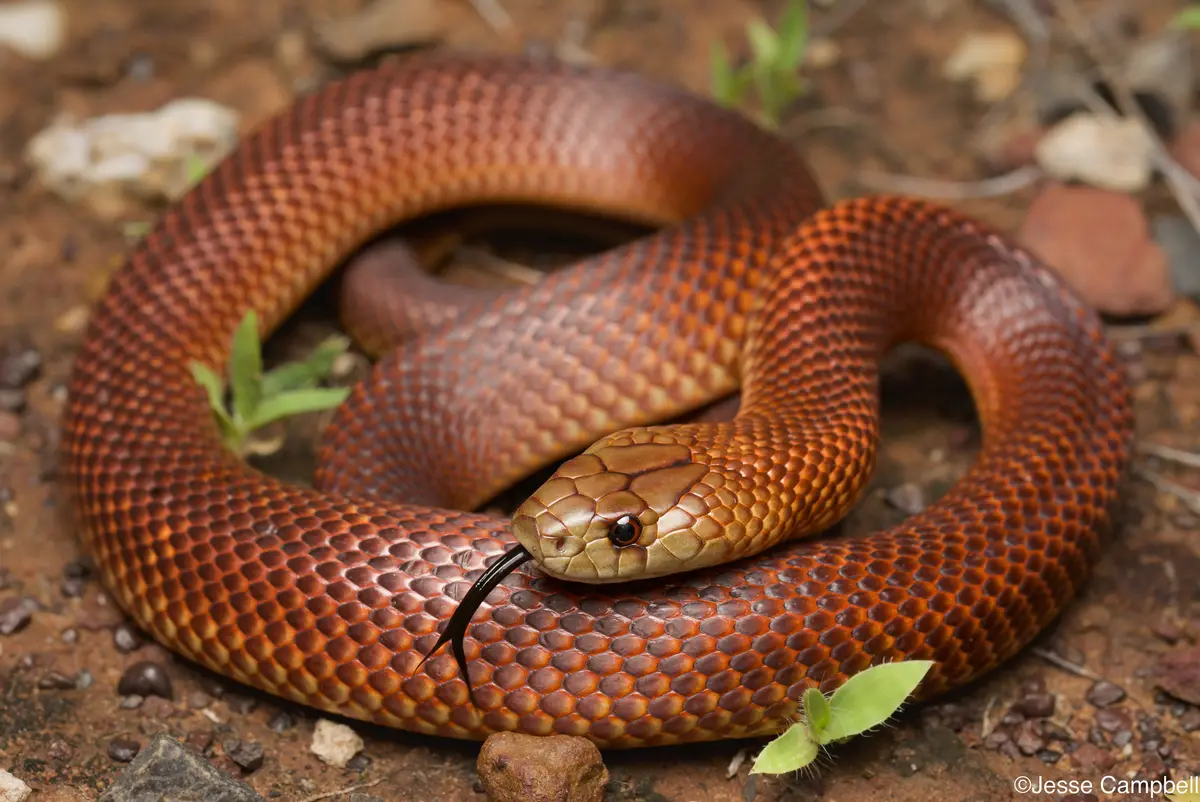
Mulga snake (king brown)
Pseudechis australis · Dangerously venomous
The most important one to get right. The Australian Museum says its venom is highly toxic and produced in large amounts, and that northern mulga snakes can be excitable when disturbed. Its scales are two-toned, darker at the tips, which gives a net-like look, and its belly is cream to salmon with orange blotches. A water python is plain, glossy and yellow-bellied, with heat pits on its lips. When in doubt, keep away.
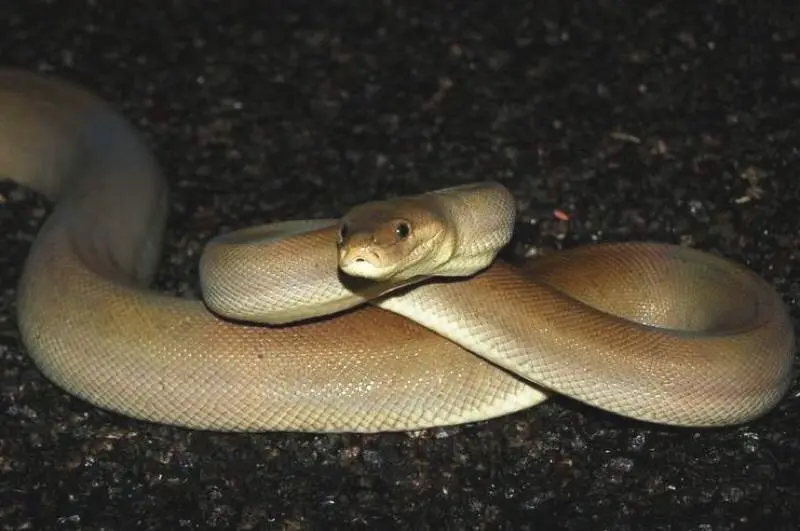
Olive python
Liasis olivaceus · Harmless
A close relative in the same genus that often lives along the same rivers. The olive python is paler olive-brown, lacks the yellow belly and strong rainbow sheen, and grows much larger, often well over 10 ft (3 m).
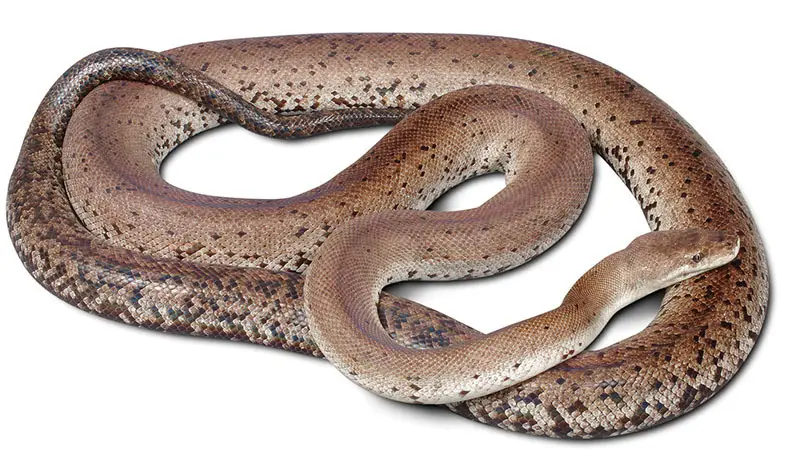
Macklot's python
Liasis mackloti · Harmless
So similar that some authors, starting with Kluge in 1993, treated the two as one species. Macklot's python is dark with pale freckles and lives on Timor and nearby Indonesian islands. A wild water python will be in Australia or New Guinea.
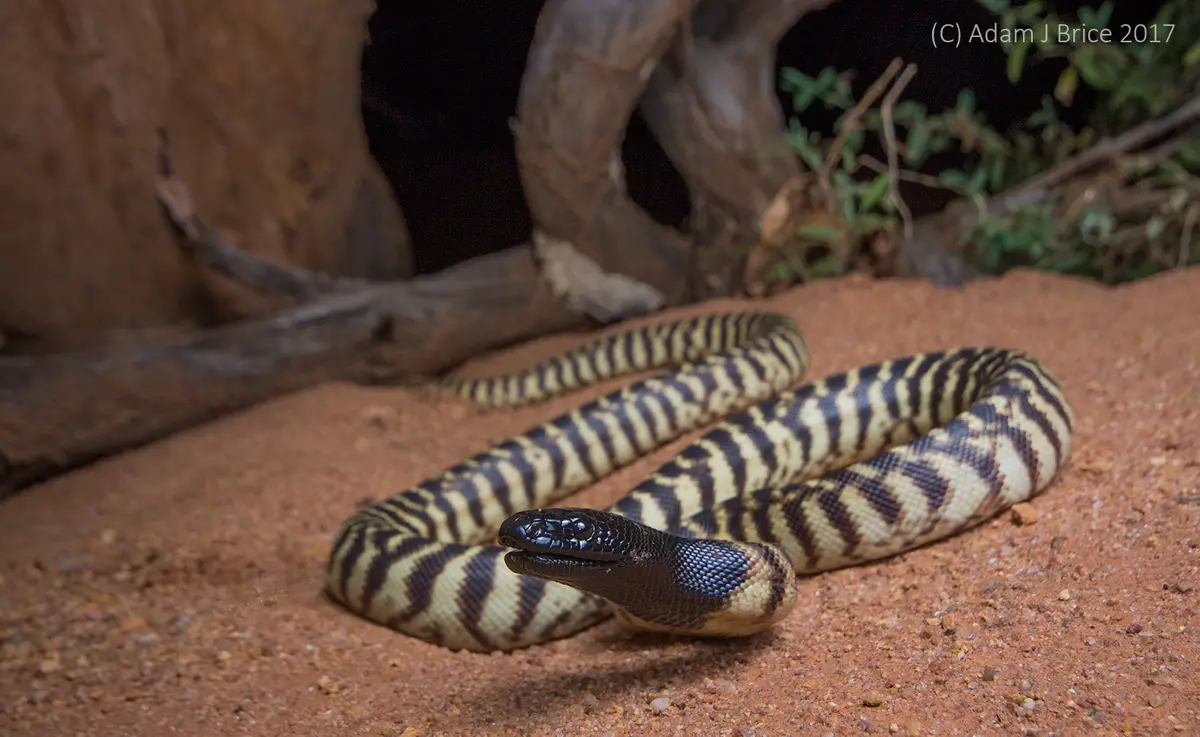
Black-headed python
Aspidites melanocephalus · Harmless
Another northern Australian python, but easy to tell apart. The black-headed python has a glossy black head and neck and a banded body in browns and creams. It also has no heat pits.
Reproduction
Brown water pythons lay eggs. Clutches average about 10 eggs and range from 10 to 19, according to the Australian Reptile Online Database. Whether a female breeds at all depends on food: in poor rat years, fewer females lay.
Females take two different approaches to their eggs. In a field study of 14 radio-tracked females, Stahlschmidt, Shine and DeNardo found that some stayed with their eggs for less than 10 days after laying, while others coiled around them for the whole incubation of more than 50 days. Making the eggs cost each female about 60% of her body mass; brooding cost less than 5% more and kept the eggs warmer and moister. The study was presented as a Society for Integrative and Comparative Biology abstract.
Bigger clutches do not always mean more surviving young. Madsen and Shine marked and released 1,224 hatchlings from 116 clutches and published the results in Proceedings of the Royal Society B (1998). Clutch size did not predict how many young were recaptured later. Rat numbers in the hatchlings' first year, and early hatching in poor years, mattered more.
Is the brown water python endangered?
No. The IUCN Red List rates the brown water python Least Concern, and it is common in good habitat, especially on the floodplains near Darwin. Like nearly all pythons, it is listed in CITES Appendix II, so international trade needs permits.
| Authority | Status |
|---|---|
| IUCN Red List | Least Concern |
| CITES | Appendix II |
Local numbers can still crash. At Fogg Dam, python numbers swing with rainfall through its effect on rats, and after the flood that wiped out the rats, many pythons starved rather than move.
One name, a few disputes
Wilhelm Peters described the species in 1873. Kluge (1993) folded it into Macklot's python, but Rawlings and colleagues (2004) supported keeping it separate, and both the Reptile Database and Schleip and O'Shea's 2010 checklist treat Liasis fuscus as a full species. A separate genus name, Katrinus, proposed by Raymond Hoser in 2000-2001, is not widely used; the Reptile Database calls it questionable.
Brown water python FAQ
Is the brown water python venomous?
No. The brown water python has no venom and kills its prey by constriction. It is not dangerous to people. A large adult can still give a painful bite with many small, sharp teeth, so wash any bite with soap and water, check that your tetanus protection is current and see a doctor if the wound looks infected.
How big do brown water pythons get?
Brown water pythons are usually 6.5-8 feet (2-2.5 m) long, and the largest reach about 10 feet (3 m). Growth depends heavily on food: a 13-year study at Fogg Dam in the Northern Territory found that pythons hatched in years with many rats grew faster for life, especially females.
Where do brown water pythons live?
Brown water pythons live in northern Australia and southern New Guinea. In Australia they range from the Kimberley in Western Australia across the Northern Territory and down the Queensland coast, plus some Torres Strait islands. They stay near rivers, billabongs, swamps and floodplains, and the densest known population is on the Adelaide River floodplain near Darwin.
Is a water python the same as a brown water python?
Yes. Water python, brown water python and yellow-bellied python are all names for Liasis fuscus. In Australia it is usually just called the water python. It should not be confused with Macklot's python, sometimes called the Indonesian or Timor water python, which is a separate species from Timor and nearby islands.
What do brown water pythons eat?
Brown water pythons eat mostly rats. On the Adelaide River floodplain their main prey is the dusky rat, and they migrate up to 12 km each wet season to follow the rats to higher ground. They also eat birds, bird eggs and reptiles, including young crocodiles.
How can you tell a water python from a king brown snake?
Look from a safe distance. A water python has a plain, glossy dark back with a strong rainbow sheen, a yellow belly and heat pits along its lips. The venomous mulga snake, or king brown, has two-toned scales that give a net-like look and a cream to salmon belly with orange blotches. If you are unsure, assume it is venomous and leave it alone.
Related snakes
Sources
- Reptile Database: Liasis fuscus Peters, 1873
- Australian Reptile Online Database: Water python (Liasis fuscus)
- Schleip and O'Shea (2010). Annotated checklist of the recent and extinct pythons (Serpentes, Pythonidae). ZooKeys 66: 29-79
- Madsen, Ujvari, Shine and Olsson (2006). Rain, rats and pythons: climate-driven population dynamics of predators and prey in tropical Australia. Austral Ecology 31: 30-37
- Ujvari, Shine and Madsen (2011). How well do predators adjust to climate-mediated shifts in prey distribution? Ecology 92: 777-783
- Madsen and Shine (2000). Silver spoons and snake body sizes. Journal of Animal Ecology 69: 952-958
- Madsen and Shine (1998). Quantity or quality? Determinants of maternal reproductive success in tropical pythons. Proceedings of the Royal Society B 265: 1521-1525
- Pizzatto, Madsen, Brown and Shine (2009). Spatial ecology of hatchling water pythons in tropical Australia. Journal of Tropical Ecology 25: 181-191
- Australian Museum: Mulga snake (Pseudechis australis)