SPOTTEDPYTHON
Antaresia maculosa · Family Pythonidae
KEY TAKEAWAYS
The spotted python (Antaresia maculosa) is a small, non-venomous member of the python family that lives along the east coast of Australia, from Cape York in Queensland to northern New South Wales. Adults average about 30 inches (75 cm) long and are harmless to people. Adults are known for hanging upside down at cave entrances and grabbing bats as they fly out.
- It has no venom. It kills prey by constriction and is not considered dangerous to people.
- The Australian Reptile Online Database gives an average length of 30 in (75 cm) and a maximum of 41 in (103 cm).
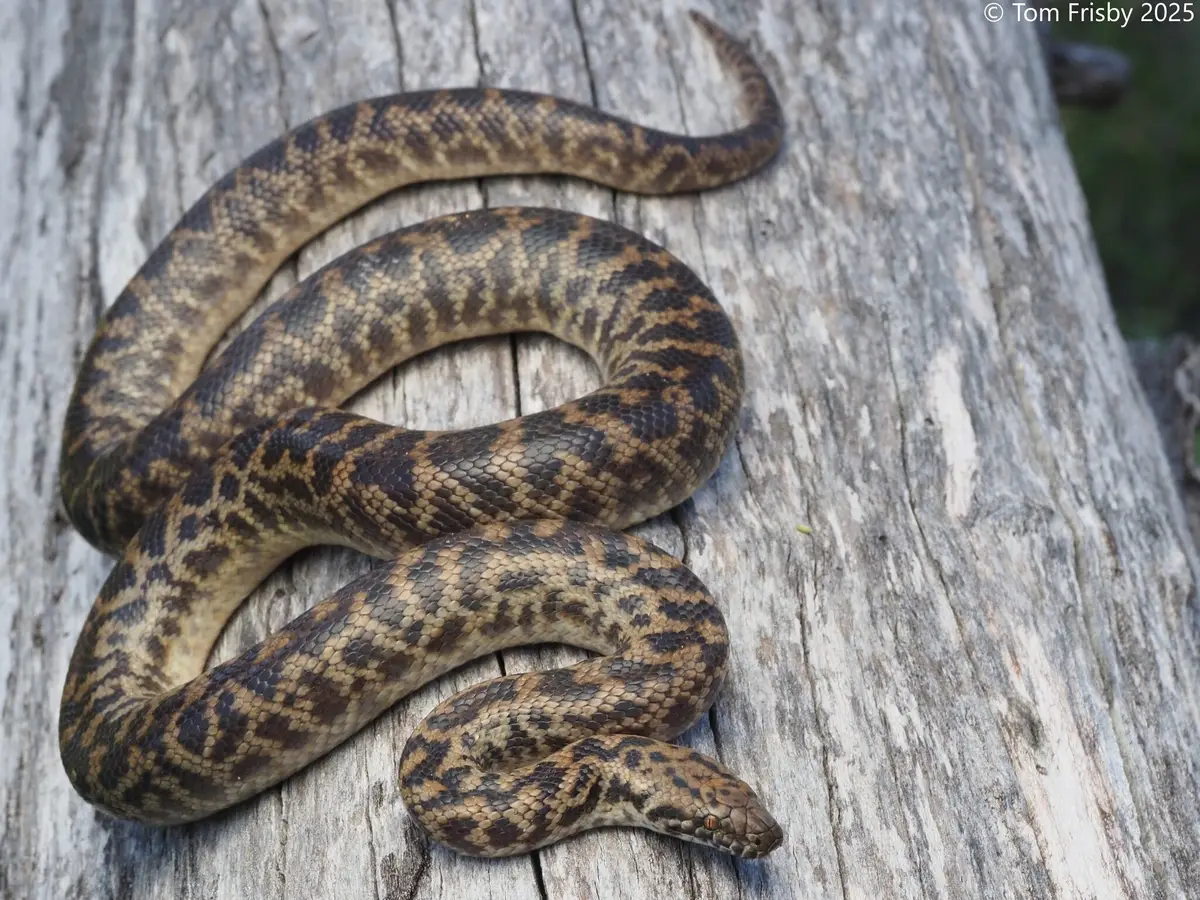
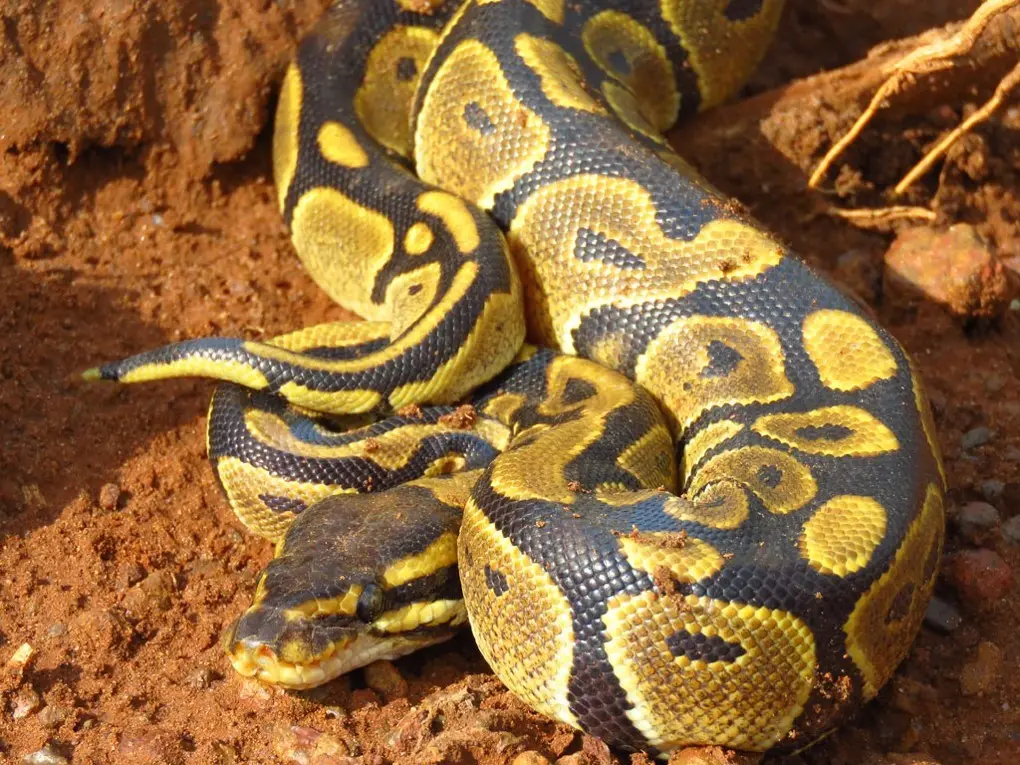
- Its light brown body is covered in ragged-edged dark brown blotches, a pattern that stays clear into adulthood.
- The IUCN rates it Least Concern. A 2021 genetic study split off the New Guinea and Torres Strait snakes as a separate species.
Spotted python quick facts
| Common name | Spotted python; also eastern small-blotched python or eastern Children's python |
|---|---|
| Scientific name | Antaresia maculosa (Peters, 1873) |
| Family | Pythonidae (pythons) |
| Venomous | No, a constrictor |
| Adult length | Average about 30 in (75 cm); maximum about 3.3-4.6 ft (1-1.4 m) |
| Coloring | Cream to light brown, sometimes reddish, with irregular dark brown blotches |
| Range | Eastern Queensland, from Cape York south to northern New South Wales |
| Habitat | Rocky outcrops, caves, escarpments, dry forest, woodland and rainforest edges |
| Diet | Lizards when young; bats, other small mammals, reptiles, frogs and birds as adults |
| Reproduction | Lays eggs; clutches of about 4-16, average 13 |
| Subspecies | A. m. maculosa (southern) and A. m. peninsularis (Cape York spotted python) |
| Conservation | IUCN Least Concern |
How to identify a spotted python
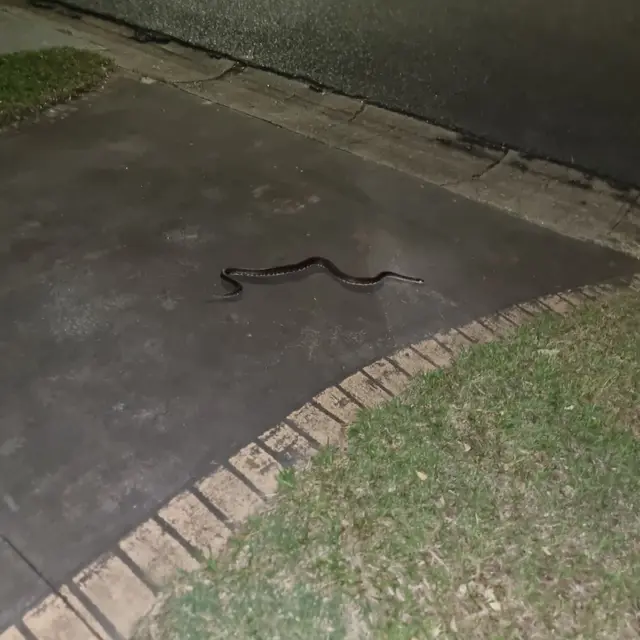
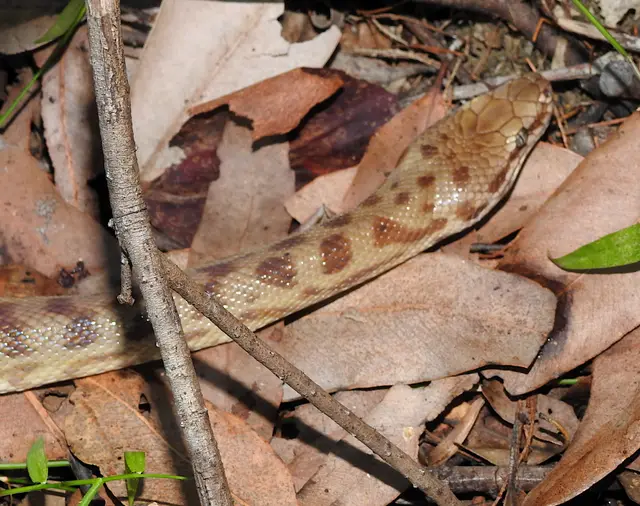
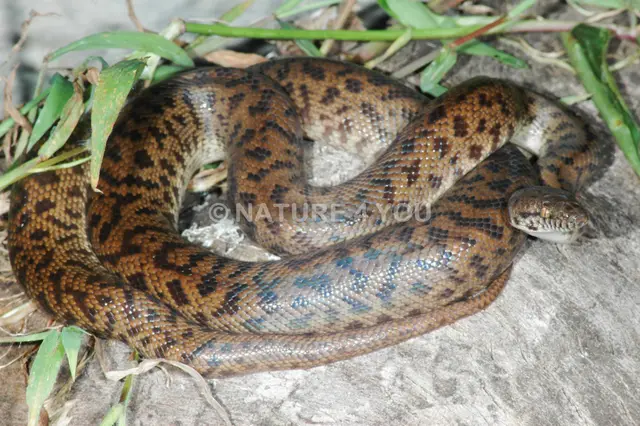
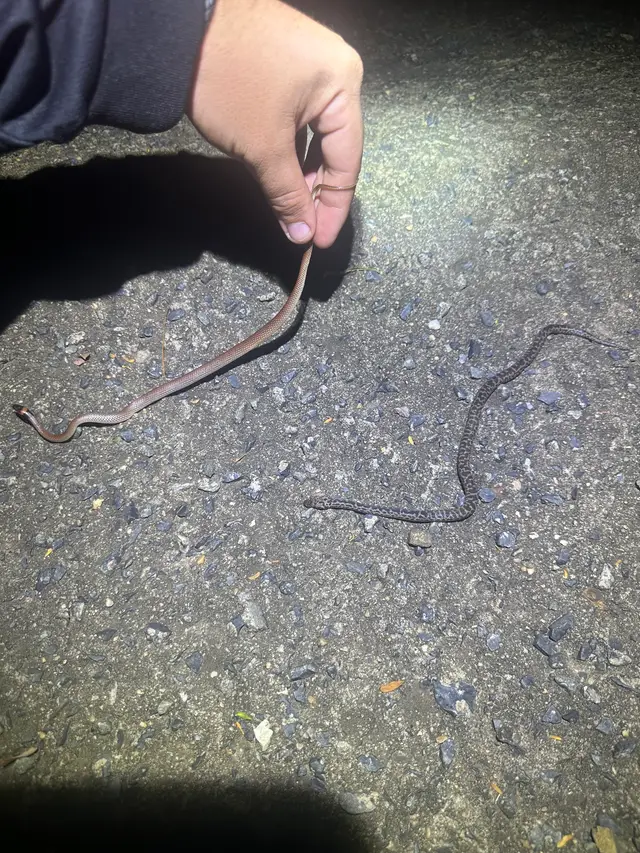
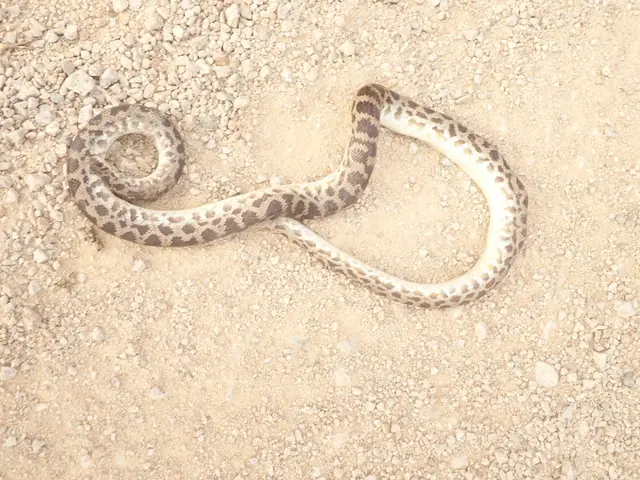
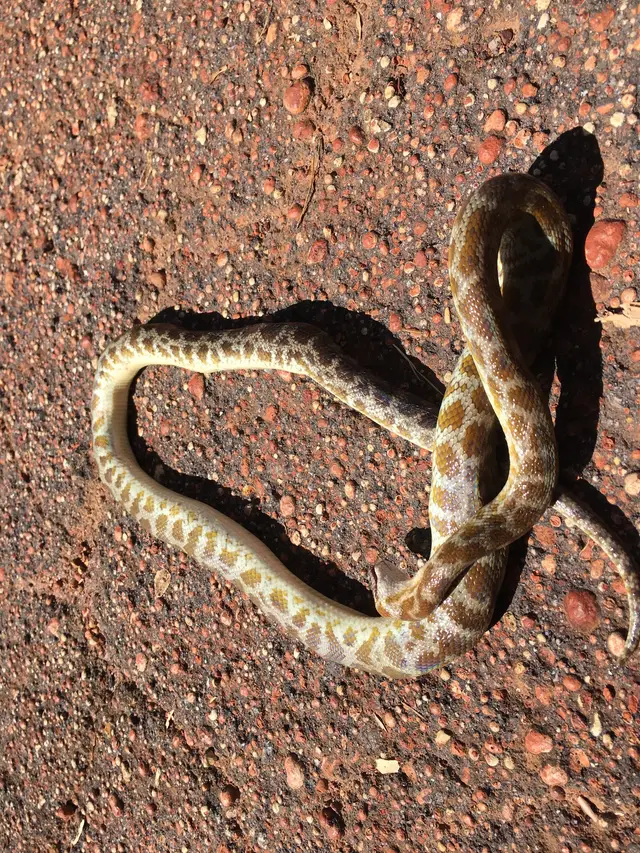
A spotted python is a small, fairly slim python with a pale body covered in dark brown blotches that have rough, ragged edges. The Australian Reptile Online Database (AROD) says the pattern is usually quite distinct. Toohey Forest Environmental Education Centre, run by the Queensland Department of Education, describes the base color as cream to yellowish-brown, sometimes tinged with red, with a dark pattern that stays strong as the snake ages. That last point matters, because the closely related Children's python fades as it grows.
- 1Ragged dark blotches: the blotches are irregular, with rough edges, on a much paler background. The Australian Reptile Park notes that they sometimes join up into stripe-like marks near the head and tail.
- 2Small adult size: most adults are around 30 in (75 cm). A python much longer than about 4.5 ft (1.4 m) in eastern Queensland is almost certainly a carpet python.
- 3Heat pits on the lower lip: AROD records heat-sensing pits on the lower lip scales and none on the snout scale. Australia's venomous snakes have no lip pits.
- 4Plated head: the top of the head is covered in large, symmetrical scales, not the tiny granular scales of a carpet python.
- 5Scale counts: for specialists, AROD gives 35-45 scale rows at midbody, 245-290 belly scales, a single anal scale and 30-45 divided scales under the tail.
How big do spotted pythons get?
Spotted pythons usually grow to about 30 in (75 cm), and few pass 4 ft. AROD gives an average total length of 75 cm and a maximum of 103 cm (41 in). The Australian Reptile Park puts the maximum at about 1-1.4 m (3.3-4.6 ft) and calls it one of the shortest python species. Toohey Forest Environmental Education Centre gives an adult average of about 1 m (3.3 ft).
| Measure | Size | Source |
|---|---|---|
| Average length | About 30 in (75 cm) | AROD |
| Typical adult | About 3.3 ft (1 m) | Toohey Forest EEC |
| Maximum length | 41 in (103 cm) | AROD |
| Maximum length | About 3.3-4.6 ft (1-1.4 m) | Australian Reptile Park |
The sources differ by a few inches, which is normal for a snake that is rarely measured in the wild. None of them lists a reliable adult weight. It is still a small python. The pygmy python of Western Australia, a close relative in the same genus, averages only 16 in (40 cm), while the coastal carpet python that shares much of the spotted python's range is usually 6.5-8 ft (2-2.5 m) long.
Where do spotted pythons live?
Short answer: along the east coast of Australia, from Cape York in far north Queensland south to northern New South Wales. The Reptile Database lists it from eastern Queensland and New South Wales, and AROD describes the range as the Queensland east coast down to northern New South Wales.
The species has two recognized subspecies. The southern form, A. m. maculosa, was first described from Rockhampton, Port Mackay and Port Bowen in central Queensland. The Cape York spotted python, A. m. peninsularis, was named in 2021 from a specimen collected at Cooktown, and the Australian Faunal Directory gives its range as Cape York south to just below Cairns. The two look the same; the Reptile Database notes they can only be told apart by differences in their DNA.
Spotted pythons in New Guinea and the Torres Strait islands are now treated as a different species, Antaresia papuensis. In 2025 a study in the Australian Journal of Zoology by Natusch and colleagues found that far northern Cape York also belongs to that species, so the spotted python's true northern limit sits a little south of the tip of the peninsula. You can compare its range with other snakes on the world snake map.
Habitat
Spotted pythons live in rocky country more than anywhere else, but they use a wide range of habitats. AROD lists rocky outcrops, hills, escarpments, caves, dry forests and rainforest margins. The Australian Reptile Park adds wet forests, dry woodlands and riverbanks, and Toohey Forest EEC includes grassland. Caves that shelter bats are especially important to adults.
The snake also climbs. The Reptile Database cites a 2018 study of python ecology by Harrington and colleagues in the Biological Journal of the Linnean Society that classed the spotted python as partly arboreal.
Behavior: how spotted pythons catch bats
Spotted pythons hunt at night, and adults are best known for ambushing bats at cave entrances. The Australian Reptile Park describes the method: the snake hangs upside down from the cave mouth with its tail gripping the rock, leaving its body free. When bats stream out at dusk, it strikes and catches them in midair, often eating them while still hanging. Toohey Forest EEC also describes spotted pythons waiting at cave entrances at dusk to ambush bats.
Away from the caves, a spotted python is a quiet, secretive snake. The Reptile Park calls it docile, which together with its small size is why it is common in the Australian pet trade. Toohey Forest EEC notes that its blotched pattern is good camouflage, that its small body lets it hunt in rock crevices, and that it can go long periods without eating. Toohey Forest EEC lists birds and pet cats among its predators.
What do spotted pythons eat?
Spotted pythons eat small mammals and reptiles, plus frogs and birds, according to AROD. The diet changes with age. Young snakes eat mainly small lizards, and adults add bats, other small mammals, reptiles and birds, according to the Australian Reptile Park. Like all pythons, it kills by wrapping its coils around prey and squeezing.
| Prey | Notes | Source |
|---|---|---|
| Small lizards | The main food of young snakes | Australian Reptile Park |
| Bats | Caught in flight at cave entrances by adults | Australian Reptile Park; Toohey Forest EEC |
| Other small mammals | Taken by adults | AROD; Australian Reptile Park |
| Birds | Small birds taken by adults | AROD; Toohey Forest EEC |
| Frogs | Listed in the general diet | AROD; Toohey Forest EEC |
No detailed published study of wild spotted python diets was found in the sources used here, so the table shows what is eaten, not how often.
Is the spotted python venomous or dangerous?
No. The spotted python has no venom and is not considered dangerous to people. AROD rates it non-venomous and not dangerous. It is a constrictor that takes prey no bigger than a bat or a small bird. A 30-inch snake cannot squeeze anything the size of a person.
Like any snake, it may bite if grabbed or cornered, and AROD warns that any reptile bite can lead to complications such as infection. Wash a bite with soap and water and see a doctor if it becomes red or swollen.
The real risk is mistaking a dangerous snake for this one. Eastern Queensland is home to the eastern brown snake, which causes more snakebite deaths in Australia than any other species, and young brown snakes can be banded. If you are not sure what a small patterned snake is, leave it alone and call a licensed snake catcher. The SnakesWiki snake venom FAQ explains why color and pattern are poor guides to danger.
Spotted python vs Children's python and other look-alikes
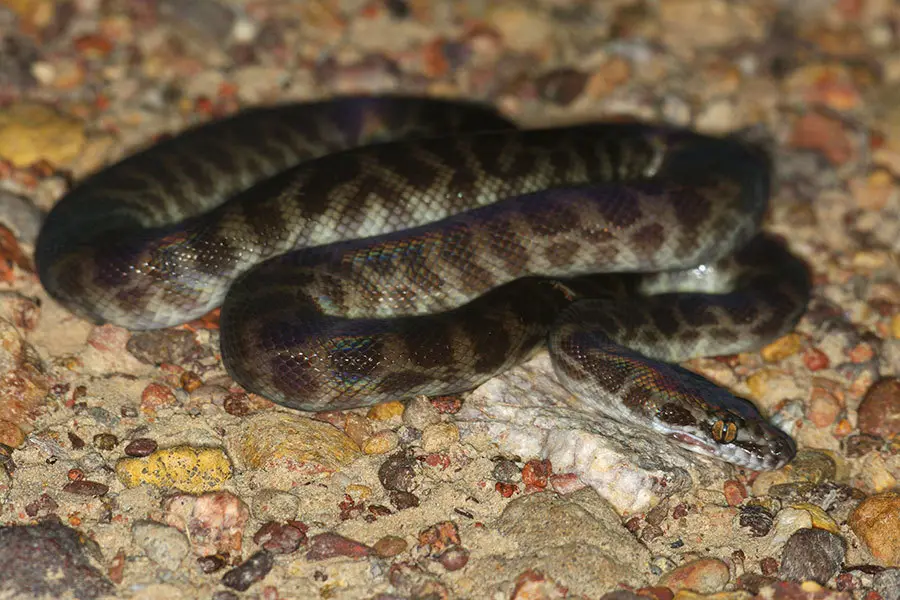
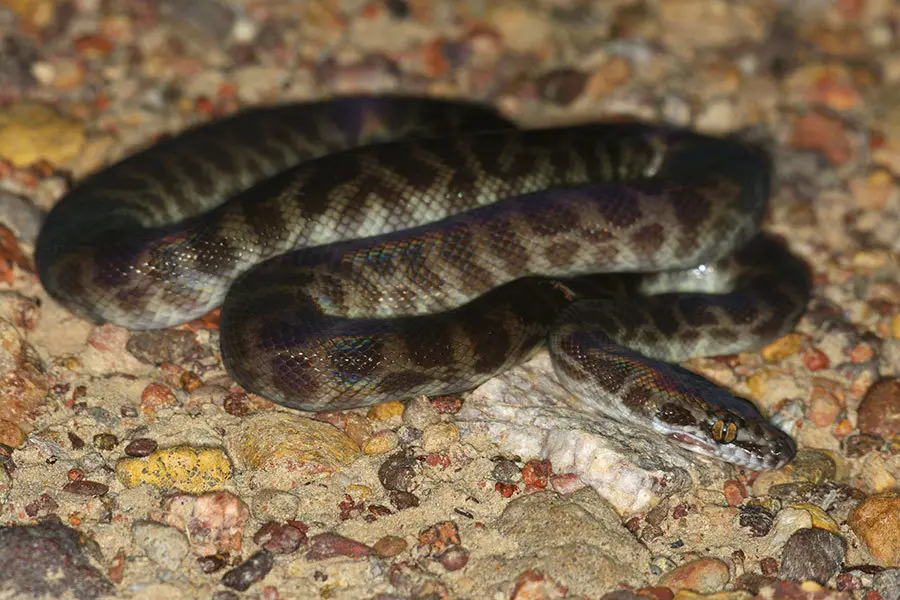
Children's python
Antaresia childreni · Harmless
The closest look-alike, and the source of the spotted python's old name, eastern Children's python. AROD says Children's python has a weaker pattern of smooth-edged, round blotches that fade with age, while the spotted python keeps its ragged blotches. Their ranges barely meet: Children's python lives in northwest Queensland, the Top End and the Kimberley, though the 2025 Natusch study found the two together on Cape York.
Stimson's python
Antaresia stimsoni · Harmless
An inland relative of arid Australia. AROD notes it has stronger contrast between the pale background and dark pattern and a pale stripe along the side of the neck, which the spotted python usually lacks.
Eastern brown snake (juvenile)
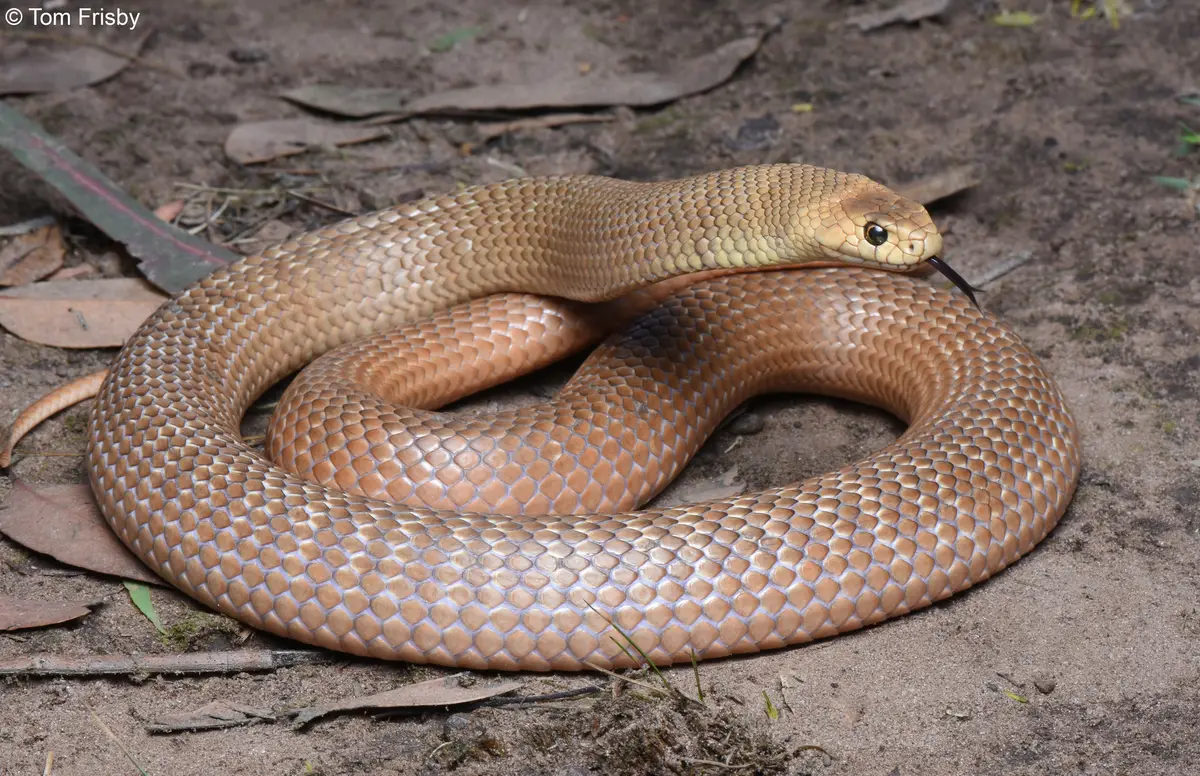
Pseudonaja textilis · Highly venomous
The look-alike that matters. The Australian Museum says hatchlings have a dark patch on the head and neck and some have dark bands along the body. Brown snakes have a small head barely wider than the neck, smooth glossy scales and no lip pits. Adults are plain brown. Treat any banded young snake with a dark head patch as dangerous.
Brown tree snake
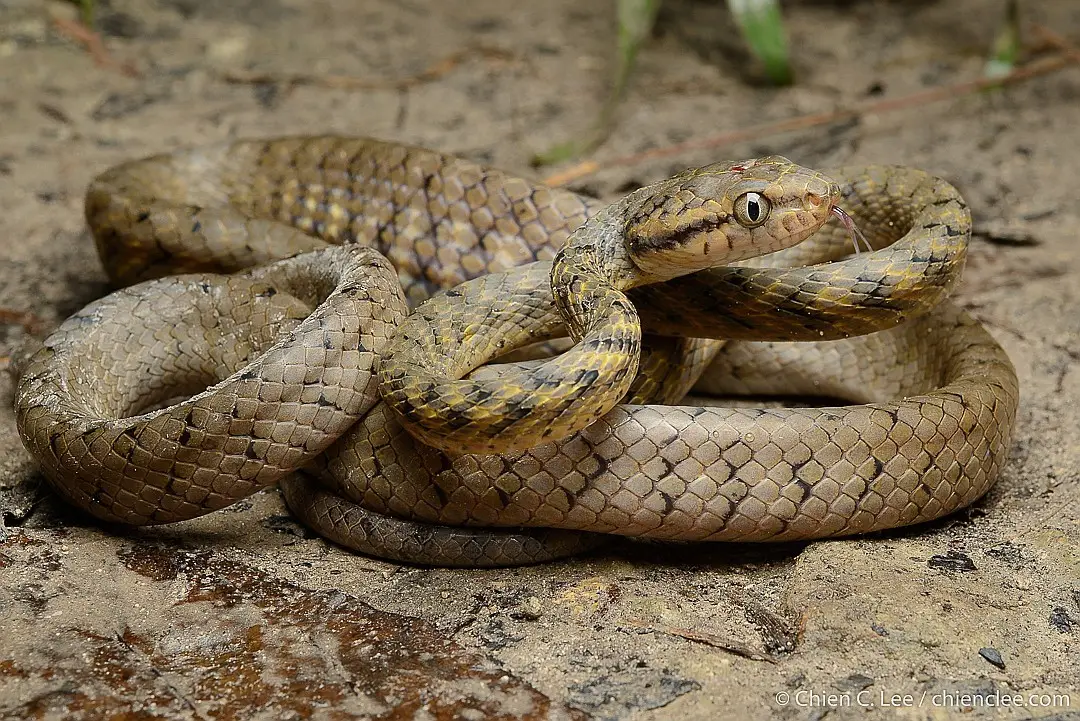
Boiga irregularis · Mildly venomous
A slender, rear-fanged climber of coastal Queensland with a large head, bulging eyes and cat-like vertical pupils. AROD describes eastern animals as brown to orange-brown with irregular dark bands and gives an average length of 4.6 ft (1.4 m). It is not considered dangerous, but large ones should be treated with caution.
Reproduction
Spotted pythons lay eggs, and the mother stays with them. AROD gives an average clutch of 13 eggs, with a range of 4-16. The Australian Reptile Park gives an average of about 10, and Toohey Forest EEC about 12. Toohey Forest EEC says mating takes place from April to August, in the cooler months, and eggs are laid in October or November.
The female coils around her clutch and, according to the Australian Reptile Park, shivers her muscles to warm it. The young hatch after about 80 days. They may stay inside the split shells for up to two days, then leave the nest together. No reliable figure for lifespan in the wild was found in the sources used here.
Is the spotted python endangered?
No. The IUCN Red List rates the spotted python Least Concern, as recorded by the Reptile Database and the Australian Reptile Park. AROD notes it does not appear to be listed as of conservation concern.
| Authority | Status |
|---|---|
| IUCN Red List | Least Concern |
| Australia (national) | Not listed as threatened |
AROD lists general threats faced by Australian reptiles, including land clearing, road deaths, feral predators and cane toads, while noting that these may not all apply to this species.
How the spotted python fits into Antaresia
The spotted python is one of the dwarf pythons in the genus Antaresia, with the pygmy python, Children's python and Stimson's python. Wilhelm Peters described it in 1873 as Liasis maculosus. AROD explains the names: Antaresia refers to Antares, the bright star in the tail of the constellation Scorpius, and maculosa means spotted. A 2021 study of the genus by Esquerré and colleagues in Molecular Phylogenetics and Evolution found strong genetic structure within the spotted python. It recognized two subspecies in northeastern Australia and moved the New Guinea and Torres Strait populations into the new species A. papuensis. The spotted python shares its rainforest-edge range in the north with larger relatives such as the jungle carpet python and, on Cape York, the green tree python.
Spotted python FAQ
Is the spotted python venomous?
No. The spotted python has no venom and kills its prey by constriction. The Australian Reptile Online Database rates it non-venomous and not dangerous to people. It can bite if handled, and any reptile bite can become infected, so wash it with soap and water and see a doctor if it becomes red or swollen.
How big do spotted pythons get?
Spotted pythons average about 30 inches (75 cm) long, according to the Australian Reptile Online Database, which gives a maximum of 41 inches (103 cm). The Australian Reptile Park puts the maximum at about 3.3-4.6 feet (1-1.4 m). It is one of the smallest pythons, though larger than its relative the pygmy python.
Where do spotted pythons live?
Spotted pythons live along the east coast of Australia, from Cape York in Queensland south to northern New South Wales. They use rocky outcrops, caves, escarpments, dry forest, woodland and rainforest edges. Snakes from New Guinea and the Torres Strait, once called spotted pythons, are now a separate species, Antaresia papuensis.
How do spotted pythons catch bats?
Adult spotted pythons hang upside down from the rock at cave entrances, holding on with their tails. When bats fly out at dusk, the snake strikes and catches them in midair, then often eats them while still hanging. The Australian Reptile Park and Toohey Forest Environmental Education Centre both describe this ambush behavior.
What is the difference between a spotted python and a Children's python?
The spotted python has ragged-edged, irregular dark blotches that stay clear as it ages. Children's python has a weaker pattern of smooth-edged, round blotches that fade with age, according to the Australian Reptile Online Database. Children's python lives mainly in northwest Queensland, the Top End and the Kimberley, west of the spotted python's range.
Are spotted pythons good pets?
Spotted pythons are often kept as pets because they are small and docile, according to the Australian Reptile Park. Most adults stay around 30 inches (75 cm), so they need far less space than a carpet python. Rules on keeping native reptiles vary between Australian states and between countries, so check with the local wildlife agency before buying one.
Related snakes
Sources
- Reptile Database: Antaresia maculosa (Peters, 1873)
- Australian Reptile Online Database: Spotted python (Antaresia maculosa)
- Australian Reptile Park: Spotted python
- Toohey Forest Environmental Education Centre (Queensland Department of Education): Spotted python
- Esquerré et al. (2021). Phylogeography, historical demography and systematics of the world's smallest pythons (Pythonidae, Antaresia). Molecular Phylogenetics and Evolution 161: 107181
- Natusch et al. (2025). Molecular and morphological analysis confirms two additional species of python (Antaresia) on Cape York Peninsula, Queensland. Australian Journal of Zoology 73(4): ZO25006
- Australian Reptile Online Database: Children's python (Antaresia childreni)
- Australian Museum: Eastern brown snake