GREEN TREEPYTHON
Morelia viridis · Family Pythonidae
KEY TAKEAWAYS
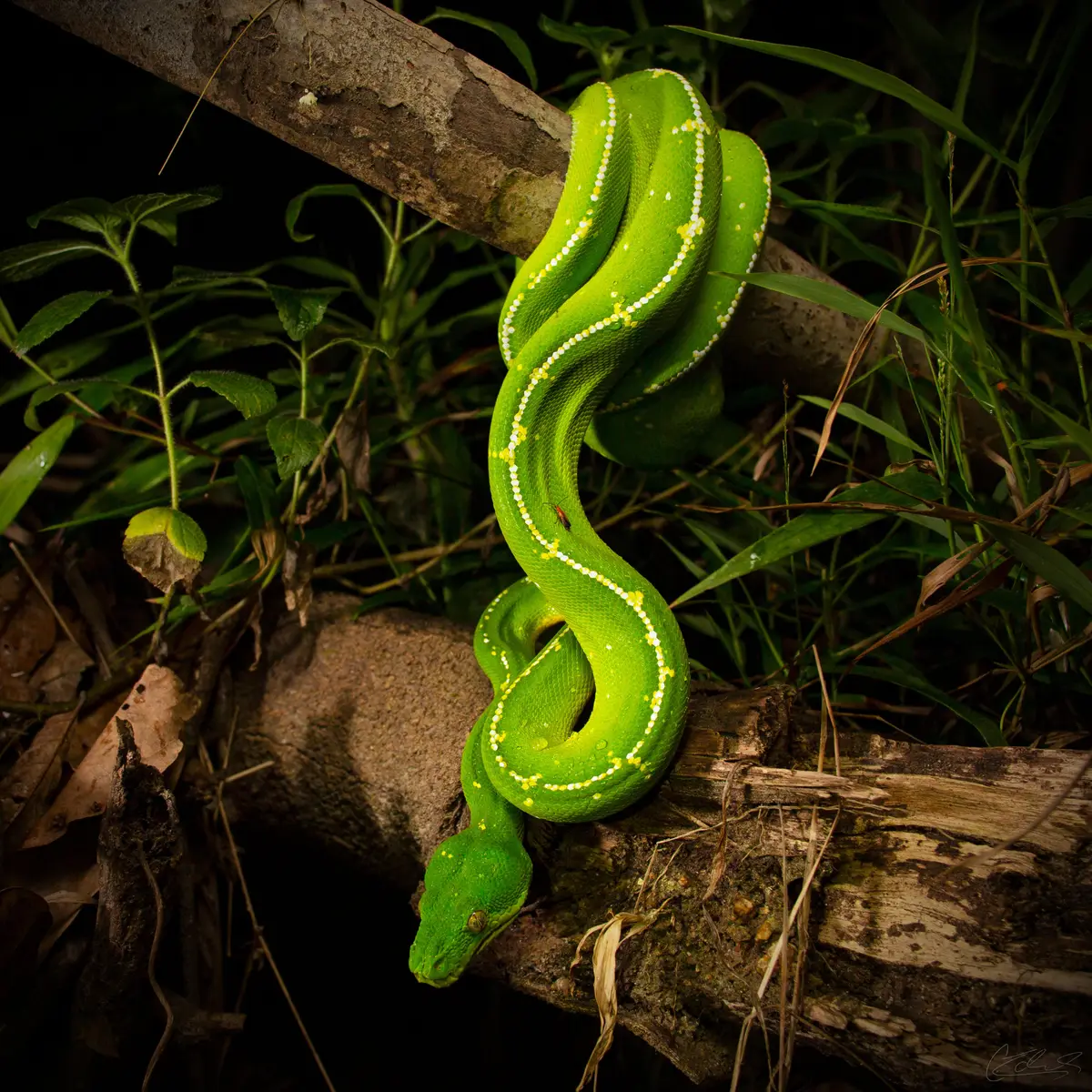
The green tree python (Morelia viridis) is a non-venomous python that lives in rainforest trees in New Guinea, the Aru Islands and a small corner of Cape York in northern Australia. It is harmless to people. Adults are bright green, but the young hatch yellow or red and change color at about a year old.
- Adults average about 5 ft (1.5 m) long. Animal Diversity Web gives the largest recorded snake as 2.2 m (about 7 ft).
- It is not venomous. It kills rats and lizards by constriction, as the Burmese python does, and its bite is painful but not dangerous.
- Hatchlings are lemon yellow or brick red. They turn green at a length of 53-59 cm (about 21-23 in), and the switch takes place without a shed.
- Since 2020 the snakes north of New Guinea's central mountains have been treated as a separate species, the northern green python (Morelia azurea). Both are sold as green tree pythons.
Green tree python quick facts
| Common name | Green tree python (also green python, southern green python) |
|---|---|
| Scientific name | Morelia viridis (Schlegel, 1872) |
| Family | Pythonidae (pythons) |
| Venomous | No, a constrictor |
| Adult length | Average about 5 ft (1.5 m); largest recorded about 7 ft (2.2 m) |
| Hatchling length | About 1 ft (30.5 cm) |
| Range | Southern New Guinea, the Aru Islands and northeastern Cape York Peninsula, Australia |
| Habitat | Lowland and hill rainforest, vine forest and forest edges, sea level to about 6,500 ft (2,000 m) |
| Diet | Small lizards when young; rats, other small mammals and some birds as adults |
| Reproduction | Lays eggs; the female coils around the clutch |
| Lifespan | At least 15 years in the wild (predicted); 20 years in captivity |
| Conservation | IUCN Least Concern; CITES Appendix II; Near Threatened in Queensland |
How to identify a green tree python
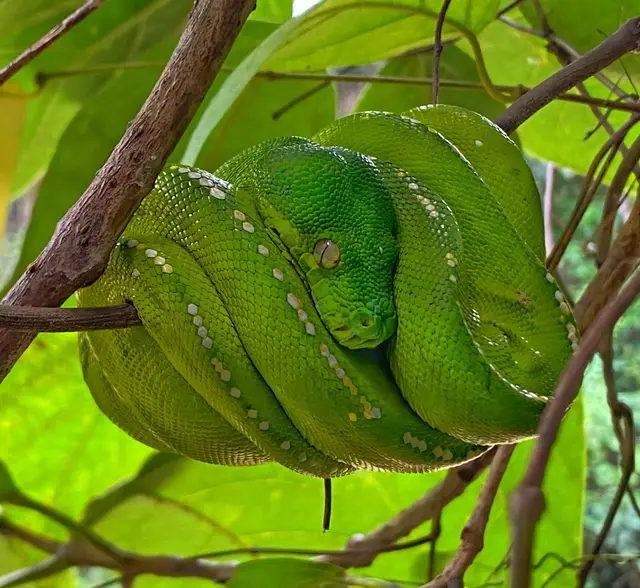
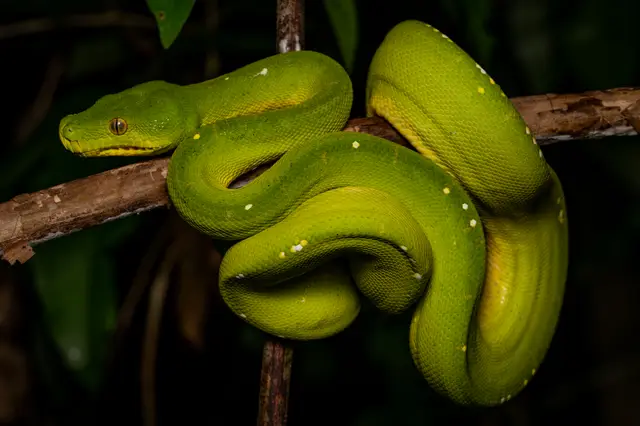
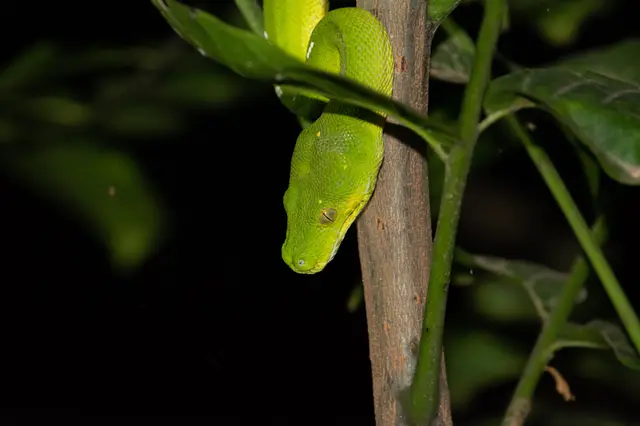
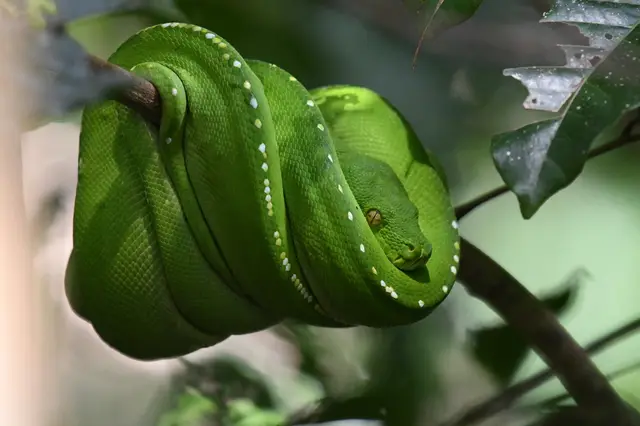
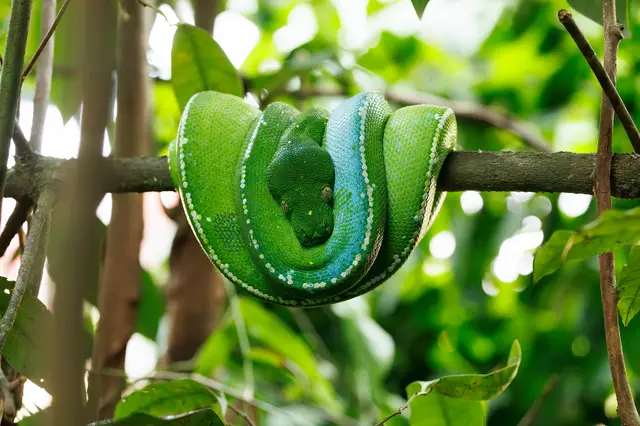
Look at how it sits before you look at the color. A resting green tree python drapes one or two loops of its body over a branch like a saddle and tucks its head in the middle of the coils. Animal Diversity Web describes it as the most tree-dwelling of all pythons.
- 1Saddle-coiled on a branch: loops of body hung evenly over a horizontal branch or vine, with the head resting on top in the center.
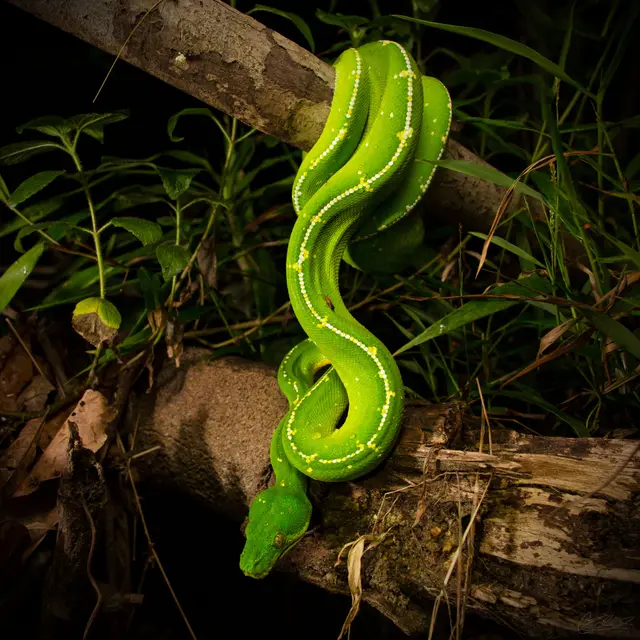
- 2Bright green adult color: leaf green to yellow-green, often with a broken line of white or pale scales running down the spine. Some snakes have scattered white scales on the flanks as well.
- 3Big head, thin neck: a broad, triangular head set off from a slim neck, with heat-sensing pits in the scales along the upper lip.
- 4Grasping tail: a prehensile tail that holds the branch while the front of the body strikes.
- 5Yellow or red young: hatchlings are lemon yellow or brick red with darker markings, nothing like the adults.
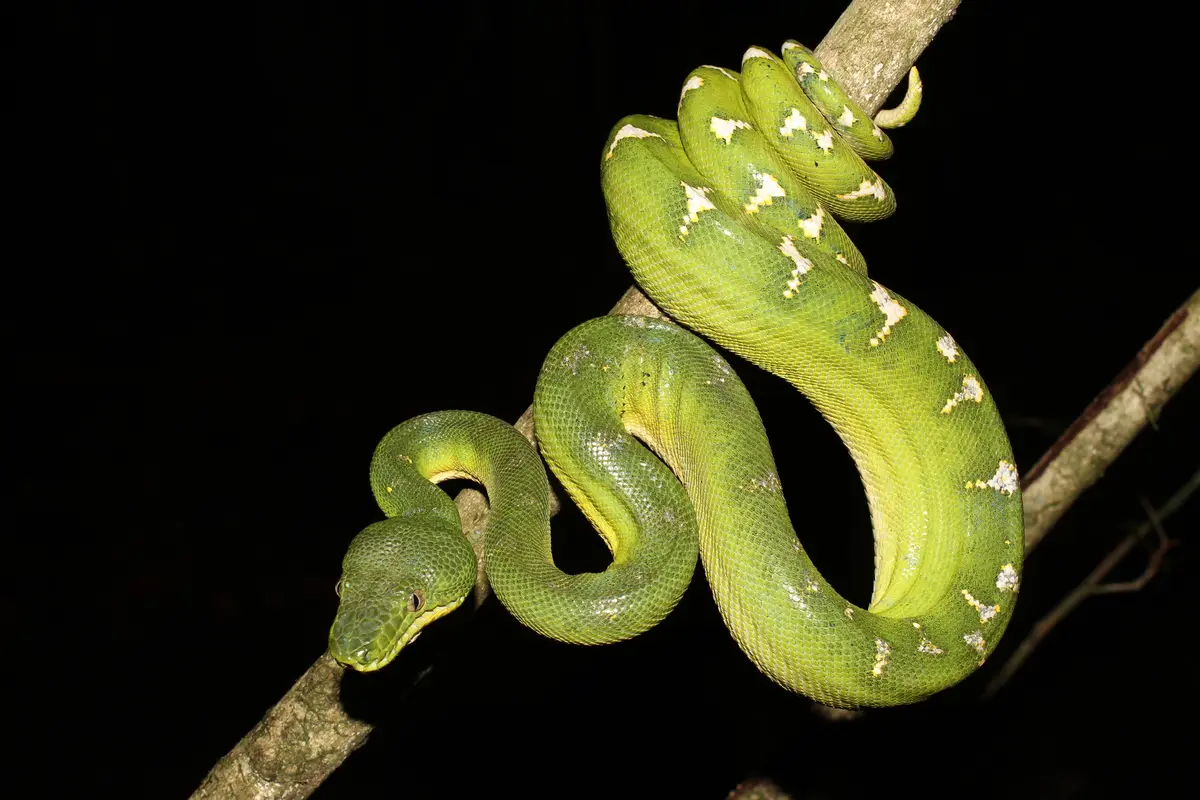
The white spine markings help separate it from the emerald tree boa, a South American snake with the same color and the same resting pose. The boa's white markings are bars and zigzags that cross its back, and it lives on a different continent.
How big do green tree pythons get?
Most adult green tree pythons are around 5 feet (1.5 m) long. Animal Diversity Web gives an average length of 1.5 m and a largest recorded snake of 2.2 m (about 7 ft). They are slim for a python, with a body that is triangular in cross-section, so even a long adult is light compared with a ground python of the same length.
A long-term field study at Iron Range National Park in Queensland, led by David Wilson and published in the Journal of Zoology (2006), found no difference in size between adult males and females at that site. A larger study by Daniel Natusch and Jessica Lyons, covering 908 green pythons from five sites in Australia and New Guinea (Journal of Herpetology, 2014), found that females grow larger than males in every population, and that average body size differs from one site to another.
| Life stage | Length | Source |
|---|---|---|
| Hatchling | About 1 ft (30.5 cm) | Animal Diversity Web |
| Color change | 21-23 in (53-59 cm), at about 1 year | Wilson et al. (2006) |
| Average adult | About 5 ft (1.5 m) | Animal Diversity Web |
| Largest recorded | About 7 ft (2.2 m) | Animal Diversity Web |
For comparison, the ball python is usually 3-5 ft but much stockier, and the blood python is about as long but far heavier in the body.
Where do green tree pythons live?
Short answer: in New Guinea, the islands around it, and a few rainforest ranges on Cape York Peninsula in Queensland, Australia. The Reptile Database lists Morelia viridis from the Aru Islands and Indonesian Papua, Papua New Guinea, Gag Island and northeastern Cape York.
The range is split by New Guinea's central mountains. A 2020 study by Natusch and colleagues in Molecular Phylogenetics and Evolution used DNA from hundreds of genes and found two species: one north of the mountains and one south of them. The southern snakes, including those on the Aru Islands and in Australia, keep the name Morelia viridis. The northern snakes are now the northern green python, Morelia azurea, with three subspecies.
Australia holds only a small slice of the range. Surveys by Natusch and Natusch (Australian Journal of Zoology, 2011) found 298 green pythons in the Iron, McIlwraith and Kawadji-Ngaachi ranges, across an estimated 2,289 sq km (about 880 sq mi). See how this compares with other pythons on the world snake map.
Habitat
Green tree pythons live in rainforest. Animal Diversity Web lists lowland and lower montane tropical forest from sea level to 2,000 m (6,500 ft), and they also use regrowth and secondary forest.
Young and adult snakes use different parts of the forest. Juveniles stay in gaps and along forest edges, often low down or on the ground. Adults move into the closed-canopy forest interior. Wilson and Ray Heinsohn (Australian Journal of Zoology, 2007) estimated 4-5 green pythons per hectare in the complex vine forest at Iron Range.
Behavior
Green tree pythons are sit-and-wait hunters, and they wait a long time. Animal Diversity Web reports single ambush sites used for up to 14 days. To hunt, the snake keeps its rear body wrapped around a perch and lets the front hang down in a tight S-shaped fold, ready to strike. Most of the change between resting and hunting postures happens at dusk and dawn.
Age changes the daily schedule. Juveniles are active by day, while adults are mostly active at night. Young snakes also wiggle the tip of the tail as a lure to draw lizards within reach. Adults are solitary and stay in one area: females used home ranges averaging 6.2 hectares (about 15 acres), while males roam more widely in search of mates.
What do green tree pythons eat?
Green tree pythons eat small lizards when young and small mammals as adults. Natusch and Lyons (2014) found that juveniles in all five populations they studied fed only on small lizards, while adults fed mainly on mammals. Large females took more small daytime prey, such as lizards and birds, than males did.
| Prey | Examples | Eaten by |
|---|---|---|
| Small lizards | Skinks such as Carlia longipes | Juveniles |
| Invertebrates | Daytime insects | Hatchlings |
| Rodents | Cape York rat (Rattus leucopus) and Cape York melomys (Melomys capensis) | Adults |
| Birds | Small canopy birds | Adults, occasionally |
The Iron Range prey species come from Animal Diversity Web. Prey is seized with a strike, then wrapped in coils and squeezed.
Is the green tree python venomous?
No. The green tree python has no venom and is not dangerous to people. It is a constrictor that eats rats and lizards, and an adult of about 5 ft is far too small to harm a person by constriction.
It can bite, and it often does when handled. Pythons have many sharp, recurved teeth, so a bite can bleed and sting. Clean it with soap and water and watch for signs of infection, as with any animal bite.
A bright green snake with a large head and heat pits can look alarming, and people sometimes take one for a venomous tree viper. Head shape alone is not a reliable guide to venom; our snake venom FAQ explains why. In Australia and New Guinea, leave any snake alone and give it room.
Why are baby green tree pythons yellow or red?
Green tree pythons hatch yellow or red and turn green as they grow, a process called ontogenetic color change. At Iron Range, Wilson and colleagues (2006) found the change happens at 53-59 cm long, at roughly one year old. It was quick and did not need a shed.
The colors match where each age lives. A study by Wilson, Heinsohn and John Endler in Biology Letters (2007) modeled how the snakes look to birds, their main predators. Yellow juveniles were harder for birds to see than green ones against the bright forest edge where the young live. Green was the least visible color in the canopy where adults hunt.
Red hatchlings occur only in parts of New Guinea, according to Animal Diversity Web; Australian green pythons hatch yellow.
Green tree python vs emerald tree boa and other look-alikes
Emerald tree boa
Corallus caninus · Harmless
The emerald tree boa lives in South America, not Australasia. It is green with white bars or zigzags across the back rather than a line along the spine, and gives birth to live young instead of laying eggs. Both snakes sit saddle-coiled on branches.
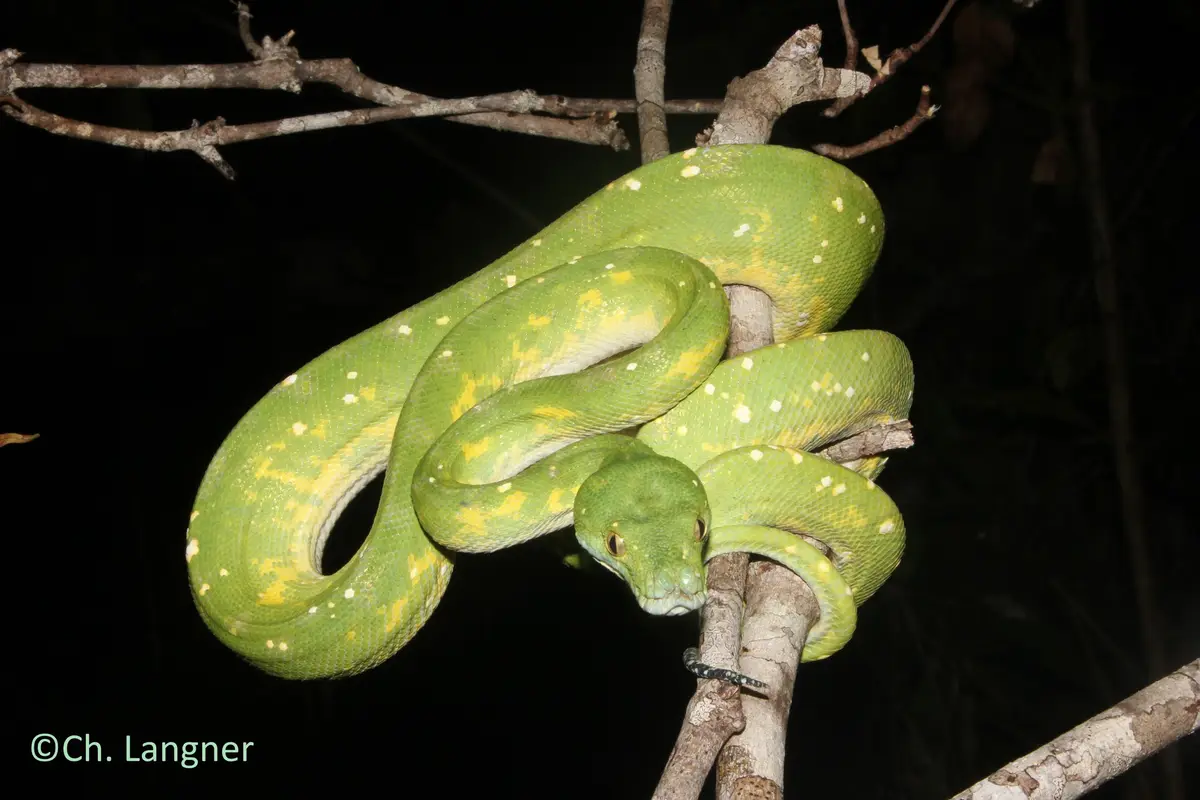
Northern green python
Morelia azurea · Harmless
Lives north of New Guinea's central mountains and on nearby islands such as Biak. It looks almost the same and was treated as the same species until Natusch et al. (2020). In the pet trade both are sold as green tree pythons, often under locality names.
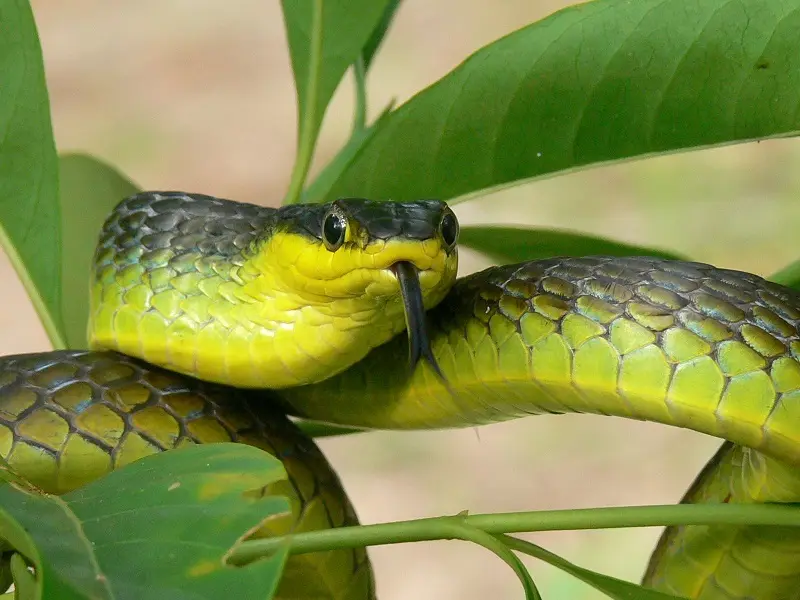
Common tree snake
Dendrelaphis punctulatus · Harmless
A slender, large-eyed snake found across northern and eastern Australia and into Papua New Guinea. It is often green or olive, but it has a narrow head, never rests in saddle coils and is active by day.
Reproduction and lifespan
Green tree pythons lay eggs. Breeding has never been watched in the wild, so most of what is known comes from field surveys of young snakes and from captivity. At Iron Range, Wilson and colleagues (2006) worked out that hatching happens in late November and that few young appear each year, which suggests adult females do not breed every year.
Animal Diversity Web reports clutches of 6 to 32 eggs and incubation of 39 to 65 days, about 50 days on average. The female coils around her eggs and shivers to produce heat, holding them at about 84-88 F (29-31 C).
How long do green tree pythons live?
Growth models from Iron Range predict that wild green pythons live at least 15 years. Males there reached maturity at about 2.4 years and females at about 3.6 years (Wilson et al. 2006). Animal Diversity Web gives the captive record as 20 years.
Is the green tree python endangered?
No, not globally. The IUCN Red List rates the green python Least Concern, with the pet trade noted as a threat that needs watching. Like all pythons it is on CITES Appendix II, so international trade needs permits.
| Authority | Status |
|---|---|
| IUCN Red List | Least Concern |
| CITES | Appendix II (trade by permit) |
| Queensland, Australia | Near Threatened (Nature Conservation Act 1992) |
| Indonesia | Protected; wild collection banned |
The Australian population is small, and it is listed as Near Threatened by the Queensland Government. Wilson and Heinsohn (2007) concluded the species is not at short-term risk of extinction, given its large range in New Guinea and the high densities at Iron Range, but asked for more work on how collecting affects wild populations.
Smuggling is the main worry. Jessica Lyons and Daniel Natusch surveyed traders in Indonesia from 2009 to 2011 and published the results in Biological Conservation (2011). As reported by Mongabay, they estimated that at least 5,337 green pythons are taken from the wild each year in Indonesian New Guinea and Maluku, and that about 80% of the snakes exported as captive-bred were in fact wild-caught, passed through breeding farms in Jakarta. Wild collection is illegal in Indonesia, where the species is protected.
Green tree python FAQ
Is the green tree python venomous?
No. The green tree python has no venom and kills its prey by constriction. It does bite when it feels threatened, and its many sharp, backward-curving teeth can cause a painful, bleeding wound. Wash any bite with soap and water and watch it for infection. It is not a danger to human life.
How big do green tree pythons get?
Adult green tree pythons average about 5 feet (1.5 m) long, and the largest recorded snake was about 7 feet (2.2 m), according to Animal Diversity Web. They are slim for pythons. Females grow larger than males in most wild populations, and hatchlings are only about 1 foot (30 cm) long.
Why are baby green tree pythons yellow?
Yellow is camouflage for the place young snakes live. Juveniles hunt lizards in sunny gaps and forest edges, where yellow is harder for birds to spot. At 53-59 cm long, about a year old, they turn green, the best color for the shaded canopy where adults live. Some New Guinea hatchlings are red instead of yellow.
Where do green tree pythons live?
Green tree pythons live in rainforest in New Guinea, the Aru Islands and other nearby islands, and a few ranges on Cape York Peninsula in Queensland, Australia, including the Iron and McIlwraith ranges. They spend most of their time in trees, from sea level up to about 2,000 m (6,500 ft).
What is the difference between a green tree python and an emerald tree boa?
They are unrelated snakes that look alike. The green tree python lives in New Guinea and Australia, lays eggs and often has a line of white scales down its spine. The emerald tree boa lives in South America, gives birth to live young and has white bars or zigzags across its back. Both rest coiled over branches.
Is the green tree python endangered?
No. The IUCN Red List rates it Least Concern because it is widespread in New Guinea. The small Australian population is listed as Near Threatened in Queensland, and illegal collection for the pet trade in Indonesia, estimated at more than 5,000 snakes a year in a 2011 study, is the main threat.
Related snakes
Sources
- Reptile Database: Morelia viridis
- Animal Diversity Web (University of Michigan): Morelia viridis
- IUCN Red List: Morelia viridis (Tallowin et al. 2018)
- Natusch et al. (2020). Species delimitation and systematics of the green pythons (Morelia viridis complex) of Melanesia and Australia. Molecular Phylogenetics and Evolution 142: 106640
- Wilson, Heinsohn and Wood (2006). Life-history traits and ontogenetic colour change in an arboreal tropical python, Morelia viridis. Journal of Zoology 270: 399-407
- Wilson, Heinsohn and Endler (2007). The adaptive significance of ontogenetic colour change in a tropical python. Biology Letters 3: 40-43
- Wilson and Heinsohn (2007). Geographic range, population structure and conservation status of the green python. Australian Journal of Zoology 55: 147-154
- Natusch and Natusch (2011). Distribution, abundance and demography of green pythons in Cape York Peninsula. Australian Journal of Zoology 59: 145-155
- Natusch and Lyons (2014). Geographic and sexual variations in body size, morphology and diet among five populations of green pythons. Journal of Herpetology 48: 317-323
- Mongabay (2011): Snake laundering rampant in the Indonesian reptile export market (Lyons and Natusch, Biological Conservation 144: 3073-3081)
- Queensland Government species profile: green python