BOELEN'SPYTHON
Simalia boeleni · Family Pythonidae
KEY TAKEAWAYS
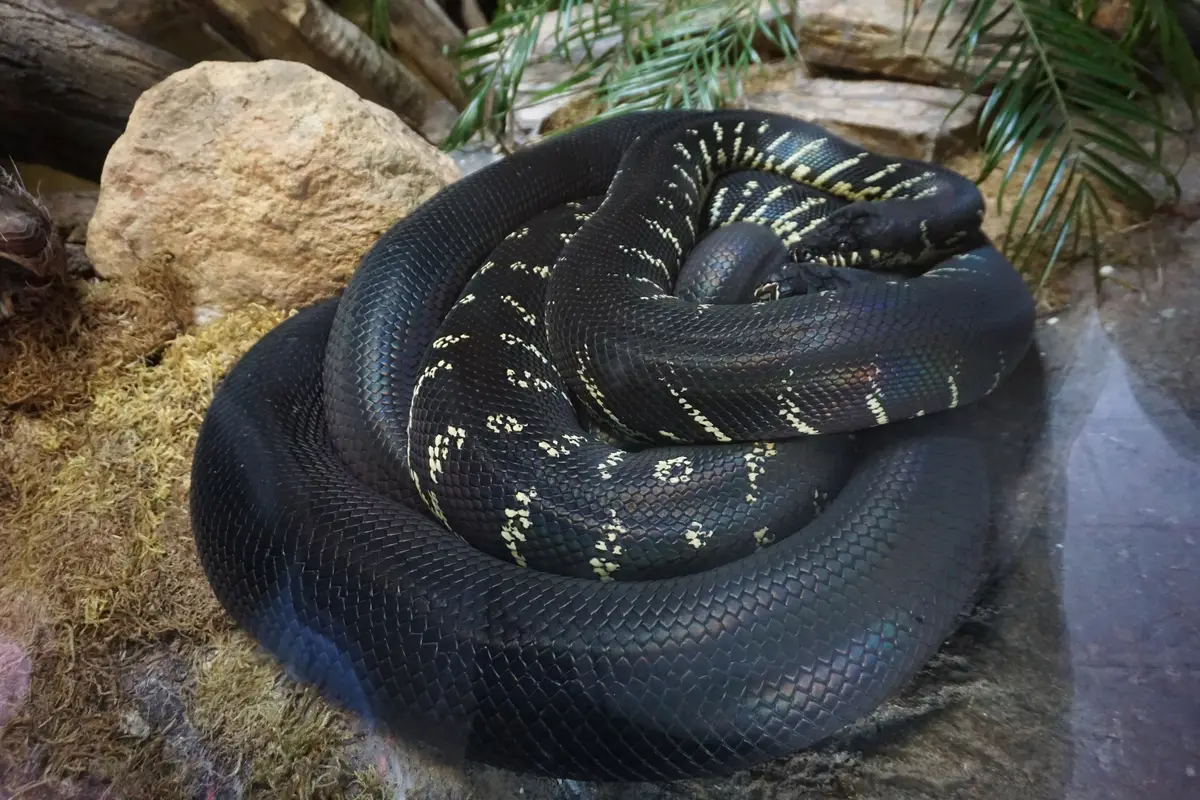
The Boelen python, or Boelen's python (Simalia boeleni), is a non-venomous python that lives only in the mountain forests of New Guinea, above about 3,300 ft (1,000 m). It is harmless to people. Adults are glossy blue-black with white bars on the sides, but hatchlings are red, and they only turn black once they reach about 3 ft (1 m).
- It has no venom. Like all pythons it grabs prey with its teeth and kills by constriction.
- Adults reach about 10 ft (3 m). Keeper reports of 13-14 ft snakes from eastern New Guinea have not been confirmed.
- Its closest relative is the amethystine python of the New Guinea lowlands.
- It is fully protected in Papua New Guinea but not in Indonesian Papua, the source of nearly every Boelen python in the pet trade.
Boelen's python quick facts
| Common name | Boelen's python (also Boelen python, black python; blu moran in Tok Pisin) |
|---|---|
| Scientific name | Simalia boeleni (Brongersma, 1953); formerly Morelia boeleni and Liasis boeleni |
| Family | Pythonidae (pythons) |
| Venomous | No, a constrictor |
| Adult length | Up to about 10 ft (3 m) |
| Hatchling color | Red with cream bands; turns black at about 3.3 ft (1 m) |
| Range | Central mountains of New Guinea, in Papua New Guinea and Indonesian Papua, plus Goodenough Island |
| Habitat | Montane and cloud forest above about 3,300 ft (1,000 m), below the tree line |
| Diet | Frogs and lizards when young; mammals and birds as adults |
| Reproduction | Lays eggs; wild-caught females have laid 13-19 |
| Conservation | IUCN Data Deficient; CITES Appendix II; fully protected in Papua New Guinea |
How to identify a Boelen python
An adult Boelen python is hard to mistake for anything else. The back is dark blue-black or purple-black, and in sunlight it shines like an oil slick. Pale bars, two or three scales wide, run up from the belly onto the flanks, and the lip scales are pale. The front of the belly is white to pale yellow.
- 1Blue-black back: dark, glossy upper scales with a blue or purple sheen in good light.
- 2White bars on the sides: short pale bands that rise from the belly and stop partway up the flanks, described by Ecology Asia as truncated barring.
- 3Pale lips: white or cream scales along the upper and lower jaws, which stand out against the dark head.
- 4Large head: a broad head, clearly wider than the neck, typical of the Simalia pythons.
- 5Red young: hatchlings are red to orange with cream bands. Black color creeps in with each shed until the snake is about 3 ft (1 m) long.
No verified photos of this snake have been shared on iNaturalist yet. Check iNaturalist for new records.
How big do Boelen pythons get?
Most sources put the maximum length at about 10 ft (3 m). A review of the species by Damian Lettoof of the University of Sydney, written as a CITES trade case study, describes it as a long snake under 3 m. Ecology Asia gives a maximum of at least 3 m.
Breeders sometimes claim more. A 2012 care article in Reptiles Magazine by Ari Flagle says snakes from western New Guinea often reach 8-9 ft, while eastern animals are heavier and can reach 13-14 ft. No measured wild snake of that size appears in the scientific record, so treat those numbers with caution.
| Measure | Size | Source |
|---|---|---|
| Length at color change | About 3.3 ft (1 m) | Lettoof, CITES case study |
| Maximum adult length | About 10 ft (3 m) | Lettoof; Ecology Asia |
| Keeper reports, eastern New Guinea | 13-14 ft (4-4.3 m), unverified | Flagle (2012), Reptiles Magazine |
No reliable weights for wild adults have been published.
Where do Boelen pythons live?
Short answer: only in the mountains of New Guinea. The species lives along the island's central ranges in both Papua New Guinea and the Indonesian province of Papua, plus at least one offshore island, Goodenough Island in Milne Bay Province. It is found above about 3,300 ft (1,000 m) and below the tree line.
The first specimen came from Dimija in the Wissel Lakes (now Paniai Lakes) region of Indonesian Papua, at about 5,700 ft (1,750 m), according to the Reptile Database. In Papua New Guinea it has been recorded from the Eastern Highlands, Southern Highlands, Morobe, Central and Milne Bay provinces, including the slopes of Mount Dayman at about 5,600 ft (1,700 m). Lettoof notes separate populations on the Huon Peninsula and Goodenough Island.
Exact range data are thin because so much of the New Guinea highlands is hard to reach. Compare it with the ranges of other pythons on the world snake map.
Habitat
Boelen pythons live in cool, wet mountain forest, including mossy cloud forest. The Saint Louis Zoo describes the habitat as humid with low light. Field notes from the Boelen's Python Group, cited by Lettoof, found that snakes in Indonesian Papua favored lush rainforest on very steep cliffs between about 6,600 and 8,900 ft (2,000-2,700 m).
These are cold places for a python. Flagle reports night temperatures in the mid-40s F (about 7 C) in its mountain range. Snakes use basking spots right next to burrows, which are usually openings under tree roots or gaps among sunken rocks.
Behavior
The Boelen python is a secretive snake that is mostly active by day, according to Lettoof's review. It spends most of its time on the forest floor, close to its burrow, and comes out to bask in patches of sun. It can climb well, and the Reptile Database lists it as partly arboreal.
Very little has been studied in the wild. No radio-tracking study has been published, and the species is among the least understood pythons in the world, as the Saint Louis Zoo puts it. Most of what is known comes from captive snakes, museum specimens and local hunters.
What do Boelen pythons eat?
Young Boelen pythons eat frogs and small lizards. As they grow they switch to warm-blooded prey, mainly mammals, and take birds when they can.
| Life stage | Prey | Source |
|---|---|---|
| Hatchlings | Frogs, small lizards | Lettoof, CITES case study |
| Juveniles | Small rodents, bats, lizards, small frogs | Flagle (2012) |
| Adults | Ground-dwelling rodents, birds, cuscus (tree-dwelling marsupials) | Flagle (2012); Lettoof |
Is the Boelen python venomous or dangerous?
No. The Boelen python has no venom and is not dangerous to people. It is a constrictor: it bites to hold prey, then wraps around it and squeezes. A snake of 10 ft cannot overpower an adult person.
A defensive bite can still cut the skin, since pythons have many sharp, backward-curved teeth. Wash any bite with soap and water and see a doctor if it is deep or looks infected. In the wild the question rarely comes up: the snake is shy and lives in remote mountain forest.
New Guinea does have dangerous venomous snakes, so do not handle any snake you cannot identify. Our snake venom FAQ explains why color is a poor guide to whether a snake is venomous.
Boelen python vs amethystine and green tree pythons
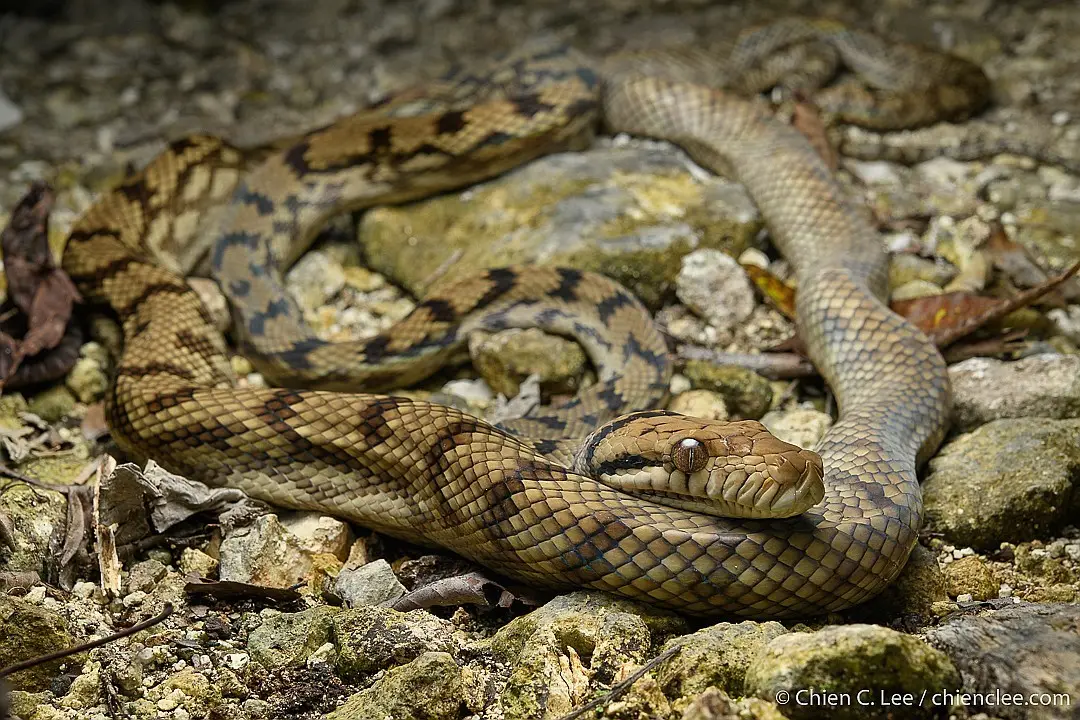
Amethystine python
Simalia amethistina · Harmless
Its closest relative and the same shape, with the same iridescent shine. The amethystine python is tan to olive with dark blotches rather than blue-black, and it lives mainly in lowland and hill forest.
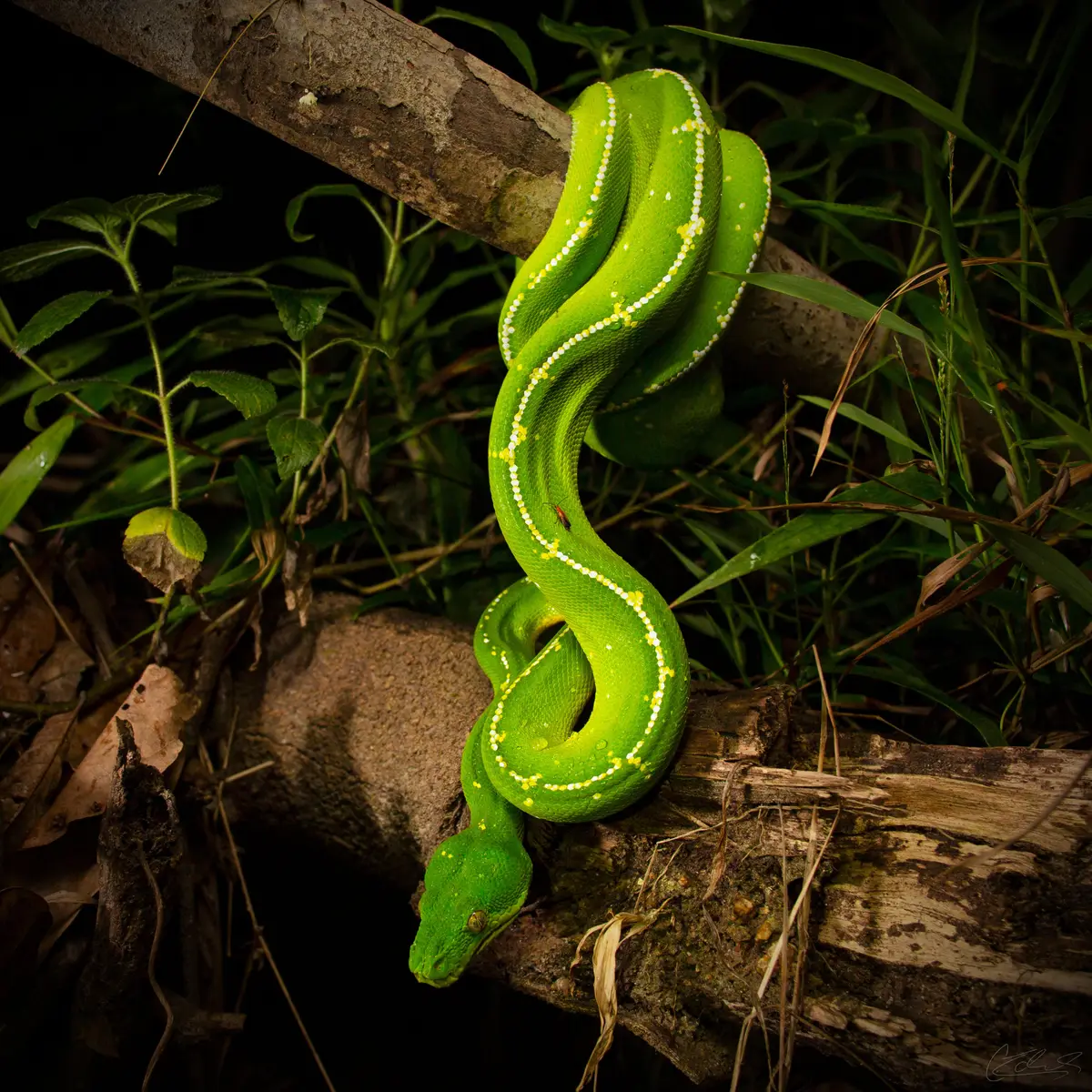
Green tree python (juvenile)
Morelia viridis · Harmless
Young green tree pythons can be red, as young Boelen pythons are. Green tree pythons are slim tree snakes that rest coiled over a branch, and they turn bright green as adults.
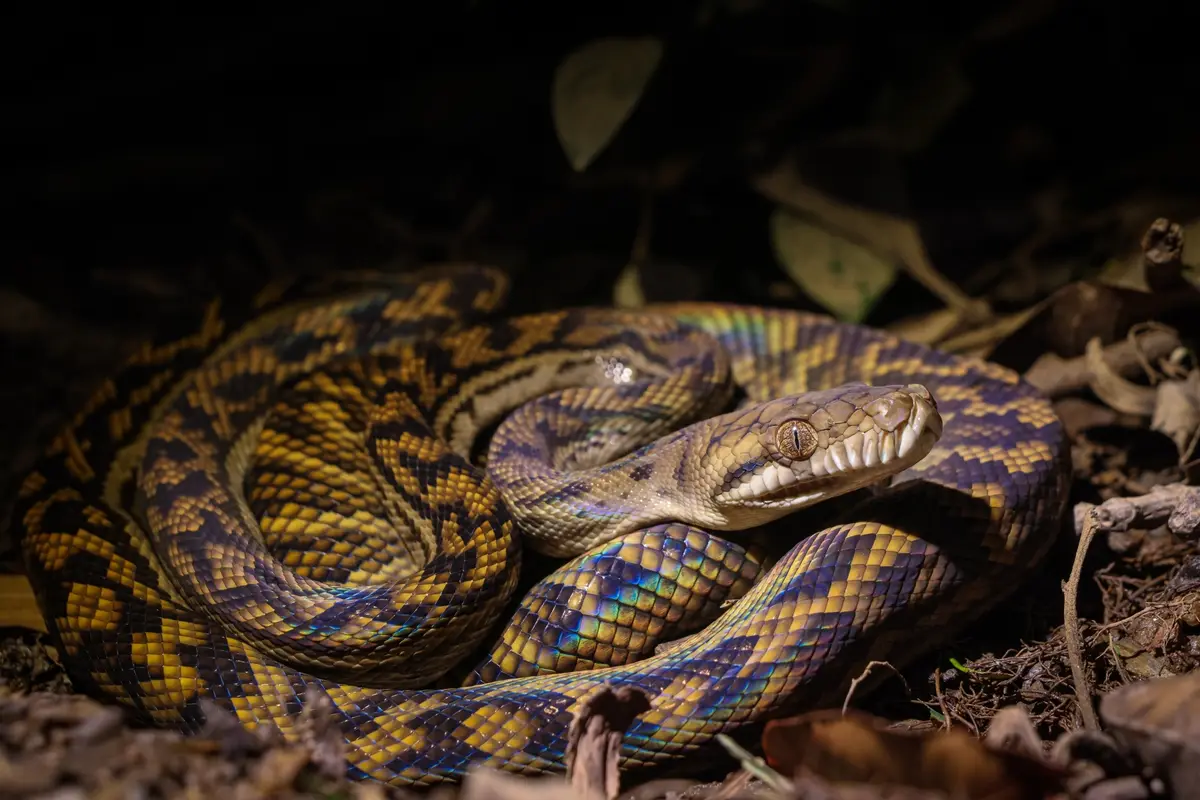
Australian scrub python
Simalia kinghorni · Harmless
Another close relative, but it lives in northeastern Australia, not New Guinea. The Australian scrub python is much longer and patterned in browns and olives.
Reproduction and the red-to-black color change
Boelen pythons lay eggs. Wild-caught females carrying eggs have laid clutches of 13-19, according to Lettoof, and the Saint Louis Zoo reports clutches of at least 14. In Papua, local people know that females brood their eggs in underground hollows, and Lettoof describes how hunters wait for the eggs to hatch and then collect the young.
Hatchlings are red with blotchy cream stripes. They darken with each shed and become jet black with white bars on the sides by about 3.3 ft (1 m). Lettoof points out the red color to wildlife and customs officers, because young snakes look nothing like the adults.
The species is very hard to breed in captivity. Lettoof's review counts fewer than 10 successful breedings by private keepers in more than 30 years, and none at the 12 zoos that held the species when it was written.
Is the Boelen python endangered?
No one knows. The IUCN Red List lists it as Data Deficient (2018 assessment by Tallowin, O'Shea and Parker), meaning there is not enough information to judge its risk. It has been on CITES Appendix II since 1975, and Papua New Guinea gives it full legal protection. Indonesia does not.
| Authority | Status |
|---|---|
| IUCN Red List | Data Deficient (2018) |
| CITES | Appendix II (trade by permit) since 1975 |
| Papua New Guinea | Fully protected; no export |
| Indonesia | Not protected; zero wild export quota since 2001 |
Genetics add to the worry. Austin and colleagues (2010) sequenced 90 Boelen pythons in the journal Conservation Genetics and found that all 16 wild snakes from Indonesia and every captive snake were identical at the three genes tested. They suggest the species has low genetic variation and a small effective population size.
Some Papuan peoples give the snake deep spiritual and cultural value, and Lettoof cites reports that killing it is traditionally forbidden. It is still hunted for food in some provinces.
The pet trade is the other pressure. Before 2001 Indonesia allowed 120 wild snakes a year to be exported. That year the European Union stopped imports, and Indonesia has set no wild quota since. Exports kept going, now declared as farmed or captive-bred: more than 1,000 such snakes have left Indonesia. Lettoof's review concludes that most, if not all, were taken from the wild, often as hatchlings from wild females. A 2006 survey of 10 Indonesian farms found three adult snakes where the farms reported 51. Lettoof judged the harvest of hatchlings unlikely to threaten the species, but no field study has measured its effect.
Boelen python FAQ
Is the Boelen python venomous?
No. The Boelen python has no venom and kills its prey by constriction. It is shy and lives in remote mountain forest in New Guinea, so bites are rare. A defensive bite from its sharp teeth can cut the skin; clean it with soap and water and see a doctor if it is deep. It is not a danger to the life of a person.
Why are baby Boelen pythons red?
Boelen pythons hatch red to orange with cream bands, and the black adult color comes in gradually with each shed. The change is usually complete when the snake is about 3.3 feet (1 m) long. Why the young are red has not been studied, though several other pythons, including the green tree python, also change color as they grow.
How big does a Boelen python get?
Adults reach about 10 feet (3 m) long, according to reviews of the species and field guides to New Guinea snakes. Some keepers report snakes of 13-14 feet from eastern New Guinea, but none of those has been measured and published.
Where does the Boelen python live?
The Boelen python lives only on New Guinea, in the central mountains of Papua New Guinea and the Indonesian province of Papua, and on Goodenough Island. It is found in montane and cloud forest above about 3,300 feet (1,000 m) and below the tree line, often on steep, rocky, densely vegetated slopes.
Why are Boelen pythons so rare and expensive?
They are hard to keep and very hard to breed. Private keepers have bred them fewer than 10 times in over 30 years, and Papua New Guinea bans their export, so almost every snake in the trade has come from Indonesian Papua. Single animals once sold for about US$5,000, according to a CITES case study by Damian Lettoof.
Is the Boelen python endangered?
Its status is unknown. The IUCN Red List rates it Data Deficient, meaning there is too little information to assess. It is fully protected in Papua New Guinea and listed on CITES Appendix II. Genetic work by Austin and colleagues in 2010 found very low genetic diversity in the snakes they tested.
Related snakes
Sources
- Reptile Database: Simalia boeleni
- Lettoof, D. Boelen's python (Morelia boeleni): CITES non-detriment findings case study, University of Sydney
- Austin, Spataro, Peterson, Jordan and McVay (2010). Conservation genetics of Boelen's python (Morelia boeleni) from New Guinea. Conservation Genetics 11: 889-896
- Ecology Asia: PNG Snakes, Boelen's python
- Saint Louis Zoo: Boelen's python
- IUCN Red List: Simalia boeleni (Tallowin, O'Shea and Parker 2018)
- Flagle (2012). Caring for the Boelen's python. Reptiles Magazine