RETICULATEDPYTHON
Malayopython reticulatus · Family Pythonidae
KEY TAKEAWAYS
The reticulated python is the longest snake in the world, a non-venomous constrictor from Southeast Asia and the largest of the pythons. Its scientific name is Malayopython reticulatus. It is shy and usually avoids people, but a big one can kill and swallow an adult human, and a handful of such deaths are well documented.
- The longest wild snake ever measured is a 23 ft 8 in (7.22 m) reticulated python from Sulawesi, confirmed by Guinness World Records in 2026.
- It is not venomous. It grabs prey with its teeth and kills by constriction.
- It lives from Bangladesh and Myanmar to the Philippines and Timor, in forest and farmland, and even in the storm drains of Singapore and Kuala Lumpur.
- It is listed as Least Concern by the IUCN, even though hundreds of thousands are taken from the wild for the skin trade.
Reticulated python quick facts
| Common names | Reticulated python, retic; ular sanca batik (Indonesian) |
|---|---|
| Scientific name | Malayopython reticulatus (Schneider, 1801); formerly Python reticulatus |
| Family | Pythonidae (pythons) |
| Venomous | No, a constrictor |
| Adult length | Usually 10-20 ft (3-6 m); wild record 23 ft 8 in (7.22 m) |
| Weight | Big females about 165 lb (75 kg); the record female weighed 213 lb (97 kg) |
| Range | Southeast Asia, from Bangladesh and Myanmar to the Philippines, Indonesia and Timor-Leste |
| Habitat | Rainforest, woodland, farmland, mangrove edges and urban drains, usually near water |
| Diet | Mammals and birds, from rats and cats to pigs, deer and sun bears |
| Reproduction | Lays eggs; about 24 eggs on average in a Sumatran study, up to about 100 |
| Subspecies | 3: reticulatus, saputrai (Selayar) and jampeanus (Tanahjampea) |
| Conservation | IUCN Least Concern; CITES Appendix II |
How to identify a reticulated python
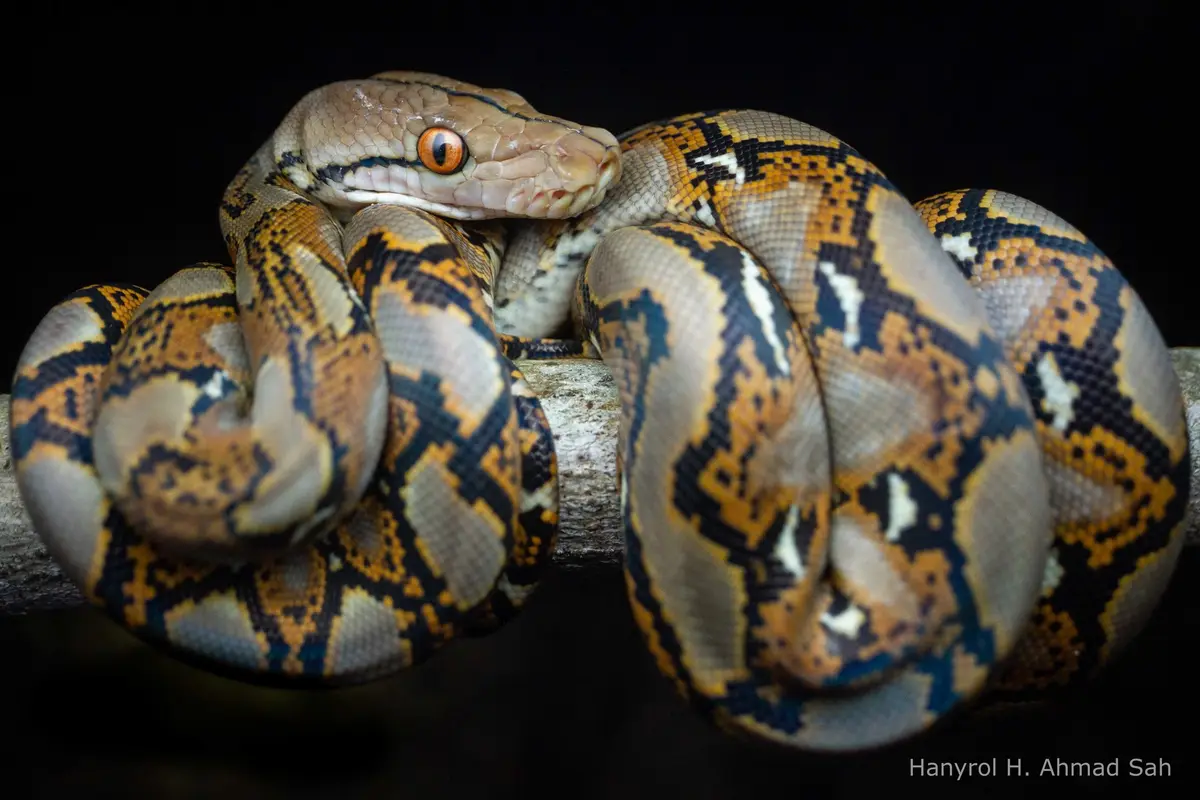
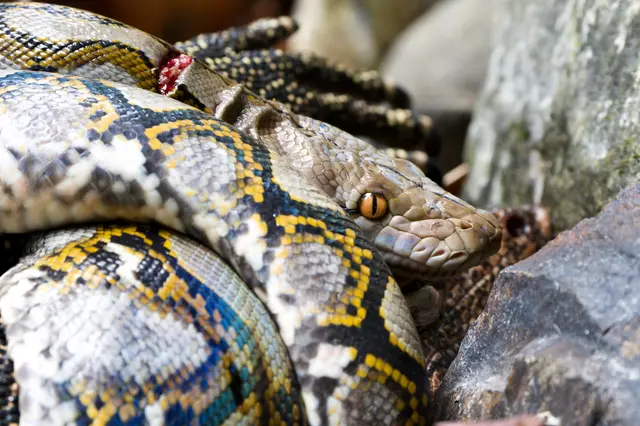
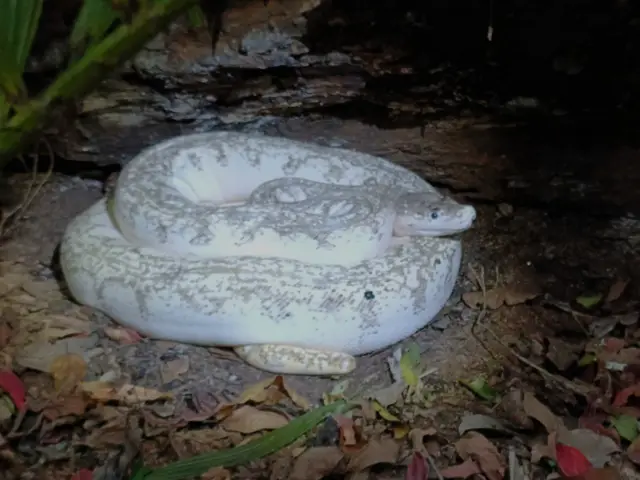
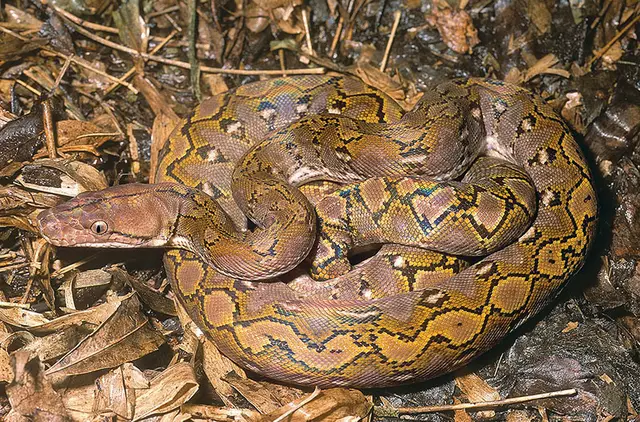
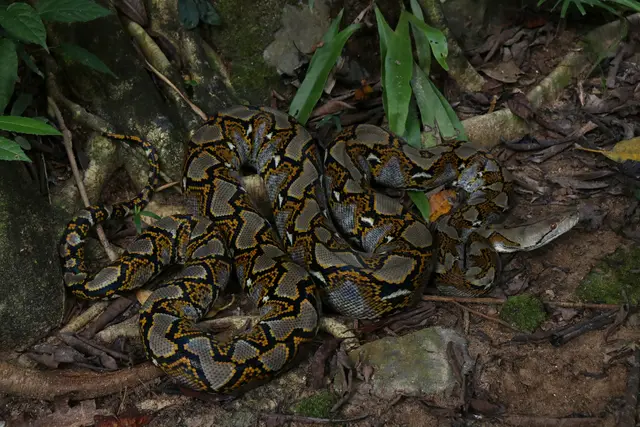
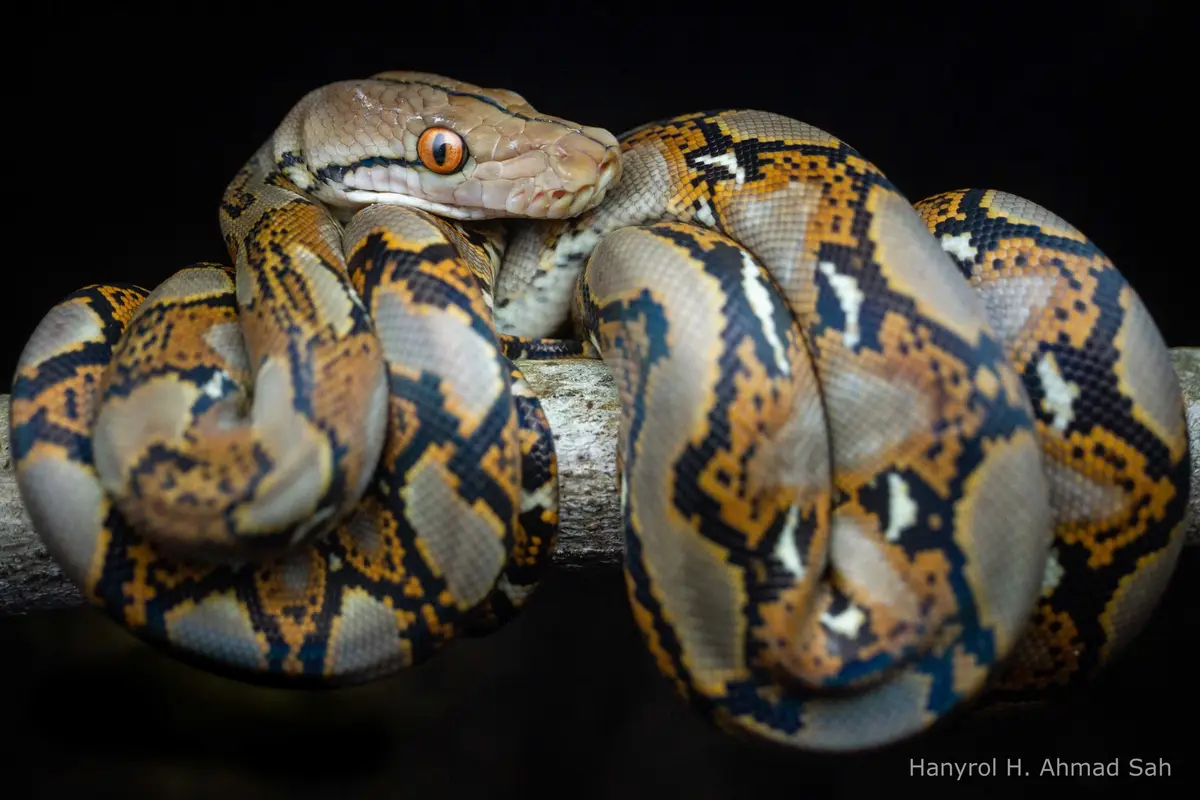
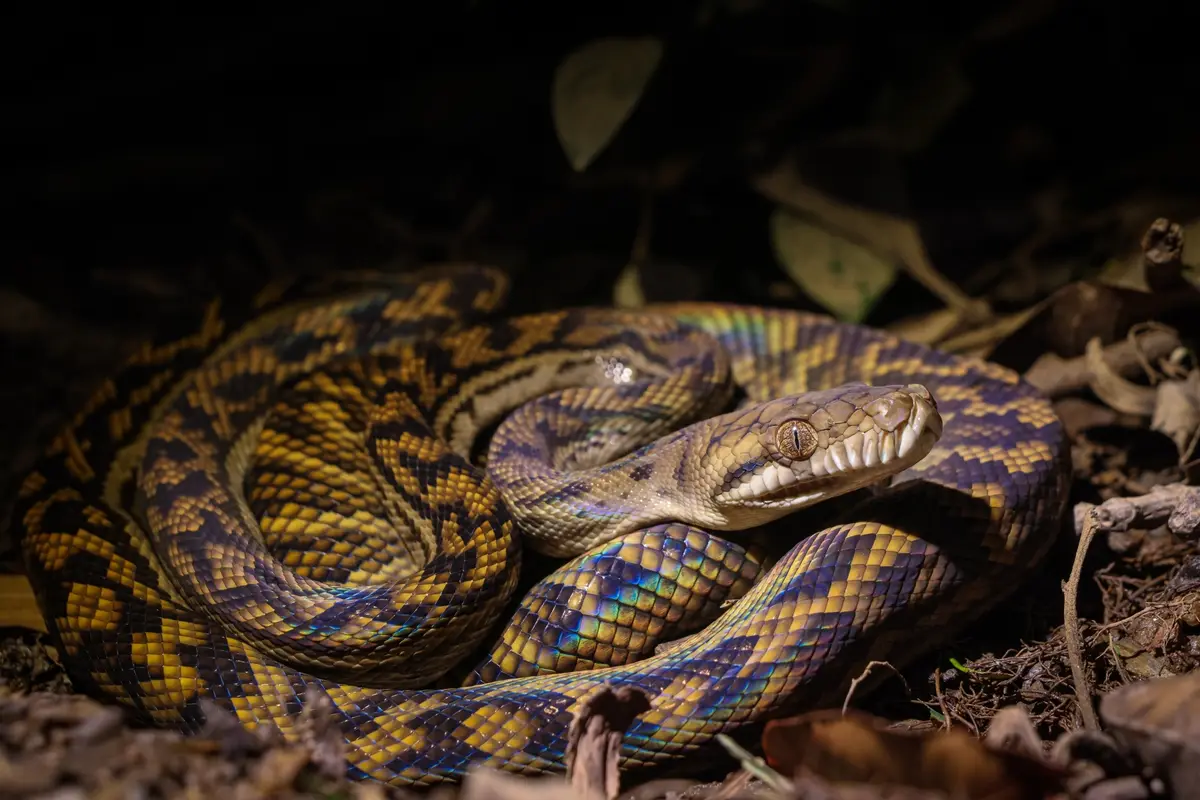
A reticulated python is a very long snake covered in a net-like pattern of black lines over gold, brown and gray patches, often with small white marks along the sides. The name comes from that net: "reticulatus" is Latin for netted. The quickest head clue is a single thin dark line running down the middle of the head, plus bright orange eyes.
- 1Body pattern: a chain of irregular diamonds along the back, outlined in black, with smaller light-centered marks on the sides. Ecology Asia describes zig-zag black lines between yellow-brown, dark brown or gray patches.
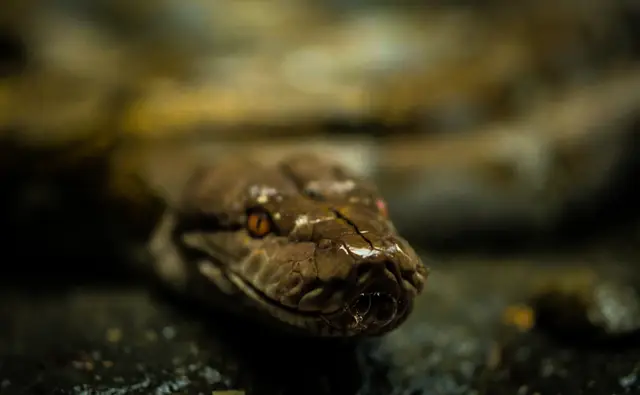
- 2Head line: one narrow dark line from the snout down the center of the head to the neck, with no large spearhead mark.
- 3Eyes: orange with vertical pupils, often with a thin dark line running from each eye back toward the corner of the jaw.
- 4Heat pits: deep heat-sensing pits set in the scales of the upper and lower lips, used to find warm prey in the dark.
- 5Build: long and muscular but slimmer for its length than a Burmese python or an anaconda, with smooth, iridescent scales that shimmer in sunlight.
How big do reticulated pythons get?
Most adult reticulated pythons are 10 to 20 feet (3 to 6 m) long, and snakes of 16 to 23 ft (5 to 7 m) count as large. It is the longest snake species alive. The green anaconda is heavier, but no anaconda has been measured as long.
Females grow much bigger than males. In their 2011 review in PNAS, Thomas Headland and Harry Greene put males at about 16 ft (5 m) and 44 lb (20 kg), and females at over 23 ft (7 m) and 165 lb (75 kg), though females "rarely reach 10 m." Wild pythons sampled in southern Sumatra ranged from about 5 to 21 ft (1.5 to 6.5 m) and 2 to 165 lb (1 to 75 kg).
| Record or life stage | Length | Notes |
|---|---|---|
| Typical adult | 10-20 ft (3-6 m) | Females far larger than males |
| Previous wild record (1999) | 22 ft 10 in (6.95 m) | Held the Guinness title until 2026 |
| Longest wild snake measured (January 18, 2026) | 23 ft 8 in (7.22 m) | Female "Ibu Baron", Maros, South Sulawesi; 213 lb (97 kg) |
| Longest snake ever in captivity (2011) | 25 ft 2 in (7.67 m) | "Medusa", Kansas City, Missouri |
The current record holder, nicknamed Ibu Baron ("the Baroness"), was measured awake rather than sedated, so her true length may be greater. Guinness World Records notes that under anesthesia, when the body fully relaxes, she could measure at least 10% longer. She weighed 213 lb on an empty stomach, Popular Science reported.
Older claims of 30 ft (9 m) or more, such as a 10.2 m (33 ft) snake reported by a rubber planter in Sumatra in 1931, were never confirmed with a measured specimen. Scientists only trust lengths taken from dead or anesthetized snakes, or verified by a body like Guinness.
Where do reticulated pythons live?
Short answer: reticulated pythons live across Southeast Asia, from Bangladesh and Myanmar east to the Philippines and south through Indonesia to Timor. The Reptile Database lists Bangladesh, Myanmar, Thailand, Laos, Cambodia, Vietnam, Malaysia, Singapore, Brunei, Indonesia, the Philippines and Timor-Leste, plus India's Nicobar Islands and Mizoram. Other records from mainland India are doubtful.
Within Indonesia it is found on Sumatra, Java, Borneo, Sulawesi and dozens of smaller islands from Nias and the Mentawais to Flores, Sumba, Timor, Seram and Halmahera. In the Philippines it occurs on Luzon, Mindanao, Palawan, the Visayas and the Sulu Archipelago. It is a strong swimmer, which helps explain how it reached so many islands. Compare its range with other giant snakes on the world snake map.
Are there reticulated pythons in Florida?
A few, but there is no breeding population. Escaped or released pets have turned up in the wild across Florida since the 1980s, according to a University of Florida IFAS guide, yet the species is not established there. The invasive giant in the Everglades is the Burmese python.
Habitat
Reticulated pythons live in tropical rainforest, woodland and the grassy edges of forest, usually close to rivers, streams or lakes. They range from the lowlands up to lower montane forest at about 4,900 ft (1,500 m), and they also use plantations, scrub and the edges of mangroves.
They adapt well to people. In Singapore and Kuala Lumpur they often live in urban drainage channels, where rats and stray cats are easy prey. In the early 1900s they were common even in busy parts of Bangkok, according to Thai National Parks.
Behavior
Reticulated pythons are ambush hunters. A python lies still beside a game trail or at the water's edge, then strikes when prey comes within reach. In Sabah, Ecology Asia notes them resting by day on branches over riverine forest, and young pythons climb more than adults.
In water they are at home. Small pythons dive to escape when disturbed, and adults swim across rivers and between islands. A big python on land is slow, but it can strike fast and hard.
What do reticulated pythons eat?
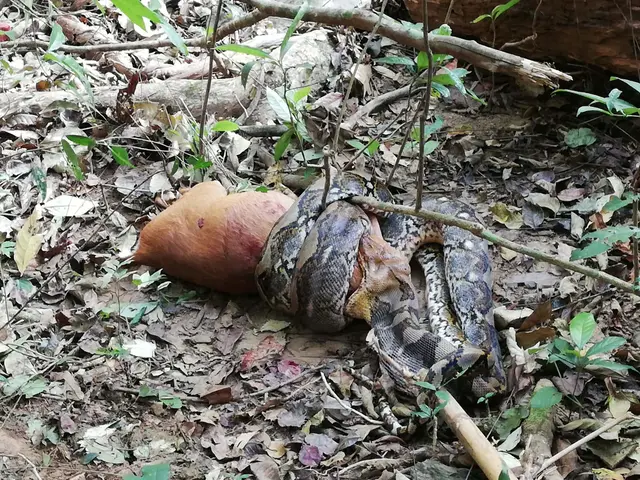
Reticulated pythons eat mammals and birds, and the bigger the snake, the bigger the prey. A python bites, throws coils around the animal and squeezes until it dies, then swallows it whole. Small pythons take rats, bats and treeshrews; large ones take pigs, deer and primates.
| Prey group | Recorded examples | Notes |
|---|---|---|
| Rodents and small mammals | Oriental house rat, Malaysian wood rat, plantain squirrel, house shrew | The main food of small and city pythons |
| Primates | Long-tailed macaque, silvered leaf monkey, lorises, tarsiers | A 7.3 ft (2.24 m) python in Singapore held two young macaques |
| Large mammals | Wild pig, sambar deer, Malayan sun bear, Sunda pangolin, smooth otter | Pigs up to about 130 lb (60 kg) can be taken |
| Domestic animals | Cats, dogs, chickens | Common near villages and in cities |
| Birds and reptiles | Red junglefowl, rock dove, clouded monitor | Taken when the chance arises |
Headland and Greene report a 21 ft (6.4 m) python killed in 1982 with a 32 lb (14.5 kg) pig in its stomach. A 2005 paper by Gabriella Fredriksson in the Raffles Bulletin of Zoology documented reticulated pythons preying on sun bears in East Kalimantan, Borneo. The prey list from Singapore Biodiversity Online also includes colugos and pangolins.
Is the reticulated python venomous or dangerous to humans?
The reticulated python is not venomous, but it is one of the very few snakes that can kill and eat an adult person. It has rows of sharp, backward-curved teeth and no venom glands. Deaths are rare, and most pythons flee from people, but this species has more well-documented cases of eating people than almost any other snake.
The best data come from the Agta, hunter-gatherers in the forests of Luzon, Philippines. In a 1970s survey reported by Headland and Greene, 15 of 58 adult men (26%) had survived attacks by reticulated pythons, and six Agta were killed between about 1934 and 1973. Two of the dead were small children taken by the same python, which entered a house at sunset in 1973. The same paper lists 19 attacks elsewhere in Indonesia and Sarawak, 11 of them fatal.
Cases still happen. In March 2017 a 25-year-old man named Akbar went missing near the village of Salubiro in West Sulawesi, Indonesia, and villagers found his body inside a python about 23 ft (7 m) long, CBS News reported.
A bite carries no venom, but it can leave deep tears and get infected. Clean any python bite and see a doctor if it is deep. Never handle a large python alone. Our snake venom FAQ explains how venomous snakes differ from constrictors.
Reticulated python vs Burmese python and other giants
Inside its range, a very long snake with a net pattern and one thin line on the head is almost certainly a reticulated python. Confusion is most common with other big pythons, in zoos and the pet trade and where ranges overlap in Myanmar, Thailand and Indochina.
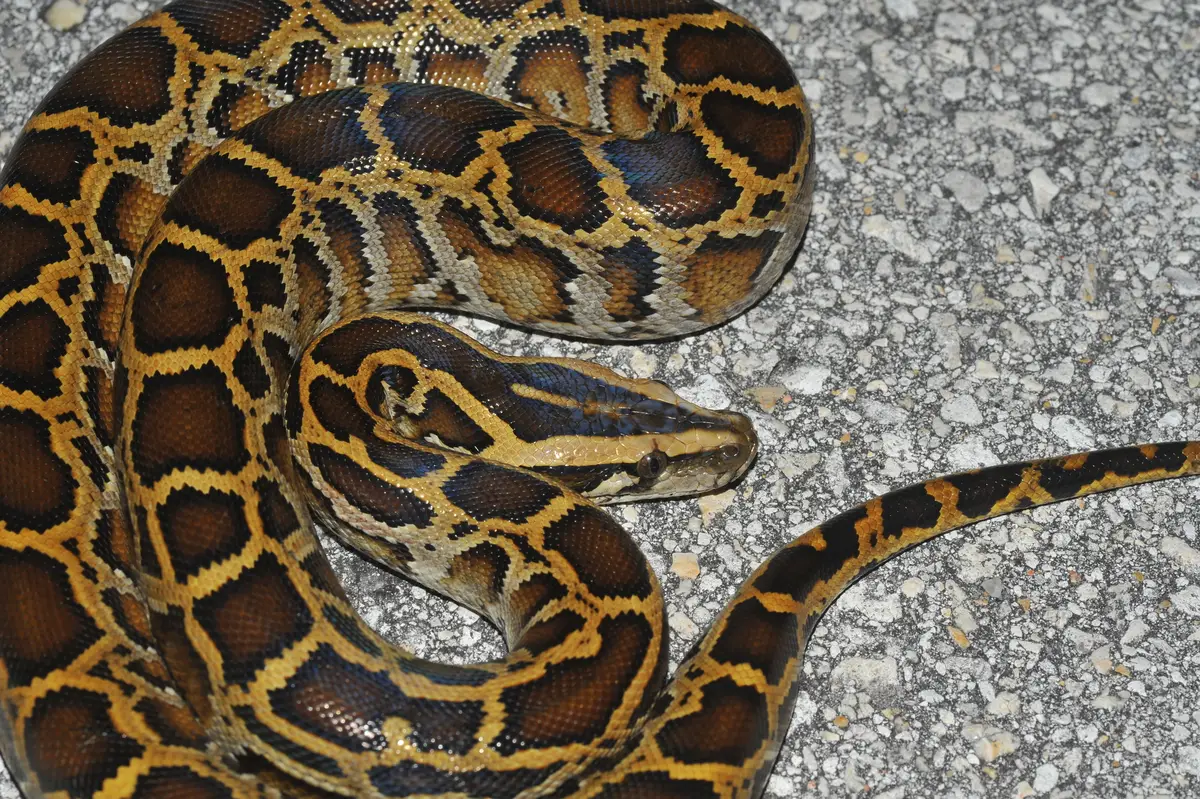 Photo: (c) Wayne Fidler, some rights reserved (CC BY-NC), uploaded by Wayne Fidler · via iNaturalist
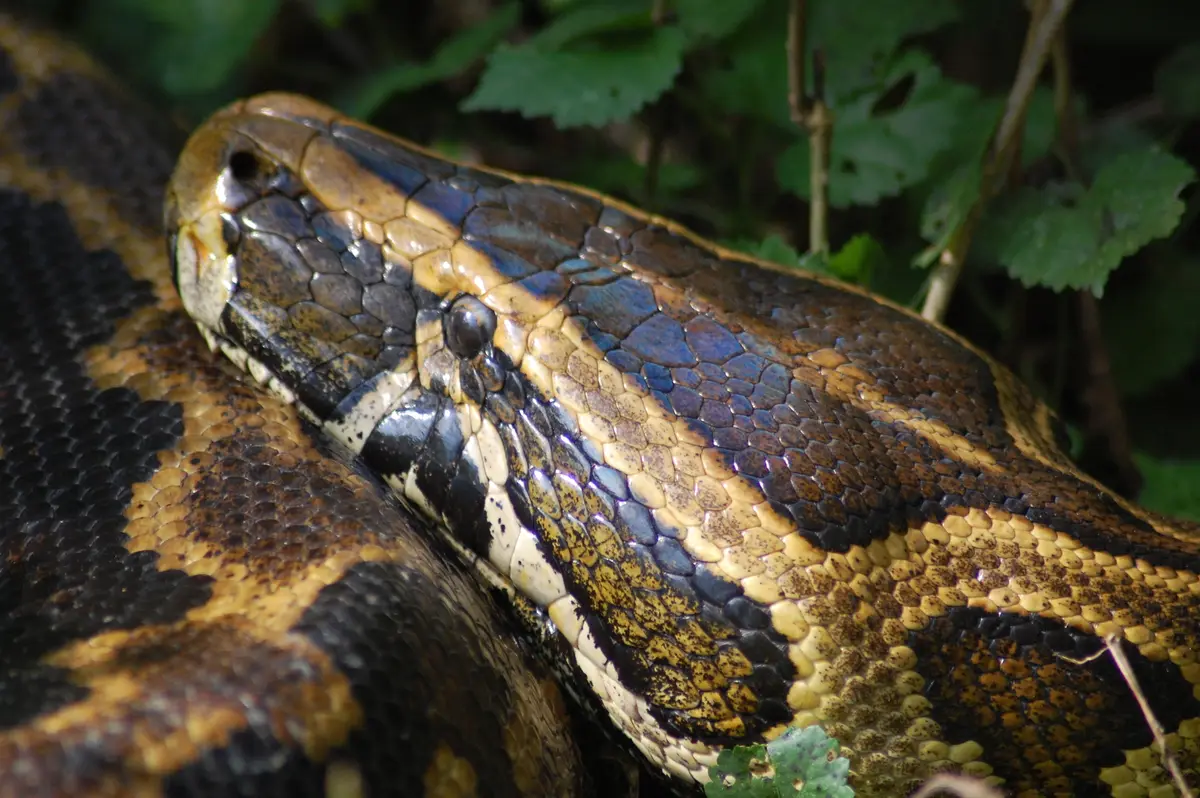
Burmese python
Python bivittatus · Non-venomous
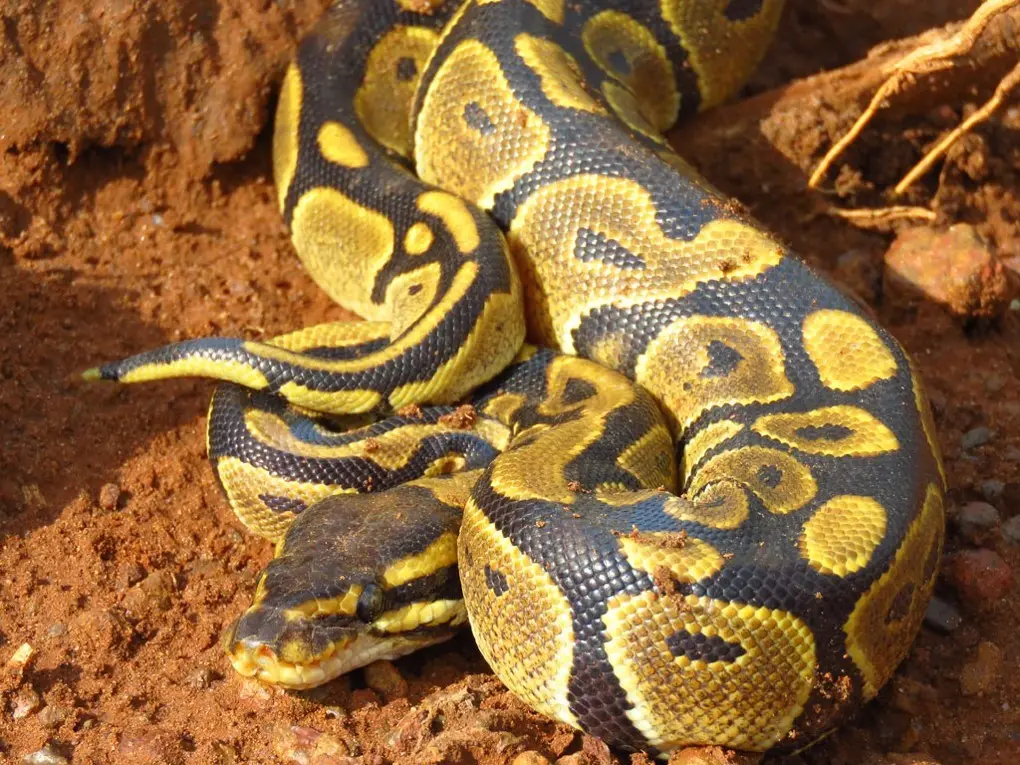
Heavier for its length, with large dark blotches like giraffe spots instead of a net, and a dark spearhead mark on top of the head. It shares much of mainland Southeast Asia with the reticulated python. See our Burmese python guide.
African rock python
Python sebae · Non-venomous
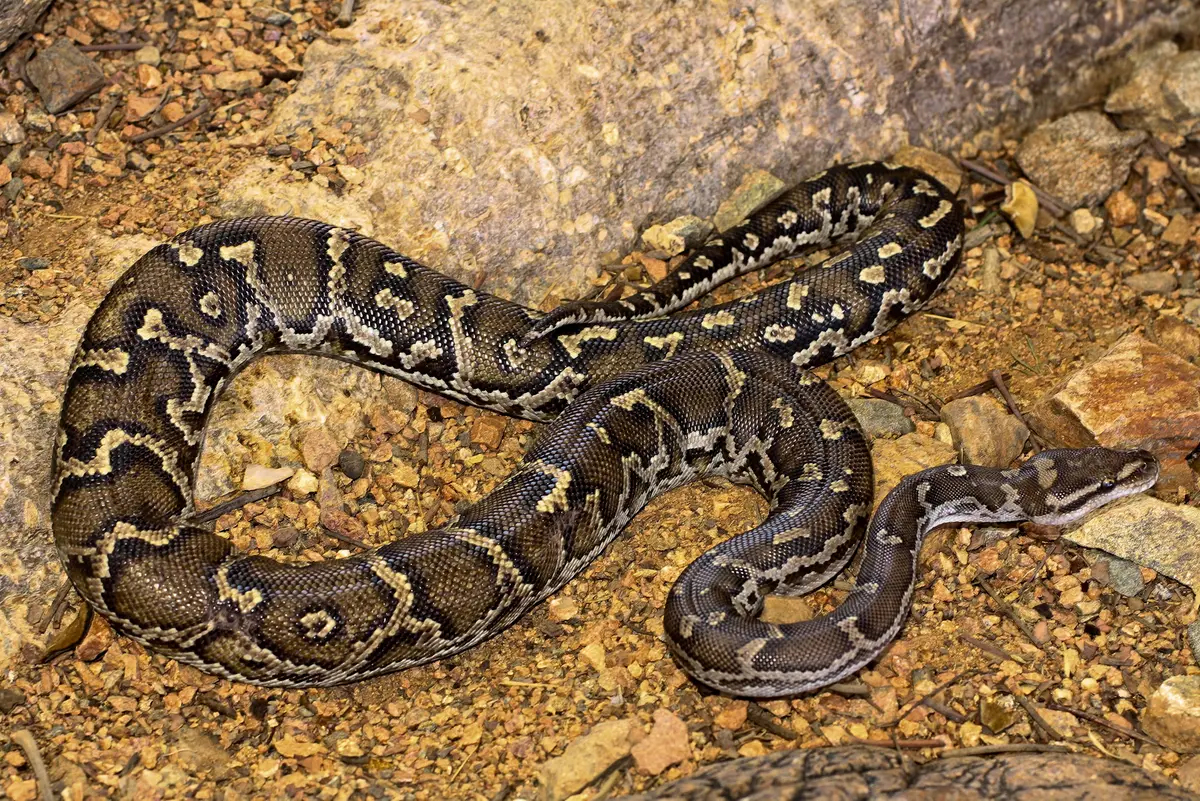
Africa's largest snake, found only south of the Sahara. Its brown and olive blotches often join into a ragged band, and it also has a spearhead mark on the head. See our African rock python guide.
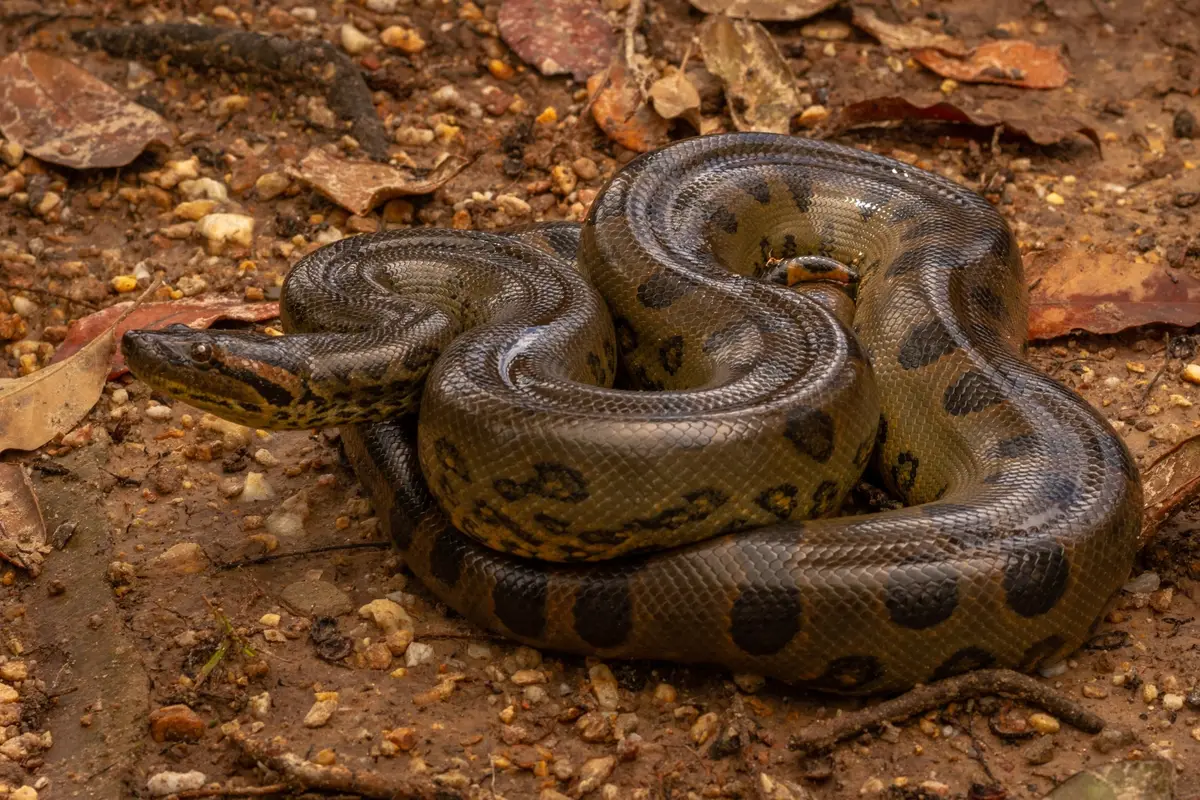 Photo: (c) Luis F. C. de Lima, all rights reserved, uploaded by Luis F. C. de Lima · via iNaturalist
Green anaconda
Eunectes murinus · Non-venomous
South American, olive green with round black spots, and much bulkier. It is the heavier snake; the reticulated python is the longer one. See our green anaconda guide.
Reproduction and lifespan
Reticulated pythons lay eggs. In a study of 784 pythons from northern Sumatra, Richard Shine and colleagues found clutches averaged about 24 eggs, each weighing more than 250 g (9 oz), and females bred only every two to four years. Big females can lay far more: Chester Zoo gives 60 to 100 eggs per clutch. The eggs hatch after about 70 to 90 days.
The female coils around her clutch and guards it. Like other pythons, she can twitch her muscles to make heat, a kind of shivering that warms the eggs. The young get no care after hatching. Females in Sumatra mature at a snout-vent length of about 8.7 ft (2.65 m), according to Natusch et al. 2016.
How long do reticulated pythons live?
Chester Zoo estimates 15 to 22 years in the wild and up to about 30 years in human care.
Selayar and Kayaudi dwarf reticulated pythons
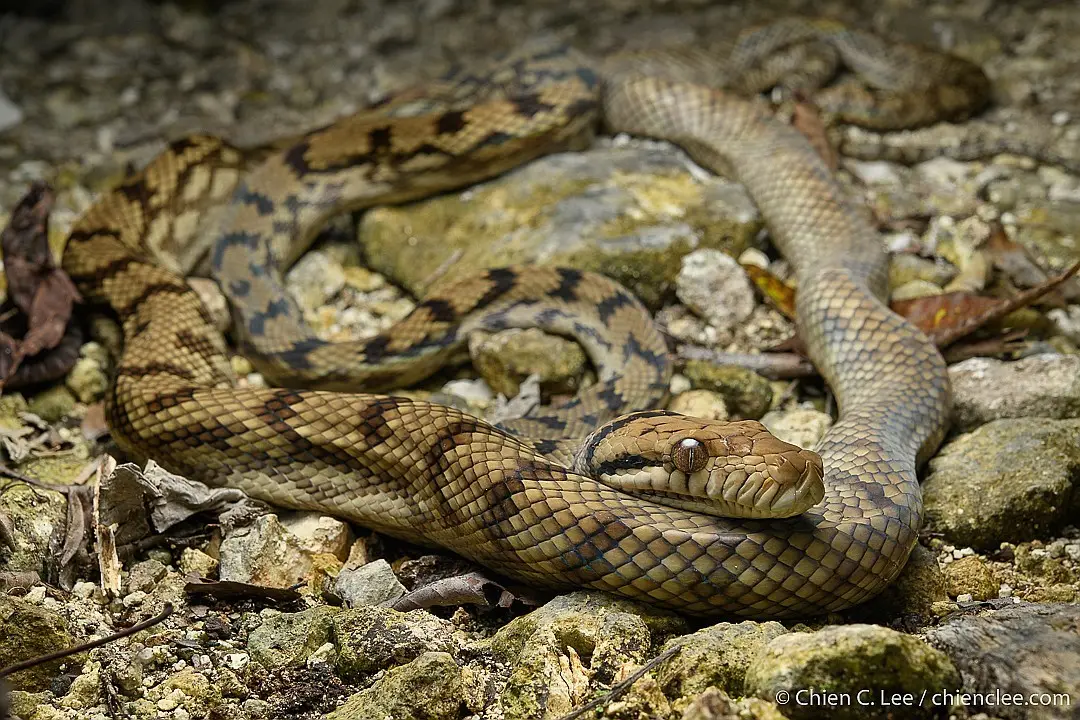
The Reptile Database recognizes three subspecies. Besides the widespread M. r. reticulatus, two small island forms were described in 2002 by Mark Auliya and colleagues: M. r. saputrai from Selayar Island and southwestern Sulawesi, sold as the Selayar reticulated python, and M. r. jampeanus from Tanahjampea, listed on iNaturalist as the Kayaudi dwarf reticulated python. Island "super dwarf" forms in the pet trade usually reach only 6 to 8 ft (1.8 to 2.4 m).
Is the reticulated python endangered?
No. The IUCN Red List lists the reticulated python as Least Concern mainly because of its huge range. It is still one of the most heavily traded reptiles on Earth. Indonesia alone had an export quota of about 157,500 skins a year, and nearly a million pythons were taken over 20 years.
Is that harvest sustainable? A team led by Daniel Natusch compared more than 4,200 pythons from Sumatran skin traders in 1995 and 2015. Body sizes, clutch sizes and the share of giant snakes had not fallen, and the authors concluded the harvest "appears to be sustainable", while urging monitoring every two to three years.
| Authority | Status |
|---|---|
| IUCN Red List | Least Concern |
| CITES | Appendix II; international trade needs permits |
| US Lacey Act | Injurious wildlife since April 9, 2015; live imports banned |
| Florida (FWC) | Prohibited species since April 29, 2021 |
The 2015 federal rule from the US Fish and Wildlife Service also tried to ban moving the snakes between states, but a federal appeals court ruled in 2017 that the Lacey Act does not cover shipments between the continental states. In Florida, report a loose reticulated python to the FWC Exotic Species Hotline, 888-IVE-GOT1 (888-483-4681).
Reticulated python FAQ
Is the reticulated python the longest snake in the world?
Yes. The reticulated python is the longest snake species alive. The longest wild snake ever measured is a female from Maros, South Sulawesi, at 23 ft 8 in (7.22 m), confirmed by Guinness World Records in 2026. The longest snake ever kept in captivity, Medusa of Kansas City, measured 25 ft 2 in (7.67 m) in 2011.
Are reticulated pythons venomous?
No. Reticulated pythons have no venom. They catch prey with sharp, backward-curved teeth and kill it by constriction, squeezing until the heart and breathing stop. A bite can still cause deep cuts and infection, so it should be cleaned well and checked by a doctor, but there is no venom to treat.
Do reticulated pythons eat people?
Rarely, but yes. It is one of the few snakes with confirmed cases of killing and swallowing people. Among the Agta of the Philippines, six people were killed by pythons between about 1934 and 1973. In 2017 a man in West Sulawesi, Indonesia, was found inside a python about 23 ft long. Most pythons avoid people.
Reticulated python vs Burmese python: which is bigger?
The reticulated python is longer; the Burmese python is bulkier for its length. Reticulated pythons regularly pass 16 ft and the wild record is 23 ft 8 in, while the longest Burmese python documented in Florida was 19 ft. Look at the head: a reticulated python has one thin center line, a Burmese python a dark spearhead.
What is a Selayar reticulated python?
It is a small island subspecies, Malayopython reticulatus saputrai, found on Selayar Island and in southwestern Sulawesi, Indonesia. It was described in 2002. Like the Tanahjampea form, sold as the Kayaudi dwarf reticulated python, it stays far smaller than mainland reticulated pythons and is popular in the pet trade.
Are there reticulated pythons in Florida?
Only escaped or released pets. The University of Florida reports occasional sightings in the wild since the 1980s, but no breeding population. Florida listed the reticulated python as a Prohibited species on April 29, 2021, so it cannot be newly kept as a pet there. Report sightings to 888-IVE-GOT1.
Related snakes
Sources
- Reptile Database: Malayopython reticulatus
- Guinness World Records: Indonesian python is the longest measured wild snake (2026)
- Guinness World Records: Longest snake ever (captivity)
- Headland and Greene 2011, Hunter-gatherers and other primates as prey, predators, and competitors of snakes (PNAS)
- Natusch et al. 2016, Jungle giants: assessing sustainable harvesting in a difficult-to-survey species (PLoS ONE)
- UF/IFAS: Large snake lineup for South Florida
- US Fish and Wildlife Service: 2015 injurious wildlife listing of four large constrictors (Federal Register)
- Ecology Asia: Reticulated python