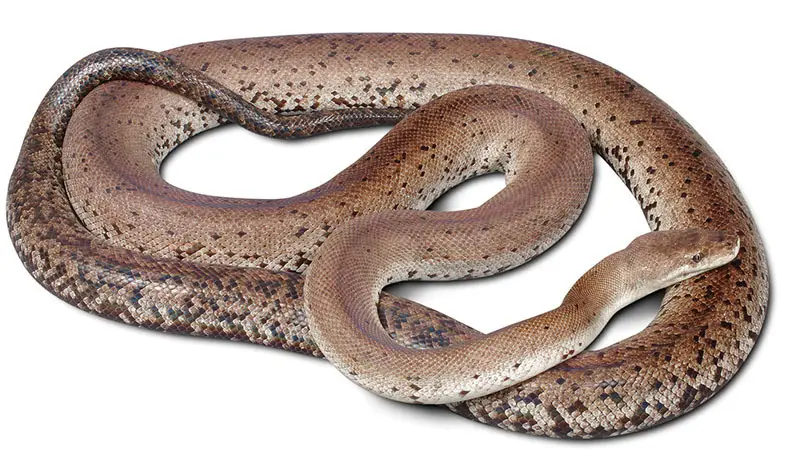
MACKLOT'SPYTHON
Liasis mackloti · Family Pythonidae
KEY TAKEAWAYS
Macklot's python (Liasis mackloti) is a non-venomous water python from Timor and a few nearby islands in the Lesser Sundas of Indonesia and Timor-Leste. It is also called the freckled python, after the pale speckles on its dark body. It has no venom and kills its prey by constriction.
- It has no venom. A bite from its long teeth can bleed, but it needs cleaning, not antivenom.
- Adults are usually 6-8 ft (1.8-2.5 m). A captive female of 9.3 ft (2.85 m) weighed about 20 lb (9 kg).
- In the wild it lives in low, wet country: rice paddies, overgrown coastal creeks and mangroves.
- The IUCN rates the species Least Concern (2021 assessment).
Macklot's python quick facts
| Common name | Macklot's python (also freckled python, Timor water python) |
|---|---|
| Scientific name | Liasis mackloti Dumeril and Bibron, 1844 |
| Subspecies | L. m. mackloti (Timor, Semau, Roti), L. m. dunni (Wetar), L. m. savuensis (Savu) |
| Family | Pythonidae (pythons) |
| Venomous | No, a constrictor |
| Adult length | Usually about 6-8 ft (1.8-2.5 m); captive females up to about 9.3 ft (2.85 m) |
| Weight | A 7.9 ft (2.42 m) captive male weighed 7.1 lb (3.2 kg); an 8.3 ft (2.53 m) female 11.2 lb (5.1 kg) |
| Coloring | Dark olive-brown to gray-brown with small pale freckles; yellowish front belly |
| Range | Timor and nearby islands of the Lesser Sundas, in Indonesia and Timor-Leste |
| Habitat | Lowland wetlands: rice paddies, coastal creeks, mangrove swamps |
| Diet | Mammals and birds; no diet study from the wild has been published |
| Reproduction | Lays eggs, often 10-20 per clutch; the female coils around them and shivers to warm them |
| Conservation | IUCN Least Concern (2021); CITES Appendix II |
How to identify a Macklot's python
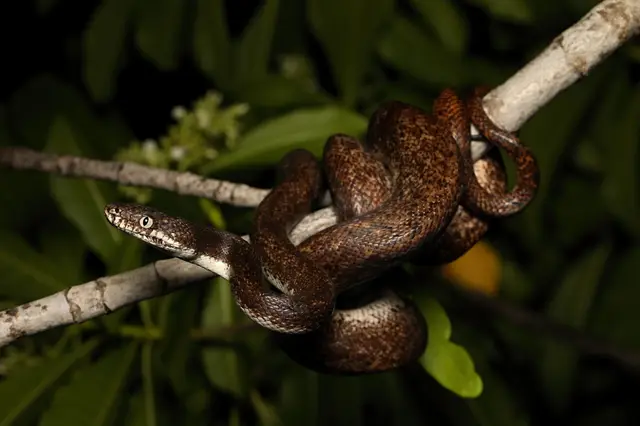
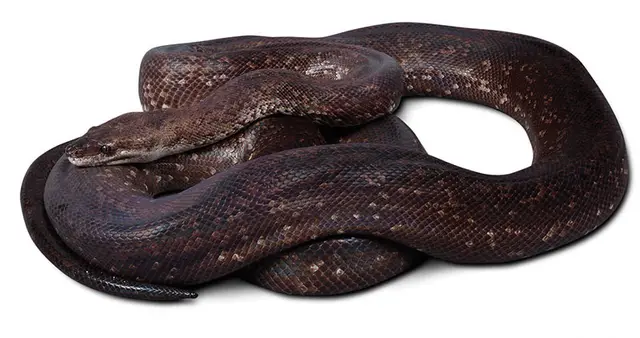
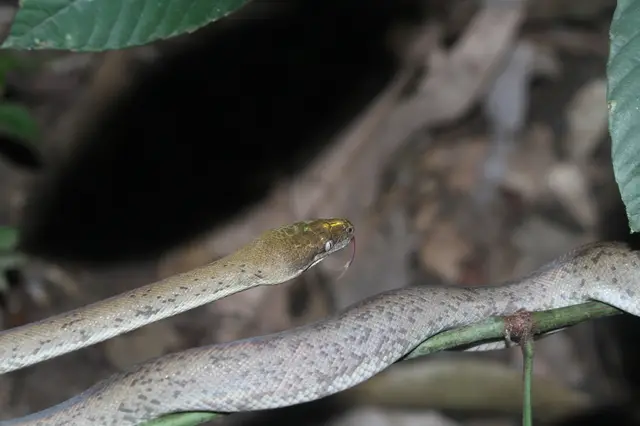
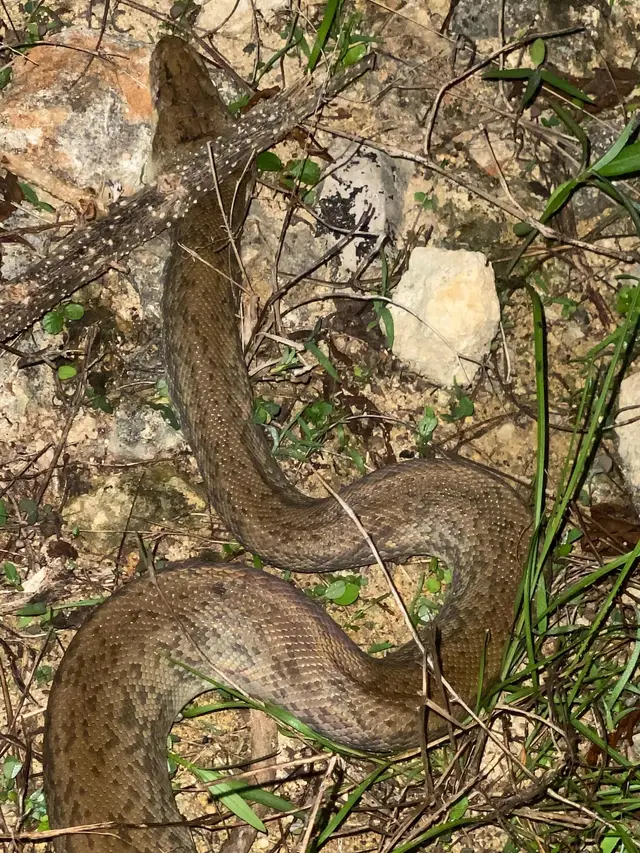
A Macklot's python is a slim, medium-sized python with a dark body covered in fine pale speckles, which is where the name freckled python comes from. German keeper Joachim Bulian, who bred the species for ten years, described a brown head, a middle to dark gray back with brown spots, a yellow front third of the belly and a grayish-white rest of the belly (Bulian 1994, Litteratura Serpentium).
- 1Pale freckles on a dark body: small light speckles are scattered over a dark olive, brown or gray back. There are no bold blotches, bands or a net pattern.
- 2Head clearly wider than the neck: Bulian measured adult heads at about 2.4 in (6 cm) long, noticeably broad compared with the slim body.
- 3Heat pits along the lips: a row of heat-sensing pits runs along the lip scales. Carmichael (2007) found that the pit positions differ slightly between the three subspecies.
- 4Yellow under the chin and throat: the front part of the belly is yellow, fading to grayish-white farther back.
- 5Location: a speckled dark python in wet lowlands on Timor, Semau, Roti, Wetar or Savu is very likely this species.
Hatchlings look different. Bulian's had brown heads and plain gray backs; the freckles appeared after the first shed and the adult pattern was complete at about one year.
How big do Macklot's pythons get?
Most adult Macklot's pythons are about 6-8 ft (1.8-2.5 m) long, and females grow larger than males. Bulian gave captive females up to about 9.2 ft (2.8 m) and males up to about 8.2 ft (2.5 m). He also cited a breeding report by Swaak (1988) of an exceptionally large female, 9.3 ft (2.85 m) long and about 20 lb (9 kg).
| Measure | Size | Source |
|---|---|---|
| Hatchling | About 17 in (43 cm), 1.1 oz (31 g) on average | Bulian (1994) |
| Adult male (captive, wild-caught) | 7.9 ft (2.42 m), 7.1 lb (3.2 kg) | Bulian (1994) |
| Adult female (captive, wild-caught) | 8.3 ft (2.53 m), 11.2 lb (5.1 kg) | Bulian (1994) |
| Largest female reported | 9.3 ft (2.85 m), about 20 lb (9 kg) | Swaak (1988), cited by Bulian (1994) |
Captive growth is quick. One of Bulian's hatchlings went from 22 in (55.8 cm) to 52 in (132 cm) in about 19 months. The Savu subspecies stays much smaller than the Timor form, which is one reason some authors treat it as a separate species.
Where do Macklot's pythons live?
Short answer: on Timor and a handful of nearby islands in the Lesser Sundas, split between Indonesia and Timor-Leste. The Reptile Database lists Timor, Semau, Roti, Alor, Savu and Wetar, with Timor as the type locality.
Each subspecies has its own island. The nominate form lives on Timor and the small islands of Semau and Roti off its western tip, L. m. dunni on Wetar to the north, and L. m. savuensis on Savu to the west. Carmichael's 2007 genetic study at the University of Southern Mississippi found no difference between the Timor, Semau and Roti snakes, and linked the split between the island forms to the Pleistocene.
Older books also list New Guinea and northern Australia, because the brown water python, Liasis fuscus, was once lumped into this species. The Reptile Database now treats the water python as a separate species and notes that reports of Macklot's python from coastal northern Australia may be misidentified water pythons. Compare the ranges of the world's pythons on the world snake map.
Habitat
Macklot's pythons live in flat, wet lowlands near the coast. Survey teams led by Mark O'Shea and Hinrich Kaiser in Timor-Leste found the species in flooded lowland habitat such as rice paddies and overgrown coastal creeks, and reported it most often on roads that cross rice fields (O'Shea and colleagues 2012 and 2015, Asian Herpetological Research).
The first specimen from Timor-Leste came from the mangrove swamp at Metinaro, east of Dili. Snakes there hid by day in the burrows of fiddler crabs and mud lobsters and came out at night as the tide came back in, according to the same team.
Are Macklot's pythons aggressive?
Young ones are. Adults usually are not. Bulian found hatchlings extremely aggressive in their first months, striking at any movement and even strangling and swallowing their clutchmates. His adults were usually calm, with some exceptions.
In the wild it is a night-active snake of wet ground. O'Shea's team found most records in the wet season, when snakes cross roads between patches of habitat and many are run over. Despite the name water python, Bulian never saw his Macklot's pythons bathe, while the Australian water pythons he kept spent long spells in their water bowls.
Males find females by scent. Carmichael tested this and found that males can tell apart the scent trails of females from their own island group and from other subspecies, and that courtship differs between the three forms.
What do Macklot's pythons eat?
Macklot's pythons eat warm-blooded prey, mainly small to medium mammals and water birds. O'Shea's team noted that no study of its diet in the wild has been published, so the details come from habitat and captive feeding.
| Prey | Notes | Source |
|---|---|---|
| Small to medium mammals | Named as prey in Timor-Leste survey notes | O'Shea and colleagues |
| Water birds | Taken in wetlands and along creeks | O'Shea and colleagues |
| Rats (captive) | Bulian fed adult males 15-18 rats a year and females 25-30 | Bulian (1994) |
| Chicks (captive) | Picky hatchlings took mice only when they smelled of chicken | Bulian (1994) |
It senses prey with the heat pits on its lips, bites, then coils and squeezes.
Is Macklot's python venomous or dangerous?
No. Macklot's python has no venom and is not dangerous to people. It kills by constriction and is far too small to threaten an adult.
A bite still hurts. Pythons have many sharp, backward-curved teeth, and a startled young Macklot's python bites readily. Wash the wound with soap and water, check that your tetanus protection is up to date, and see a doctor if it turns red or swollen. If you cannot tell what kind of snake bit you, treat it as venomous and get medical help. Our snake venom FAQ explains why color and pattern are a poor guide to danger.
Outside the Lesser Sundas, most people meet it in the pet trade. Breeders have produced it since at least the 1970s, and Bulian's first female alone produced 102 young in ten years.
Macklot's python vs water python and other look-alikes
Water python
Liasis fuscus · Harmless
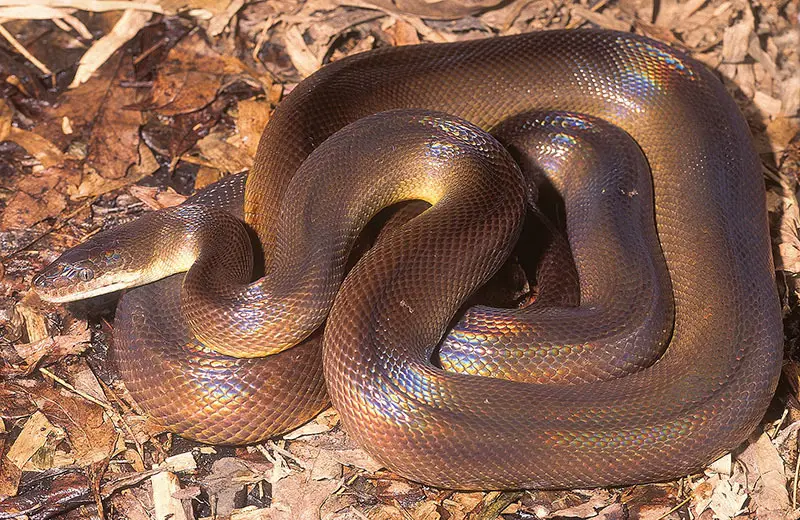
Its closest relative, from northern Australia and Papua New Guinea. Carmichael found it to be the sister lineage of the Macklot's python group. Bulian described the water python as plain olive-brown with a bright yellow belly, a smaller head of about 1.6 in (4 cm), and adults of only about 5.6-6.6 ft (1.7-2 m).
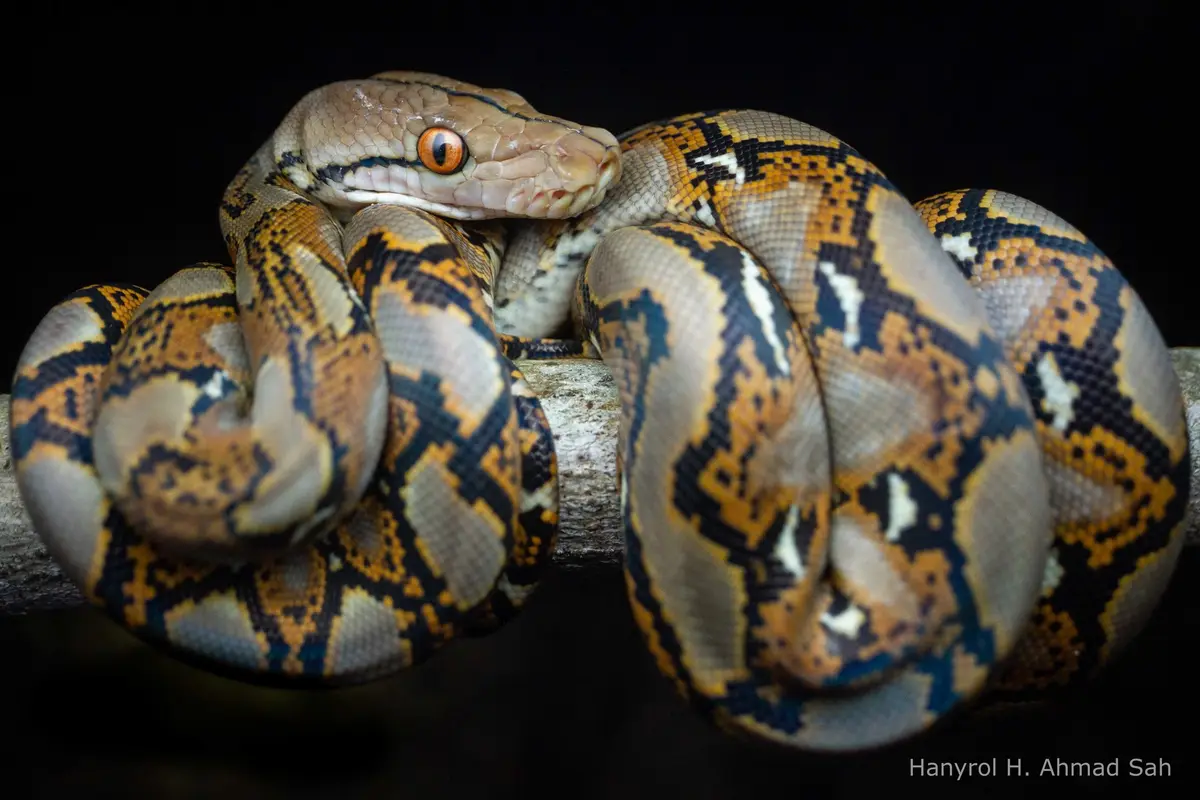
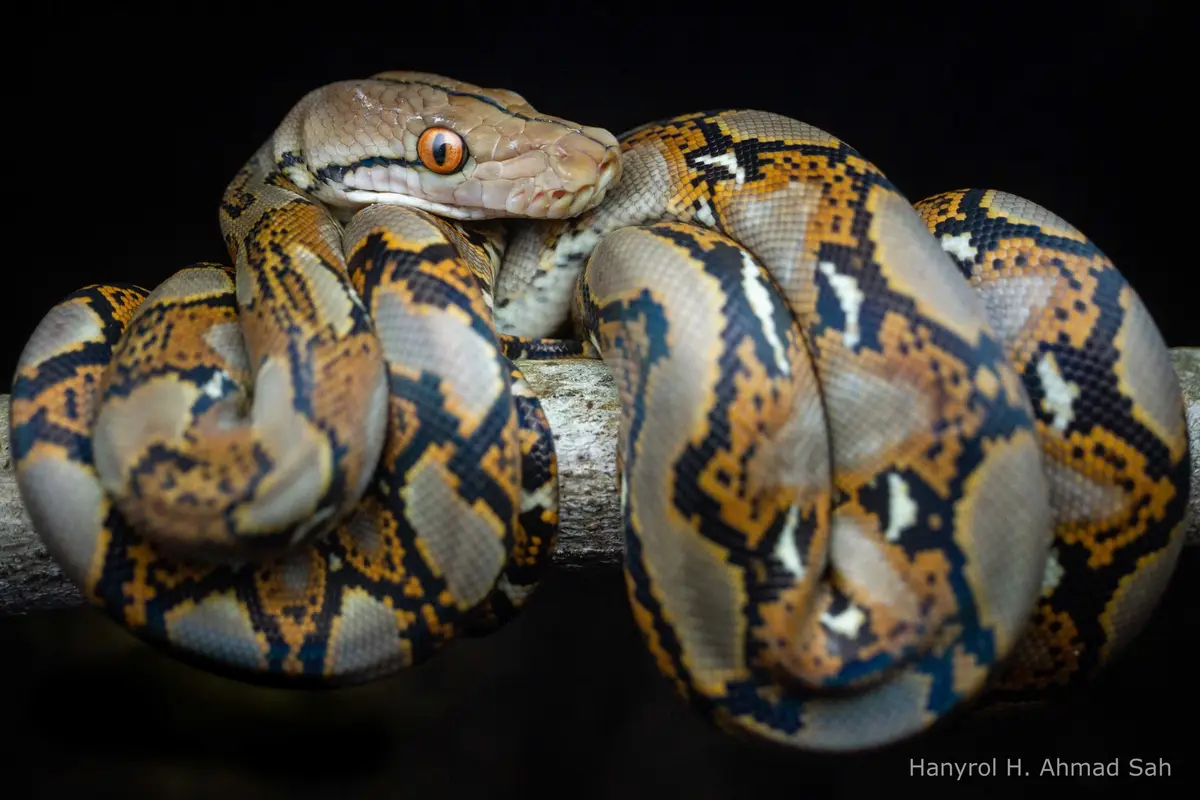
Reticulated python
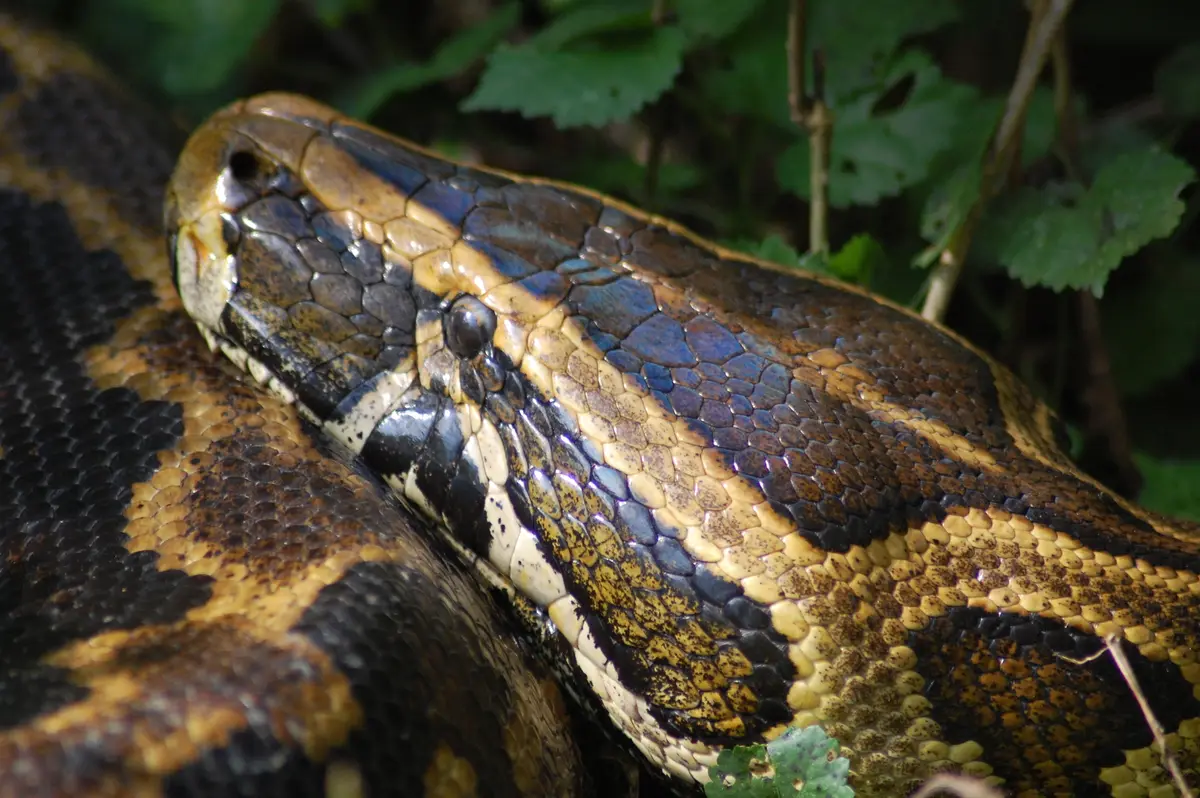
Malayopython reticulatus · Non-venomous; very large adults can be dangerous
Also found on Timor, according to the Reptile Database. The reticulated python has a bold net of black, gold and gray markings, not fine freckles, and grows far larger.
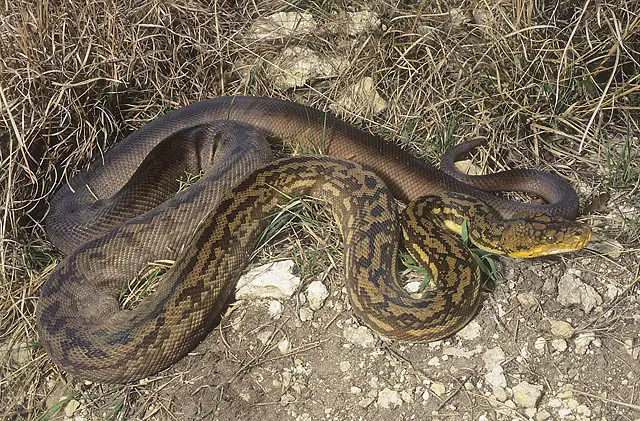
Timor python
Malayopython timoriensis · Harmless
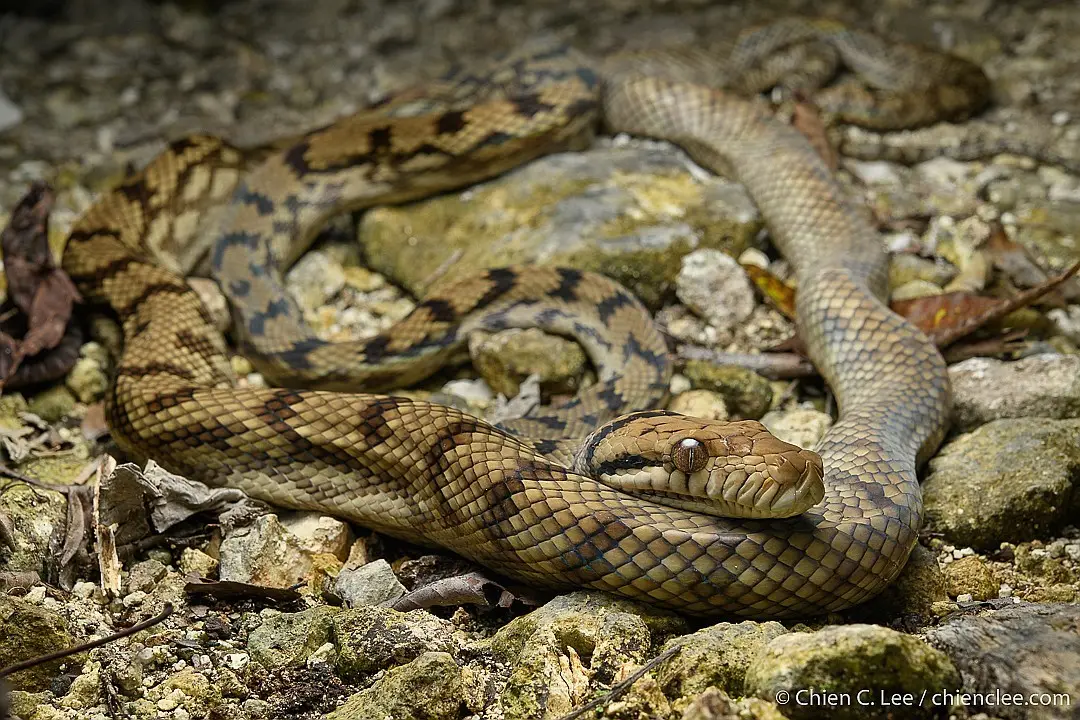
Despite its name, the Reptile Database lists it from Flores and Lembata and calls records from Timor doubtful, so a python found on Timor is very unlikely to be this one.
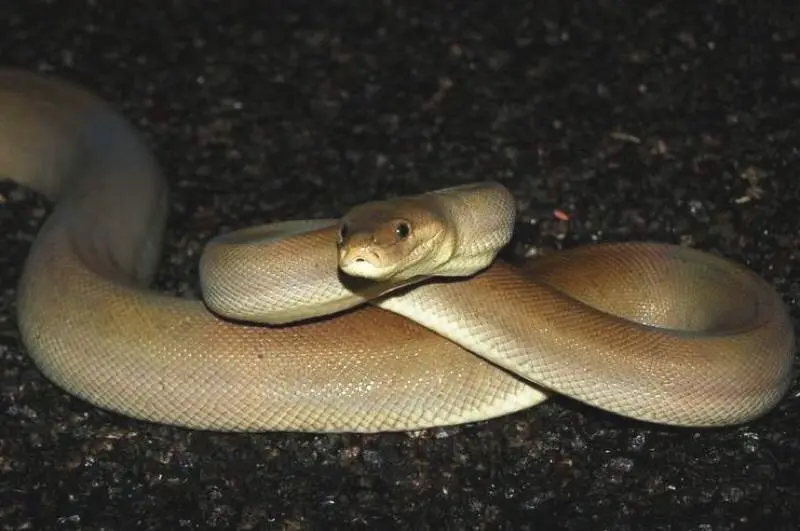
Olive python
Liasis olivaceus · Harmless
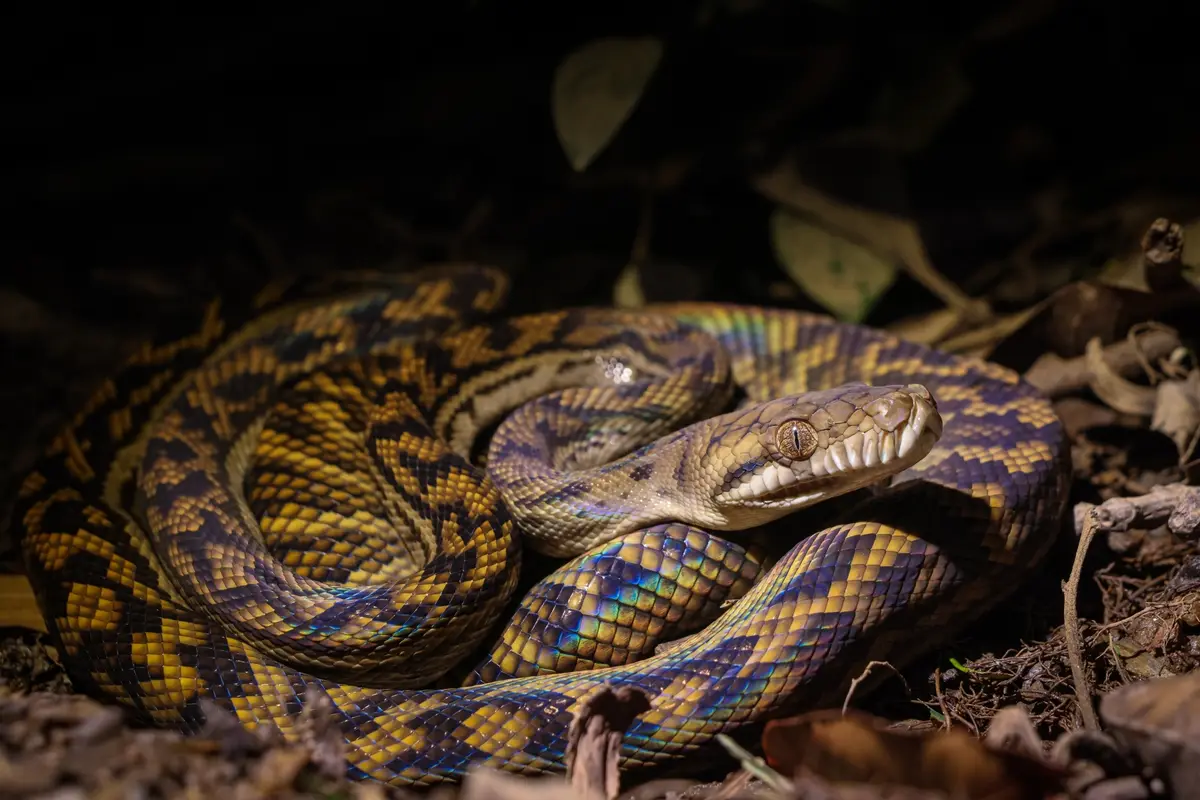
A larger Australian relative in the same genus. The olive python is plain olive to brown, without freckles, and does not live in the Lesser Sundas.
Reproduction and lifespan
Macklot's pythons lay eggs, and the female coils around them and shivers her muscles to warm them. In Bulian's colony, mating took place from late December to the end of February and eggs were laid between late February and late April. Clutches there ranged from 8 to 25 eggs, and the very large female reported by Swaak laid 26 and 27.
Fertile eggs averaged about 2.4 by 1.6 in (6 by 4 cm) and weighed 1.8-2.8 oz (50-80 g). At an average of 31 C (88 F), most clutches hatched after about 75-90 days in Bulian's incubator. Other breeders he cites report 56-77 days at different temperatures. Males matured at 3-4 years and females at 4-5.
No reliable lifespan figure for wild Macklot's pythons has been published.
Is Macklot's python endangered?
No. The IUCN Red List rates Liasis mackloti as Least Concern in a 2021 assessment by Evy Arida, Graeme Gillespie and Sean Reilly (IUCN Red List entry). Like nearly all pythons it is on CITES Appendix II, so international trade needs permits.
| Authority | Status |
|---|---|
| IUCN Red List | Least Concern (2021) |
| CITES | Appendix II |
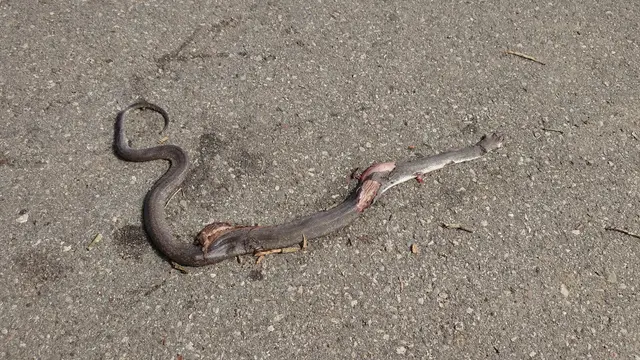
Road deaths are the most visible threat: in Timor-Leste, most of O'Shea's records were wet-season road kills.
One species or three?
The Reptile Database still lists three subspecies, but some authors treat the Wetar and Savu forms as full species, Liasis dunni and Liasis savuensis. Carmichael's work supports that view: the three forms differ in DNA, scales and courtship, and in breeding trials they did not readily interbreed. The species is named for Heinrich Christian Macklot (1799-1832), a taxidermist. Larger Asian relatives include the blood python and Indian python.
Macklot's python FAQ
Is Macklot's python venomous?
No. Macklot's python has no venom. Like all pythons, it kills its prey by constriction, coiling around it and squeezing. A bite from its sharp, curved teeth can bleed, so clean it well with soap and water and check your tetanus protection. If you are bitten by a snake you cannot identify, treat it as venomous and get medical help.
How big does a Macklot's python get?
Most adults are about 6-8 feet (1.8-2.5 m) long, and females grow larger than males. Breeder Joachim Bulian recorded a 7.9 ft male weighing 7.1 lb (3.2 kg) and an 8.3 ft female weighing 11.2 lb (5.1 kg). The largest female he cites was 9.3 ft (2.85 m) and about 20 lb (9 kg).
Where does Macklot's python come from?
It comes from Timor and nearby islands in the Lesser Sundas, split between Indonesia and Timor-Leste. The Reptile Database lists Timor, Semau, Roti, Alor, Savu and Wetar. In Timor-Leste it lives in low, wet country near the coast: rice paddies, overgrown creeks and mangrove swamps, where it hides in crab burrows by day.
Are Macklot's pythons aggressive?
Young ones often are. Bulian found hatchlings extremely aggressive in their first months, biting at any movement and even eating their clutchmates. Adults in his long-term colony were usually calm, though some stayed snappy. Like any python, an adult that is grabbed or cornered may bite to defend itself.
What is the difference between Macklot's python and a water python?
They are close relatives, and the water python, Liasis fuscus, was once counted as the same species. The water python lives in northern Australia and Papua New Guinea, is plain olive-brown with a bright yellow belly, and stays smaller. Macklot's python lives on Timor and nearby islands and has pale freckles on a darker body.
Is the Savu python the same as Macklot's python?
It is usually listed as a subspecies, Liasis mackloti savuensis, found only on Savu Island in Indonesia. It stays much smaller than the Timor form and has a different head pattern. Genetic and breeding studies by Carmichael (2007) show clear differences, and some authors treat it as a separate species, Liasis savuensis.
Related snakes
Sources
- Reptile Database: Liasis mackloti Dumeril and Bibron, 1844
- Arida, Gillespie and Reilly (2021). Liasis mackloti. IUCN Red List of Threatened Species
- Bulian, J. (1994). Ten years of breeding Liasis mackloti mackloti. Litteratura Serpentium 14(2): 46-56
- Carmichael, C. K. (2007). Phylogeography of the Indonesian water python, Liasis mackloti ssp. PhD dissertation, University of Southern Mississippi
- O'Shea and colleagues (2015). Herpetological diversity of Timor-Leste: updates and a review of species distributions. Asian Herpetological Research 6(2): 73-131
- Reptile Database: Liasis fuscus (water python)
- Reptile Database: Malayopython timoriensis (Timor python)