BLOODPYTHON
Python brongersmai · Family Pythonidae
KEY TAKEAWAYS
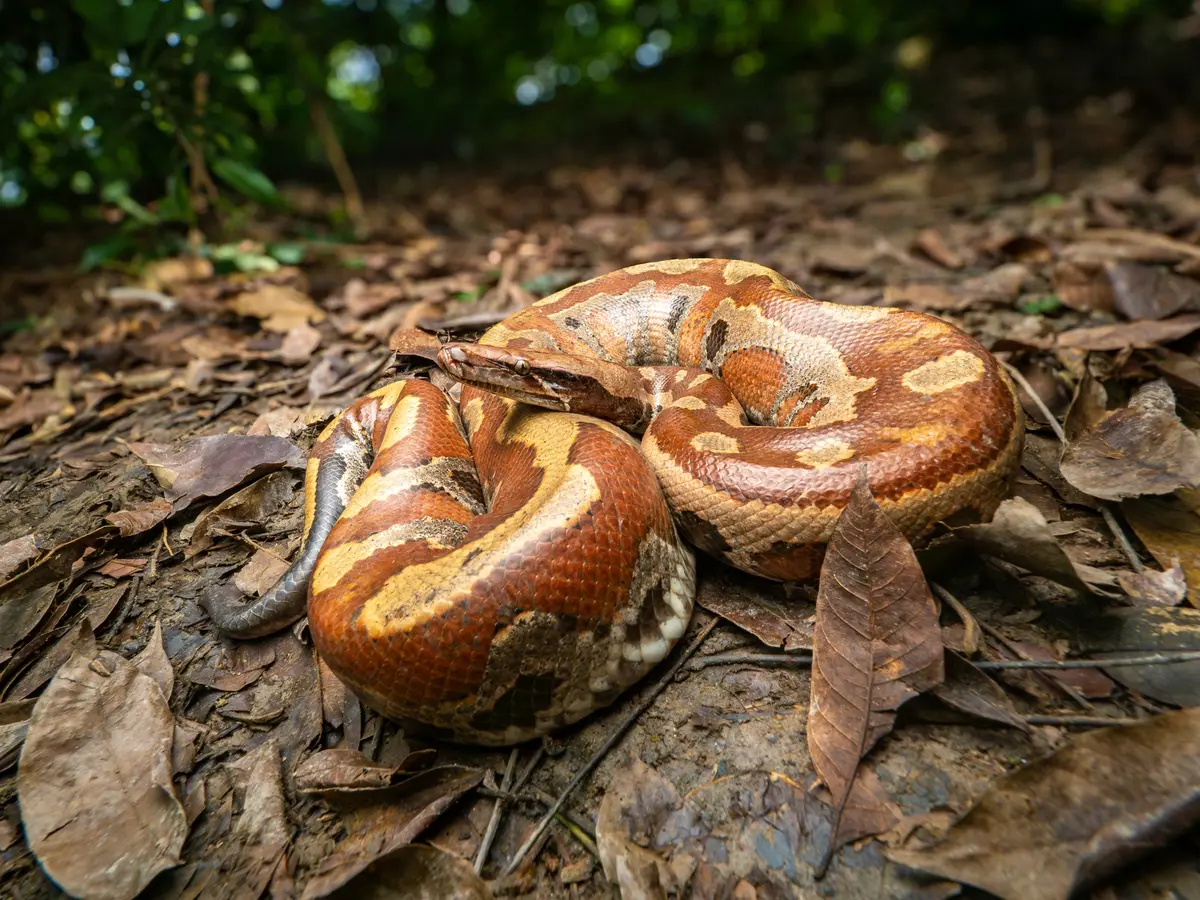
The blood python is a non-venomous Southeast Asian python with a very thick body, a short tail and, in many adults, a deep red color. It lives in swamps, paddies and plantations in eastern Sumatra, Peninsular Malaysia and southern Thailand. It is not dangerous to people, but a wild adult defends itself hard and its bite is painful.
- Adults are usually 4-6 ft (1.2-1.8 m) long, and the species reaches about 8.5 ft (2.6 m). A 5 ft snake can weigh around 17 lb (8 kg).
- It is not venomous. It kills rats and other prey by constriction, like the Burmese python.
- Not every blood python is red. Adults range from red and orange to yellow, tan and dark brown, and hatchlings are often dull brown.
- Hundreds of thousands are caught in Sumatra for the leather trade, and researchers disagree on whether that harvest is sustainable.
Blood python quick facts
| Common name | Blood python (also red blood python, Malaysian blood python, Sumatran blood python) |
|---|---|
| Scientific name | Python brongersmai Stull, 1938 |
| Family | Pythonidae (pythons) |
| Venomous | No, a constrictor |
| Adult length | Usually 4-6 ft (1.2-1.8 m); maximum about 8.5 ft (2.6 m) |
| Weight | Typically 10-15 lb (4.5-7 kg); large adults over 20 lb (9 kg) |
| Range | Eastern Sumatra and nearby islands, Peninsular Malaysia, southern Thailand; also listed from Vietnam |
| Habitat | Swamps, marshes, rice paddies, ditches, fish farms and oil palm plantations |
| Diet | Almost entirely rodents; occasional birds |
| Reproduction | Lays eggs, usually about 12-16 per clutch |
| Lifespan | About 20 years in captivity |
| Conservation | IUCN Least Concern; CITES Appendix II |
How to identify a blood python
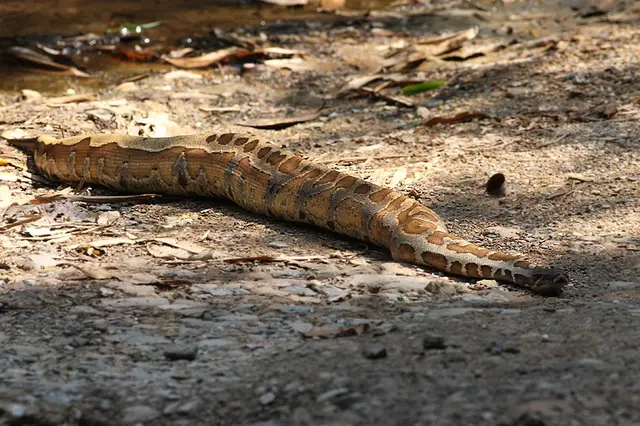
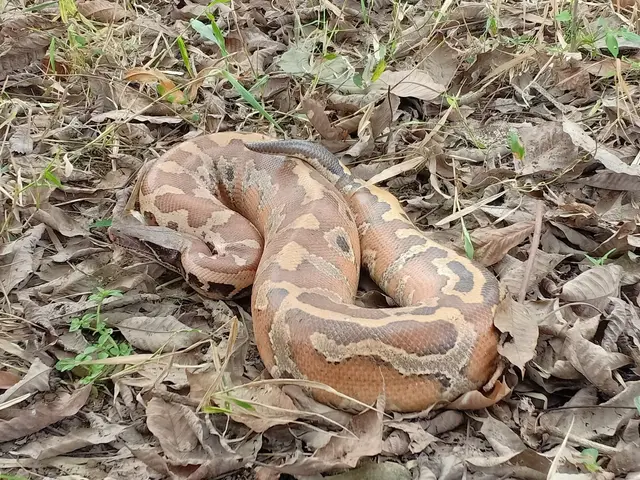
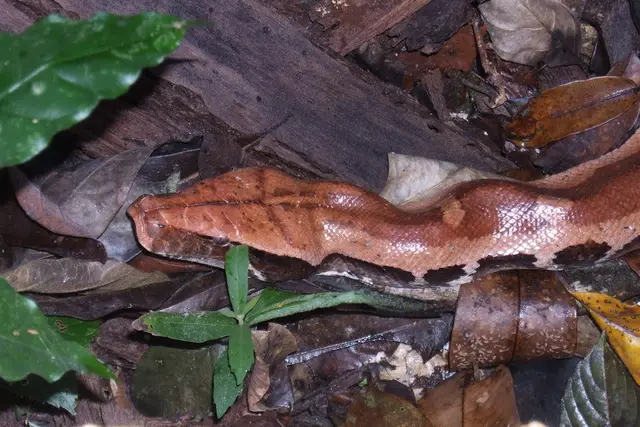
Body shape gives a blood python away before color does. It is short and very thick, with almost no neck and a tail that narrows suddenly to a stub. The head is broad and flat. Thailand Snakes describes the ground color as brick red, reddish brown or ochre, with darker brown blotches along the body and a whitish or pale yellow belly.
- 1Short, heavy body: far thicker for its length than most snakes, so it looks almost like a short log.
- 2Stubby tail: short and abruptly tapering, the feature behind the group's other name, short-tailed pythons.
- 3Red, orange, yellow or brown: a background color that varies from snake to snake, crossed by tan and dark blotches and stripes. Only this species of short-tailed python has red or orange forms.
- 4Broad, grey-toned head: flat and wide, often greyish. Keogh and colleagues (2001) note two upper lip scales reaching each eye, where the other short-tailed pythons have one.
- 5Pale belly: white to pale yellow, sometimes with small dark marks.
Young snakes can be confusing. According to breeder Kara Norris writing for Reptiles Magazine, hatchlings are often a dull ruddy brown or tan, and full red color can take two to three years to come in.
How big do blood pythons get?
Most adult blood pythons are 4 to 6 feet (1.2 to 1.8 m) long. Thailand Snakes gives 1.2 to 1.8 m with occasional snakes reaching 2 m. A 2001 study of the group by J. Scott Keogh, David Barker and Richard Shine in the Biological Journal of the Linnean Society gives the maximum as about 2.6 m (8.5 ft), larger than the roughly 2 m reached by the other two short-tailed pythons.
Length undersells this snake. It is heavy for its size: Thailand Snakes notes that a 1.5 m (5 ft) blood python can weigh about 8 kg (17.6 lb). Reptiles Magazine puts captive adults at 10 to 15 lb on average, with older snakes passing 20 lb. Females grow larger than males and mature at a larger size, according to a study of more than 2,000 wild snakes from Sumatra by Shine and colleagues (1999).
| Life stage | Length | Weight | Source |
|---|---|---|---|
| Hatchling | About 8-12 in (20-30 cm) | Not given | Reptiles Magazine, Thailand Snakes |
| Typical adult | 4-6 ft (1.2-1.8 m) | 10-15 lb (4.5-7 kg) | Thailand Snakes, Reptiles Magazine |
| Largest recorded | About 8.5 ft (2.6 m) | Over 20 lb (9 kg) | Keogh, Barker and Shine (2001); Reptiles Magazine |
For scale, the ball python is a similar length at 3-5 ft but much lighter. A large blood python is a mid-sized snake with the weight of a much longer one.
Where do blood pythons live?
Short answer: in Southeast Asia, mainly eastern Sumatra and the Malay Peninsula. The Reptile Database lists it from Sumatra, West (Peninsular) Malaysia, Thailand and Vietnam. In Sumatra it lives east of the central mountains, and it also occurs on nearby islands such as Bangka and the islands of the Strait of Malacca.
In Thailand it is a southern snake. Thailand Snakes reports it mainly south of about Surat Thani, with the strongest populations in Yala, Pattani, Narathiwat and Songkhla. Vincent Nijman's 2022 review in Nature Conservation points out that its exact range inside Sumatra is still unclear. Western and southern Sumatra belong to a different species, the Sumatran short-tailed python. Compare its range with other pythons on the world snake map.
Habitat
Blood pythons live in wet, flat lowland country. Thailand Snakes lists peat swamps, rice paddies, drainage ditches, fish farms and the edges of slow rivers, and calls it a wetland snake rather than a forest snake.
Farmland suits it. Shine and colleagues (1999) wrote that clearing for oil palm plantations has increased blood python numbers in north Sumatra, since plantations are full of rats. A follow-up study by Daniel Natusch and colleagues in the Journal of Wildlife Management (2020) found that most blood pythons in the trade are now caught in oil palm plantations, which makes them easy to target.
Are blood pythons aggressive?
Wild adults often are, at least when cornered. Thailand Snakes says a threatened blood python holds its ground, hisses loudly, strikes repeatedly and bites hard. It can swing its head round 180 degrees from a coil in under a second, so an apparently resting snake is not a safe one to pick up.
The reputation depends partly on origin. Reptiles Magazine reports that wild-caught adults imported from Malaysia years ago were jumpy and unpredictable, while most imports since about 2013 have come from Sumatra and are calmer. Captive-bred blood pythons raised with regular handling are usually much easier to manage, though they still hiss.
Blood pythons are ambush hunters and are most active at dusk and night. By day they may lie in shallow water with only the eyes above the surface, coil in floating plants, or retreat into burrows when the weather is hot and dry.
What do blood pythons eat?
Blood pythons eat rodents, and not much else. Shine and colleagues examined 2,063 wild blood pythons collected for the leather trade in northeastern Sumatra and found they fed almost entirely on commensal rodents, meaning rats that live around farms and villages. Bigger snakes fed more often, and feeding rates changed with the season.
| Prey group | Examples | How often |
|---|---|---|
| Rodents | Rats around plantations, paddies and villages | Main prey |
| Other small mammals | Voles and similar | Occasional |
| Birds | Small birds | Occasional |
Like other pythons, it grabs prey with a fast strike, coils around it and squeezes until the animal stops breathing. Its large recurved teeth hold struggling rats in place.
Is the blood python venomous or dangerous?
No. The blood python has no venom and is not a threat to human life. It is a constrictor, and even a large adult is far too small to overpower a person.
The bite is another matter. Thailand Snakes describes an adult's bite as severe because of the long, backward-curving teeth and strong jaws, and recommends that two people handle large adults. Wash any python bite with soap and water and watch it for infection.
People sometimes assume a thick, short snake with a broad head must be a viper. That shape is a poor guide to venom on its own. Our snake venom FAQ explains the real differences. In southern Thailand and Malaysia, where venomous snakes also live in paddies and plantations, leave any unfamiliar snake alone and call a rescue team.
Blood python vs short-tailed python and other look-alikes
Until about 2000, the blood python and two close relatives were all treated as one species, Python curtus. Keogh, Barker and Shine (2001) showed with DNA and scale counts that they are three separate species. The blood python is the most distinct of them, with about 8.9% divergence in a mitochondrial gene from the other two. Breeders sometimes call the others "Borneo blood pythons" or "black blood pythons", but those names are misleading.
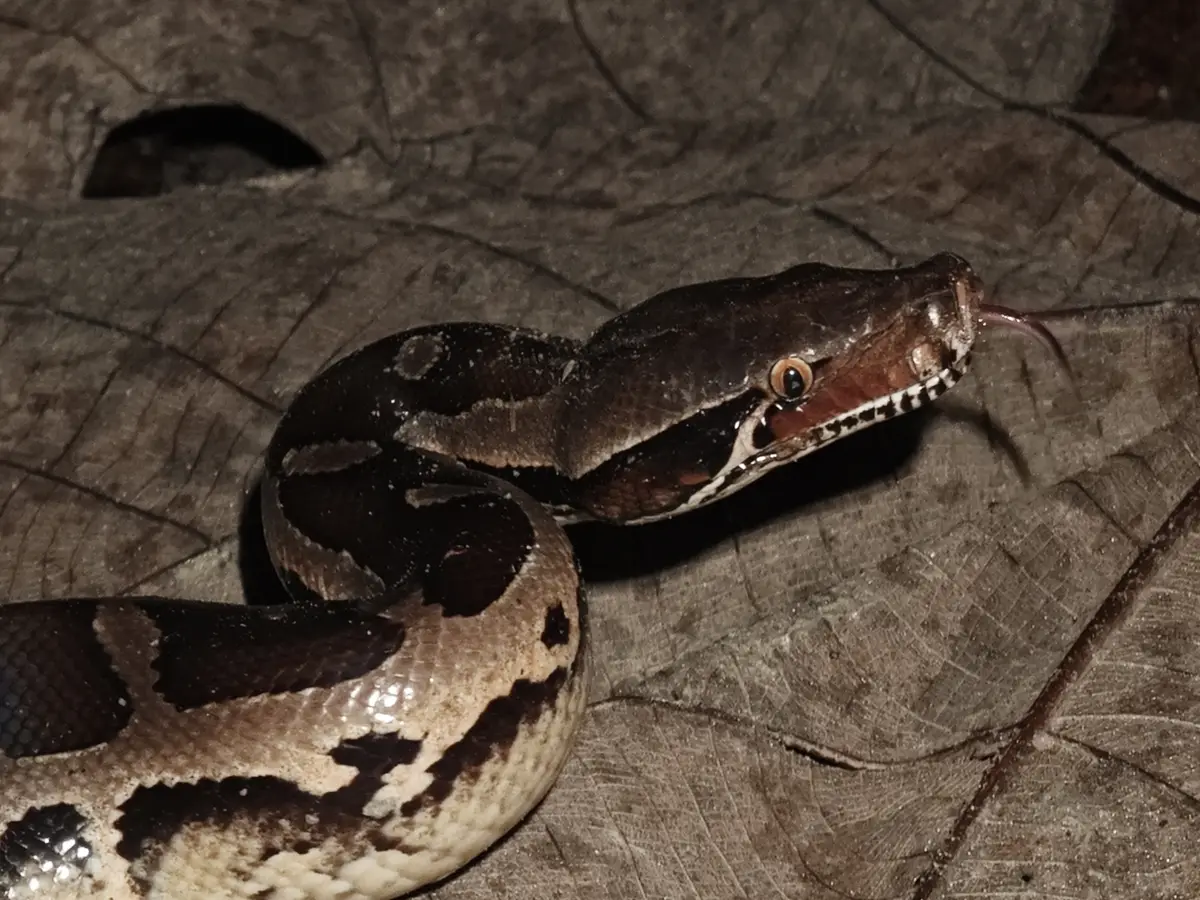
Sumatran short-tailed python
Python curtus · Harmless
Lives in western and southern Sumatra, on the other side of the mountains. Dusky brown to black, often with a grey, silver or black head, and never red. It is slightly smaller and, per Shine et al. (1999), heavier-bodied with a longer tail.
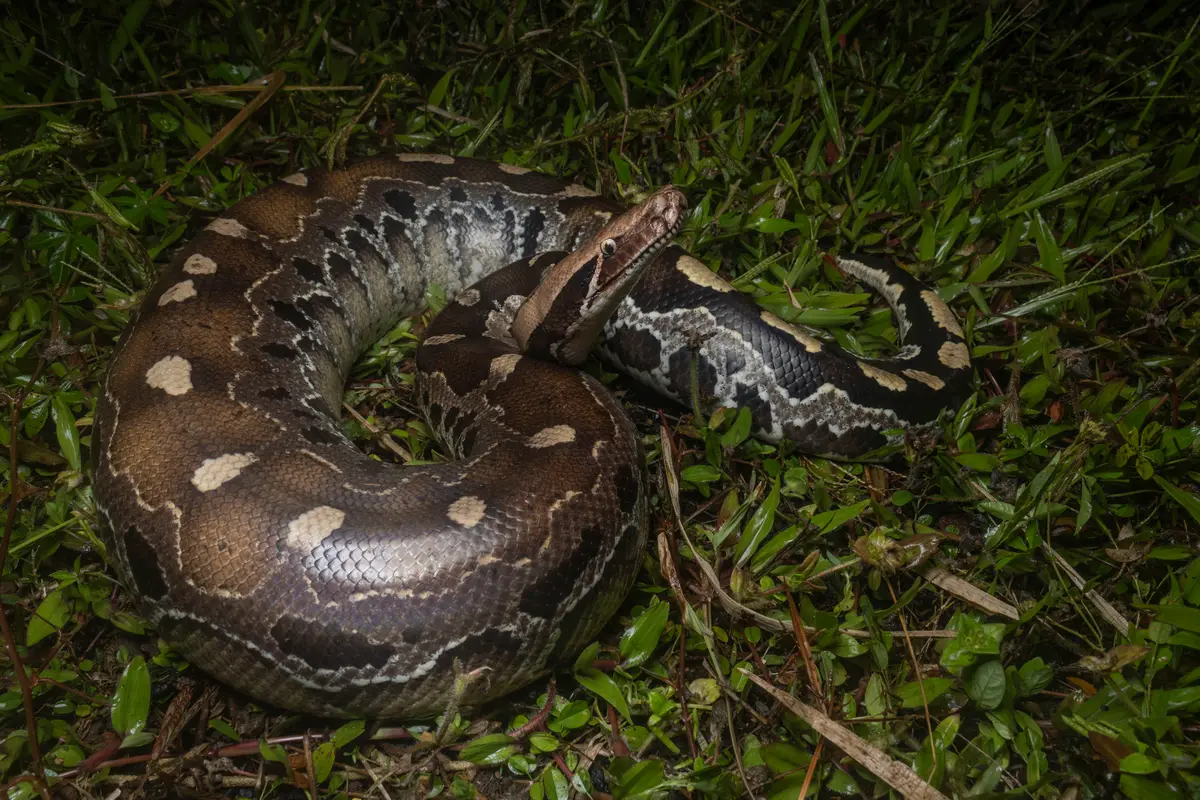
Borneo short-tailed python
Python breitensteini · Harmless
Found only on Borneo. Coffee brown to pale tan with black, white and brown markings, and no red or orange forms. Its ventral scale count is under 166, while the blood python has more than 166, a difference Keogh and colleagues say can identify even dried skins.
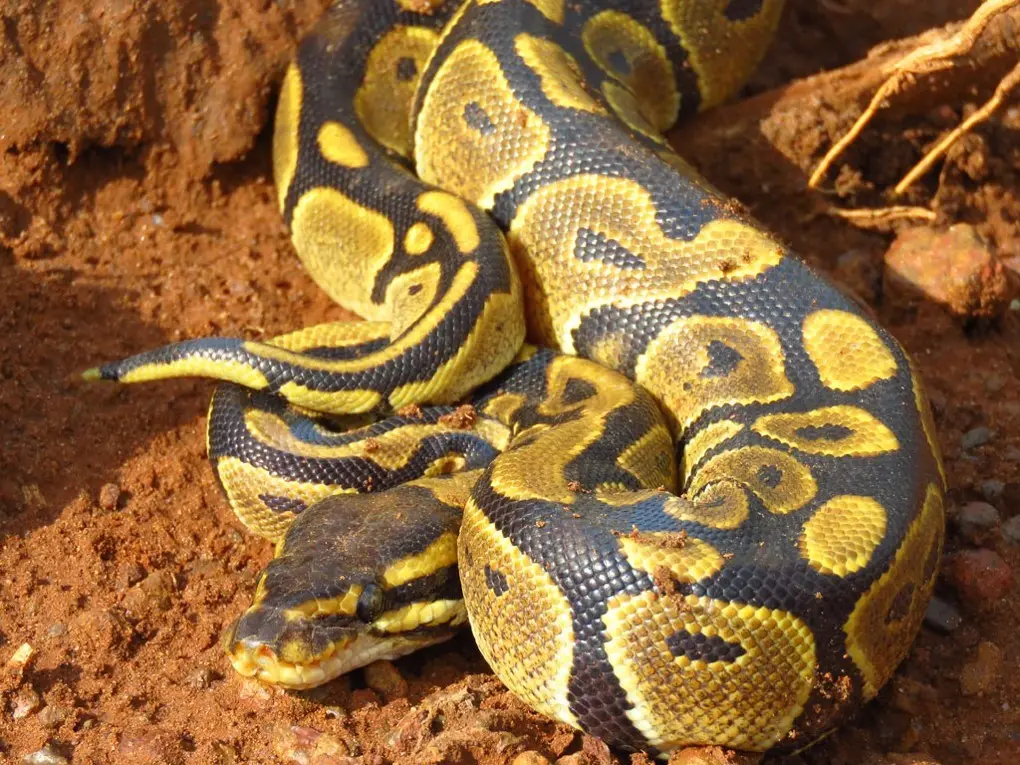
Ball python
Python regius · Harmless
An African relative common in the pet trade. The ball python is also short and stocky but slimmer, black to dark brown with tan blotches, and is never wild in Asia.
Reproduction and lifespan
Blood pythons lay eggs. In north Sumatra, Shine and colleagues (1999) found that breeding is strongly seasonal and that adult females breed about every other year. The average clutch was 12 to 16 eggs, and the eggs are large, averaging 83 to 90 g (about 3 oz) each. Thailand Snakes gives a wider range of 12 to 30 eggs.
The female coils around her eggs and twitches her muscles to warm them, keeping them 1 to 2 C (2 to 4 F) above the surrounding air, according to Thailand Snakes. In southern Thailand the young hatch from April to June at about 30 cm (1 ft) long.
How long do blood pythons live?
Captive blood pythons can live about 20 years, according to longevity records compiled by Frank and Kate Slavens (2003). Wild lifespan is not well known, and many wild snakes are caught for the skin trade long before old age.
Is the blood python endangered?
No, it is not listed as threatened. The IUCN Red List rates the blood python Least Concern. Like all pythons it is on CITES Appendix II, which means international trade needs permits but is allowed.
| Authority | Status |
|---|---|
| IUCN Red List | Least Concern |
| CITES | Appendix II (trade regulated by permit) |
| Indonesian law | Not protected; harvest set by annual quota |
The big issue is the leather trade. Keogh, Barker and Shine (2001) estimated that more than 100,000 short-tailed and blood pythons are taken from Sumatra and Borneo every year. Natusch and colleagues (2020) put the number of blood pythons taken from Indonesia at about 900,000 over 18 years, with roughly 35% from North Sumatra. Comparing surveys from 1996-1997 and 2014-2015, they found later snakes were thinner, matured at smaller sizes, bred less often and laid smaller clutches for their size, changes they linked mainly to harvesting.
Not everyone reads the numbers the same way. Nijman (2022), reported by Mongabay, found no conclusive evidence that the harvest is sustainable and evidence that much of the trade is misdeclared or illegal, including skins re-exported from Singapore labeled as coming from Laos, where the species does not occur. In Thailand, Thailand Snakes reports illegal collecting and the loss of swamps to oil palm, with local declines in Yala and Narathiwat.
Blood python FAQ
Is the blood python venomous?
No. The blood python has no venom and kills its prey by constriction. It can still give a painful bite with long, backward-curving teeth, and wild adults often strike when cornered. Wash any bite with soap and water and watch it for signs of infection. It is not a danger to human life.
Why is it called a blood python?
The name comes from the deep red color of many adults. It is the only one of the three short-tailed python species with red or orange forms. Not every blood python is red, though: adults range from red and orange to yellow, tan and dark brown, and hatchlings are often dull brown, with full red color taking two to three years to develop.
What is a red blood python?
A red blood python is a blood python (Python brongersmai) with bright red coloring. It is the same species, not a separate snake. Red snakes occur in the wild alongside orange, yellow and brown ones, and breeders have also selected captive lines for strong red color. Red is the color the species was named for.
How big do blood pythons get?
Most adults are 4 to 6 feet (1.2 to 1.8 m) long, and the largest reach about 8.5 feet (2.6 m). They are very heavy for their length. Adults usually weigh 10 to 15 pounds, some pass 20 pounds, and a 5 ft snake can weigh around 17 pounds (8 kg). Females grow larger than males.
Are blood pythons aggressive?
Wild adults can be. A cornered blood python hisses, strikes repeatedly and bites hard. Wild-caught snakes from Malaysia earned the species a bad name, while Sumatran imports and captive-bred snakes are generally calmer. Captive-bred blood pythons that are handled gently and regularly usually settle down, but most still hiss when first picked up.
Where do blood pythons live in the wild?
Blood pythons live in Southeast Asia: eastern Sumatra and nearby islands, Peninsular Malaysia and southern Thailand, and the Reptile Database also lists Vietnam. They live in swamps, marshes, rice paddies, ditches and oil palm plantations, usually in wet lowland country where rats are plentiful.
What is the difference between a blood python and a short-tailed python?
They are close relatives but separate species. The blood python lives in eastern Sumatra and the Malay Peninsula and can be red or orange. The Sumatran short-tailed python lives in western and southern Sumatra and the Borneo short-tailed python on Borneo, and neither has red forms. The blood python also grows larger, to about 8.5 ft.
Related snakes
Sources
- Reptile Database: Python brongersmai
- Keogh, Barker and Shine (2001). Systematics and biogeography of commercially harvested pythons (Python curtus group). Biological Journal of the Linnean Society 73: 113-129
- Shine et al. (1999). Ecological attributes of two commercially-harvested python species in northern Sumatra. Journal of Herpetology 33(2)
- Natusch et al. (2020). Harvest effects on blood pythons in North Sumatra. Journal of Wildlife Management 84(2): 249-255
- Mongabay (2022): Study casts doubt on sustainability of regulated blood python snakeskin trade (Nijman, Nature Conservation 48: 99-121)
- Thailand Snakes: Blood python in southern Thailand
- Reptiles Magazine: Blood and short-tailed python care sheet
- iNaturalist: Python brongersmai (photos, observations)