BURMESEPYTHON
Python bivittatus · Family Pythonidae
KEY TAKEAWAYS
The Burmese python is a giant, non-venomous constrictor from Southeast Asia and one of the largest of the world's pythons. Since the 1980s it has also lived wild in southern Florida, where it is an invasive species that eats native mammals, birds and even alligators. Wild Burmese pythons very rarely harm people.
- Adults usually measure 10-16 ft (3-4.9 m). The longest documented in Florida was a 19 ft (5.8 m) female caught in 2023.
- It is not venomous. It kills prey by constriction, and no person has been killed by a wild Burmese python in Florida.
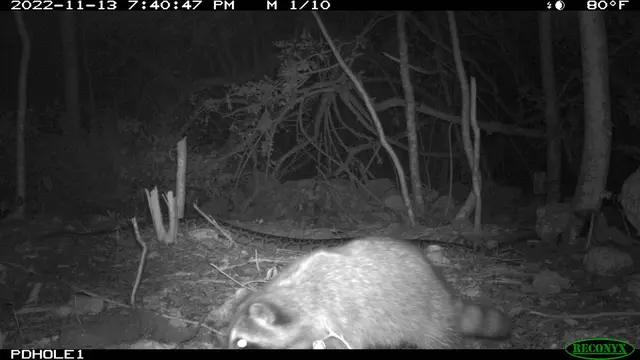
- Pythons in Florida have eaten at least 76 prey species, and their spread lines up with steep drops in raccoons, opossums and rabbits in Everglades National Park.
- In its native Asia the species is listed as Vulnerable on the IUCN Red List because of hunting for skins, food and medicine.
Burmese python quick facts
| Common names | Burmese python, Burmese rock python |
|---|---|
| Scientific name | Python bivittatus Kuhl, 1820 (often treated as Python molurus bivittatus) |
| Family | Pythonidae (pythons) |
| Venomous | No, a constrictor |
| Adult length | Usually 10-16 ft (3-4.9 m); Florida record 19 ft (5.8 m) |
| Weight | Large females 132-214 lb (60-97 kg); Florida record 215 lb (98 kg) |
| Native range | Southeast Asia, from southeastern Nepal and India to southern China and Indonesia |
| Introduced range | Southern Florida, USA, including Everglades National Park and Key Largo |
| Habitat | Forest, grassland, swamp and marsh, usually near water |
| Diet | Mammals, birds and some reptiles, from cotton rats to deer and alligators |
| Reproduction | Lays eggs; average clutch about 34 in Florida wild nests, up to about 100 |
| Lifespan | 20-25 years in human care; captive records over 30 years |
| Conservation | IUCN Vulnerable (native range); invasive and Prohibited in Florida |
How to identify a Burmese python
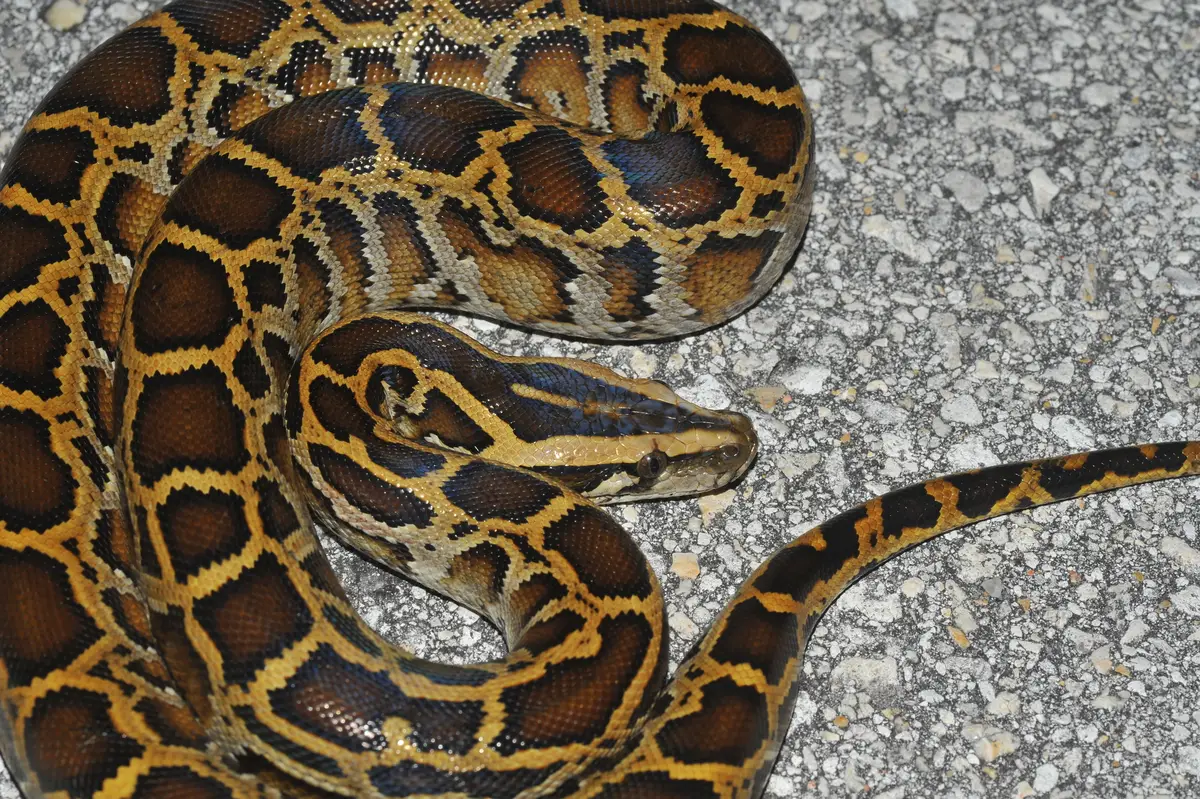
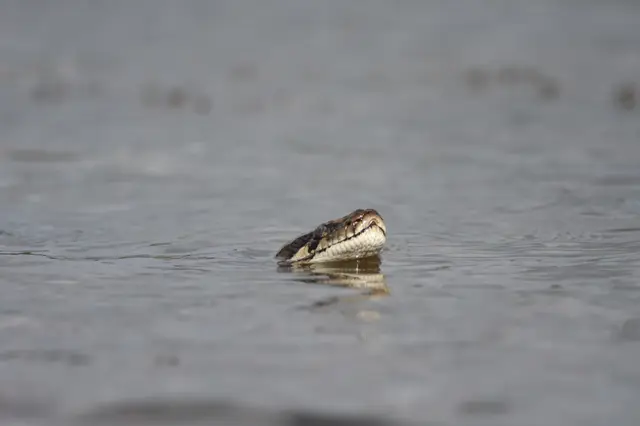
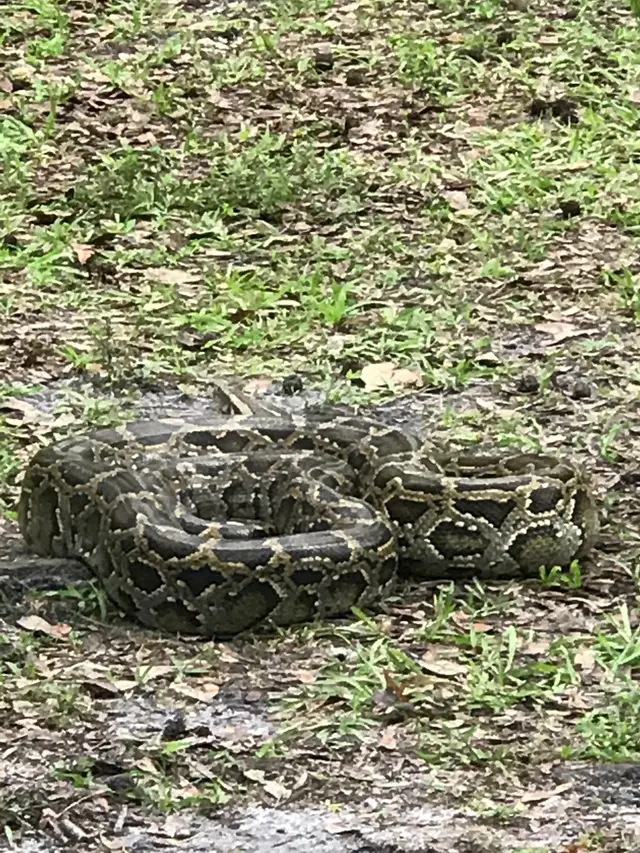
A Burmese python is a very large, heavy snake with a tan to light brown body covered in big, dark-edged brown blotches, like giraffe spots. The best single clue is the dark, spear-shaped mark on top of the head. Young pythons look like small copies of the adults.
- 1Size and build: thick and muscular. Even a hatchling is 12-18 in (31-46 cm) long, usually longer than the newborns of even Florida's largest native snakes, according to the USGS-led python synthesis.
- 2Body pattern: brown blotches bordered in black along the back and sides, separated by tan or golden skin.
- 3Head spearhead: a dark triangular spearhead on top of the head, running forward to the snout.
- 4Eye stripe: a pale line runs back from below the eye, and a small scale sits just under the eye (the subocular scale).
- 5Belly: white and unpatterned in the middle, edged with black spots.
How big do Burmese pythons get?
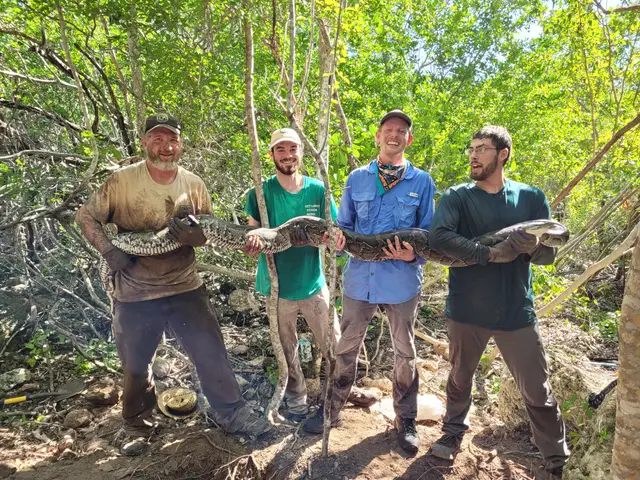
Most adult Burmese pythons are 10 to 16 feet (3 to 4.9 m) long, and lengths over 15 feet (4.6 m) are common, according to the Smithsonian's National Zoo. Claims of snakes over 20 feet exist, but the zoo calls them unverified. It is far heavier for its length than slimmer giants such as the reticulated python, though the green anaconda of South America outweighs both.
Females are much bigger than males. In Florida the heaviest females weigh nearly twice as much as the largest males, about 187 lb (85 kg) against 97 lb (44 kg), as the 2023 synthesis in NeoBiota reports. Young pythons grow fast, up to 2.8 in (7.2 cm) a month in their first year.
| Life stage or record | Length | Weight |
|---|---|---|
| Hatchling | 12-18 in (31-46 cm) | A few ounces |
| Typical adult | 10-16 ft (3-4.9 m) | Varies widely with sex and condition |
| Largest Florida females | 16.4-19.7 ft (5-6 m) | 132-214 lb (60-97 kg) |
| Longest documented in Florida (July 2023) | 19 ft (5.8 m) | 125 lb (57 kg) |
| Heaviest removed from Florida (2021) | 17.7 ft (5.4 m) | 215 lb (98 kg) |
The 19 ft female was caught in Big Cypress National Preserve and measured by the Conservancy of Southwest Florida, beating the previous Florida record of 18 ft 9 in, NBC News reported. The heaviest, a 215 lb female, carried 122 developing eggs.
Where do Burmese pythons live?
Short answer: Burmese pythons are native to southern and Southeast Asia and have an invasive wild population in southern Florida. The Reptile Database lists the native range as southeastern Nepal, India, southern Bhutan, Bangladesh, Myanmar, Thailand, Laos, Cambodia, Vietnam and southern China, plus the Indonesian islands of Java, Bali and Sulawesi. Older records from Sumatra and Borneo are thought to be misidentifications.
Burmese pythons in Florida
A road-killed Burmese python 11.7 ft (3.58 m) long was found on US-41 at the northern edge of Everglades National Park in 1979. For years such finds were treated as escaped or released pets. Biologists confirmed a breeding population in the park around 2000, and the snakes probably began reproducing there in the 1980s, according to the USGS.
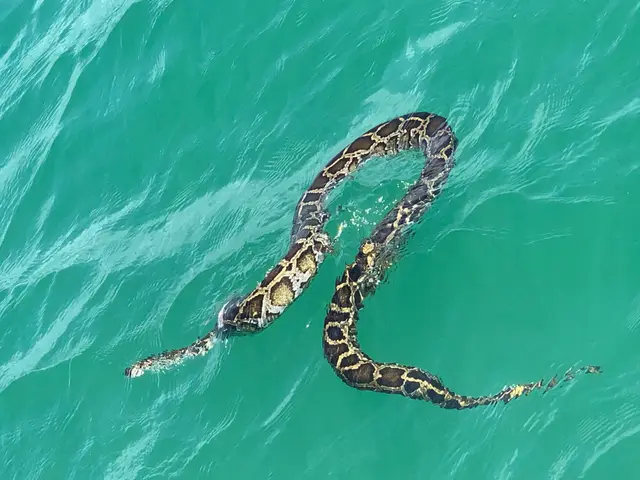
By 2019-2021 the population covered roughly 11,500 sq mi (29,900 km2) of southern Florida, west toward Naples and north to Palm Beach County near Lake Okeechobee. Pythons are established on Key Largo and have been seen swimming up to 15.5 mi (25 km) from the mainland. Cold limits their spread north: many died in a severe cold snap in January 2010, though plenty survived. Compare this range with other giant snakes on the world snake map.
Habitat
In Asia, Burmese pythons live in rainforest, grassland, swamp, marsh and rocky foothills, usually near water. Animal Diversity Web notes that they are rarely found far from water and can stay under water for up to 30 minutes without breathing.
In Florida they use marsh, forested wetland, pine uplands, mangrove islands, farmland and the western edge of Miami. Much of this land floods for part of the year and is hard to reach on foot.
Behavior
Burmese pythons are slow, secretive ambush hunters. They spend long periods lying still under cover and can go weeks between meals. They are strong swimmers and move easily between land and water. In cool weather they bask in the morning sun to warm up, and after a large meal a python may stay put for days or weeks while it digests.
They are also very hard to see. The USGS synthesis rates their chance of being detected as essentially zero away from the few places people can search, and most pythons removed in Florida are found within about half a mile (1 km) of a road.
What do Burmese pythons eat?
Burmese pythons eat almost any bird or mammal they can overpower, plus some reptiles. A python seizes prey with its teeth, wraps coils around it and squeezes until it dies, then swallows it whole. In Florida, a USGS diet study of 1,716 pythons collected from 1995 to 2020 found 76 prey species.
| Prey group | Examples in Florida | Notes |
|---|---|---|
| Rodents | Hispid cotton rat, black rat, cotton mouse, round-tailed muskrat | Most numerous prey; cotton rats and black rats alone were 45% of identified items |
| Larger mammals | Raccoon, opossum, marsh rabbit, bobcat, white-tailed deer, wild pig | Fewer in number but a large share of what pythons eat by weight |
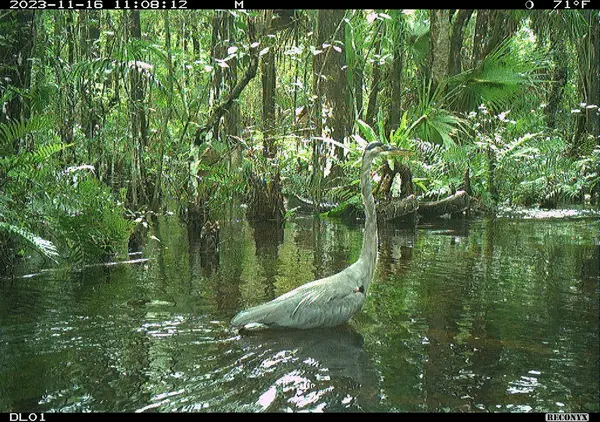
| Birds | Great blue heron, other wading birds and songbirds | Many species, mostly wading birds |
| Reptiles | American alligator, green iguana | The only two reptiles recorded so far |
In Asia, records of big meals include deer, goats, wild boar, jackals, porcupines, peafowl, langur monkeys and even leopards.
Why are Burmese pythons a problem in the Everglades?
Burmese pythons have removed most of the medium-sized mammals from large parts of Everglades National Park. Road surveys covering 35,400 miles (56,971 km) from 2003 to 2011 found raccoon sightings down 99.3%, opossums down 98.9% and bobcats down 87.5%, and no rabbits at all. Losses were worst in the far south of the park, where pythons have lived longest (Dorcas et al. 2012, USGS).
That study showed the two trends lined up but could not prove cause. A later study that tracked radio-collared marsh rabbits gave the first direct evidence that pythons caused the rabbit losses. The USGS now says pythons have altered the food web across the Greater Everglades, and that no existing tool can wipe them out.
Few native animals can kill an adult. American alligators are the main known predator, with at least six records of alligators eating adult pythons. Bobcats, eastern indigo snakes and Florida cottonmouths kill smaller ones, and bobcats raid nests.
Is the Burmese python venomous or dangerous to humans?
No, the Burmese python is not venomous. It has teeth but no venom glands, and it kills by constriction. No person has been killed by a wild Burmese python in Florida; the few recorded deaths involved captive pythons, according to the 2023 USGS synthesis.
Wild pythons in Florida do bite, almost always when someone tries to catch them. From 2003 to 2012, Everglades National Park recorded 5 unprovoked python strikes on people, all on biologists wading through remote wetlands, and none led to constriction or serious injury. A large python's bite can still leave deep cuts, so clean it well and see a doctor if it is deep or looks infected.
Still, a python big enough to swallow a deer can injure an adult, so nobody should handle a large one alone. Our snake venom FAQ explains how venomous snakes differ from constrictors like this one.
Burmese python vs other big snakes
In Florida, almost any very large blotched snake in the wild is a Burmese python. Elsewhere, and in the pet trade, it can be confused with its close relatives and with boas. If you are not sure, take a photo from a safe distance and post it to iNaturalist.
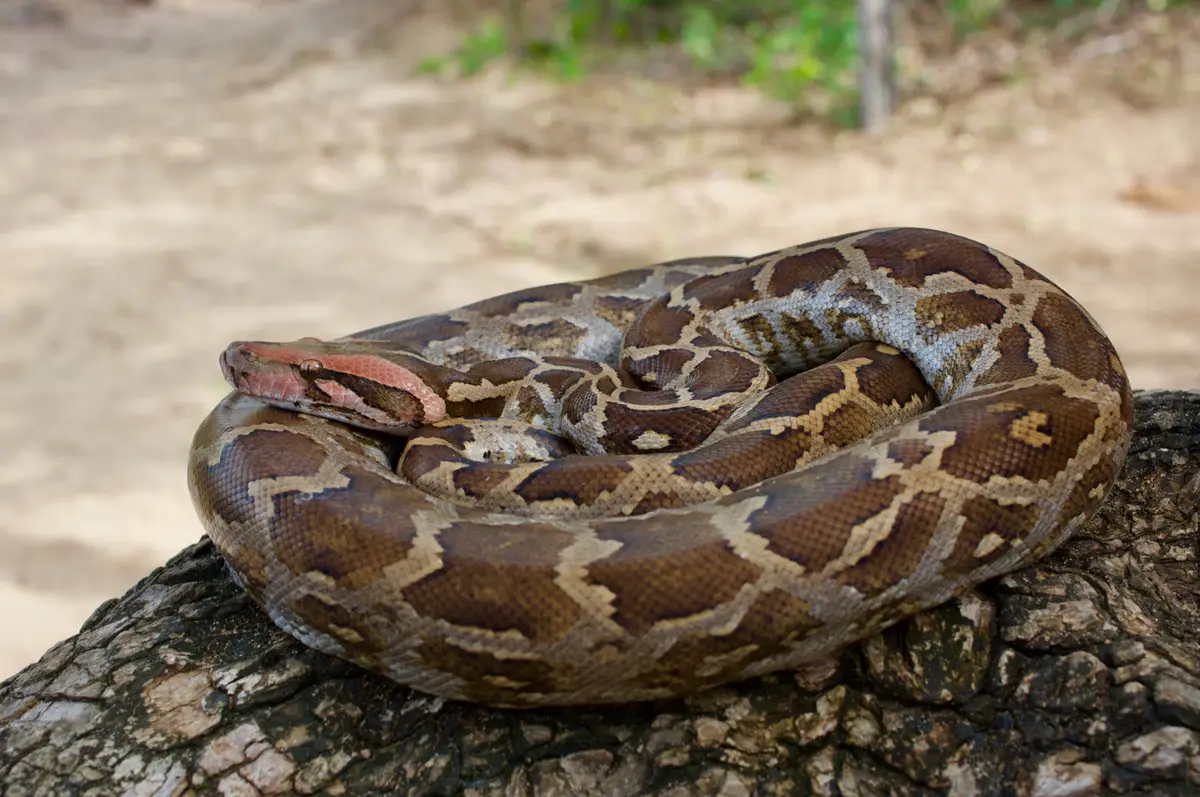
Indian python
Python molurus · Non-venomous
Its closest relative, from the Indian subcontinent, and sometimes treated as the same species. It looks very similar. One traditional difference: the Indian python lacks the small subocular scale under the eye, so a lip scale touches the eye.
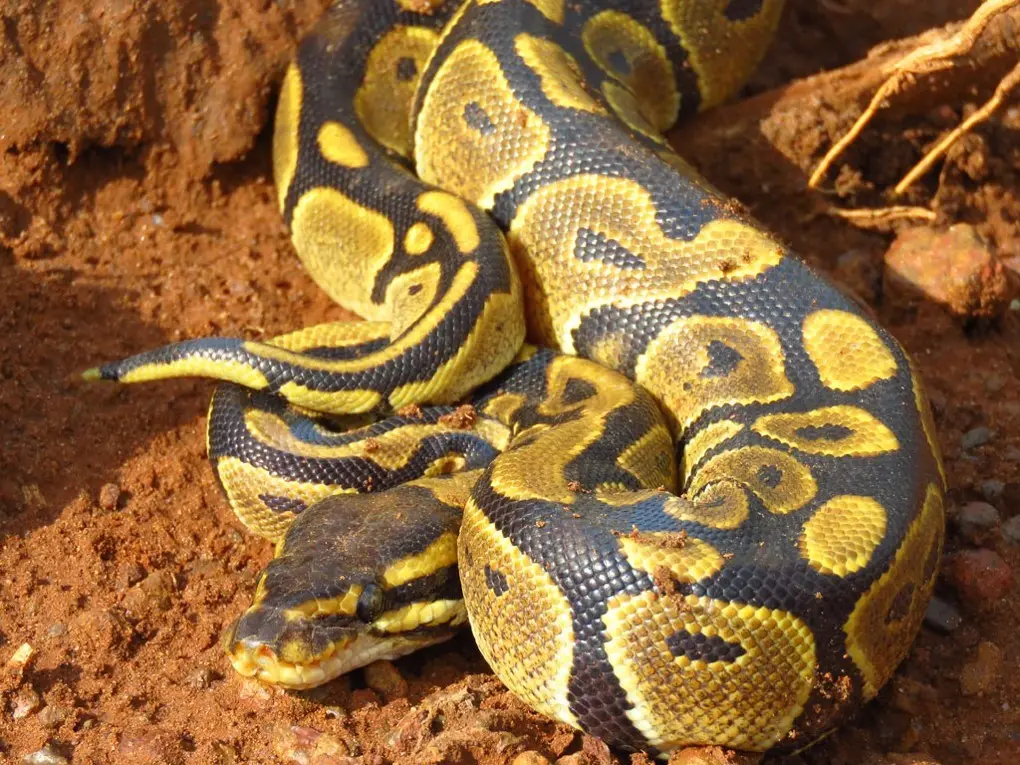
Ball python
Python regius · Harmless
An African python with a similar brown and tan pattern but a fraction of the size: adults are only 3-5 ft. See our ball python guide.
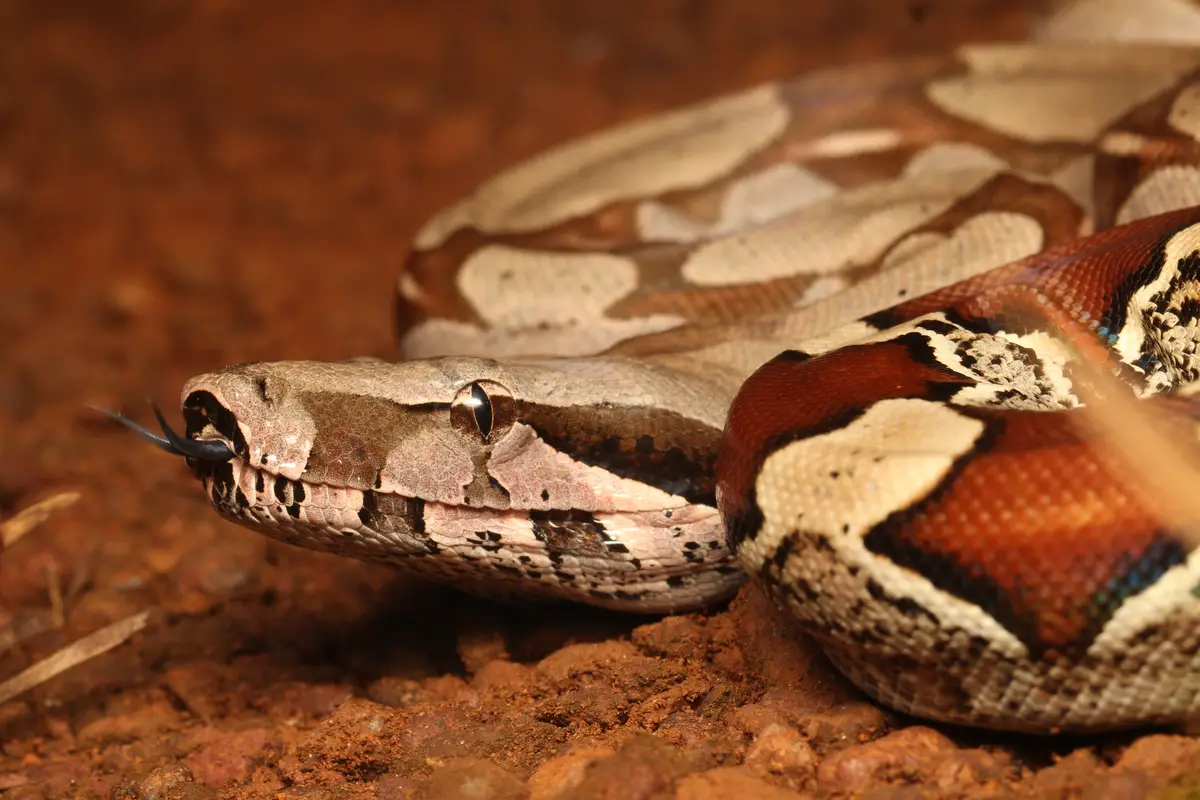
Boa constrictor
Boa constrictor · Harmless to adults
A Central and South American snake, also common as a pet. It is smaller, usually 6.5-10 ft, with saddle-shaped markings and a reddish tail, and it gives birth to live young. See our boa constrictor guide.
Reproduction and lifespan
Burmese pythons lay eggs. In Florida they mate over about 100 days from early December to mid-March, when several males may gather around one female. Females lay in late spring, and hatchlings appear in July and August. Captive eggs take 58 to 68 days to hatch.
Clutch size grows with the female. Wild nests in southern Florida average about 34 eggs, and the National Zoo gives 30 to 60 on average, with up to 100. The mother coils around her eggs for the whole incubation without feeding and can warm them by shivering, twitching her muscles to make heat.
Females in Florida mature at about 7.5 ft (230 cm) of body length, not counting the tail. The Reptile Database also notes evidence that a female can produce young without mating, a process called parthenogenesis.
How long do Burmese pythons live?
Nobody knows the wild lifespan yet. In human care they live about 20 to 25 years, and the longest captive records are 28 to 34 years. One radio-tagged male in Florida has been tracked since 2013.
Is the Burmese python endangered?
In Asia, yes, it is under threat. The IUCN Red List assesses the Burmese python as Vulnerable (2012 assessment), with an estimated decline of about 30% over ten years. Hundreds of thousands are killed each year for their skins, and others for meat and traditional medicine. In Florida, the same species is an invasive pest.
| Authority | Status |
|---|---|
| IUCN Red List | Vulnerable (2012 assessment) |
| CITES | International trade regulated |
| US Lacey Act | Injurious wildlife since March 2012; commercial imports stopped |
| Florida (FWC) | Prohibited species since April 29, 2021 |
What to do if you see a Burmese python in Florida
Report it to the Florida Fish and Wildlife Conservation Commission on the Exotic Species Hotline, 888-IVE-GOT1 (888-483-4681), or at IveGot1.org. Pythons are protected only by anti-cruelty law, so they may be humanely killed on private land with the landowner's permission and no permit, but live pythons may not be moved. FWC and South Florida Water Management District contractors, and the yearly Florida Python Challenge, remove pythons from public land.
Burmese python FAQ
Are Burmese pythons venomous?
No. Burmese pythons have no venom. They kill prey by grabbing it with their teeth and squeezing it with their coils. A bite from a large python can cause deep cuts that need cleaning and sometimes medical care, but there is no venom to treat. No person has been killed by a wild Burmese python in Florida.
How big do Burmese pythons get?
Adults usually reach 10 to 16 feet (3 to 4.9 m), and females are much larger than males. The longest documented in Florida was a 19 ft (5.8 m), 125 lb female caught in Big Cypress National Preserve in July 2023. The heaviest removed from Florida weighed 215 lb (98 kg) and was 17.7 ft long.
How did Burmese pythons get to Florida?
Through the pet trade. The first wild record was a road-killed python on US-41 in 1979, and for years such snakes were treated as escaped or released pets. A breeding population was confirmed in Everglades National Park around 2000. US imports stopped in 2012, when the species was listed as injurious wildlife under the Lacey Act.
Do Burmese pythons attack people?
Very rarely. Wild Burmese pythons in Florida usually bite only when someone tries to catch them. From 2003 to 2012, Everglades National Park recorded five unprovoked strikes, all on biologists in remote flooded wetlands, and none led to constriction or serious injury. The few known deaths from Burmese pythons involved captive snakes.
Can Burmese pythons eat alligators?
Yes. American alligators are among the 76 prey species found in the stomachs of Florida pythons. The relationship goes both ways: alligators are the main known predator of adult pythons in Florida, with at least six cases of alligators eating adult pythons and eight of them eating hatchlings on record.
Can you kill a Burmese python in Florida?
Yes. The FWC says Burmese pythons may be humanely killed on private land at any time with the landowner's permission, and no permit is needed. Because they are a Prohibited species in Florida, live pythons may not be transported. Report sightings to the Exotic Species Hotline at 888-IVE-GOT1.
Related snakes
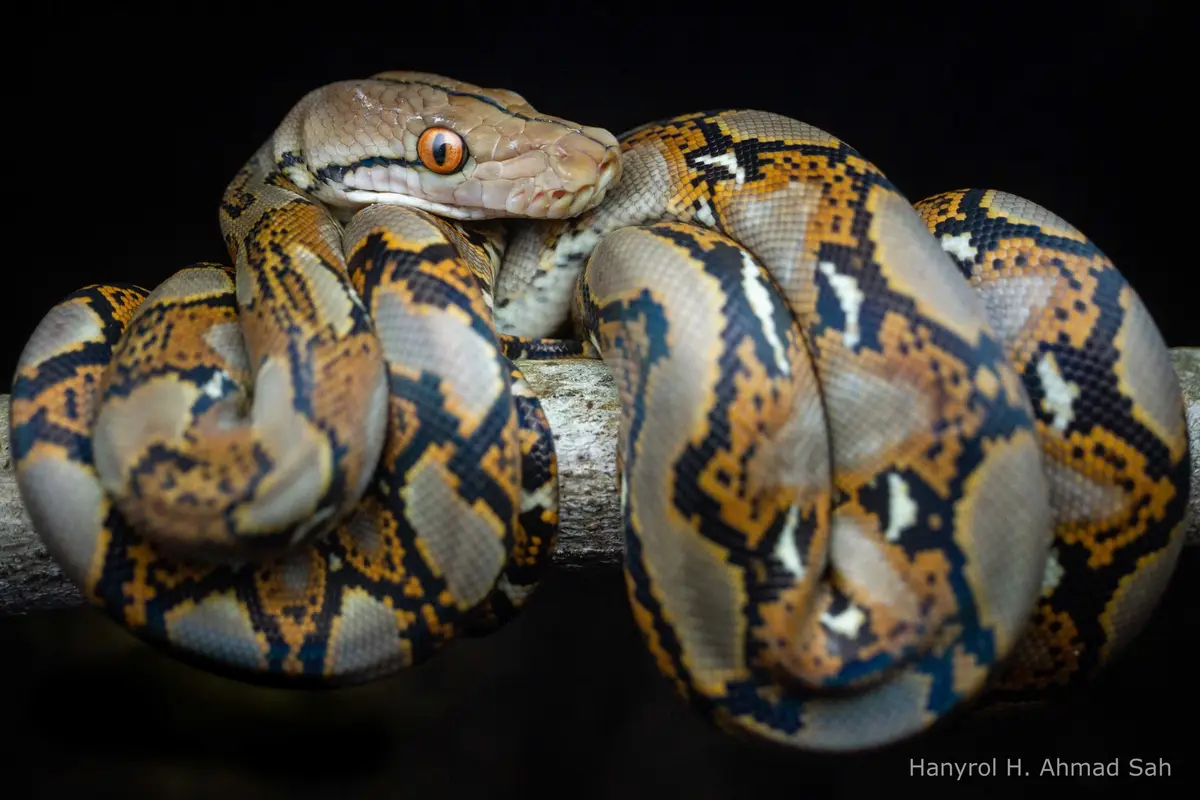
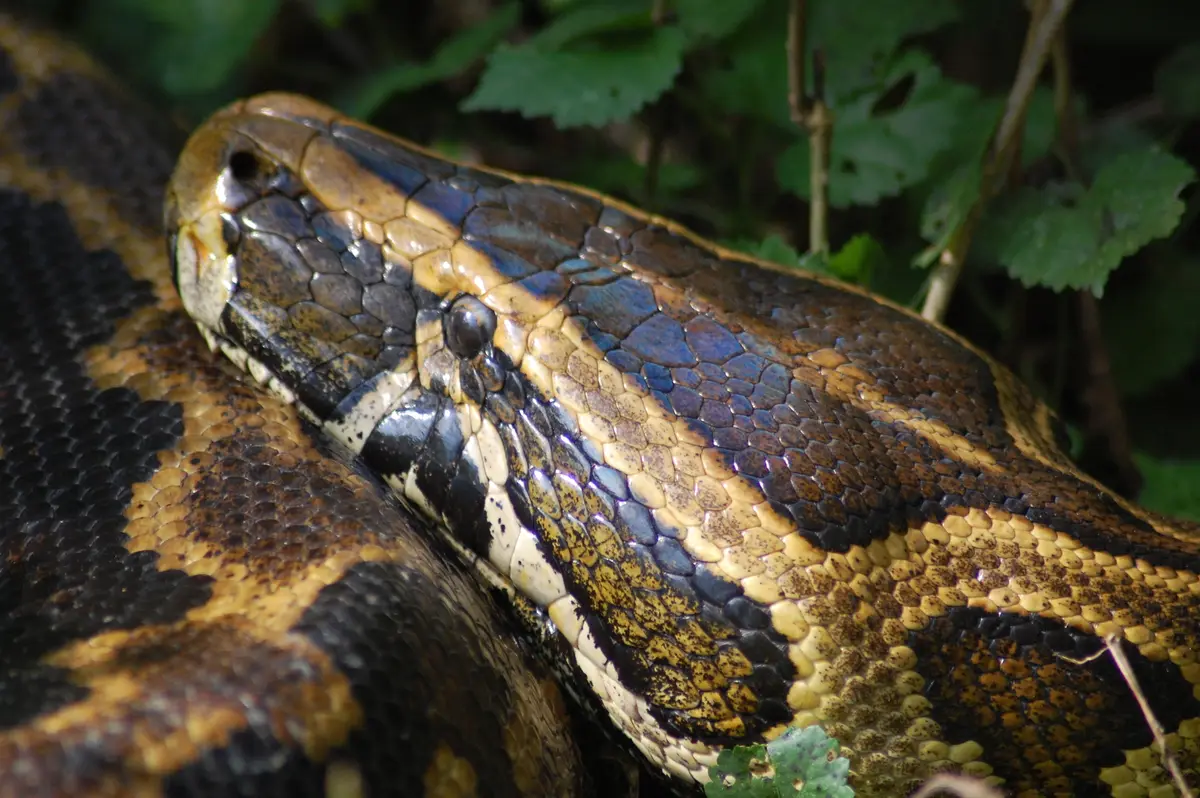
Sources
- Reptile Database: Python bivittatus
- Guzy et al. 2023, Burmese pythons in Florida: a synthesis of biology, impacts, and management tools (NeoBiota)
- USGS: Comprehensive review of Burmese python science
- Dorcas et al. 2012, Severe mammal declines coincide with proliferation of invasive Burmese pythons (USGS)
- USGS data: Diet of invasive Burmese pythons in southern Florida, 1995-2020
- Smithsonian's National Zoo: Burmese python
- Florida Fish and Wildlife Conservation Commission: Removing pythons in Florida
- iNaturalist: Python bivittatus (photos, observations)