TIMORPYTHON
Malayopython timoriensis · Family Pythonidae
KEY TAKEAWAYS
The Timor python (Malayopython timoriensis) is a slim, medium-sized, non-venomous python from the Lesser Sunda Islands of Indonesia, mainly Flores and Lembata. It is the only close relative of the reticulated python, but it is far smaller. It is not dangerous to people.
- It has no venom and kills its prey by constriction.
- Adults are usually 5-8 ft (1.5-2.4 m) long and weigh up to about 20 lb (9 kg).
- Despite the name, it is probably not found on Timor. The Reptile Database calls the Timor records doubtful.
- The IUCN Red List rates it Vulnerable (2021), mainly because of collecting for the pet trade and forest loss on Flores.
Timor python quick facts
| Common names | Timor python, Lesser Sundas python; sanca timor in Indonesian |
|---|---|
| Scientific name | Malayopython timoriensis (Peters, 1876) |
| Family | Pythonidae (pythons) |
| Closest relative | Reticulated python (Malayopython reticulatus), the only other species in the genus |
| Venomous | No, a constrictor |
| Adult length | 5-8 ft (1.5-2.4 m); females slightly larger |
| Weight | Up to about 20 lb (9 kg) |
| Range | Lesser Sunda Islands of Indonesia: Flores, Lembata (Lomblen) and the Komodo National Park area; Timor doubtful |
| Habitat | Open forest and grassland; partly arboreal |
| Diet | Rats, mice, birds and small reptiles |
| Reproduction | Lays eggs, usually about 5 per clutch |
| Conservation | IUCN Vulnerable (2021); CITES Appendix II |
How to identify a Timor python
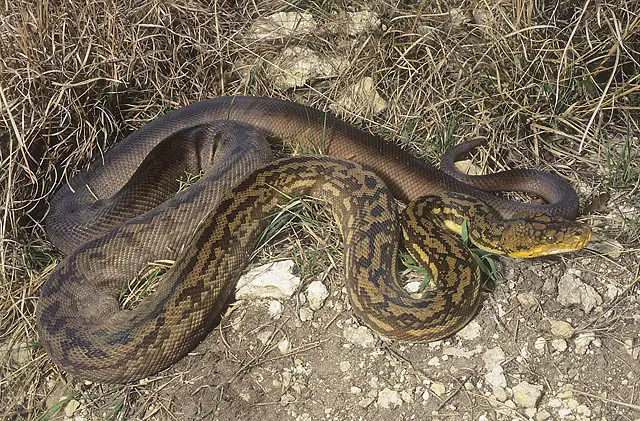
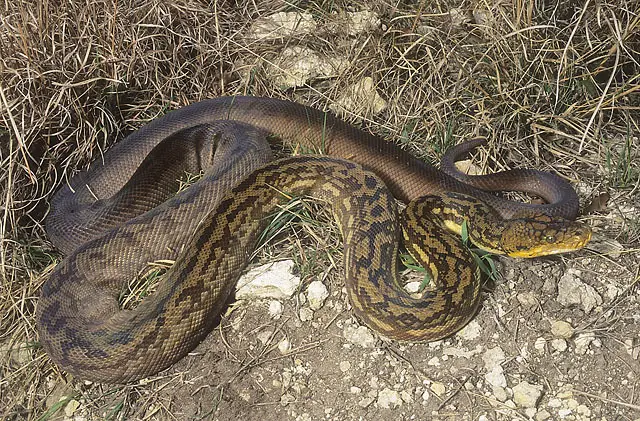
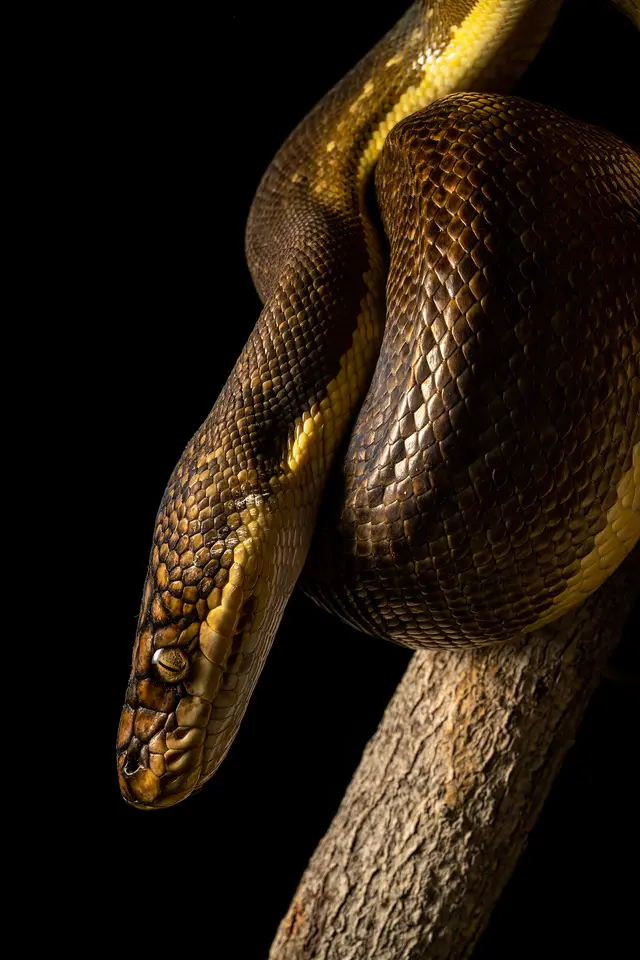
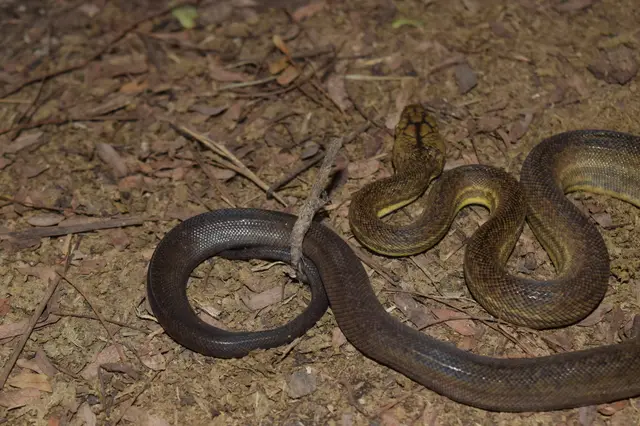
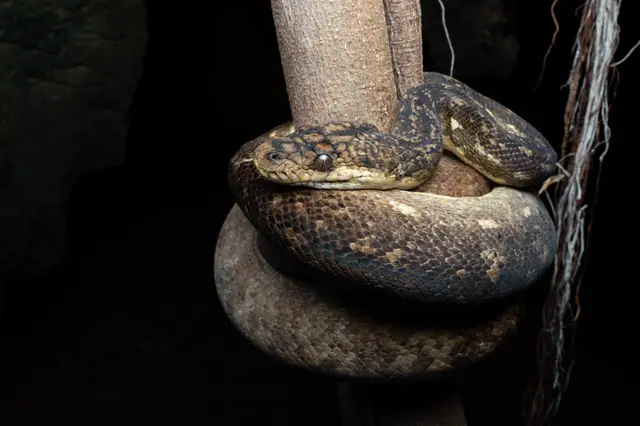
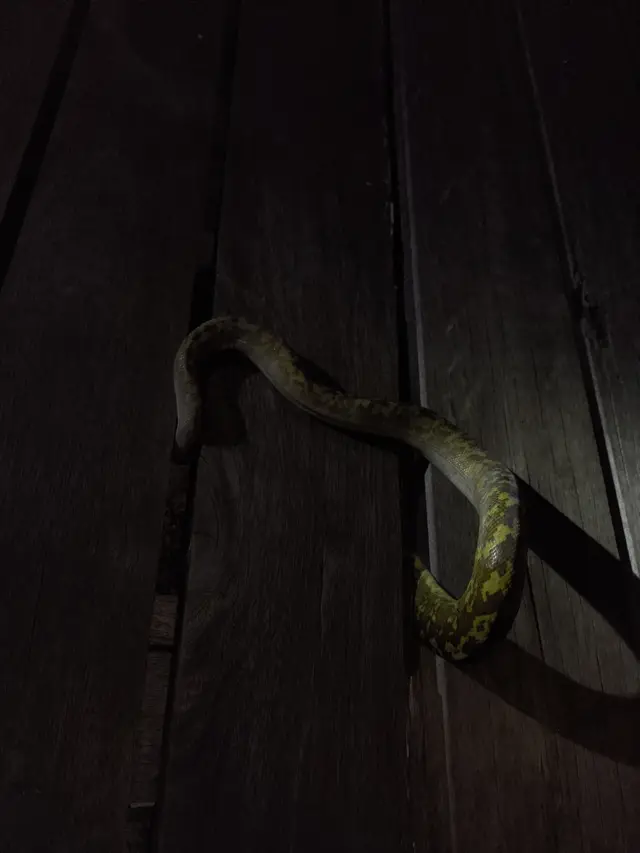
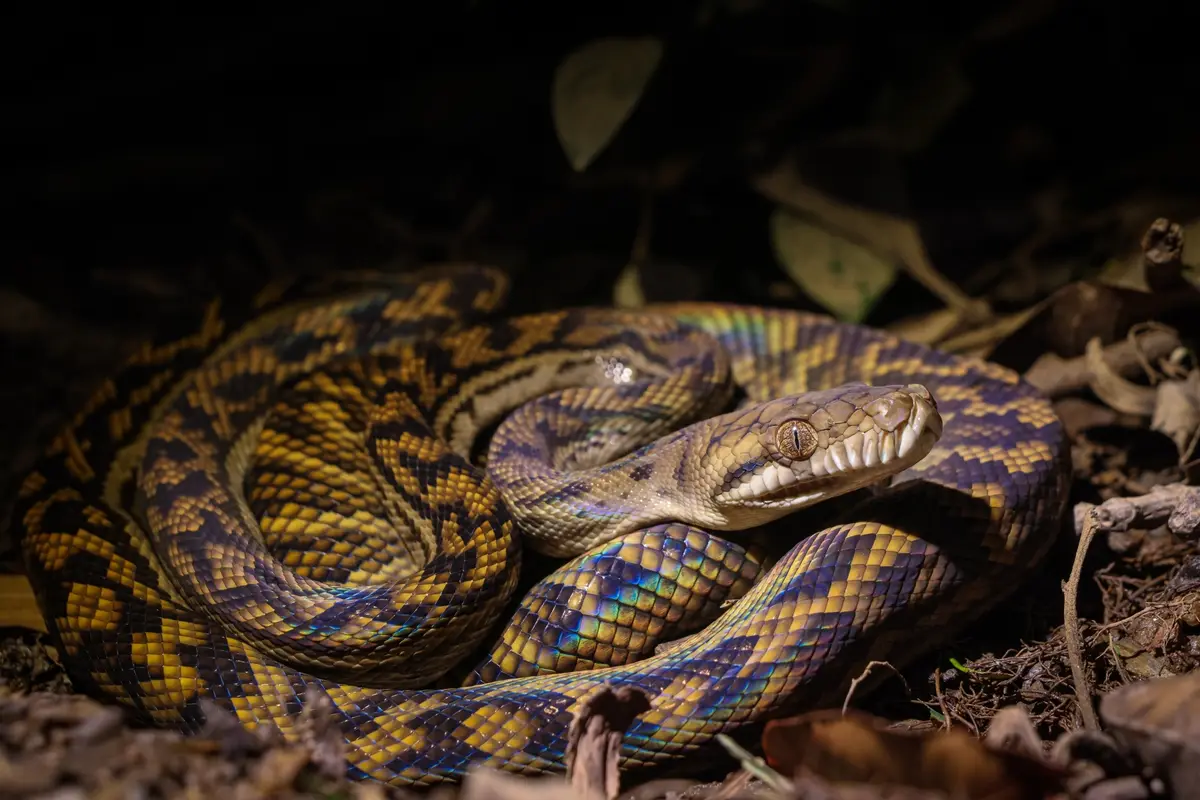
A Timor python is a long, rather thin python whose pattern fades out halfway down the body. The Smithsonian's National Zoo describes the skin as green-brown with a dark brown pattern from the head to mid-body, and the back half as plain brown. Some snakes are more yellow or orange-yellow. In sunlight the scales shine with a rainbow sheen, the same iridescence seen on its big relative, the reticulated python.
- 1Pattern on the front half only: dark brown blotches and lines on the neck and front of the body that fade toward the middle, leaving the rear half and tail plain brown.
- 2Slim body: a long, fairly slender snake for a python, not the heavy build of a Burmese python.
- 3Iridescent scales: smooth, glossy scales that flash blue and purple in direct light.
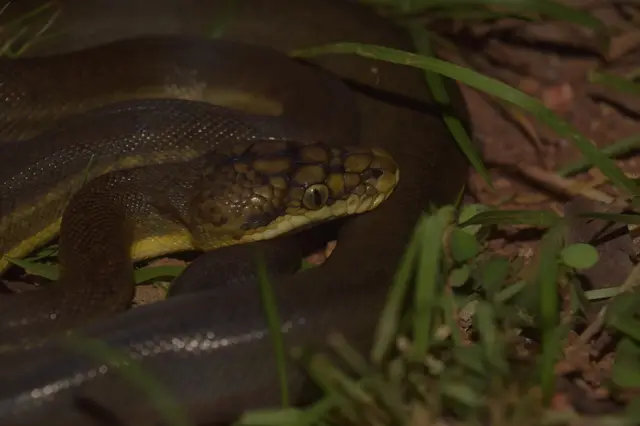
- 4Heat pits on the lips: a row of small pits in the lip scales, which pythons use to sense warm-blooded prey in the dark. Venomous vipers on Flores have a single pit between eye and nostril, or none at all, instead.
- 5Size and place: a medium python of 5-8 ft (1.5-2.4 m), seen on Flores, Lembata or the islands of Komodo National Park.
How big do Timor pythons get?
Adult Timor pythons average 5-8 ft (1.5-2.4 m) and weigh up to about 20 lb (9 kg), according to the Smithsonian's National Zoo, which keeps the species. Females are slightly larger than males. That makes it a small snake next to its sister species: the reticulated python is the world's longest snake, and the genus description in the Reptile Database gives adults of that species a reported length of up to 10 m (33 ft).
| Measure | Timor python | Reticulated python |
|---|---|---|
| Typical adult length | 5-8 ft (1.5-2.4 m) | Usually far longer; reported to 33 ft (10 m) |
| Weight | Up to about 20 lb (9 kg) | Many times heavier |
| Build | Slim | Long and heavy-bodied in big adults |
No reliable record length from the wild has been published. Treat claims of Timor pythons much longer than 8 ft (2.4 m) with caution, since a long, slim python on Flores could also be a young reticulated python.
Where do Timor pythons live?
Short answer: on Flores and Lembata in Indonesia's Lesser Sunda Islands, and on the islands at the western tip of Flores. The Reptile Database lists Flores and Lomblen (the old name for Lembata), and marks Timor with a question mark, citing Schleip and O'Shea (2010), who considered the Timor reports doubtful.
Most recent photos come from one corner of the range. Of the 14 research-grade iNaturalist observations available in October 2026, 13 came from the Komodo National Park area and the Manggarai Barat district of western Flores, recorded between 2018 and 2026. The other was from Flores Timur at the island's eastern end, in 1992. The pattern says more about where tourists with cameras go than about where the snake is common.
Why is it called the Timor python?
Because of a label. Wilhelm Peters described the species in 1876 from a specimen said to come from Kupang, on Timor, and named it after that place. No one has confirmed the snake on Timor since. Three years later Anton Hubrecht described the same python from Larantuka, on Flores, as Liasis petersii. Both the Smithsonian's National Zoo and Mongabay Indonesia note that the snake is not known from Timor, and some herpetologists prefer the name Lesser Sundas python. See how small this range is on the world snake map.
Habitat
Timor pythons live in the seasonally dry country of the Lesser Sundas, in open forest and grassland. The Reptile Database describes the species as partly arboreal, citing a 2018 study of tree-dwelling snakes by Harrington and colleagues in the Biological Journal of the Linnean Society. It hunts on the ground and climbs well.
Behavior
Very little is known about wild Timor pythons. No radio-tracking or population studies have been published. In 2023 the Norwegian Scientific Committee for Food and Environment (VKM), assessing the risk of trade to every CITES-listed python, found too little data on this species to reach a conclusion at all.
Keepers know it better. The Smithsonian's National Zoo describes Timor pythons as very active snakes with a high metabolism, and calls the species one of the most nervous and high-strung pythons. Mongabay Indonesia reports that it is active in the morning and at night. A nervous python of this size bites rather than flees when grabbed, but it has no reason to approach people.
What do Timor pythons eat?
Timor pythons eat rats, mice, birds and small reptiles, according to the Smithsonian's National Zoo. They find warm prey with the heat pits on their lips, seize it with many backward-curved teeth, and kill it by constriction. No field study of their wild diet has been published.
| Prey | Notes |
|---|---|
| Rats and mice | Likely the main food of adults; at the National Zoo, young snakes get mice and adults get rats |
| Birds | Taken on the ground or in trees, which suits a partly arboreal snake |
| Small reptiles | Listed for wild snakes by the National Zoo |
Is the Timor python venomous or dangerous?
No. The Timor python has no venom and is not dangerous to people. It kills by squeezing, and an 8 ft (2.4 m) python with a slim body cannot overpower an adult person.
It does bite if handled, and the National Zoo's description of a nervous, high-strung snake fits that. A bite leaves rows of small punctures that can bleed freely. Wash any python bite well with soap and water and check your tetanus protection, and see a doctor if it turns red, hot or swollen.
The real risk on Flores and Komodo comes from other snakes. The Eastern Russell's viper and the Southern Indonesian spitting cobra both live there, and both are dangerously venomous. If you cannot identify a snake, leave it alone. The SnakesWiki snake venom FAQ explains why color and size are poor guides to danger.
Timor python vs reticulated python and other look-alikes
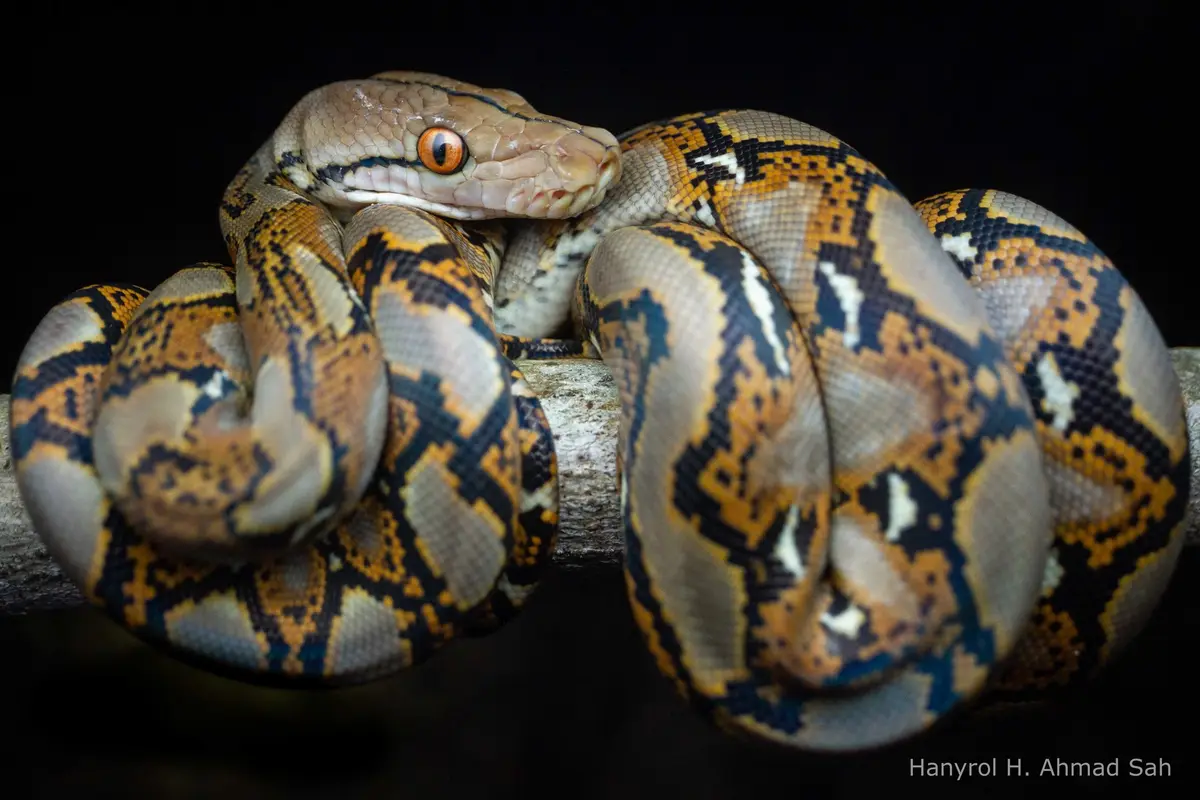
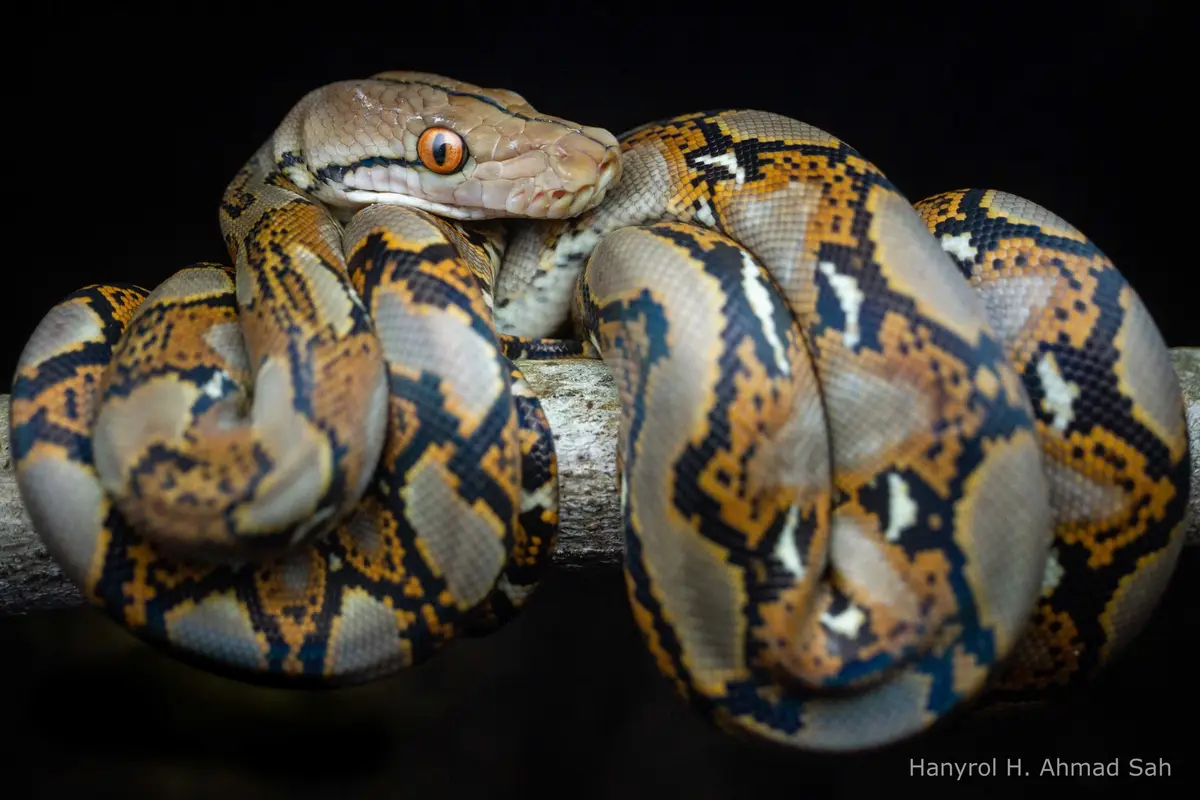
Reticulated python
Malayopython reticulatus · Harmless, but large
Also found on Flores, according to the Reptile Database. The reticulated python has its net pattern of black, gold and gray running the whole length of the body to the tail tip. On the Timor python, the pattern stops at mid-body. Adult reticulated pythons are also much longer and heavier.
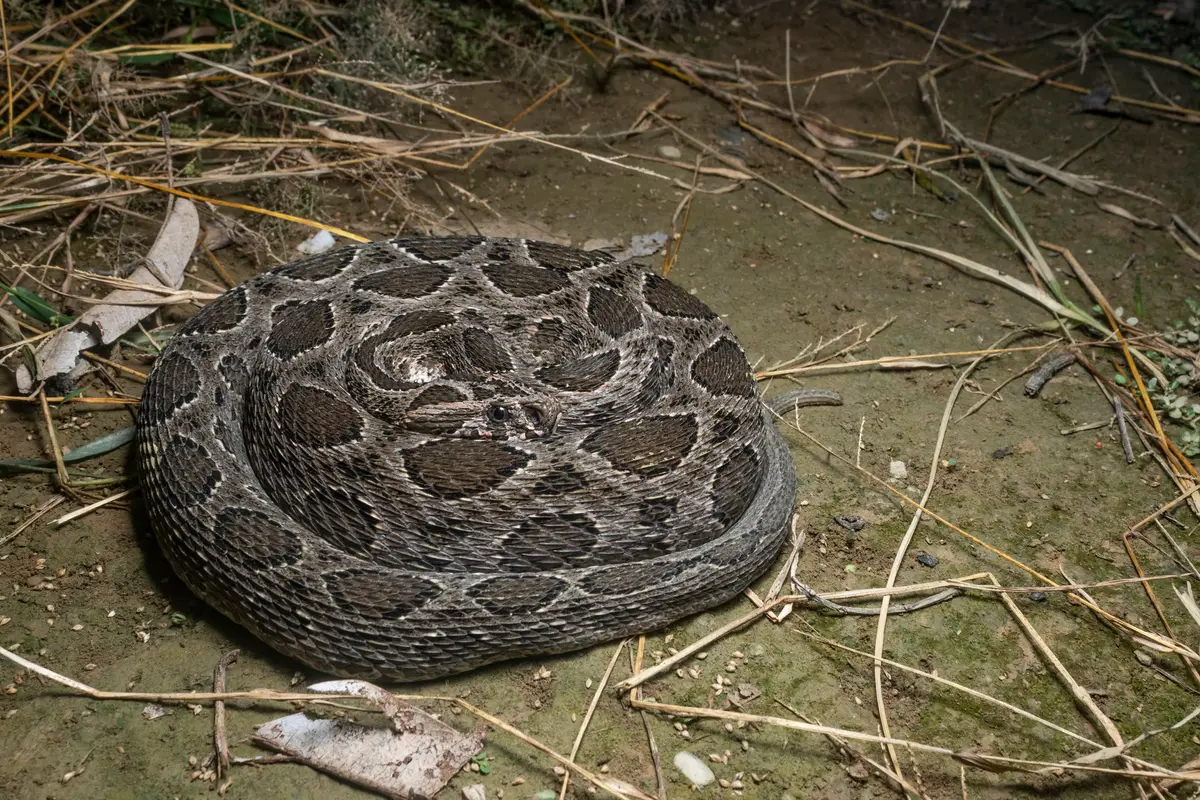
Eastern Russell's viper
Daboia siamensis · Dangerously venomous
Recorded from Komodo, Flores and Lomblen by the Reptile Database. A thick, short viper with rough, keeled scales, a flat triangular head and rows of dark oval blotches along its whole body. It has no heat pits on the lips. Never handle a heavy-bodied, blotched snake on these islands.
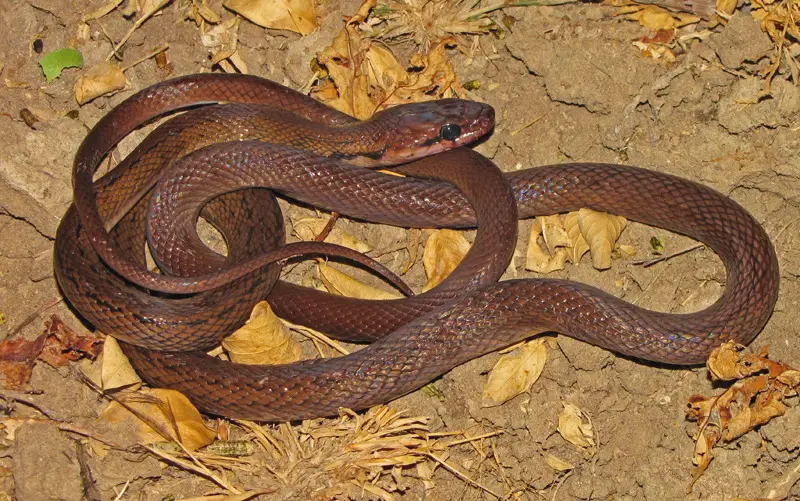
Lesser Sunda rat snake
Coelognathus subradiatus · Harmless
A non-venomous colubrid found on Komodo, Flores and other islands from Lombok to Timor. It lacks the heat pits along the lips that every python has, and it has no venom either, so confusing the two does no harm.
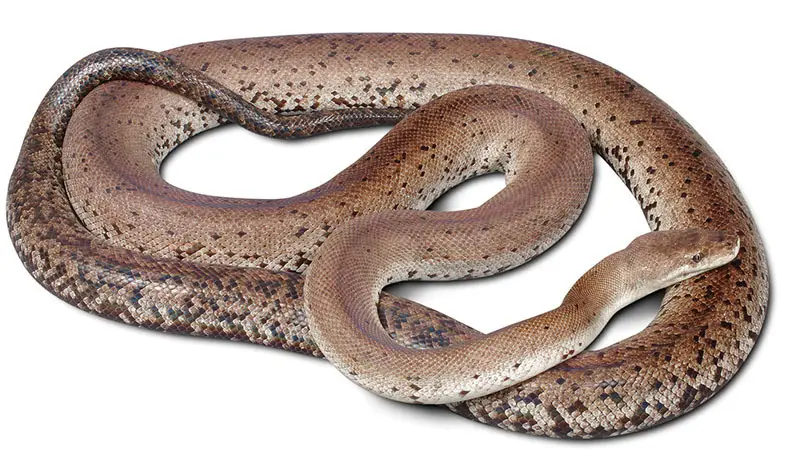
Macklot's python
Liasis mackloti · Harmless
This is the python that actually lives on Timor. Macklot's python is dark brown to greenish-black with fine pale freckles and no bold markings on the front half. The two ranges do not overlap in the wild.
Reproduction
Timor pythons lay eggs. Females usually lay about five, pile them together and coil around the clutch for the 9-10 weeks of incubation, according to the Smithsonian's National Zoo. Like several other pythons, the mother can warm her eggs by making small muscle twitches, or shivers.
Five eggs is a small clutch for a python, which matters for a species that is collected from the wild. Timor pythons reach maturity at about four years old and have lived for more than 20 years in human care. Wild nesting seasons and clutch sizes have not been described in the scientific literature.
Is the Timor python endangered?
It is threatened, though not listed as Endangered. The IUCN Red List rates the Timor python Vulnerable in its 2021 assessment. Like nearly all pythons, it is on CITES Appendix II, so international trade needs export permits.
| Authority | Status |
|---|---|
| IUCN Red List (2021) | Vulnerable |
| CITES | Appendix II |
| VKM trade risk assessment (Norway, 2023) | Not assessed: insufficient data |
The main threat named in the IUCN assessment is collection for the international pet trade, as reported by Mongabay Indonesia. The same assessment lists road building, especially a main road through central Flores that could open up the remaining forest, along with clearing for small farms and plantations, and tourism development. A snake that lives on only a few islands and lays about five eggs at a time has little room to absorb those losses.
Some zoo pages still say the IUCN has not evaluated the species. That was true before 2021 but is now out of date.
A python with many names
Few snakes have had as many names. Peters first called it Liasis amethystinus var. timoriensis, a variety of the amethystine python. It has since been placed in Python (Boulenger, 1893), Morelia (Kluge, 1993) and Broghammerus (Rawlings and colleagues, 2008). In 2014, a multilocus DNA study of boas and pythons by Reynolds, Niemiller and Revell in Molecular Phylogenetics and Evolution confirmed that it is the sister species of the reticulated python and named the genus Malayopython for the pair. No other living python is closer to either of them.
Timor python FAQ
Is the Timor python venomous?
No. The Timor python has no venom and kills its prey by constriction. It is not dangerous to people. It can bite if handled, and the Smithsonian's National Zoo describes it as a nervous, high-strung python, so wash any bite well with soap and water, check your tetanus protection and see a doctor if the wound becomes infected.
Does the Timor python live on Timor?
Probably not. The species was named in 1876 from a specimen labeled as coming from Kupang on Timor, but the snake has not been confirmed there since. The Reptile Database calls the Timor records doubtful. Known populations are on Flores, Lembata (Lomblen) and the islands of Komodo National Park, which is why some people call it the Lesser Sundas python.
How big do Timor pythons get?
Timor pythons usually reach 5-8 feet (1.5-2.4 m) and weigh up to about 20 pounds (9 kg), according to the Smithsonian's National Zoo. Females are slightly larger than males. It is a slim python, much smaller than its closest relative, the reticulated python, which is the longest snake in the world.
Is the Timor python related to the reticulated python?
Yes. The Timor python and the reticulated python are sister species and the only two members of the genus Malayopython. A 2014 DNA study by Reynolds, Niemiller and Revell confirmed the relationship and named the genus. Both have iridescent scales, but the Timor python is far smaller and its pattern fades out halfway down its body.
Is the Timor python endangered?
It is listed as Vulnerable, one step below Endangered, by the IUCN Red List in its 2021 assessment. The main threat is collection for the international pet trade, followed by forest loss on Flores from road building, farming, plantations and tourism. It is also listed on CITES Appendix II, which controls international trade.
What do Timor pythons eat?
Timor pythons eat rats, mice, birds and small reptiles, according to the Smithsonian's National Zoo. They locate warm-blooded prey with heat-sensing pits along their lips and kill it by constriction. In the zoo, young snakes are fed mice and adults are fed rats. No field study of their wild diet has been published.
Are there Timor pythons in Komodo National Park?
Yes. Most recent verified photos of the Timor python on iNaturalist come from inside the Komodo National Park World Heritage Site and nearby western Flores. The park is also home to dangerous snakes such as the Eastern Russell's viper and the Southern Indonesian spitting cobra, so visitors should keep their distance from any snake.
Related snakes
Sources
- Reptile Database: Malayopython timoriensis (Peters, 1876)
- Smithsonian's National Zoo and Conservation Biology Institute: Timor python
- IUCN Red List: Malayopython timoriensis (2021 assessment)
- Mongabay Indonesia (2025): Sanca timor, ular dengan sejarah taksonomi berliku
- VKM (2023). Scientific assessment of risk to populations of pythons listed by CITES as a result of trade. Report 2023:17
- Reptile Database: Malayopython reticulatus (reticulated python)
- Reptile Database: Daboia siamensis (Eastern Russell's viper)
- iNaturalist: Timor python (Malayopython timoriensis)