TANIMBARPYTHON
Simalia nauta · Family Pythonidae
KEY TAKEAWAYS
The Tanimbar python (Simalia nauta) is a slender, non-venomous python from the Tanimbar Islands in Maluku province, eastern Indonesia. It is harmless to people. It belongs to the scrub python group and was named as a separate species in 2000, after being filed for years under the amethystine python.
- It has no venom and kills its prey by constriction.
- The largest measured adult in the species description was 6.5 ft (1,985 mm) and 4.2 lb (1.9 kg).
- Most are plain silver or gold with a pointed snout; a few have rows of cream spots on the flanks.
- The IUCN Red List rates it Data Deficient: there is too little information to judge its risk of extinction.
Tanimbar python quick facts
| Common names | Tanimbar python, Tanimbar scrub python, Tanimbar island python |
|---|---|
| Scientific name | Simalia nauta (Harvey, Barker, Ammerman & Chippindale, 2000); first named Morelia nauta |
| Family | Pythonidae (pythons) |
| Venomous | No, a constrictor |
| Adult length | Usually 5-6.5 ft (1.5-2 m); largest in the species description 6.5 ft (1,985 mm) |
| Weight | Up to about 4.2 lb (1.9 kg) in the species description |
| Coloring | Plain silver to graphite, or brownish gold; some with cream flank spots |
| Range | Tanimbar Islands, Maluku, Indonesia; recorded from Yamdena |
| Habitat | Forest and shrubland; partly arboreal |
| Diet | Not studied in the wild; probably birds and small mammals |
| Reproduction | Lays eggs; one captive clutch held 20 |
| Conservation | IUCN Data Deficient (assessed 2019, published 2021) |
How to identify a Tanimbar python
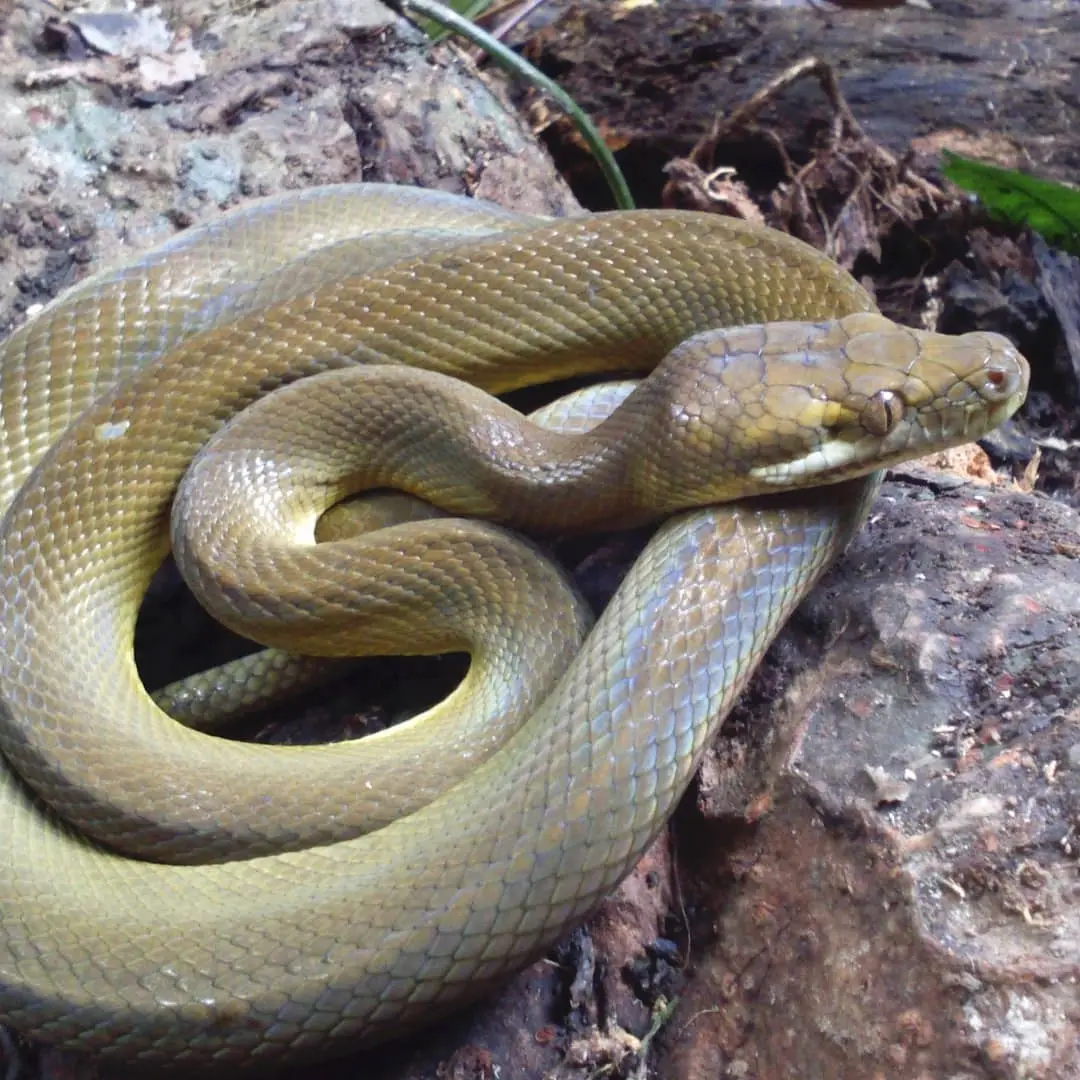
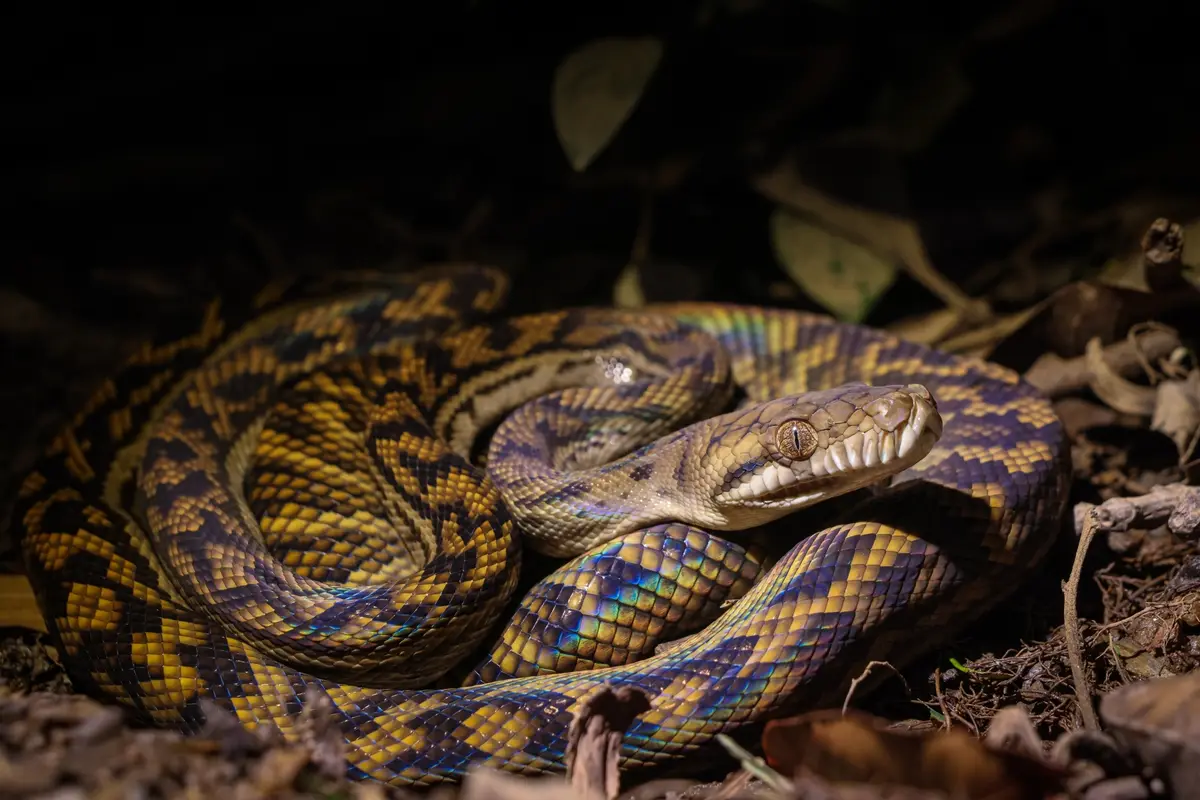
A Tanimbar python is a thin, long-necked scrub python with a pointed snout and very little pattern. Harvey and colleagues called it the most morphologically distinctive of the scrub pythons, and the diagnosis in the Reptile Database says it can be recognized at once by its build, color pattern and low scale counts. It looks far lighter than the heavy-bodied Moluccan python or Halmahera python.
- 1Slim build: adults are gracile, the word the species description uses, and even a 6.5 ft snake weighed only 4.2 lb. The head is large and clearly set off from the thin neck.
- 2Pointed snout: seen from above, the snout is more pointed than in any other scrub python.
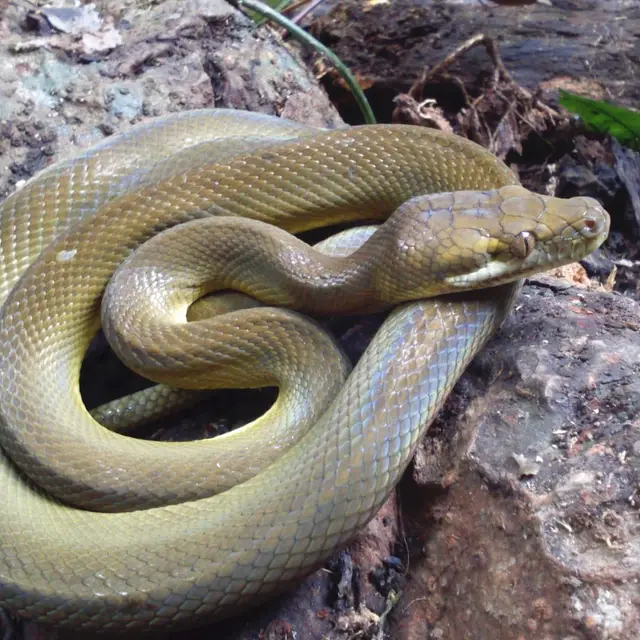
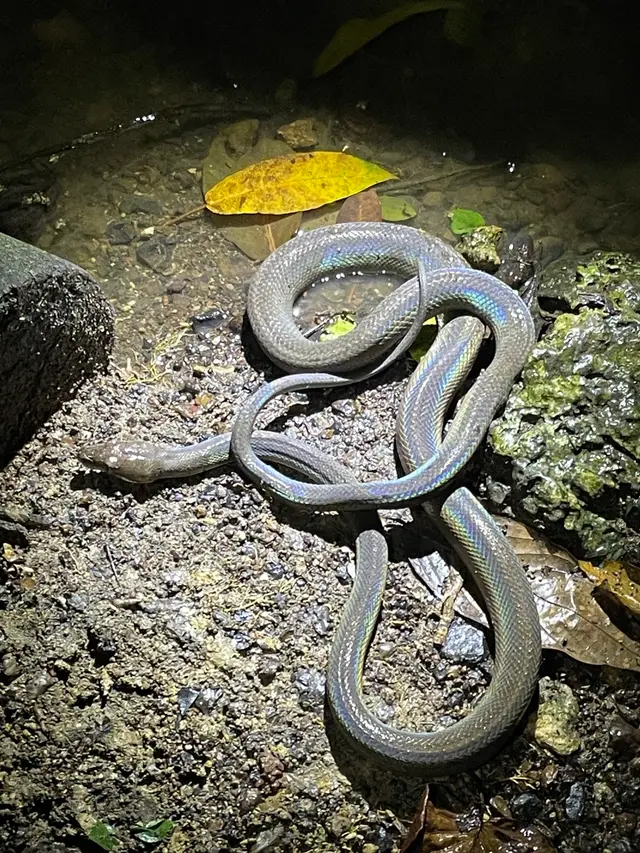
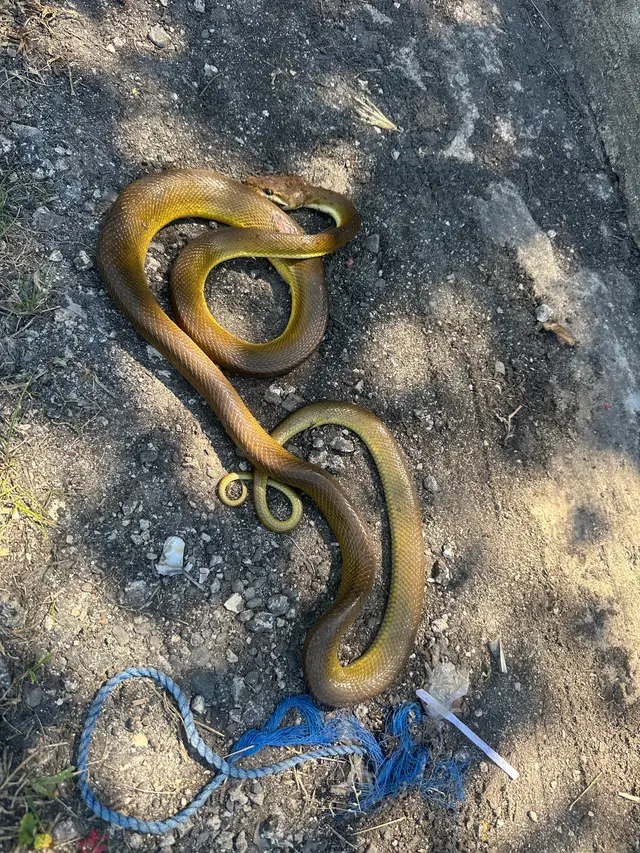
- 3Plain silver or gold body: German breeder Balazs Ferencz described patternless silver, from pale to nearly black graphite, as the usual color, with a brownish gold form as the alternative. The belly is white.
- 4Cream flank spots: patterned snakes carry rows of cream spots along the sides. Every other scrub python has crosswise bands instead, so spots in rows are the best single clue.
- 5Divided head scales: for anyone with a snake in hand: two or three pairs of enlarged, symmetrical parietal scales meet along the midline on top of the head.
How big do Tanimbar pythons get?
Tanimbar pythons reach about 6.5 ft (2 m) and 4.2 lb (1.9 kg), the figures given in the diagnosis by Harvey and colleagues (2000). That makes it the small one of its family branch. The amethystine python and Australian scrub python grow far longer. Ferencz, writing in the German journal Elaphe in 2005, gave 5-6.5 ft (1.5-2 m) as the normal adult range. His own female measured about 6.5 ft (2 m) and his male about 5.6 ft (1.7 m).
| Measure | Figure | Source |
|---|---|---|
| Largest in species description | 6.5 ft (1,985 mm) | Harvey et al. (2000), via Reptile Database |
| Weight in species description | 4.2 lb (1.9 kg) | Harvey et al. (2000), via Reptile Database |
| Typical captive adult | 5-6.5 ft (1.5-2 m) | Ferencz (2005) |
| Hatchling | 16-18 in (40-45 cm) | Ferencz (2005), one clutch |
Keepers on hobby forums mention longer snakes, but no published measurement backs them. No one has measured a wild population, so these numbers rest on a small set of specimens and captive animals.
Where do Tanimbar pythons live?
Short answer: only in the Tanimbar Islands of Maluku province, Indonesia, and nearly every record comes from the main island, Yamdena. The Reptile Database gives the range as the Tanimbar group, and Wikispecies also names nearby Laibobar. The type locality, the place the first described specimen came from, is Yamdena, according to the annotated checklist of pythons by Schleip and O'Shea (2010). The holotype is an adult female held at the University of Texas at Arlington (UTA 44482).
The islands sit on the border of the Banda and Arafura seas, directly north of Darwin, Australia. Wild sightings are few. In November 2026 the GBIF record for the species held 13 occurrences, most of them museum specimens, and iNaturalist held 4 observations, all from southern Yamdena. There is no wild population anywhere outside Indonesia.
What habitat does the Tanimbar python use?
The Tanimbar python lives in forest and shrubland and spends part of its time off the ground. The IUCN Red List entry lists forest, shrubland and artificial land habitats, and Harrington and colleagues (2018) class the species as partly arboreal.
Yamdena's forests are drier than most in Indonesia. A vegetation survey by Laumonier and Nasi (2018) found about 70% of the island under forest of three types: seasonal evergreen, moist deciduous and dry deciduous. The dry deciduous forest drops all its leaves in the dry season. The authors call these the last natural seasonal forests in Indonesia. Hobby accounts often describe the snake's home as rain forest, which does not match this survey.
How does the Tanimbar python behave?
Tanimbar pythons are shy, and their habits are known almost entirely from captive snakes. Ferencz found adults calmer than other Morelia-type pythons: a frightened snake almost never bit and tried to escape and hide instead. If grabbed, it released a foul-smelling musk. His snakes moved about by day as well as at night. Heat-sensing pits along the lips help it find warm prey in the dark.
Young snakes were less polite. His hatchlings struck readily, and when he housed them in groups one ate its cagemate, so he kept them apart after that. No field study of wild movements, home range or activity has been published.
What do Tanimbar pythons eat?
No one has recorded what wild Tanimbar pythons eat. Ferencz suggested from their long teeth and tree-climbing build that adults take birds and smaller mammals, and that juveniles may catch tree frogs and geckos. That is informed guesswork, so treat it as such.
| Life stage | Likely or recorded food | Basis |
|---|---|---|
| Wild adult | Birds, small mammals | Inferred from teeth and build |
| Wild juvenile | Tree frogs, geckos | Inferred |
| Captive adult | Rats and mice, every 10-14 days | Ferencz (2005) |
Is the Tanimbar python dangerous?
No. The Tanimbar python has no venom, and at 4 lb or so it is far too small to threaten an adult person. Like every python it subdues prey by constriction, and the targets are small animals. See the venom FAQ for how venomous and non-venomous snakes differ.
A bite is possible, since a stressed or brooding snake will defend itself. The long teeth can cut skin. Wash any bite with soap and water, keep tetanus protection current and see a doctor if it looks infected.
The real snake hazard on these islands is a different animal. RepFocus lists the Seram death adder for the Tanimbar Islands, including Yamdena, and notes that the identity of that island population is unsettled. A 2012 PLOS study also places death adders on Tanimbar. If you are there and cannot name a snake, leave it alone.
Tanimbar python vs amethystine python and other look-alikes
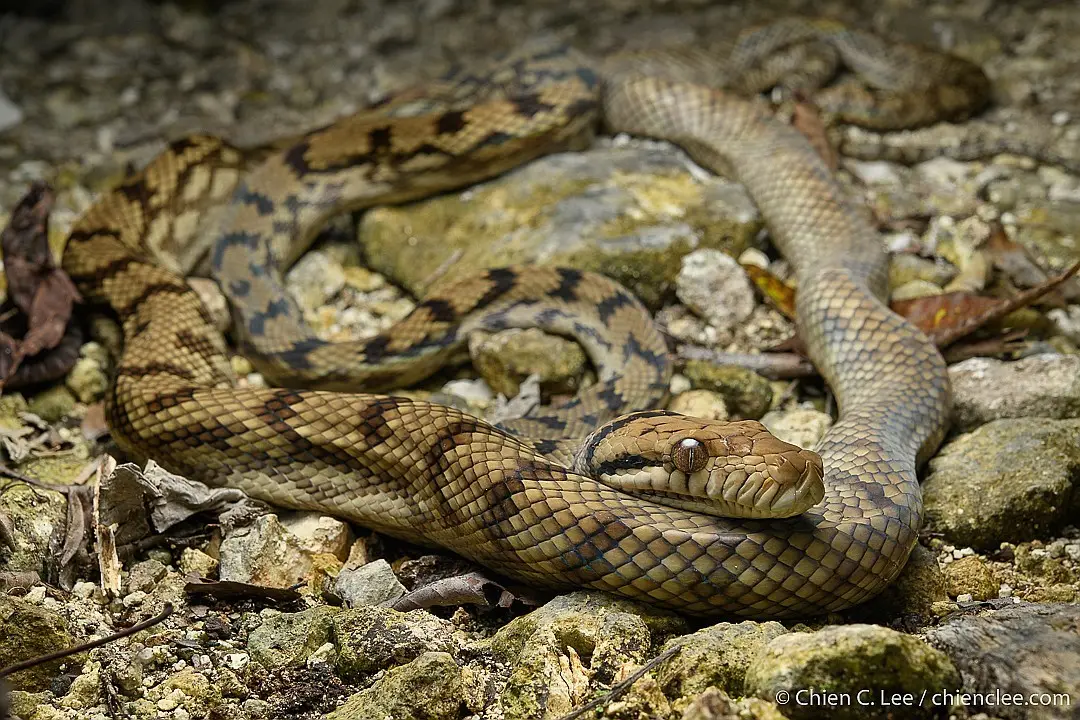
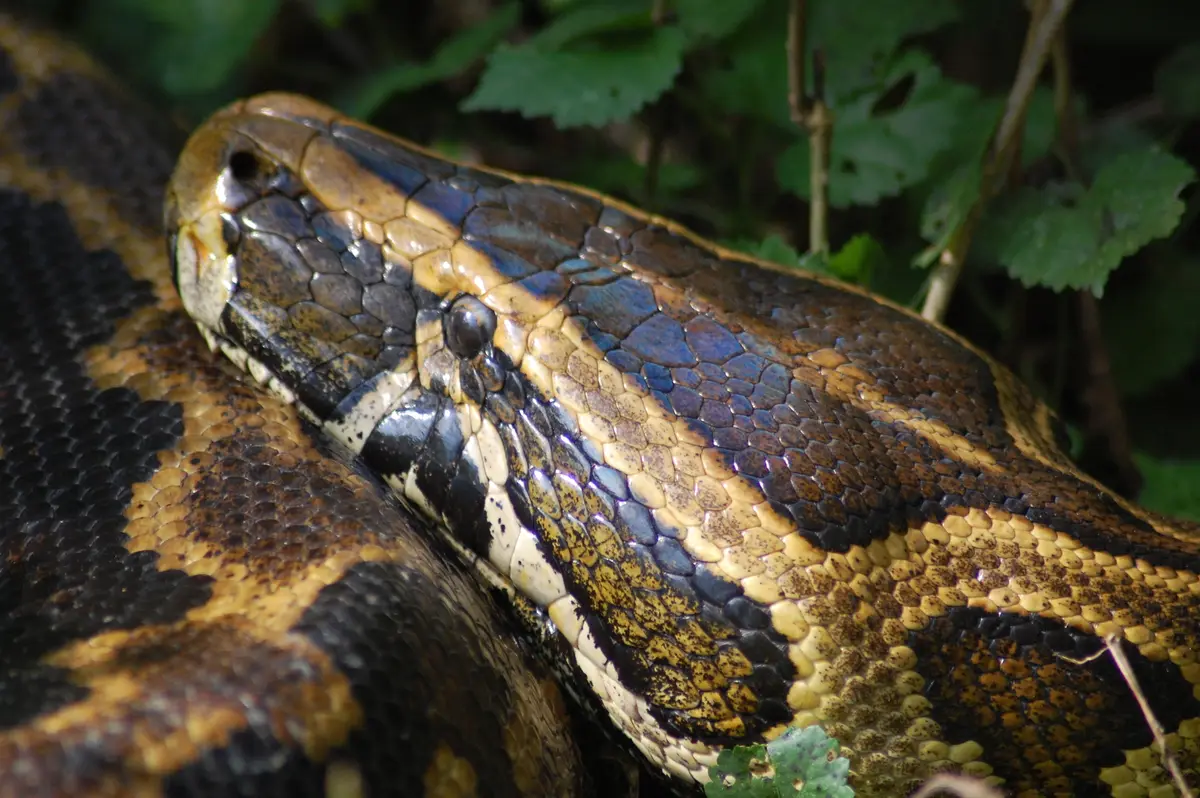
Amethystine python
Simalia amethistina · Harmless
The species it was filed under before 2000. The amethystine python is a bigger, banded or blotched snake of New Guinea and nearby islands. The Tanimbar python is slimmer and mostly plain.
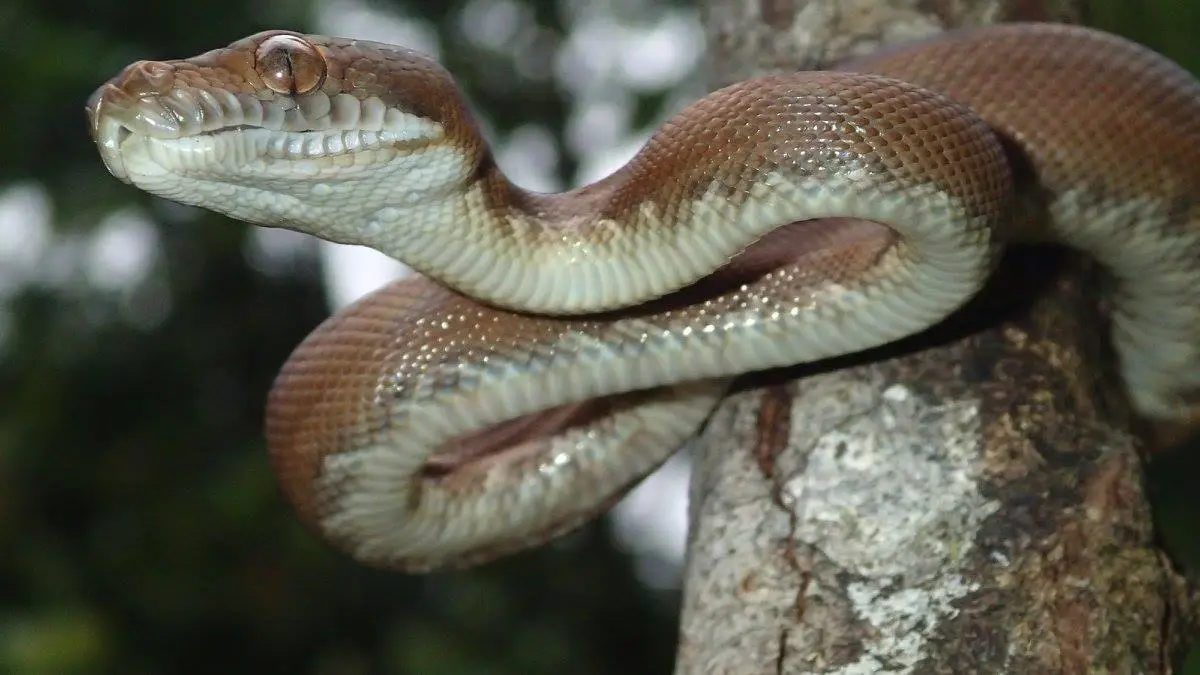 Photo: (c) Tom Kirschey, some rights reserved (CC BY-NC), uploaded by Tom Kirschey · via iNaturalist
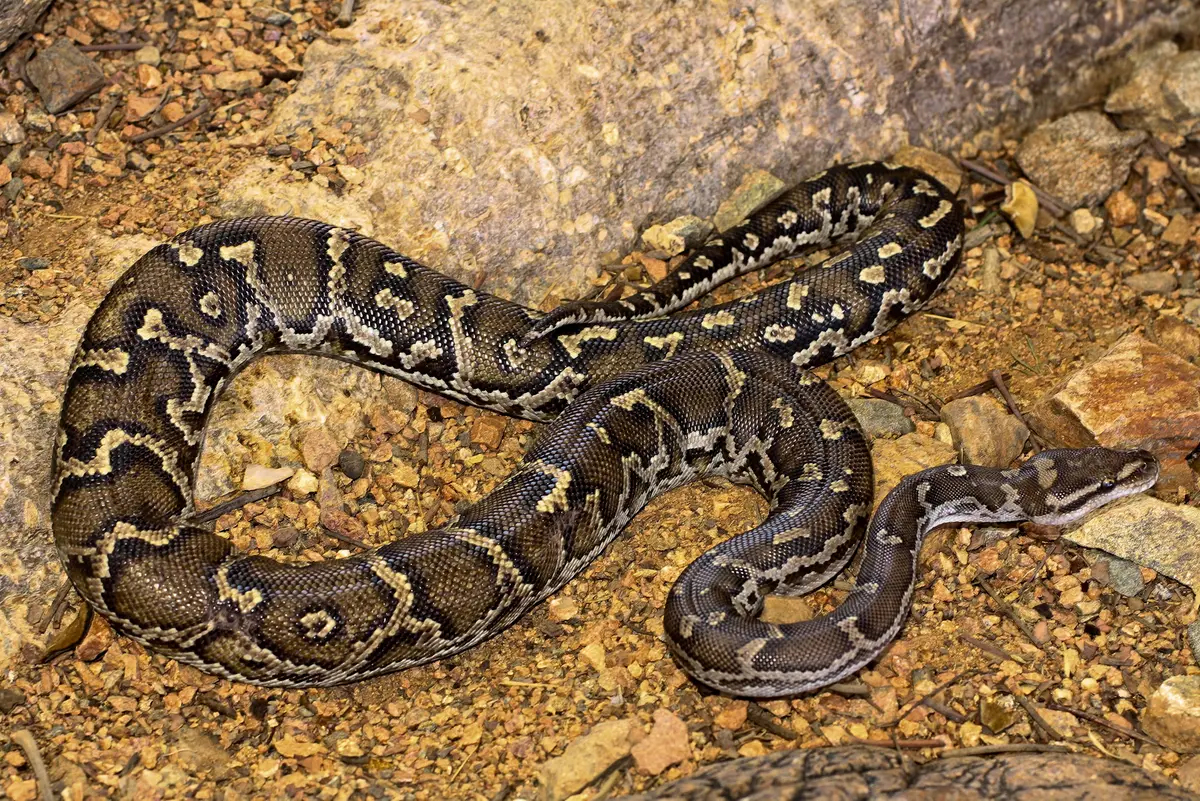
Moluccan python
Simalia clastolepis · Harmless
Also nearly plain, so color alone will not separate them. The Moluccan python is a heavy snake with a rounded snout that grows to about 12.5 ft (3.8 m), and it lives on Seram and Ambon, not Tanimbar.
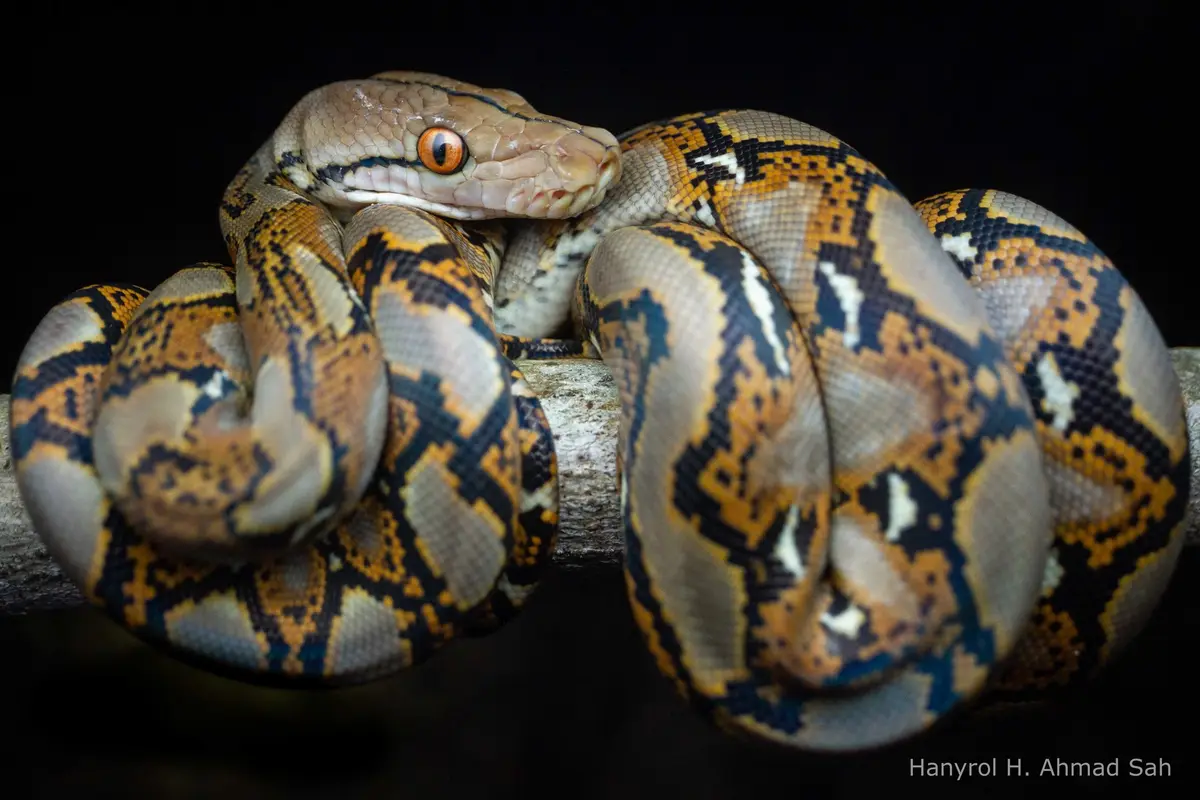
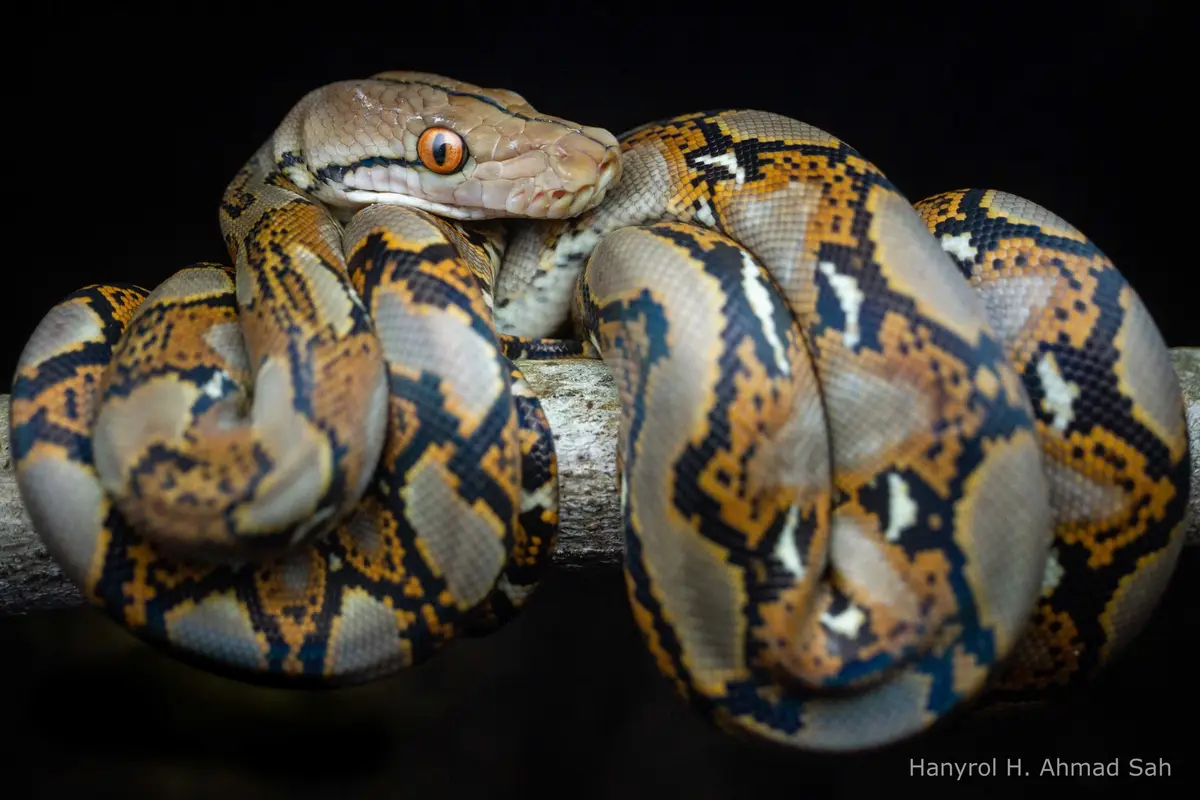
Reticulated python
Malayopython reticulatus · Harmless, but very large
The Reptile Database includes Tanimbar in its range. The reticulated python has a bold net of black lines and gold patches and grows far longer. A big snake with a busy pattern is not a Tanimbar python.
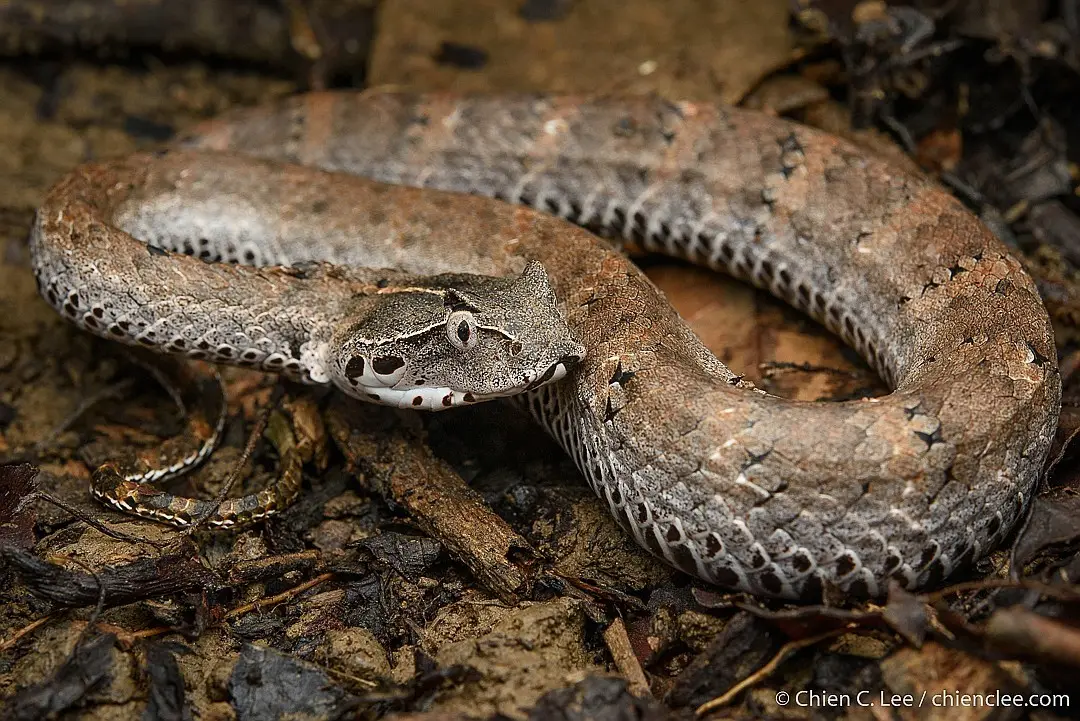
Seram death adder
Acanthophis ceramensis · Dangerously venomous
Short and thick, with a broad head and a thin tail tip, the opposite of the long, thin Tanimbar python. Never handle a thick, short snake on these islands.
How do Tanimbar pythons reproduce?
Tanimbar pythons lay eggs, and the best account is a single captive clutch reported by Ferencz. His pair mated from October 23 to November 30. The female went dark during pregnancy, laid 20 eggs on February 26 and bit to defend them. Three eggs were infertile and another failed in the second week. The other 16 hatched on May 5 and 6, about 10 weeks later, at 84 F (29 C).
Ferencz's hatchlings were orange and began turning silver in their third month. The species description reports a much smaller change, with brown or tan juveniles only slightly darker than adults, so hatchling color may vary. The female took two months to regain her condition, and he suspected females do not breed every year. Wild clutch size and nesting sites are unknown.
Is the Tanimbar python endangered?
Nobody can say yet. The IUCN Red List rates the Tanimbar python Data Deficient (Iskandar and Stubbs, assessed August 2019, published 2021), which means there is not enough information to assign a threat category. The same entry gives the population trend as stable, and lists hunting and trapping, roads and the international pet trade as pressures.
| Authority | Status |
|---|---|
| IUCN Red List | Data Deficient |
| IUCN population trend | Stable |
| CITES | Appendix II, the python family listing |
Forest loss deserves attention. The species has a tiny range, and an Eco-Business report on the Laumonier and Nasi study says logging companies moved onto eastern Yamdena around 2014 and that, in 2018, the island had no national protected areas. Its thin soils recover poorly once cleared. Ferencz wrote in 2005 that captive Tanimbar pythons were almost all wild-caught and that few had been bred.
A species named after a sailor
The name nauta is Latin for sailor. Harvey, Barker, Ammerman and Chippindale chose it because the snake could only have reached its islands by rafting across the sea. Their 2000 revision split the amethystine python into five species. The DNA study by Reynolds, Niemiller and Revell (2014) gave strong support to three of them but not to the closely related S. nauta and S. kinghorni, whose split had weak backing in that analysis. Both remain listed as species, and the Reptile Database uses Simalia nauta.
Tanimbar python FAQ
Is the Tanimbar python venomous?
No. The Tanimbar python has no venom and kills its prey by constriction. It is a small, slender python of about 4 pounds and poses no real danger to people. A stressed snake can still bite, so wash any wound with soap and water, keep your tetanus protection current and see a doctor if it looks infected.
How big do Tanimbar pythons get?
Tanimbar pythons reach about 6.5 feet (2 m) and 4.2 pounds (1.9 kg), the figures given in the 2000 species description by Harvey and colleagues. Normal adults run 5 to 6.5 feet. Hatchlings measure about 16 to 18 inches. No wild population has been measured, so the true upper limit is not known.
Where is the Tanimbar python found?
The Tanimbar python lives only in the Tanimbar Islands of Maluku province, eastern Indonesia, between the Banda and Arafura seas. Nearly all records come from Yamdena, the main island, and Wikispecies also names nearby Laibobar. Wild sightings are few, with just 4 iNaturalist observations as of November 2026.
What does a Tanimbar python look like?
It is a thin python with a large head, a narrow neck and a pointed snout. Most are plain silver, from pale to dark graphite, or a brownish gold, with a white belly. Some carry rows of cream spots on the flanks, a mark no other scrub python has.
Is the Tanimbar python the same as the amethystine python?
No. Tanimbar pythons were filed under the amethystine python until 2000, when Harvey and colleagues described them as a separate species named Morelia nauta. They are smaller and slimmer, with a more pointed snout. A 2014 DNA study by Reynolds and colleagues placed them very close to the Australian scrub python and did not strongly separate the two.
Is the Tanimbar python endangered?
Its status is unknown. The IUCN Red List rates it Data Deficient, meaning there is too little information to assign a threat category. The entry gives a stable population trend and lists hunting, trapping, roads and the pet trade as pressures. Its range is small, and logging returned to Yamdena around 2014.
Related snakes
Sources
- Reptile Database: Simalia nauta (Harvey, Barker, Ammerman & Chippindale, 2000), including the diagnosis, etymology and reference to Ferencz (2005), Elaphe 13(3): 22-28
- Harvey, Barker, Ammerman and Chippindale (2000). Systematics of pythons of the Morelia amethistina complex (Serpentes: Boidae) with the description of three new species. Herpetological Monographs 14: 139-185
- IUCN Red List: Simalia nauta (Data Deficient). Iskandar and Stubbs, 2021
- Reynolds, Niemiller and Revell (2014). Toward a tree-of-life for the boas and pythons. Molecular Phylogenetics and Evolution 71: 201-213
- Schleip and O'Shea (2010). Annotated checklist of the recent and extinct pythons (Serpentes, Pythonidae). ZooKeys 66: 29-79
- Laumonier and Nasi (2018). The last natural seasonal forests of Indonesia. Applied Vegetation Science 21: 461
- Eco-Business (2018): Logging is claiming the last of Indonesia's forests
- GBIF: Simalia nauta occurrence records