HALMAHERAPYTHON
Simalia tracyae · Family Pythonidae
KEY TAKEAWAYS
The Halmahera python (Simalia tracyae) is a large, non-venomous python found only on Halmahera, the biggest island of the Moluccas in eastern Indonesia. It is harmless to people. It belongs to the scrub python group and was treated as part of the amethystine python until scientists described it as a separate species in 2000.
- It has no venom and kills its prey by constriction.
- Adults are heavy-bodied and reach at least 13 ft (4 m), according to the Reptile Database.
- It is the only scrub python with a red iris and broad dark bands across its back.
- The IUCN Red List rates it Data Deficient: there is not enough information to judge its risk of extinction.
Halmahera python quick facts
| Common names | Halmahera python, Halmahera scrub python |
|---|---|
| Scientific name | Simalia tracyae (Harvey, Barker, Ammerman & Chippindale, 2000); first named Morelia tracyae |
| Family | Pythonidae (pythons) |
| Venomous | No, a constrictor |
| Adult length | About 8-13 ft (2.5-4 m); at least 13 ft (4 m) at the top end |
| Coloring | Brown, russet or straw-tan with about 48-56 broad dark bands; red iris |
| Range | Northwestern Halmahera, North Maluku, Indonesia |
| Habitat | Evergreen rainforest; on the ground and in trees |
| Diet | Fruit bats and other mammals, birds; reported to take chickens |
| Reproduction | Lays eggs |
| Conservation | IUCN Data Deficient; CITES Appendix II |
How to identify a Halmahera python
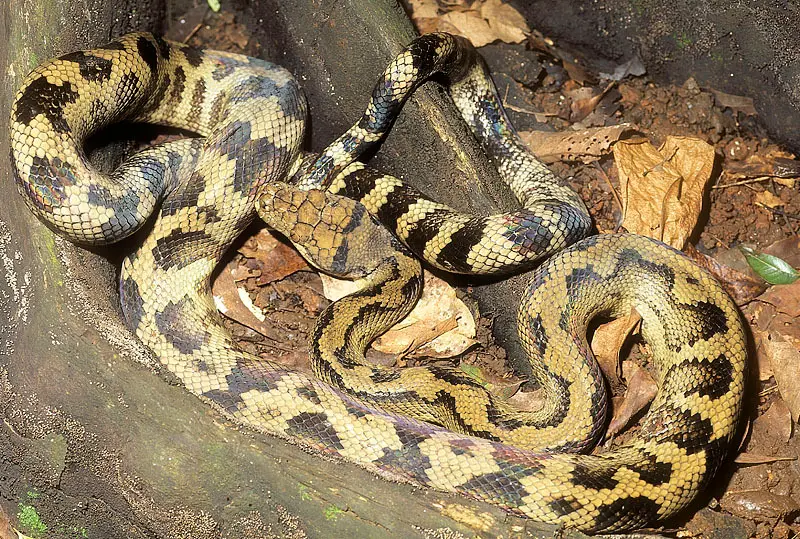
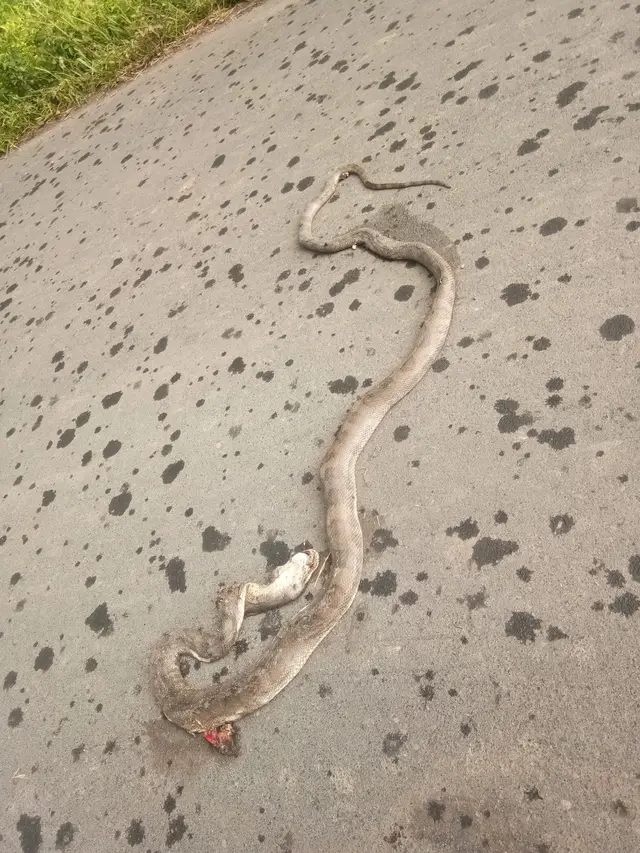
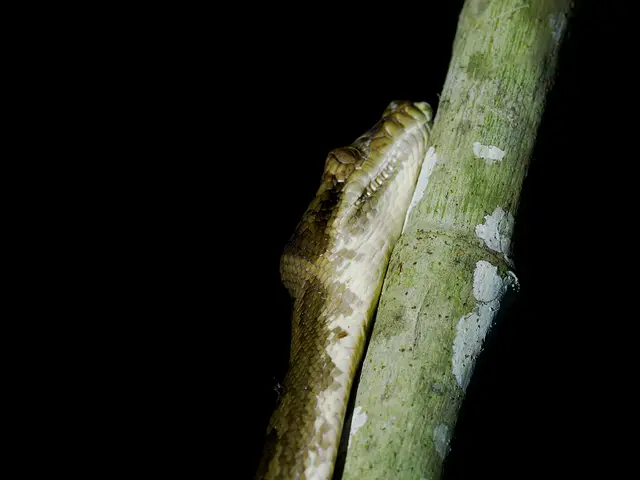
A Halmahera python is a thick, heavy scrub python with broad dark bands across a brown back and a red eye. The eye is the giveaway. The diagnosis in the Reptile Database, drawn from the original description, calls it the only scrub python with both a red iris and broad bands. Its relatives have brown to gold eyes and narrower bands. It looks more like a boa than a slim tree python, with a rounded snout and a solid build.
- 1Red iris: no other member of the scrub python group has red eyes. The amethystine python and its relatives have brown or golden eyes.
- 2Broad dark bands: about 48 wide dark brown to black bands cross the back, each covering about 15 scale rows at midbody. Published counts run from 48 to 56. No patternless Halmahera python has been recorded.
- 3Neck bars and eye stripe: one or two dark bars sit on the neck, and a dark stripe runs back from the eye.
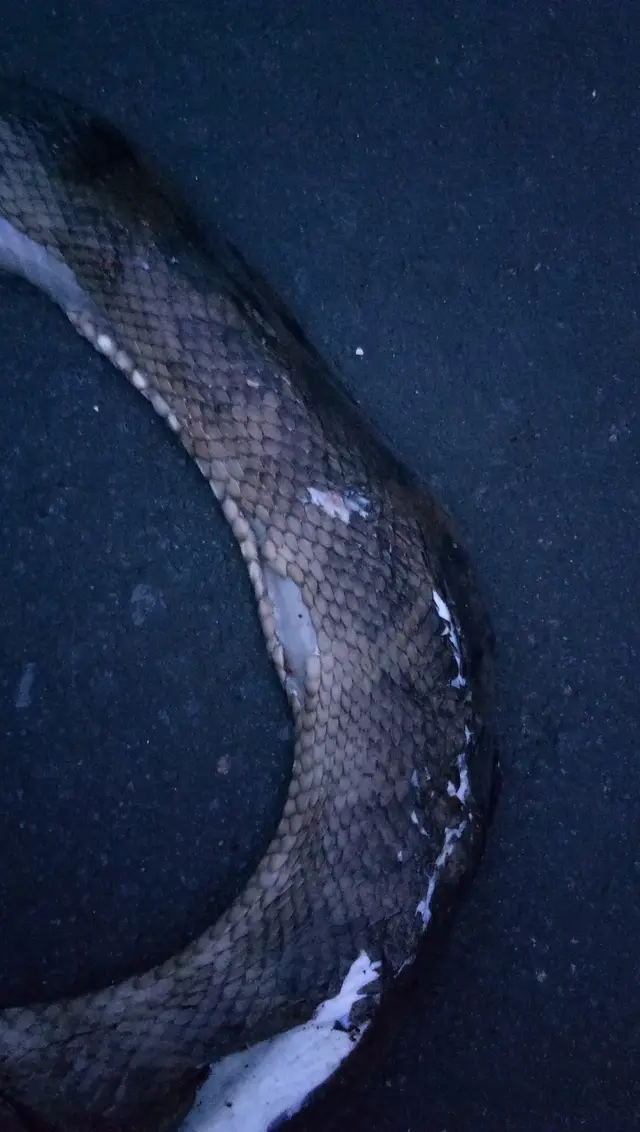
- 4Shifting base color: the ground color can change over a short time, from medium brown to russet, or from greenish straw to tan. The reason is not known. The band pattern itself stays the same from youth to adulthood.
- 5Head scales: for anyone with a specimen in hand: two or three pairs of large, symmetrical scales on top of the head (parietals) that meet in the middle, and no small scales below the eye (suboculars). The tongue is black.
How big do Halmahera pythons get?
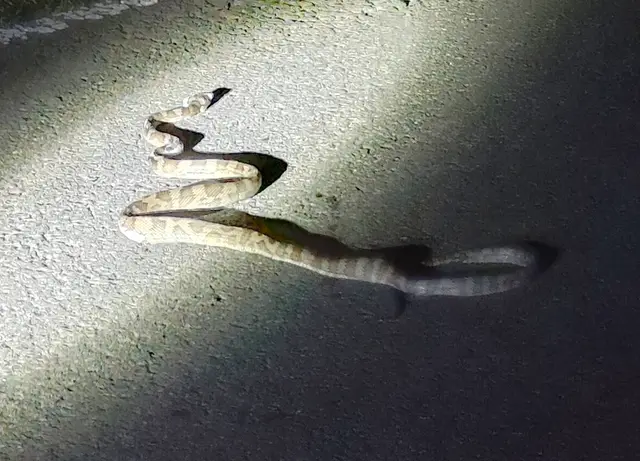
Adult Halmahera pythons are usually about 8-13 ft (2.5-4 m) long, and the Reptile Database says adults reach at least 13 ft (4 m). They are heavy for their length. That puts them in the same size class as the Australian scrub python, well short of the reticulated python, which also lives on Halmahera.
| Measure | Figure | Source |
|---|---|---|
| Typical adult length | 8-13 ft (2.5-4 m) | Accounts based on Harvey et al. (2000) |
| Maximum length | At least 13 ft (4 m) | Reptile Database |
| Build | Heavy-bodied | Reptile Database |
No weight records or record-length specimens have been published for this species. Females have a shorter snout than males, which makes their heads look wider.
Where do Halmahera pythons live?
Short answer: only on Halmahera Island in North Maluku province, Indonesia, and mainly in its northwest. The Reptile Database gives the range as Halmahera alone. Specimens are known from as far south as Jailolo on the west coast and from near Galela and Tobelo in the north. The type locality, cited in the annotated checklist of pythons by Schleip and O'Shea (2010), is Tobelo.
Halmahera sits west of New Guinea, in the island zone between Asia and Australia that biologists call Wallacea. Older range maps and some databases still list the amethystine python on Halmahera, because the island's pythons were filed under that species until 2000. Records from Halmahera now belong to Simalia tracyae. Compare the range with other snakes on the world snake map.
Habitat
Halmahera pythons live mainly in the evergreen rainforest of northern Halmahera. The Reptile Database describes the species as partly arboreal. It moves about equally well on the ground and in trees, and it is often found near the roosts of fruit bats, its main prey.
Behavior
Very little is known about how Halmahera pythons live. No radio-tracking or population study has been published. Most of what exists comes from the specimens examined for the 2000 description and from what local people and collectors report.
Local people most often see the snake on the ground, even though it climbs well. Scrub pythons as a group have a reputation for biting when handled, and a large one can open real wounds.
What do Halmahera pythons eat?
Halmahera pythons eat fruit bats, according to local collectors, and presumably other small mammals and birds. Residents of Halmahera also report pythons taking large numbers of domestic chickens. Small prey is swallowed straight away; larger prey is killed by constriction first.
| Prey | Notes |
|---|---|
| Fruit bats | The main reported prey; pythons are often found near bat roosts |
| Other small mammals | Presumed, as in other scrub pythons |
| Wild birds | Presumed |
| Domestic chickens | Reported by villagers, sometimes in large numbers |
Is the Halmahera python venomous?
No. The Halmahera python has no venom. Like every python, it kills by coiling around its prey and squeezing. It eats animals the size of a bat or a chicken and is no threat to an adult person who leaves it alone.
It can still bite. A python of 10 ft or more has many sharp, backward-curved teeth, and a bite leaves rows of bleeding punctures. Wash any python bite well with soap and water and check that your tetanus protection is current. See a doctor if the wound turns red, hot or swollen, or if teeth may be left in it.
Color and pattern are a poor guide to whether a snake is dangerous. If you are not sure what a snake is, keep your distance. The SnakesWiki snake venom FAQ explains the basics.
Halmahera python vs amethystine python and other look-alikes
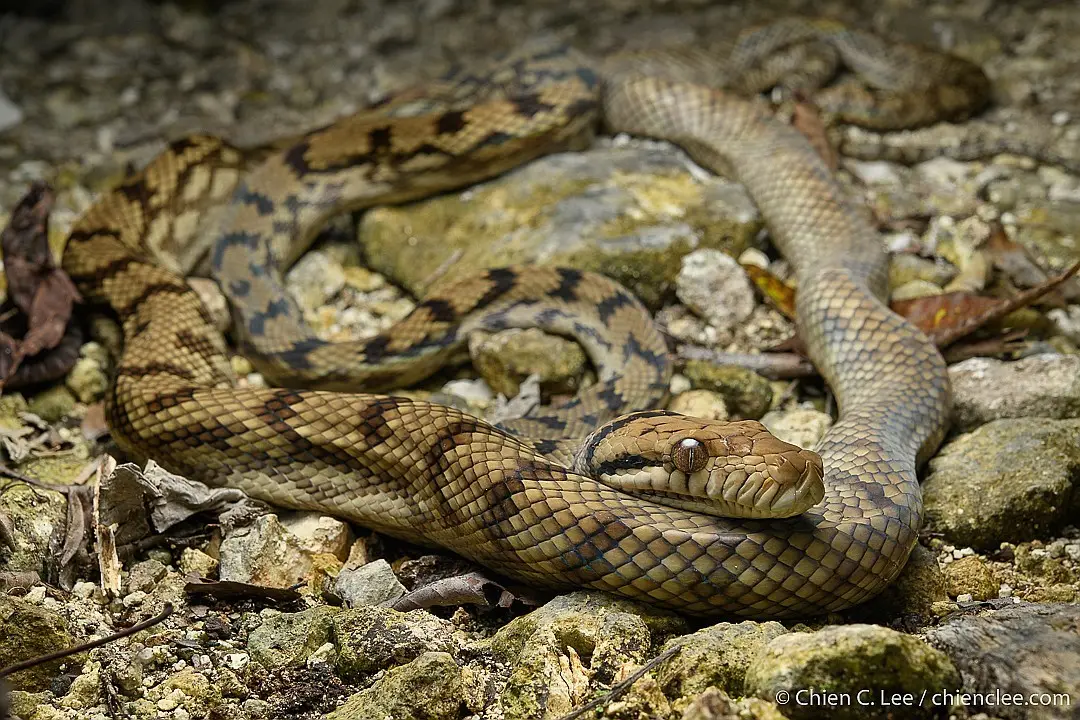
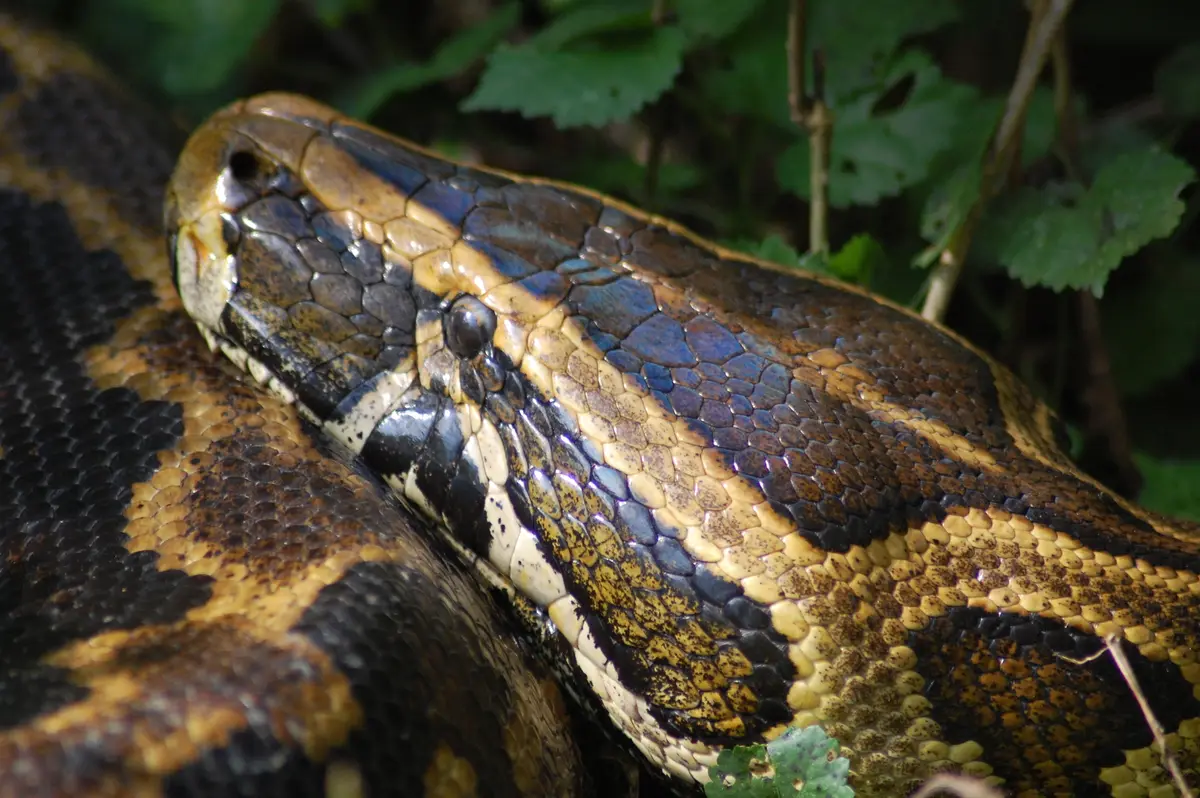
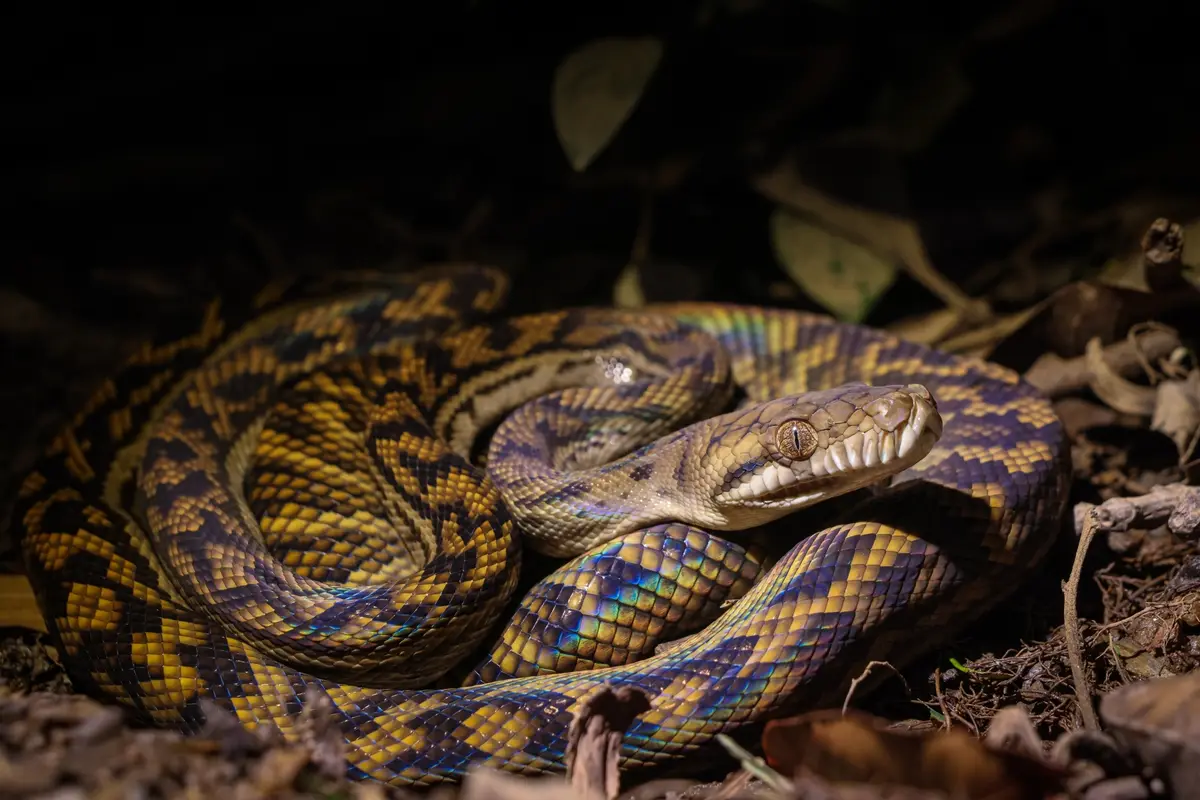
Amethystine python
Simalia amethistina · Harmless
The snake it was lumped with until 2000. The amethystine python of New Guinea and nearby islands has brown to gold eyes and narrower bands. A red-eyed, broad-banded scrub python on Halmahera is S. tracyae.
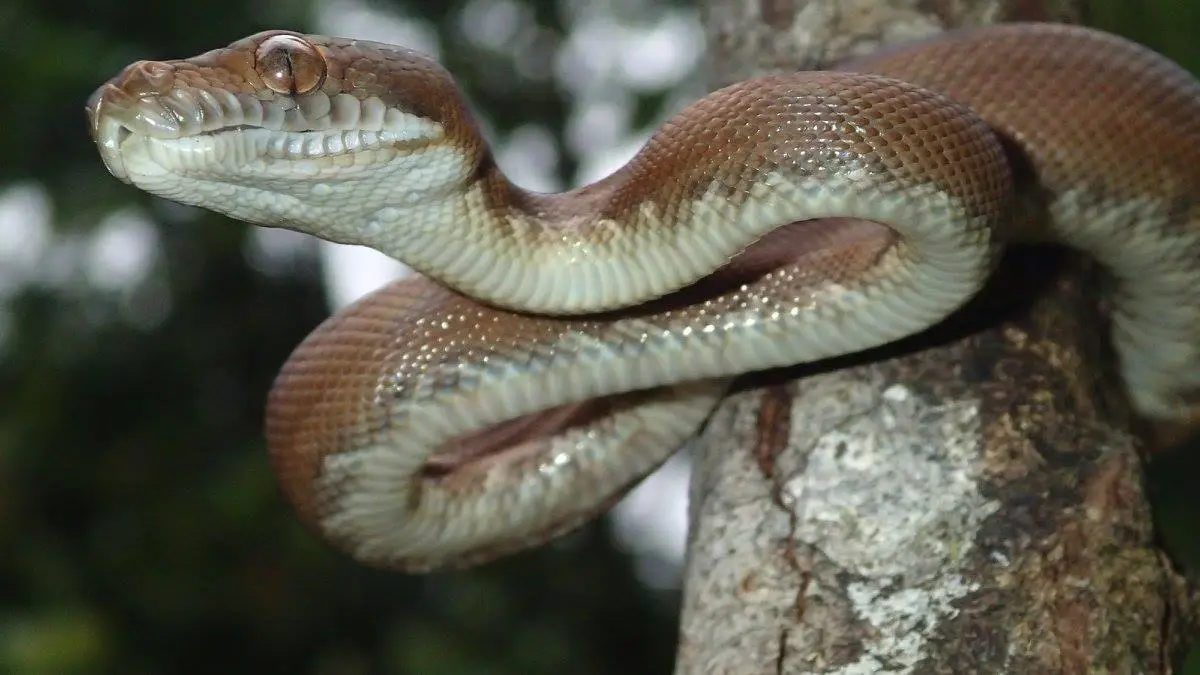 Photo: (c) Tom Kirschey, some rights reserved (CC BY-NC), uploaded by Tom Kirschey · via iNaturalist
Southern Moluccan python
Simalia clastolepis · Harmless
Another scrub python described in the same 2000 paper, from Ambon and Seram to the south. According to the Reptile Database, adults are almost patternless, have no neck bars and have gray or brown eyes. It is also the only scrub python with small scales below the eye.
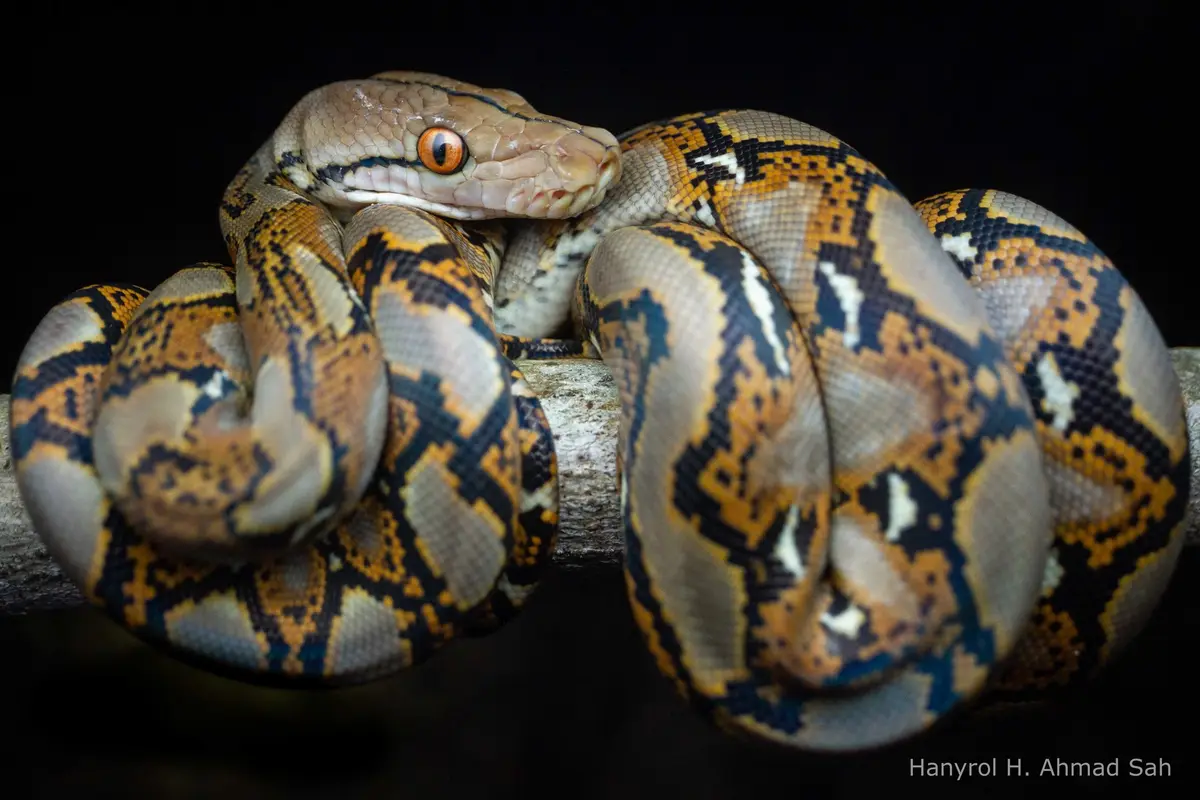
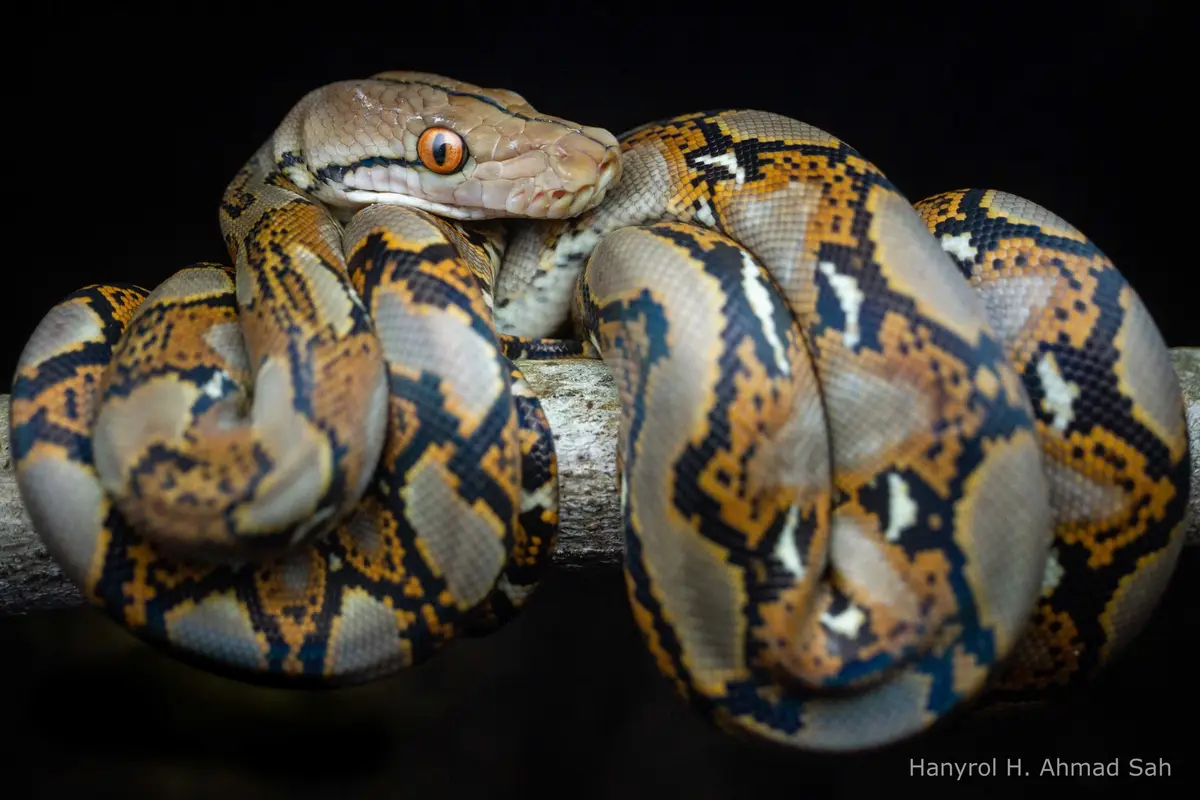
Reticulated python
Malayopython reticulatus · Harmless, but very large
A much bigger python that also lives on Halmahera. The reticulated python has a net-like pattern of black lines, gold patches and pale diamonds, rather than bold crossbands, and it grows far longer.
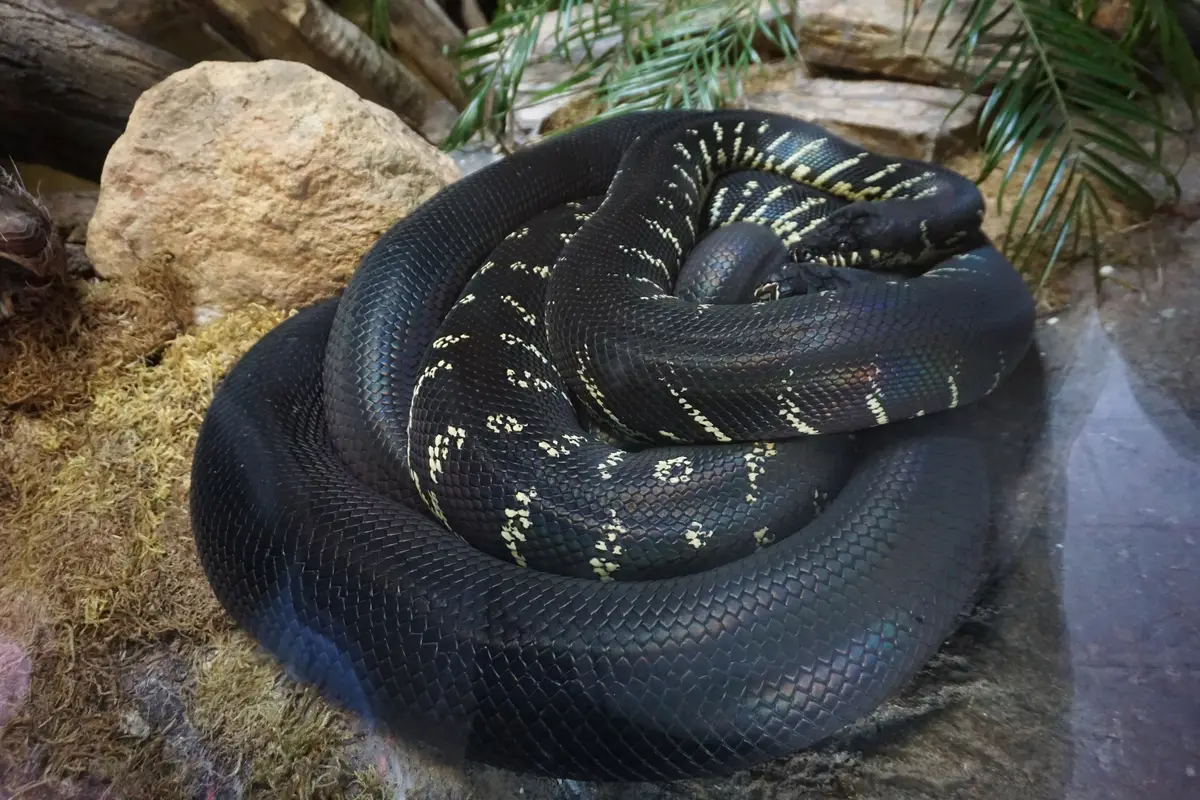
Boelen's python
Simalia boeleni · Harmless
The closest relative of the scrub python group, according to Harvey and colleagues (2000). Boelen's python lives in the mountains of New Guinea, not on Halmahera, and is glossy blue-black as an adult, with white bars on the sides and white or cream lip scales.
Reproduction
Halmahera pythons lay eggs, as all pythons do. Beyond that, almost nothing is published. Clutch size, the breeding season and incubation time in the wild are unknown, and wild hatchlings have not been described. Harvey and colleagues predicted that hatchlings would be very dark reddish-brown.
In the related Australian scrub python, females coil around their eggs until they hatch. The same has not been documented for the Halmahera python in the wild.
Is the Halmahera python endangered?
Nobody knows yet. The IUCN Red List rates the Halmahera python Data Deficient, which means there is not enough information on its numbers, range or threats to place it in a risk category. It lives on a single island, which makes any threat on Halmahera, such as forest clearing, a threat to the whole species. All pythons are listed in CITES Appendix II, so international trade needs permits.
| Authority | Status |
|---|---|
| IUCN Red List | Data Deficient |
| CITES | Appendix II (all Pythonidae) |
A species named in 2000
Michael Harvey, David Barker, Loren Ammerman and Paul Chippindale named the Halmahera python in their 2000 revision of the scrub pythons in Herpetological Monographs. According to the East Tennessee State University record of the paper, they studied museum specimens and new material from eastern Indonesia, raised the Australian scrub python to a full species and described three new ones, including this one. The name honors herpetologist Tracy M. Barker. A 2014 DNA study by Reynolds, Niemiller and Revell moved the scrub pythons from Morelia to the genus Simalia, and the Reptile Database follows that change. Raymond Hoser's name Australiasis tracyae (2004) is not accepted; Schleip and O'Shea list it as unavailable.
Halmahera python FAQ
Is the Halmahera python venomous?
No. The Halmahera python has no venom and kills its prey by constriction. It is not dangerous to people who leave it alone. A large adult can still give a painful bite with many sharp teeth, so wash any bite with soap and water, make sure your tetanus protection is current and see a doctor if the wound becomes infected.
How big do Halmahera pythons get?
Halmahera pythons usually grow to about 8-13 feet (2.5-4 m), and the Reptile Database says adults reach at least 13 feet (4 m). They are heavy-bodied for their length, more like a boa in build than a slender tree python. No weight records or confirmed record lengths have been published.
Where does the Halmahera python live?
The Halmahera python lives only on Halmahera Island in North Maluku province, eastern Indonesia, mainly in the northwest of the island. Specimens are known from Jailolo north to Galela and Tobelo. It lives mostly in evergreen rainforest and is often found near fruit bat roosts.
How can you tell a Halmahera python from an amethystine python?
Look at the eye and the bands. The Halmahera python is the only scrub python with a red iris and broad dark crossbands, about 48 to 56 of them. The amethystine python has brown to gold eyes and a narrower pattern, and it lives on New Guinea and nearby islands rather than on Halmahera.
What does the Halmahera python eat?
Fruit bats are its main reported prey, and it is often found near bat roosts. Local collectors say it also takes other small mammals and birds, and villagers on Halmahera report pythons eating domestic chickens. It swallows small prey right away and constricts larger prey first.
Is the Halmahera python endangered?
Its status is unknown. The IUCN Red List rates the Halmahera python Data Deficient, meaning there is too little information on its population and threats to assess it. Because it lives on just one island, habitat loss on Halmahera could affect the entire species. Like all pythons, it is listed in CITES Appendix II.
Related snakes
Sources
- Reptile Database: Simalia tracyae (Harvey, Barker, Ammerman & Chippindale, 2000)
- Harvey, Barker, Ammerman and Chippindale (2000). Systematics of pythons of the Morelia amethistina complex (Serpentes: Boidae) with the description of three new species. Herpetological Monographs 14: 139-185
- Schleip and O'Shea (2010). Annotated checklist of the recent and extinct pythons (Serpentes, Pythonidae). ZooKeys 66: 29-79
- Reptile Database: Simalia clastolepis (Southern Moluccan python)
- Reptile Database: Malayopython reticulatus (distribution including Halmahera)
- iNaturalist: Halmahera python (Simalia tracyae)