SELAYER RETICULATEDPYTHON
Malayopython reticulatus saputrai · Family Pythonidae
KEY TAKEAWAYS
The Selayer reticulated python (Malayopython reticulatus saputrai) is a non-venomous subspecies of the reticulated python, one of Asia's pythons, named from Selayar Island off southwestern Sulawesi, Indonesia. It has no venom. Island snakes are usually described as a dwarf form of about 13 ft (4 m) at most, far short of the giants on other islands, though a snake that size can still bite hard and should not be handled casually.
- It has no venom. It kills prey by constriction, and a bite needs cleaning, not antivenom.
- The 4 m limit is the figure usually quoted from the 2002 description. Hard measurements of wild Selayar snakes are scarce.
- It was named in 2002, and DNA places it with snakes from southwestern Sulawesi, apart from other reticulated python populations studied.
- The species is rated Least Concern by the IUCN, but this island lineage is traded, and scientists want distinct lineages weighed when quotas are set.
Selayer reticulated python quick facts
| Common name | Selayer reticulated python (also Selayar dwarf reticulated python; the island is also spelled Salayar) |
|---|---|
| Scientific name | Malayopython reticulatus saputrai (Auliya, Mausfeld, Schmitz and Böhme, 2002), a subspecies of Malayopython reticulatus (Schneider, 1801) |
| Family | Pythonidae (pythons) |
| Venomous | No, a constrictor |
| Adult length | Up to about 13 ft (4 m), as reported from the 2002 description |
| Scale counts | 330-334 belly scales and 77-81 rows at midbody |
| Range | Selayar Island in the Flores Sea and southwestern Sulawesi, Indonesia |
| Habitat | Not studied in detail; the species uses lowland forest, farmland, scrub and mangrove edges |
| Diet | Warm-blooded prey such as rats and other small mammals |
| Reproduction | Lays eggs; the species guards its clutch |
| Conservation | IUCN Least Concern for the species; CITES Appendix II |
How to identify a Selayer reticulated python
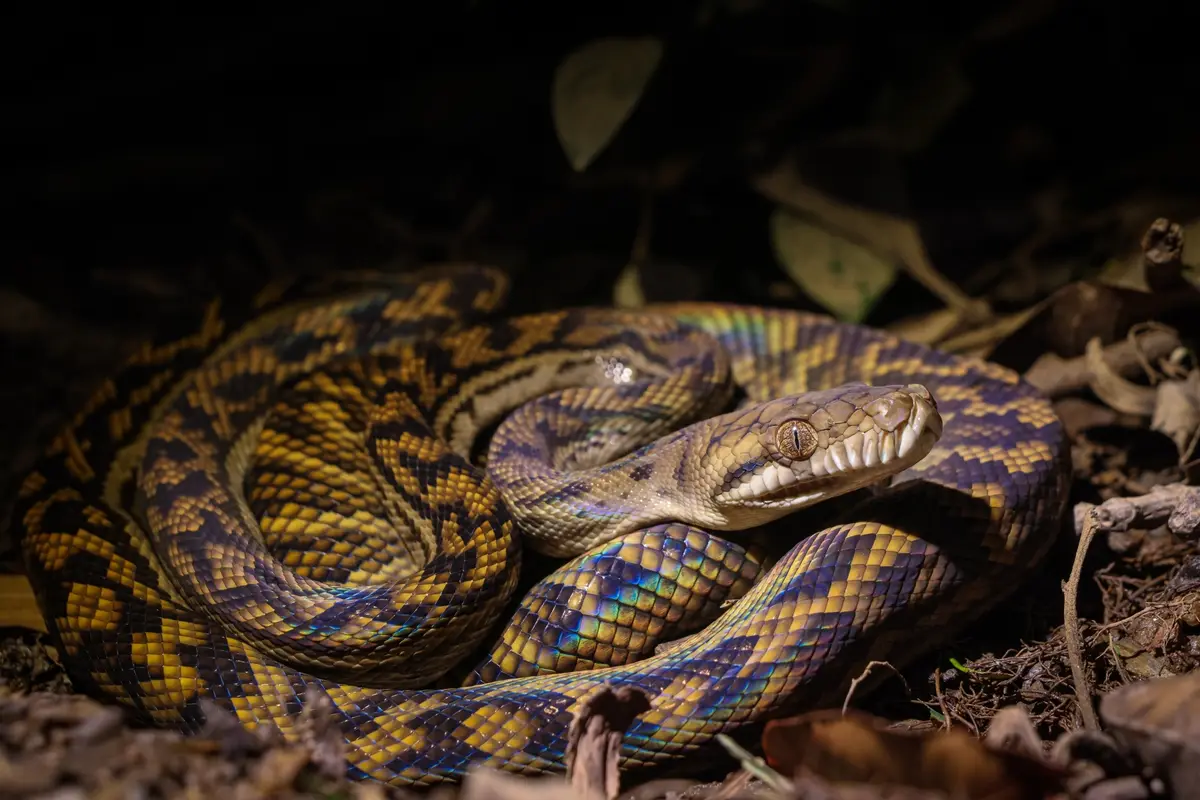
A Selayer reticulated python looks like a small reticulated python: a net of black lines over brown, gold or gray patches, with one thin dark line down the head. Auliya and colleagues (2002) separated it from other populations on color pattern, scalation and DNA. Their full color description sits behind a paywall, so this page does not try to repeat it. The features below are the ones that can be checked from open sources.
- 1Net pattern: zig-zag black lines between yellow-brown, dark brown or gray patches, as Ecology Asia describes for the species.
- 2Head line: a single dark line running down the center of a long head, with no large spearhead mark.
- 3Eyes: orange with vertical pupils in the species as a whole.
- 4Heat pits: heat-sensing pits set in the lip scales, used to find warm prey in the dark.
- 5Scale counts: the firmest test, though it takes a specimen in the hand: 330-334 belly scales and 77-81 rows at midbody. The belly count sits above both other subspecies; the midbody range overlaps the widespread form by a row or two.
No verified photos of this snake have been shared on iNaturalist yet. Check iNaturalist for new records.
Nobody can name this subspecies from a photo alone. Locality decides it. A wild-caught snake needs a known origin, and a captive one needs a breeding record that traces back to Selayar.
How big do Selayer reticulated pythons get?
The figure usually given is a maximum of about 13 ft (4 m). Wikipedia's reticulated python article attributes that limit to Auliya et al. (2002). The original paper was not available in full for this page, so treat the number as reported rather than checked. Measured records from wild Selayar snakes are hard to find.
Work on neighboring islands points the same way. Hanifa and colleagues (2016) sampled small retics on Kalaotoa, Madu and Karumpa in the Flores Sea. Their longest snake reached about 10 ft (3 m), and locals described a few up to 13 ft (4 m), but snakes over 3 m were very rare.
| Population | Reported length | Source |
|---|---|---|
| Selayer reticulated python | Up to about 13 ft (4 m) | Auliya et al. 2002, as cited by Wikipedia |
| Tanahjampea form | Little over 6.5 ft (2 m) | Auliya et al. 2002, as cited by Wikipedia |
| Kalaotoa, Madu and Karumpa | Largest sampled about 10 ft (3 m); locals report up to 13 ft (4 m) | Hanifa et al. 2016 |
| Large mainstream retics | 16-23 ft (5-7 m) | Ecology Asia |
| Longest measured wild snake | 23 ft 8 in (7.22 m) | Guinness World Records, Maros, Sulawesi |
Why the dwarf label needs a caveat
The Reptile Database includes southwestern Sulawesi in this subspecies' range. The Maros district is in that same part of Sulawesi, and it produced the longest measured wild snake on record: a 23 ft 8 in (7.22 m) female reported by Guinness World Records. Guinness names no subspecies, and no source consulted here assigns her to this one. Still, the two facts sit awkwardly together. Nothing published says where the subspecies ends on the mainland, and "dwarf" fits the island snakes better than it fits every python in southwestern Sulawesi.
Where does the Selayer reticulated python live?
Short answer: on Selayar Island and in southwestern Sulawesi, Indonesia. The Reptile Database gives Selayar as the type locality, the place the subspecies was first described from, and lists its range as Selayar, south of southwestern Sulawesi in the Flores Sea, plus southwestern Sulawesi itself.
Selayar is a long, narrow island, more than 50 miles (80 km) from end to end, off Cape Bira at the southwestern tip of Sulawesi. The Selayar Straits separate it from the mainland. You can see the wider picture of where snakes live on our world map.
Habitat
Nobody seems to have published a detailed habitat study of the Selayer reticulated python. The species as a whole is highly adaptable: Ecology Asia lists lowland to lower montane forest up to about 4,900 ft (1,500 m), along with farmland, scrub and mangrove edges. In Singapore and Kuala Lumpur it even lives in storm drains. Snakes on Selayar probably use a similar mix of forest edge and farmland, but that is a guess from the species, not a field result.
Behavior
Reticulated pythons are strong swimmers, and that habit helps explain how they reached so many islands. Ecology Asia notes that smaller individuals readily take to water when disturbed and dive quickly into deeper water. By day, some rest on branches above rivers.
Swimming has limits, though. Auliya and colleagues proposed that strong surface currents block gene flow between Tanahjampea and Selayar, and that Pleistocene sea-level changes helped isolate the two islands. That would explain why two neighboring islands in the same sea hold separate lineages.
What do Selayer reticulated pythons eat?
They most likely eat rats and other small mammals, as other reticulated pythons of this size do. With no published diet study for this subspecies, the table draws on related populations. A python that stops growing near 13 ft (4 m) stays in the size class that hunts small prey.
| Prey | Notes | Source |
|---|---|---|
| Rats and small mammals | Main prey of reticulated pythons up to about 10-13 ft (3-4 m) | Shine et al. 1998, as cited by Wikipedia |
| Cats and rats | Taken around towns and cities | Ecology Asia |
| Young lambs | Rare, on Flores Sea islands; locals report it happens after years without one | Hanifa et al. 2016 |
Like all pythons, it holds prey in its teeth, throws coils around it and squeezes until the animal stops breathing.
Is the Selayer reticulated python venomous or dangerous?
No, it is not venomous. Like every python, the Selayer reticulated python has no venom and kills by constriction. Our venom FAQ explains how constrictors differ from venomous snakes.
At up to about 13 ft (4 m) it is much less of a risk than a giant retic, but it is not a toy. Any python this size has many sharp, backward-curved teeth and can leave deep cuts. Wash a bite with soap and water, and see a doctor if it is deep or turns red or swollen. Never handle a large python alone.
Reticulated pythons on Sulawesi can be a real danger when they are big. In March 2017 a man in West Sulawesi was found dead inside a python reported as 23 ft (7 m) long, The Jakarta Post reported. That snake was not identified to subspecies. On the Sulawesi mainland, judge a python by its size, not by the dwarf label. If you cannot identify a snake that has bitten you in Indonesia, treat it as venomous and get medical help.
Selayer reticulated python vs other pythons
The closest look-alikes are other reticulated pythons. Scale counts below come from the table in Hanifa et al. (2016), which credits earlier work.
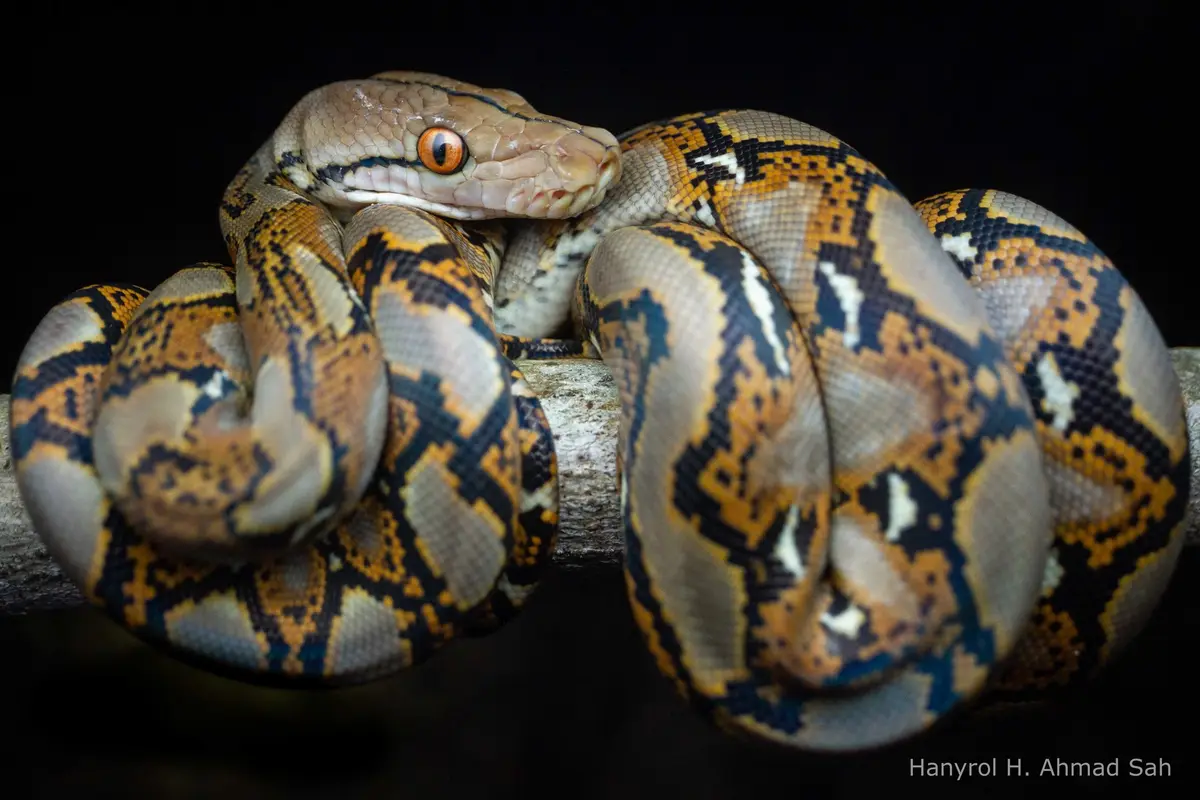
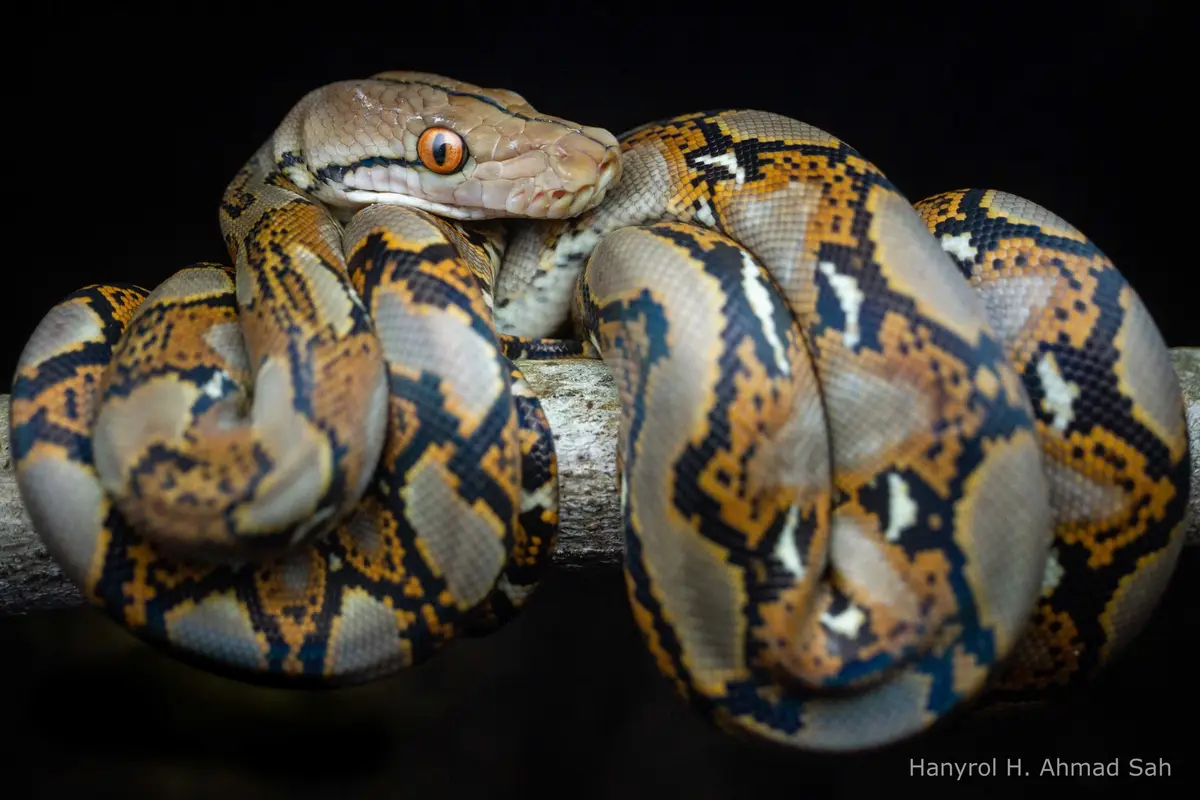
Reticulated python
Malayopython reticulatus · Non-venomous
The widespread form has 304-325 belly scales and 68-78 midbody rows, so its belly count is lower than a Selayer snake's, and it grows far longer. See our reticulated python guide.
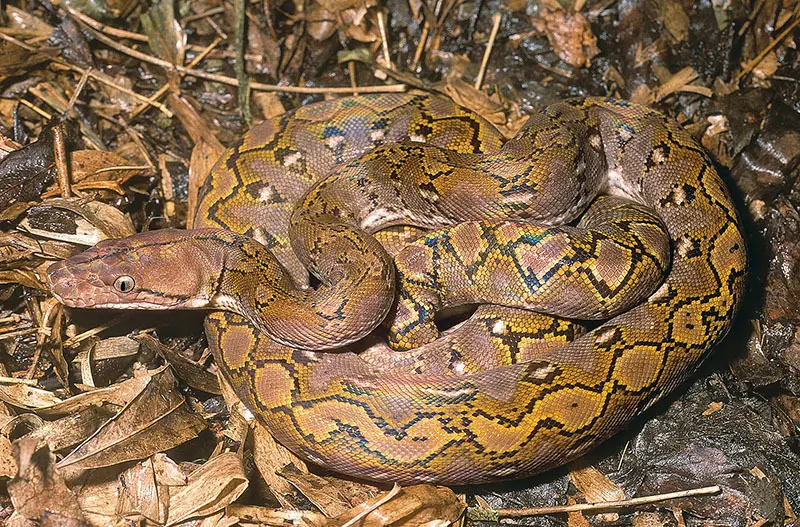
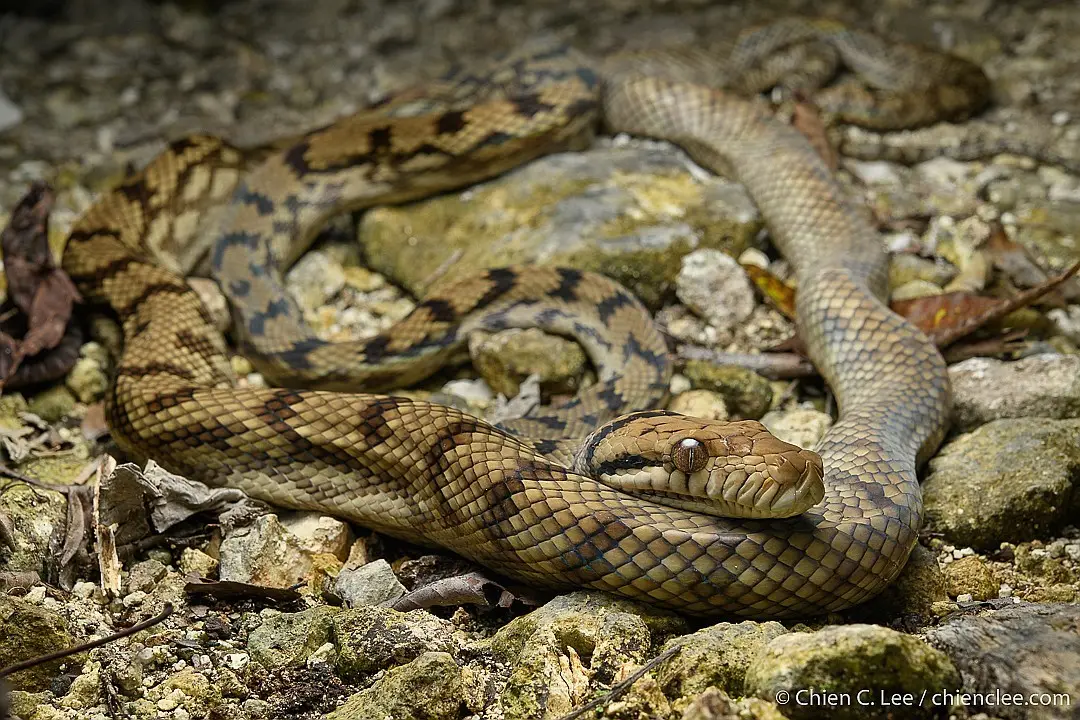
Kayaudi dwarf reticulated python
Malayopython reticulatus jampeanus · Non-venomous
The other island subspecies, from Tanahjampea. It is smaller still, with the lowest counts of the three: 290-301 belly scales and 64-68 midbody rows. DNA ties it to Sunda Island and mainland Southeast Asian snakes, not to Selayar's.
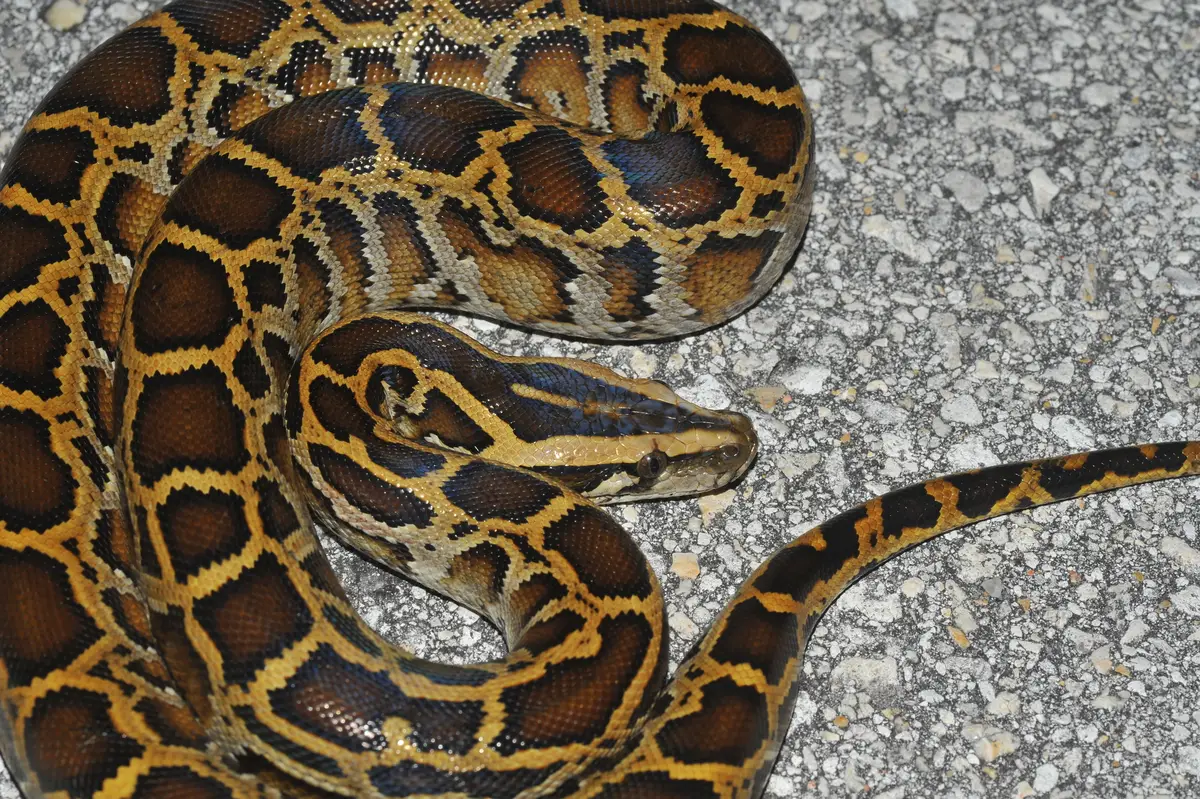 Photo: (c) Wayne Fidler, some rights reserved (CC BY-NC), uploaded by Wayne Fidler · via iNaturalist
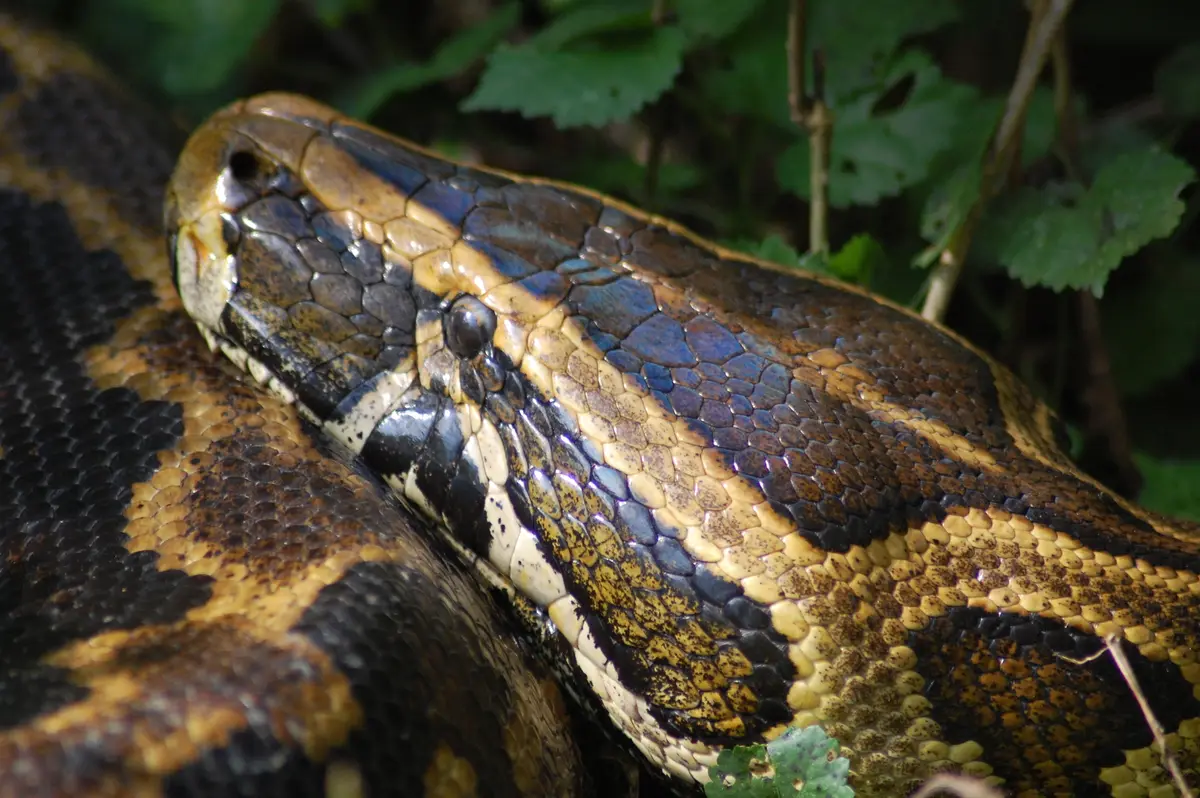
Burmese python
Python bivittatus · Non-venomous
Also found on Sulawesi, as the subspecies progschai, which the Reptile Database describes from the southwest. It is thicker for its length, with large dark blotches and no net pattern. See our Burmese python guide.
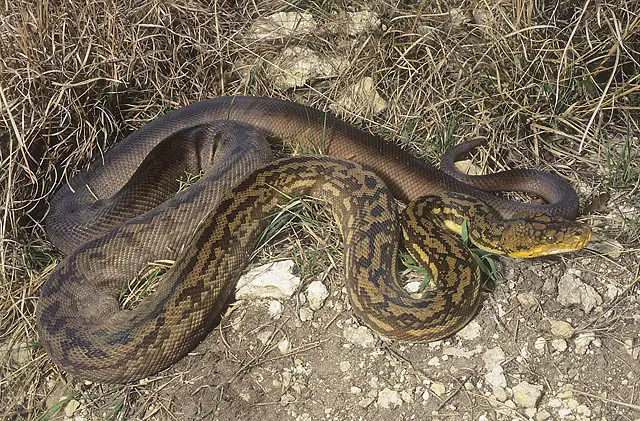
Timor python
Malayopython timoriensis · Non-venomous
The reticulated python's closest relative, but from the Lesser Sunda Islands, not Sulawesi. It is smaller, at 5-8 ft (1.5-2.4 m), and its pattern fades toward the middle, leaving the rear half plain brown. See our Timor python guide.
Kalaotoa, Madu and Karumpa snakes
Small retics from other Flores Sea islands are sold under locality names and are easy to mix up with Selayar stock. Hanifa and colleagues found these populations closer to the widespread form and to the Tanahjampea subspecies than to the Selayer reticulated python, which formed an exclusive group of its own. Kalaotoa snakes tend to be dark gray or silver, Madu snakes are yellowish and bright, and Karumpa snakes have a smaller pattern with varied color.
Reproduction
Reticulated pythons lay eggs, and the female stays with her clutch. Ecology Asia says clutches of 50 to 100 eggs are common in the species, though that reflects large snakes. Wild clutch counts for the Selayer reticulated python are missing. A much shorter female should lay fewer eggs, but nobody has put a number on it.
Hatchlings get no care after they leave the egg. Wikipedia, citing Mattison (1999), gives an average of 88 days to hatch at 88-90 F (31-32 C) for the species, with young of at least 2 ft (0.6 m).
Is the Selayer reticulated python endangered?
It is not listed as endangered, but the listing covers the whole species. The IUCN rates Malayopython reticulatus as Least Concern, and this page found no separate rating for the subspecies. A status based on a range stretching from South Asia to the Philippines says little about one island population.
| Authority | Status |
|---|---|
| IUCN Red List | Least Concern (species Malayopython reticulatus) |
| CITES | Appendix II; international trade needs permits |
| United States | Injurious wildlife under the Lacey Act since 2015; live imports banned |
Trade is the main pressure. Murray-Dickson and colleagues (2017) report that about 350,000 skins are exported each year, that South Sulawesi had Indonesia's highest provincial quota in 2016, and that trade in this subspecies has outnumbered the provincial quotas for Sumatra and Kalimantan. They argue that distinct lineages should be weighed when quotas are set. The Sulawesi snakes in their study carried haplotypes found nowhere else, and they suggest two of these may belong to this subspecies.
Nobody has shown how Selayar's snakes are holding up. Natusch and colleagues (2016) concluded that the skin harvest in Sumatra "appears to be sustainable", but that study does not cover Selayar. Farther out in the Flores Sea, a Mohamed bin Zayed fund project recorded collectors taking hundreds of pythons a year from Madu and Kalaotoa and selling them to buyers on Selayar. The project asked for quotas set apart from those for mainland populations.
Hanifa and colleagues raise another concern: keepers can crossbreed isolated populations without knowing it, which muddles identification later. Buyers in the "dwarf" retic market should ask for clear locality records.
Selayer reticulated python FAQ
Is the Selayer reticulated python venomous?
No. The Selayer reticulated python has no venom and kills its prey by constriction, like every other python. Its teeth are sharp and curve backward, so a bite can bleed and leave deep cuts. Wash it well and see a doctor if it is deep. If you cannot identify a snake that bit you in Indonesia, treat it as venomous and get medical help.
How big does a Selayer reticulated python get?
About 13 feet (4 m) at most, according to the figure attributed to the 2002 description by Auliya and colleagues. Measured records from wild Selayar snakes are scarce, so that number is best read as reported. On nearby Kalaotoa, Madu and Karumpa, Hanifa and colleagues found snakes over 10 feet (3 m) to be very rare.
Is the Selayer reticulated python a true dwarf?
On the island, it is usually described that way. The caveat is geography. The Reptile Database also places this subspecies in southwestern Sulawesi, and the longest measured wild snake on record, 23 feet 8 inches (7.22 m), came from Maros in that region. Guinness did not name a subspecies, so the link is unproven, but dwarf is not a safe label for every snake there.
Where is Selayar Island?
Selayar is an Indonesian island in the Flores Sea, off Cape Bira at the southwestern tip of Sulawesi. It is more than 50 miles (80 km) long and narrow, and the Selayar Straits separate it from the mainland. It is the type locality of this subspecies, which was described in 2002, and the spelling Salayar is also used.
How do you tell a Selayer retic from other reticulated pythons?
Reliably, by locality and scale counts rather than by looks. It has 330-334 belly scales and 77-81 midbody rows, against 304-325 and 68-78 in the widespread form and 290-301 and 64-68 in the Tanahjampea form. Those figures come from Hanifa and colleagues (2016). Most keepers will rely on a breeding record that traces back to Selayar.
Are Selayer reticulated pythons good pets?
They suit only experienced keepers. Even a small retic is a strong snake with a hard bite, and at up to about 13 feet (4 m) it needs a large enclosure. Rules vary, so check them first: the US lists reticulated pythons as injurious wildlife, and our reticulated python guide covers federal and Florida law. Ask for locality records, because crossbred animals are a known problem.
Related snakes
Sources
- Reptile Database: Malayopython reticulatus, including subspecies saputrai
- Auliya, Mausfeld, Schmitz and Böhme 2002, Review of the reticulated python with the description of new subspecies from Indonesia (Naturwissenschaften; abstract read)
- Hanifa, Nugraha, Nanda and Daryono 2016, Phylogenetic analysis of Malayopython reticulatus from Southern Sulawesi (AIP Conference Proceedings)
- Murray-Dickson et al. 2017, Phylogeography of the reticulated python (PLoS ONE)
- Natusch et al. 2016, Jungle giants: assessing sustainable harvesting in a difficult-to-survey species (PLoS ONE)
- Guinness World Records: Indonesian python is the longest measured wild snake (2026)
- Ecology Asia: Reticulated python
- Mohamed bin Zayed Species Conservation Fund: Reticulated python project