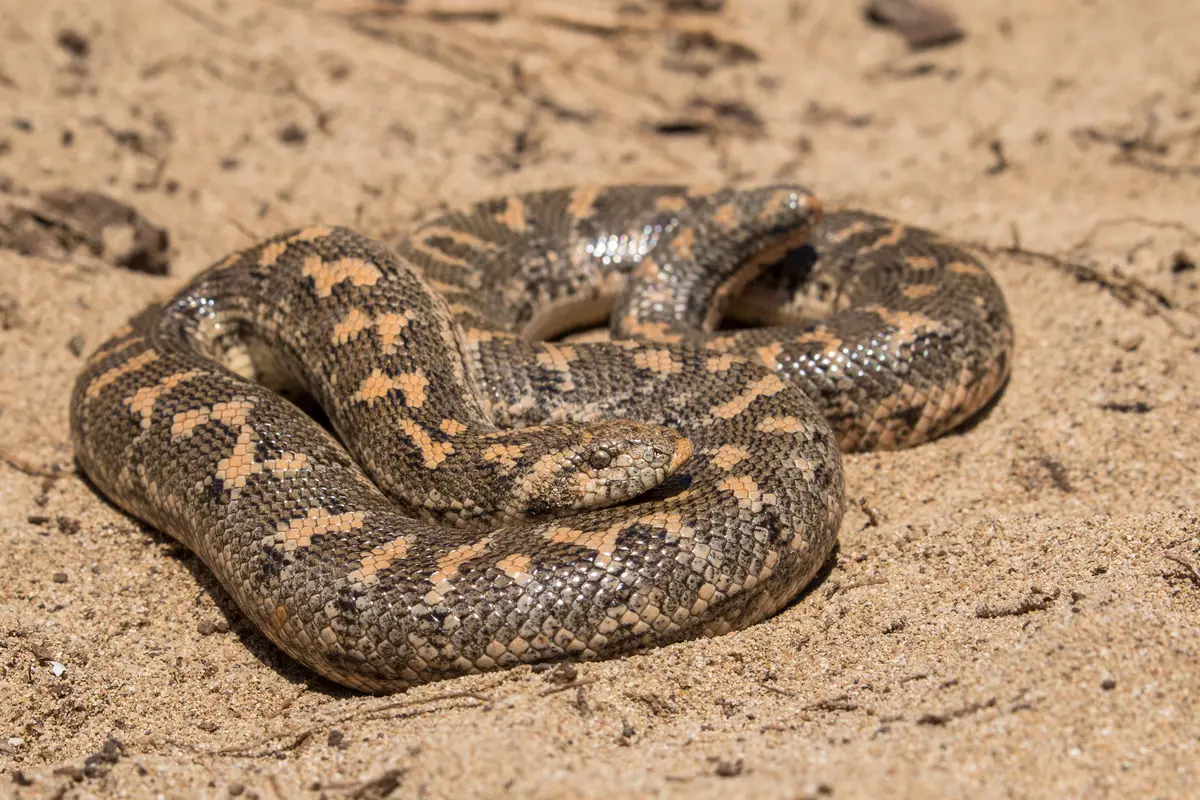
JAVELIN SANDBOA
Eryx jaculus · Family Boidae
KEY TAKEAWAYS
The javelin sand boa (Eryx jaculus) is a small, non-venomous sand boa that lives under loose soil in North Africa, the Middle East, Turkey, the Caucasus and southeastern Europe. It is harmless to people, and it is one of the few boas found anywhere in Europe.
- Adults are short and thick: Sicilian females average about 16 in (40 cm) from snout to vent, and the largest snakes reach about 31 in (80 cm) in total length.
- It is not venomous. It kills mice and lizards by squeezing them.
- It spends most of its time buried and is mostly active at night, so even common populations go unseen for decades.
- The IUCN Red List rates it Least Concern, but it is rare and declining at the edges of its range in Romania, Bulgaria and North Macedonia.
Javelin sand boa quick facts
| Common name | Javelin sand boa |
|---|---|
| Scientific name | Eryx jaculus (Linnaeus, 1758) |
| Family | Boidae, subfamily Erycinae (some authors use a separate family, Erycidae) |
| Venomous | No |
| Adult length | About 12-24 in (30-60 cm); maximum about 31 in (80 cm) total |
| Weight | Males 0.6-3.4 oz (18-95 g); females up to 7.2 oz (204 g) in Sicily |
| Range | North Africa, Middle East, Turkey, Caucasus, Balkans, southern Sicily |
| Habitat | Dry, open ground with sand, loam or loose soil among rocks; also farmland |
| Diet | Small mammals, lizard eggs, lizards |
| Reproduction | Live birth, 6-20 young in July-September |
| Conservation | IUCN Least Concern; Endangered in North Macedonia |
How to identify a javelin sand boa
A javelin sand boa is a short, round-bodied snake with no visible neck and a stubby tail. It looks thick for its length. Color varies a lot from place to place, so body shape and head scales are the better clues.
- 1Small head, no neck: the head is not set off from the neck and is covered in small, irregular, smooth scales instead of large plates, according to the Reptile Database genus description. The snout ends in a very large rostral scale used for digging.
- 2Tiny eyes with slit pupils: the eyes are small and have vertical pupils. A viper also has slit pupils, so use the other features too.
- 3Blotched back: the base color is orange, sand or yellowish in Sicily, and gray, tan or brown in other places. Dark brown blotches or crossbars cover the back, from a few narrow bars to a dense dark pattern with only small pale patches left.
- 4Short, blunt tail: the tail is short and ends bluntly. Males have longer tails than females and small spurs beside the vent, the remains of hind legs.
- 5Pale, speckled belly: the belly is usually pale yellowish orange or cream with small blackish spots. The belly scales are much narrower than in most snakes.
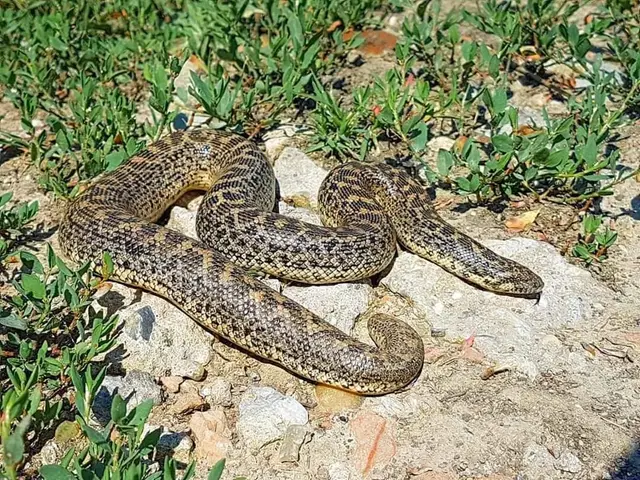
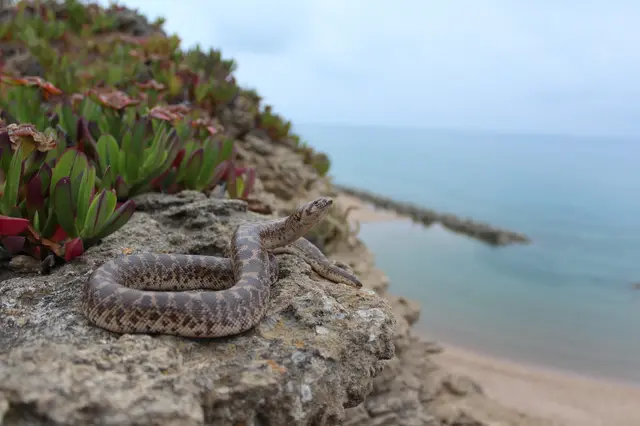
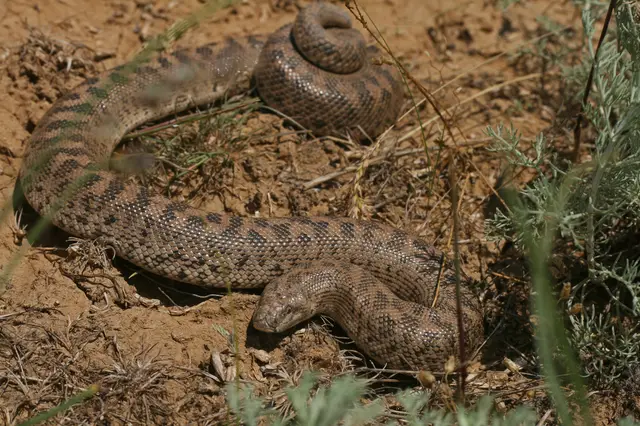
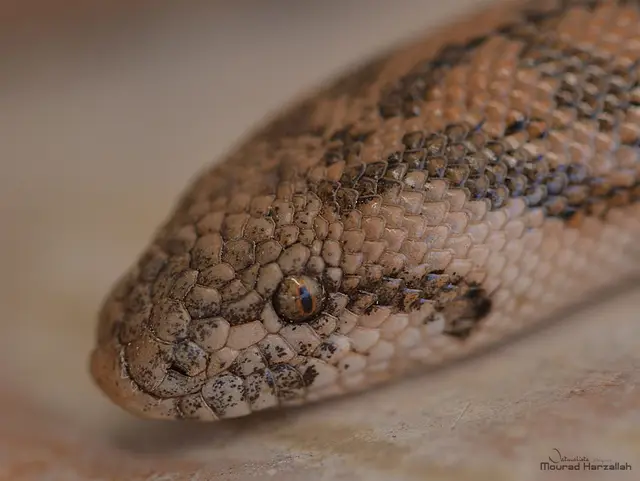
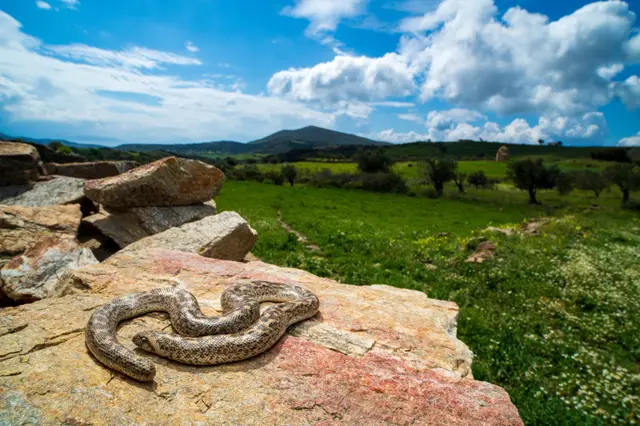
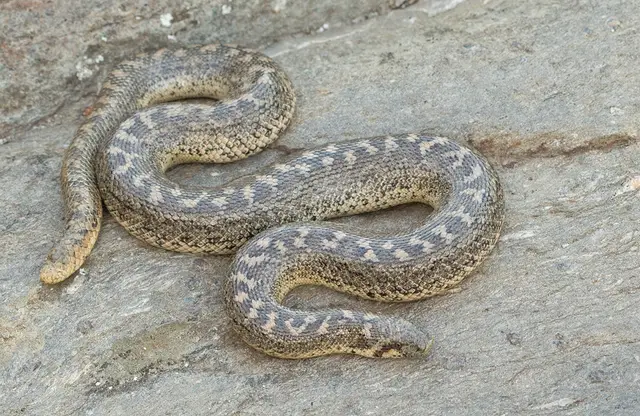
Young snakes are paler than adults, with less contrast in the dark pattern. A 2019 study of 96 Sicilian snakes in Acta Herpetologica found no difference in color pattern between males and females.
How big do javelin sand boas get?
Javelin sand boas are small: most adults are 1-2 ft (30-60 cm) long, and a big one is about 31 in (80 cm). Females grow larger and heavier than males. The best measurements come from Sicily, where researchers measured adults between 2014 and 2018.
| Sicilian adults | Snout-vent length | Weight |
|---|---|---|
| Males (average) | 13.5 in (342 mm) | 1.3 oz (37 g) |
| Males (range) | 10.6-16.5 in (270-420 mm) | 0.6-3.4 oz (18-95 g) |
| Females (average) | 15.8 in (400 mm) | 2.3 oz (64 g) |
| Females (range) | 10.6-22.8 in (270-580 mm) | 0.5-7.2 oz (15-204 g) |
The tail adds only a little. In that study, any snake under 10.6 in (270 mm) from snout to vent was treated as a juvenile. Reports of total length from other parts of the range fall between 20 and 31 in (50-80 cm).
Where do javelin sand boas live?
Short answer: North Africa from Morocco to Egypt, the Middle East east to Iran, Turkey, the Caucasus, and southeastern Europe from Greece and Albania to Romania, plus one small area of southern Sicily. The Reptile Database lists Israel, Jordan, Syria, Iraq, northern Saudi Arabia, Armenia, Georgia, Azerbaijan and southern Russia, and Greek islands such as Lesbos, Chios, Samos, Corfu and Milos. Compare it with other snakes on our world snake map.
The edges of the range in Europe
The European populations are small and patchy. In Romania the snake was known from only four places in Dobruja, south of the Danube, until a road-killed one turned up between Turnu Magurele and Corabia in September 2011, the first record north of the river, as Covaciu-Marcov and colleagues reported in Acta Herpetologica. A living snake was found near the Danube in 2014 after no confirmed live sightings in Romania since 1937.
In Italy it lives only in south-central Sicily. Zoologists confirmed a breeding population there in 2015, on a floodplain called La Piana near Licata and the Salso River, after locals had reported odd snakes on nearby beaches for about 80 years, ANSA reported. Later surveys found it between Palma di Montechiaro and Butera. Nobody knows for sure how it got there. One idea, suggested by Gianni Insacco of the Comiso Natural History Museum, is that ancient Greeks brought it, but that has not been tested.
Habitat
The javelin sand boa needs ground it can dig into. The National Red List of North Macedonia describes its habitat there as dry, open areas with loam soil and rocks, plus farmland and rocky slopes where enough loose soil collects. In Bulgaria's Eastern Rhodopes it has been found in oak scrub on sandy, rocky soil. In Sicily it lives on a coastal floodplain of fields and greenhouses.
Farmland can be a trap. Of the 96 Sicilian snakes in the 2019 study, 16 were found stuck in abandoned water cisterns or a greenhouse tunnel, and four of those were dead.
Behavior: a snake that stays out of sight
Javelin sand boas spend most of their lives buried in loose soil and come out mainly at night. The Speybroeck et al. (2016) field guide to European reptiles lists it among the night-active snakes, and in Sicily about half of the 96 snakes in the 2019 study were found on night searches. They do sometimes move by day; two snakes in Bulgaria were found in early June at 11:45 and 17:00.
Roads kill many of them. A third of the Sicilian sample, 32 of 96 snakes, were road-kills, and some of the Romanian and Greek records are also dead snakes on roads. In Sicily the researchers treat March to October as the active season.
The name comes from the Latin iaculum, a javelin, and iacere, to throw. The Reptile Database says it refers to the snake's quick strike from cover.
What does the javelin sand boa eat?
Javelin sand boas eat mostly small mammals, plus lizard eggs and lizards. The only detailed diet study, by Faraone and colleagues in the Journal of Herpetology, checked 132 snakes in Sicily and found prey remains in 43% of them.
| Prey type | Found in |
|---|---|
| Small mammals | 71.4% |
| Lizard eggs | 30.2% |
| Lizards | 7.9% |
Diet changes with age. Adult females probably wait in ambush for mice, while juveniles hunt actively for lizard eggs buried in the soil. Feeding dropped in August, probably because of the heat, and rose again in September before winter. Like other boas, it grabs prey with its teeth and kills it by constriction.
Is the javelin sand boa venomous or dangerous?
No, the javelin sand boa is not venomous and is harmless to people. It looks a little like a viper. It is not one: it has no venom glands or fangs. It kills prey by squeezing it, and even a large female is far too small to hurt a person that way.
A bite from a handled snake leaves small pinpricks. Wash the bite with soap and water and watch it for infection. The real risk is a mix-up with a viper, since both have slit pupils and blotched backs. If you are not sure, leave the snake alone. Our snakebite FAQ covers first aid for any bite.
Snakes confused with the javelin sand boa
One of these is dangerous. If you find a short, blotched snake in the Balkans, check the snout first.
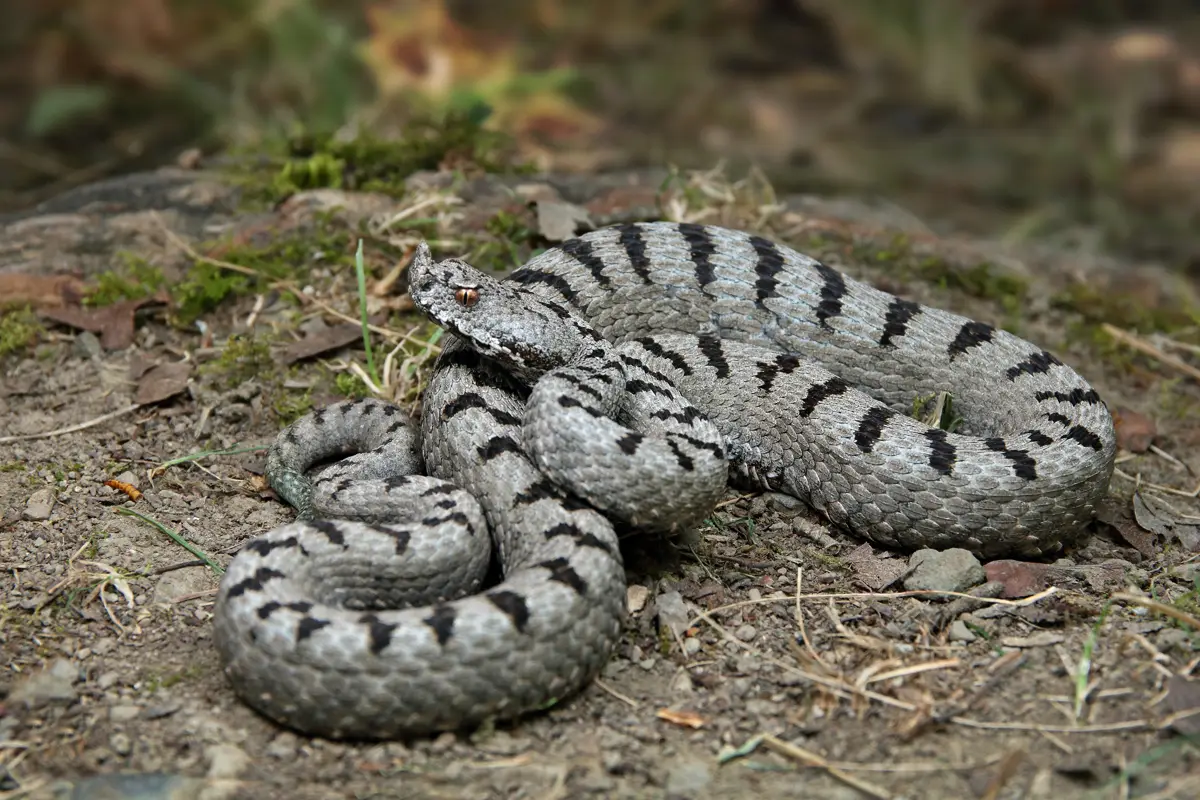
Nose-horned viper
Vipera ammodytes · Venomous
Shares the Balkans, Romania, Bulgaria and Greece with the javelin sand boa. It has a soft horn on the tip of the snout, a dark zigzag stripe down the back, and a triangular head clearly wider than the neck. A sand boa has no horn, no zigzag, and no neck.
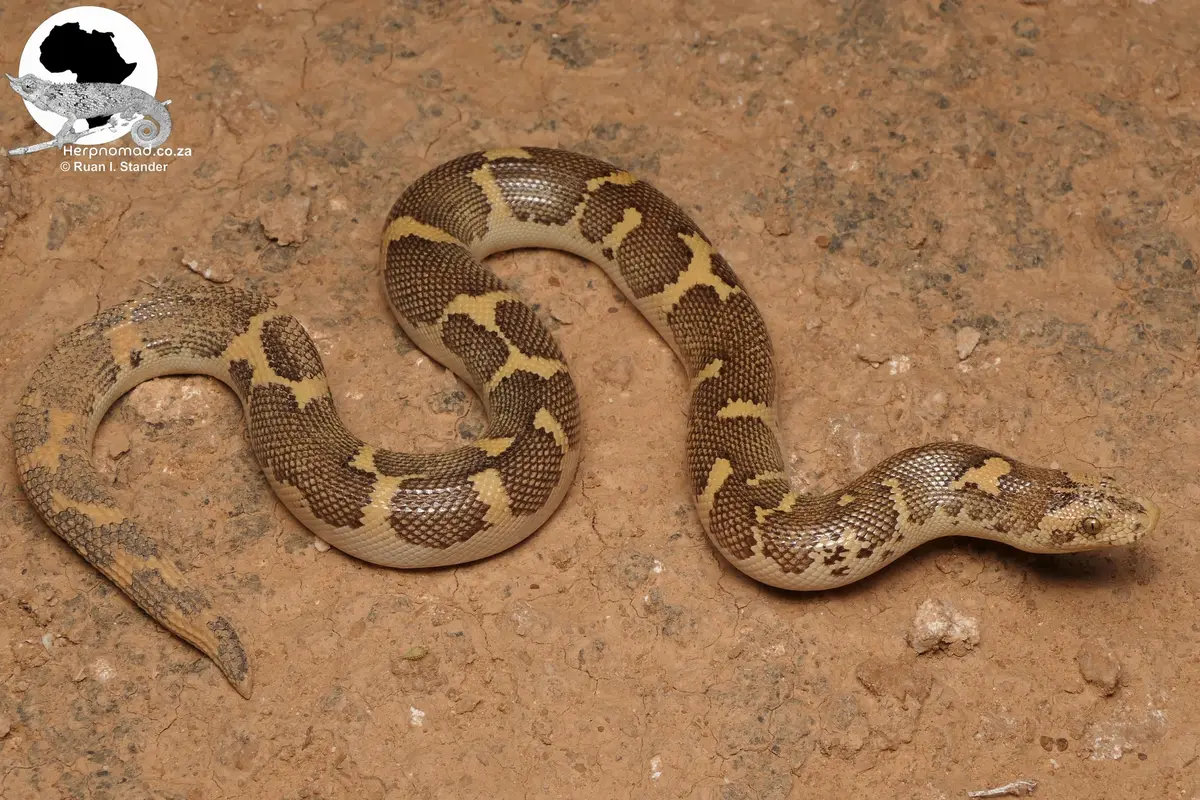
Kenyan sand boa
Eryx colubrinus · Harmless
A close relative from northeastern Africa and the sand boa most often seen in pet shops. It is orange or yellow with dark blotches, and it does not overlap with the javelin sand boa in the wild. See our sand boa guide for all 13 species.
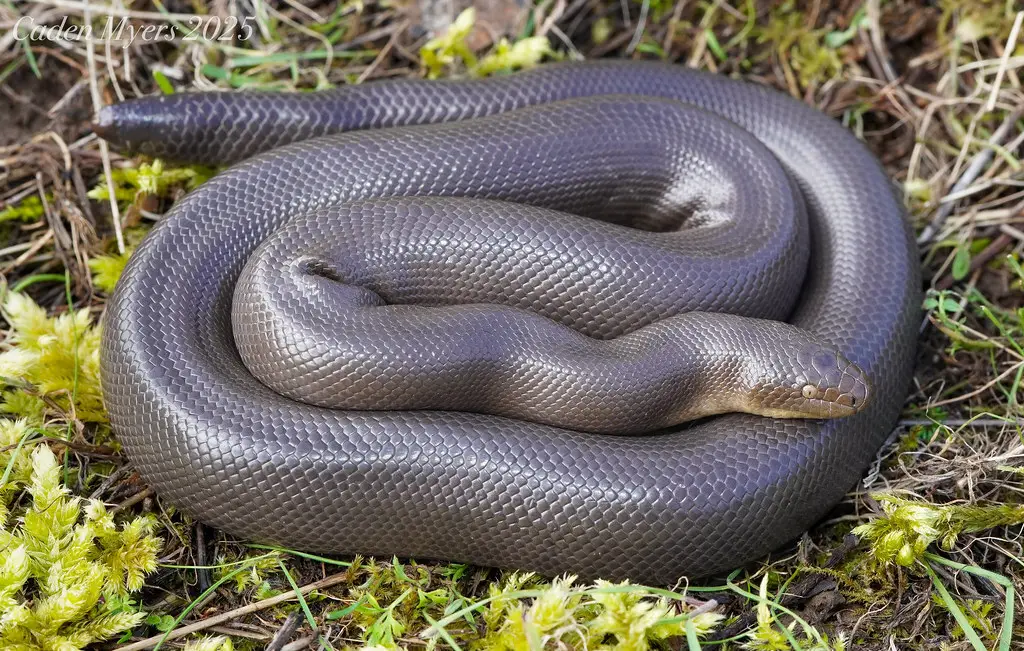
Rubber boa
Charina bottae · Harmless
North American readers may know the rubber boa of the western US, which has the same blunt, short-tailed shape. It is plain brown or olive with no blotches and lives only in North America. Its southwestern relative, the rosy boa, has lengthwise stripes instead of blotches.
Reproduction
Javelin sand boas give birth to live young instead of laying eggs. In North Macedonia, females give birth to 6-20 young between July and September, according to the national Red List. The Sicilian study suggests that bigger bodies let females carry more young, which may be why they outgrow the males.
Conservation status
| Authority | Status |
|---|---|
| IUCN Red List (2021) | Least Concern |
| North Macedonia national Red List (2019) | Endangered, population decreasing |
| EU Habitats Directive | Annex IV (strictly protected) |
| Bern Convention | Annex II |
| CITES | Appendix II (trade needs export permits) |
Across its whole range the javelin sand boa is widespread and not at risk. Europe is different. In North Macedonia it occupies only about 17 sq mi (44 sq km), recent records all come from south of Gradsko, and none have been found farther north for more than 30 years. The main threats there are intensive farming and the planting of conifers and acacias on its bare, open habitat. In Bulgaria it is one of the country's rarest reptiles, although one slope south of Asenovgrad held at least 28 snakes in a 2023 survey.
Javelin sand boa FAQ
Is the javelin sand boa venomous?
No. The javelin sand boa has no venom glands or fangs. It is a small constrictor that grabs mice and lizards with its teeth and squeezes them. A bite from a handled snake leaves only shallow pinpricks. Wash it with soap and water. The main danger is mistaking a venomous viper for a sand boa, so check the head before touching any snake.
How big does a javelin sand boa get?
Most adults are 1-2 ft (30-60 cm) long, and the largest reach about 31 in (80 cm). Females are bigger. In Sicily, adult females averaged 15.8 in (400 mm) from snout to vent and up to 22.8 in (580 mm), while males averaged 13.5 in (342 mm). Females weighed up to about 7 oz (204 g).
Where does the javelin sand boa live?
It lives in North Africa from Morocco to Egypt, the Middle East east to Iran and northern Saudi Arabia, Turkey and the Caucasus, and southeastern Europe, including Greece, Bulgaria, Romania, North Macedonia and Albania. There is also a small population in southern Sicily, the only boa in Italy. It does not live in the Americas.
Are there boas in Europe?
Yes, a few. The javelin sand boa is the main European boa, found in Greece, the Balkans, Romania and southern Sicily. The related desert sand boa reaches southern Russia. Both are small burrowing snakes and harmless to people. Europe has no large boas or pythons in the wild.
What does a javelin sand boa eat?
Mostly small mammals such as mice, plus lizard eggs and lizards. A study of 132 wild snakes in Sicily found small mammals in 71.4% of the samples that held prey, lizard eggs in 30.2% and lizards in 7.9%. Adult females tend to ambush mice, while young snakes dig up lizard eggs.
Why is it called a javelin sand boa?
Its scientific name, jaculus, comes from the Latin iaculum, meaning javelin, and iacere, to throw. According to the Reptile Database, the name refers to the snake's fast strike when it lunges at prey from under the sand. Carl Linnaeus named it in 1758. The reference specimen was collected at Rosetta, in Egypt's Nile Delta, in 1750.
Related snakes
Sources
- Reptile Database: Eryx jaculus
- IUCN Red List: Eryx jaculus (2021)
- Faraone et al. (2019), Morphological variation of the javelin sand boa in Sicily, Acta Herpetologica 14(2)
- Faraone et al. (2021), Food habits of the javelin sand boa in Sicily, Journal of Herpetology 55(4)
- Covaciu-Marcov et al. (2012), Eryx jaculus north of the Danube, Acta Herpetologica 7(1)
- National Red List of North Macedonia: Eryx jaculus
- ANSA: Javelin sand boa discovered in Sicily
- iNaturalist: Javelin sand boa observations