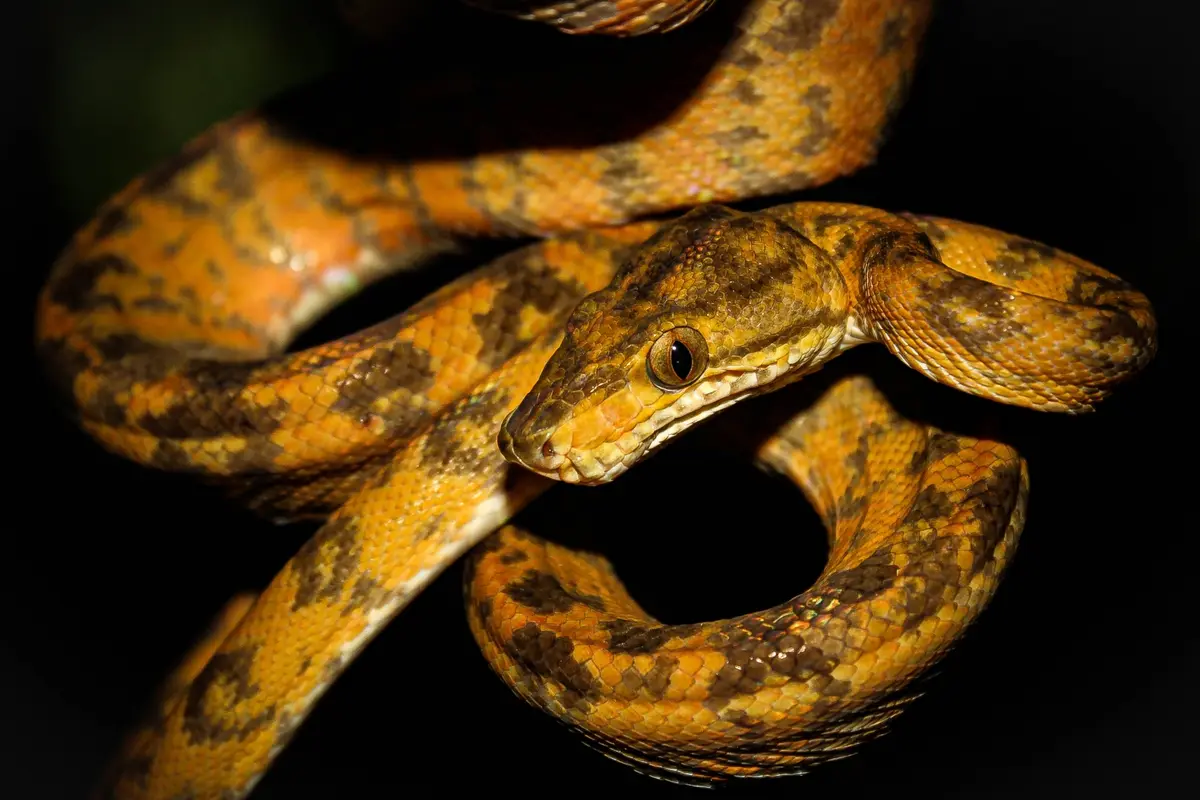
AMAZON TREEBOA
Corallus hortulana · Family Boidae
KEY TAKEAWAYS
The Amazon tree boa (Corallus hortulana) is a slender, tree-living boa found across the Amazon Basin, the Guianas and eastern Brazil. It is not venomous and poses no real danger to people, but it bites fast and its long front teeth draw blood.
- It is not venomous. It kills birds, rodents, bats and lizards by constriction.
- Most adults are 4 to 5 ft (1.2 to 1.5 m) long; the longest on record is about 6.2 ft (1.88 m).
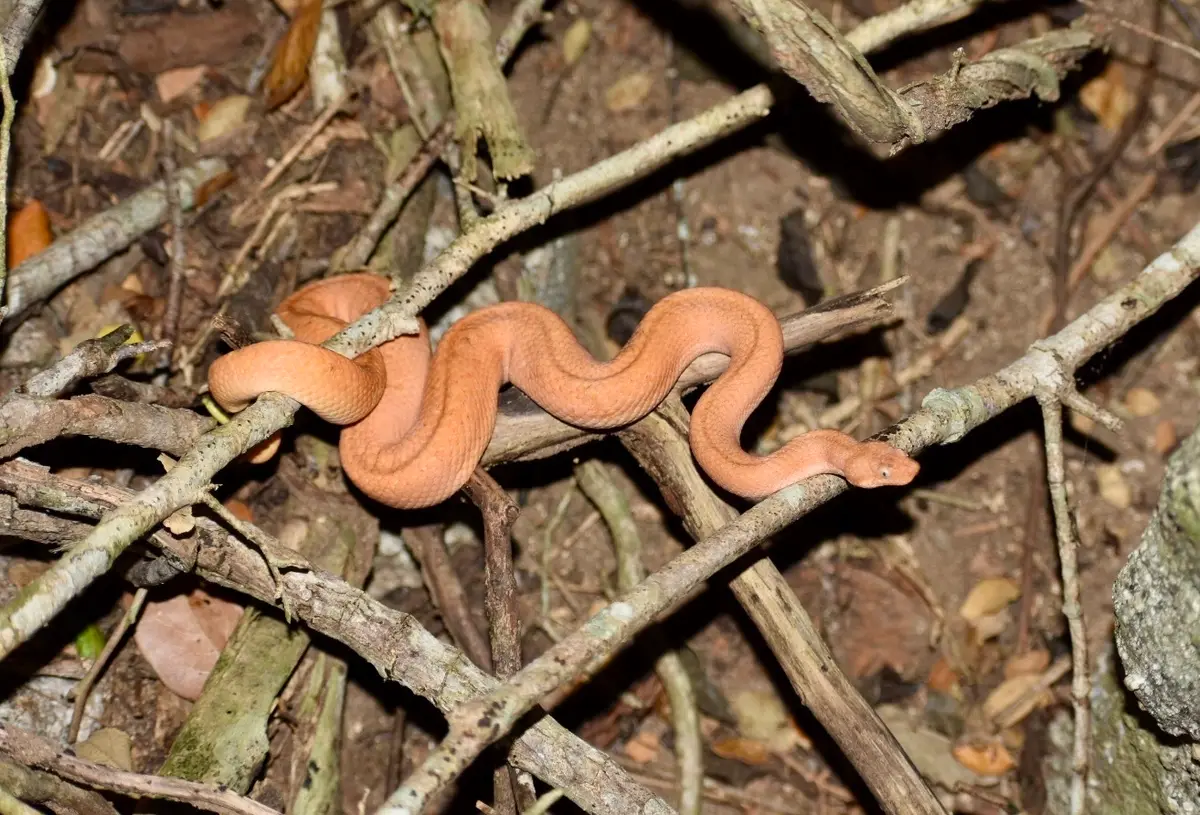
- Color varies more than in almost any other snake: black, gray, brown, yellow, orange and red snakes all occur, often in the same forest.
- The IUCN rates it Least Concern, and it is one of nine species of tree boa in the genus Corallus.
Amazon tree boa quick facts
| Common name | Amazon tree boa, garden tree boa, common tree boa |
|---|---|
| Scientific name | Corallus hortulana (Linnaeus, 1758); older books spell it hortulanus |
| Family | Boidae (boas), subfamily Boinae |
| Venomous | No, a constrictor |
| Adult length | Usually 47-59 in (1.2-1.5 m); record about 74 in (1.88 m) |
| Weight | Light for its length; a 5.3 ft (1.62 m) wild snake weighed 1.4 lb (650 g) |
| Range | Colombia east of the Andes, southern Venezuela, the Guianas, Ecuador, Peru, northern Bolivia and much of Brazil |
| Habitat | Rainforest, flooded forest, dry forest, savanna edges and riverbanks, sea level to about 2,950 ft (900 m) |
| Diet | Birds, rodents, bats, opossums, lizards and treefrogs |
| Reproduction | Live-bearing, 2-29 young per litter |
| Conservation | IUCN Least Concern (2016); CITES Appendix II |
How to identify an Amazon tree boa
An Amazon tree boa is a long, thin snake with a big, wide head on a narrow neck, a body that looks slightly flattened from side to side, and a gripping tail. Color is the least useful clue. Reptiles of Ecuador lists yellow, gray, greenish gray, brown, taupe, pink, orange tan, reddish brown and black backgrounds, usually marked with a row of dark or pale oval blotches down each side.
- 1Head much wider than the neck: the head is broad at the back and looks oversized for the thin neck behind it.
- 2Pits along the lips: rows of heat-sensing pits sit between the lip scales. A pit viper has one larger pit on each side between the eye and the nostril instead.
- 3Dark stripes behind the eyes: most have five dark stripes running back from the eyes, according to Animal Diversity Web. The tongue is black.
- 4Eyeshine at night: the eyes are yellowish, gray or reddish and glow back in a flashlight beam, which is how most people find them after dark.
- 5Prehensile tail and spurs: the tail wraps tightly around twigs, and small claw-like spurs on each side of the vent are the remains of hind legs, as in all boas.
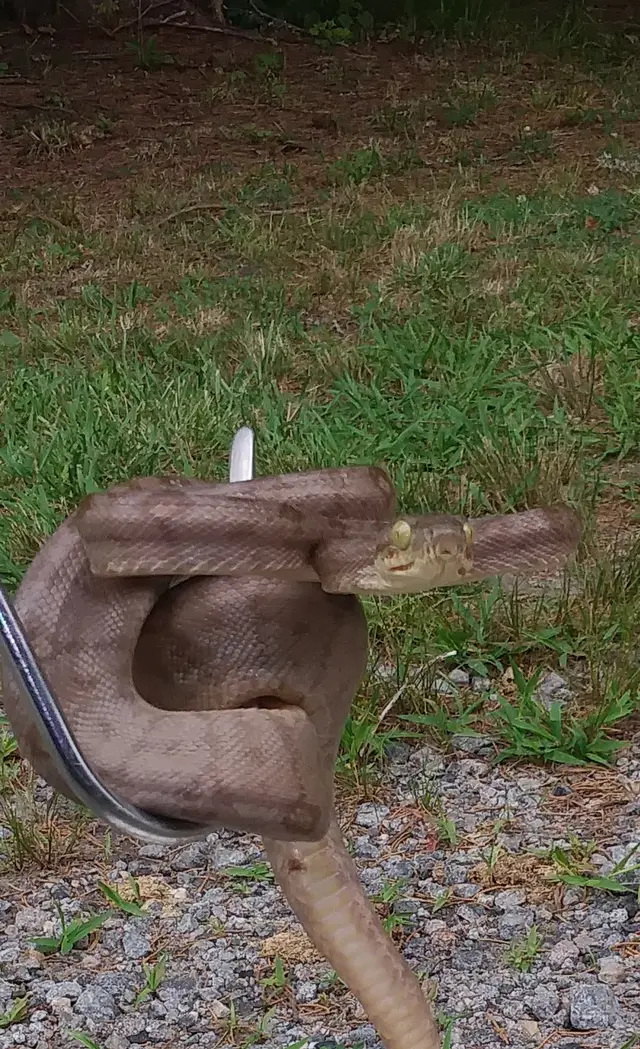
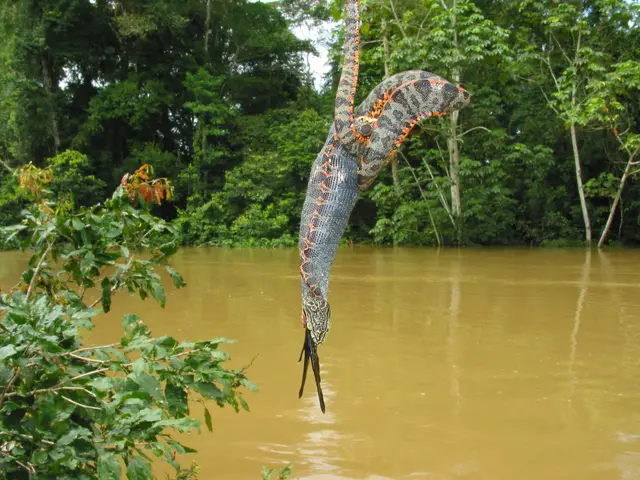
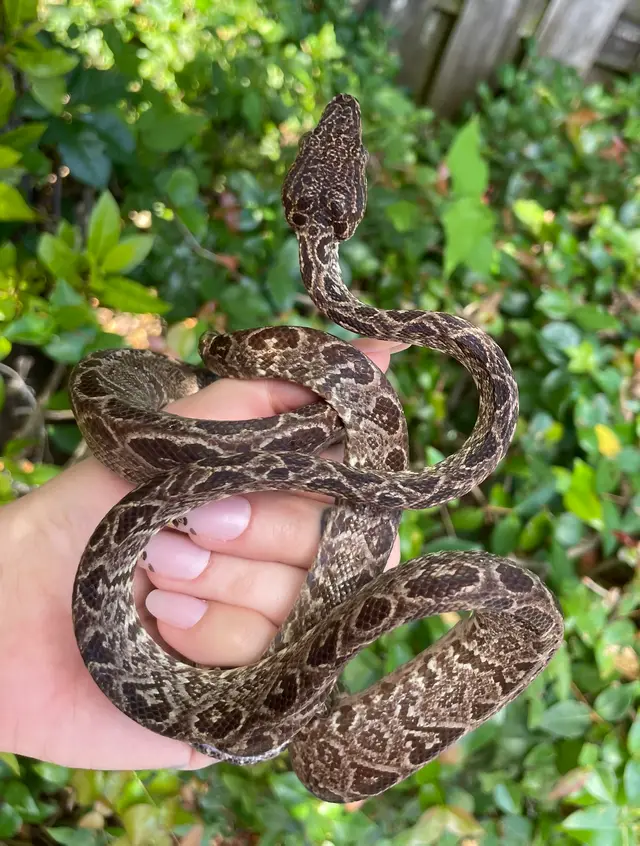
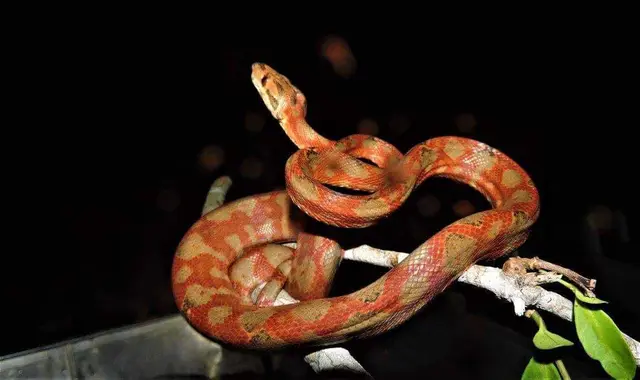
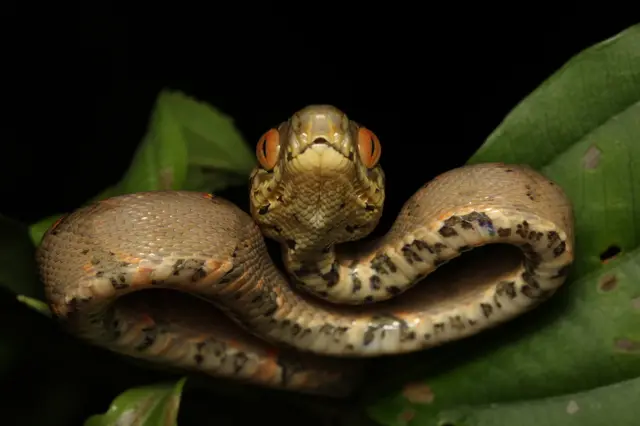
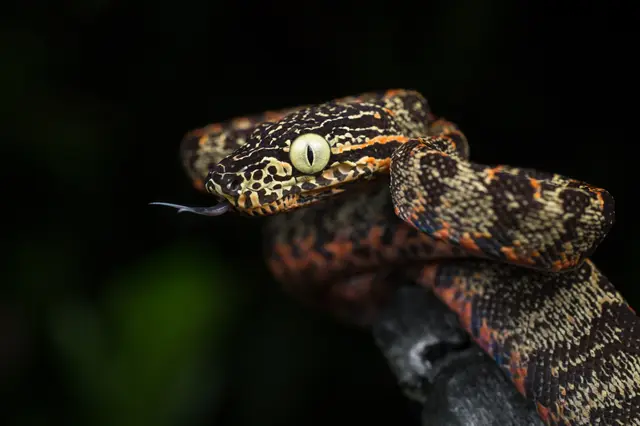
Keepers often split them into a drab "garden phase" and a bright "colored phase" of red, orange and yellow snakes. Those are trade labels, not subspecies. The Reptile Database follows Reynolds and Henderson (2018) in recognizing no subspecies at all.
How big do Amazon tree boas get?
Most adult Amazon tree boas are 4 to 5 ft (1.2 to 1.5 m) long. Animal Diversity Web gives a full range of 20.7 to 74 in (52.5 to 188 cm) and says males and females are about the same size. Reptiles of Ecuador lists the longest known male at 164.3 cm (5.4 ft) and the longest female at 187.6 cm (6.2 ft).
They are built light: a wild snake in Brazil with a 5.3 ft (1.62 m) body weighed 1.4 lb (650 g), far less than a boa constrictor of that length.
| Measure | Figure | Source |
|---|---|---|
| Typical adult length | 47-59 in (1.2-1.5 m) | Animal Diversity Web |
| Longest male | 64.7 in (164.3 cm) | Reptiles of Ecuador |
| Longest female | 73.9 in (187.6 cm) | Reptiles of Ecuador |
| Newborns | 11-25 in (28.2-64.4 cm) | Reptiles of Ecuador |
| Wild adult weight example | 1.4 lb (650 g) at 5.3 ft body length | Ribeiro-Junior et al. 2016 |
Where do Amazon tree boas live?
Short answer: Amazon tree boas live east of the Andes in South America, through the Amazon Basin and the Guianas and south along the Atlantic side of Brazil to Rio de Janeiro state. They do not live in the United States, Central America or the Caribbean.
The Reptile Database lists southern Colombia, southern Venezuela, Guyana, Suriname, French Guiana, Ecuador, Peru and the Beni region of Bolivia, plus Brazilian states from Amazonas and Pará in the north to Bahia and Rio de Janeiro in the east. Animal Diversity Web puts the southern edge near the Tropic of Capricorn. In Ecuador it is the boa seen most often in the Amazon lowlands.
Older books also list it on Trinidad, St. Vincent and Grenada. Those island snakes are now treated as separate species, the St. Vincent tree boa and the Grenada Bank tree boa, and the Reptile Database notes the Amazon tree boa has not been recorded from Trinidad or Tobago. Compare its range with other snakes on the world snake map.
Habitat
The Amazon tree boa needs trees and little else. Reptiles of Ecuador records it in old-growth and lightly disturbed rainforest, both on dry ground and in seasonally flooded forest, and says it is most common along river and stream edges. It perches anywhere from 1 ft (0.3 m) to about 82 ft (25 m) up. Animal Diversity Web adds dry forest, scrub and savanna woodland. It also lives in human-altered habitat and sometimes enters houses near the forest.
Behavior
Amazon tree boas hunt at night. Reptiles of Ecuador found them most active between sunset and midnight and on moonless nights. By day they rest in a loose bundle of coils on a branch.
They hunt two ways: moving through the branches in search of prey, or sitting still and waiting. Adults rely more on waiting in ambush.
This is not a calm snake. Animal Diversity Web calls it "notoriously aggressive". Approached, it pulls its neck back into an S-coil and strikes, often several times. Handled, it may also ball up, release musk or regurgitate its last meal. Black caimans, dwarf caimans, hawks and owls all prey on it.
What do Amazon tree boas eat?
Amazon tree boas eat almost any small vertebrate they can catch in a tree, and they shift toward birds and mammals as they grow. Reptiles of Ecuador describes the diet as euryphagic, meaning very broad, and lists the prey below. Juveniles and subadults take frogs and lizards; adults take mostly birds and mammals.
| Prey | Examples on record |
|---|---|
| Frogs | Mostly treefrogs, eaten by young snakes |
| Lizards | Anoles, basilisks, young green iguanas, Ameiva whiptails |
| Birds | Roosting songbirds, including a white-banded swallow in Ecuador |
| Mammals | Rodents, bats, opossums, porcupines and small monkeys |
The biggest meal on record is a squirrel monkey. In 2016, Ribeiro-Junior and colleagues reported a tree boa in the Piratuba Lake Biological Reserve, in the northeastern Brazilian Amazon, finishing off a young adult female squirrel monkey that weighed 600 g (1.3 lb). The snake weighed 650 g, so the monkey was about 92% of its own weight. It was the first record of the species eating a New World monkey.
A 2017 note from Yasuní National Park in Ecuador added a swallow and a rice rat to the list. A 2013 study by Henderson, Pauers and Colston grouped the Amazon tree boa with the other slim, short-headed tree boas that take a wide range of prey, unlike the stout, long-headed emerald tree boa, which leans toward larger mammals.
Is the Amazon tree boa venomous or dangerous?
No, the Amazon tree boa is not venomous, and it is not dangerous to people. Like every member of the boa family, it has no venom glands and kills prey by squeezing. At under 2 m long and slim, it cannot constrict anything larger than a monkey or a bird.
Its bite is another matter. The long front teeth are built to reach through feathers and fur, and a defensive tree boa strikes fast and often. Bites bleed freely but are only puncture wounds. Wash with soap and water, keep the wound clean and see a doctor if it becomes red, hot or swollen over the next few days. Our snakebite FAQ covers first aid for any snake bite.
The real risk is mistaking a venomous pit viper for a tree boa. If you cannot tell which snake is in the branches, leave it there.
Snakes confused with the Amazon tree boa
Check the face first. A pit viper has one large pit on each side between the eye and the nostril. A tree boa has rows of smaller pits along its lips.
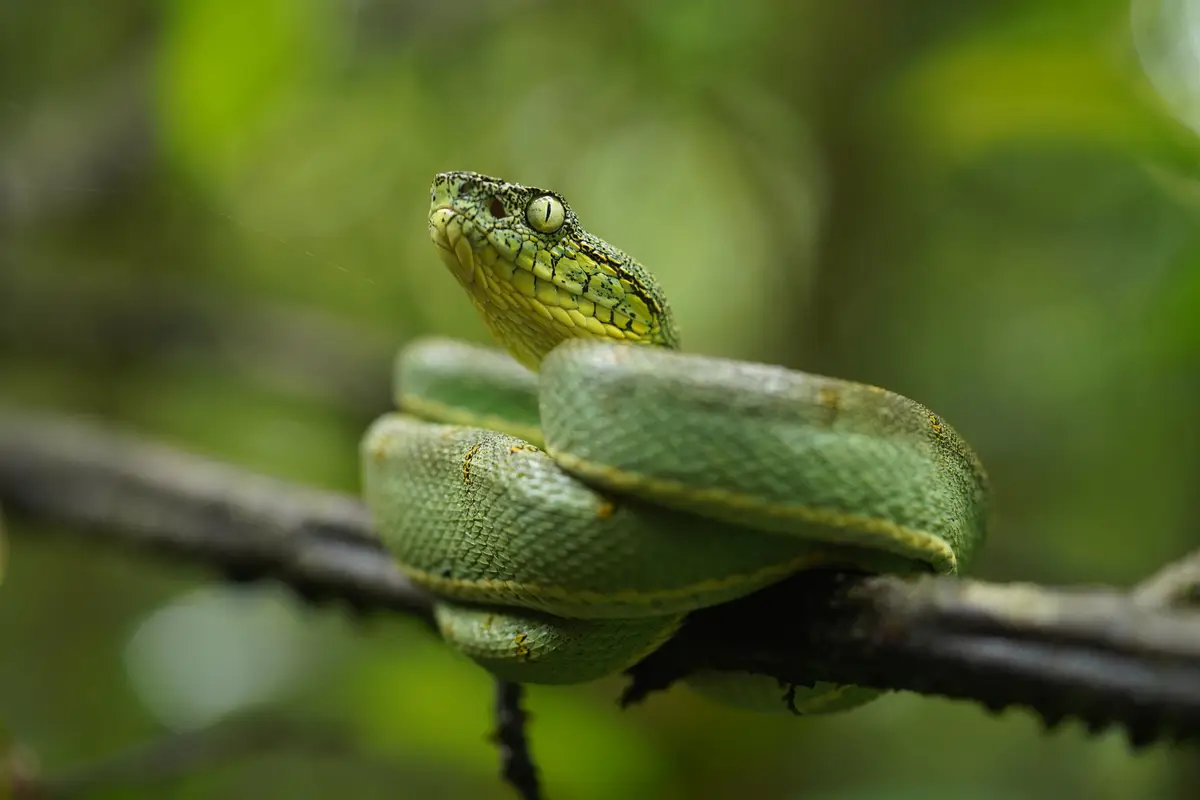
Two-striped forest pit viper
Bothrops bilineatus · Venomous
A green tree viper of the Amazon and the Atlantic Forest and a known cause of snakebite in the Amazon, per a 2021 review in Frontiers in Immunology. It is turquoise green with fine dark speckles, has keeled scales and is usually under 28 in (70 cm). An Amazon tree boa is rarely green and has smooth, glossy scales.
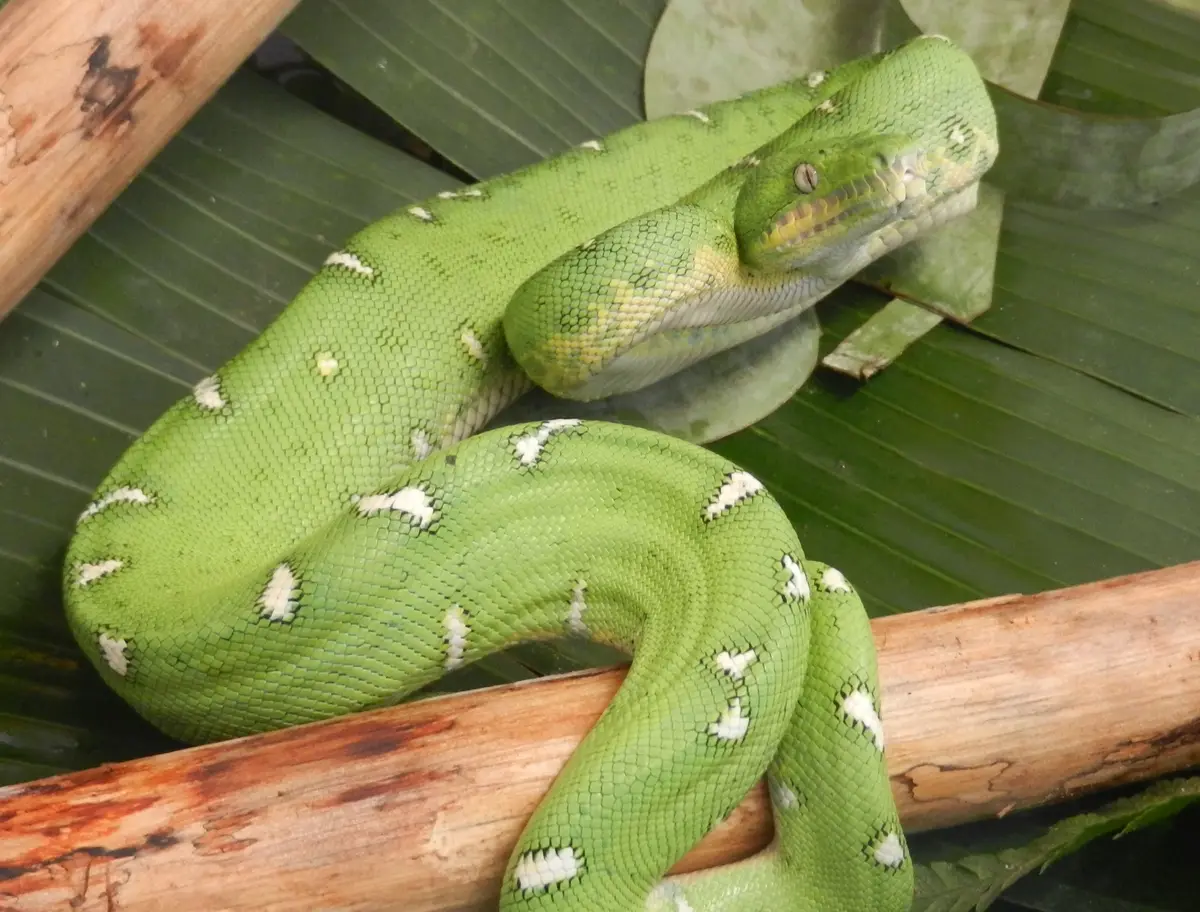
Amazon Basin emerald tree boa
Corallus batesii · Harmless
Shares much of the same range in the upper Amazon. Adults are bright green with white markings, and the young are orange-red, per Reptiles of Ecuador. An Amazon tree boa is slimmer, with a shorter head, and never turns solid green as an adult. The closely related emerald tree boa lives farther east in the Guianas.
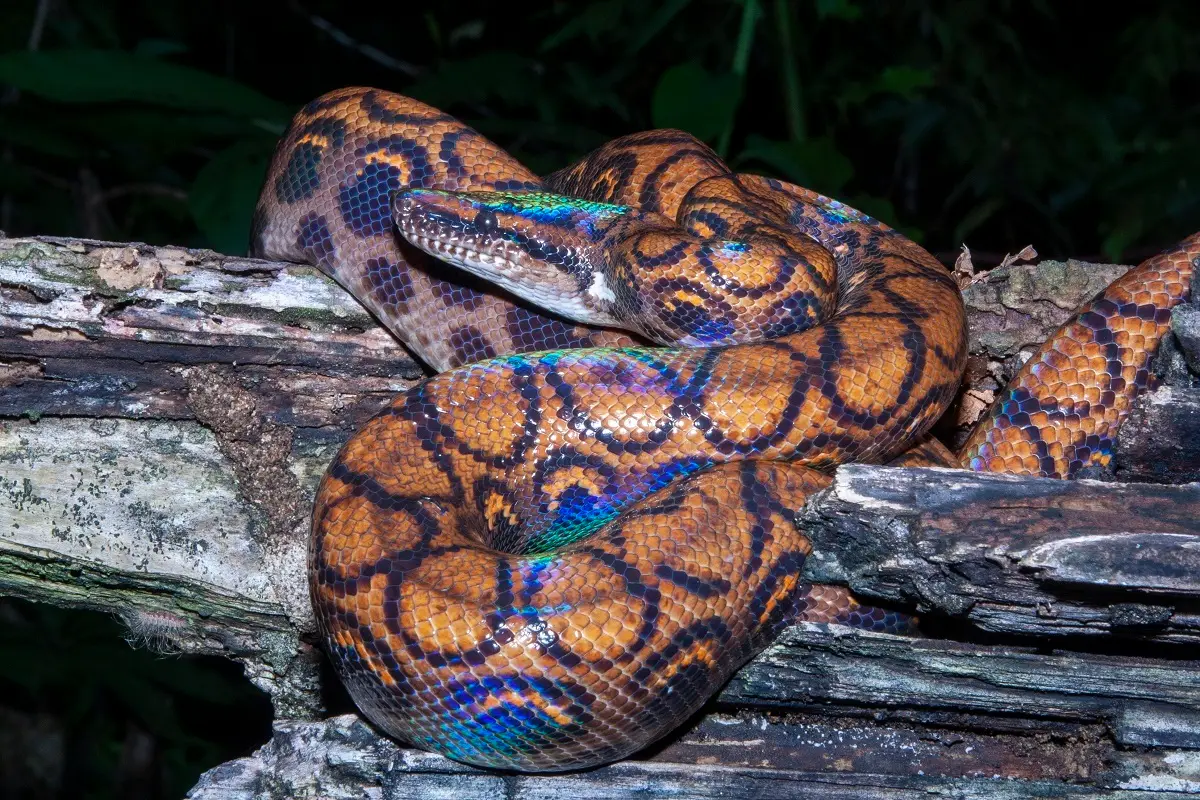
Rainbow boa
Epicrates cenchria · Harmless
The rainbow boa shares the same forests. It is heavier, spends more time on the ground, and has an iridescent orange sheen with round, dark-edged spots instead of the tree boa's oval blotches.
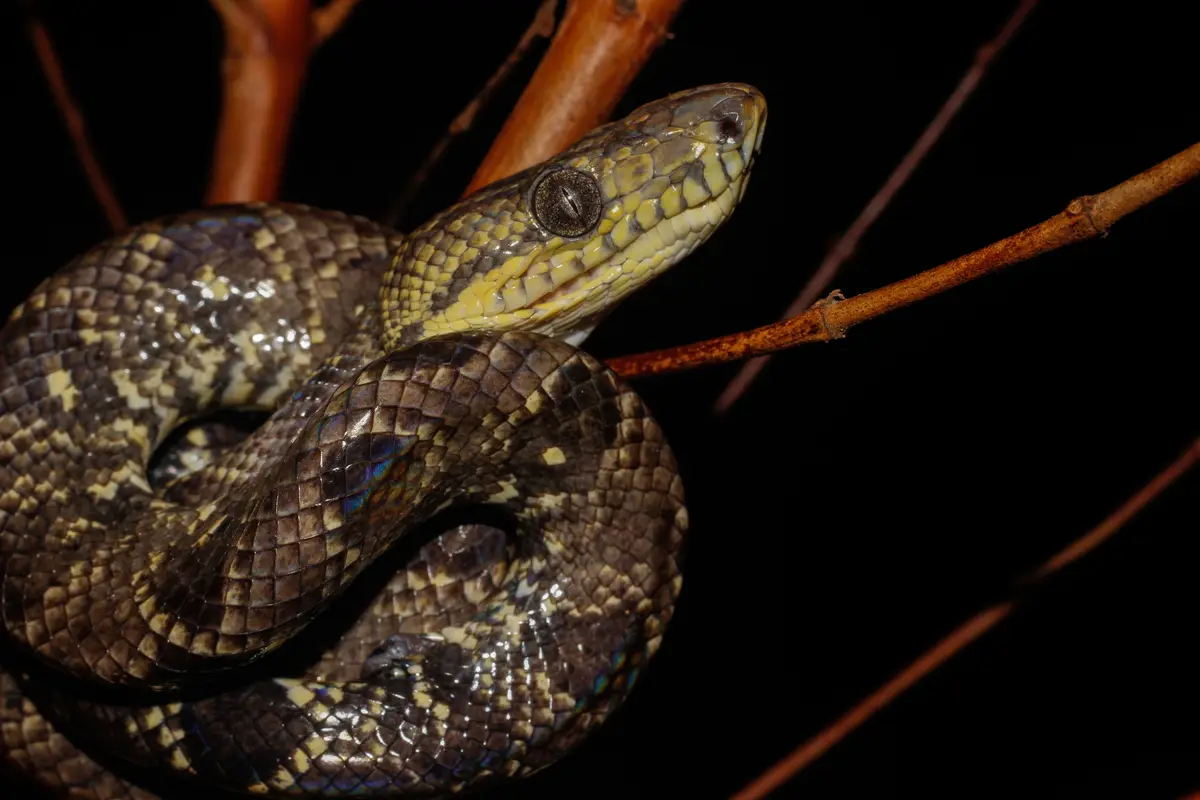
Central American tree boa
Corallus ruschenbergerii · Harmless
Lives farther north, from Costa Rica to northern Colombia, northern Venezuela and Trinidad. It is longer, sometimes over 6.5 ft (2 m), and adults are usually khaki green or brown with a yellow chin.
Reproduction and lifespan
Amazon tree boas give birth to live young. The eggs develop and hatch inside the mother over a gestation of about 6 to 7 months, and a litter holds anywhere from 2 to 29 babies, each 11 to 25 in (28.2 to 64.4 cm) long, according to Reptiles of Ecuador. Births are recorded mainly from January to June, plus November. The young are on their own from the start, and mothers sometimes eat a few of them.
Mating in the wild is rarely seen; the male wraps about 30% of his body around the female. Animal Diversity Web puts sexual maturity at about 3 years for both sexes. Wild lifespan is not known; captive snakes live about 15 to 20 years, depending on the source.
Conservation status
| Authority | Status |
|---|---|
| IUCN Red List (2016) | Least Concern |
| CITES | Appendix II (trade is regulated) |
The Amazon tree boa is in no danger at the global level. The IUCN assessment by Calderón and colleagues (2016) rates it Least Concern because it has a huge range, lives in many protected areas and has large, stable populations. The main long-term threat is clearing of forest, since it cannot live without trees.
It is common in the pet trade: Animal Diversity Web reports about 3,000 live exports from Guyana and 1,902 from Suriname in 2002.
Amazon tree boa FAQ
Is the Amazon tree boa venomous?
No. The Amazon tree boa has no venom glands. It is a constrictor that grabs prey with its teeth and squeezes it. Its long front teeth can still cause a painful, bleeding bite, so it is best left alone. Clean any bite with soap and water and watch it for signs of infection over the next few days.
How big does an Amazon tree boa get?
Most adults are 4 to 5 ft (1.2 to 1.5 m) long. The longest female on record measured 187.6 cm, about 6.2 ft, and the longest male 164.3 cm, according to Reptiles of Ecuador. Amazon tree boas are slim snakes; a 5.3 ft wild adult in Brazil weighed only 1.4 lb (650 g).
Why are Amazon tree boas so many different colors?
Their color is highly variable by nature. Individuals can be black, gray, brown, yellow, orange, pink or red, plain or blotched, even within the same area. Keepers call the drab ones "garden phase" and the bright ones "colored phase", but these are not subspecies. The Reptile Database recognizes no subspecies of Corallus hortulana.
What is the difference between an Amazon tree boa and an emerald tree boa?
They are separate species in the same genus. Emerald tree boas are bright green with white markings as adults and have heavier bodies and longer heads. Amazon tree boas are slimmer, have shorter heads, come in many colors but rarely green, and eat a wider range of prey, from frogs and lizards to birds and bats.
Do Amazon tree boas make good pets?
Not for beginners. They are kept by experienced keepers, but Animal Diversity Web calls the species notoriously aggressive, and its long front teeth make bites deep. They need tall enclosures with branches and steady warmth and humidity. Captive Amazon tree boas live about 15 to 20 years, so owning one is a long commitment.
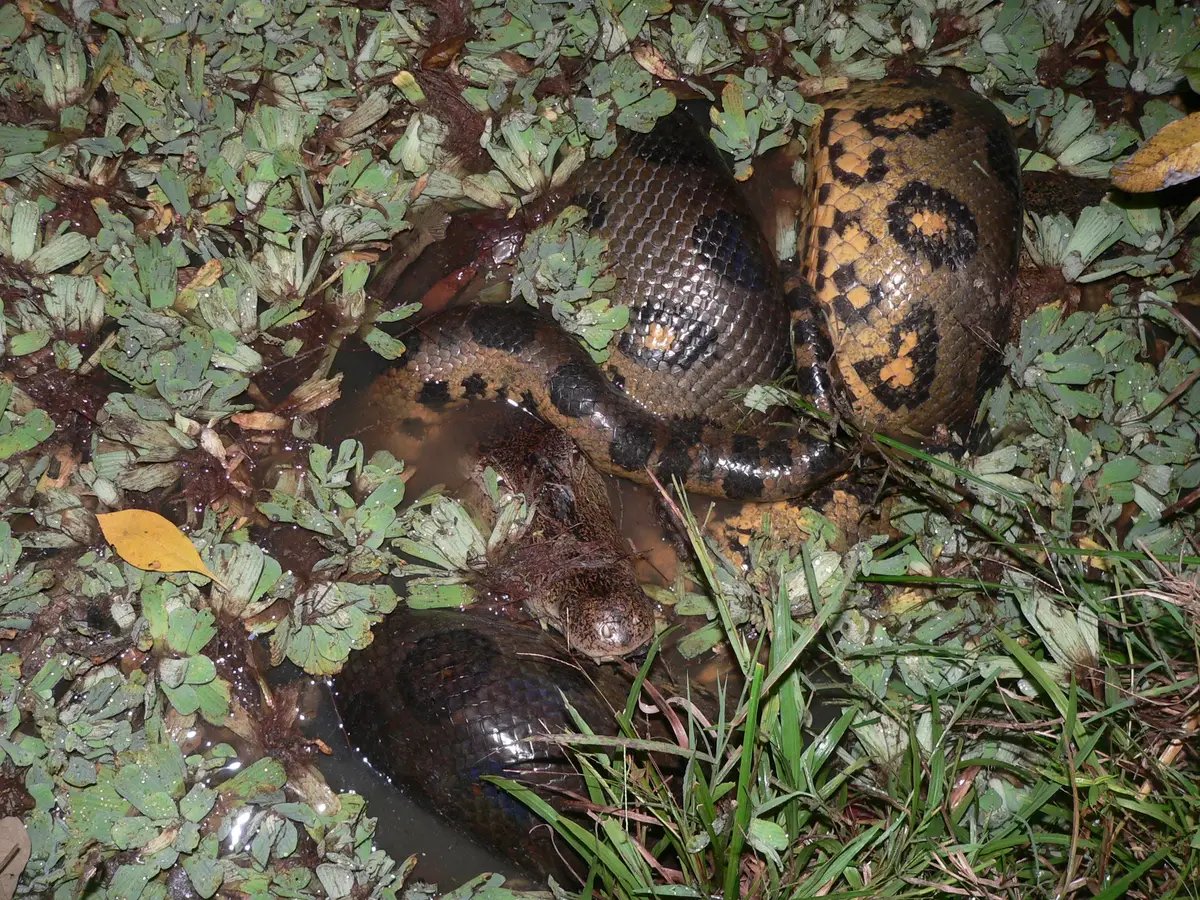
Related snakes
Sources
- Reptile Database: Corallus hortulana
- Animal Diversity Web: Corallus hortulanus
- Reptiles of Ecuador: Amazon tree-boa (Corallus hortulana)
- Ribeiro-Junior et al. (2016), predation on a squirrel monkey by an Amazon tree boa, Primates
- Yánez-Muñoz et al. (2017), new diet records for Corallus hortulanus in Yasuní
- Henderson, Pauers and Colston (2013), morphology and diet in Neotropical treeboas, summary
- Frontiers in Immunology (2021), snakebite in the Amazon review
- iNaturalist: Corallus hortulana observations