DUMERIL'SBOA
Acrantophis dumerili · Family Boidae
KEY TAKEAWAYS
Dumeril's boa (Acrantophis dumerili) is a heavy-bodied ground boa found only in the south and southwest of Madagascar. It is not venomous and is not dangerous to people.
- It is not venomous. It kills rodents, tenrecs, birds and even lemurs by constriction.
- Adults usually reach 4-6.5 ft (1.2-2 m); the largest reported was about 8 ft 6 in (2.59 m).
- Its mottled gray and brown pattern hides it in dry leaf litter, and it has been seen lying underwater in a cave pool, probably waiting for animals to come and drink.
- The IUCN rated it Least Concern in 2011. It is on CITES Appendix I, and captive-bred snakes are common in the pet trade.
Dumeril's boa quick facts
| Common name | Dumeril's boa, Dumeril's ground boa, southern Madagascar ground boa |
|---|---|
| Scientific name | Acrantophis dumerili Jan, 1860 |
| Family | Boidae (boas) |
| Venomous | No, a constrictor |
| Adult length | Usually 4-6.5 ft (1.2-2 m); maximum reported about 8 ft 6 in (2.59 m) |
| Range | Southern and southwestern Madagascar |
| Habitat | Dry forest, spiny thicket and open country, often in leaf litter |
| Diet | Rodents, tenrecs, lemurs, birds and lizards |
| Reproduction | Live-bearing; young born about 6-8 months after mating |
| Lifespan | 20 years or more in captivity |
| Conservation | IUCN Least Concern (2011); CITES Appendix I |
How to identify a Dumeril's boa
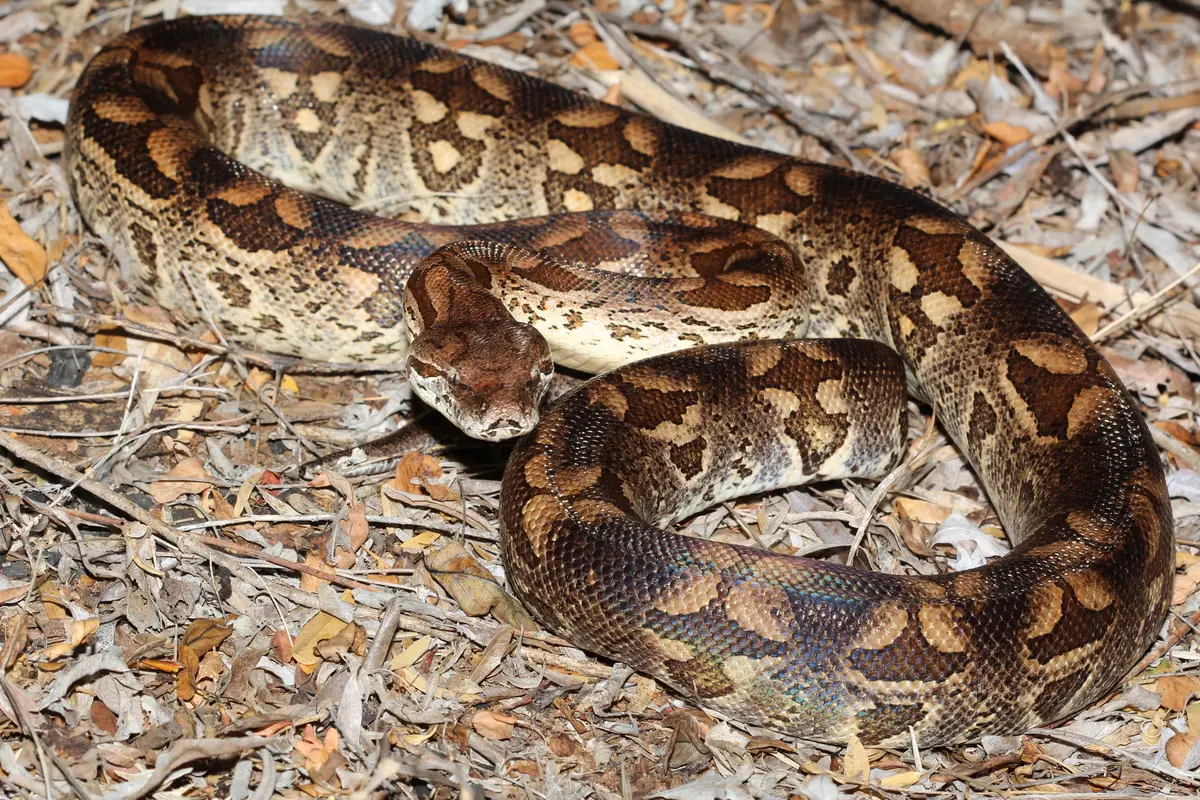
Dumeril's boa is a thick, heavy snake patterned for life on the forest floor. Its gray-brown body is covered in darker, irregular patches and lighter areas that can look peach or pinkish, a pattern that breaks up its outline in dead leaves. Females are generally larger, and males have longer, slimmer tails.
- 1Mottled gray and brown: a busy pattern of dark brown patches on gray, tan or pinkish brown, like scattered dead leaves.
- 2Heavy body: much bulkier than the island's tree boa, with a short tail.
- 3No lip pits: unlike the Madagascar tree boa, it has no heat-sensing pits along its lips.
- 4On the ground: found on the forest floor, in leaf litter or in burrows dug by other animals, rather than up in trees.
- 5Spurs by the vent: small claw-like spurs beside the vent, which males use during courtship.
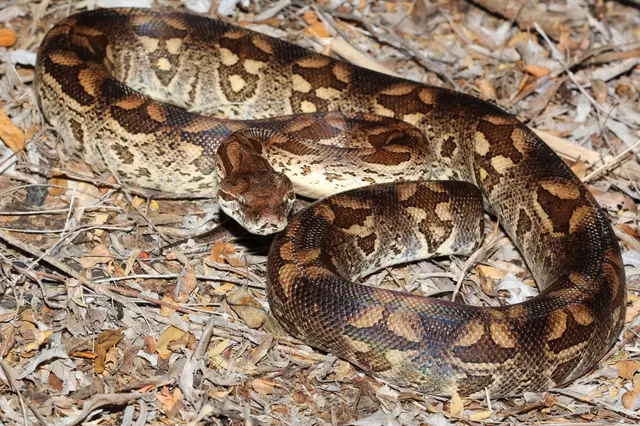
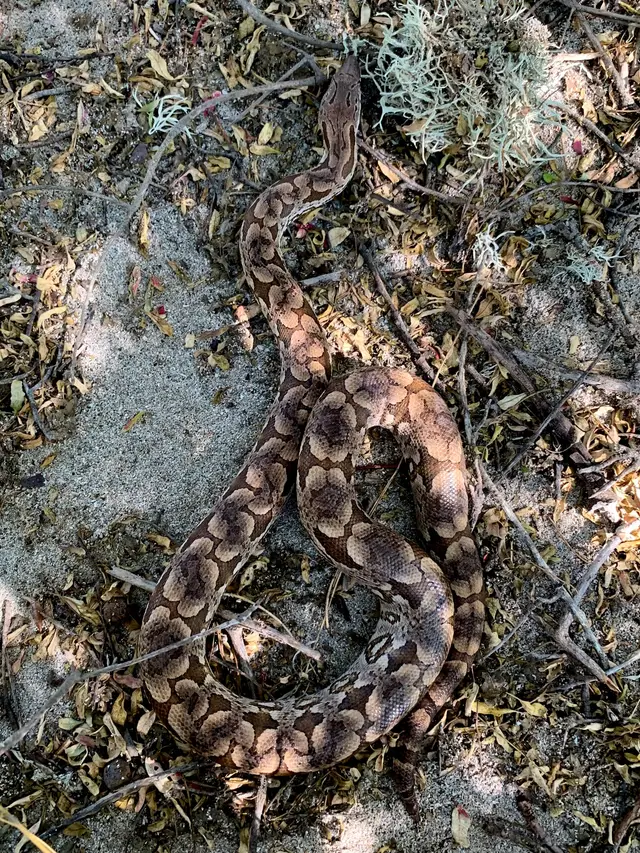
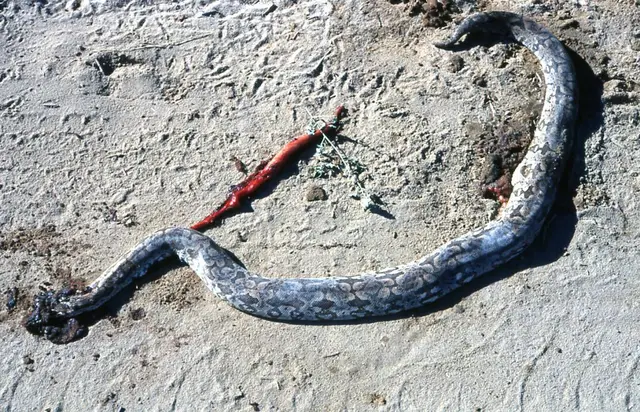
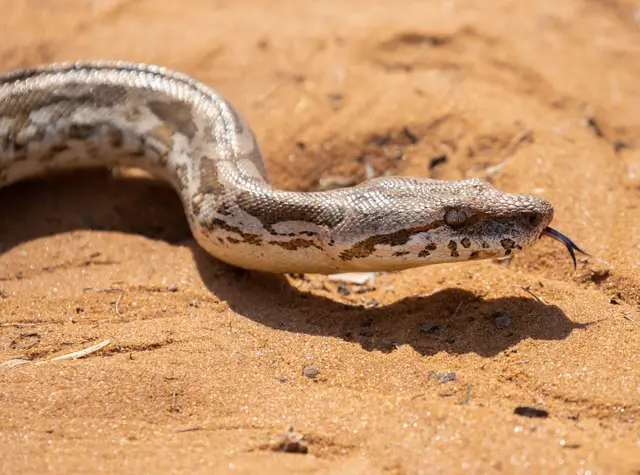
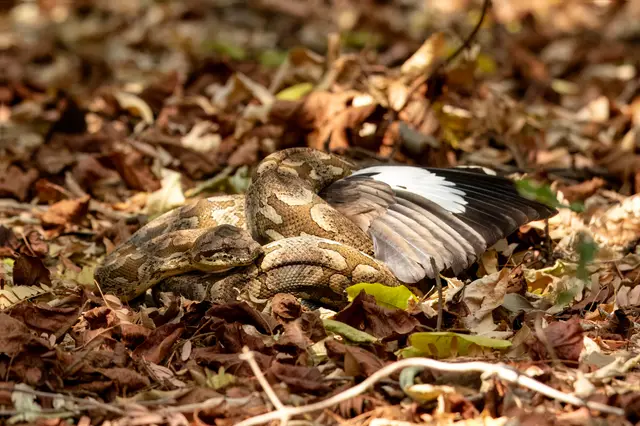
The name honors the French zoologist Andre Marie Constant Dumeril. The genus Acrantophis holds Madagascar's two ground boas: this species in the south and the Madagascar ground boa (Acrantophis madagascariensis) farther north. The Reptile Database notes that Dumeril's boa itself may turn out to be two species.
How big do Dumeril's boas get?
Most adult Dumeril's boas are 4 to 6.5 ft (1.2-2 m) long, with about 6 ft (1.8 m) the usual size for a grown female. The largest reported was about 259 cm (8 ft 6 in). Reports of 10 ft snakes in some care guides are not backed by measurements. They are heavy for their length, and full adult size takes about five years.
| Measure | Figure |
|---|---|
| Typical adult | 4-6.5 ft (1.2-2 m) |
| Usual adult female | About 6 ft (1.8 m) |
| Maximum reported | About 8 ft 6 in (2.59 m) |
| Newborns | About 12-18 in (30-46 cm) |
| Time to full size | About 5 years |
Where do Dumeril's boas live?
Short answer: Dumeril's boas live only on Madagascar, in the south and southwest of the island. This is the dry side of Madagascar, with spiny thicket and dry forest rather than rainforest.
Tsimanampesotse National Park, on the limestone Mahafaly Plateau in the far southwest, is one of the places it has been studied. Old reports from Reunion and the other Mascarene Islands are probably wrong, according to the Reptile Database.
Pet snakes have also turned up in Florida. Somma, Krysko and Conner (2017) reported the first vouchered specimens from Miami-Dade and Bay counties, likely escaped or released pets. They found no clear sign of a breeding population, though two boas found at the same rural Bay County site less than a month apart were a concern. See how its range compares with other snakes on the world snake map.
Habitat
Dumeril's boa lives in semi-arid forest and spiny thicket, and both Malagasy ground boas also use open habitats. It spends its time on the ground among leaf litter, loose soil and rocks, and shelters in burrows dug by other animals.
Water is scarce in this part of Madagascar, and boas seem to use that to their advantage. Places where animals come to drink concentrate prey in a dry landscape, as the next section shows.
Behavior and water ambushes
Dumeril's boas are ground dwellers that can be active by day or by night. They hunt mainly by ambush, lying still in leaf litter until prey comes close.
In 2017 Charlie Gardner and colleagues published the first records of Madagascar's ground boas using water, in Herpetology Notes. On 29 December 2013, at Grotte Mitoho, a flooded cave in Tsimanampesotse National Park, they found an adult Dumeril's boa with most of its body under water. When they came back that afternoon it was hidden behind the submerged roots of a fig tree with only its nostrils and the top of its head showing. Disturbed, it ducked fully under water.
The cave pool is one of the few sources of fresh water in the area, and ring-tailed lemurs and Madagascar turtle doves come there to drink. Park guides told the researchers an adult boa lives in the cave permanently. The authors ruled out cooling off as the main reason and suggested the boa was waiting in ambush for drinking animals, the only cover available at a pool with no surrounding vegetation.
What do Dumeril's boas eat?
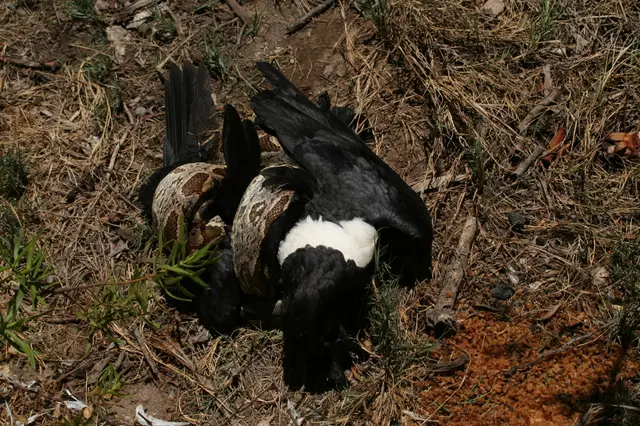
Dumeril's boas eat mostly mammals. Gardner and colleagues list rodents, tenrecs and lemurs as prey of Madagascar's ground boas, and other accounts add birds, lizards and other snakes.
| Prey | Notes |
|---|---|
| Rodents | Listed as prey of Malagasy ground boas by Gardner et al. (2017) |
| Tenrecs | Small mammals found only on Madagascar, also listed by Gardner et al. |
| Lemurs | Including juvenile lemurs |
| Birds | Recorded in general accounts of the species |
| Reptiles | Lizards and other snakes |
Like all boas it seizes prey with its teeth, wraps it in coils and squeezes until the animal's blood flow stops.
Is Dumeril's boa venomous or dangerous?
No, Dumeril's boa is not venomous and is not dangerous to people. It has no venom glands and kills its prey by constriction.
It is usually docile and slow to bite. A large one can still give a painful bite if handled roughly or mistaken for food. Wash the wound with soap and water and see a doctor if it becomes red or swollen over the next few days. The snakebite FAQ covers basic first aid.
Madagascar has no vipers or cobras, and none of its snakes is a serious danger to people. Some people there still kill boas on sight, which is one of the threats the species faces.
Snakes confused with Dumeril's boa
Madagascar has only a few boas, so in the wild the choice is short. In captivity, Dumeril's boa is often compared with other heavy-bodied boas.
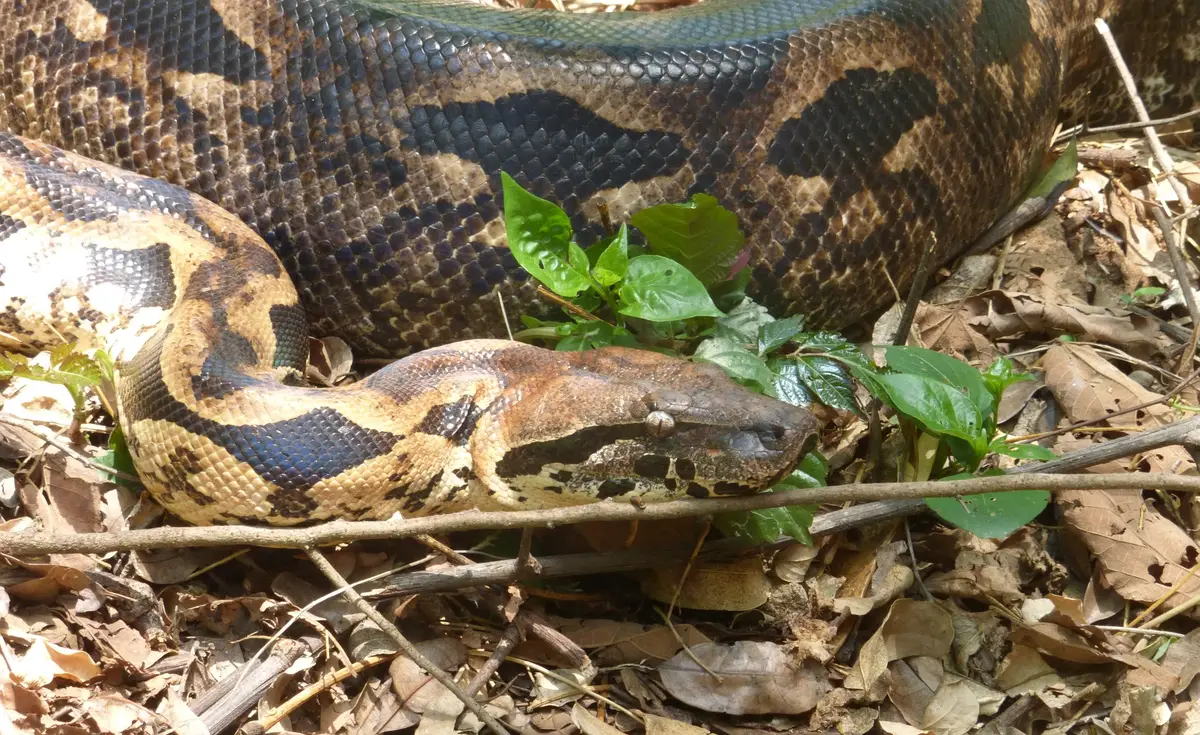
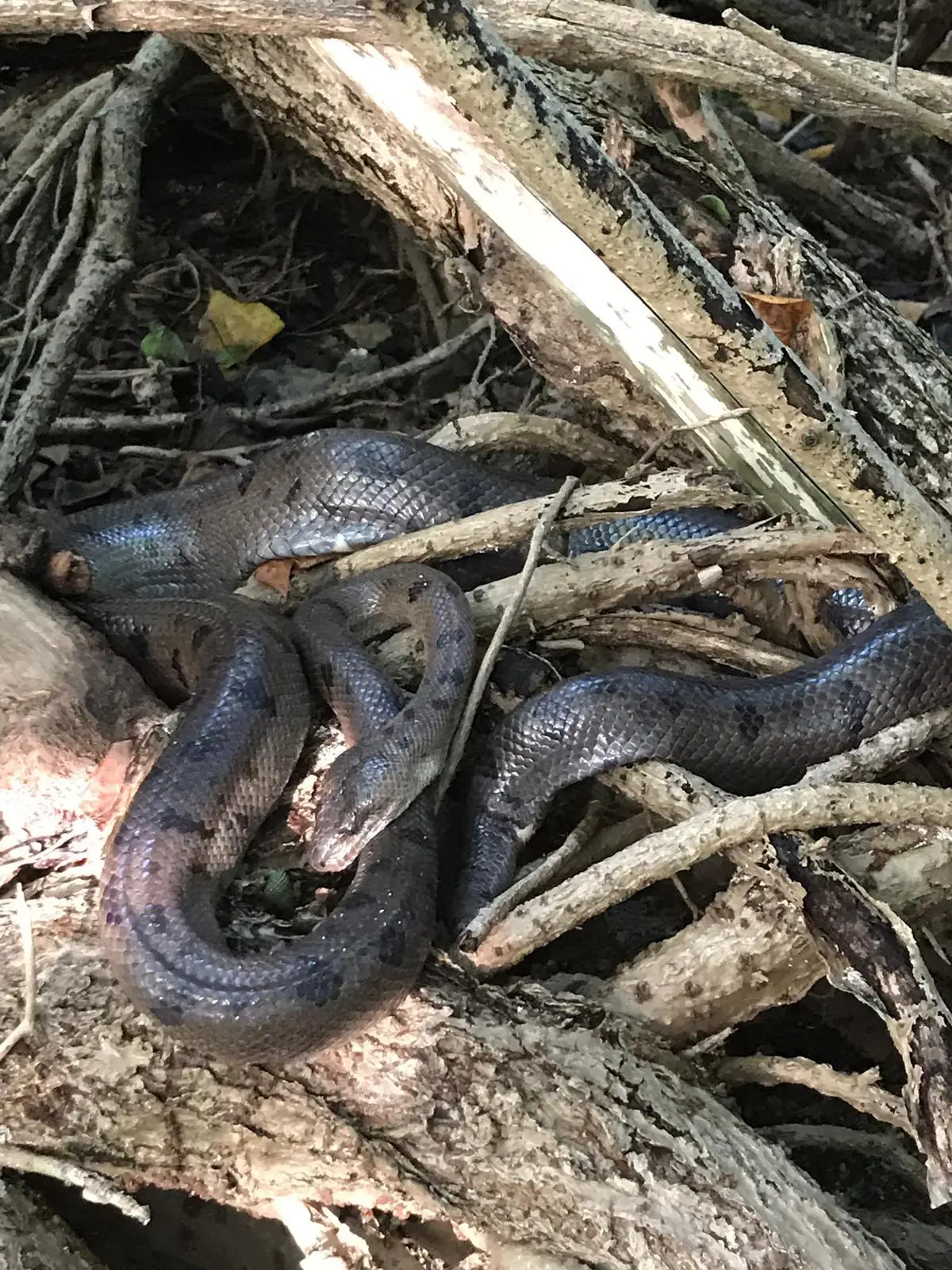
Madagascar ground boa
Acrantophis madagascariensis · Harmless
Its closest relative, the other Acrantophis, lives farther north. The two look alike and share the same ground-dwelling habits, so range is the easiest clue: Dumeril's boa is the southern species.
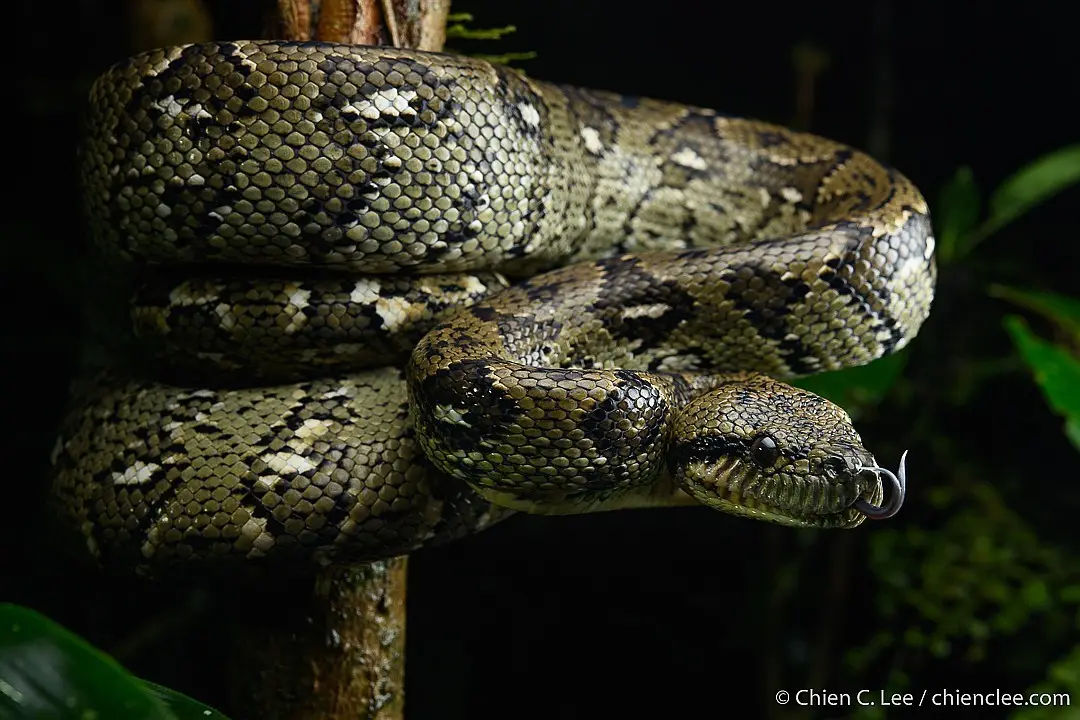
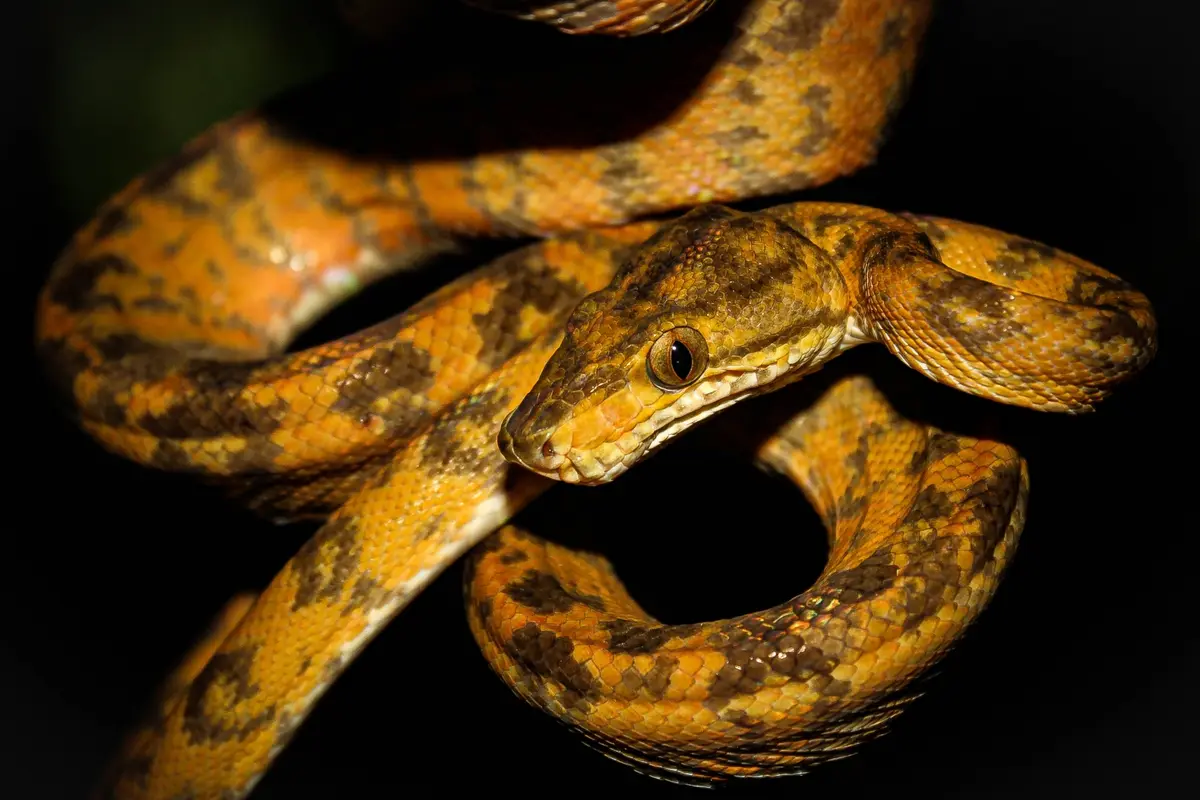
Madagascar tree boa
Sanzinia madagascariensis · Harmless
The Madagascar tree boa is slimmer, green or brown, lives in trees and has obvious heat pits along its lips. Its babies are born red.
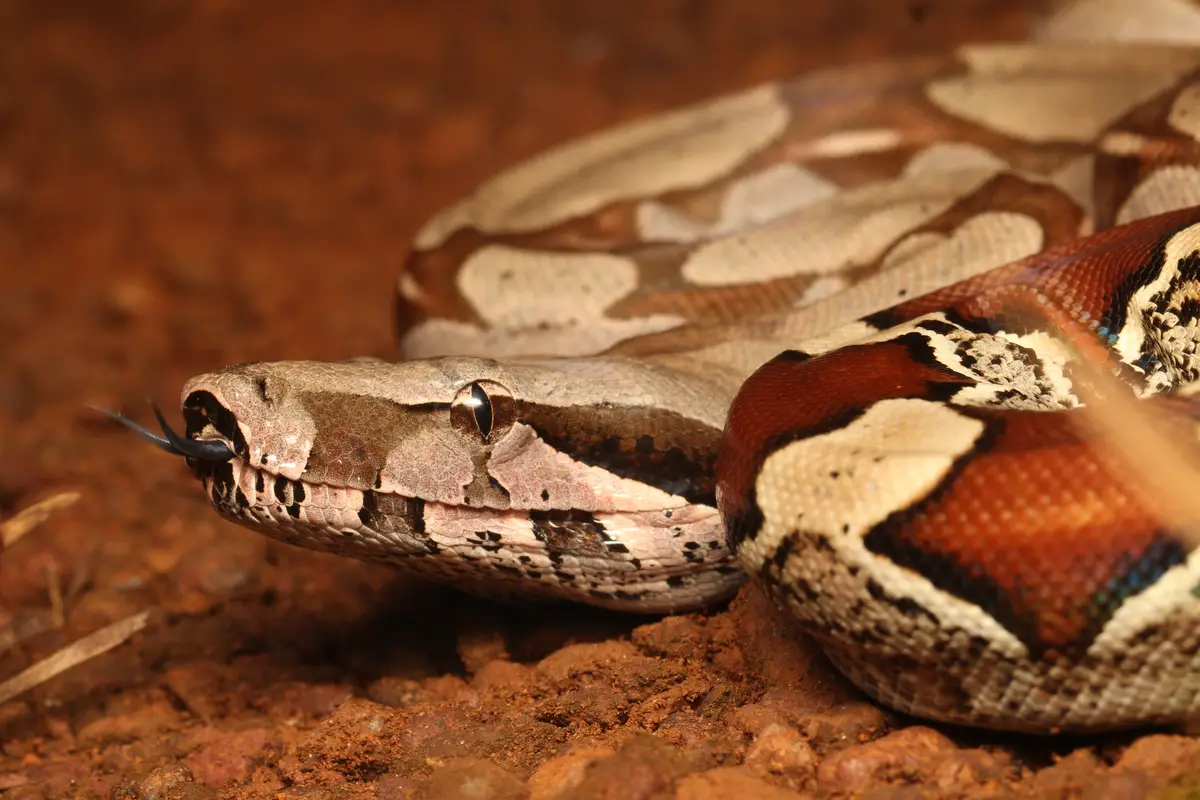
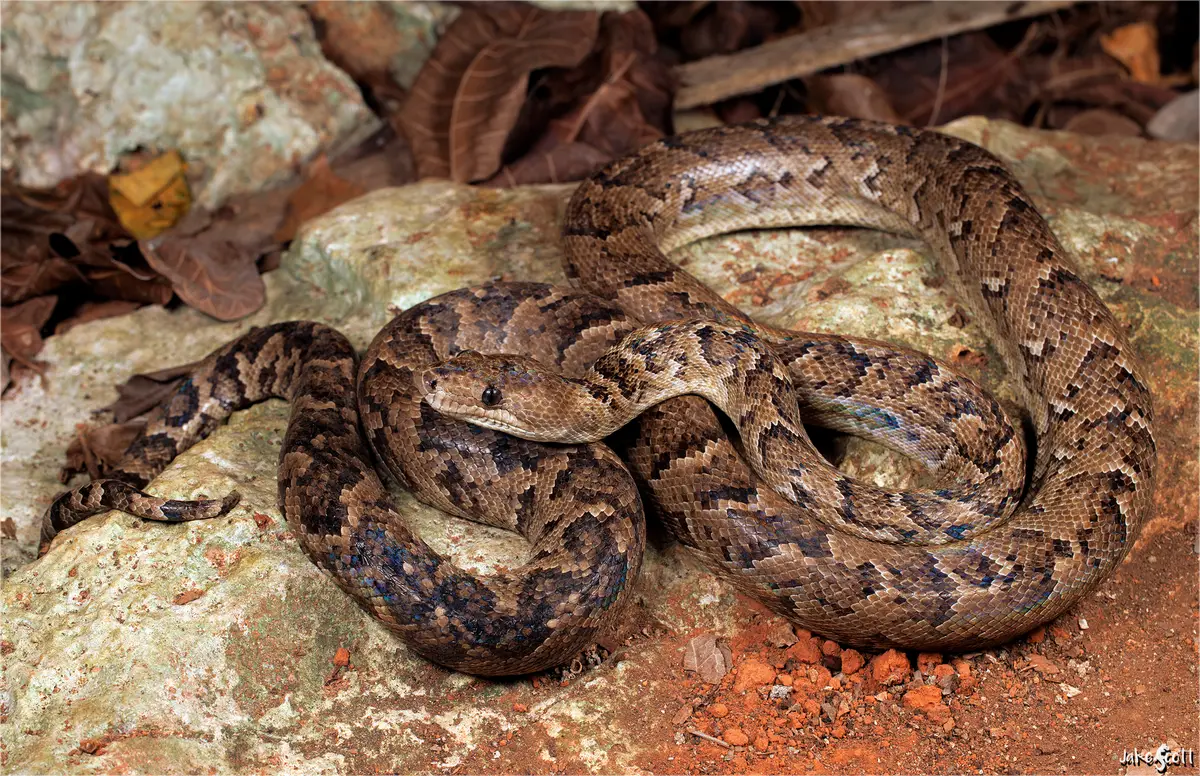
Boa constrictor
Boa constrictor · Harmless
The boa constrictor of the Americas has neat saddles on a tan back and a reddish tail, while Dumeril's boa has an irregular, mottled pattern. Dumeril's boa was once classed in the genus Boa.
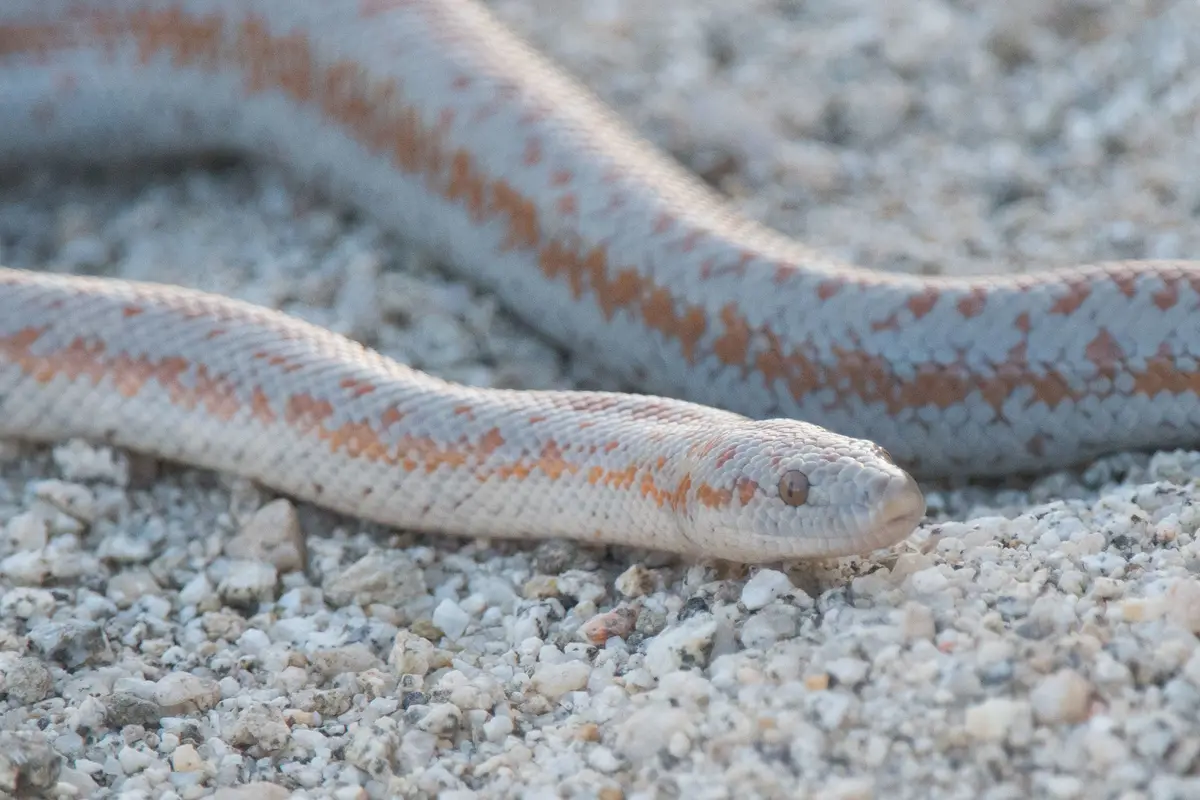
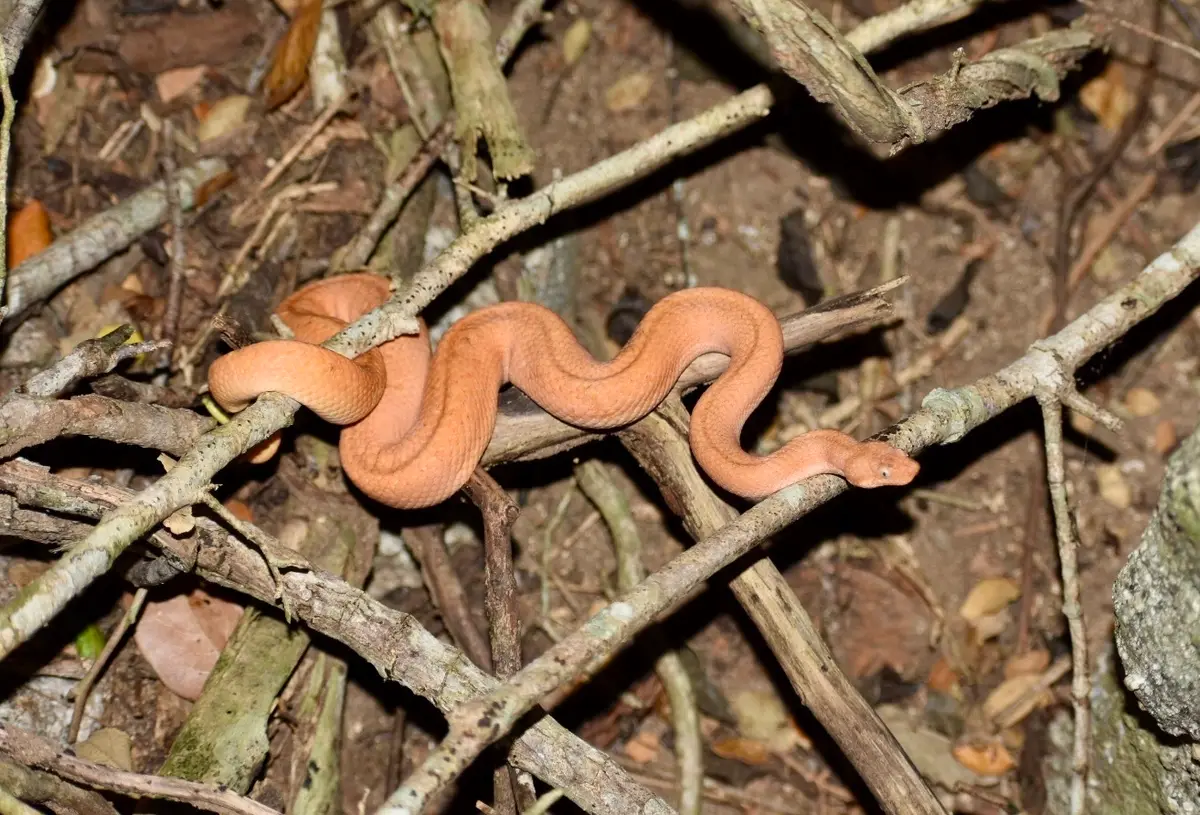
Rosy boa
Lichanura · Harmless
The rosy boa of the American Southwest is another calm ground boa, but it is far smaller, rarely over 3 ft, with three lengthwise stripes.
Reproduction and lifespan
Dumeril's boas give birth to live young. Mating takes place from about March to May, and males use their vent spurs to stimulate females during courtship. The young are born about six to eight months later.
Litter sizes vary a lot between reports. Zoo and keeper sources give anywhere from about 6 to 28 young, and newborns are roughly 30-46 cm (12-18 in) long. They reach adult size in about five years and can live 20 years or more in captivity.
The species breeds readily in captivity. Captive-bred snakes are common in the pet trade, while trade in wild ones is tightly restricted.
Conservation status
| Authority | Status |
|---|---|
| IUCN Red List (2011, Raxworthy et al.) | Least Concern |
| IUCN Red List (1996, older assessment) | Vulnerable |
| CITES | Appendix I (commercial trade in wild snakes banned) |
The current IUCN assessment rates Dumeril's boa Least Concern. Some care guides and zoo signs still give the older Vulnerable label.
The main threats are the loss of dry forest, much of it cut for charcoal, and people killing snakes they fear. Its listing on CITES Appendix I keeps wild-caught snakes out of the international pet trade.
Dumeril's boa FAQ
Is Dumeril's boa venomous?
No. Dumeril's boa has no venom and kills its prey by constriction. It is usually docile, though a large one can give a painful bite if handled roughly. Madagascar has no vipers or cobras, and none of its snakes is a serious danger to people.
How big do Dumeril's boas get?
Most adults are 4 to 6.5 ft (1.2-2 m) long, and a grown female is usually about 6 ft (1.8 m). The largest reported was about 8 ft 6 in (2.59 m). They are heavy for their length and take about five years to reach full size.
Where do Dumeril's boas live?
Dumeril's boas live only on Madagascar, in the dry south and southwest of the island. They live on the ground in dry forest and spiny thicket. Escaped pets have been found in Florida, but a 2017 report found no clear evidence of a breeding population there.
What do Dumeril's boas eat?
They eat mostly mammals, including rodents, tenrecs and lemurs, plus birds and lizards. They hunt by ambush, and a 2017 study described one lying underwater in a cave pool in Tsimanampesotse National Park, likely waiting for lemurs and birds that come to drink.
Is Dumeril's boa endangered?
No. The IUCN rated it Least Concern in 2011, replacing an older Vulnerable rating. It is still listed on CITES Appendix I, which bans commercial international trade in wild snakes. Loss of dry forest for charcoal and killing by people are the main threats.
What is the difference between Dumeril's boa and the Madagascar ground boa?
Both are Malagasy ground boas in the genus Acrantophis. Dumeril's boa lives in the south and southwest and has a busy mottled gray and brown pattern. The Madagascar ground boa lives farther north. The two look and behave much alike, so location is the simplest way to tell them apart.
Related snakes
Sources
- Reptile Database: Acrantophis dumerili
- Gardner et al. (2017), Observations of aquatic behaviour in Malagasy ground boas, Herpetology Notes
- Somma, Krysko and Conner (2017), Acrantophis dumerili in Florida, Herpetological Review
- ReptiFiles: Dumeril's boa natural history and care
- iNaturalist: Acrantophis dumerili observations