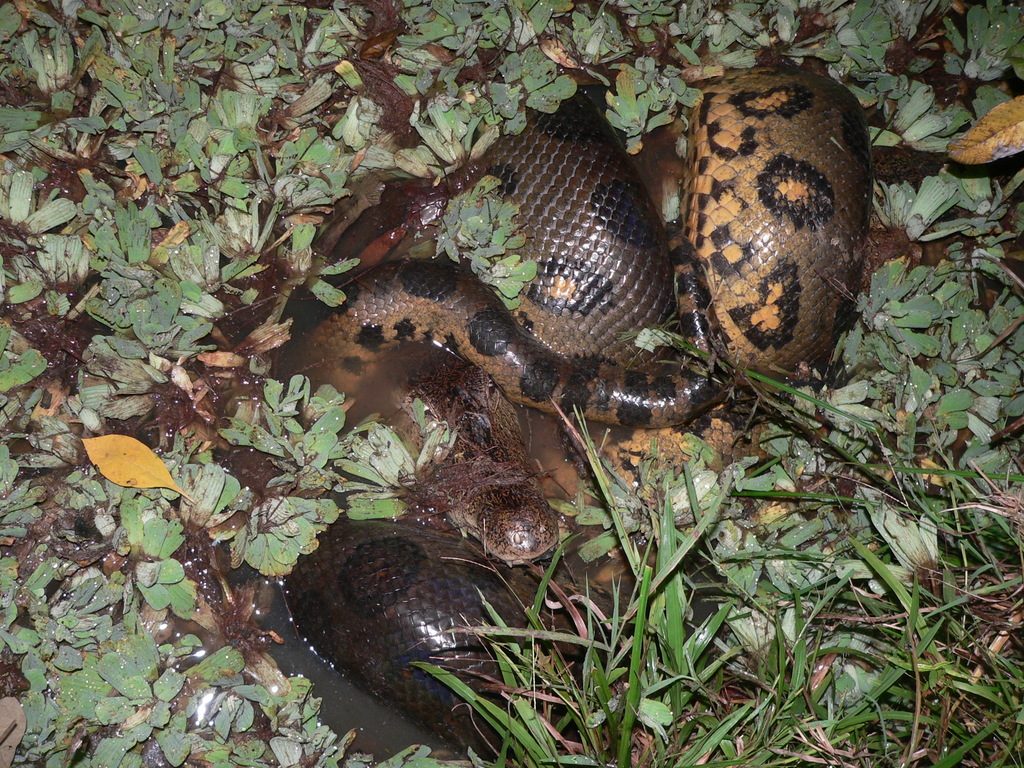
SPECIES GUIDEBOA
Boidae · Family Boidae
Photo: (c) Nicholas Sly, some rights reserved (CC BY-NC), uploaded by Nicholas Sly · via iNaturalist
KEY TAKEAWAYS
A boa is a non-venomous snake in the family Boidae that kills its prey by constriction. Most boas live in Central and South America, with a few in North America, Madagascar, Africa, Asia and the Pacific. Boas are not dangerous to people unless handled roughly, though a large one can give a painful bite.
- Boas have no venom. They grab prey with their teeth, coil around it and squeeze until its blood stops flowing.
- Most boas give birth to live young. Pythons, their Old World look-alikes, lay eggs.
- The boa constrictor usually reaches 6.5-10 ft (2-3 m). The largest boa of all is the green anaconda, the heaviest snake on Earth.
- Two boas are native to the United States: the rubber boa of the Northwest and the rosy boa of the Southwest.
Boa quick facts
| Common name | Boa |
|---|---|
| Family | Boidae (boas) |
| Venomous | No, all boas are constrictors |
| Species | About 67 in the broad boa group listed by the Reptile Database |
| Best-known species | Boa constrictor (Boa constrictor Linnaeus, 1758) |
| Adult length | About 16 in (40 cm) in the smallest sand boas to 13 ft (4 m) in boa constrictors; anacondas grow larger |
| Weight | Large boa constrictors can pass 100 lb (45 kg) |
| Range | Mexico to Argentina, the Caribbean, western North America, Madagascar, Africa, Asia, southeastern Europe, Pacific islands |
| Habitat | Rainforest, dry forest, savanna, desert scrub, coniferous forest |
| Diet | Rodents, birds, bats, lizards; large species take opossums and other mammals |
| Reproduction | Mostly live birth; some sand boas lay eggs |
| Conservation | Most species IUCN Least Concern; some island boas are threatened |
What kinds of boa are there?
Short answer: boas include the boa constrictor, the anacondas, tree boas, rainbow boas, the North American rubber and rosy boas, the sand boas of Africa and Asia, and the boas of Madagascar and the Pacific islands. The Reptile Database lists 67 species in this broad group.
Their classification is not settled. Some herpetologists keep every boa in one family, Boidae. Others give the sand boas (Erycidae) and the Madagascar boas (Sanziniidae) families of their own. Either way, all of them are non-venomous constrictors. The table below covers the boas people ask about most.
| Boa | Scientific name | Where it lives | Typical adult size |
|---|---|---|---|
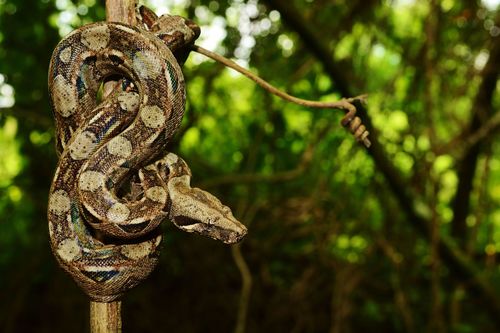
| Boa constrictor (red-tailed boa) | Boa constrictor | South America east of the Andes, Trinidad and Tobago | 6.5-10 ft (2-3 m) |
| Central American boa | Boa imperator | Mexico through Central America to Ecuador | Similar to boa constrictor |
| Green anaconda | Eunectes murinus | Amazon and Orinoco basins | 10-17 ft (3-5.2 m); see our anaconda guide |
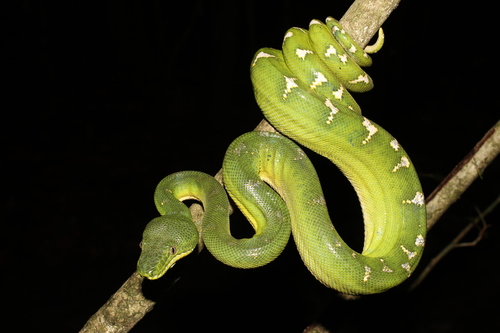
| Emerald tree boa | Corallus caninus | Northern South America north of the Amazon | Up to about 6.5 ft (2 m) |
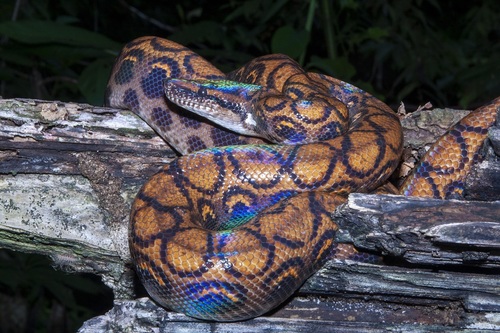
| Rainbow boa | Epicrates cenchria | Central America to the Amazon and Atlantic Brazil | 5-6.5 ft (1.5-2 m) |
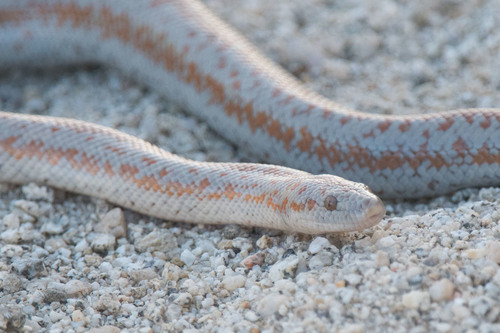
| Rosy boa | Lichanura trivirgata | Southern California, Arizona, northwestern Mexico | 17-44 in (43-112 cm) |
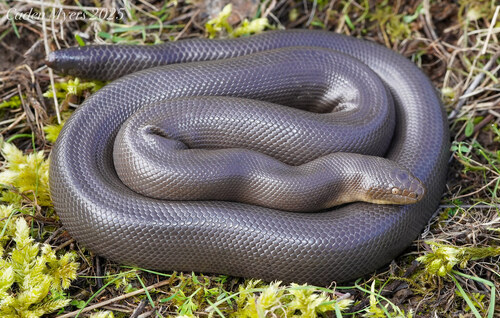
| Rubber boa | Charina bottae | Western US north into British Columbia | 15-25 in (38-64 cm) |
| Sand boas | Eryx species | Africa, the Middle East, Asia, southeastern Europe | Some species under 16 in (40 cm) |
| Madagascar tree boa | Sanzinia madagascariensis | Eastern Madagascar | Medium-sized, fully arboreal |
How to identify a boa
A boa is a thick-bodied, muscular snake with smooth scales and a head that is only a little wider than the neck. Most have vertical pupils, like a cat. Check several features together.
- 1Heavy body: thick and muscular for its length, with a short tail. Even a 2 ft rubber boa looks stocky.
- 2Saddles or blotches: the boa constrictor has dark brown, hourglass-shaped saddles on a tan to gray body, turning reddish toward the tail, according to the Florida Museum.
- 3Head stripes: a boa constrictor has a thin dark stripe down the top of the head and a dark wedge behind each eye. Rosy boas have three long stripes down the body. Young emerald tree boas are red-orange to brown and turn green by about 4 months old.
- 4Heat-sensing lips: boas sense warm prey with special scales around the mouth. Tree boas have visible pits along the lips, a row of small slits rather than the single deep pit between eye and nostril of a pit viper such as the eastern diamondback rattlesnake.
- 5Where you are: a large snake in Central or South America is far more likely to be a boa than a python. In North America, native boas are small and live only in the West.
How big do boas get?
Short answer: most boa constrictors are 6.5 to 10 feet long as adults, and the largest reach about 13 feet and more than 100 pounds. Many other boas are much smaller, and the anacondas are much bigger.
Smithsonian's National Zoo gives a range of 20 inches for a newborn boa constrictor to 13 feet (3.9 m) for an adult. Animal Diversity Web puts typical adults at 2 to 3 m and the longest recorded at a little over 4 m. Claims of 18 ft boa constrictors turn up online, but none is backed by a measured specimen.
| Boa | Typical adult length | Notes |
|---|---|---|
| Arabian and elegant sand boas | Up to 16 in (40 cm) | Among the smallest boas |
| Rubber boa | 15-25 in (38-64 cm) | Rarely over 33 in (84 cm) |
| Rosy boa | 17-44 in (43-112 cm) | Most under 36 in (91 cm) |
| Rainbow boa | 5-6.5 ft (1.5-2 m) | Average weight about 2.9 lb (1.3 kg) |
| Emerald tree boa | Up to about 6.5 ft (2 m) | Females larger than males |
| Boa constrictor | 6.5-10 ft (2-3 m) | Record a little over 13 ft (4 m) |
| Green anaconda | 10-17 ft (3-5.2 m) | Heaviest snake on Earth |
Where do boas live?
Short answer: most boas live in the tropical Americas, from northern Mexico to Argentina and through the Caribbean. Smaller groups live in western North America, Madagascar, North and East Africa, the Middle East, southern Asia, southeastern Europe and islands of the southwestern Pacific.
The boa constrictor and its close relatives cover the widest area. The Reptile Database splits them into the Central American boa (Boa imperator), found from Sonora and Chihuahua in Mexico to Ecuador, and the boa constrictor proper in South America. Sand boas reach Europe: the javelin sand boa (Eryx jaculus) lives in Greece, Bulgaria, Turkey, Cyprus and nearby countries.
Boas in the United States
Two boas are native to the US. The rubber boa ranges from southern California north through Oregon, Washington and Idaho into British Columbia, and east into Montana, Wyoming and Utah. That makes it the most northern boa in the world. The rosy boa lives in the deserts and dry hills of southern California and southwestern Arizona.
Non-native boa constrictors also breed in one small area of South Florida, in and around the Charles Deering Estate in Miami, where they have been established since perhaps the 1970s. See where every snake group lives on our world snake map.
Habitat
Boa constrictors live in wet rainforest, dry forest, open savanna, semi-desert and farmland, and often turn up near villages where rats are common. Emerald tree boas spend their entire lives in rainforest trees. Rubber boas prefer cool, damp conifer forest and meadows from sea level to about 10,000 ft (3,050 m). Rosy boas favor rocky canyons and desert scrub, and sand boas burrow in loose sand and soil.
Behavior
Most boas are active at night and hunt by ambush. A boa constrictor waits under cover until a rat, bird or lizard comes close, then strikes and throws coils around it.
For a long time people believed constriction suffocates prey. A 2015 study led by Scott Boback in the Journal of Experimental Biology found otherwise: when boa constrictors squeezed rats, blood pressure collapsed within seconds, so the prey died from stopped blood flow.
Defense varies by species. A cornered boa constrictor hisses loudly, gapes and may bite. A rubber boa rolls into a ball, hides its head and raises its blunt tail, which looks like a second head, so that a predator bites the tail. Rubber boas are also unusually cold-tolerant, staying active at about 57 F (14 C).
What do boas eat?
| Boa | Main prey |
|---|---|
| Boa constrictor | Rats, squirrels, opossums, bats, mongooses, birds, large lizards |
| Emerald tree boa | Rodents, lizards, small marsupials |
| Rainbow boa | Small mammals, birds, eggs, lizards, frogs |
| Rosy boa | Rodents, small birds, lizards, small snakes |
| Rubber boa | Nestling mice, voles and shrews; some lizard and snake eggs |
Boas swallow prey whole. Small species such as the rubber boa raid nests and burrows, while a big boa constrictor can take an opossum.
Are boas venomous or dangerous?
No, boas are not venomous. No species in the boa family produces venom. They are constrictors, and they bite only to hold prey or to defend themselves.
Small boas such as rubber and rosy boas are harmless to people; a bite from one is a pinch at most. A large boa constrictor is a different matter. Its teeth are sharp and curve backward, and the Florida Museum notes that a big one can cause serious cuts and can eat cats and dogs. Boas are not aggressive, though. Bites happen when someone grabs, corners or tries to move the snake. Clean any bite well and have deep cuts checked by a doctor.
Not sure what you are looking at? Keep your distance. Our snake safety FAQ covers what to do around any snake you cannot identify.
Boa vs python: how to tell them apart
Boas and pythons are both heavy, non-venomous constrictors, and they are easy to confuse. According to the San Diego Zoo Wildlife Alliance, the clearest difference is reproduction: pythons lay eggs, while nearly all boas give birth to live young. Pythons live only in Africa, Asia and Australia, while boas also live throughout the Americas. Pythons also have one more bone in the skull and extra teeth.
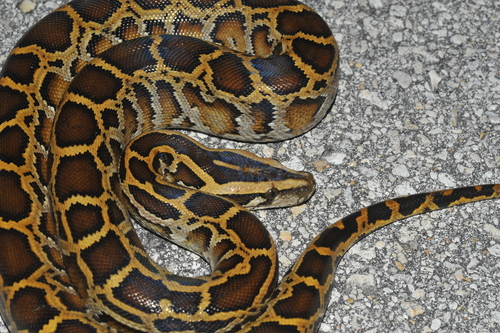
Burmese python
Python bivittatus · Harmless
Native to Southeast Asia and now invasive in the Florida Everglades. Lays eggs. Large, dark-edged brown blotches on a tan body, and grows longer than a boa constrictor.
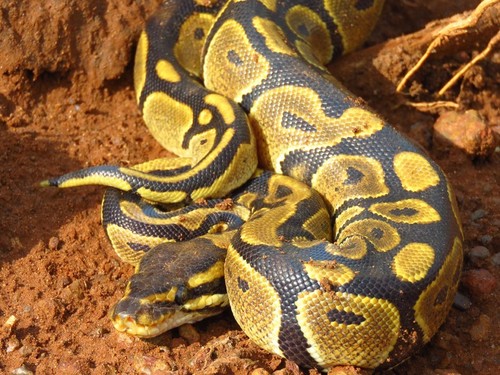
Ball python
Python regius · Harmless
A small African python, popular as a pet. Lays eggs. Rolls into a tight ball when scared, much like a rosy boa does.
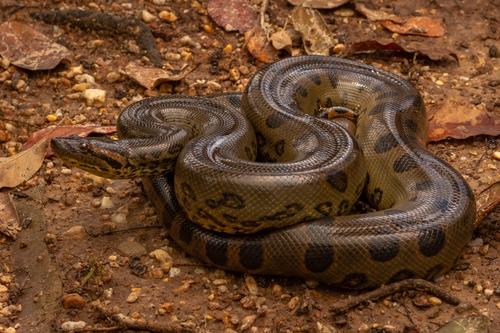
Green anaconda
Eunectes murinus · Harmless
Technically a boa, but far bulkier, olive green with black oval blotches, and nearly always in water. See our anaconda guide.
Reproduction and lifespan
Most boas are live-bearers. The young grow inside the mother attached to a yolk sac and wrapped in a clear membrane rather than a shell. Some sand boas are the exception and lay eggs.
Boa constrictors carry their young for 5 to 8 months and give birth to 10 to 64 babies, about 25 on average, according to Smithsonian's National Zoo. The young reach maturity at 2 to 3 years. Female boa constrictors can also reproduce without a male: the Reptile Database cites a 2010 study by Booth and colleagues documenting parthenogenesis in the species. Emerald tree boas have 5 to 12 young, rosy boas 3 to 14, and rubber boas just 2 to 5, often breeding only every three or four years.
Boa constrictors live 20 to 30 years in the wild, and captive boas often reach the same range or longer.
Conservation status
| Boa | Status | Notes |
|---|---|---|
| Boa constrictor | IUCN Least Concern | CITES Appendix II; one subspecies, B. c. occidentalis, is on Appendix I |
| Emerald tree boa | IUCN Least Concern | Lives in remote lowland rainforest |
| Rosy boa | IUCN Least Concern | Southwestern US and northwestern Mexico |
| Mona boa | US Endangered Species Act: Threatened (1978) | Found only on Mona Island, Puerto Rico |
| Virgin Islands boa | US Endangered Species Act: Endangered | Tiny island range; proposal to downlist withdrawn |
Most widespread boas are doing well. The species in trouble are island boas with tiny ranges. The US Fish and Wildlife Service lists the Mona boa as threatened because feral cats prey on it and feral pigs and goats damage its dry forest. In 2022 the agency proposed removing the Puerto Rican boa from the endangered list after its populations recovered.
Boa FAQ
Are boas venomous?
No. No boa has venom. Boas are constrictors that hold prey with their teeth and squeeze until its blood stops flowing. A large boa constrictor can still bite hard enough to cause deep cuts, so any bite should be cleaned well and checked by a doctor if it is deep.
What is the difference between a boa and a python?
Pythons lay eggs and live only in Africa, Asia and Australia. Most boas give birth to live young, and boas also live across the Americas. Pythons have one more bone in the skull and extra teeth. Both are non-venomous constrictors and can look very similar.
How big does a boa constrictor get?
Most adult boa constrictors are 6.5 to 10 ft (2 to 3 m) long. The largest reliably recorded reach a little over 13 ft (4 m) and can weigh more than 100 lb (45 kg). Island populations tend to stay smaller.
Are there boas in the United States?
Yes. Two boas are native: the rubber boa, found from California to British Columbia and east to Montana and Utah, and the rosy boa of southern California and Arizona. Both are small and harmless. A non-native boa constrictor population also breeds near the Deering Estate in Miami, Florida.
What is a red-tailed boa?
Red-tailed boa is a common name for the boa constrictor, Boa constrictor, especially in the pet trade. The name comes from the dark saddles near the tail, which turn reddish brown.
Do boas lay eggs?
Most do not. Nearly all boas give birth to live young that develop inside the mother in a thin membrane, not a shell. A few sand boas are the exception and lay eggs. Pythons all lay eggs.
What is the biggest boa?
The green anaconda. It is a member of the boa family and the heaviest snake on Earth, with the largest measured female reaching 17 ft 1 in (5.21 m) and 214 lb (97.5 kg). Among land-dwelling boas, the boa constrictor is the largest.
Boa species on SnakesWiki
Sources
- Reptile Database: Boa constrictor
- Reptile Database: Boa imperator
- Smithsonian's National Zoo: Boa constrictor
- Animal Diversity Web: Boa constrictor
- Animal Diversity Web: Rubber boa (Charina bottae)
- San Diego Zoo Wildlife Alliance: Boa
- Florida Museum of Natural History: Boa constrictor
- US Fish and Wildlife Service: Mona boa