BOACONSTRICTOR
Boa constrictor · Family Boidae
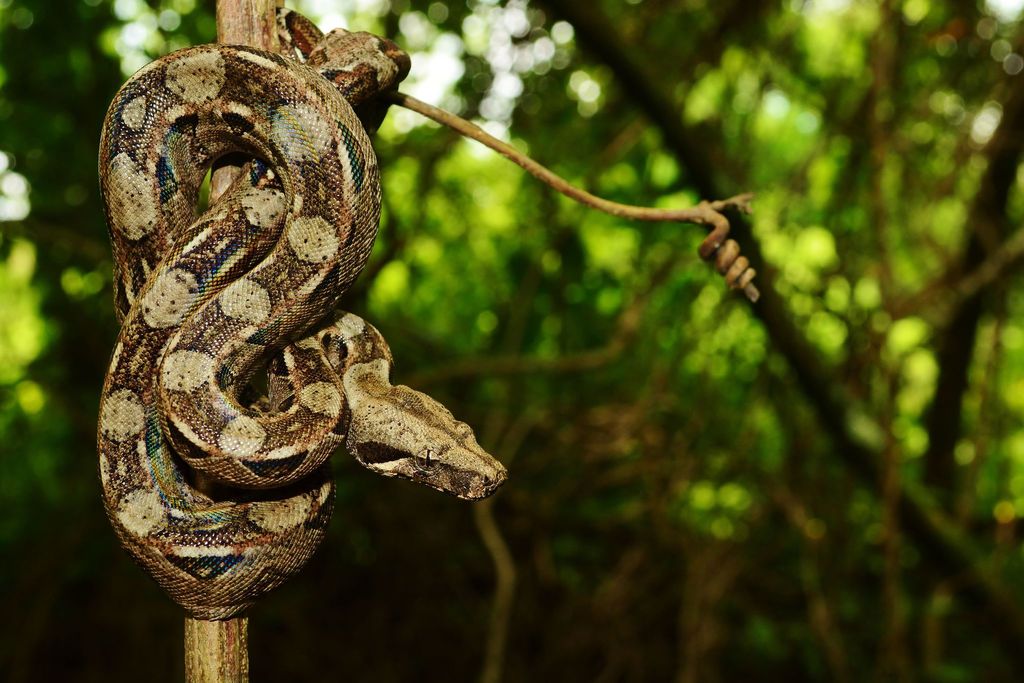
Photo: (c) Jesus Gordolomi Butterball RC, some rights reserved (CC BY-NC), uploaded by Jesus Gordolomi Butterball RC · via iNaturalist
KEY TAKEAWAYS
The boa constrictor (Boa constrictor) is a large, non-venomous snake and one of the best-known members of the boa family. It lives in South America east of the Andes and kills prey by constriction rather than venom. It is also one of the most widely kept pet snakes in the world.
- It is not venomous. The boa constrictor kills by squeezing prey until its blood flow stops, not by biting with poison.
- Most adults reach 6.5 to 10 ft (2 to 3 m); the largest confirmed specimens reach a bit over 13 ft (4 m).
- Many snakes sold in pet stores as boa constrictors are actually the closely related Boa imperator from Central America, now usually treated as a separate species.
- It gives birth to live young rather than laying eggs, and a female can carry 10 to 64 babies at once.
Boa constrictor quick facts
| Common name | Boa constrictor (red-tailed boa) |
|---|---|
| Scientific name | Boa constrictor Linnaeus, 1758 |
| Family | Boidae (boas) |
| Venomous | No, a constrictor |
| Adult length | 6.5-10 ft (2-3 m); record a little over 13 ft (4 m) |
| Weight | Large adults can pass 100 lb (45 kg) |
| Range | South America east of the Andes: Colombia, Venezuela, the Guianas, Peru, Bolivia, Brazil, Argentina, Paraguay, plus Trinidad and Tobago |
| Habitat | Rainforest, dry forest, savanna, farmland |
| Diet | Rodents, birds, bats, opossums, large lizards |
| Reproduction | Live birth, 10-64 young, about 25 on average |
| Conservation | IUCN Least Concern; one subspecies on CITES Appendix I |
How to identify a boa constrictor
A boa constrictor is a thick, muscular snake with smooth scales and a head only a little wider than its neck, like every boa. Its pattern is one of the clearest ways to recognize it.
- 1Body: heavy and muscular, with a short, thick tail.
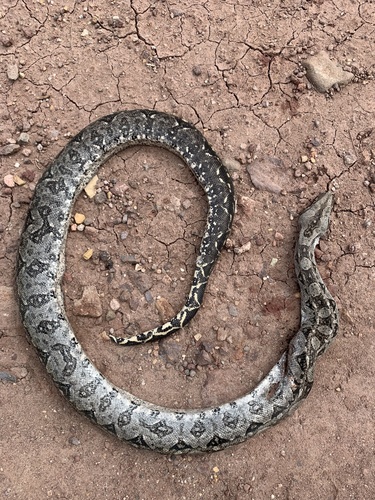
- 2Color and pattern: tan, light brown or gray background with dark brown, hourglass-shaped saddles that turn reddish brown toward the tail, which is why pet keepers often call it the red-tailed boa.
- 3Head markings: a thin dark stripe runs down the top of the head, with a dark, elongated mark behind each eye.
- 4Eyes: vertical, cat-like pupils, typical of a nocturnal ambush predator.
- 5Where you are: wild boa constrictors live in South America east of the Andes. A similar-looking snake farther north, from Mexico to Ecuador, is more likely the related Boa imperator.
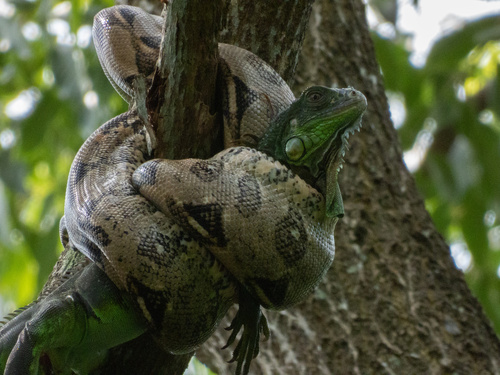
How big does a boa constrictor get?
Short answer: most adult boa constrictors reach 6.5 to 10 ft (2 to 3 m). The longest reliably measured specimens reach a bit over 13 ft (4 m), and large adults can weigh more than 100 lb (45 kg).
Smithsonian's National Zoo gives a range from 20 in (50 cm) at birth to 13 ft (3.9 m) as an adult, with weights up to 100 lb (45 kg). Animal Diversity Web reports typical adults at 2 to 3 m, with the longest confirmed individual a little over 4 m. Island populations of boa constrictor, such as those on some Caribbean islands, tend to stay smaller, often under 6.5 ft (2 m). Reports of 18 ft boa constrictors circulate online but are not backed by any measured specimen in these sources.
Where does the boa constrictor live?
Short answer: the boa constrictor lives in South America east of the Andes, from Colombia and Venezuela south through the Guianas, Peru, Bolivia, Brazil, Paraguay and Argentina, plus the islands of Trinidad and Tobago.
The closely related Boa imperator takes over farther north, from Mexico through Central America into Ecuador. For decades both were treated as subspecies of one species, but the Reptile Database now generally lists Boa imperator as its own species based on genetic studies going back to Hynkova and colleagues in 2010. The pet trade still sells snakes from both species under the single name boa constrictor, so a captive-bred pet's exact species often depends on its specific bloodline rather than the label on the tank.
A small non-native population of boa constrictors also breeds in and around the Charles Deering Estate in Miami, Florida, established since perhaps the 1970s, according to the Florida Museum of Natural History. See the boa group page for how this species compares to its relatives, and our world snake map for every group's range.
Habitat
Boa constrictors use a wide range of habitats: wet rainforest, dry tropical forest, open savanna, semi-desert scrub and farmland. They often turn up near human settlements where rodents are common, and they climb when needed but spend most of their time on the ground.
Behavior
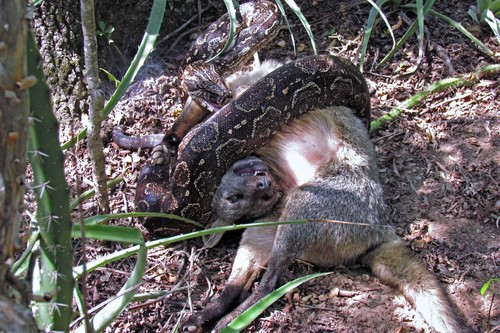
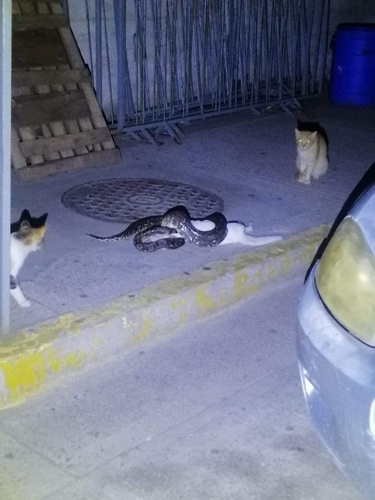
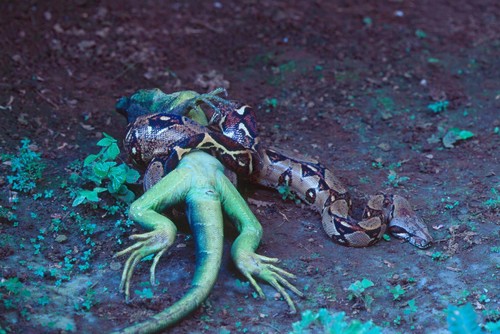
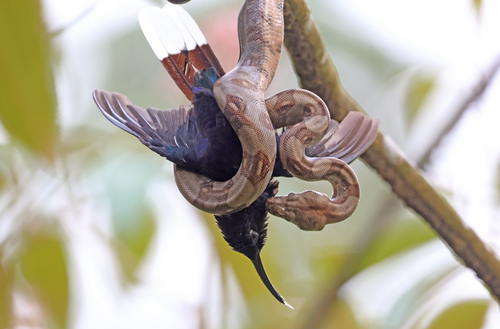
Boa constrictors are mostly nocturnal ambush hunters. One waits under cover or along a trail until a rat, bird or other animal comes within reach, strikes, grips with its teeth and throws coils around the prey.
A 2015 study in the Journal of Experimental Biology, led by Scott Boback, tested how boa constrictors actually kill. Researchers found that constriction causes blood pressure in prey to collapse within seconds, cutting off circulation rather than suffocating the animal by stopping its breathing, as was long assumed.
When threatened, a boa constrictor hisses loudly, gapes its mouth and may strike, but the Florida Museum notes it is not an aggressive species and uses biting only as a last resort in defense.
What does the boa constrictor eat?
| Prey group | Examples |
|---|---|
| Rodents | Rats, squirrels, agoutis |
| Birds | Various ground and perching birds |
| Mammals | Opossums, bats, mongooses where introduced |
| Reptiles | Large lizards |
After a large meal, a boa constrictor can go weeks without eating again. Young snakes take smaller prey such as mice and lizards, while large adults can overpower animals the size of an opossum.
Is the boa constrictor venomous or dangerous?
No, the boa constrictor is not venomous. It has no venom glands of any kind and kills prey purely by constriction.
A bite from a large adult can still cause real damage. Its teeth are sharp and curve backward to hold struggling prey, and a serious bite can leave deep puncture wounds or lacerations that trap bacteria. Clean any bite thoroughly with soap and water, and see a doctor for a deep wound, since infection is the main risk rather than venom. Boa constrictors are not aggressive by nature, and most bites happen when someone grabs, corners or mishandles one. Our snake safety FAQ covers what to do around any large snake.
Snakes confused with the boa constrictor
The boa constrictor's own close relatives cause the most mix-ups, since all are heavy, patterned, non-venomous constrictors.
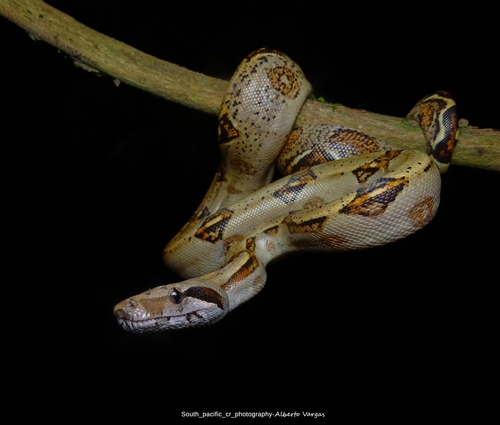
Central American boa
Boa imperator · Harmless
Nearly identical in build and often sold under the same pet-trade name, but native to Mexico, Central America and northwestern South America rather than South America east of the Andes.
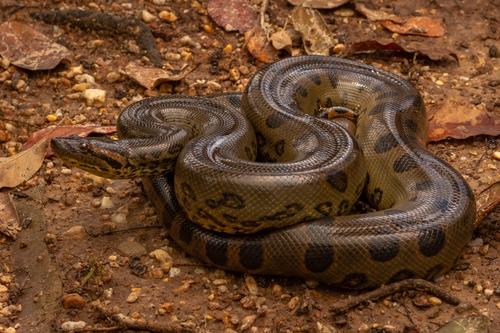
Green anaconda
Eunectes murinus · Harmless
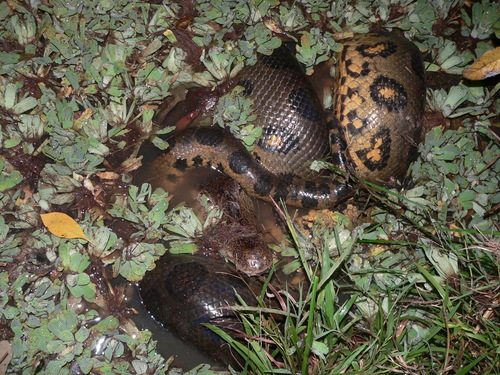
Much bulkier, olive green with black oval blotches, and almost always found in or near water. See our anaconda guide.
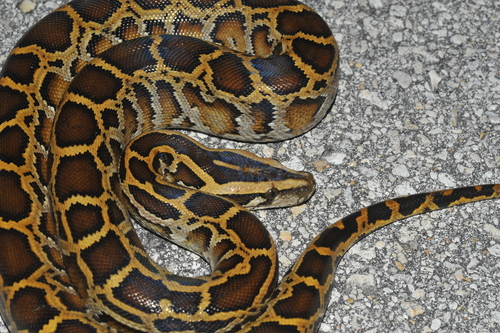
Burmese python
Python bivittatus · Harmless
Native to Southeast Asia and invasive in the Florida Everglades. Lays eggs rather than giving live birth, and typically grows longer than a boa constrictor.
Reproduction and lifespan
Boa constrictors give birth to live young rather than laying eggs, like almost every boa. Pregnancy lasts 5 to 8 months, and a female gives birth to 10 to 64 babies at once, about 25 on average, according to Smithsonian's National Zoo. The young reach sexual maturity at 2 to 3 years.
Female boa constrictors have also been documented reproducing without a male. The Reptile Database cites a 2010 study by Booth and colleagues that found evidence of parthenogenesis in the species, meaning some females can produce offspring on their own.
Boa constrictors live 20 to 30 years in the wild, and captive animals often reach the same range or longer with steady care.
Conservation status
| Status | Detail |
|---|---|
| IUCN Red List | Least Concern |
| CITES | Appendix II; the subspecies Boa constrictor occidentalis is on Appendix I |
| Subspecies | Six recognized by the Reptile Database, including a newly described form from Brazil in 2024 |
The species as a whole is not threatened, but local populations face pressure from habitat loss and collection for the pet and leather trades in some areas. The Argentine subspecies, occidentalis, has the strictest international trade protection of the group.
Boa constrictor FAQ
Is the boa constrictor venomous?
No. The boa constrictor has no venom glands. It kills prey by constriction, gripping with its teeth and squeezing until blood flow stops. A bite can still cause deep puncture wounds that need cleaning and, if severe, medical care.
How big does a boa constrictor get?
Most adults reach 6.5 to 10 ft (2 to 3 m). The longest reliably measured specimens reach a bit over 13 ft (4 m), and large individuals can weigh more than 100 lb (45 kg).
What is the difference between a boa constrictor and a red-tailed boa?
Red-tailed boa is just a common name for the boa constrictor, referring to the dark saddles near its tail that turn reddish brown. Some snakes sold under this name in the pet trade are actually the closely related Boa imperator.
Is a boa constrictor the same species as a Central American boa?
No, not anymore. Boa constrictor and Boa imperator were once treated as subspecies of one species, but genetic studies starting around 2010 led most sources, including the Reptile Database, to treat them as separate species.
Do boa constrictors lay eggs?
No. Boa constrictors give birth to live young. A female typically carries 10 to 64 babies and gives birth after a pregnancy of 5 to 8 months.
Are boa constrictors found in the United States?
Not natively. A small non-native population breeds in one area of Miami, Florida, near the Charles Deering Estate, established since perhaps the 1970s, but the species is not native to North America.
How long do boa constrictors live?
About 20 to 30 years in the wild. Captive boa constrictors with steady food and veterinary care often live within the same range or longer.