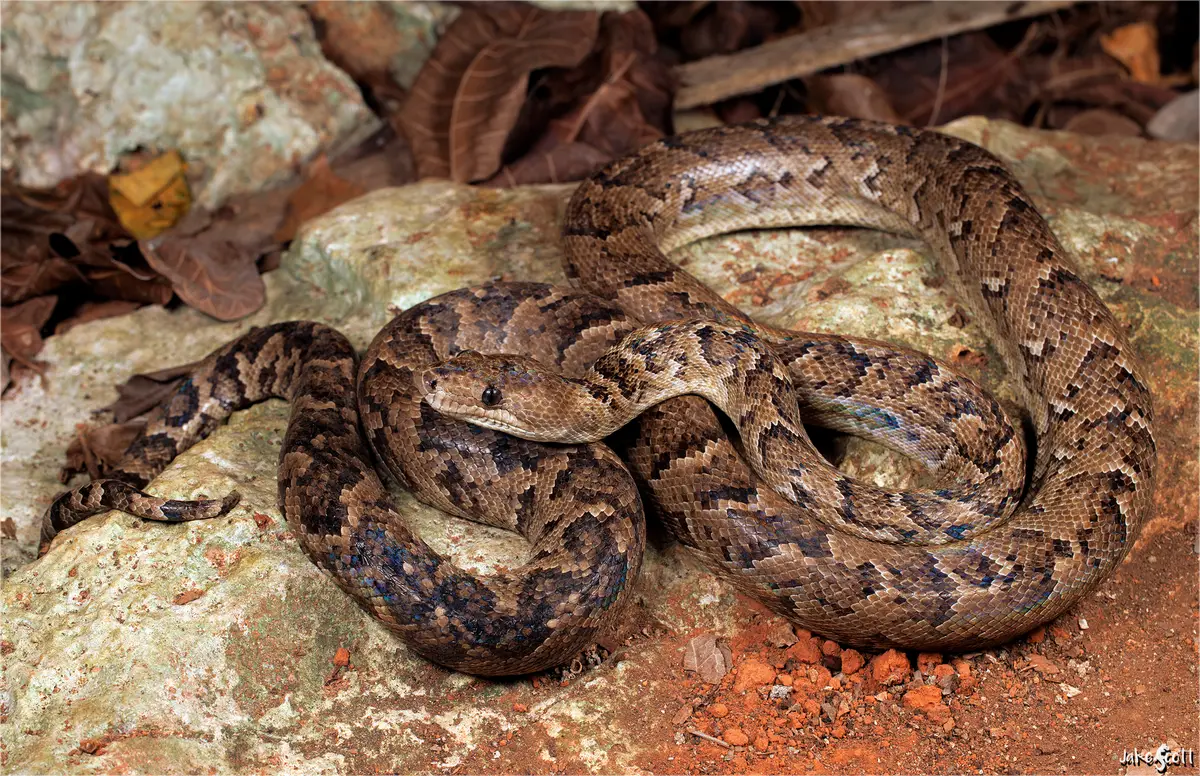
CUBANBOA
Chilabothrus angulifer · Family Boidae
KEY TAKEAWAYS
The Cuban boa (Chilabothrus angulifer) is a heavy-bodied boa that lives only in Cuba and its offshore islands, and it is the largest snake in the West Indies. It is not venomous and is no danger to people, though a big one can give a painful bite.
- It is not venomous. It kills hutias, rats, birds and bats by constriction.
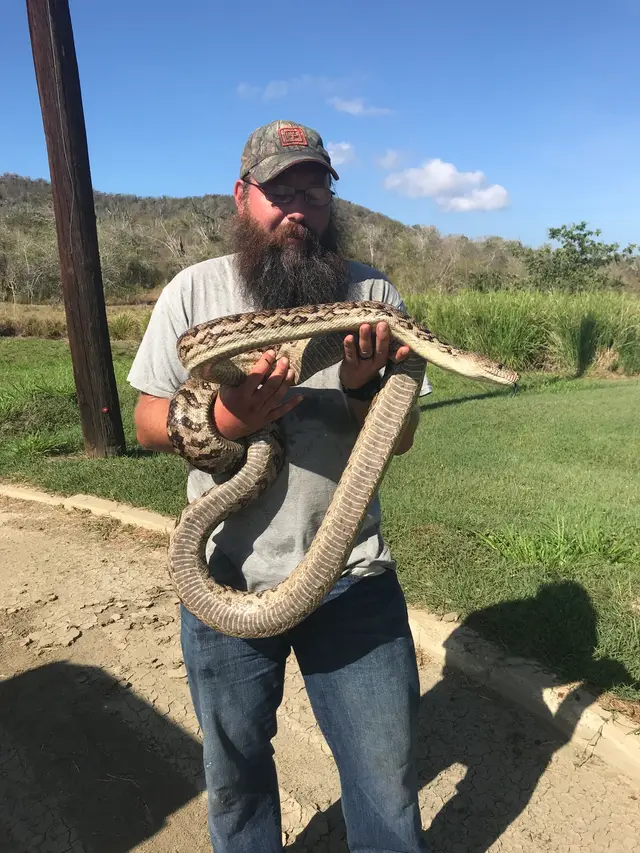
- The longest one measured was a 15 ft 11 in (4.85 m) female found dead on a road at Guantanamo Bay in 1989. Snakes over 10 ft (3 m) are rare today.
- Some Cuban boas hang from cave ceilings and grab bats in flight, and a 2017 study found they coordinate their positions when several hunt together.
- The IUCN rates it Least Concern (2021). Habitat loss, road traffic and people killing snakes on sight are its main problems.
Cuban boa quick facts
| Common name | Cuban boa, Cuban tree boa |
|---|---|
| Scientific name | Chilabothrus angulifer (Cocteau and Bibron, 1840); formerly Epicrates angulifer |
| Family | Boidae (boas), subfamily Boinae |
| Venomous | No, a constrictor |
| Adult length | Matures at about 3.8-4.6 ft (1.15-1.4 m) snout-vent length; over 10 ft (3 m) is rare; record 15 ft 11 in (4.85 m) |
| Range | Cuba, Isla de la Juventud and the Canarreos, Colorados and Sabana-Camaguey archipelagos |
| Habitat | Forest, rocky cliffs, caves, river cuts, grassy slopes and farmland, sea level to 3,983 ft (1,214 m) |
| Diet | Hutias, rats, domestic chickens, wild birds and bats, plus a few lizards and frogs |
| Reproduction | Live-bearing, 2-22 young per litter in the wild |
| Lifespan | Over 30 years in the wild |
| Conservation | IUCN Least Concern (2021); CITES Appendix II |
How to identify a Cuban boa
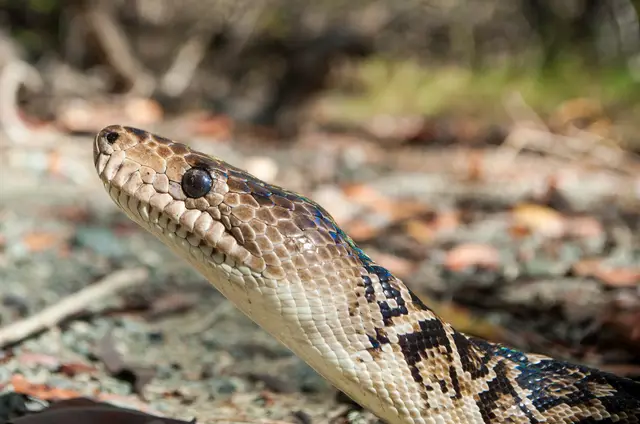
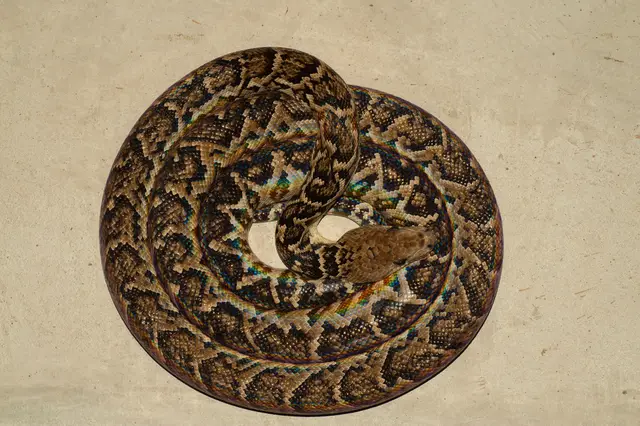
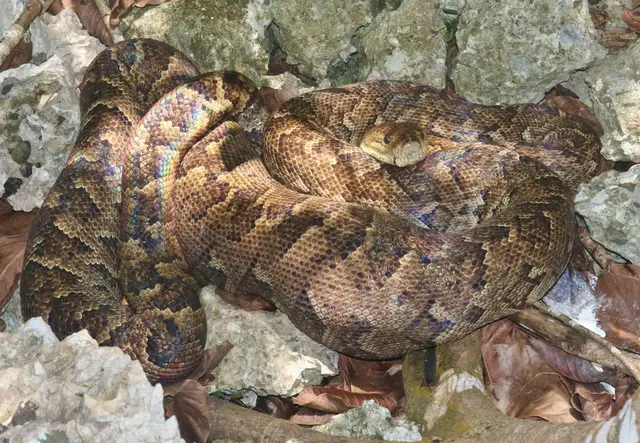
A Cuban boa is a thick, heavy snake with a yellowish to tan body covered in dark brown or black angular blotches. The West Indian Boas project counts 42 to about 65 of these markings down the back. The species name angulifer means "bearing angles", which probably refers to that pattern.
- 1Angular dark blotches: dark brown to black, roughly diamond or zigzag-shaped markings on a pale tan or yellowish background. Snakes from western Cuba are often paler, with little dark color.
- 2Heat pits on the lips: it is the only member of the genus Chilabothrus with pits in its lip scales. A pit viper has a single large pit between the eye and nostril instead, and Cuba has no pit vipers.
- 3Short tail: the tail is short for a boa, with 45-55 scales underneath, the fewest in the genus. It is usually plain or has up to 12 dark marks.
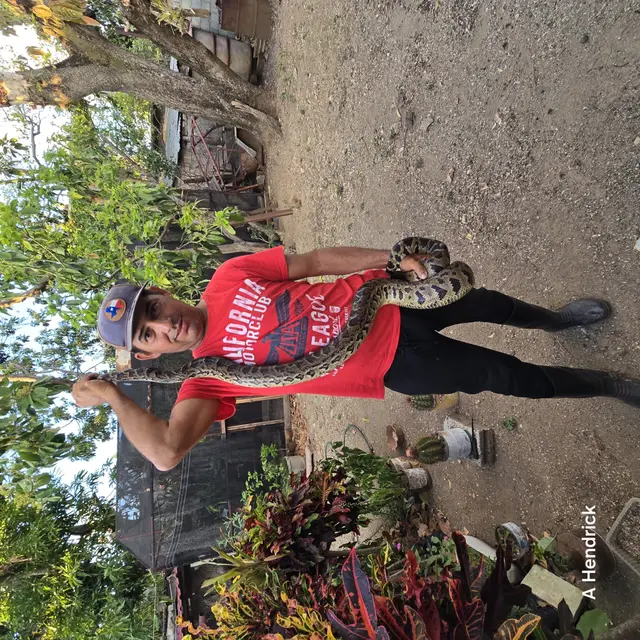
- 4Size and bulk: even a newborn is 21-24 in (54-62 cm) from snout to vent, and adults are much heavier than any other snake in Cuba.
- 5Spurs by the vent: small claw-like spurs on each side of the vent are the remains of hind legs, found in all boas.
Older books and many pet sellers call it Epicrates angulifer. The West Indian boas were moved to the genus Chilabothrus in 2013, after a DNA study by Reynolds and colleagues showed they form their own group, separate from the mainland rainbow boa and its relatives in Epicrates.
How big do Cuban boas get?
The Cuban boa is the largest snake in the West Indies. A 2016 study of wild boas by Rodriguez-Cabrera and colleagues gives a maximum snout-vent length of more than 400 cm (13 ft), not counting the tail. The longest one measured whole was a 4,851 mm (15 ft 11 in) female killed by a truck on the US Naval Base at Guantanamo Bay in 1989.
Big ones were more common in the past. The 19th-century naturalist Juan Gundlach reported snakes of about 6.4 m (21 ft), a figure that has never been confirmed. The West Indian Boas project says snakes over 10 ft are "certainly rare today".
| Measure | Figure | Source |
|---|---|---|
| Longest measured | 15 ft 11 in (4.85 m), female, Guantanamo, 1989 | West Indian Boas project |
| Maximum snout-vent length | Over 13 ft (4 m) | Rodriguez-Cabrera et al. 2016 |
| Males mature at | About 3.8 ft (1.15 m) snout-vent, around 3 years old | West Indian Boas project; Rodriguez-Cabrera et al. 2016 |
| Females mature at | About 4.3-4.6 ft (1.3-1.4 m) snout-vent, around 5 years old | West Indian Boas project; Rodriguez-Cabrera et al. 2016 |
| Newborns | 21-24 in (54-62 cm) snout-vent | West Indian Boas project |
Growth in the wild is slow. Wild boas tracked at Guantanamo grew no more than 15 mm (0.6 in) a month, about half the rate of well-fed captive snakes. That is why wild snakes start breeding at smaller sizes than captive ones.
Where do Cuban boas live?
Short answer: Cuban boas live only in Cuba. The Reptile Database lists the main island, Isla de la Juventud and the cays of the Canarreos, Colorados and Sabana-Camaguey archipelagos. They do not live wild in Florida, the Bahamas or anywhere else.
The species is found from western to eastern Cuba, with paler snakes in the west and darker ones in the east. The best-studied population is on the US Naval Base at Guantanamo Bay, where Peter Tolson and US Navy staff have radio-tracked boas since 2000. Compare its range with other snakes on the world snake map.
Habitat
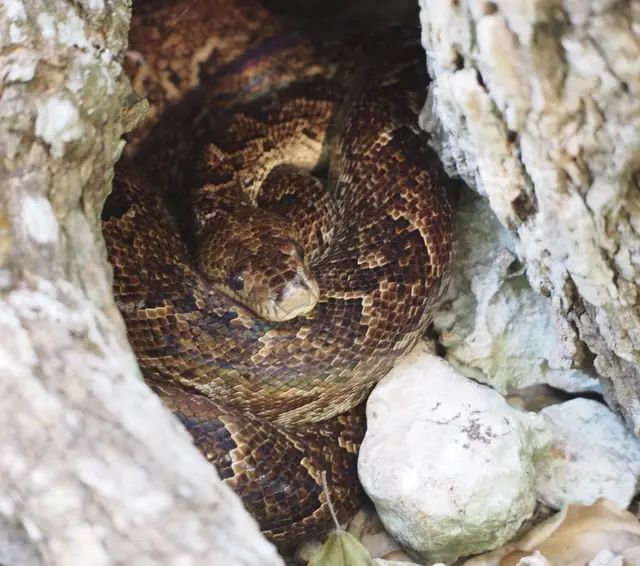
Cuban boas use almost every kind of habitat on the island that has cover and prey. The West Indian Boas project lists lowland and mountain woodland, roadsides, rocky cliffs, river cuts, caves and grassy slopes, from sea level to 1,214 m (3,983 ft). They also turn up in sugar cane fields and around farms, where chickens and rats are easy food.
They are partly arboreal. Most are found on the ground or among rocks, but they climb well, and one has been recorded 9.2 m (30 ft) up a tree. Caves matter more to this boa than to most snakes, because cave-roosting bats are an important food.
Behavior and bat hunting
The Cuban boa is mostly a sit-and-wait hunter. It picks a spot along a trail, a rock ledge or a cave passage and waits for prey to come within reach.
Its best-known habit is catching bats. In 1957 J. D. Hardy Jr. described boas at Cueva de Majas in Cuba striking at bats as they flew through the narrow cave opening. The smallest bat-hunting boa on record was only 70 cm (28 in) long.
In 2017 Vladimir Dinets of the University of Tennessee took it further. His study, Coordinated hunting by Cuban boas, watched boas gathering in a cave passage after sunset and before dawn, when bats fly out and return. New arrivals were more likely to settle where other snakes already hung, and together they formed a barrier across the bats' flight path. The more snakes in place, the faster each one caught a bat, while lone snakes did poorly. Dinets called it the first scientifically documented case of coordinated hunting by snakes.
Outside of hunting, Cuban boas are solitary. Several may gather in one place during the breeding season, and males fight each other in ritual wrestling bouts for access to females.
What do Cuban boas eat?
Cuban boas eat mostly mammals and birds. The largest diet study, Rodriguez-Cabrera and colleagues (2020), looked at 351 prey items from 218 snakes and found 49 prey species. Mammals made up about 55% of meals, birds 41% and cold-blooded prey such as lizards and frogs only 4%.
| Prey | Examples on record |
|---|---|
| Native mammals | Desmarest's hutia (Capromys pilorides), a large native rodent, and cave bats |
| Introduced mammals | Black rats, plus young livestock and pets near farms |
| Birds | Domestic chickens and other poultry, plus wild birds |
| Ectotherms | A small share of lizards and frogs |
The authors describe it as an opportunistic generalist. In natural habitat it eats mainly native hutias, birds and bats. Near people the menu shifts toward chickens, rats and pets, which is one reason farmers kill boas. On Guantanamo, the West Indian Boas project links a drop in boa numbers to a rise in hutias.
Is the Cuban boa venomous or dangerous?
No, the Cuban boa is not venomous, and it is not dangerous to people. Like all boas it has no venom glands and kills prey by squeezing it until its circulation stops.
A big adult can still bite hard. Newborns are described as "high strung and irascible from birth" by the West Indian Boas project, though most calm down with age. A bite is a set of puncture wounds and lacerations. Wash it with soap and water, keep it clean and see a doctor if it becomes red, hot or swollen over the following days. Our snakebite FAQ covers basic first aid.
Cuba has no dangerously venomous snakes at all. A few small Cuban snakes, such as the racers, have rear fangs and a mild venom used on prey, but none is a serious threat to people.
Snakes confused with the Cuban boa
In Cuba, size alone usually settles it: no other native snake comes close. Young boas are the ones most often mixed up with other species.
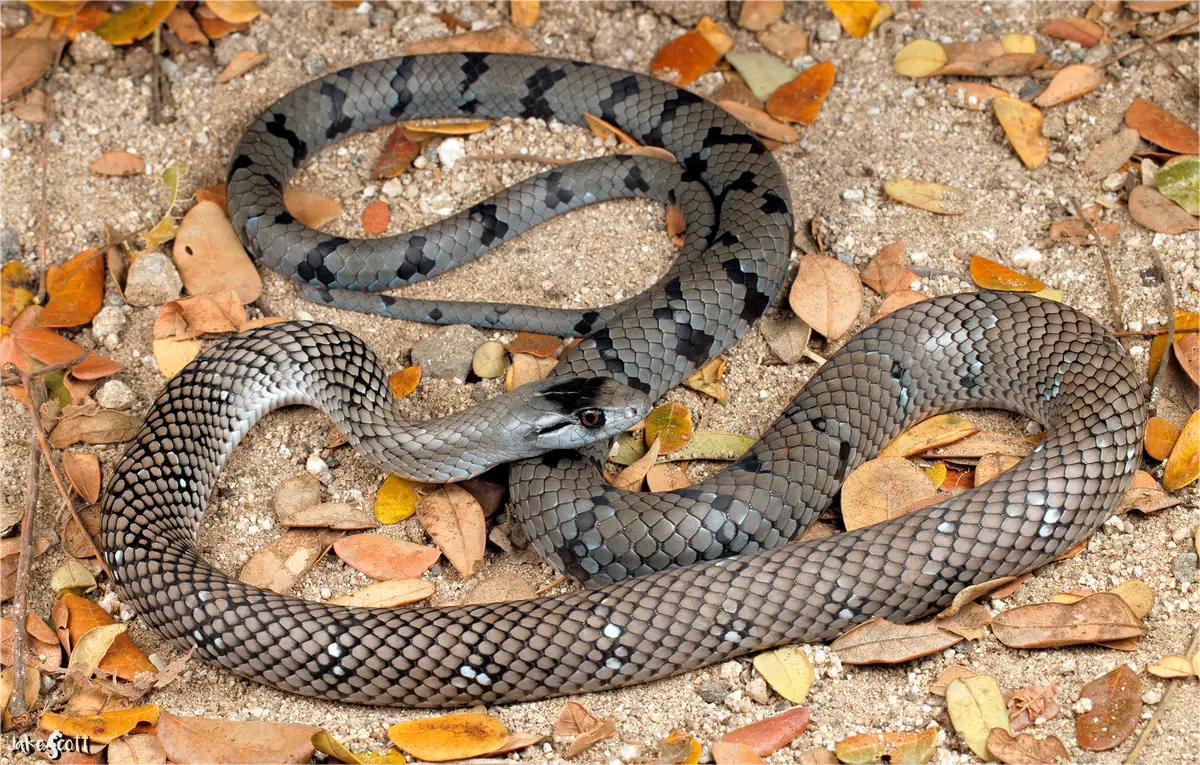
Cuban racer
Cubophis cantherigerus · Mildly venomous
A slim, fast snake found across Cuba and on Cay Sal Bank, per the Reptile Database. It has rear fangs and a weak venom for prey. A Cuban boa is far bulkier, moves slowly, has a short tail and has heat pits along its lips.
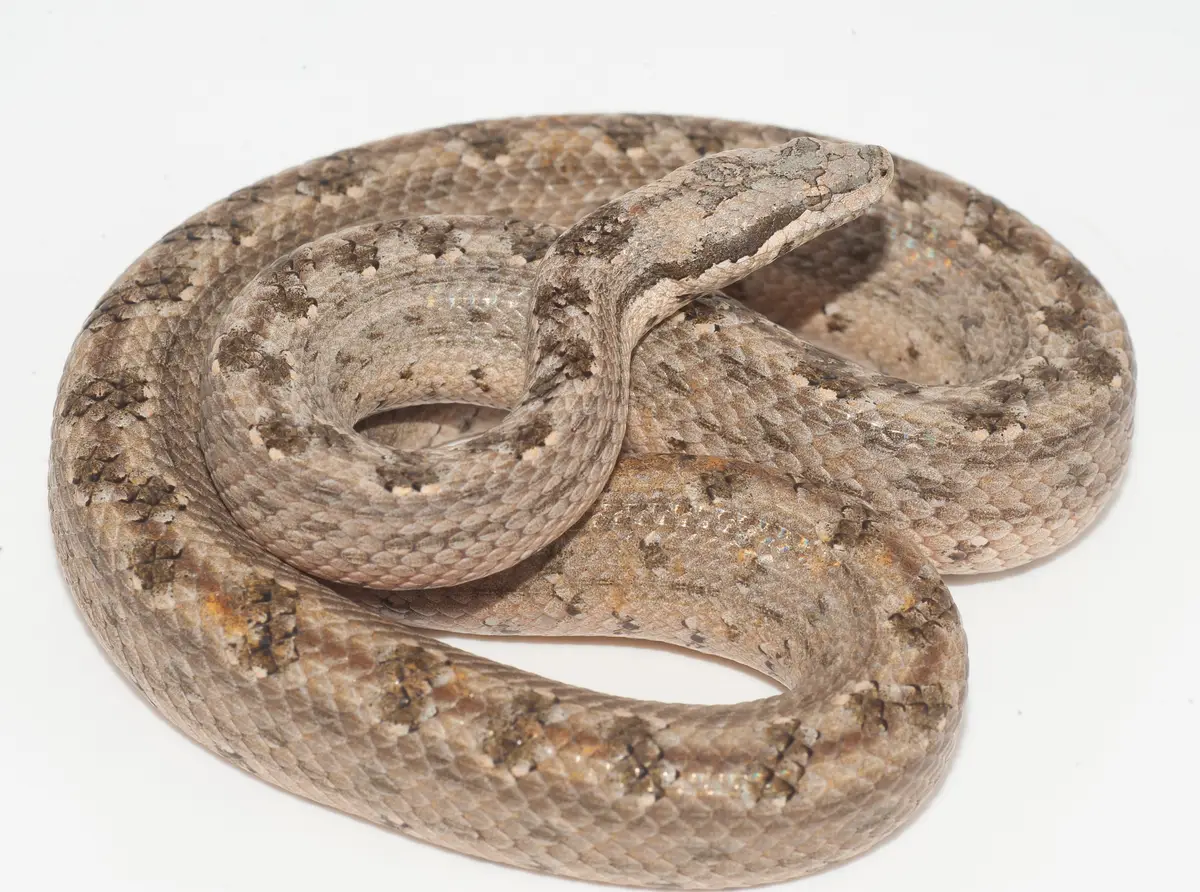 Photo: (c) Wayne Fidler, some rights reserved (CC BY-NC), uploaded by Wayne Fidler · via iNaturalist
Cuban dwarf boa
Tropidophis melanurus · Harmless
Also called the giant trope, it is in a different family (Tropidophiidae) and is much smaller. Its species name melanurus means "black tail", and a 2014 paper described it bleeding on purpose as a defense, a habit called autohemorrhaging. It has no lip pits.
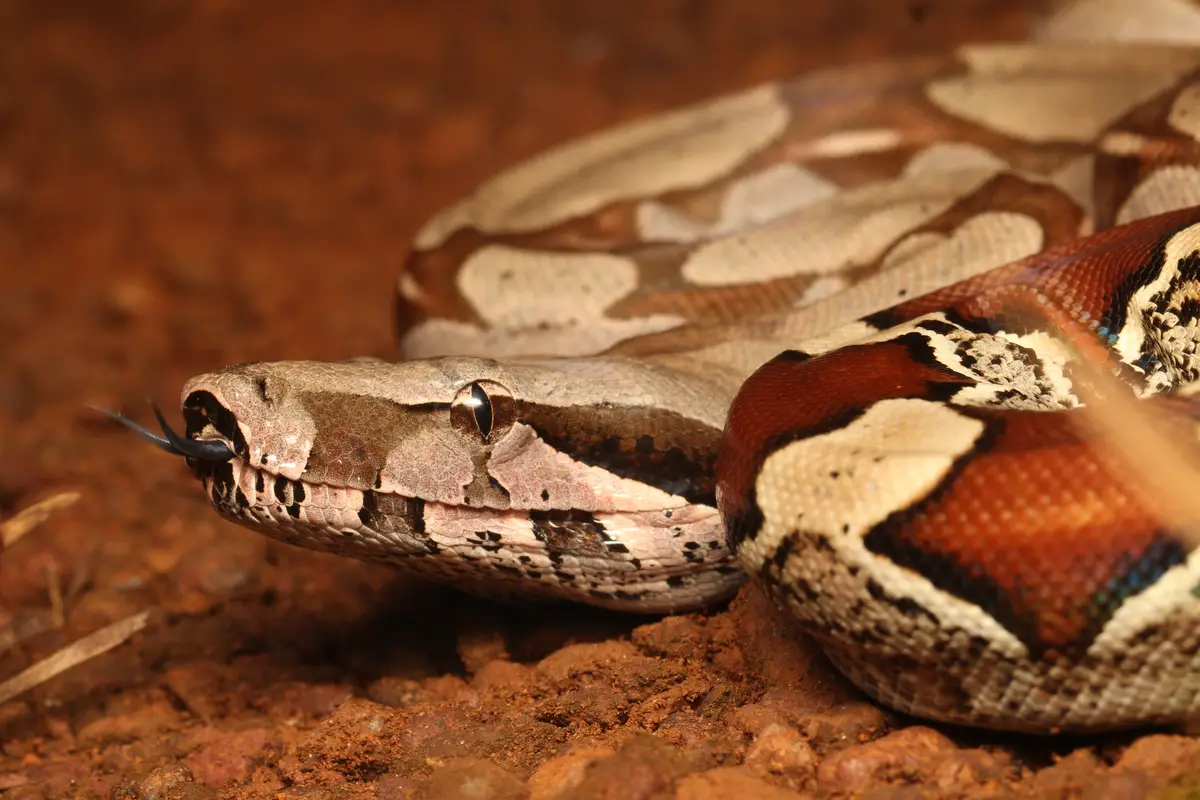
Boa constrictor
Boa constrictor · Harmless
The mainland boa constrictor does not live in Cuba but is the boa most often compared with it in the pet trade. It has rounded saddles that turn reddish on the tail and a dark stripe through the eye. A Cuban boa has angular blotches, a shorter tail and pits on its lips.
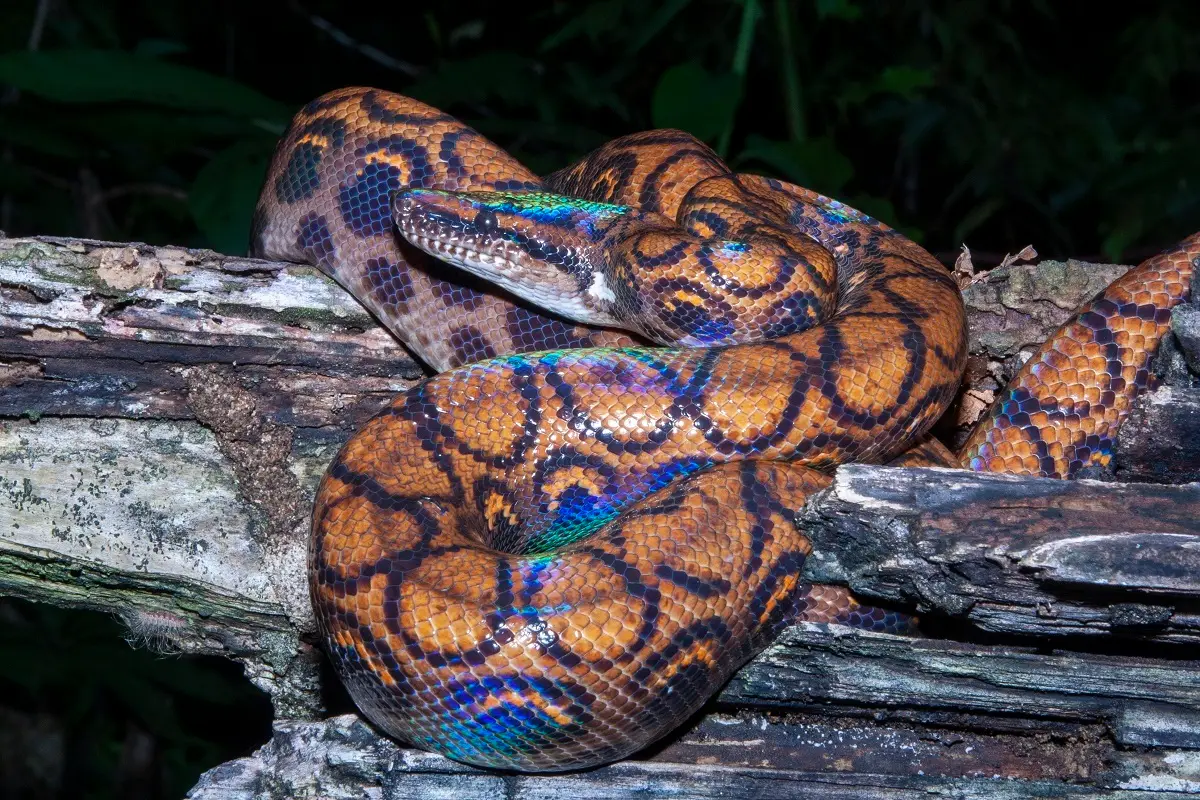
Rainbow boa
Epicrates cenchria · Harmless
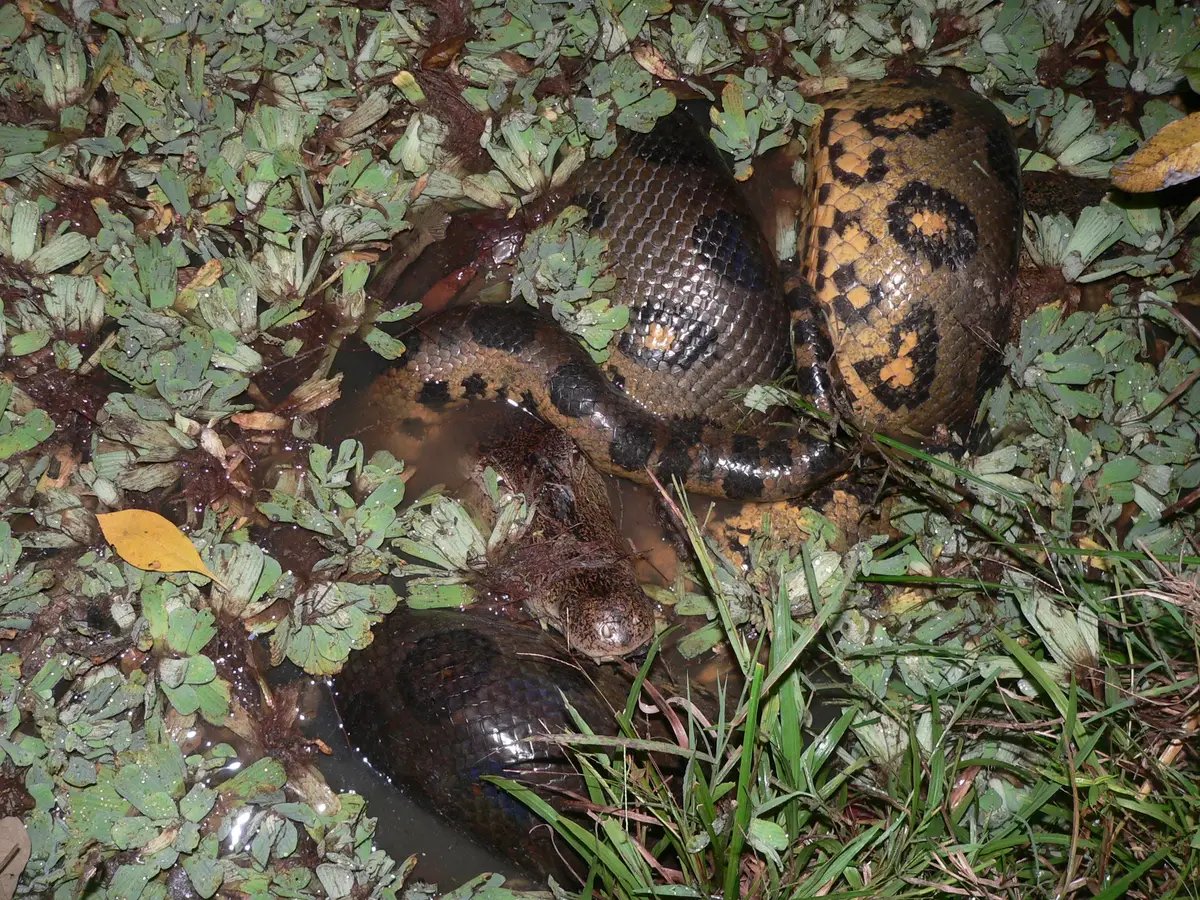
A South American relative and former genus-mate. The rainbow boa is smaller and slimmer and has round, dark-ringed spots with a strong iridescent sheen.
Reproduction and lifespan
Cuban boas give birth to live young. Mating takes place from April to June, and after a wild gestation of 150 to 180 days the young are born mostly in September and October, according to the West Indian Boas project. Wild litters hold 2 to 22 babies; captive litters are usually 3 to 9. Bigger females have bigger litters and bigger babies.
Females breed every other year, while males can mate every year. Size, not age, decides when a female is ready. The newborns are the largest in their genus and can eat mice and rats after their first shed, about three weeks after birth. Few make it: fewer than one in ten survive their first year, mostly lost to feral dogs and cats and to birds of prey.
Two odd records come from captivity. In 2020 Seixas and colleagues confirmed with DNA tests that a captive female Cuban boa had produced young without a male, the first proven case of parthenogenesis in the species. A 2022 note in the Herpetological Bulletin described the birth of what appeared to be non-identical twins. Survivors live a long time: wild Cuban boas can pass 30 years, and captive females have given birth at over 30.
Conservation status
| Authority | Status |
|---|---|
| IUCN Red List (2021, Fong) | Least Concern |
| IUCN Red List (1996, older assessment) | Lower Risk/Near Threatened |
| CITES | Appendix II (international trade is regulated) |
The current IUCN assessment rates the Cuban boa Least Concern because it is still found across the whole island. Older lists, and some keeper sites, still give the earlier Near Threatened label.
It is far from free of trouble. Cuba's forest cover fell from about 89% in 1812 to 14% in 1959, cleared mainly for cattle and sugar cane, before recovering to about 31% by 2019. Field workers report that people still kill boas on sight. On Guantanamo, cars and trucks killed 14% of 51 boas followed by researchers.
Cuban boa FAQ
Is the Cuban boa venomous?
No. The Cuban boa has no venom glands. It is a constrictor that seizes prey with its teeth and squeezes it. A large adult can still give a painful bite with many small puncture wounds. Clean any bite with soap and water and watch it for signs of infection. Cuba has no snakes that are dangerously venomous to people.
How big do Cuban boas get?
The record is a 15 ft 11 in (4.85 m) female killed by a truck at Guantanamo Bay in 1989. Wild boas mature at about 4 to 4.5 ft snout-vent length, and snakes over 10 ft (3 m) are rare today. Old reports of 21 ft snakes from the 1800s have never been confirmed.
Is the Cuban boa the biggest snake in the Caribbean?
Yes. The Cuban boa is the largest snake in the West Indies and the largest member of its genus, Chilabothrus, which includes the Jamaican, Puerto Rican and Hispaniolan boas. A 2016 field study by Rodriguez-Cabrera and colleagues gives a maximum snout-vent length of more than 400 cm (13 ft), not counting the tail.
Do Cuban boas really hunt bats?
Yes. Cuban boas hang from the walls and ceilings of cave entrances and grab bats in flight as they leave or return to their roosts. A 2017 study by Vladimir Dinets found that boas arriving at a cave passage placed themselves near snakes already there, forming a barrier that caught bats faster. It was the first documented case of coordinated hunting in snakes.
What do Cuban boas eat?
Mostly mammals and birds. A 2020 study of 351 prey items found mammals made up about 55% of meals and birds about 41%. Native hutias and bats are key wild prey, while boas near farms eat many chickens and rats. Lizards and frogs make up only about 4% of the diet.
How long do Cuban boas live?
Cuban boas can live more than 30 years in the wild, according to the West Indian Boas project, and captive females have given birth at over 30 years old. They grow slowly in the wild, so males do not breed until about 3 years old and females until about 5.
Related snakes
Sources
- Reptile Database: Chilabothrus angulifer
- West Indian Boas project: Chilabothrus angulifer
- Dinets (2017), Coordinated hunting by Cuban boas, Animal Behavior and Cognition
- Rodriguez-Cabrera et al. (2020), Trophic ecology of the Cuban boa, Reptiles and Amphibians
- Rodriguez-Cabrera et al. (2016), Sexual maturation in free-ranging Chilabothrus angulifer, Phyllomedusa
- IUCN Red List: Chilabothrus angulifer
- Reptile Database: Cuban racer (Cubophis cantherigerus)
- iNaturalist: Chilabothrus angulifer observations