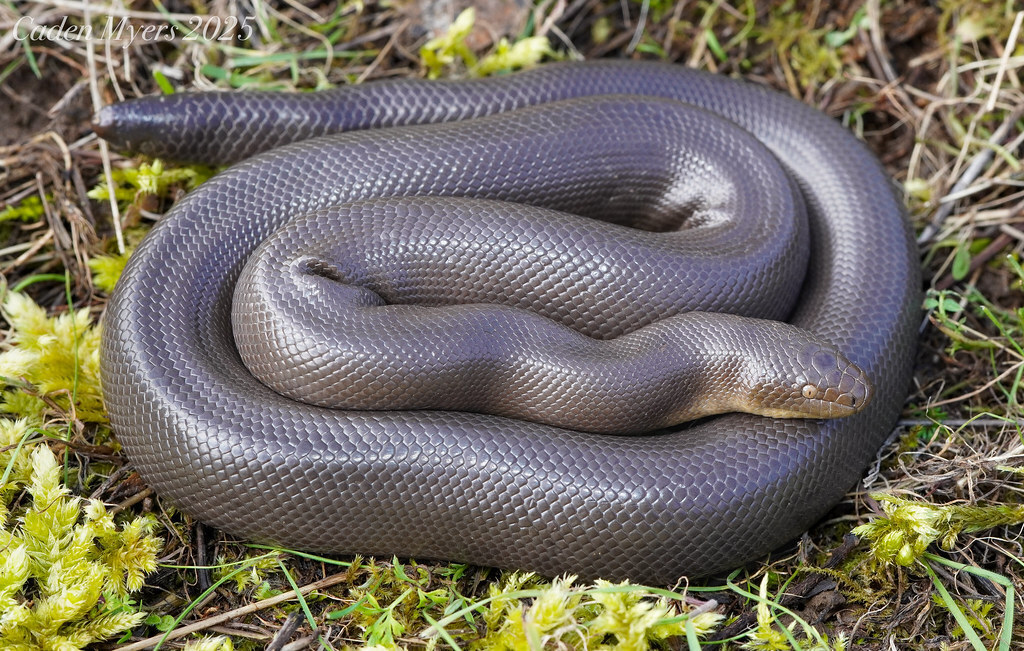
RUBBERBOA
Charina bottae · Family Boidae
Photo: (c) Caden Myers, all rights reserved, uploaded by Caden Myers · via iNaturalist
KEY TAKEAWAYS
The rubber boa (Charina bottae) is a small, non-venomous constrictor that lives in forests, meadows and rocky slopes across the western United States and southern British Columbia. It is one of the few boas native to the United States, and it is harmless to people.
- It is not venomous and almost never bites. It kills small prey by constriction.
- Most adults are 15 to 25 in (38 to 64 cm) long; the largest reach about 33 in (84 cm).
- Its short, blunt tail looks like a head. When threatened it hides its real head in its coils and waves the tail.
- It handles cold better than most snakes and lives from sea level to above 10,000 ft (3,050 m).
Rubber boa quick facts
| Common name | Rubber boa (also northern rubber boa, two-headed snake) |
|---|---|
| Scientific name | Charina bottae (Blainville, 1835) |
| Family | Boidae (boas); some authors place it in Charinaidae |
| Venomous | No, a constrictor |
| Adult length | 14-33 in (35-84 cm), usually 15-25 in |
| Newborn size | About 7.5-10 in (19-26 cm), 7-8 g |
| Range | Southern British Columbia south to central California, east to western Montana, western Wyoming and northern Utah |
| Habitat | Conifer and oak forest, meadows, grassland, chaparral and rocky slopes, often near water |
| Diet | Mostly small mammals, especially nestling mice and shrews; also lizards, birds and reptile eggs |
| Reproduction | Live birth, 1-8 young, born late summer to fall |
| Conservation | IUCN Least Concern; Special Concern in Canada |
How to identify a rubber boa
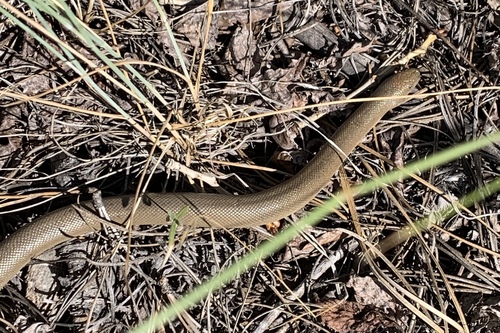
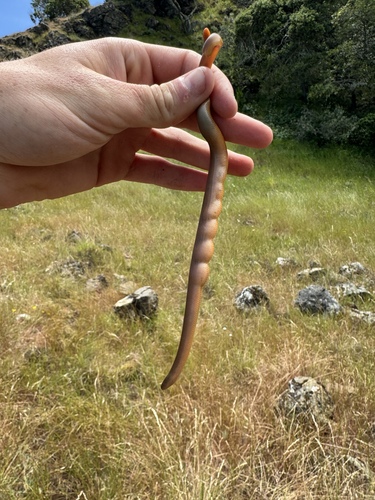
A rubber boa looks like a short length of brown garden hose with a head at one end and what seems to be a second head at the other. Few snakes in its range share that shape, so body and tail are the best clues.
- 1Plain, unpatterned back: the back is one color: light or dark brown, olive green, tan or pinkish. Some northern snakes have dark spots or mottling, which CaliforniaHerps suggests may partly be scars.
- 2Yellow or cream belly: the underside is yellow, orange or cream, usually without a pattern.
- 3Blunt, head-like tail: the tail is short and thick and ends in a rounded tip. From a distance it is hard to tell which end is which.
- 4Rubbery skin: the scales are tiny and smooth, and the skin sits loose with small wrinkles. It looks and feels like rubber, which gives the snake its name.
- 5Small eyes, slow moves: the eyes are small with vertical pupils, and the head is barely wider than the neck. Rubber boas crawl slowly and rarely try to flee fast.
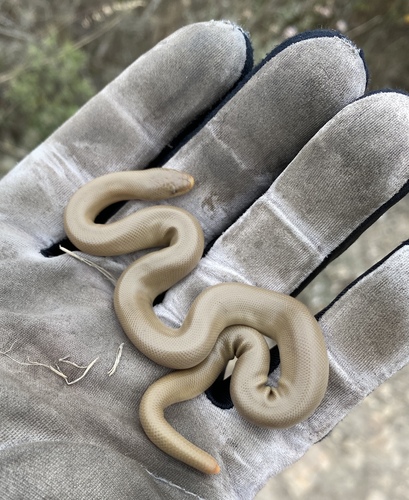
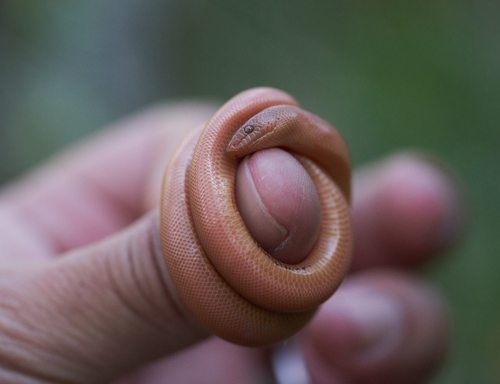
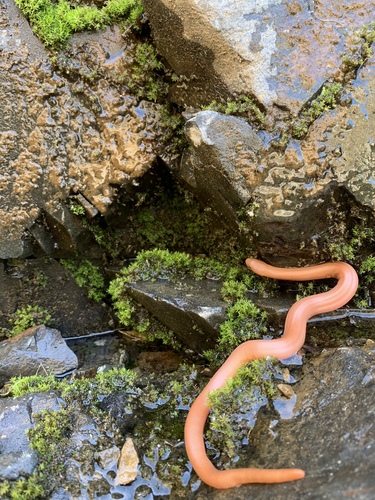
Newborns look different from adults: they are pink or tan and can be almost see-through. Males have small spurs beside the vent, the remains of hind legs; in females the spurs are tiny or missing.
How big does a rubber boa get?
Rubber boas are small snakes: most adults measure 15 to 25 in (38 to 64 cm), and the full adult range given by CaliforniaHerps is 14 to 33 in (35 to 84 cm). Females grow longer than males. In an Oregon study summarized by COSEWIC, adult males averaged about 21 in (535 mm) and females about 25.6 in (651 mm). Some mountain populations in southern California, such as those in the Tehachapi Mountains and on Mount Pinos, stay unusually small. That is a fraction of the size of its tropical relative, the boa constrictor.
| Life stage | Length | Weight |
|---|---|---|
| Newborn | 7.5-10 in (19-26 cm) | 7-8 g (about 0.25 oz) |
| Adult male (Oregon average) | About 21 in (53 cm) | Not well documented |
| Adult female (Oregon average) | About 25.6 in (65 cm) | Not well documented |
| Largest adults | About 33 in (84 cm) | Not well documented |
Where do rubber boas live?
Short answer: rubber boas live in the western United States and southern British Columbia, from the Pacific coast east to western Montana and western Wyoming, and south to central California, Nevada and Utah. The Reptile Database lists Washington, Oregon, California, Idaho, western Montana, Nevada, northern Utah and western Wyoming. See where other American snakes live on the world snake map.
In California the range runs from northern Monterey County north through the Coast Ranges to the Siskiyou Mountains, and down the Sierra Nevada to its southern end. It is missing from the Central Valley and the deserts. In Montana, the Montana Field Guide now records it in 26 counties; a 2008 find in Big Horn County pushed the known range 115 mi (185 km) east. In Canada it lives only in southern British Columbia, which is the northern edge of the species' range.
Habitat
Rubber boas live in conifer and deciduous forest, oak woodland, mountain meadows, grassland, chaparral and along streams. What they need most is cover. They hide under logs, rocks, loose bark and rotting stumps, and in Montana they often turn up under boards, sheet metal and cardboard near houses. Many are found close to water. In the lava beds of Siskiyou and Modoc counties, California, some even live in caves at about 4,500 ft.
Behavior and the two-headed tail trick
The rubber boa's best-known habit is its defense. When something grabs or pokes it, the snake rolls into a loose ball, tucks its head inside and lifts its blunt tail, moving it like a head. A predator that strikes hits the tail instead of the skull, which explains why so many adults have scarred tails. It may also release a strong-smelling musk. That is about as aggressive as a rubber boa gets: it rarely bites, even when picked up.
Rubber boas are active mostly at dusk and at night, though they sometimes bask on trails or roads. They burrow well, climb trees and swim. They also tolerate cold better than most snakes. Body temperatures of active snakes in Idaho ranged from 43 to 82 F (6 to 28 C), with most around 57 F (14 C), and people in the Okanagan Valley of British Columbia have seen them crawling on snow in early spring.
Winter is spent underground, often in groups. COSEWIC reports dens holding from 2 to more than 25 snakes, in rock outcrops, talus, forest soil about 3 ft (1 m) deep, and even compost or burn piles. Most emerge in March or April and stay active into October or November. They stay close to home. Two radio-tracked snakes in British Columbia used home ranges of about 0.7 and 3 acres (0.3 and 1.2 ha).
What does a rubber boa eat?
Rubber boas eat mostly small mammals, and they specialize in raiding nests of baby rodents. Museum and field records from California summarized by COSEWIC break down as below. Small boas take more lizards and eggs; big ones take more mammals and birds.
| Prey type | Share of records (California) | Examples |
|---|---|---|
| Mammals | 66% | Nestling mice, voles, shrews |
| Lizards | 17% | Small lizards |
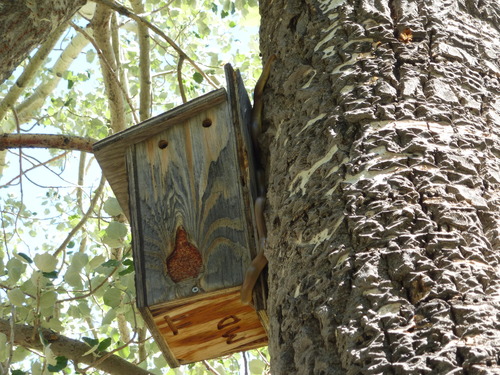
| Birds | 7% | Nestlings, such as chickadees from a nest box |
| Reptile eggs | 4.5% | Lizard and snake eggs |
The tail helps at mealtime too. When a rubber boa enters a burrow full of baby mice, the mother attacks. The snake keeps its head on the nestlings and offers its tail to the bites, which is another reason adult tails are so often scarred. Prey is killed by constriction, and most feeding happens at night.
Is the rubber boa venomous or dangerous?
No, the rubber boa is not venomous and is not dangerous to people. It has no venom glands, like every other boa, and it is far too small to constrict anything bigger than a vole. CaliforniaHerps rates it "Not Dangerous", and the Montana Field Guide describes it as docile.
Bites are rare. If one happens, it leaves only small pinpricks; wash them with soap and water. The bigger risk runs the other way: rubber boas are slow, so they die on roads, get tangled in plastic garden netting, and are killed by people who mistake them for something else. One found in a yard is most likely hunting mice and can be left alone. Our snakebite FAQ covers first aid for any bite.
Snakes confused with the rubber boa
None of the snakes most often mistaken for a rubber boa is dangerous. If unsure, post a photo to iNaturalist for an identification.
Rosy boa
Lichanura · Harmless
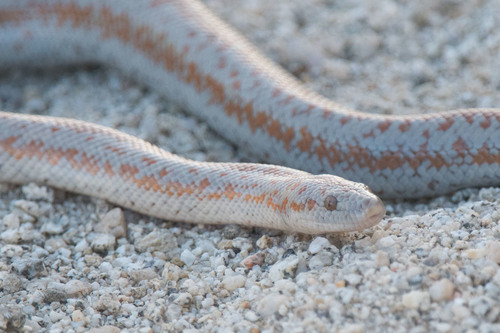
The rubber boa's closest US relative. The rosy boa has a similar thick body and blunt tail but carries three lengthwise stripes, and it lives in the deserts and dry scrub of southern California and Arizona, mostly south of the rubber boa's range.
Southern rubber boa
Charina umbratica (or C. bottae umbratica) · Harmless
Looks almost identical and is told apart mainly by location: it lives only in the San Bernardino and San Jacinto Mountains of southern California, at about 5,000 to 8,200 ft. California lists it as Threatened, so it must not be collected or disturbed.
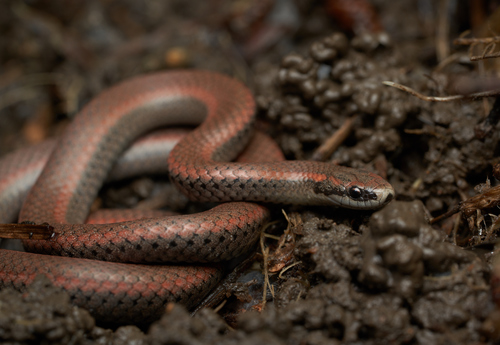
Sharp-tailed snake
Contia tenuis · Harmless
A small reddish snake of the same Pacific Northwest and California woods. It is much thinner, usually 8 to 12 in long, with a black-and-white barred belly and a sharp spine at the tail tip instead of a rounded one.
Reproduction and lifespan
Rubber boas mate in April and May, soon after leaving their winter dens, and give birth to live young. In 378 captive litters from Oregon, litter size ranged from 1 to 8 with an average of 4.2; Montana records give 2 to 8. Young are born from late July to November, depending on the region. Females do not breed every year: some breed every other year and others every 3 to 5 years, and CaliforniaHerps gives an average of once every four years.
They grow up slowly and live a long time. Oregon males matured at 3 to 4 years and females at 4 to 5. Captives have lived more than 30 years, and wild Oregon snakes have been recaptured 10 to 24 years after they were first marked. That slow pace is why COSEWIC considers the species sensitive to losses: a population that loses adults takes a long time to recover.
Northern vs southern rubber boa
The snake on this page is often called the northern rubber boa, to separate it from the southern rubber boa of the mountains east of Los Angeles. A 2001 genetic study by Rodriguez-Robles and colleagues raised the southern form to a full species, Charina umbratica. A 2022 study by Grismer and colleagues found it distinct in body form but kept it as a subspecies so that the rest of C. bottae would remain a natural group. Both views are still in use.
Conservation status
| Authority | Status |
|---|---|
| IUCN Red List (Charina bottae) | Least Concern |
| NatureServe global rank | G4 (apparently secure) |
| Canada (COSEWIC, 2016; SARA Schedule 1) | Special Concern |
| Montana | S4; Species of Greatest Conservation Need |
| California (southern rubber boa only) | Threatened since 1971 |
Across most of its range the rubber boa is secure. Canada is the exception. COSEWIC first listed it as Special Concern in 2003 and kept that status in 2016, citing its slow breeding and patchy range in British Columbia. The main threats there are vineyards, ranching, roads and new housing; one proposed subdivision near Pemberton could wipe out at least six dens. COSEWIC suggests the Canadian population may number in the tens of thousands, though it has never been counted.
Rubber boa FAQ
Is the rubber boa venomous?
No. The rubber boa has no venom and is harmless to people. It kills small prey such as nestling mice by constriction. It almost never bites, even when handled; when threatened it usually hides its head in its coils and waves its tail instead. A rare bite leaves only small pinpricks.
How big do rubber boas get?
Most adults are 15 to 25 in (38 to 64 cm) long, and the largest reach about 33 in (84 cm). Females are longer than males. Newborns measure roughly 7.5 to 10 in and weigh only 7 to 8 g, about the weight of three pennies.
Why is it called a rubber boa?
Its skin is covered in tiny, smooth scales and sits loose with small wrinkles, so the snake looks and feels like rubber. Adults are plain brown or olive with no pattern, and a resting snake with its blunt tail can pass for a short piece of hose.
Why does the rubber boa look like it has two heads?
Its tail is short, thick and rounded, so it looks like a second head. The boa uses this as a decoy: it hides its real head in its coils and lifts the tail toward a predator. It also offers the tail to biting mother mice while it eats their young.
Where do rubber boas live?
Rubber boas live in the western United States and southern British Columbia: Washington, Oregon, California, Idaho, western Montana, Nevada, northern Utah and western Wyoming. They use forests, meadows, grassland and rocky slopes from sea level to above 10,000 ft, and are often found under logs or rocks near water.
How long do rubber boas live?
A long time for a small snake. Captive rubber boas have lived more than 30 years, and wild snakes in Oregon have been recaptured 10 to 24 years after first being marked. They mature late, at 3 to 5 years, and females often breed only every few years.
Related snakes
Sources
- Reptile Database: Charina bottae
- CaliforniaHerps: Northern rubber boa (Charina bottae)
- CaliforniaHerps: Southern rubber boa (Charina umbratica)
- Montana Field Guide: Rubber boa
- COSEWIC assessment and status report on the northern rubber boa (2016)
- Aquarium of the Pacific: Rubber boa
- iNaturalist: Charina bottae