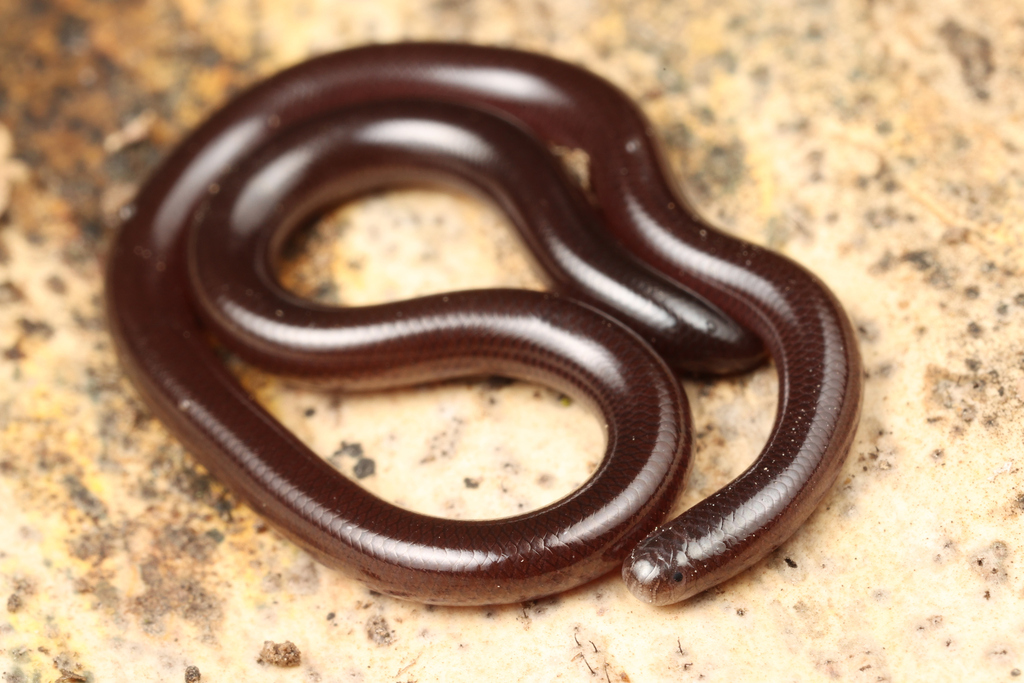
SANDBOA
Eryx · Family Boidae
Photo: (c) captainjack0000, all rights reserved, uploaded by captainjack0000 · via iNaturalist
KEY TAKEAWAYS
A sand boa is one of 13 species of small, burrowing boas in the genus Eryx, found in deserts, dry savanna and farmland from West Africa and southeastern Europe to India and Mongolia. Sand boas are not venomous and are harmless to people.
- They are not venomous. They grab rodents and lizards from ambush and kill them by constriction.
- Most adults are 1 to 2 ft (30 to 60 cm) long. The red sand boa of South Asia is the largest and can pass 3 ft (0.9 m).
- They spend most of the day buried, with eyes and nostrils set high on the head so they can watch and breathe from under the sand.
- The Kenyan sand boa is a common pet. The red sand boa is one of India's most trafficked reptiles because of a 'two-headed snake' superstition.
Sand boa quick facts
| Common name | Sand boa, Old World sand boa |
|---|---|
| Scientific name | Eryx Daudin, 1803 (13 species) |
| Family | Boidae, subfamily Erycinae; some authors use a separate family, Erycidae |
| Venomous | No, a constrictor |
| Adult length | Mostly 1-2 ft (30-60 cm); red sand boa up to about 3 ft (0.9 m) or a little more |
| Weight | Not well documented for wild snakes |
| Range | North, West and East Africa, Arabia, southeastern Europe, the Caucasus, Central Asia to Mongolia and western China, Iran, Pakistan, India, Nepal, Bangladesh and Sri Lanka |
| Habitat | Sand and loose soil in desert, semi-desert, dry savanna, scrub and farmland |
| Diet | Mainly small rodents; also lizards, lizard eggs and small birds |
| Reproduction | Most species give birth to live young; the Arabian and Mueller's sand boas lay eggs |
| Conservation | Most species IUCN Least Concern; red, rough-scaled and Whitaker's sand boas Near Threatened; all on CITES Appendix II |
How to identify a sand boa
A sand boa looks like a short, thick cylinder with a small head and a stumpy tail that is easy to mistake for a second head. Most are sandy orange, tan, brown or gray, usually with darker blotches or speckles. Shape tells you more than color.
- 1Stubby, thick body: the body is heavy for its length and the same width almost from neck to tail. There is no obvious neck.
- 2Eyes and nostrils on top: the eyes are tiny and sit high on the head with the nostrils. The Oakland Zoo notes this lets a buried snake keep its airway open and its eyes clear of sand.
- 3Shovel snout: a flat, wedge-shaped snout scale works like a spade for pushing through loose soil.
- 4Short, blunt tail: the tail is short and rounded at the tip, with no rattle. In some species, such as the red sand boa, it is almost as thick as the head.
- 5Spurs in males: small claw-like spurs beside the vent are the remains of hind limbs. They are more visible in males, which are also smaller than females and have longer tails.
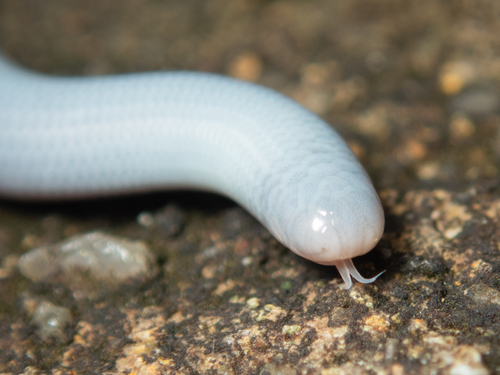
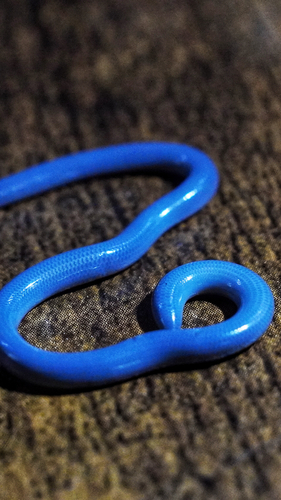
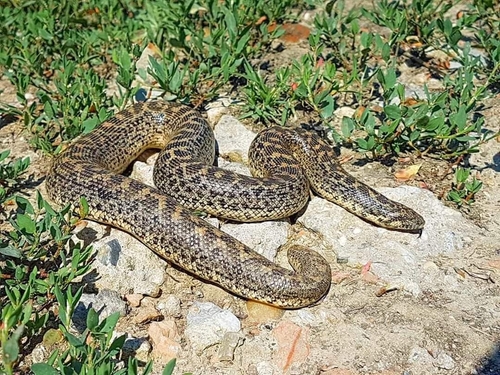
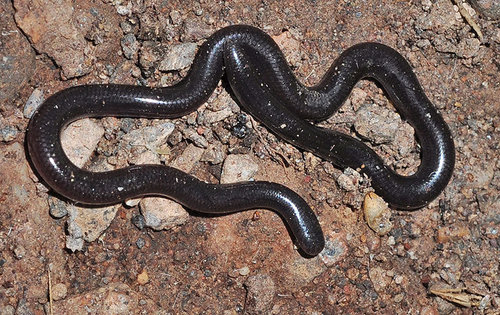
Scales differ between species, which helps with ID where two sand boas share a range. The rough-scaled sand boa of India and Sri Lanka has strongly keeled scales, roughest on the tail. The red sand boa is smooth and glossy, reddish brown to dull yellowish tan, and some are nearly black. The Kenyan sand boa is bright orange or yellow with irregular dark brown or black patches and a white belly.
Types of sand boa
The Reptile Database lists 13 species in the genus Eryx. A few others, such as the Tartar sand boa (E. tataricus), have been merged into existing species. The best-known ones are below. Two of them, the Kenyan and rough-scaled sand boas, are also placed by some authors in a separate genus, Gongylophis, so you will see both names in books and pet shops.
| Species | Where it lives | Notes |
|---|---|---|
| Kenyan or East African sand boa (E. colubrinus) | Egypt and Sudan south to Kenya and Tanzania, plus Ethiopia, Eritrea and Somalia | Orange with dark blotches; the sand boa most often kept as a pet |
| Red or Indian sand boa (E. johnii) | India, Pakistan, Nepal, eastern Iran and Afghanistan | The largest sand boa; smooth, reddish brown, with a very blunt tail |
| Rough-scaled sand boa (E. conicus) | India, Sri Lanka, Nepal, Bangladesh and southern Pakistan | Keeled scales and a blotched back; often mistaken for Russell's viper |
| Javelin sand boa (E. jaculus) | North Africa, the Middle East, Turkey, the Caucasus and southeastern Europe | The main European sand boa, found in Greece, Bulgaria, Romania and Sicily |
| Desert sand boa (E. miliaris) | Southern Russia and the Caucasus east through Central Asia to western China and Mongolia | Now includes the snakes once called the Tartar sand boa |
| Arabian sand boa (E. jayakari) | Saudi Arabia, Oman, the UAE, Kuwait, Qatar, Iraq and southwestern Iran | One of two egg-laying sand boas |
| Mueller's sand boa (E. muelleri) | West and Central Africa, from Mauritania and Senegal east to Sudan and the Central African Republic | Also egg-laying |
| Whitaker's sand boa (E. whitakeri) | Coastal southwestern India: Kerala, Karnataka, Goa and Maharashtra | Near Threatened; named after herpetologist Romulus Whitaker |
How big do sand boas get?
Sand boas are small: most adults are 1 to 2 ft (30 to 60 cm) long, and females are bigger than males. The Oakland Zoo describes the Kenyan sand boa as short and stout at about 1 to 2 ft. The BGSU Herpetarium gives adult females at 22 to 24 in (56 to 61 cm) and males at 15 to 20 in (38 to 51 cm). The red sand boa is the largest. Field guides put most adults at around 2 ft (60 cm), with some reaching 3 ft (0.9 m) and rare snakes reported near 4 ft (1.2 m). Next to a boa constrictor, even a big sand boa is tiny.
| Species and stage | Length | Source |
|---|---|---|
| Kenyan sand boa, newborn | About 8 in (20 cm) | BGSU Herpetarium |
| Kenyan sand boa, adult male | 15-20 in (38-51 cm) | BGSU Herpetarium |
| Kenyan sand boa, adult female | 22-24 in (56-61 cm) | BGSU Herpetarium |
| Red sand boa, typical adult | About 2-3 ft (0.6-0.9 m) | Regional field guides |
| Red sand boa, largest reported | About 4 ft (1.2 m) | Reported, not well verified |
Where do sand boas live?
Short answer: sand boas live in the dry parts of the Old World, from Senegal and Morocco east across North Africa, Arabia and Central Asia to Mongolia, and south through East Africa to Tanzania and through South Asia to Sri Lanka. None are native to the Americas; the rosy boa and the rubber boa are their closest relatives there. Compare ranges on the world snake map.
The javelin sand boa reaches farthest into Europe, with records from Greece and many of its islands, Bulgaria, Romania, North Macedonia, Albania and Sicily, according to its Reptile Database entry. In Africa, the Kenyan sand boa runs from Egypt along the Nile into Sudan and south to Kenya and northeastern Tanzania. India has three species: the red, rough-scaled and Whitaker's sand boas. Local populations tend to be patchy because the snakes need particular soils they can dig into.
Habitat
Sand boas need loose ground. They live in sandy and gravelly desert, semi-desert, dry savanna, grassland, steppe and scrub, and they hide in rodent burrows, termite mounds, under rocks and logs, or straight in the sand. Farmland suits some species well. The Oakland Zoo notes that Kenyan sand boas do well on agricultural land with plenty of rodents, and the red sand boa favors loose, crumbly soil that is easy to dig. The Kenyan sand boa is seldom found in moist savanna or on the coast.
Behavior: life under the sand
A sand boa spends most of its life buried. The Oakland Zoo says Kenyan sand boas stay under the surface for upwards of 80% of the day, which is one reason they are poorly studied in the wild. They come out mainly at dusk, at night and in the early morning. Where winters are cold they hibernate; in Sicily, Faraone and colleagues found that adult female javelin sand boas eat more in September, probably to build reserves before winter.
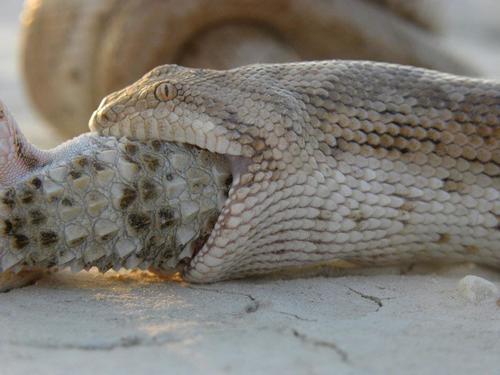
Hunting is an ambush. The snake lies just under the sand with only its eyes and nostrils showing. When a mouse or lizard comes close, it bursts out, bites, wraps its coils around the prey and often pulls it back under the surface to swallow it.
Most sand boas are calm when handled, but they are not all the same. The BGSU Herpetarium notes that Kenyan sand boas are head shy and may nip if startled. When threatened, some species coil into a ball, hide the head and lift the blunt tail, so a predator strikes the wrong end.
What do sand boas eat?
Sand boas eat mostly small mammals, with lizards and lizard eggs a distant second. The best diet data come from a 2021 study of the javelin sand boa in Sicily by Faraone and colleagues. They checked 132 snakes and found prey in 43% of them. Small mammals turned up in 71.4% of the samples, lizard eggs in 30.2% and lizards in only 7.9%. Many of the lizard remains were dropped tails, which suggests the snakes often miss.
| Prey | Notes |
|---|---|
| Rodents and shrews | The main food for adults of most species, especially females |
| Lizard eggs | Dug up mainly by young snakes, whose small gape limits them to small prey |
| Lizards | Taken by many species; often only the dropped tail is caught |
| Small birds | Occasional prey, listed for the Kenyan sand boa by the Oakland Zoo |
| Other snakes | Recorded for the red sand boa in West Bengal |
The Sicily study also found that females tend to ambush mammals while young snakes hunt actively for lizard eggs, and adult males eat both, probably because they move around more in the mating season.
Are sand boas venomous or dangerous?
No, sand boas are not venomous and are not dangerous to people. Like other members of the boa family, they have no venom glands. They kill prey by squeezing it, and even the largest sand boa is far too small to constrict anything bigger than a rat.
A bite is rare. When it happens, it leaves a ring of small pinpricks that may bleed a little. Wash it with soap and water and watch for signs of infection. The real risk in South Asia is a mix-up: a dangerous viper taken for a harmless sand boa, or a sand boa killed on sight because it looks like a viper. See the look-alikes below, and our snakebite FAQ for first aid for any snake bite.
Why is the red sand boa called a two-headed snake?
In India the red sand boa is known as do muha, roughly "double-headed", because its thick, blunt tail looks like a second head. The snake makes use of this: rolled into a ball, it raises the tail as a decoy and keeps the real head tucked away.
Superstition has turned that into a market. Mongabay reports beliefs that the snake can lead people to hidden treasure or bring wealth, and that some sellers force snakes to swallow lead balls to make them heavier, because heavier snakes are thought to fetch more, which can kill them. A 2023 WCS India report, summarized by Outlook Traveller, found 172 media records of illegal sand boa trade in 18 states and one union territory between 2016 and 2021, most of them in Maharashtra and Uttar Pradesh. The same coverage reports local declines of up to 80% in sightings. Catching, keeping or selling native sand boas is illegal under India's Wild Life (Protection) Act, 1972.
Snakes confused with sand boas
Two of these are dangerous. If you are not sure what you are looking at, keep your distance and post a photo to iNaturalist for an identification.
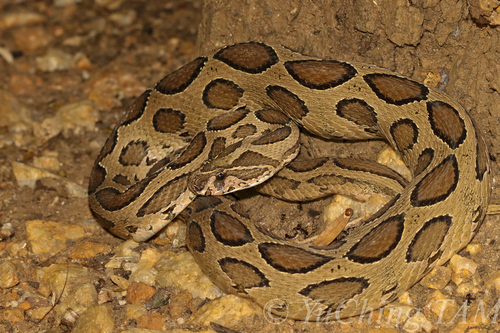
Russell's viper
Daboia russelii · Venomous
The rough-scaled sand boa is often killed after being taken for this viper, as Mongabay India reported from Assam. A Russell's viper has a large triangular head clearly wider than the neck, a thinner tapering tail, and three rows of dark oval spots ringed in black and white. A sand boa has a tiny head and a blunt tail.
Saw-scaled viper
Echis carinatus · Venomous
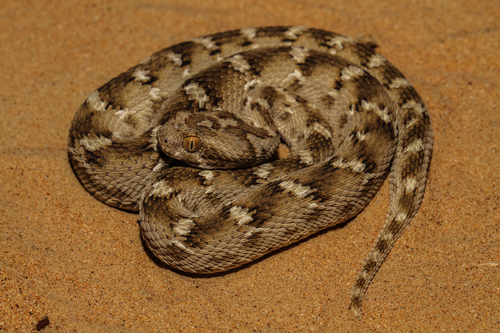
Shares dry, sandy country with sand boas in India, Arabia and Africa. It has a distinct pear-shaped head, a thin neck and a pale cross or arrow mark on the head, and it coils in a C shape while rubbing its scales together to make a rasping hiss.
Rosy boa
Lichanura · Harmless
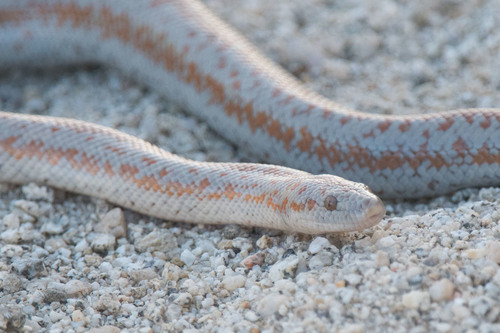
A New World relative from the US Southwest. The rosy boa has the same small, stout shape but carries three lengthwise stripes instead of blotches.
Rubber boa
Charina bottae · Harmless
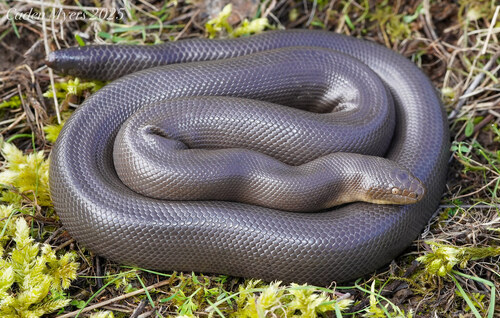
Another American relative. The rubber boa is plain brown or olive with smooth, rubbery-looking skin and lives in cooler mountain and forest country, not desert sand.
Reproduction and lifespan
Most sand boas give birth to live young; the eggs develop and hatch inside the mother. The Reptile Database lists two exceptions that lay eggs: the Arabian sand boa and Mueller's sand boa. Kenyan sand boas breed from about April to July, according to the Oakland Zoo, and give birth after roughly 4 months to 4 to 20 young. The BGSU Herpetarium gives newborns at about 8 in (20 cm) long. Young are on their own from birth and, per the Oakland Zoo, mature in 2 to 3 years. The red sand boa has up to 14 young in late summer and the monsoon, per its IUCN assessment.
They live a long time for small snakes. The Oakland Zoo gives 15 to 30 years in human care. Wild lifespans are unknown.
Conservation status
| Species or authority | Status |
|---|---|
| Red sand boa (IUCN, 2021) | Near Threatened |
| Rough-scaled sand boa (IUCN, 2021) | Near Threatened |
| Whitaker's sand boa (IUCN) | Near Threatened |
| Kenyan, javelin and desert sand boas (IUCN) | Least Concern |
| CITES | Appendix II (trade needs export permits) |
| India, Wild Life (Protection) Act, 1972 | Protected; capture and trade banned |
Most sand boas are widespread and not at risk. The trouble spots are where people collect them. Collection for the pet trade has cut the Kenyan sand boa population in Egypt, according to the Oakland Zoo, even though the species overall is rated Least Concern. In India, the illegal trade and killing out of fear, often after a sand boa is mistaken for a viper, are the main threats to the three native species.
Sand boa FAQ
Are sand boas venomous?
No. Sand boas have no venom glands. They are small constrictors that seize rodents and lizards with their teeth and squeeze them. A bite is rare and leaves only shallow pinpricks, which should be cleaned with soap and water like any small wound. They are often mistaken for vipers, so check the ID before handling any snake.
How big do sand boas get?
Most sand boas are 1 to 2 ft (30 to 60 cm) long as adults, and females are larger than males. Kenyan sand boa females reach about 22 to 24 in, males 15 to 20 in. The red sand boa of South Asia is the largest species and can reach about 3 ft (0.9 m), with rare reports near 4 ft.
Where do sand boas live in the wild?
Sand boas live in dry regions of Africa, the Middle East, southeastern Europe and Asia. Their range stretches from Senegal and Morocco to Mongolia and western China, and south to Tanzania and Sri Lanka. They prefer sandy or loose soil in desert, dry savanna, steppe, scrub and farmland. None are native to the Americas.
What is the difference between a Kenyan sand boa and a red sand boa?
They are different species on different continents. The Kenyan sand boa (Eryx colubrinus) lives in northeastern Africa, stays under about 2 ft, and is orange or yellow with dark blotches. The red sand boa (Eryx johnii) lives in India, Pakistan and nearby countries, grows larger, is plain reddish brown, and has an extremely blunt, head-like tail.
Why do sand boas bury themselves?
Burying hides them from predators and the midday heat, and it puts them in place to ambush prey. The eyes and nostrils sit on top of the head, so a snake can lie under the sand with only those showing and still breathe and watch. The Oakland Zoo reports that Kenyan sand boas spend upwards of 80% of the day buried.
Is it illegal to own a red sand boa?
In India, yes. The red sand boa is protected under the Wild Life (Protection) Act, 1972, so catching, keeping or selling one is a crime there, and all sand boas are on CITES Appendix II, which controls international trade. Rules elsewhere vary. In the US and Europe, the sand boa most often sold as a pet is the Kenyan sand boa.
Related snakes
Sources
- Reptile Database: genus Eryx species list
- Reptile Database: Eryx colubrinus
- Reptile Database: Eryx jaculus
- Oakland Zoo: Kenyan sand boa
- BGSU Herpetarium: Kenyan sand boa
- Faraone et al. (2021), Food habits of the javelin sand boa in Sicily, Journal of Herpetology 55(4)
- Mongabay: Superstitions fuel trafficking of India's red sand boa
- Mongabay India: Misinformation about Russell's viper in Assam