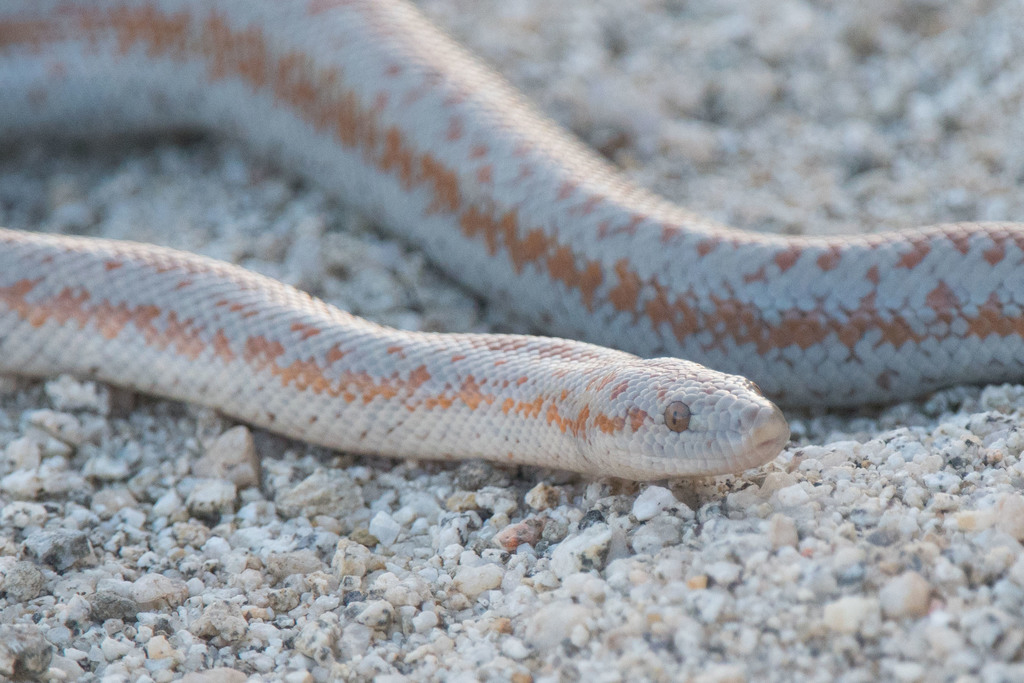
ROSYBOA
Lichanura · Family Boidae
Photo: (c) Nancy Christensen, all rights reserved, uploaded by Nancy Christensen · via iNaturalist
KEY TAKEAWAYS
The rosy boa (Lichanura trivirgata in the broad sense) is a small, non-venomous constrictor that lives in the deserts and rocky scrublands of southern California, southwestern Arizona and northwestern Mexico. It is one of the few boas native to the United States, and it is harmless to people.
- It is not venomous. It kills rodents and other small prey by constriction.
- Adults are usually 2 to 3 ft (0.6 to 0.9 m) long and weigh about a pound; the largest reach roughly 44 in (112 cm).
- When frightened it often rolls into a ball with its head tucked inside and waves its blunt tail like a decoy head.
- Scientists disagree on whether it is one species or two. Many now split it into a coastal and a desert rosy boa.
Rosy boa quick facts
| Common name | Rosy boa (also coastal rosy boa, desert rosy boa, three-lined boa) |
|---|---|
| Scientific name | Lichanura trivirgata Cope, 1861; some authors also recognize L. orcutti (or L. roseofusca) |
| Family | Boidae (boas) |
| Venomous | No, a constrictor |
| Adult length | 17-44 in (43-112 cm), usually under 3 ft (0.9 m) |
| Weight | About 1 lb (0.45 kg) |
| Range | Southern California, southwestern Arizona, a sliver of southern Nevada, Baja California and western Sonora |
| Habitat | Rocky desert, canyons, arid scrub and chaparral |
| Diet | Mainly small mammals such as woodrats and mice; also lizards and small birds |
| Reproduction | Live birth, about 1-14 young, born mid-summer to November |
| Conservation | IUCN Least Concern; threatened (Amenazada) under Mexico's NOM-059 |
How to identify a rosy boa
A rosy boa looks like a short, thick, glossy tube with three stripes running from head to tail. Color varies a lot from place to place, so look at body shape and pattern together rather than color alone.
- 1Three lengthwise stripes: one stripe runs down the middle of the back and one down each side. They can be sharp chocolate brown, rusty orange, reddish or a blurry gray, depending on the population.
- 2Pale ground color: the background between the stripes is cream, tan, gray or bluish gray. Coastal snakes tend to be darker with less defined stripes; desert snakes are paler with crisp stripes.
- 3Small, smooth scales: the scales are tiny and smooth, so the snake looks polished and feels soft, almost rubbery, in the hand.
- 4Small head and eyes: the head is barely wider than the neck, and the small eyes have vertical pupils. There is no broad, triangular head like a rattlesnake's.
- 5Blunt tail: the tail is short and tapers bluntly, with no rattle. Males have noticeable spurs, the remains of hind limbs, on either side of the vent.
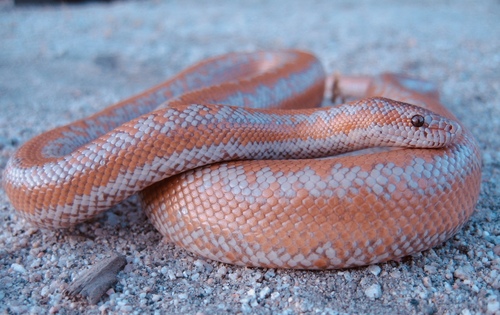
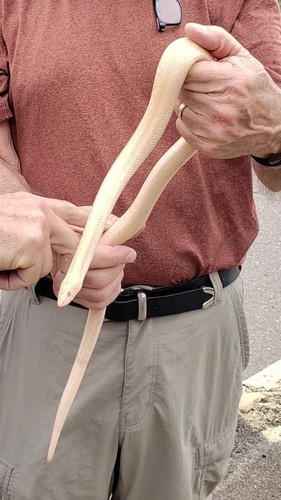
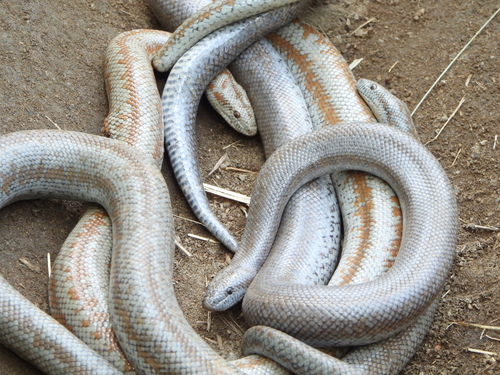
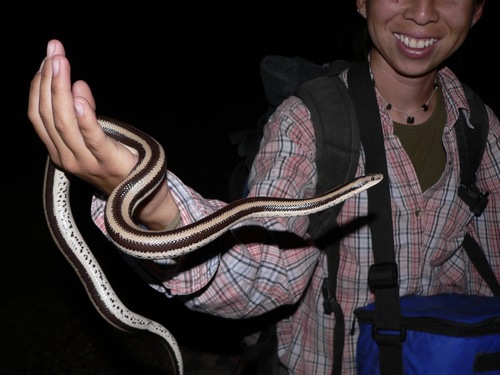
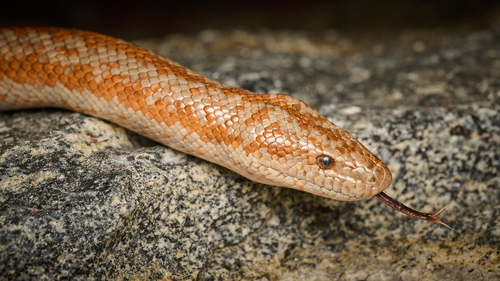
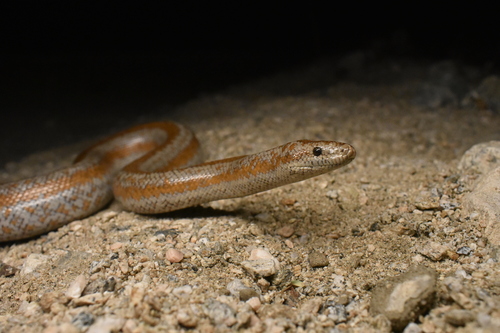
The name is a little misleading. Some rosy boas have pinkish or salmon tones on the belly and lower sides, which the Los Angeles Zoo gives as the origin of the name, but many wild snakes show no pink at all. The scientific name trivirgata means "three-striped", which describes the snake better.
How big does a rosy boa get?
Rosy boas are small for a boa: most adults measure 2 to 3 ft (0.6 to 0.9 m). CaliforniaHerps gives an adult range of 17 to 44 in (43 to 112 cm), with most snakes under 36 in. In southern Arizona the Tucson Herpetological Society puts local adults at under about 30 in (76 cm). A large adult weighs around a pound. Next to its tropical cousin the boa constrictor, it is a pocket-sized snake that fits in two cupped hands.
| Life stage | Length | Weight |
|---|---|---|
| Newborn | 10-14 in (25-36 cm) | Not well documented |
| Typical adult | 2-3 ft (0.6-0.9 m) | About 1 lb (0.45 kg) |
| Largest recorded | About 44 in (112 cm) | Not documented |
Where do rosy boas live?
Short answer: rosy boas live in southern California, southwestern Arizona and northwestern Mexico, including most of the Baja California peninsula and the coast of Sonora. A few records come from the Mojave Desert of southern Nevada. See how this compares with other American snakes on the world snake map.
In California, the range runs from the Mexican border in San Diego County north through the coastal mountains and into the Mojave Desert, and east into the Sonoran (Colorado) Desert. Rosy boas are missing from much of the farmed Imperial Valley. In Arizona, the Tucson Herpetological Society records them from the North Maricopa and Sand Tank Mountains south to the Agua Dulce Mountains and Organ Pipe Cactus National Monument, at about 1,150 to 2,950 ft (350 to 900 m) elevation. The Reptile Database adds the length of Baja California, Isla Espiritu Santo in the Gulf of California, and western Sonora.
Is the rosy boa one species or two?
That depends on whom you ask. For most of the 20th century, all rosy boas were treated as one species, Lichanura trivirgata, split into several subspecies by color pattern. In 2008, a study of mitochondrial DNA from 131 snakes by Wood, Fisher and Reeder found three main genetic lineages: one mostly in California, one mostly in Arizona, with the Colorado River roughly dividing them, and a third scattered across Baja California, south-central Arizona and coastal Sonora.
Based on that work, many references, including iNaturalist, now list two species: the coastal rosy boa (L. orcutti) across California, southern Nevada and western Arizona, and the desert rosy boa (L. trivirgata) in south-central Arizona, Sonora and Baja California. Other authors, such as Hansen and Shedd (2024), use the older name L. roseofusca for the northern snakes. The Reptile Database still calls the taxonomy "unsatisfactory". For a hiker or a homeowner, the difference does not matter: the two forms look and behave alike, and both are harmless. This article covers them together.
Habitat
Rosy boas are rock snakes. They favor rocky desert slopes, boulder piles, canyons and granite outcrops, along with arid scrub and coastal chaparral. They often turn up near desert streams and springs but do not need permanent water. Radio-tracking at Organ Pipe Cactus National Monument showed that Arizona rosy boas also move onto flatter, rock-free bajadas in late spring and summer, hiding in rodent burrows, then return to rocky slopes for fall and winter, according to the Tucson Herpetological Society.
Behavior and temperament
Rosy boas keep a schedule set by the heat. In spring and fall they may bask or hunt on warm days; by mid-summer they become mostly nocturnal, moving at dusk and through the night. During the hottest and coldest stretches of the year they stay underground or deep in rock crevices. They are slow but good climbers.
Their temperament is mild. Both the Los Angeles Zoo and the Tucson Herpetological Society describe them as docile, and they seldom bite. A frightened snake is more likely to roll into a tight ball with its head hidden in the middle and wave its blunt tail, which looks enough like a head to draw an attack away from the real one.
What does a rosy boa eat?
Rosy boas eat mostly small mammals. They are ambush hunters: the snake waits near a burrow or rock crack, strikes with an open mouth, holds on and wraps its coils around the prey, then swallows it headfirst once it stops moving. The Los Angeles Zoo lists nestling woodrats among their wild prey. The wild diet has not been studied in depth, so the table reflects field reports and captive records.
| Prey group | Notes |
|---|---|
| Rodents | Woodrats (packrats), mice and other small rodents; the main food |
| Lizards | Taken now and then, especially by smaller snakes |
| Small birds | Occasional prey |
| Small snakes and amphibians | Rare; CaliforniaHerps lists both |
| Bats | Possible; one rosy boa was seen in a southern Arizona mine, perhaps hunting them |
Is the rosy boa venomous or dangerous?
No, the rosy boa is not venomous and is not dangerous to people. Like every member of the boa family, it has no venom glands and kills only by constriction. CaliforniaHerps rates it "Not Dangerous". It is far too small to constrict anything larger than a rat.
Bites are uncommon. When they happen, they leave a row of small pinpricks that may bleed a little. Wash the spot with soap and water and keep an eye on it for signs of infection. People sometimes mistake it for a rattlesnake, since both live on rocky desert hillsides; see the look-alikes below. Our snakebite FAQ explains first aid for any snake bite.
Snakes confused with the rosy boa
Only one of these is dangerous. If unsure, keep your distance and post a photo to iNaturalist for an identification.
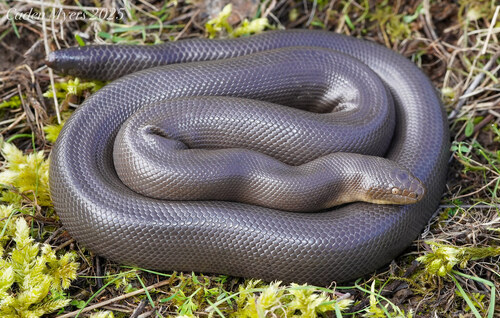
Rubber boa
Charina bottae · Harmless
Its closest relative north of Mexico. It has the same stubby shape and blunt tail but is plain brown, olive or yellowish with no stripes, and in the US it mostly lives farther north or higher in the mountains, away from desert rock.
Speckled rattlesnake
Crotalus mitchellii complex · Venomous
Shares rocky desert slopes with the rosy boa. A rattlesnake has a rattle or button on the tail, a broad triangular head on a thin neck, rough keeled scales and crossbands or blotches instead of three lengthwise stripes.
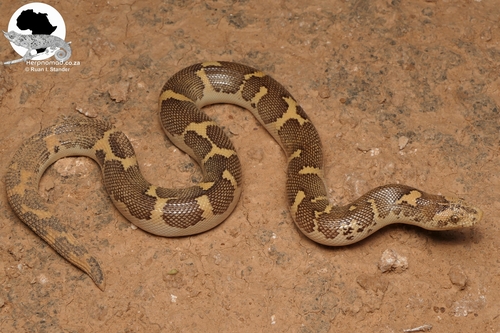
Kenyan sand boa
Eryx colubrinus · Harmless
An African boa common in the pet trade, so escaped pets can cause confusion. It has a similar small, thick body but is orange or yellow with irregular dark brown blotches, not stripes.
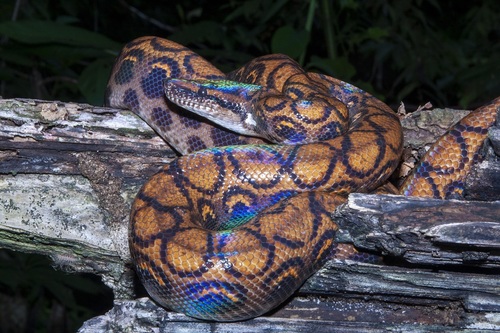
Rainbow boa
Epicrates cenchria · Harmless
Another pet-trade boa, the rainbow boa grows to about twice the length, shows a strong iridescent sheen and is marked with rounded rings rather than stripes. It is native to South America, not the US.
Reproduction and lifespan
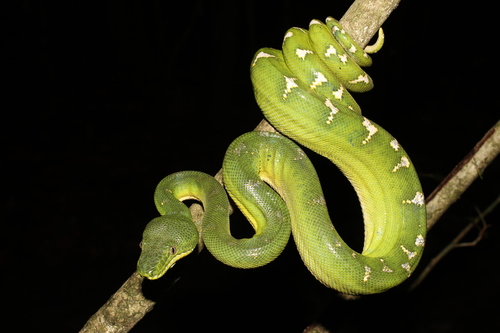
Rosy boas give birth to live young instead of laying eggs, as do the emerald tree boa and nearly all other boas. Courtship likely runs from spring into mid-summer. Litters are small: CaliforniaHerps reports 3 to 14 young in California, usually born in October and November, and the Tucson Herpetological Society reports 1 to 12 young in Arizona, born from mid-summer to late November. Newborns are 10 to 14 in (25 to 36 cm) long and on their own from birth.
These are long-lived snakes. The Los Angeles Zoo gives a lifespan of 20 to 30 years, a figure that comes mainly from snakes in human care. Most rosy boas sold as pets today are captive-bred.
Conservation status
| Authority | Status |
|---|---|
| IUCN Red List (desert rosy boa, L. trivirgata) | Least Concern |
| IUCN Red List (coastal rosy boa, L. orcutti) | Least Concern |
| Mexico, NOM-059 | Amenazada (threatened) |
| US Endangered Species Act | Not listed |
| USDA Forest Service (California) | Sensitive species (coastal form) |
Rosy boas are not in danger worldwide, but they face local pressure. The Tucson Herpetological Society reports that collectors have destroyed rock shelters at Organ Pipe Cactus National Monument and that the population along Arizona's Highway 85 appears to have dropped sharply, most likely from road deaths. Collecting is banned in Organ Pipe and in Cabeza Prieta National Wildlife Refuge. Elsewhere in Arizona a licensed hunter may take two a year and keep no more than four.
Rosy boa FAQ
Is the rosy boa venomous?
No. The rosy boa has no venom glands. It is a small constrictor that grabs rodents with its teeth and squeezes them until they stop breathing. A bite is rare and leaves only small pinpricks, which should be washed with soap and water like any minor wound.
How big do rosy boas get?
Most adults are 2 to 3 ft (0.6 to 0.9 m) long and weigh about a pound. CaliforniaHerps gives a full adult range of 17 to 44 in (43 to 112 cm), and Arizona snakes tend to stay under about 30 in. Newborns are 10 to 14 in long.
Where do rosy boas live?
Rosy boas live in southern California, southwestern Arizona, a small part of southern Nevada, and northwestern Mexico, including Baja California and western Sonora. They prefer rocky desert hillsides, canyons, arid scrub and chaparral, often near springs or desert streams.
Why is it called a rosy boa?
The name comes from the pinkish or salmon tones on the belly and lower sides of some individuals. Many wild rosy boas show no pink at all, and the scientific name trivirgata, meaning three-striped, describes them better: most have three dark stripes running the length of the body.
What is the difference between a coastal rosy boa and a desert rosy boa?
They are two genetic lineages that many authors now treat as separate species. The coastal rosy boa (L. orcutti) lives in California, southern Nevada and western Arizona; the desert rosy boa (L. trivirgata) lives in south-central Arizona, Sonora and Baja California. Range is the most reliable way to tell them apart.
Do rosy boas make good pets?
Many keepers consider them one of the easiest snakes to keep, because they stay small, are rarely aggressive and can live 20 to 30 years. Buy a captive-bred snake: wild collection is banned in some parks and limited by law in Arizona, and Mexico lists the species as threatened.
Related snakes
Sources
- Reptile Database: Lichanura trivirgata
- CaliforniaHerps: Rosy boa (Lichanura orcutti)
- Tucson Herpetological Society: Rosy boa
- Los Angeles Zoo: Rosy boa
- USGS: Wood, Fisher and Reeder (2008), Molecular Phylogenetics and Evolution
- IUCN Red List: Lichanura trivirgata assessment
- iNaturalist: Lichanura (rosy boas)