EMERALD TREEBOA
Corallus caninus · Family Boidae
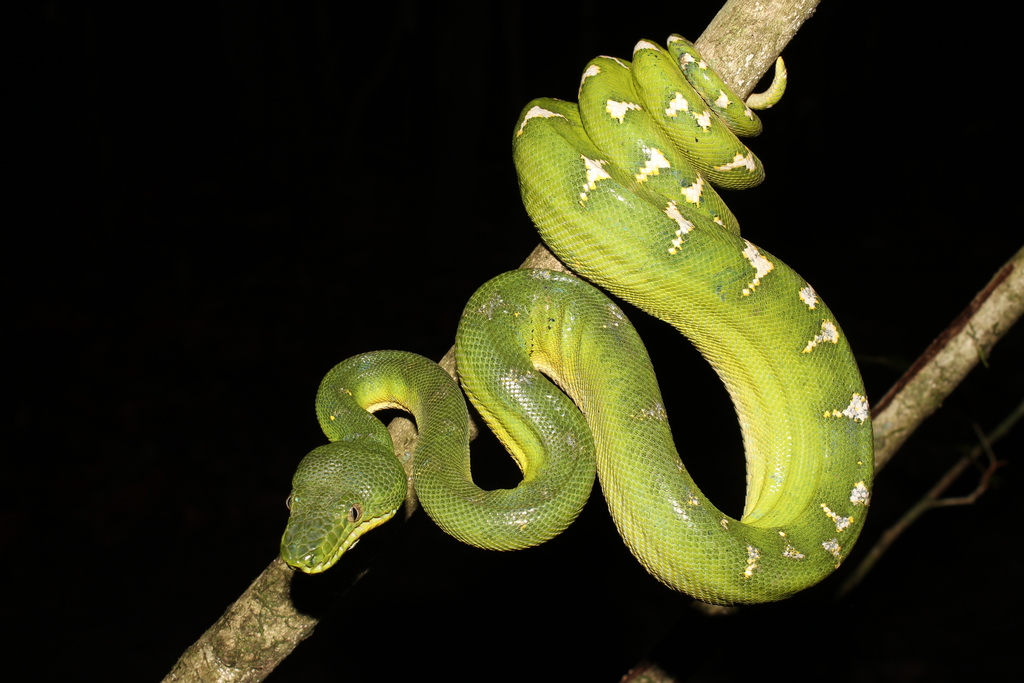
Photo: (c) Sébastien SANT, some rights reserved (CC BY-NC), uploaded by Sébastien SANT · via iNaturalist
KEY TAKEAWAYS
The emerald tree boa (Corallus caninus) is a non-venomous constrictor from the rainforests of northern South America, prized by reptile keepers and photographers for its brilliant green color and long, curved teeth. It is one of several boas and spends almost its entire life coiled in the branches of the canopy.
- It is not venomous. Like every boa, it kills by constriction, not a toxic bite.
- Most adults measure 5 to 6.5 ft (1.5 to 2 m); the magazine Iguana reports some Amazon Basin individuals reaching 7 to 9 ft (2.1 to 2.7 m).
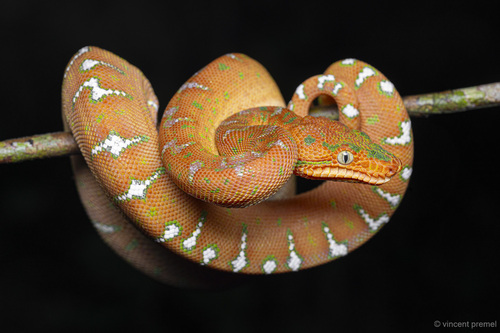
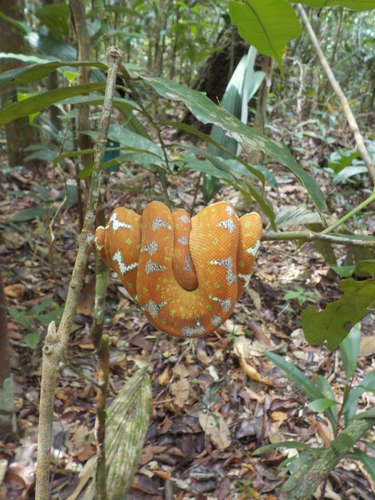
- Hatchlings are brick red or orange, not green, and only turn emerald over their first 9 to 12 months.
- It lives in the Guiana Shield and northern Amazon Basin of South America and spends nearly all its time off the ground.
Emerald tree boa quick facts
| Common name | Emerald tree boa |
|---|---|
| Scientific name | Corallus caninus (Linnaeus, 1758) |
| Family | Boidae (boas) |
| Venomous | No, a constrictor |
| Adult length | 5-6.5 ft (1.5-2 m); some populations reported to 9 ft (2.7 m) |
| Weight | Slim-bodied for its length, roughly 1-2 lb (0.5-0.9 kg) |
| Range | Guyana, Suriname, French Guiana, eastern Venezuela, northern Brazil |
| Habitat | Rainforest canopy, often near rivers and streams |
| Diet | Rodents, bats, opossums, occasional birds and lizards |
| Reproduction | Live birth, 5-20 young per litter |
| Conservation | IUCN Least Concern; CITES Appendix II |
How to identify an emerald tree boa
An adult emerald tree boa is simple to recognize, though a newly hatched one looks nothing like it. Check for these features together.
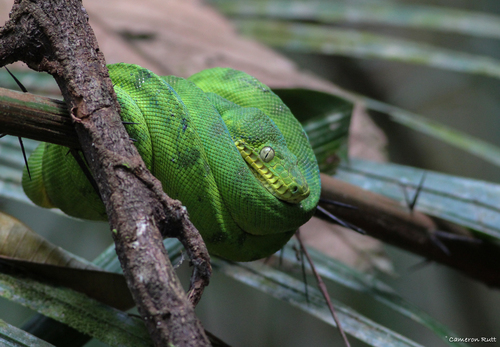
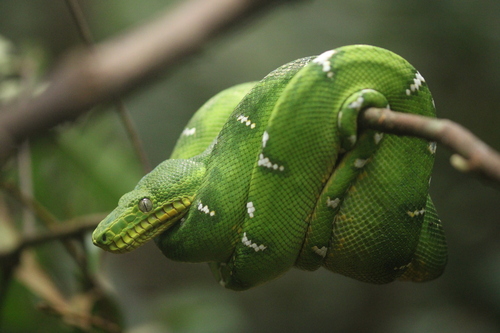
- 1Color: emerald green over the whole body with a broken, irregular white stripe zigzagging down the back and a pale yellow belly.
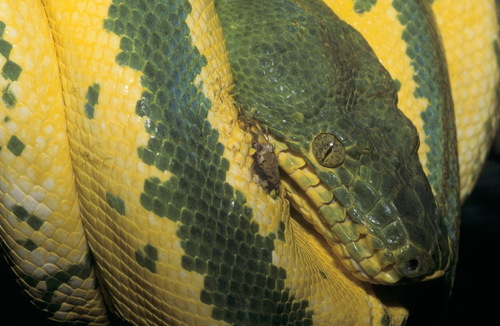
- 2Head: a large, triangular head clearly wider than the neck, with deep heat-sensing pits set into both lips.
- 3Teeth: unusually long front teeth for a non-venomous snake, sometimes visible even with the mouth closed.
- 4Resting posture: draped over a horizontal branch in a tight, saddle-like coil with the head resting near the middle of the loops.
- 5Juveniles: hatch brick red or orange with white markings and only turn green after 9 to 12 months, which confuses many new owners.
How big does an emerald tree boa get?
Short answer: most adult emerald tree boas measure 5 to 6.5 ft (1.5 to 2 m). Length varies noticeably by population.
Virginia Zoo gives a typical adult length of about 6.5 ft (2 m). Animal Diversity Web describes the species as regularly exceeding 2 m, with hatchlings about 12 in (30 cm) long and weighing 20 to 50 g at birth. The magazine Iguana, published by the International Reptile Conservation Foundation, reports that some individuals from the Amazon Basin grow larger still, reaching 7 to 9 ft (2.1 to 2.7 m). Females tend to end up heavier-bodied than males, though not necessarily longer.
Where does the emerald tree boa live?
Short answer: the emerald tree boa lives in the Guiana Shield and parts of the northern Amazon Basin: Guyana, Suriname, French Guiana, eastern Venezuela and northern Brazil. Compare it with other snakes on our world snake map.
The Reptile Database lists its range as Guyana, Suriname, French Guiana, eastern Venezuela and the Brazilian states of Amapa, Para, Roraima and Amazonas, at elevations up to roughly 800 m (2,600 ft). A closely related species, Corallus batesii, takes over farther west and south across much of the Amazon Basin in Colombia, Ecuador, Peru and western Brazil. The two were treated as one species until a 2005 phylogenetic study in the Journal of Herpetology found enough genetic and physical differences to split them. See the boa group page for how this species fits among the world's boas.
Habitat
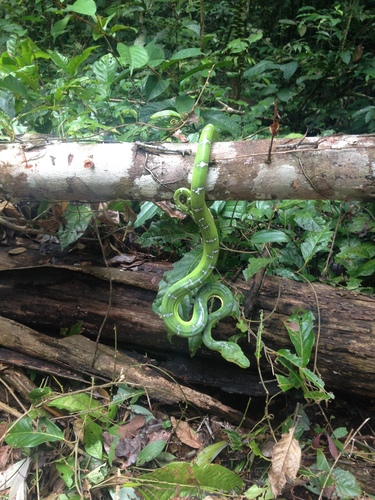
Emerald tree boas live almost entirely off the ground, in the canopy and understory of lowland tropical rainforest, often close to rivers, streams or swamp forest. Toronto Zoo notes they occupy both mature, undisturbed forest and secondary growth, from sea level up to roughly 800 m (2,600 ft). Their green color and broken white pattern blend into sunlit leaves and tangled vines so well that the species is far easier to describe than to actually spot in the wild.
Behavior
This is a nocturnal, almost entirely arboreal snake. By day it rests looped over a horizontal branch in a tight, saddle-like coil, with its head usually resting near the middle of the loops. At night it repositions to hang its head down over a trail used by small mammals and waits, motionless, for hours.
Heat-sensing pits along both lips let it detect a warm body passing below in total darkness, then strike downward and grip with its unusually long front teeth before throwing coils around the prey. Animal Diversity Web describes this ambush-and-grip strategy as typical of the genus Corallus.
When it feels threatened, an emerald tree boa gives an open-mouthed strike at the source of the disturbance and then pulls back rather than pursuing. It shows no interest in defending territory beyond the branch it happens to be resting on, and most bites happen when someone reaches toward it rather than the other way around.
What does the emerald tree boa eat?
| Prey group | Notes |
|---|---|
| Rodents | Rats, mice and other small rodents |
| Bats | Taken from perches or in flight near roost openings |
| Marsupials | Opossums, especially by larger adults |
| Birds | Taken occasionally, more often by adults |
| Lizards | Mainly taken by juveniles before they switch to mammals |
Because it ambushes rather than chases, an emerald tree boa can go weeks between meals. Toronto Zoo notes that its diet also includes birds and lizards in addition to small mammals, which fits a snake that simply waits for whatever walks, flies or climbs within reach.
Is the emerald tree boa venomous or dangerous?
No, the emerald tree boa is not venomous. Like every member of the boa family, it has no venom glands and kills purely by constriction.
That does not make it harmless to handle. Its front teeth are proportionally among the longest of any non-venomous snake, built to snag birds and bats out of the air or off a branch before they can escape. A defensive bite can leave deep, needle-like puncture wounds that bleed freely and need thorough cleaning with soap and water; see a doctor if a wound looks infected or will not stop bleeding. Our snake safety FAQ covers what to do after any snake bite.
Snakes confused with the emerald tree boa
Three snakes get mistaken for the emerald tree boa, two of them its own close relatives and one a complete stranger on the other side of the world.
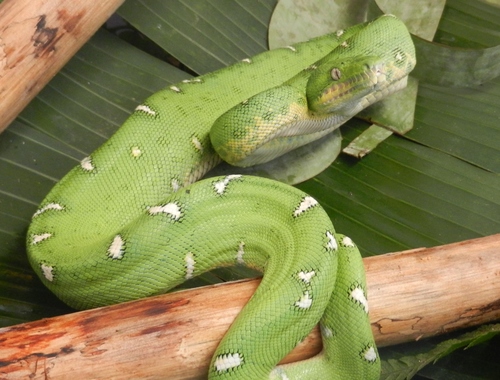
Northern emerald tree boa
Corallus batesii · Harmless
Nearly identical and only recognized as a separate species after a 2005 to 2009 run of taxonomic studies. It has more scales across the snout and more blotches along its sides, and replaces Corallus caninus across most of the western and southern Amazon Basin.
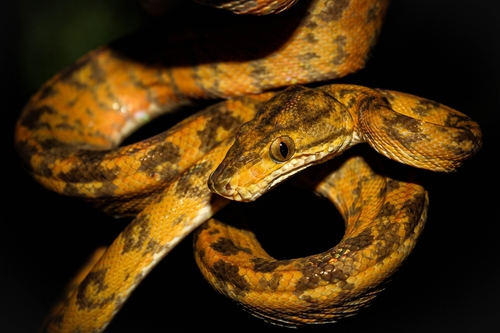
Amazon tree boa
Corallus hortulanus · Harmless
Slimmer, with a narrower head and far more color variation: gray, brown, orange, red or yellow are all common, and solid green individuals are the exception rather than the rule.
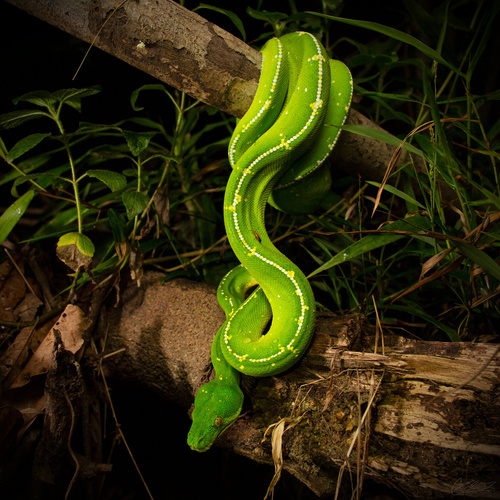
Green tree python
Morelia viridis · Harmless
Looks almost identical and rests in the same coiled, head-down posture, but it is an unrelated python from New Guinea, Indonesia and northern Australia, never found in the wild in the Americas. Its heat-sensing pits sit between scales rather than within them.
Reproduction and lifespan
The emerald tree boa gives birth to live young rather than laying eggs, like almost every boa. Animal Diversity Web reports litters of 5 to 12 young on average, occasionally up to 20, after a gestation of roughly 6 to 7 months. Newborns measure about 12 in (30 cm) and weigh 20 to 50 g.
Every hatchling is born brick red or orange with white markings, not green. Over its first 9 to 12 months it gradually shifts color until it reaches the adult emerald green, a change that regularly puzzles new keepers who assume they were sold the wrong species. Females reach sexual maturity around 4 to 5 years old and males slightly earlier, at 3 to 4 years, and wild females typically breed only every other year.
Conservation status
| Status | Detail |
|---|---|
| IUCN Red List | Least Concern |
| CITES | Appendix II |
| Local pressure | Collection for the pet trade and deforestation, worst in parts of Suriname |
The species as a whole remains common across its range. Virginia Zoo lists deforestation and the exotic pet trade as its main threats while describing the overall population as stable, and collection pressure has historically run highest in parts of Suriname, where large numbers have been caught for export. CITES Appendix II means international trade is legal but must be permitted and tracked, rather than banned outright.
Emerald tree boa FAQ
Is the emerald tree boa venomous?
No. It has no venom glands and kills prey by constriction, gripping with unusually long front teeth and squeezing until blood flow stops. A bite is not toxic but can cause deep puncture wounds that need cleaning.
How big do emerald tree boas get?
Most adults reach 5 to 6.5 ft (1.5 to 2 m). Some individuals in the Amazon Basin have been reported at 7 to 9 ft (2.1 to 2.7 m), according to the magazine Iguana.
Why are baby emerald tree boas orange instead of green?
Hatchlings are born brick red or orange with white markings and gradually change to adult emerald green over their first 9 to 12 months. Researchers have not settled on a single confirmed reason for this color shift.
What is the difference between an emerald tree boa and an Amazon tree boa?
The Amazon tree boa (Corallus hortulanus) is slimmer, has a narrower head, and comes in many colors including gray, brown, orange and red; solid green individuals are uncommon. The emerald tree boa is reliably green as an adult and has a broader head.
Where do emerald tree boas live?
In the rainforest canopy of the Guiana Shield and northern Amazon Basin: Guyana, Suriname, French Guiana, eastern Venezuela and northern Brazil.
Are emerald tree boas good pets?
They are kept by experienced reptile owners but have a reputation for being more defensive and quicker to bite than calmer relatives like the boa constrictor, so most keepers recommend them for people who already have snake-handling experience.
What do emerald tree boas eat?
Mostly rodents, bats and opossums caught by ambush from a branch, along with occasional birds and, in young snakes, lizards.