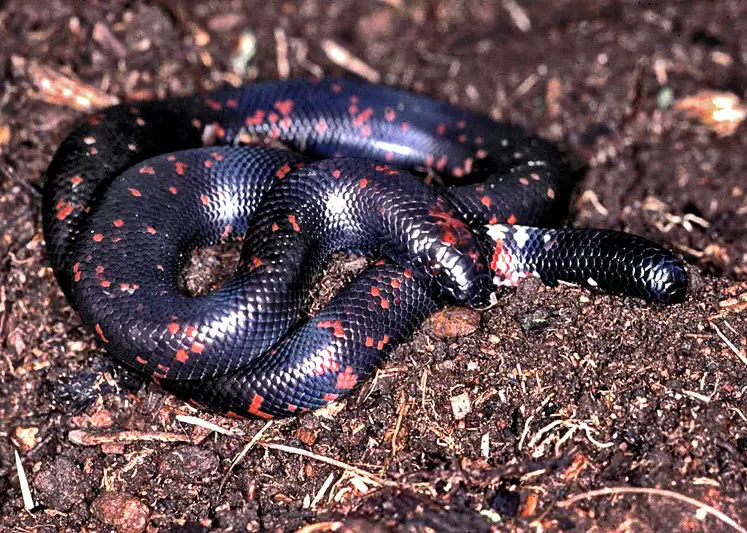
CALABARPYTHON
Calabaria reinhardtii · Family Boidae
KEY TAKEAWAYS
The Calabar python (Calabaria reinhardtii) is a small, non-venomous burrowing snake of the rainforest belt of West and Central Africa. It is sold and often listed with the pythons, but DNA work places it with the boas. Adults reach about 3 ft (1 m), spend most of their lives underground and are harmless to people.
- It has no venom and rarely bites. When disturbed, it rolls into a ball with its head hidden in the middle.
- Its blunt tail looks like its head, and it waves the tail at attackers as a decoy.
- It feeds mostly on young rodents and shrews, which it finds inside their underground nests.
- The Reptile Database lists it as Least Concern on the IUCN Red List. It is on CITES Appendix II and is fully protected in Nigeria.
Calabar python quick facts
| Common name | Calabar python; also Calabar ground python, African burrowing python, Calabar boa |
|---|---|
| Scientific name | Calabaria reinhardtii (Schlegel, 1851), first described as Eryx reinhardtii |
| Family | Boidae (boas), subfamily Calabariinae; some authors use a separate family, Calabariidae |
| Venomous | No |
| Adult length | Usually 2-3 ft (60-90 cm); maximum about 3.3 ft (1 m) |
| Coloring | Dark brown, with yellowish or reddish flecks; the tail is often brighter than the body |
| Range | West and Central Africa, from Sierra Leone and Liberia east to the Democratic Republic of the Congo |
| Habitat | Leaf litter and soil of rainforest, swamp forest and semi-deciduous forest; also farm and bush mosaics |
| Diet | Mainly young rodents and shrews; occasionally lizards and reptile eggs |
| Reproduction | Lays eggs; 2-9 per clutch in a Nigerian study, with females breeding about every other year |
| Conservation | Least Concern (IUCN); CITES Appendix II; fully protected in Nigeria; Vulnerable on Benin's national red list |
How to identify a Calabar python
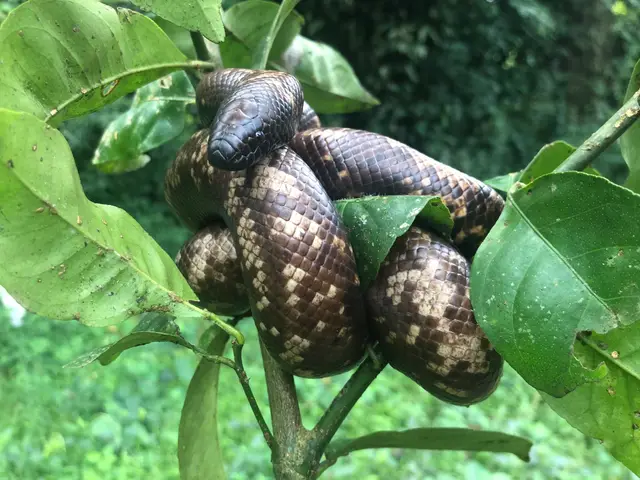
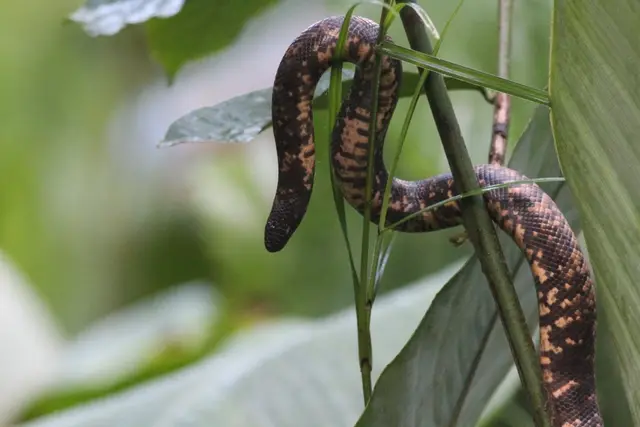
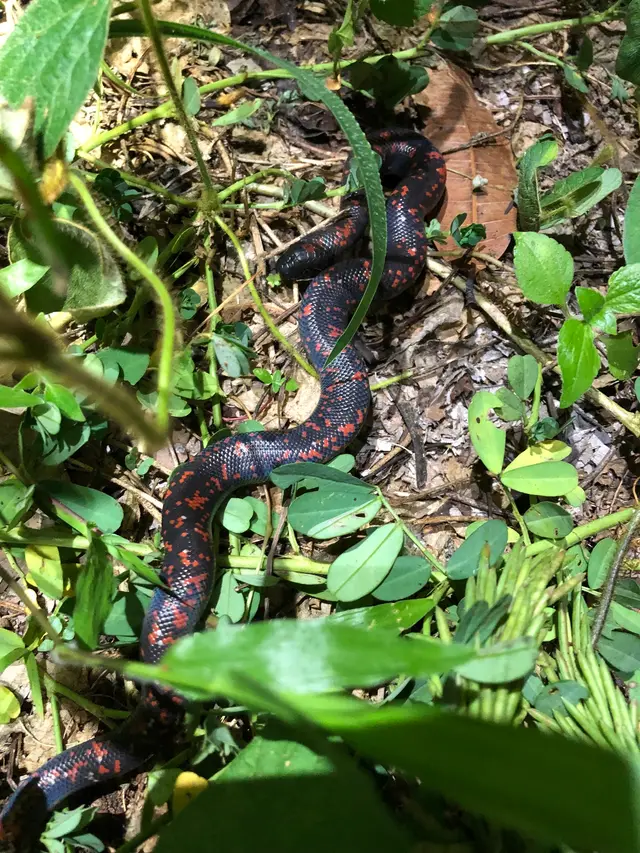
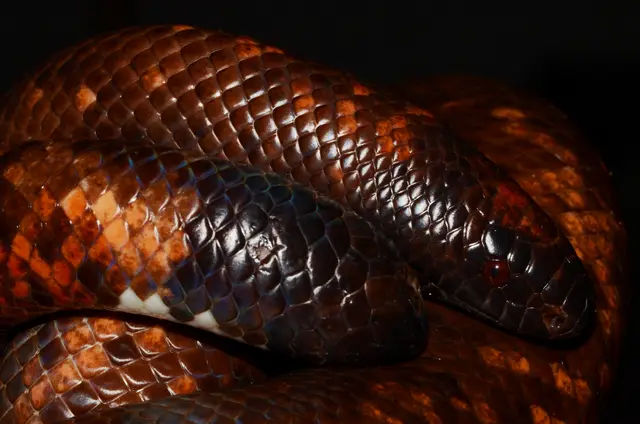
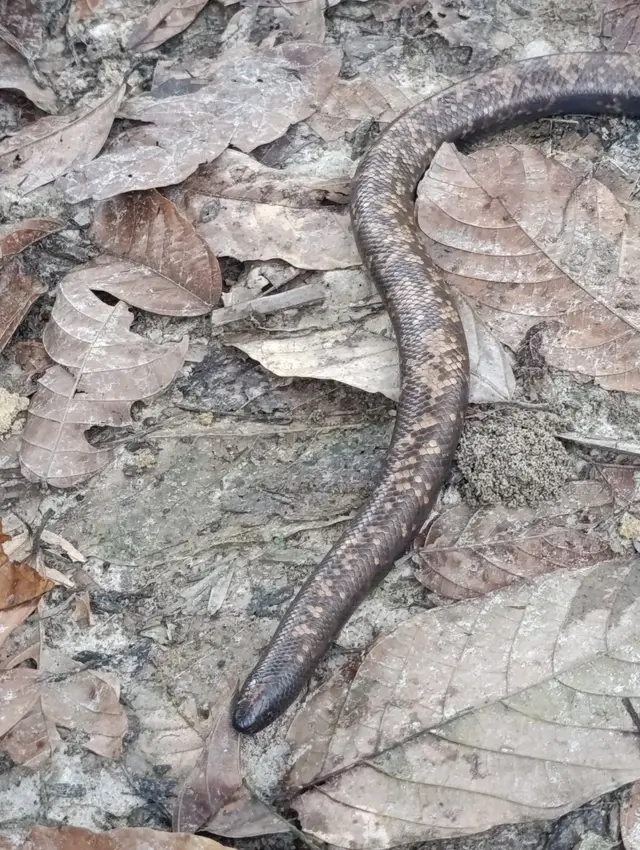
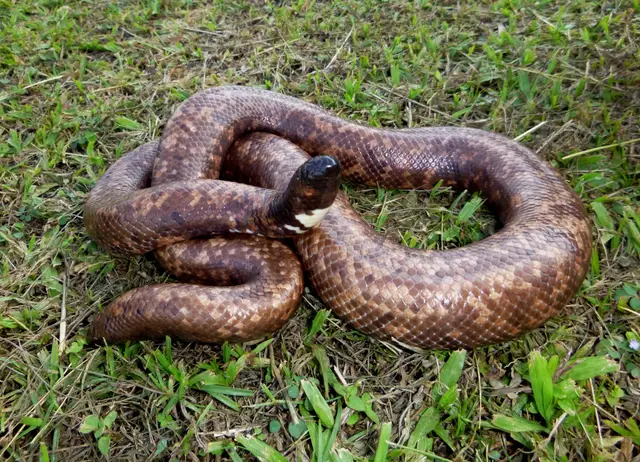
A Calabar python is a short, thick, tube-shaped snake with a blunt head and a blunt tail that look almost the same. Earth Touch News describes its coloring as splotchy brown and yellow, with a tail that is more brightly colored than the rest of the body. The body is about the same thickness from end to end, which is what you would expect from a snake built to push through soil.
- 1Tail shaped like a head: the tail is short, thick and rounded at the tip, so at a glance you cannot tell which end is which. This is the best single clue.
- 2Small head, no neck: the head is no wider than the body and the eyes are small. There is no obvious neck, unlike the ball python, whose head is clearly wider than its neck.
- 3Dark body with light flecks: most are dark brown or blackish with scattered yellowish or reddish flecks rather than a bold, regular pattern.
- 4Smooth, tight scales: the scales are smooth, glossy and packed tightly together. A 2018 study found that they cannot be spread apart the way most snake scales can.
- 5Rolls up instead of striking: a disturbed Calabar python tucks its head under its coils and lifts or waves its tail. It almost never bites.
How big do Calabar pythons get?
Calabar pythons grow to about 3.3 ft (1 m) at most, and most adults are 2-3 ft (60-90 cm) long. Earth Touch News puts adults at about a meter. The best field numbers come from a 1998-2001 study in Akwa Ibom State, Nigeria, by Luiselli and colleagues, published in the Herpetological Journal in 2002. They measured 13 adult females from the snout to the vent, which leaves out the short tail.
| Measure | Size | Source |
|---|---|---|
| Adult total length | About 3 ft (1 m) | Earth Touch News |
| Adult females, snout to vent | 24-35 in (61.1-88.6 cm) | Luiselli et al. (2002), Nigeria |
| Smallest female carrying eggs, snout to vent | 25 in (63.8 cm) | Luiselli et al. (2002) |
Over years of trapping in southern Nigeria, Luca Luiselli's team found that the average body length of captured snakes did not change much between sites or from year to year. No reliable weight figure for wild adults was found in the sources used here. For scale, the African rock python, which also lives in Nigeria, usually grows to 10-16 ft (3-4.9 m).
Where do Calabar pythons live?
Short answer: in the humid forest belt of West and Central Africa, from Sierra Leone and Liberia east to the Democratic Republic of the Congo. The Reptile Database lists Sierra Leone, Guinea, Liberia, Ivory Coast, Ghana, Togo, Benin, Nigeria, Cameroon, Equatorial Guinea, Gabon, the Central African Republic, both Congos and the Cabinda enclave of Angola. It marks some records from the two Congos as uncertain.
Inside many of those countries it occupies only a small area. In a case study on the species prepared on the pet trade, Luiselli writes that in Togo it lives only in the hilly forests along the Ghana border, around Kpalimé and Badou. In Benin it is rare and found only in the south. In Nigeria it is confined to the southern forest zone, and in Cameroon and Central Africa it seems more common than in West Africa. Its range touches the eastern edge of the DR Congo near Kivu. You can compare it with other African snakes on the world snake map.
The name comes from Calabar, a town and river in southeastern Nigeria. The Reptile Database gives the type locality as the Gold Coast, the colonial name for Ghana, and says the species honors Johannes Theodor Reinhardt, a Danish zoologist who lived from 1816 to 1882.
Habitat
Calabar pythons live in the leaf litter and loose soil of humid forest. Luiselli's case study lists rainforest leaf litter in Cameroon, semi-deciduous forest around Kpalimé in Togo and swamp forest around Omoku in Nigeria. The snake also turns up in abandoned farmland and in patchworks of farms and bush.
Mature forest is still what it prefers. Across 365 males and 326 females captured in the Niger Delta between 1994 and 2014, Luiselli's team found most in mature dryland and swamp forest, with plantations and forest-derived savanna used much less. Radio-tracking by Angelici and colleagues, published in 2000, showed that the snakes spend most of their time in burrows under leaves or in soil, and also a good deal of time inside mammal burrows and termite mounds.
Behavior and the head-like tail
Calabar pythons are active at dusk and at night, and most often after rain, according to the radio-tracking work summarized by Luiselli. During the day they stay underground. That makes them hard to study: in the Nigerian field study, the team caught them with lines of pitfall traps and by lifting cover objects, because the snakes are rarely seen moving on the surface.
Its defense is to hide the head and offer the tail. When a Calabar python is threatened, it buries its head under its coils and raises or waves its blunt tail. Mongabay calls this cephalic mimicry: a predator that strikes the decoy hits the toughest part of the snake. The Reptile Database adds that a strongly disturbed snake coils into a tight ball with its head in the middle, is hard to unroll and never tries to bite, citing an early account by H. Lang published by Schmidt in 1923.
Why is its skin so tough?
The Calabar python has some of the thickest, hardest-to-pierce skin measured in any snake. In a 2018 study in the Journal of Morphology, Dawei Han and Bruce Young compared its skin with that of 13 other snake species. Mongabay reports that the Calabar python's skin was about 15 times thicker than the others', and that it took far more force to puncture with a needle. Layers of collagen fibers cross each other at right angles, an arrangement the authors compared to rhinoceros hide. Earth Touch News explains the likely reason: the snake raids nests of baby rodents, and the mothers fight back with sharp incisors.
What do Calabar pythons eat?
Calabar pythons eat mainly small mammals, especially young rodents taken from their underground nests. Luiselli and Akani found that rodents made up over 80% of the diet in Nigeria. In the 2002 study, the team checked 44 captures (16 males, 13 females and 15 recaptures) for droppings and stomach contents.
| Prey | What was found | Source |
|---|---|---|
| Rats | Young black rats regurgitated by two snakes; Rattus in the droppings of four | Luiselli et al. (2002) |
| Mice | Adult African pygmy mice in two stomachs and four droppings; nestling mice in two stomachs | Luiselli et al. (2002) |
| Shrews | Probably Crocidura, in the droppings of six snakes | Luiselli et al. (2002) |
| Snake eggs | One stomach held eggs, probably of a sand snake (Psammophis phillipsi) | Luiselli et al. (2002) |
| Lizards | Occasional skinks and skink eggs | Luiselli (CITES case study) |
Inside a narrow burrow there is little room to wrap prey in coils. Mongabay, reporting on the Han and Young study, says the Calabar python instead squashes young rodents against the burrow wall, which lets it eat a whole litter. Snakes that had eaten rodents in the Nigerian study had no shrews in their droppings, and the reverse was also true.
Is the Calabar python venomous or dangerous?
No. The Calabar python has no venom and is not dangerous to people. Earth Touch News describes it as non-venomous, and the Reptile Database records that a disturbed snake curls into a ball rather than biting. At about 3 ft, it is far too small to constrict a person. It looks like a strange, two-ended worm. It is harmless.
Any snake can bite if it is grabbed, so wash a bite with soap and water and see a doctor if it becomes red or swollen. The bigger risk is a mix-up. The same forests hold venomous burrowing snakes, including the burrowing asps, and a small dark snake dug out of the soil should not be picked up unless you are sure what it is. The SnakesWiki snake venom FAQ explains why color is a poor guide to danger.
Calabar python vs ball python and other look-alikes
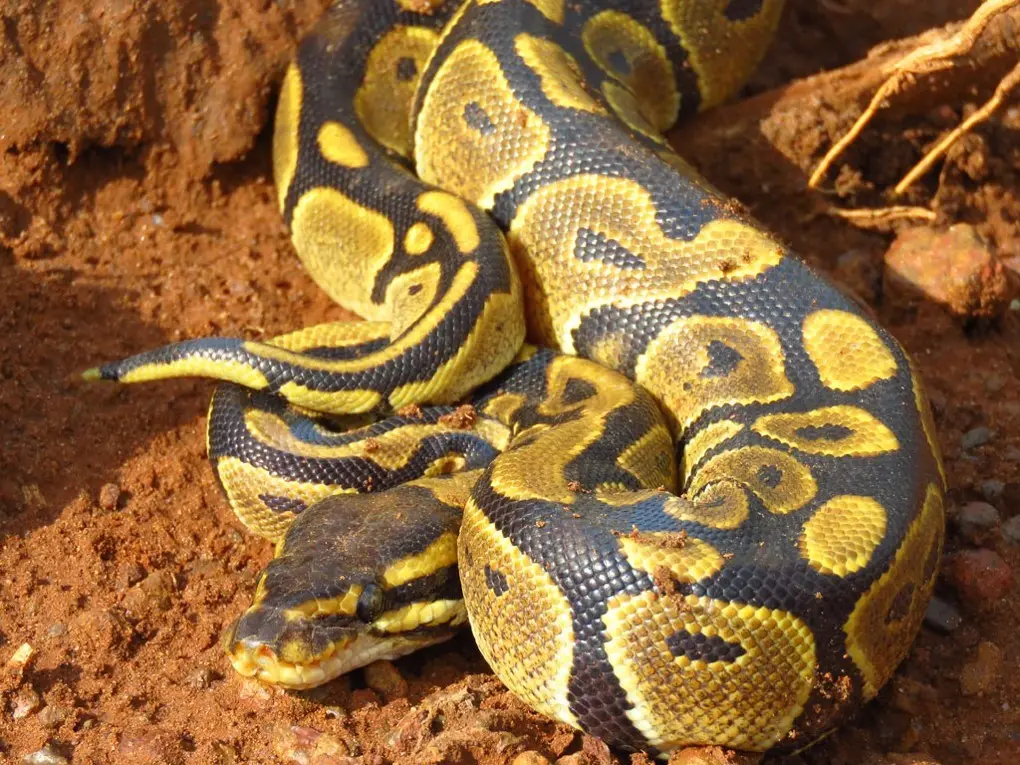
Ball python
Python regius · Harmless
The ball python shares much of the same range, including Ghana, Togo and southern Nigeria, and also rolls into a ball when scared. It grows larger, usually 3-5 ft, and has a head clearly wider than its neck and a bold pattern of rounded tan blotches on a dark body. Both are common in the pet trade from Ghana and Togo.
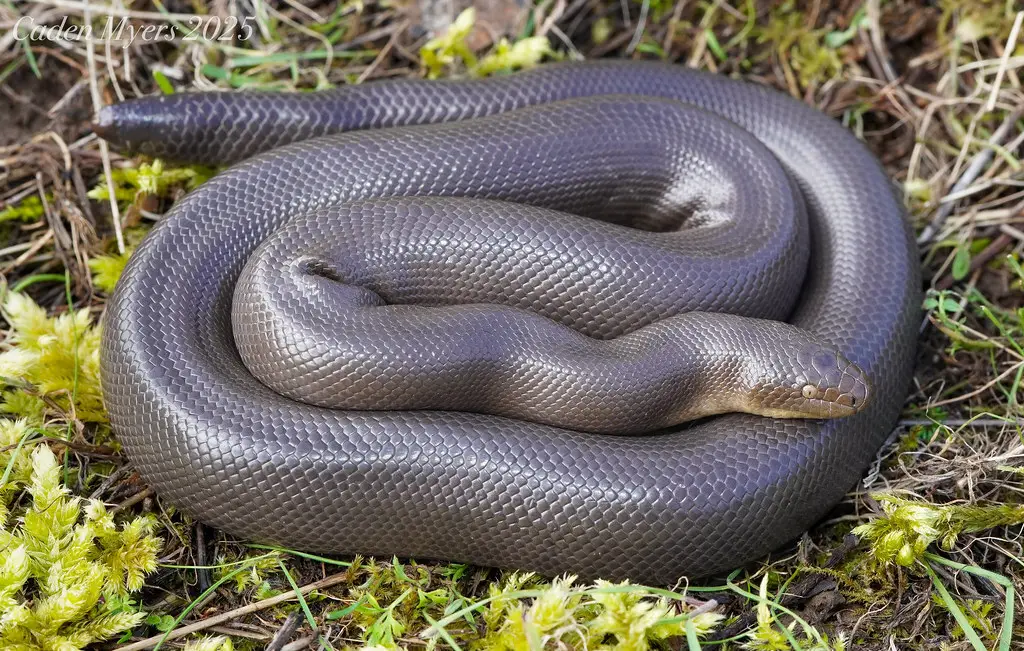
Rubber boa
Charina bottae · Harmless
The rubber boa of western North America has the same blunt, head-like tail and the same habit of hiding its head. Kluge (1993) once grouped the two together, and Luiselli's team found that both breed about every other year and eat mostly small mammals. They live on different continents, so there is no risk of confusion in the wild.
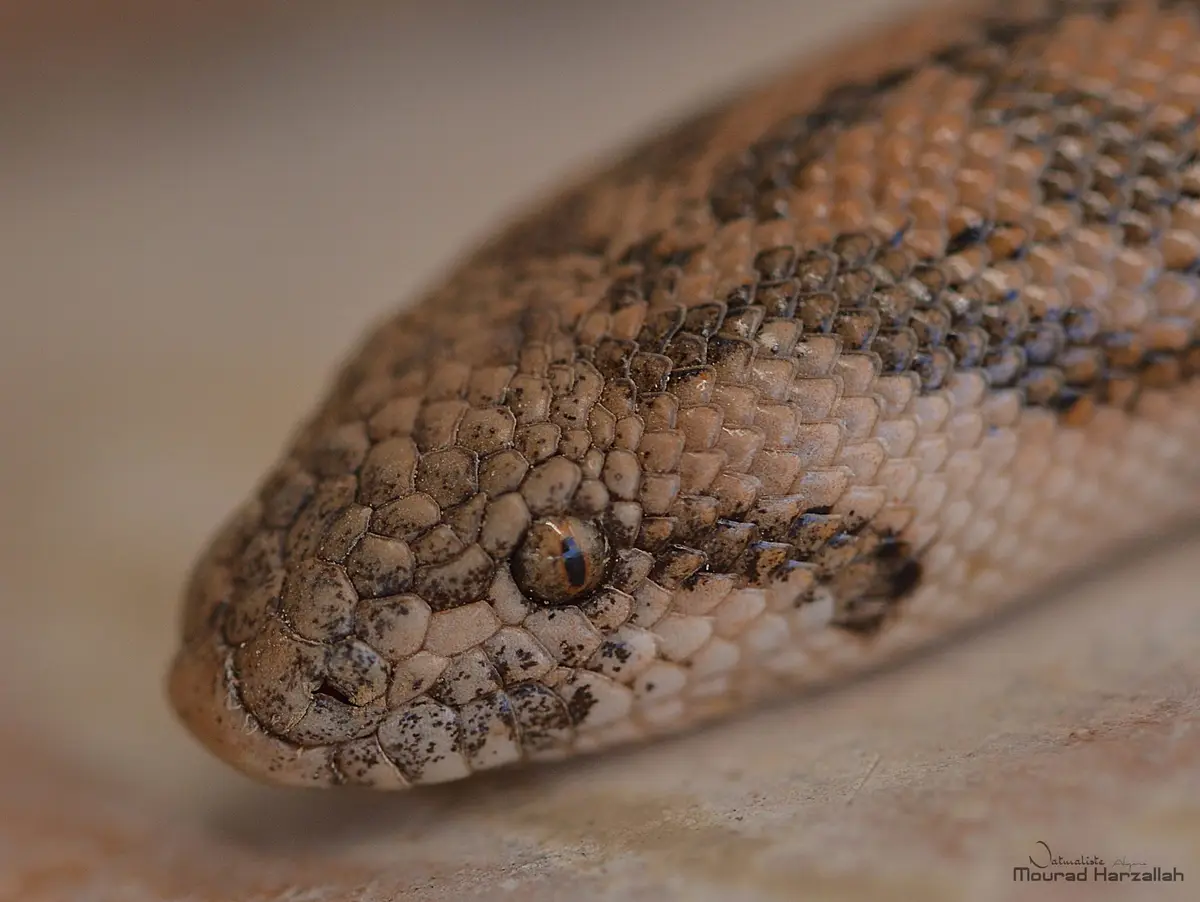
Sand boas
Eryx spp. · Harmless
The Calabar python was first described as a sand boa, Eryx reinhardtii. Sand boas are also stout burrowers with short tails, but they live in dry country across Africa, the Middle East and Asia, not in rainforest.
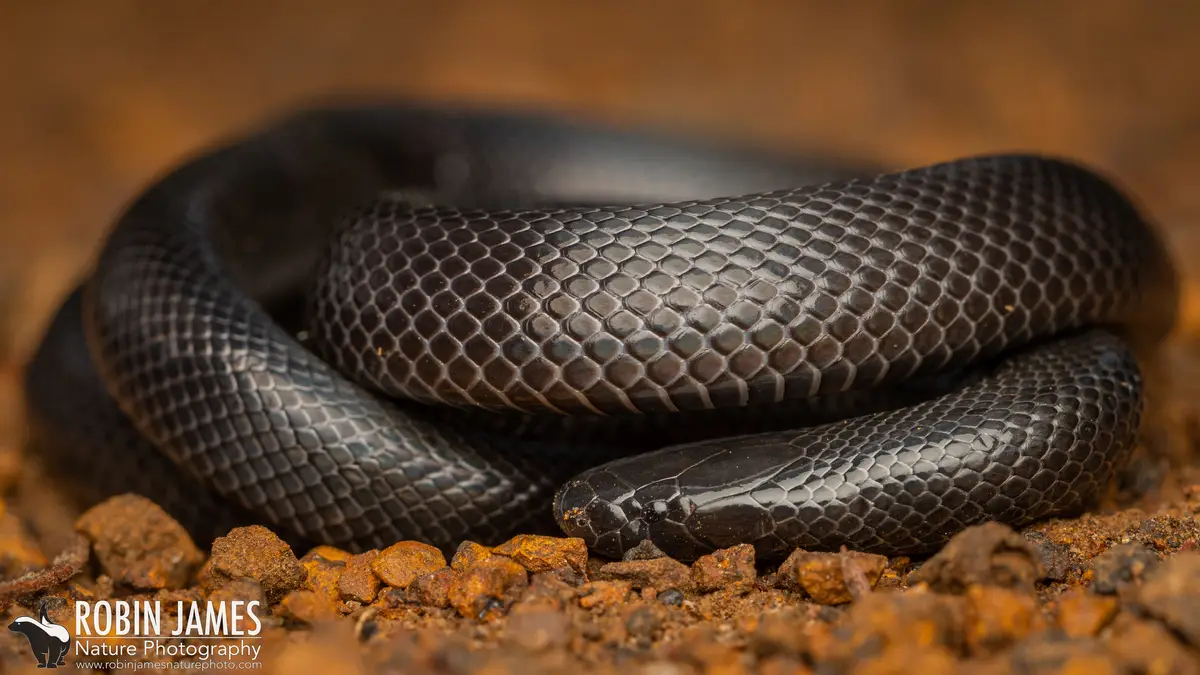
Variable burrowing asp
Atractaspis irregularis · Venomous
The look-alike that matters. The Reptile Database lists this venomous burrowing snake from Guinea, Liberia, Ivory Coast, Ghana, Togo, Nigeria, Cameroon and the Congos, overlapping much of the Calabar python's range. Both are dark, live underground and surface at night. Do not handle any small dark burrowing snake you cannot identify.
Reproduction
Calabar pythons lay eggs, and the females breed about every other year. In the Nigerian study, Luiselli's team recorded 13 adult females over four years. Only 11 of 20 yearly records, or 55%, were of females carrying eggs, and females recaptured in later years usually skipped at least one year between clutches.
Clutches are small. The Nigerian females carried 2-9 eggs, and larger females carried more: the smallest gravid female, 25 in (63.8 cm) from snout to vent, had 2 eggs, while the largest, 35 in (88.6 cm), had 9. Luiselli's case study says the eggs are large and are laid in the dry season, and the young hatch in the wet season. Mongabay notes that the low egg count fits a snake whose stiff skin limits how much its body can stretch. Nothing is known about age at maturity or lifespan in the wild, according to the case study.
Is the Calabar python endangered?
No. The Reptile Database lists the Calabar python as Least Concern on the IUCN Red List. It has a large range and tolerates some disturbed habitat, though it lives at low density, about 0.9 snakes per hectare (roughly 1 per 2.7 acres) at the Nigerian study site.
| Authority | Status |
|---|---|
| IUCN Red List | Least Concern |
| CITES | Appendix II (international trade is regulated) |
| Nigeria | Schedule I of the National Endangered Species Act 11 of 1985, fully protected |
| Benin | Vulnerable on the national red list (Toudonou 2011) |
The main threats, according to Luiselli's case study, are forest loss to farming and towns and local hunting for bushmeat and traditional medicine. The pet trade takes a smaller share. CITES records show an average of about 1,040 snakes exported a year between 1990 and 2013, with a peak of about 2,000, and Ghana, Togo and Benin supplied more than 80% of them. Almost all were caught in the wild. Luiselli judged this level sustainable across the range, with the possible exception of Benin, where the snake is rare.
Is the Calabar python a boa or a python?
It is a boa, despite the name. Hermann Schlegel described it in 1851 as a sand boa, and many later authors treated it as a python. The Reptile Database says a 2014 study by Pyron, Reynolds and Burbrink found that Calabaria sits within the boa family, Boidae. The database keeps it there as its own subfamily, Calabariinae, while some authors give it a family of its own. The pet trade and most field guides still call it the Calabar python, which is why SnakesWiki lists it with the pythons.
Calabar python FAQ
Is the Calabar python venomous?
No. The Calabar python has no venom and is harmless to people. When disturbed, it hides its head under its coils and waves its blunt tail as a decoy, or rolls into a tight ball. The Reptile Database records that it never tries to bite in this state, though any snake can bite if grabbed roughly.
How big do Calabar pythons get?
Calabar pythons grow to about 3.3 feet (1 m) at most, and most adults are 2-3 feet long. In a field study in southern Nigeria, adult females measured 24-35 inches (61-89 cm) from the snout to the vent, not counting the short tail. Males and females are both small compared with true pythons.
Why does the Calabar python's tail look like its head?
The blunt, head-shaped tail is a decoy. When attacked, the Calabar python buries its real head under its coils and lifts or waves its tail. A predator that strikes the tail hits thick, tough skin instead of the head. Scientists call this cephalic mimicry, and the North American rubber boa uses the same trick.
Is the Calabar python a boa or a python?
It is a boa. Genetic work by Pyron and colleagues in 2014 placed Calabaria inside the boa family, Boidae, and the Reptile Database lists it there as subfamily Calabariinae. The name python stuck from older classifications, and it is still sold and widely known as the Calabar python or Calabar ground python.
What does a Calabar python eat?
It eats mostly small mammals. A Nigerian study found rats, mice, nestling mice and shrews, plus one meal of snake eggs, and rodents made up over 80% of the diet in an earlier study. The snake often finds young rodents inside their nests and presses them against the burrow wall instead of coiling around them.
Where does the Calabar python live?
It lives in the humid forest belt of West and Central Africa, from Sierra Leone and Liberia east to the Democratic Republic of the Congo, including Ghana, Togo, Nigeria, Cameroon and Gabon. It burrows in leaf litter and soil in rainforest and swamp forest, and also uses termite mounds and rodent burrows.
Is the Calabar python endangered?
No. It is listed as Least Concern on the IUCN Red List, though it lives at low density and is listed on CITES Appendix II because it is exported for the pet trade. It is fully protected in Nigeria and rated Vulnerable on Benin's national red list, where it is rare.
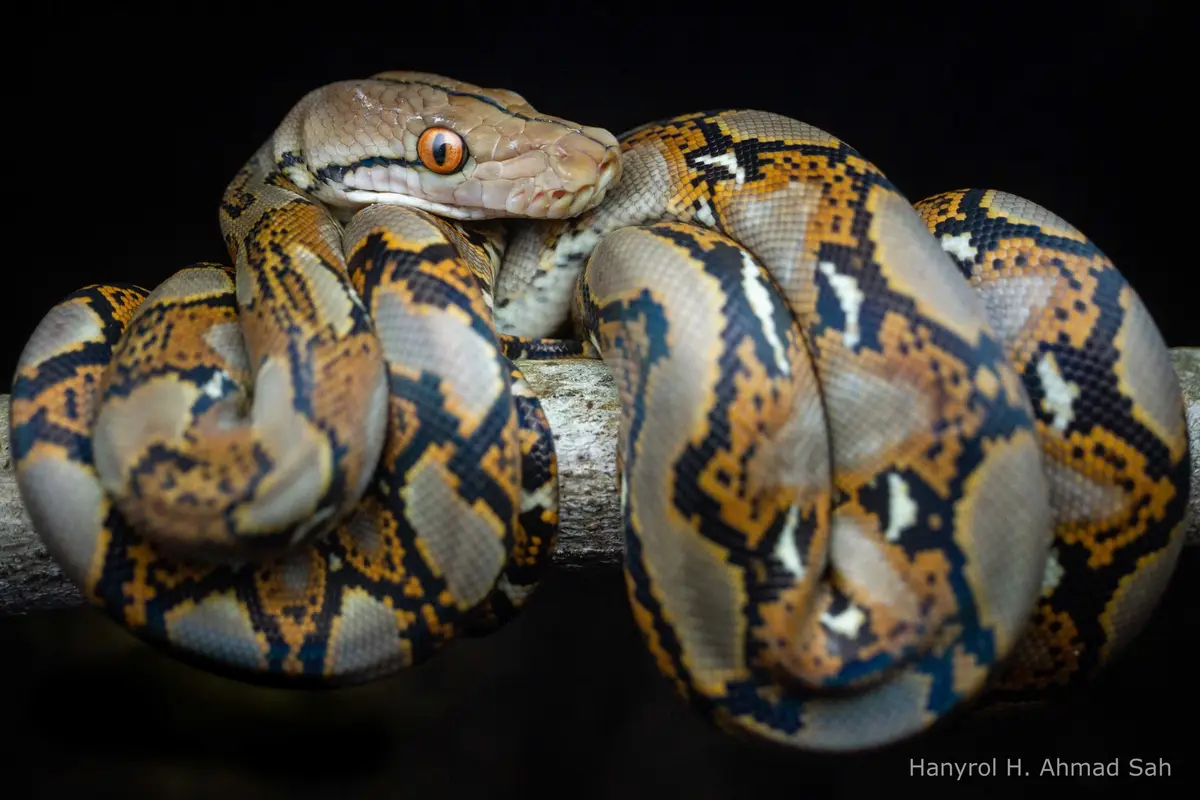
Related snakes
Sources
- Reptile Database: Calabaria reinhardtii (Schlegel, 1851)
- Luiselli et al. (2002). Female breeding frequency, clutch size and dietary habits of a Nigerian population of Calabar ground python, Calabaria reinhardtii. Herpetological Journal 12: 127-129
- Luiselli, L. Calabar ground python Calabaria reinhardtii: case study on the impact of the pet trade (CITES non-detriment findings workshop)
- Han, D. and Young, B.A. (2018). The rhinoceros among serpents: comparative anatomy and experimental biophysics of Calabar burrowing python (Calabaria reinhardtii) skin. Journal of Morphology 279: 86-96
- Mongabay (2017): The toughest snake on Earth lives in central Africa and eats baby rodents
- Earth Touch News: Meet the African snake that's been called the 'rhinoceros among serpents'
- Reptile Database: Atractaspis irregularis (variable burrowing asp)