SPECIES GUIDEANACONDA
Eunectes · Family Boidae
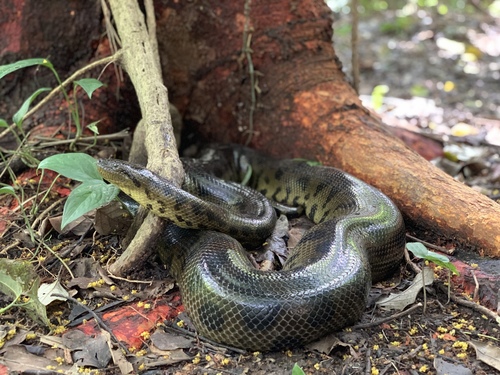
Photo: (c) David Torres, some rights reserved (CC BY-NC), uploaded by David Torres · via iNaturalist
KEY TAKEAWAYS
An anaconda is a large, non-venomous water boa in the genus Eunectes, found only in tropical and subtropical South America. The green anaconda is the heaviest snake in the world, though not the longest. Anacondas kill prey by constriction and rarely pose a danger to people.
- Four species are widely accepted: green, yellow, dark-spotted and Beni anacondas. A fifth, the northern green anaconda, was proposed in 2024 and is still debated.
- The biggest reliably measured green anaconda was 17 ft 1 in (5.21 m) and 214 lb (97.5 kg). Claims of 30 ft or more have never been verified.
- Anacondas are not venomous. They ambush prey from the water and squeeze until it stops breathing.
- Females are far larger than males, often several times heavier.
Anaconda quick facts
| Common name | Anaconda (water boa) |
|---|---|
| Genus | Eunectes Wagler, 1830 |
| Family | Boidae (boas) |
| Venomous | No, a constrictor |
| Species | 4 accepted, plus 1 proposed in 2024 |
| Largest species | Green anaconda (Eunectes murinus) |
| Adult length | Mostly 10-17 ft (3-5.2 m) in green anacondas; yellow anacondas are smaller |
| Weight | Large female green anacondas commonly 66-176 lb (30-80 kg) |
| Range | South America east of the Andes, plus Trinidad |
| Habitat | Swamps, marshes, flooded savannas, slow rivers |
| Reproduction | Live birth, usually 20-40 young |
| Conservation | IUCN Least Concern (green and yellow) |
How many species of anaconda are there?
Short answer: four species are recognized by the Reptile Database, and a fifth was proposed in 2024. The name Eunectes comes from Greek and means "good swimmer", which is fair: anacondas spend most of their lives in or beside water.
| Species | Scientific name | Where it lives | Typical adult size |
|---|---|---|---|
| Green anaconda | Eunectes murinus | Amazon and Orinoco basins, the Guianas, Trinidad | 10-17 ft (3-5.2 m) |
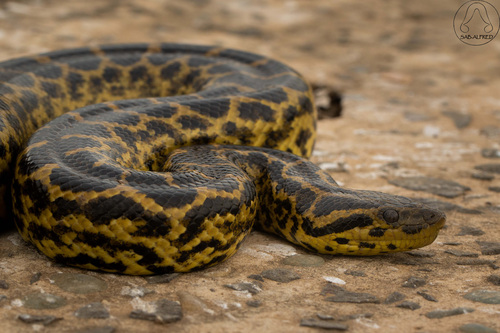
| Yellow anaconda | Eunectes notaeus | Pantanal and Chaco: Paraguay, Bolivia, Brazil, Argentina | 10-13 ft (3-4 m) |
| Dark-spotted anaconda | Eunectes deschauenseei | Northeastern Brazil and coastal French Guiana | Smaller; few measured |
| Beni (Bolivian) anaconda | Eunectes beniensis | Beni and Pando departments of Bolivia | Smaller; few measured |
| Northern green anaconda (proposed) | Eunectes akayima | Ecuador and Colombia to Venezuela and French Guiana | Similar to green anaconda |
The northern green anaconda comes from a 2024 study led by Jesus Rivas in the journal Diversity. Genetic data split green anacondas into a northern and a southern group, and the authors named the northern one Eunectes akayima. The same paper suggested the dark-spotted and Beni anacondas may belong in the yellow anaconda. Other herpetologists have challenged the naming, so many references, including this guide, still treat the green anaconda as one species until the debate settles.
How to identify an anaconda
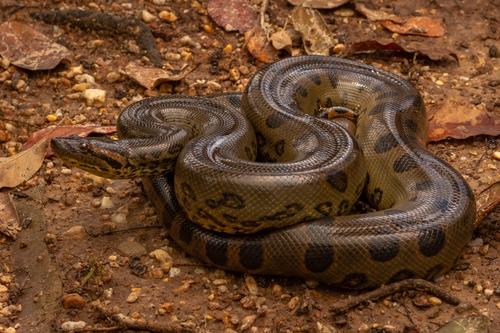
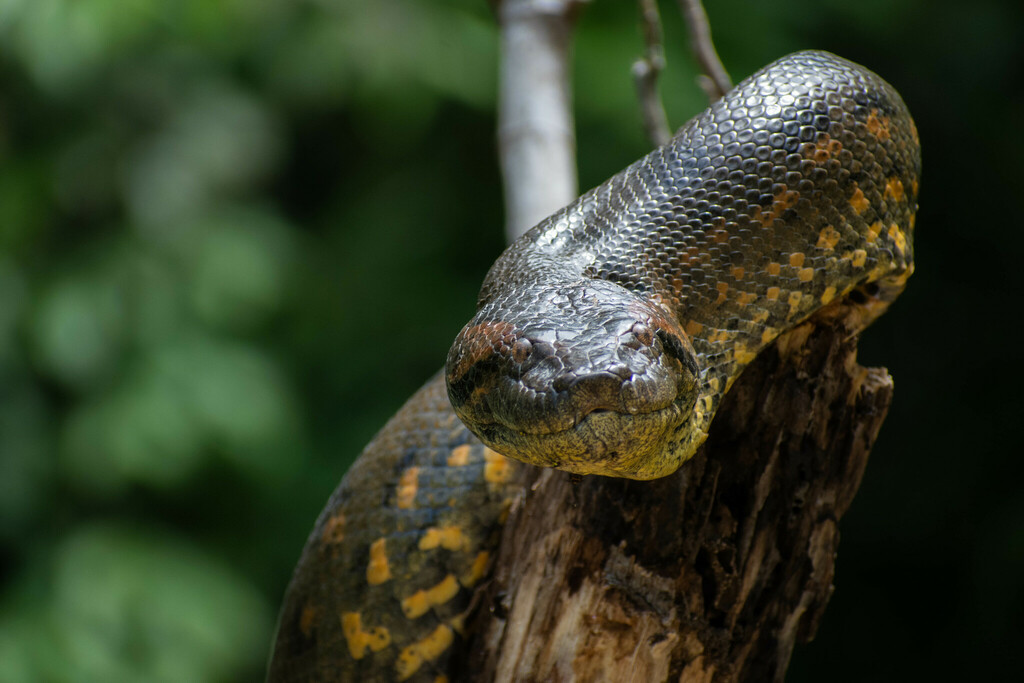
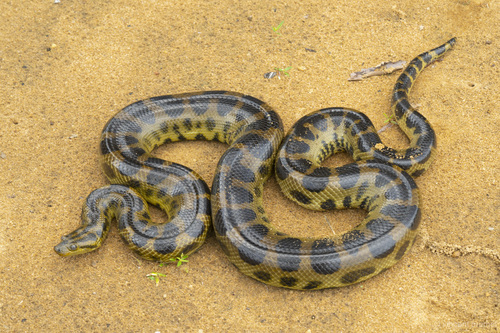
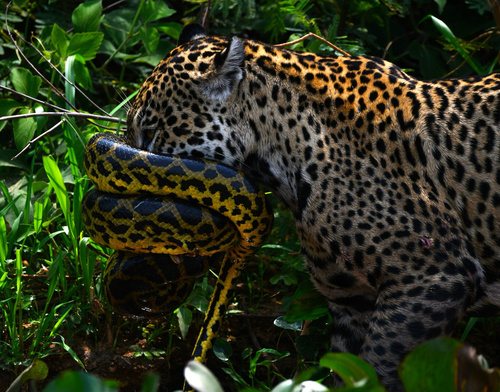
An anaconda is a very thick, heavy snake with a narrow head that is barely wider than the neck. Its eyes and nostrils sit high on top of the head, so it can breathe and watch while almost fully under water. Check these features together.
- 1Body shape: massive and muscular, much thicker than a python or boa of the same length.
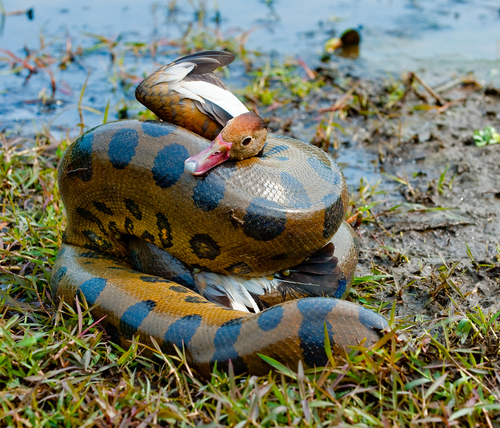
- 2Color: olive green in green anacondas, yellow to tan in yellow anacondas, with rows of large black oval blotches down the back.
- 3Head stripes: an orange to yellow stripe edged in black runs from each eye back to the jaw.
- 4Eyes and nostrils: set on top of the head, like a crocodile's, for life at the waterline.
- 5Habitat: almost always in or near slow, shallow water. A large snake basking on a riverbank in the Amazon or the Pantanal is likely an anaconda.
How big do anacondas get?
Short answer: most adult female green anacondas are 10 to 17 feet long and weigh 66 to 176 pounds. The green anaconda is the heaviest snake on Earth, but the reticulated python of Southeast Asia grows longer.
Size claims for anacondas are some of the most inflated in all of zoology. Explorers reported snakes of 40, 60 and even 100 feet, and none were ever backed by a specimen. The best data come from Jesus Rivas, a Venezuelan herpetologist who measured more than 900 wild anacondas in the llanos of Venezuela. His largest female was 17 ft 1 in (5.21 m) and 214 lb (97.5 kg).
| Green anaconda | Length | Weight |
|---|---|---|
| Newborn | 28-31 in (70-80 cm) | Under 1 lb (0.5 kg) |
| Adult male | About 10 ft (3 m) | Often under 25 lb (11 kg) |
| Adult female | About 15 ft (4.6 m) | 66-176 lb (30-80 kg) |
| Largest verified | 17 ft 1 in (5.21 m) | 214 lb (97.5 kg) |
Females outgrow males by a wide margin. In the wild, a big female can weigh five times as much as the males courting her, one of the largest size gaps between sexes in any land vertebrate.
Where do anacondas live?
Short answer: anacondas live in South America east of the Andes, from Venezuela and the Guianas south to northern Argentina, plus the island of Trinidad. Green anacondas fill the Amazon and Orinoco basins. Yellow anacondas live farther south, in the Pantanal wetlands and the Paraguay River system.
There are no native anacondas in North America. A few escaped pets have turned up in Florida, and the state now lists both green and yellow anacondas as prohibited species, so they cannot be kept as pets. See where every snake group lives on our world snake map.
Habitat
Anacondas are tied to slow or still water: swamps, marshes, oxbow lakes, flooded forest and the seasonally flooded grasslands called llanos in Venezuela. They are clumsy on land and graceful in water. In the dry season, when pools shrink, they may bury themselves in mud and wait for the rains.
Behavior
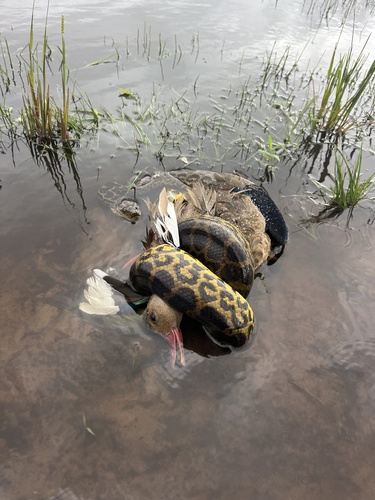
Anacondas are ambush hunters. One will lie in shallow water with only its eyes and nostrils showing, sometimes for days, until an animal comes to drink. It strikes, grabs with backward-curving teeth, and wraps its coils around the prey. Constriction stops blood flow, so prey loses consciousness quickly.
They are mostly active at dusk and at night, and spend long stretches resting after a big meal. After swallowing a capybara, an anaconda may not eat again for weeks.
What do anacondas eat?
| Prey group | Examples | How often |
|---|---|---|
| Fish | Catfish and other river fish | Common, especially for young snakes |
| Birds | Wading birds, ducks | Common |
| Mammals | Capybaras, agoutis, peccaries, deer | Main prey of large females |
| Reptiles | Turtles, caimans | Occasional |
| Snails (yellow anaconda) | Apple snails | Regular in some areas |
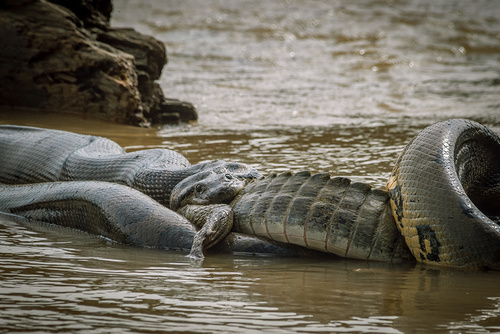
Large anacondas sometimes eat caimans, and the reverse also happens. Cannibalism is well documented too: females occasionally eat males after mating, which may help them through the long pregnancy.
Are anacondas venomous or dangerous?
No, anacondas are not venomous. They kill by constriction. A bite from a large anaconda can still cause deep cuts, because the teeth are sharp and curve backward, so wounds should be cleaned and checked by a doctor.
Attacks on people are rare. Anacondas do not regularly hunt humans, and verified fatal attacks are almost unknown, though a very large female could in theory overpower a child. Most bites happen when someone grabs or handles one. If you see an anaconda in the wild, give it space and do not try to touch or move it. Our snake safety FAQ covers what to do around any large snake.
Snakes confused with anacondas
Any large snake near water in South America tends to get called an anaconda. These are the usual mix-ups.
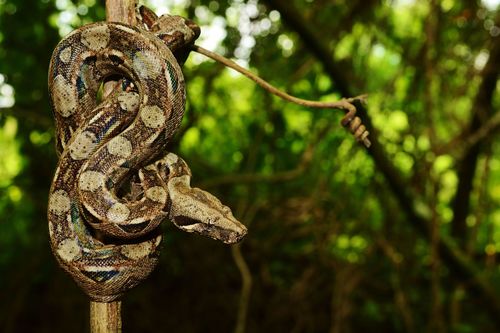
Boa constrictor
Boa constrictor · Harmless
Lives on land and in trees, not in water. Tan body with darker saddles that turn reddish toward the tail.
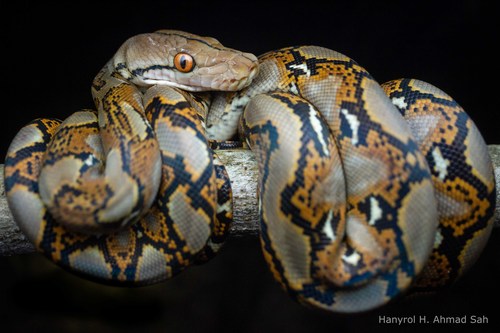
Reticulated python
Malayopython reticulatus · Harmless
Native to Southeast Asia, not South America. Longer and slimmer, with a net-like pattern.
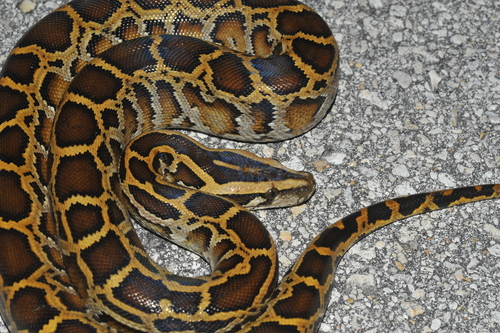
Burmese python
Python bivittatus · Harmless
The giant snake loose in the Florida Everglades. Brown blotches on a tan body, and eyes on the sides of the head, not on top.
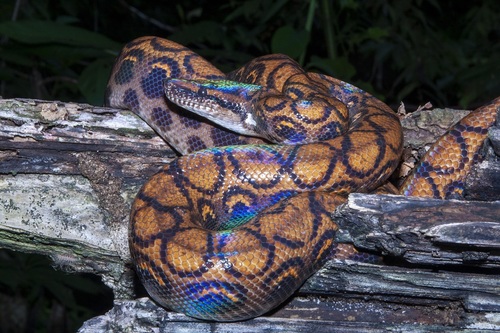
Rainbow boa
Epicrates cenchria · Harmless
Much smaller, usually under 6 ft, with an iridescent sheen and ringed spots.
Reproduction and lifespan
Green anacondas mate once a year in the dry season, often in a "breeding ball" where up to a dozen males wrap around a single female for two to four weeks. Pregnancy lasts six to seven months. Anacondas give birth to live young, usually 20 to 40 babies, and occasionally many more. Newborns are 2 to 2.5 ft long and fend for themselves right away.
Wild anacondas probably live about 10 years. In zoos they can pass 30, and the oldest on record reached almost 38 years.
Conservation status
| Species | IUCN status | Main threats |
|---|---|---|
| Green anaconda | Least Concern | Wetland drainage, killing out of fear, skin trade |
| Yellow anaconda | Least Concern | Harvest for leather (regulated in Argentina), habitat loss |
| Dark-spotted anaconda | Not well assessed | Small range, coastal development |
| Beni anaconda | Not well assessed | Small range, cattle ranching |
All anacondas are listed on CITES Appendix II, which means international trade in live snakes and skins needs permits. The proposed split of the green anaconda matters here: if the northern and southern populations are separate species, each has a smaller range than scientists thought, which could change how threatened they are.
Anaconda FAQ
Is the anaconda the biggest snake in the world?
Yes, by weight. The green anaconda is the heaviest snake on Earth, with large females passing 200 lb (90 kg). The reticulated python is longer, with records over 20 ft, but it is much slimmer than an anaconda of the same length.
Are anacondas venomous?
No. Anacondas have no venom. They are constrictors that grab prey with their teeth and squeeze until it loses consciousness. A bite can still cause deep cuts from their backward-curving teeth, so any bite should be cleaned and seen by a doctor.
Can an anaconda eat a human?
It is physically possible for a very large female to overpower a child or a small adult, but verified cases are almost unknown. Anacondas do not hunt people. Most human injuries come from handling or trying to catch one.
What is the difference between a green anaconda and a yellow anaconda?
The green anaconda is olive green, lives in the Amazon and Orinoco basins, and grows to about 17 ft. The yellow anaconda is yellow to tan with denser black blotches, lives farther south in the Pantanal and Paraguay River basin, and rarely passes 13 ft.
Do anacondas live in the United States?
Not naturally. A few escaped or released pet anacondas have been found in Florida, but no established breeding population is confirmed. Florida lists green and yellow anacondas as prohibited species, and federal law bans importing green and yellow anacondas into the US.
How long do anacondas live?
About 10 years in the wild, based on field studies. In zoos with steady food and vet care, anacondas often live past 30 years, and the oldest recorded individual reached almost 38.
What is the northern green anaconda?
It is a species, Eunectes akayima, proposed in a 2024 study after genetic tests split green anacondas into northern and southern groups. Its suggested range runs from Ecuador and Colombia to Venezuela and French Guiana. Some herpetologists dispute the name, so it is not yet universally accepted.