THE LARGEST SNAKE EVERTITANOBOA
Titanoboa cerrejonensis · Family Boidae
Photo: iNaturalist contributor · via iNaturalist
KEY TAKEAWAYS
Titanoboa (Titanoboa cerrejonensis) is an extinct snake and a member of the boa family, known only from fossils found in Colombia. It is the largest snake ever discovered, living roughly 58 to 60 million years ago, and it is not a mythical creature. It has been extinct for tens of millions of years, and no snake alive today comes close to its size.
- It was not venomous. Like living boas and anacondas, Titanoboa was a constrictor.
- Fossils were found at the Cerrejon coal mine in La Guajira, Colombia, and the species was formally named in 2009 by paleontologist Jason Head and colleagues.
- Based on vertebra size, scientists estimate it reached about 42 ft (12.8 m) and weighed over 1,100 kg (2,500 lb), though the exact top length is debated.
- Titanoboa lived in the Paleocene epoch, a few million years after the asteroid impact that wiped out the dinosaurs, in a hot, swampy tropical rainforest.
Titanoboa quick facts
| Common name | Titanoboa |
|---|---|
| Scientific name | Titanoboa cerrejonensis Head et al., 2009 |
| Family | Boidae (boas), related to living anacondas |
| Status | Extinct; known only from fossils |
| Venomous | No, a constrictor, like its living relatives |
| Estimated length | About 42 ft (12.8 m), with estimates ranging roughly 40-47 ft |
| Estimated weight | Over 1,100 kg (2,500 lb) |
| When it lived | Middle to Late Paleocene, about 58-60 million years ago |
| Where fossils were found | Cerrejon Formation, La Guajira, Colombia |
| Diet | Likely mostly fish, based on skull anatomy |
What did Titanoboa look like?
No complete skeleton of Titanoboa has ever been found, so its exact appearance is reconstructed from vertebrae and, later, skull fragments. Based on its close relationship to living boas and anacondas, paleontologists picture it as a very thick-bodied constrictor, essentially an anaconda scaled up to roughly twice the length and many times the mass.
- 1Body: extremely thick and heavy for its length, in the same basic shape as a modern boa constrictor or green anaconda, just far larger.
- 2Head: skull fragments found in 2011 show features associated with eating fish, rather than the broader skull of an ambush predator that tackles large land mammals.
- 3Scale comparison: at its widest, reconstructions suggest Titanoboa would have come up to roughly a person's hips while lying flat on the ground.
- 4Color: unknown. Fossils do not preserve skin color or pattern, so any depiction of Titanoboa's coloring in documentaries or museum models is an artistic guess.
How big was Titanoboa really?
Short answer: the best current estimate puts Titanoboa at around 42 ft (12.8 m) long and more than 1,100 kg (2,500 lb), making it the largest snake known to science, living or extinct. There is real uncertainty around the exact number.
Paleontologist Jason Head and colleagues described the species in a 2009 paper in Nature, based on vertebrae recovered from the Cerrejon coal mine. Because no complete skeleton exists, they estimated size by comparing the width of Titanoboa's largest vertebrae to the vertebra-to-body-size ratio of living boas and anacondas. That method produced a central estimate of about 12.82 m (42.1 ft), with an uncertainty range of plus or minus 2.18 m, and a weight estimate between about 652 and 1,819 kg (1,438 to 4,000 lb). Geologist David Polly of Indiana University, who worked out the position of the vertebrae in the snake's body, said that at its widest point the animal would have come up to about a person's hips.
Later skull discoveries let other researchers try alternate methods based on anaconda skull-to-body proportions, which pushed some estimates as high as 14.3 m (47 ft). The uncertainty exists because Titanoboa is known from a relatively small number of fossils, unlike a living animal that scientists can simply measure directly.
Where and when did Titanoboa live?
Short answer: Titanoboa is known only from fossils found at the Cerrejon open-pit coal mine in La Guajira, in northeastern Colombia, and it lived during the Middle to Late Paleocene epoch, roughly 58 to 60 million years ago.
That places it about 5 to 8 million years after the asteroid impact that ended the age of dinosaurs. The Cerrejon fossil site preserves an entire ancient tropical rainforest ecosystem, including fish, turtles, crocodile relatives and early mammals, giving scientists an unusually complete picture of the world Titanoboa lived in. Students Jonathan Bloch, now a curator at the Florida Museum of Natural History, and Carlos Jaramillo of the Smithsonian Tropical Research Institute led the excavations that produced the first fossils in the early 2000s. See the boa group page for how Titanoboa's living relatives compare, and our world snake map for where modern snake groups live today.
Habitat
The Cerrejon Formation preserves a hot, swampy tropical rainforest crossed by rivers and wetlands, not unlike parts of the Amazon basin today, but considerably warmer. The fossil site also contains the remains of giant turtles and crocodile relatives, suggesting Titanoboa shared its wetland habitat with other oversized reptiles.
What did Titanoboa eat, and how did it hunt?
Titanoboa was long assumed to have been an apex predator capable of taking down large mammals or crocodile relatives, since nothing else in its ecosystem could rival its size. Skull fragments recovered in a 2011 expedition changed that picture. The bones showed features typical of fish-eating snakes, suggesting Titanoboa specialized in hunting fish rather than acting as a generalized super-predator.
Like its living relatives, Titanoboa almost certainly killed by constriction rather than venom. A snake of its size would have had little need for anything else: a body that thick could overpower most prey through sheer strength alone.
Was Titanoboa venomous?
No, Titanoboa was not venomous. It belonged to the boa family, and every known member of that family, living or extinct, kills by constriction rather than venom. There is no evidence of venom glands in any Titanoboa fossil.
Because it has been extinct for tens of millions of years, Titanoboa poses no danger to anyone today. The real danger it represents is only to the imagination: it is a popular subject for documentaries and museum exhibits precisely because its size is hard to believe.
What is Titanoboa's closest living relative?
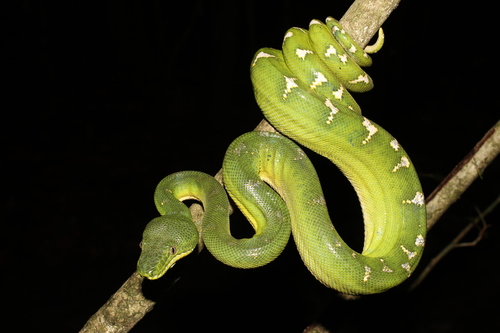
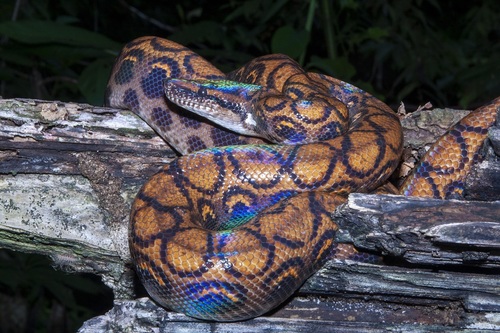
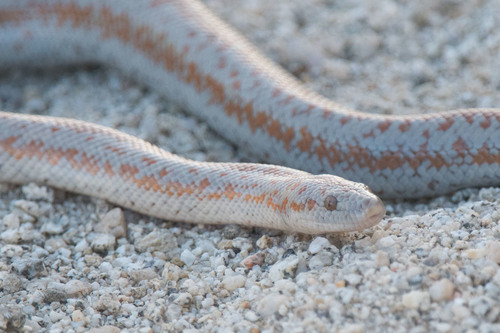
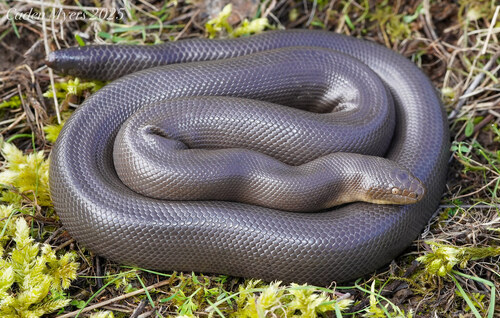
Titanoboa belonged to the same family as today's boas and anacondas, and its closest living relatives are generally considered to be anacondas and other New World boas, though some researchers have also pointed to boas now found in Madagascar and the Indo-Pacific as relevant to its broader family tree.
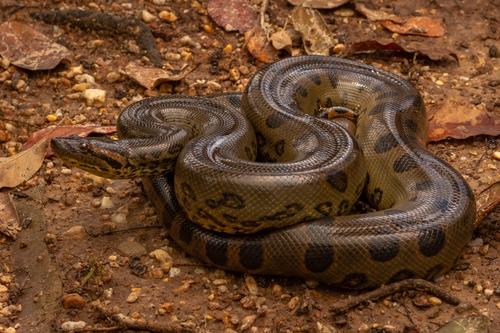
Green anaconda
Eunectes murinus · Harmless
The heaviest living snake, but at most around 17 ft (5.2 m), roughly a third of Titanoboa's estimated length. See our green anaconda guide.
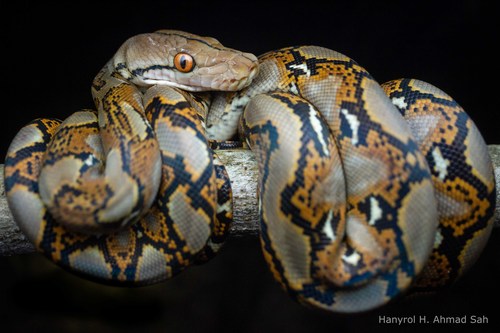
Reticulated python
Malayopython reticulatus · Harmless
Not closely related (a python, not a boa), but the longest living snake today, with verified records over 20 ft, still far short of Titanoboa.
Reproduction
No direct fossil evidence shows how Titanoboa reproduced. Because it belongs to the boa family, and almost every living boa gives birth to live young rather than laying eggs, paleontologists generally assume Titanoboa reproduced the same way, though this cannot be confirmed from the fossil record alone.
Why did Titanoboa go extinct?
| Status | Detail |
|---|---|
| Current status | Extinct; known only from fossils |
| When it disappeared | Sometime after the Late Paleocene, exact timing unknown |
| Likely cause | Global cooling after the very warm Paleocene, which snake-sized ectotherms depend on for body heat |
Titanoboa's gigantic size has become an important clue for reconstructing ancient climate. Because snakes rely on outside heat to stay active, researchers who study Titanoboa's size have argued that reptiles of that scale could only survive in tropical temperatures considerably warmer than the Cerrejon region sees today. As global temperatures cooled in the tens of millions of years after the Paleocene, the conditions that let a snake grow to such an extreme size likely disappeared, though the precise end date of Titanoboa as a species is not pinned down by the fossil record.
Titanoboa FAQ
Was Titanoboa venomous?
No. Titanoboa belonged to the boa family, and every known boa, living or extinct, kills by constriction. No Titanoboa fossil shows any evidence of venom glands.
How big was Titanoboa really?
The best current estimate, based on vertebra size compared to living boas and anacondas, puts it at about 42 ft (12.8 m) and over 1,100 kg (2,500 lb). Some alternate methods using later skull finds suggest a length as high as 47 ft, but the exact figure carries real uncertainty since no complete skeleton has been found.
Is Titanoboa still alive?
No. Titanoboa has been extinct for tens of millions of years. It is known only from fossils found at the Cerrejon coal mine in Colombia and lived about 58 to 60 million years ago.
What did Titanoboa eat?
Skull fossils found in 2011 suggest Titanoboa specialized in eating fish, rather than being a generalized predator of land animals as originally assumed when only vertebrae were known.
How does Titanoboa compare to the green anaconda?
Titanoboa was roughly twice as long as the largest verified green anaconda, which reaches about 17 ft (5.2 m), and would have massively outweighed it as well, based on current size estimates.
Where was Titanoboa discovered?
At the Cerrejon open-pit coal mine in La Guajira, northeastern Colombia. The first fossils were found in the early 2000s, and the species was formally named in 2009.
Related snakes
Sources
- Head et al. 2009, Giant boid snake from the Paleocene neotropics reveals hottest tropical temperatures, Nature 457
- Smithsonian Magazine: How Titanoboa, the 40-Foot-Long Snake, Was Found
- National Geographic: Titanoboa, 13 metres, one tonne, the largest snake ever
- Reptile Database: Eunectes murinus (green anaconda, closest living relative for comparison)