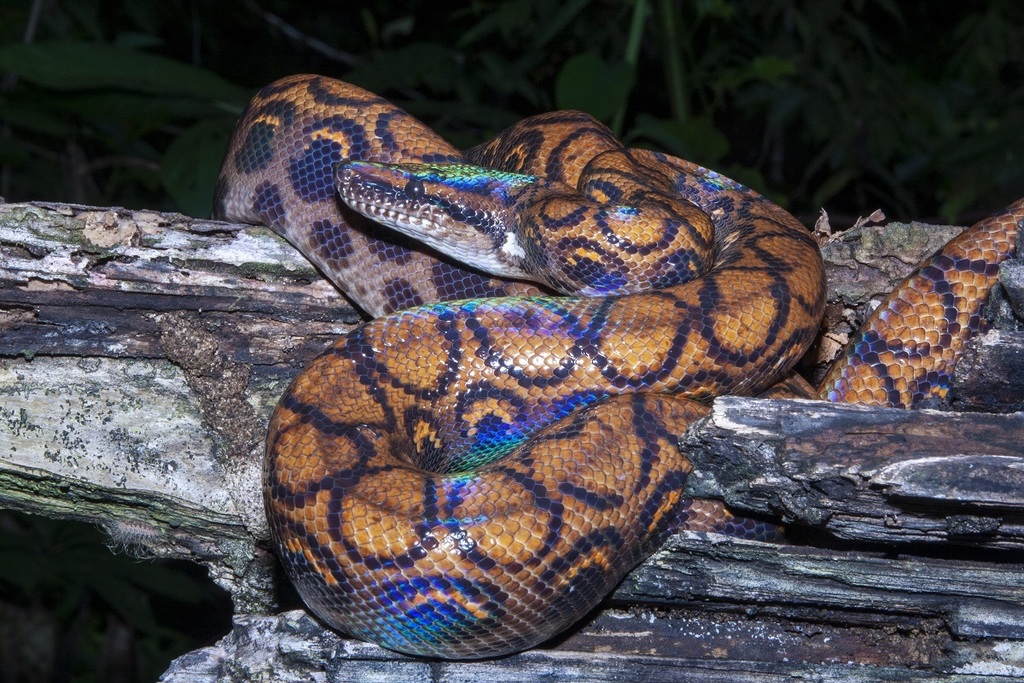
RAINBOWBOA
Epicrates cenchria · Family Boidae
Photo: (c) dhfischer, some rights reserved (CC BY), uploaded by dhfischer · via iNaturalist
KEY TAKEAWAYS
The rainbow boa (Epicrates cenchria) is a non-venomous constrictor native to northern and central South America, best known for the metallic, rainbow-like sheen on its reddish-brown scales. It is one of the boas, a family of live-bearing constrictors found across the Americas and a few other regions.
- It is not venomous. It kills by constriction, like every member of the boa family.
- Adults typically reach 4 to 6 ft (1.2 to 1.8 m); some reports claim individuals up to 7 ft, though no measured record at that length is published.
- The shimmer is structural, not pigment: microscopic ridges on the scales split light into shifting colors, strongest on the tail.
- The IUCN Red List classifies it as Least Concern, with habitat loss and the pet trade as the main pressures on wild populations.
Rainbow boa quick facts
| Common name | Rainbow boa |
|---|---|
| Scientific name | Epicrates cenchria (Linnaeus, 1758) |
| Family | Boidae (boas) |
| Venomous | No, a constrictor |
| Adult length | 4-6 ft (1.2-1.8 m); rare reports to 7 ft (2.1 m) |
| Weight | Roughly 2-5 lb (1-2.3 kg); reliable averages are scarce |
| Range | Colombia, Venezuela, the Guianas, Peru, Brazil, Bolivia, northern Argentina; introduced in Florida |
| Habitat | Tropical rainforest and gallery forest, often near streams |
| Diet | Rodents, birds, bats, opossums, occasional lizards |
| Reproduction | Live birth, roughly 2-25 young per litter |
| Conservation | IUCN Least Concern (2021 assessment) |
How to identify a rainbow boa
A rainbow boa is easiest to recognize in direct light, where its shine gives the game away. Check for these features together; captive-bred color morphs can vary quite a bit from the wild-type look.
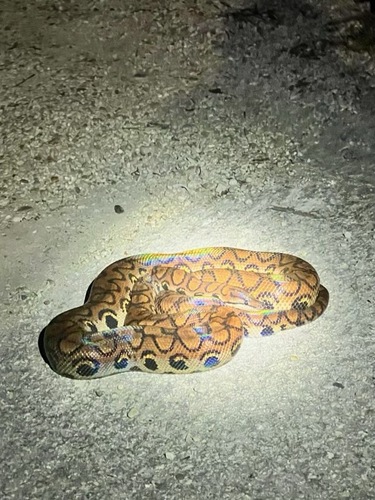
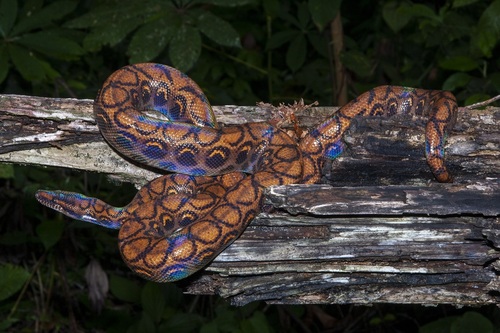
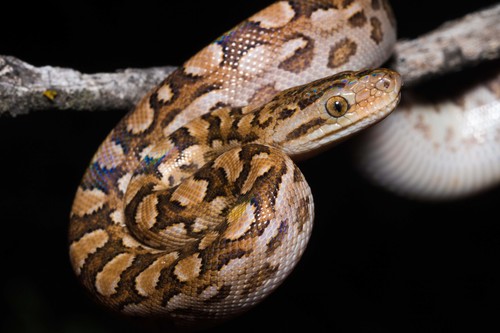
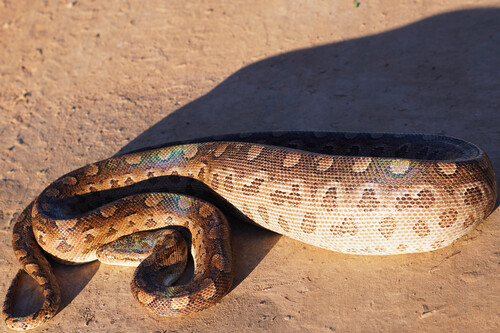
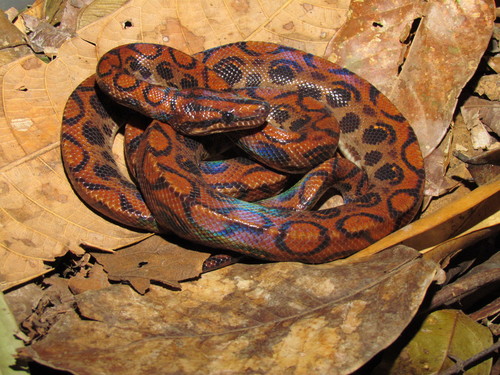
- 1Iridescent sheen: microscopic ridges on the scales bend light into shifting blues, greens and purples, most visible on the tail and strongest in direct sun.
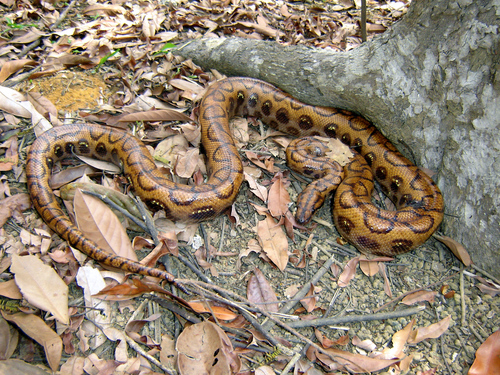
- 2Base color: reddish-brown to olive-brown overall, darkening with age; hatchlings often look more orange.
- 3Body pattern: large rounded black rings run down the back, many with a paler center, plus smaller round blotches along the sides.
- 4Head: three narrow dark stripes run lengthwise across the top of the head, and small heat-sensing pits line both lips.
- 5Build: a thick, round-bodied snake with a head only slightly wider than the neck, unlike the broad, triangular head of a pit viper.
How big does a rainbow boa get?
Most adult rainbow boas measure 4 to 6 ft (1.2 to 1.8 m), and females tend to end up longer and heavier-bodied than males. The University of Illinois Wildlife Medical Clinic describes an adult female close to 6 ft and about 5 lb, in line with figures from other zoos and clinics. A handful of keepers and breeders report individuals pushing 7 ft, but no measured specimen at that length has turned up in the scientific literature, so treat it as an outer limit rather than the norm. Weight is poorly documented for wild animals; the figures above come mostly from captive individuals.
| Life stage | Length | Weight |
|---|---|---|
| Newborn | 15-20 in (38-50 cm) | A few ounces |
| Typical adult | 4-6 ft (1.2-1.8 m) | Roughly 2-5 lb (1-2.3 kg) |
| Reported maximum | About 7 ft (2.1 m) | Not documented |
Where do rainbow boas live?
Short answer: the rainbow boa lives across northern and central South America, from Colombia and Venezuela east through the Guianas and south into Peru, Bolivia, Brazil and the far north of Argentina. Escaped or released pets have also turned up in Florida. Compare its range with other boas on our world snake map.
The Reptile Database lists confirmed populations in French Guiana, Suriname, Guyana, Colombia, Venezuela and Peru, plus Brazilian states from Amapa and Roraima south to Rio de Janeiro, and provinces in Bolivia and northern Argentina near the Andean foothills. The same database notes that the species does not reach Costa Rica, Panama or Trinidad and Tobago, where a very similar-looking relative, the Colombian rainbow boa (Epicrates maurus), takes its place.
Habitat
Rainbow boas favor humid rainforest and gallery forest, especially near streams, swamps and riverbanks where rodents and amphibians come to drink. Juveniles spend more time off the ground, resting on low branches and tangled vines, while heavier adults shift toward hunting along the forest floor. The species also turns up at the forest edge, in secondary growth and even cleared farmland, as long as enough cover and prey remain.
Behavior and temperament
Rainbow boas are mostly nocturnal, spending the day hidden under leaf litter, logs or burrows and becoming active after dark. They hunt by ambush: a boa coils near a trail or burrow entrance and waits, using heat-sensing pits along its lips to find warm-blooded prey in total darkness, a hunting style Animal Diversity Web describes across the genus. Once it strikes, it grips with its teeth and throws coils around the prey until blood flow and breathing stop.
Handled calmly and often, many captive rainbow boas settle down and tolerate people well, which has made the species a long-running favorite with reptile keepers. A startled or cornered wild one is a different story: it may hiss, strike repeatedly, or release a foul-smelling musk from glands near the tail, a defense the Illinois clinic also notes in boas brought in for care.
What does a rainbow boa eat?
| Prey group | Notes |
|---|---|
| Rodents | The main prey for most adults |
| Birds | Taken from low perches or nests |
| Bats | Caught near roost entrances |
| Opossums and small mammals | Taken mostly by larger adults |
| Lizards | Mainly eaten by juveniles before they switch to mammals |
Is the rainbow boa venomous or dangerous?
No, the rainbow boa is not venomous. Like every member of the family Boidae, it has no venom glands. It subdues prey purely with the grip of its teeth and the pressure of its coils, not a toxic bite.
A defensive bite from a large adult, especially a female, can still leave several deep puncture wounds that bleed freely. Wash the wound with soap and water and watch for signs of infection over the next few days. Our snakebite FAQ covers basic first aid for any snake bite, venomous or not.
Snakes confused with the rainbow boa
A few snakes get mixed up with the rainbow boa, some because they share its range and others because they share its shine. Photograph an unfamiliar snake from a distance and post it to iNaturalist if you want help confirming the species.
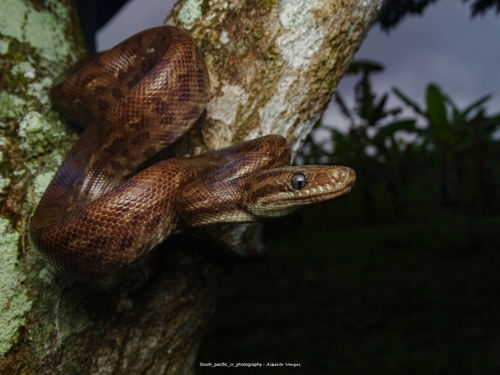
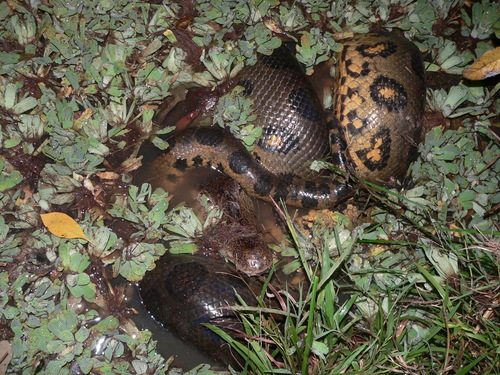
Colombian rainbow boa
Epicrates maurus · Harmless
Once treated as a subspecies of the rainbow boa, this smaller, more northern relative has duller, more olive-brown coloring and a weaker sheen. It replaces the rainbow boa from Central America into Colombia and Trinidad.
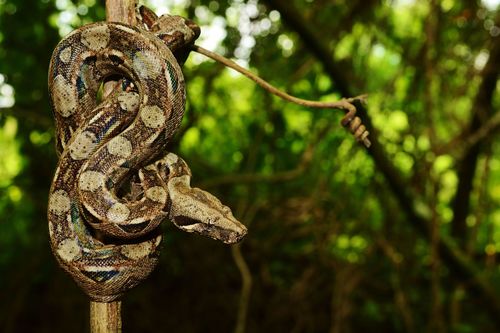
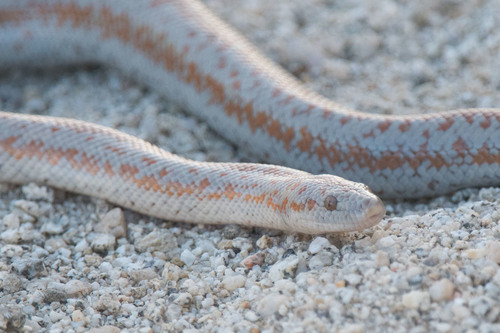
Boa constrictor
Boa constrictor · Harmless
Shares much of the same range and similar brown tones, but the boa constrictor has bold hourglass-shaped saddles rather than rounded rings, lacks the strong iridescent shine, and grows considerably larger.
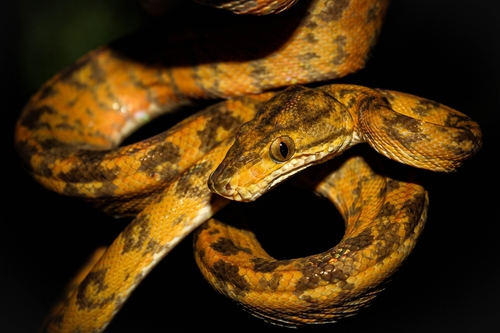
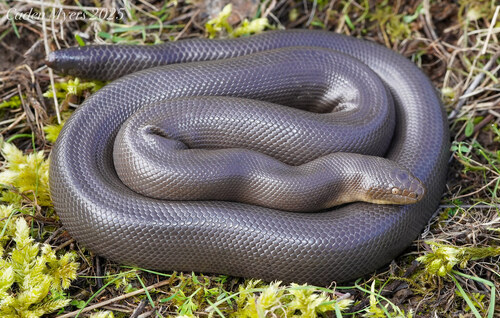
Amazon tree boa
Corallus hortulanus · Harmless
A slimmer, more arboreal cousin found across much of the same range, with a narrower head and far more color variation. It spends most of its life off the ground; adult rainbow boas spend more time on the forest floor.
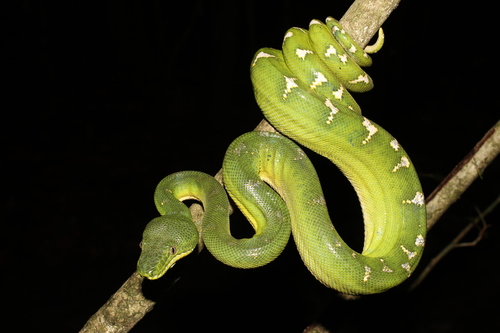
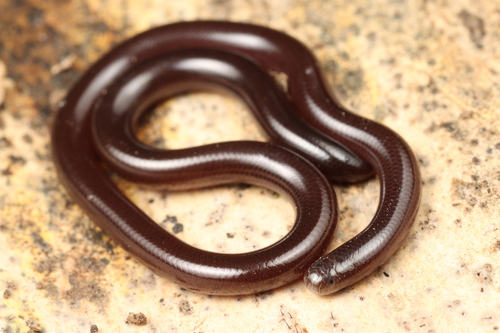
Emerald tree boa
Corallus caninus · Harmless
A relative from farther north and east in the Guiana Shield, the emerald tree boa is bright green with a white zigzag stripe, never the reddish-brown background of a rainbow boa, and stays in the canopy for life.
Reproduction and lifespan
Rainbow boas give birth to live young rather than laying eggs, a trait shared with nearly every boa. Gestation runs roughly five months, and recorded litters range from as few as 2 to as many as 35 young, with 12 to 25 being typical, according to Smithsonian's National Zoo. Newborns measure about 15 to 20 in (38 to 50 cm) and are capable of biting and musking defensively within hours of birth.
Males typically reach breeding size around 4 ft and females around 4.5 ft, usually between 2.5 and 4 years old; size, more than age, decides when a rainbow boa is ready to breed. Well-kept captive rainbow boas regularly live 15 to 20 years, and some individuals have reportedly passed 25.
Conservation status
| Authority | Status |
|---|---|
| IUCN Red List | Least Concern (2021 assessment) |
| US Endangered Species Act | Not listed |
The IUCN Red List classifies the rainbow boa as Least Concern, citing a wide range and populations that remain stable or locally common. The main pressures are habitat loss from deforestation and collection for the international pet trade, which ran heaviest in the 1980s and 1990s and has eased as captive breeding became widespread. Its extinct relative, the Titanoboa, once the largest snake known to science, is a reminder of how differently fortune has treated this boa family over 60 million years.
Rainbow boa FAQ
Is the rainbow boa venomous?
No. It has no venom glands and kills prey by constriction, gripping with its teeth and squeezing until blood flow stops. A defensive bite is not toxic but can cause deep puncture wounds.
How big do rainbow boas get?
Most adults reach 4 to 6 ft (1.2 to 1.8 m), with females usually larger than males. A few keepers report individuals near 7 ft, though no measured specimen at that length has been published.
Where do rainbow boas live in the wild?
In northern and central South America, including Colombia, Venezuela, the Guianas, Peru, Brazil, Bolivia and northern Argentina, mainly in humid rainforest and gallery forest near water.
Why does a rainbow boa's skin shimmer like a rainbow?
The shimmer is structural color, not pigment. Microscopic ridges on the scales split sunlight into shifting bands of color, an effect that shows up most clearly on the tail in direct light.
What is the difference between a rainbow boa and a boa constrictor?
A boa constrictor has bold hourglass-shaped saddles and a duller surface, while a rainbow boa has rounded black rings and a strong iridescent sheen. Boa constrictors also grow considerably larger.
Are rainbow boas good pets?
Many keepers consider them good pets once settled, since regularly handled individuals tend to calm down. They need stable, humid enclosures, and a cornered or newly acquired snake may still strike and musk defensively.