GREENANACONDA
Eunectes murinus · Family Boidae
Photo: (c) Luis F. C. de Lima, all rights reserved, uploaded by Luis F. C. de Lima · via iNaturalist
KEY TAKEAWAYS
The green anaconda (Eunectes murinus) is a giant, non-venomous constrictor and the heaviest snake species in the world. It lives in the rivers, swamps and flooded forests of tropical South America and kills prey by squeezing, not biting. Despite its size, it rarely poses a danger to people.
- It is not venomous. The green anaconda is a member of the boa family and kills by constriction.
- The largest scientifically measured green anaconda was 17 ft 1 in (5.21 m) and 214 lb (97.5 kg), recorded by herpetologist Jesus Rivas in Venezuela. Claims of 20 to 30 ft or more are not backed by a measured specimen.
- Females are far larger than males and can weigh several times as much.
- It is one of several anaconda species; the others are smaller and live farther south.
Green anaconda quick facts
| Common name | Green anaconda (common anaconda) |
|---|---|
| Scientific name | Eunectes murinus Linnaeus, 1758 |
| Family | Boidae (boas) |
| Venomous | No, a constrictor |
| Adult length | 10-17 ft (3-5.2 m); females far larger than males |
| Weight | Large females commonly 66-176 lb (30-80 kg); record 214 lb (97.5 kg) |
| Range | Amazon and Orinoco basins: Venezuela, Colombia, the Guianas, Brazil, Ecuador, Peru, Bolivia, plus Trinidad |
| Habitat | Swamps, marshes, flooded savanna, slow rivers |
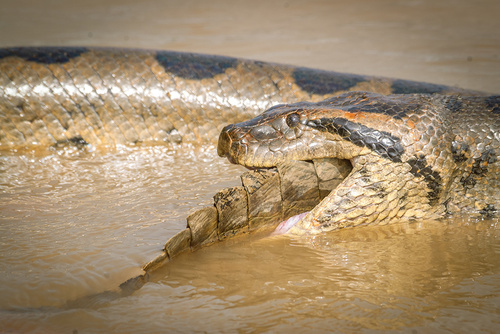
| Diet | Fish, birds, capybaras, caimans, deer, peccaries |
| Reproduction | Live birth, usually 20-40 young |
| Lifespan | About 10 years wild; 30+ in captivity |
| Conservation | IUCN Least Concern |
How to identify a green anaconda
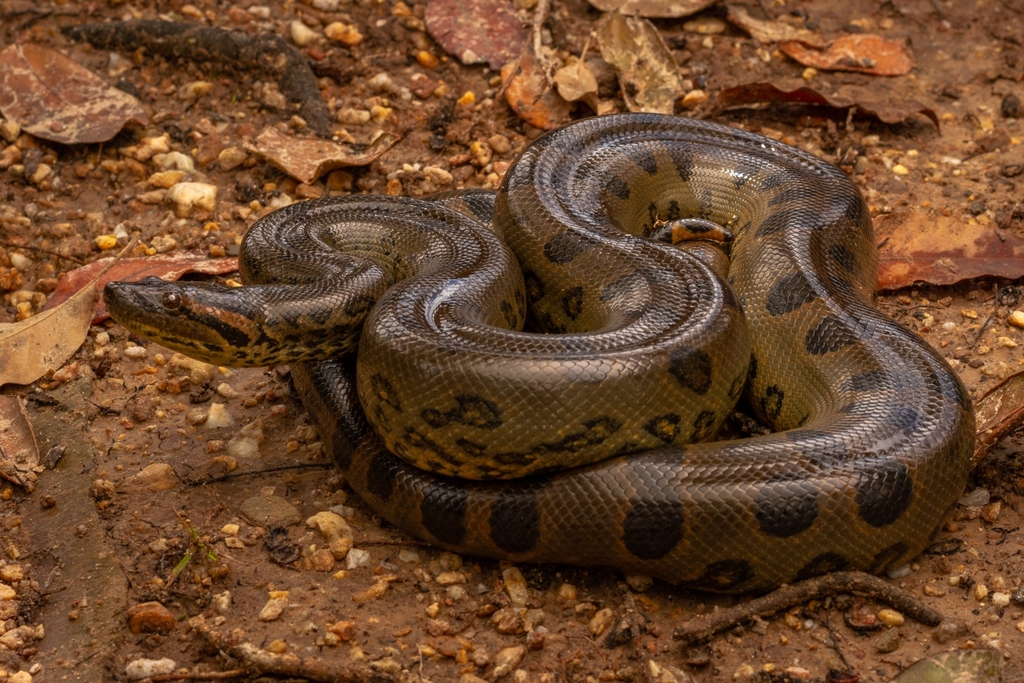
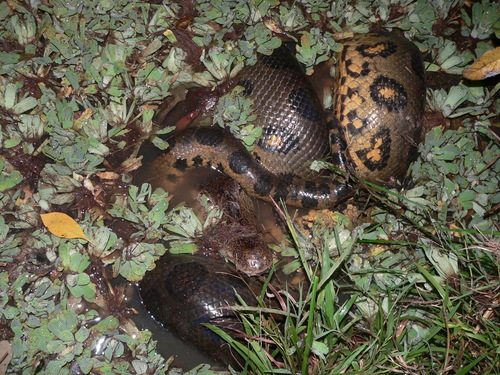
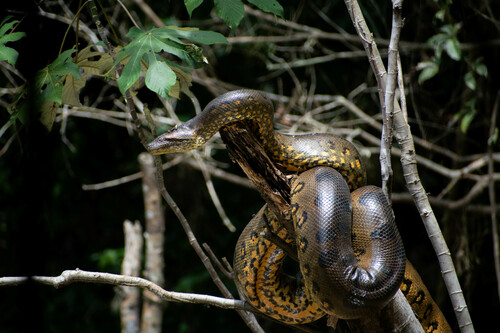
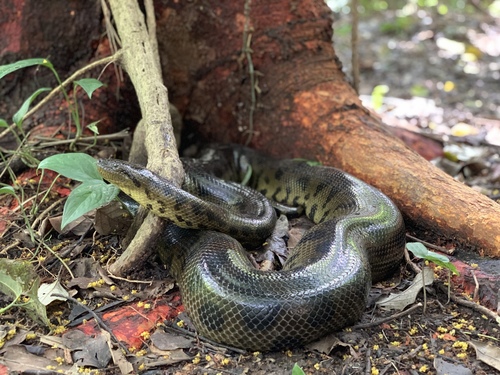
The green anaconda is a very thick, heavy-bodied snake with a narrow head barely wider than its neck. Its eyes and nostrils sit on top of the head, letting it watch and breathe while almost completely submerged.
- 1Body: massive and muscular, far thicker than a boa constrictor or python of the same length.
- 2Color: olive green to dark green above, with large, irregular black oval blotches running down the back.
- 3Head stripes: an orange to yellow stripe edged in black runs from each eye back along the jaw.
- 4Eyes and nostrils: positioned high on the head, like a crocodile's, for a life spent mostly in water.
- 5Habitat and behavior: almost always found in or beside slow water. A heavy snake basking on an Amazon riverbank is likely this species rather than its smaller relatives.
How big does a green anaconda get?
Short answer: most adult female green anacondas measure 10 to 17 ft (3 to 5.2 m) and weigh 66 to 176 lb (30 to 80 kg), per Smithsonian's National Zoo. It is the heaviest snake species on Earth, though the reticulated python of Southeast Asia grows longer.
Green anaconda size claims are some of the most inflated in zoology. Popular sources and old explorer accounts cite 20 to 30 ft and up to 550 lb, but no specimen of that size has ever been produced or measured. The best field data come from herpetologist Jesus Rivas, who measured more than 900 wild anacondas in the llanos of Venezuela. His largest confirmed female was 17 ft 1 in (5.21 m) and 214 lb (97.5 kg), the figure used by the Reptile Database and other scientific sources.
| Green anaconda | Length | Weight |
|---|---|---|
| Newborn | 28-31 in (70-80 cm) | Under 1 lb (0.5 kg) |
| Adult male | About 10 ft (3 m) | Often under 25 lb (11 kg) |
| Adult female | About 15 ft (4.6 m) | 66-176 lb (30-80 kg) |
| Largest verified | 17 ft 1 in (5.21 m) | 214 lb (97.5 kg) |
Females outgrow males by a wide margin, one of the largest size gaps between sexes of any land vertebrate. A big female can weigh five times as much as the males competing for her.
Where does the green anaconda live?
Short answer: the green anaconda lives in tropical South America east of the Andes, mainly the Amazon and Orinoco river basins. Its range covers Venezuela, Colombia, Ecuador, Peru, Bolivia, Brazil, Guyana, Suriname, French Guiana and the island of Trinidad.
There is no wild, breeding population of green anacondas in the United States. A handful of escaped or released pets have turned up in Florida, and since 2015 the US Fish and Wildlife Service has listed the species as injurious wildlife under the Lacey Act, banning its import and interstate transport. Florida added it to its own prohibited species list in 2021. See the anaconda group page for the other anaconda species and our world snake map for every group's range.
Habitat
Green anacondas stay close to slow or still water: swamps, marshes, oxbow lakes, flooded forest and the seasonally flooded grasslands called llanos in Venezuela. They are clumsy on land but graceful swimmers, and in the dry season they may bury themselves in mud to wait out a drought.
Behavior
A green anaconda hunts by ambush, lying in shallow water with only its eyes and nostrils above the surface, sometimes for hours. When prey comes close, it strikes, grips with backward-curving teeth and throws its body into coils around the animal.
A 2015 study of related boa constrictors in the Journal of Experimental Biology, led by Scott Boback, found that constriction kills by cutting off blood flow rather than by suffocation: blood pressure in test animals collapsed within seconds of being gripped. Anacondas are thought to kill the same way.
They swim well and can stay underwater for roughly 10 minutes while hunting, surfacing briefly to breathe. After a large meal, an anaconda may not eat again for weeks.
What does the green anaconda eat?
| Prey group | Examples | How often |
|---|---|---|
| Fish | Catfish and other river fish | Common, especially for young snakes |
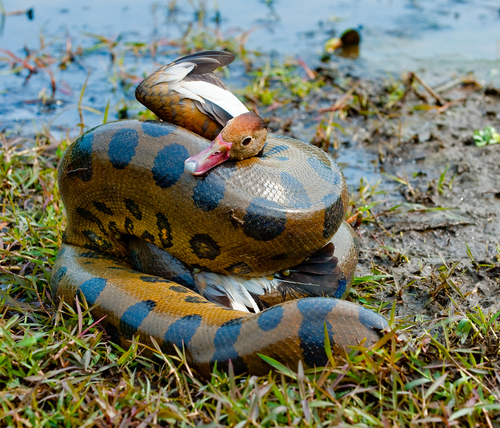
| Birds | Wading birds, ducks | Common |
| Mammals | Capybaras, agoutis, peccaries, deer, feral pigs | Main prey of large females |
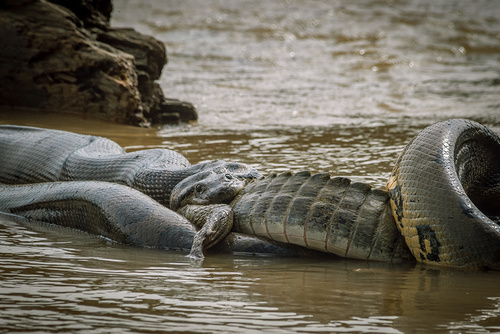
| Reptiles | Turtles, caimans | Occasional, more often by the largest individuals |
Large females sometimes take caimans, and young anacondas are themselves eaten by caimans, large birds of prey and other predators. Cannibalism happens too: a female occasionally eats a smaller male after mating.
Is the green anaconda venomous or dangerous?
No, the green anaconda is not venomous. It has no venom glands and kills by constriction. A bite from a large individual can still cause deep lacerations, since the teeth are long and curve backward, so any wound should be cleaned and checked by a doctor.
Verified fatal attacks on people are almost unknown. Green anacondas do not hunt humans, and most injuries happen when someone grabs, corners or tries to handle one. A very large female could, in theory, overpower a small child, but this is not a documented risk in practice. If you see one in the wild, keep your distance and do not try to touch or move it. Our snake safety FAQ covers what to do around any large snake.
Snakes confused with the green anaconda
Any large, heavy snake near water in South America tends to get called an anaconda. These are the usual mix-ups.
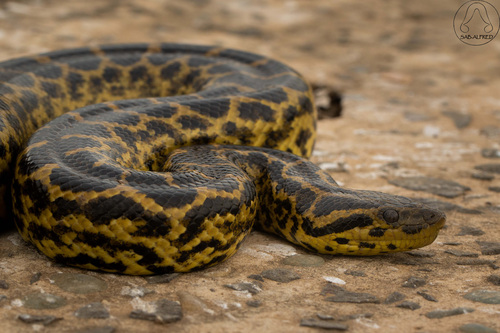
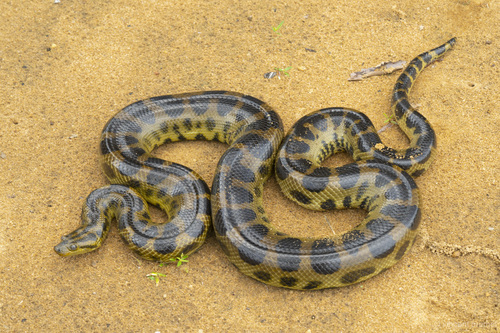
Yellow anaconda
Eunectes notaeus · Harmless
Smaller and lives farther south, in the Pantanal and Paraguay River basin. Yellow to tan with denser black blotches.
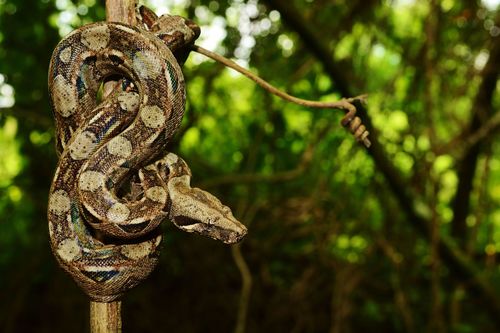
Boa constrictor
Boa constrictor · Harmless
Lives on land and in trees, not mainly in water. Tan body with darker saddles that turn reddish toward the tail. See our boa guide.
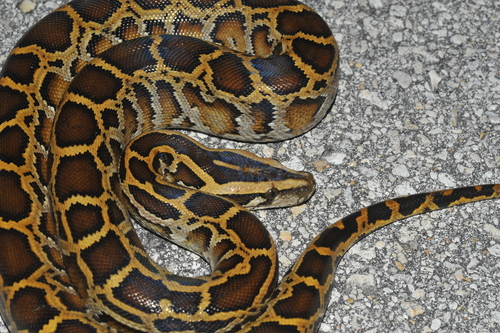
Burmese python
Python bivittatus · Harmless
The giant snake established in the Florida Everglades. Brown blotches on a tan body, eyes on the sides of the head rather than the top, and lays eggs instead of giving live birth.
Reproduction and lifespan
Green anacondas mate once a year in the dry season, typically March to May. Several males, sometimes up to a dozen, coil around one female in a 'breeding ball' that can last two to four weeks. The female occasionally eats the smallest male during or after this period.
Pregnancy lasts six to seven months. Anacondas give birth to live young, usually 20 to 40 at a time, though larger litters happen. Newborns are 2 to 2.5 ft long and fend for themselves right away, reaching sexual maturity at 3 to 4 years.
Wild green anacondas probably live about 10 years. In zoos they can pass 30; the oldest confirmed individual lived almost 38 years.
Conservation status
| Status | Detail |
|---|---|
| IUCN Red List | Least Concern |
| CITES | Appendix II: international trade in live snakes and skins needs permits |
| US Lacey Act (2015) | Listed as injurious wildlife; import and interstate transport banned |
| Florida | Added to the state's prohibited species list in 2021 |
The main threats are wetland drainage, killing out of fear and the skin trade. A proposed split of the green anaconda into northern and southern species, described in a 2024 study led by Jesus Rivas, could eventually affect conservation planning if the northern population turns out to have a smaller range than once thought.
Green anaconda FAQ
Is the green anaconda venomous?
No. The green anaconda has no venom glands. It kills prey by constriction, gripping with its teeth and squeezing until blood flow stops. A bite can still cause deep cuts that need medical attention, but there is no poison involved.
How big is the largest green anaconda ever recorded?
The largest scientifically verified green anaconda was 17 ft 1 in (5.21 m) long and weighed 214 lb (97.5 kg), measured by herpetologist Jesus Rivas during decades of fieldwork in Venezuela. Reports of 20 to 30 ft snakes are not backed by any measured specimen.
Is the green anaconda the biggest snake in the world?
By weight, yes. It is the heaviest snake species on Earth. By length, the reticulated python is longer, with verified records over 20 ft, but it is much slimmer than a green anaconda of the same length.
Can a green anaconda eat a person?
It is physically possible for a very large female to overpower a small child, but no reliably documented case exists. Green anacondas do not hunt people, and most injuries to humans happen when someone tries to catch or handle one.
Where do green anacondas live?
In the Amazon and Orinoco river basins of tropical South America, including Venezuela, Colombia, Ecuador, Peru, Bolivia, Brazil, the Guianas and Trinidad. They stay close to swamps, marshes and slow rivers and are not native to the United States.
What is the difference between a green anaconda and a yellow anaconda?
The green anaconda is olive green, lives in the Amazon and Orinoco basins, and reaches about 17 ft. The yellow anaconda is yellow to tan with denser black blotches, lives farther south in the Pantanal and Paraguay River basin, and rarely passes 13 ft.
How long do green anacondas live?
About 10 years in the wild, based on field studies. In captivity, with steady food and veterinary care, they often live past 30 years; the oldest confirmed individual reached almost 38.
Related snakes

Sources
- Reptile Database: Eunectes murinus
- Smithsonian's National Zoo: Green anaconda
- Animal Diversity Web: Eunectes murinus
- National Geographic: Green anaconda
- US Fish and Wildlife Service: Injurious wildlife listing of large constrictor snakes (2015)
- Rivas et al. 2024, Disentangling the Anacondas, Diversity 16(2): 127