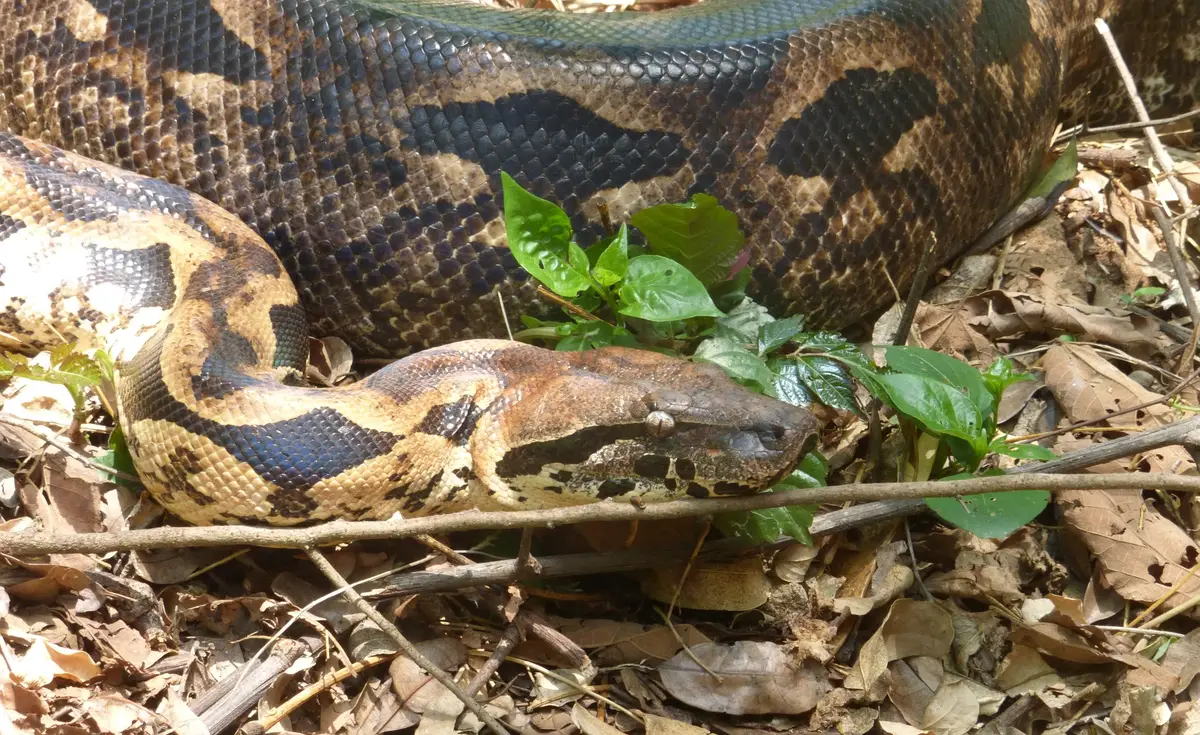
MADAGASCAR GROUNDBOA
Acrantophis madagascariensis · Family Boidae
KEY TAKEAWAYS
The Madagascar ground boa (Acrantophis madagascariensis) is a heavy, ground-dwelling boa found only on Madagascar, mostly in the north and west of the island. It is not venomous and is not dangerous to people.
- It is not venomous. It kills rodents, tenrecs, birds and lemurs by constriction.
- It is usually described as the largest snake on Madagascar. Big females are reported at 8-10 ft (2.4-3 m), though most adults are smaller.
- Its close relative, Dumeril's boa, replaces it in the dry south. The two look alike, but the Madagascar ground boa has larger scales on top of its head.
- The IUCN rated it Least Concern in 2011. It is listed on CITES Appendix I, which bans commercial trade in wild-caught snakes.
Madagascar ground boa quick facts
| Common name | Madagascar ground boa, Malagasy ground boa, northern Madagascar boa |
|---|---|
| Scientific name | Acrantophis madagascariensis (Dumeril and Bibron, 1844) |
| Family | Boidae (boas) |
| Venomous | No, a constrictor |
| Adult length | Usually about 5-8 ft (1.5-2.4 m); large females reported to about 10 ft (3 m) |
| Weight | A thin 5 ft 7 in (1.7 m) adult weighed 5.5 lb (2.5 kg); healthy large adults are much heavier |
| Range | Northern, northwestern and western Madagascar, including the island of Nosy Be |
| Habitat | Dry deciduous forest, open woodland and degraded land, often near rivers and villages |
| Diet | Rats, tenrecs, lemurs and birds |
| Reproduction | Live-bearing, with small litters of large young |
| Conservation | IUCN Least Concern (2011); CITES Appendix I |
How to identify a Madagascar ground boa
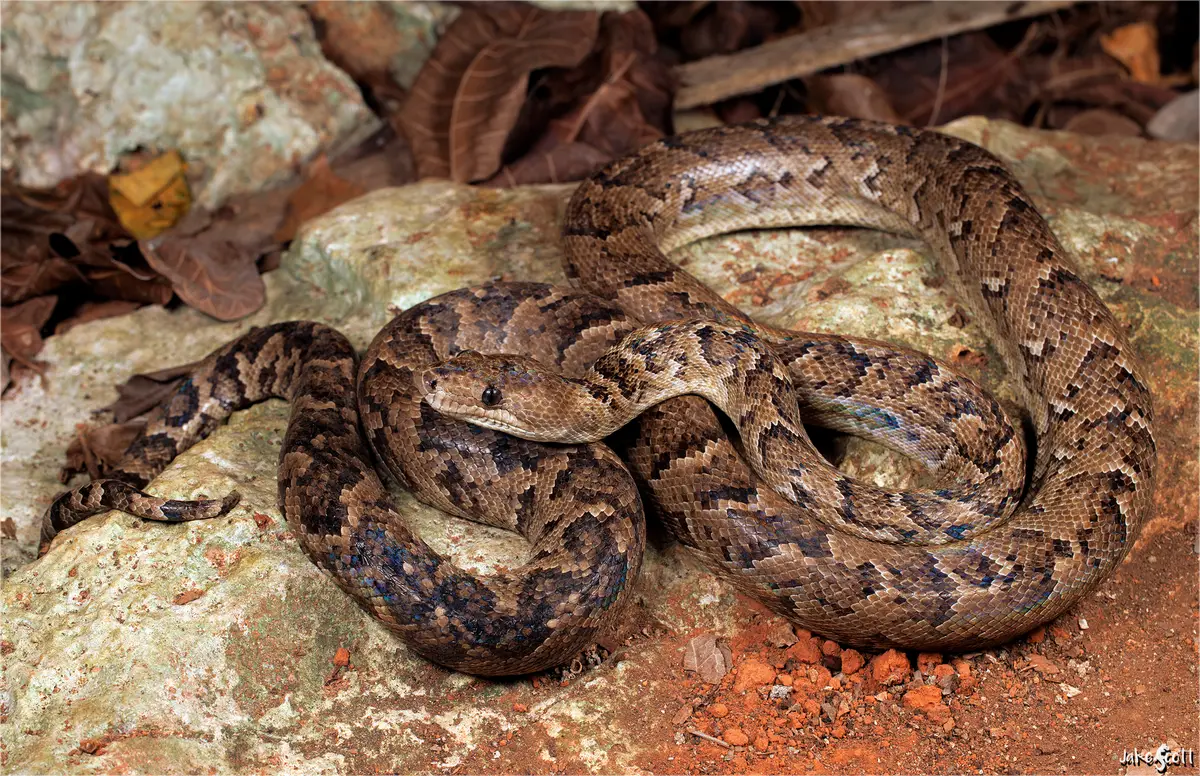
A Madagascar ground boa is a thick, heavy snake with a reddish brown to gray body. Down its back runs a chain of dark-edged diamonds, which can blur into a loose zigzag. Its sides carry dark oval blotches, often with reddish or white centers. The pattern looks busy up close but disappears in dead leaves.
- 1Heavy, short-tailed body: far bulkier than Madagascar's tree boa or any of the island's slender colubrid snakes.
- 2Reddish brown and gray: a warm ground color mixed with gray, crossed by dark diamond shapes along the spine.
- 3Pale-centered side spots: dark oval markings along the flanks, many with a white or reddish center.
- 4Large head scales: the top of the head has larger plates than Dumeril's boa, which has many small head scales.
- 5No lip pits: unlike the Madagascar tree boa, it has no heat-sensing pits along its lips.
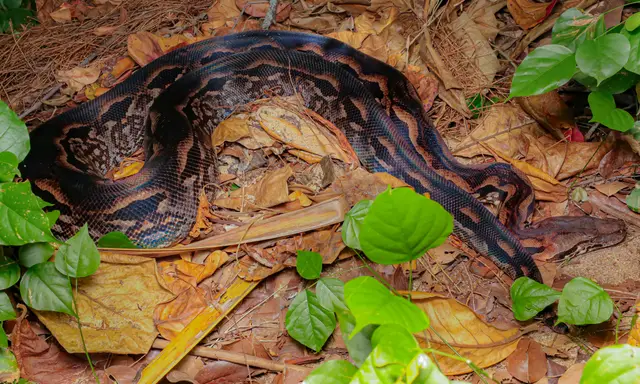
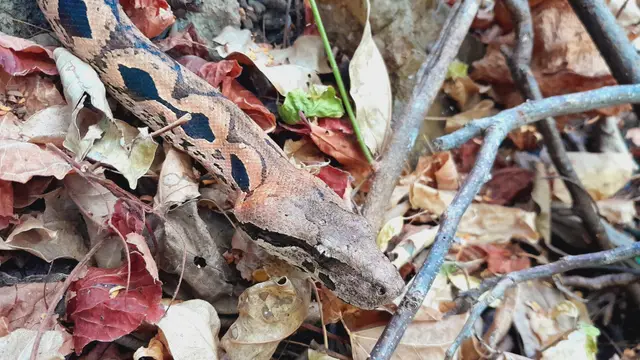
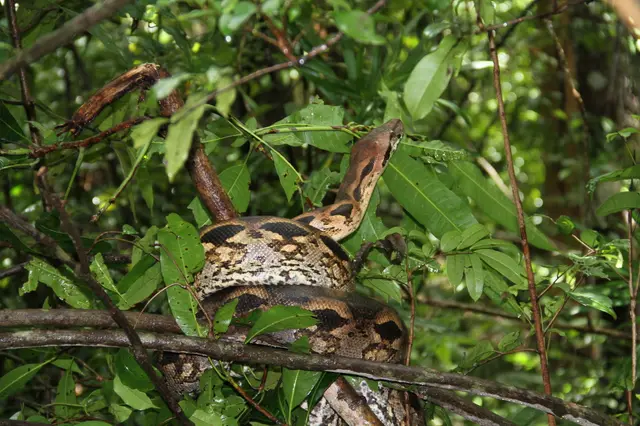
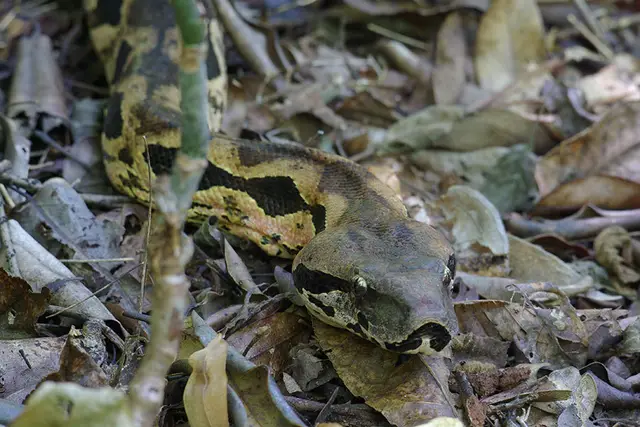
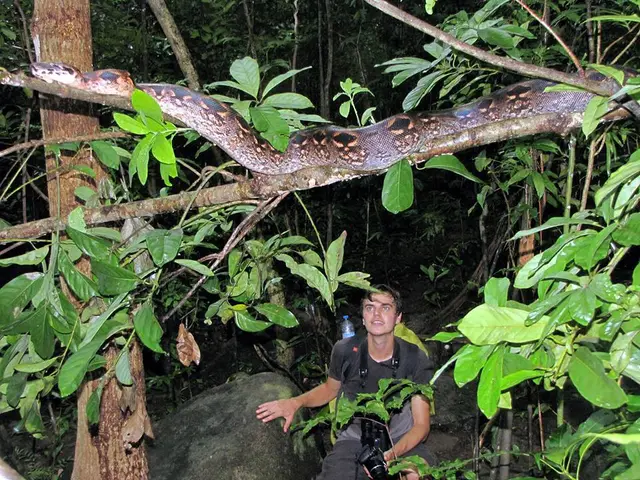
The head scales are the most reliable feature. Miguel Vences and Frank Glaw compared living snakes of both Acrantophis species in a 2003 review of Malagasy boas and pointed to the small head scales of Dumeril's boa as the clearest visible difference. Males of both species have small claw-like spurs beside the vent, as in other boas.
How big do Madagascar ground boas get?
Most adult Madagascar ground boas are about 5 to 8 ft (1.5-2.4 m) long. Field-guide accounts give large females up to about 10 ft (3 m), with males smaller, and the species is generally called the biggest snake on Madagascar. Size reports vary between sources, and the 10 ft figure is the top of the range rather than a typical snake.
One measured wild snake gives a useful reference point. On 21 July 2014 surveyors in the Mariarano Classified Forest in northwest Madagascar caught an adult that was 1.7 m (5 ft 7 in) long and weighed 2.5 kg (5.5 lb). The researchers noted it was clearly thin, so a well-fed snake of that length would weigh more.
| Measure | Figure |
|---|---|
| Typical adult | About 5-8 ft (1.5-2.4 m) |
| Large females (reported) | Up to about 10 ft (3 m) |
| Measured wild adult, Mariarano, 2014 | 5 ft 7 in (1.7 m), 5.5 lb (2.5 kg), thin |
| Newborns (reported) | About 19-24 in (48-61 cm) |
Where do Madagascar ground boas live?
Short answer: Madagascar ground boas live only on Madagascar, across the north, northwest and west of the island, and on the offshore island of Nosy Be. Dumeril's boa takes their place in the south and southwest.
The Reptile Database gives its range as northern Madagascar including Nosy Be. Specimens examined by Vences and Glaw came from places such as Montagne des Francais near the northern tip, Ankarafantsika National Park in the northwest and Nosy Be. The type specimen probably came from Mahajanga on the northwest coast.
Where exactly the two ground boas meet is still not settled. In the same study, a boa from Berenty in the far south carried mitochondrial DNA closer to northwestern Madagascar ground boas than to Dumeril's boas from the Toliara area. The authors also noted informal reports of hybrids. See how this range compares with other snakes on the world snake map.
Habitat
Madagascar ground boas live in forest and in open country, and cope well with land people have changed. Typical habitat is dry deciduous forest and sparse woodland in the west, but the species also turns up in degraded land, farmland and the edges of villages.
It often lives near rivers and streams. During the day it rests in mammal burrows, under fallen trees or in piles of debris. Vences and Glaw noted that Malagasy boas are often found close to villages, where they eat rats and mice, and that people in western Madagascar once kept boas near or even inside their homes to control rodents.
Behavior: ambushes, water and a lemur rescue
Madagascar ground boas are ground dwellers that can be active by day or by night. Like other boas they are mostly ambush hunters, waiting in cover until prey comes within reach.
Water can be part of that cover. On the night of 21 July 2014, about 2.5 hours after sunset, surveyors found an adult lying still in Lake Matsedroy, a small permanent lake in the Mariarano Classified Forest. Only its head was above the surface, and it sat less than 0.5 m (20 in) from the shore. Gardner and colleagues (2017) reported it with a similar case for Dumeril's boa as the first published records of aquatic behavior in Malagasy boas.
It was mid-winter and the water gave no obvious thermal benefit, so the authors doubted the snake was regulating its temperature. Their view is that in dry country animals gather at water to drink, and a boa lying in an open pool with no plants around it has nowhere else to hide.
Big prey can fight back. In northwest Madagascar a large female Madagascar ground boa caught an adult female Coquerel's sifaka, a lemur that lives in groups. The rest of the group bit and scratched the snake until it let go, and the sifaka survived. The boa broke its lower jaw in the struggle and starved to death about two months later, as Gardner and colleagues reported in Primates (2015).
What do Madagascar ground boas eat?
Madagascar ground boas eat mostly mammals. Rodents, tenrecs and lemurs are all recorded as prey of Malagasy ground boas, and captive snakes also take birds.
| Prey | Notes |
|---|---|
| Rats and mice | Malagasy boas often hunt them around villages (Vences and Glaw, 2003) |
| Tenrecs | Small insect-eating mammals found only on Madagascar |
| Lemurs | Including a documented attack on an adult Coquerel's sifaka |
| Birds | Taken in captivity; also reported in general accounts of wild snakes |
It grabs prey with its teeth, throws coils around it and squeezes until the animal's circulation stops. Prey is then swallowed whole, usually head first.
Is the Madagascar ground boa venomous or dangerous?
No, the Madagascar ground boa is not venomous and is not dangerous to people. It has no venom glands and kills its food by constriction.
It is a big, strong snake, and a large one can give a painful bite if it is grabbed, cornered or mistaken for food during feeding. Clean any bite with soap and water and see a doctor if it turns red or swollen over the next few days. The snakebite FAQ covers basic first aid.
Madagascar has no vipers, cobras or other front-fanged venomous snakes. Many people on the island still fear boas, and some kill them, while in other regions boas have long been tolerated as rat catchers.
Madagascar ground boa vs Dumeril's boa and other look-alikes
Only a few boas live on Madagascar, so the realistic mix-ups are short. The main one is its sister species in the south.
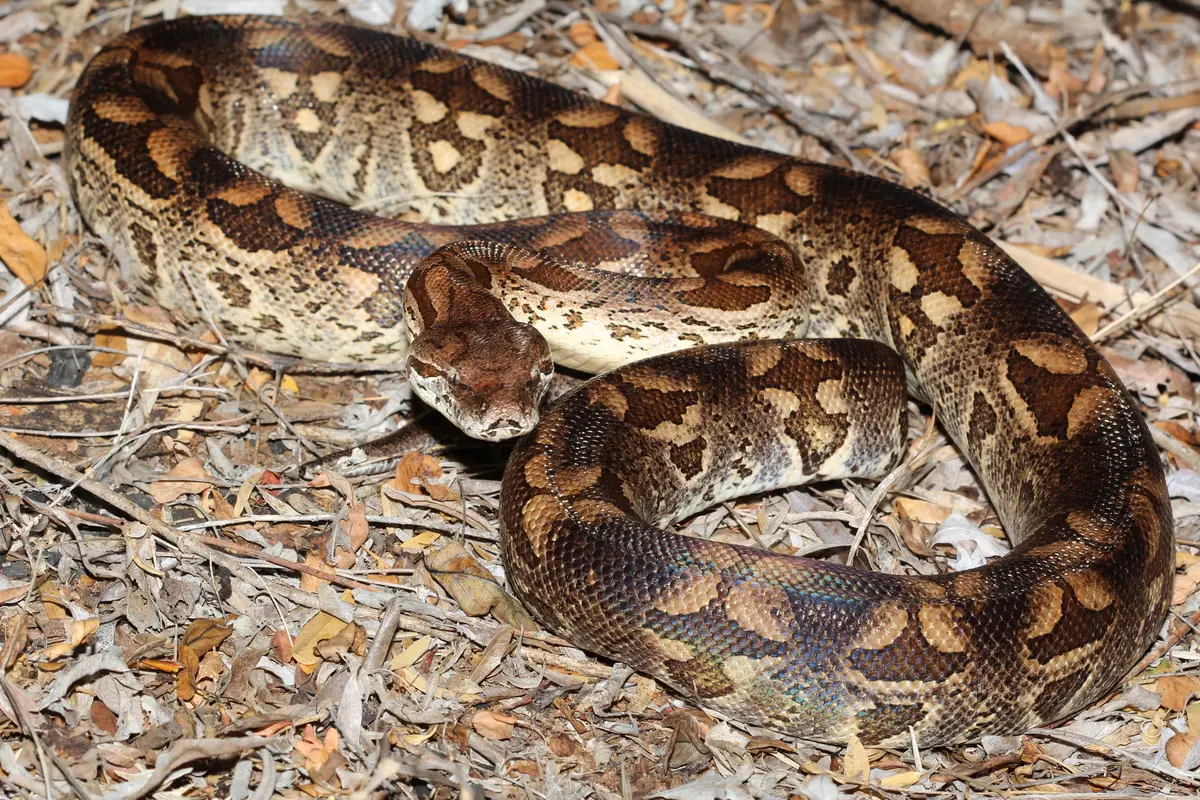
Dumeril's boa
Acrantophis dumerili · Harmless
Dumeril's boa lives in the south and southwest, is usually smaller, mostly under 6.5 ft (2 m), and has many small scales on top of its head. The Madagascar ground boa is the northern and western species, with larger head plates.
Madagascar tree boa
Sanzinia madagascariensis · Harmless
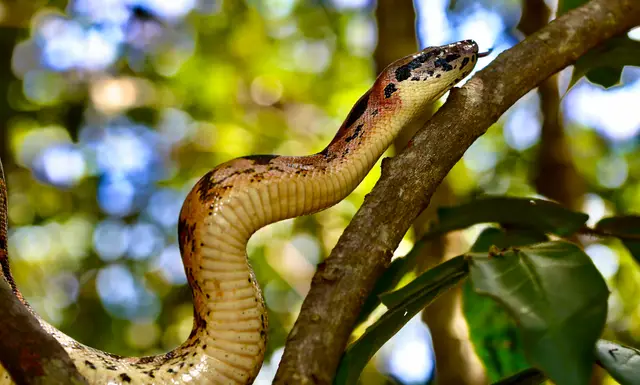
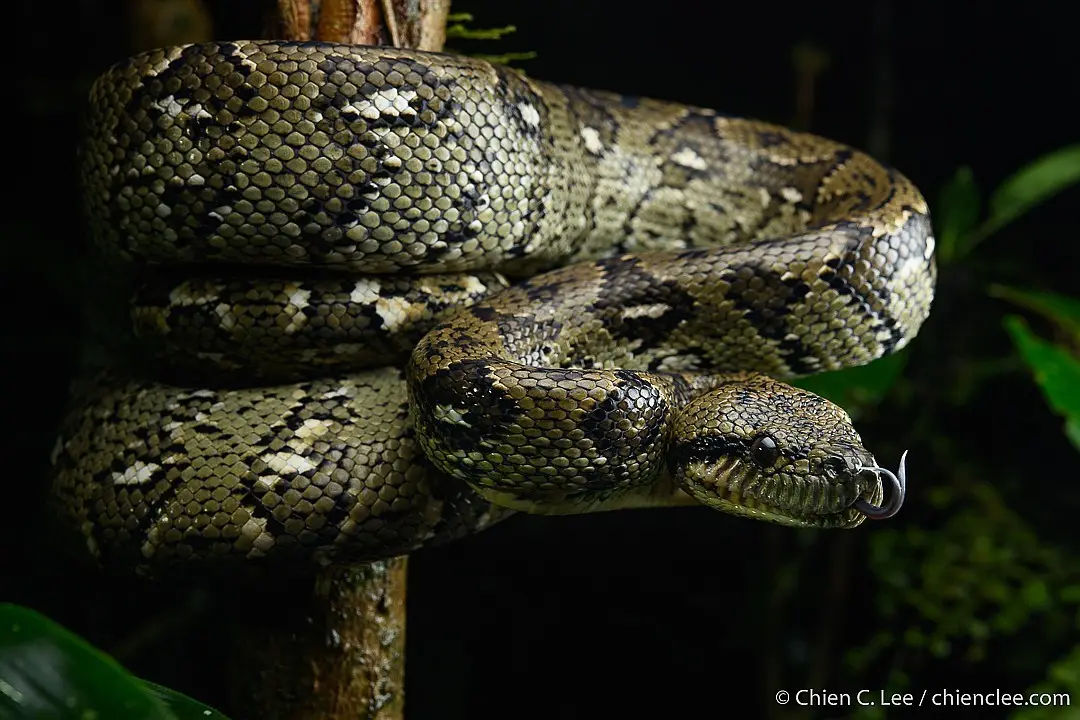
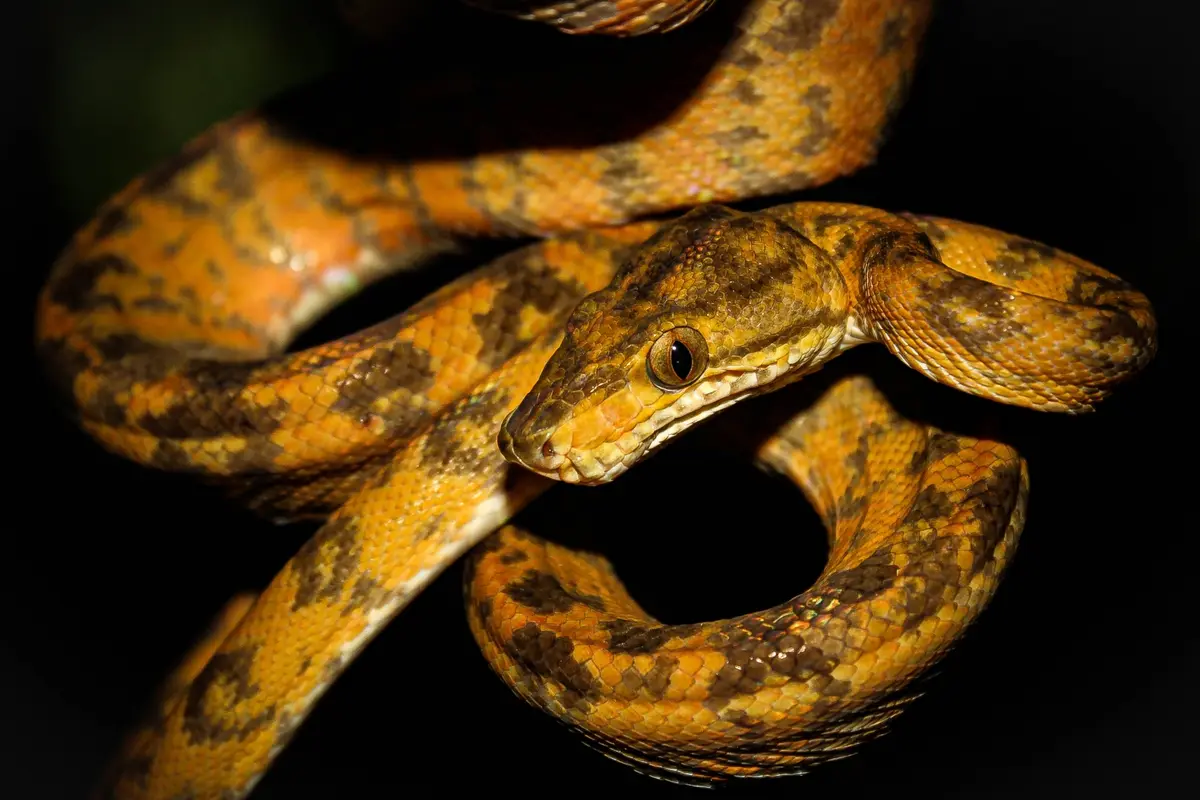
The Madagascar tree boa is slimmer, green or brown, climbs well and has obvious heat pits along its lips. Its newborns are bright red.
Boa constrictor
Boa constrictor · Harmless
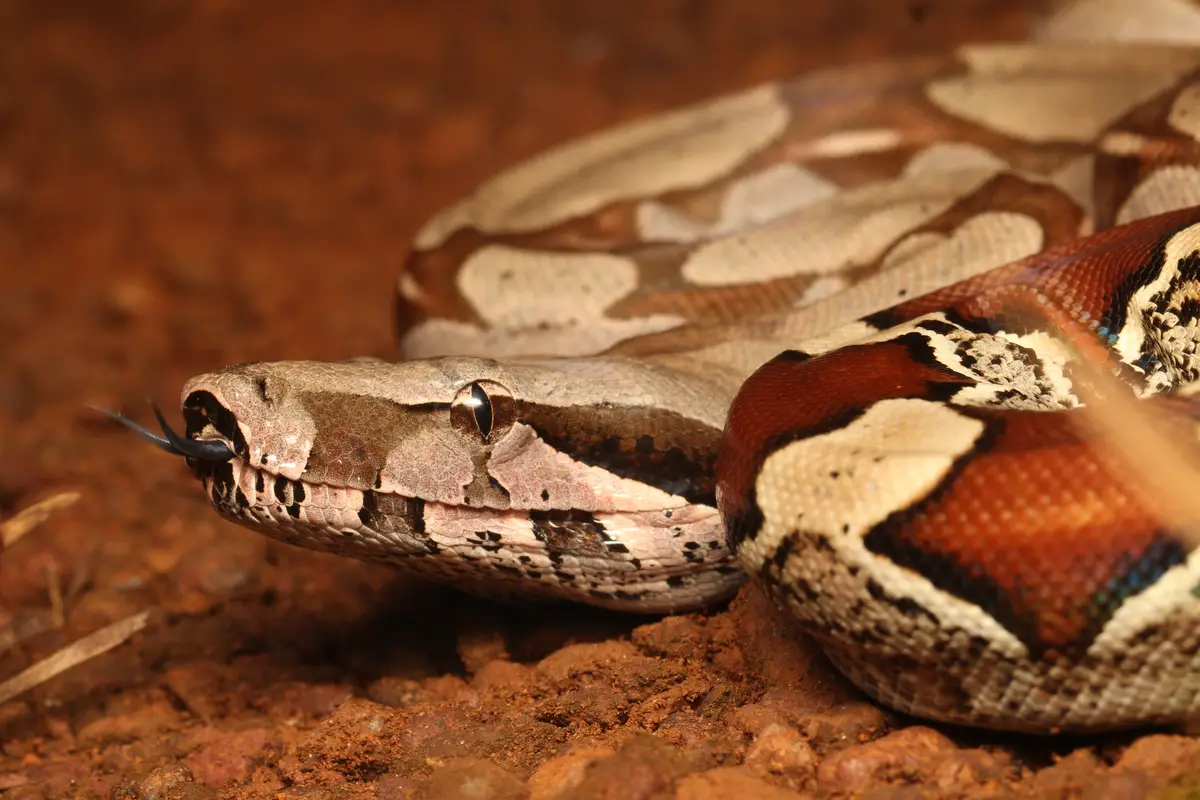
The boa constrictor lives in the Americas, not Madagascar. In captivity the two can look alike, but the boa constrictor has neat saddles on a tan back and a reddish tail. The Madagascar ground boa was once placed in the genus Boa.
Reproduction
Madagascar ground boas give birth to live young. The Reptile Database lists the species as ovoviviparous, meaning the eggs develop and hatch inside the mother.
Reported litters are small, often only a handful of young, but the newborns are large, around 19-24 in (48-61 cm) long, and big enough to eat small rodents and birds from the start. Published figures for litter size and gestation vary, and much of what is known comes from captive breeding rather than wild snakes.
Is the Madagascar ground boa endangered?
No. The IUCN Red List rates the Madagascar ground boa Least Concern, in a 2011 assessment by Christopher Raxworthy and colleagues. Before that, all three Malagasy boa species were listed as Vulnerable.
| Authority | Status |
|---|---|
| IUCN Red List (2011, Raxworthy et al.) | Least Concern |
| IUCN Red List (older assessment) | Vulnerable |
| CITES | Appendix I (commercial trade in wild snakes banned) |
Vences and Glaw argued that the old Vulnerable rating overstated the risk. The species has a large range, is known from many protected areas and often lives in degraded habitat near people. Threats still exist: forest clearance, snakes killed out of fear, and collection of boas for a domestic leather trade around Marovoay in the northwest. In some areas boas are also eaten. Its CITES Appendix I listing keeps wild-caught snakes out of the international pet trade.
Madagascar ground boa FAQ
Is the Madagascar ground boa venomous?
No. The Madagascar ground boa has no venom and kills its prey by constriction. It is not dangerous to people, though a large adult can give a painful bite if handled roughly. Madagascar has no vipers or cobras, and none of its snakes is a serious danger to humans.
How big do Madagascar ground boas get?
Most adults are about 5 to 8 ft (1.5-2.4 m) long, and large females are reported to reach about 10 ft (3 m). It is usually described as the largest snake on Madagascar. A thin wild adult measured in 2014 was 1.7 m (5 ft 7 in) long and weighed 2.5 kg (5.5 lb).
Where does the Madagascar ground boa live?
It lives only on Madagascar, in the north, northwest and west of the island, including Nosy Be and Ankarafantsika National Park. It uses dry forest, open woodland and degraded land, often near rivers and villages. Dumeril's boa replaces it in the south and southwest.
What is the difference between the Madagascar ground boa and Dumeril's boa?
They are sister species in the genus Acrantophis. The Madagascar ground boa lives in the north and west, grows larger and has bigger scales on top of its head. Dumeril's boa lives in the south and southwest, is mostly under 6.5 ft (2 m) and has many small head scales. Their DNA differs only slightly.
Do Madagascar ground boas eat lemurs?
Yes. Lemurs are recorded prey of Malagasy ground boas. In one 2015 report from northwest Madagascar, a large female caught an adult Coquerel's sifaka, but the lemur's group attacked the snake until it let go. The boa broke its jaw and starved about two months later.
Is the Madagascar ground boa endangered?
No. The IUCN rated it Least Concern in 2011, replacing an older Vulnerable listing. It is still on CITES Appendix I, which bans commercial international trade in wild snakes. Forest loss, killing by people and collection for leather and food are the main local threats.
Related snakes
Sources
- Reptile Database: Acrantophis madagascariensis
- Vences and Glaw (2003), Phylogeography, systematics and conservation status of boid snakes from Madagascar, Salamandra 39
- Gardner et al. (2017), Observations of aquatic behaviour in Malagasy ground boas, Herpetology Notes
- Gardner et al. (2015), Cooperative rescue and predator fatality involving Coquerel's sifaka and a Madagascar ground boa, Primates
- iNaturalist: Acrantophis madagascariensis observations