YELLOWANACONDA
Eunectes notaeus · Family Boidae
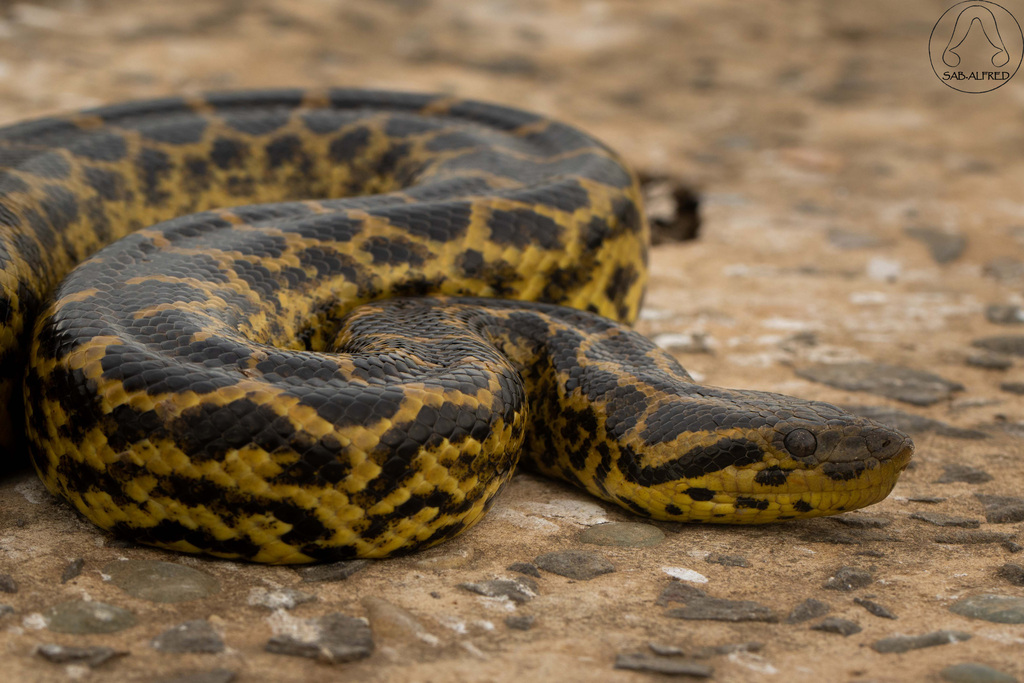
Photo: (c) Alfredo Sabaliauskas, some rights reserved (CC BY-NC), uploaded by Alfredo Sabaliauskas · via iNaturalist
KEY TAKEAWAYS
The yellow anaconda (Eunectes notaeus) is a non-venomous constrictor and one of four widely recognized species in the anaconda group. It is smaller than its relative the green anaconda and lives farther south, mainly in the Pantanal wetlands of Paraguay, Bolivia, Brazil and Argentina.
- It is not venomous. Like all anacondas, it kills by constriction.
- Adults typically reach 7 to 13 ft (2.1 to 4 m); the largest confirmed specimen was about 15 ft (4.6 m) and 121 lb (55 kg).
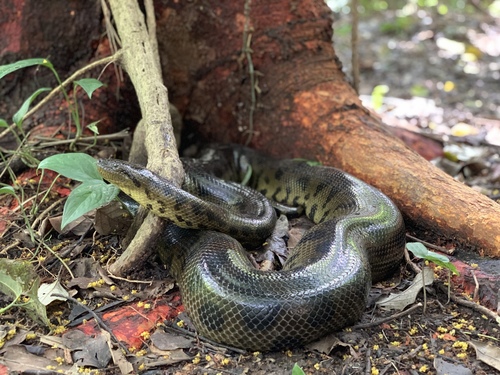
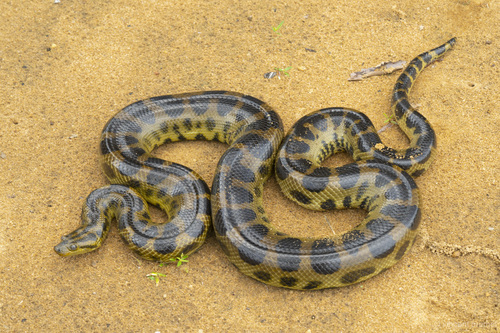
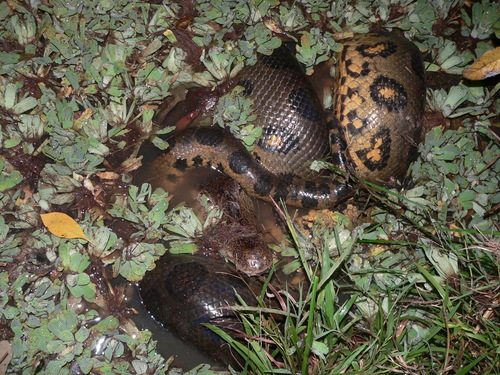
- It is yellow to olive green with dark brown to black blotches, a pattern that camouflages it in murky water.
- The IUCN lists it as Least Concern, though local populations have declined from hunting and wetland pollution.
Yellow anaconda quick facts
| Common name | Yellow anaconda (Paraguayan anaconda) |
|---|---|
| Scientific name | Eunectes notaeus Cope, 1862 |
| Family | Boidae (boas) |
| Venomous | No, a constrictor |
| Adult length | 7-13 ft (2.1-4 m); up to about 15 ft (4.6 m) |
| Weight | Commonly 55-77 lb (25-35 kg); largest recorded about 121 lb (55 kg) |
| Range | Paraguay River basin: Paraguay, Bolivia, western Brazil, northeastern Argentina, Uruguay |
| Habitat | Pantanal wetlands, marshes, flooded grassland, riverbanks |
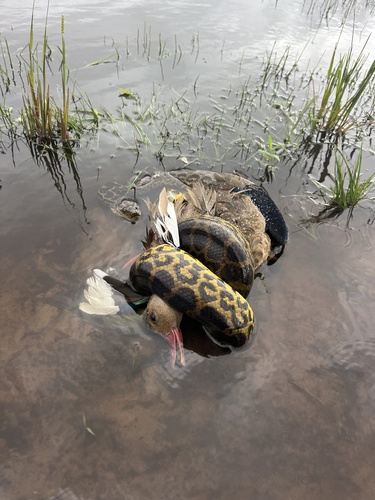
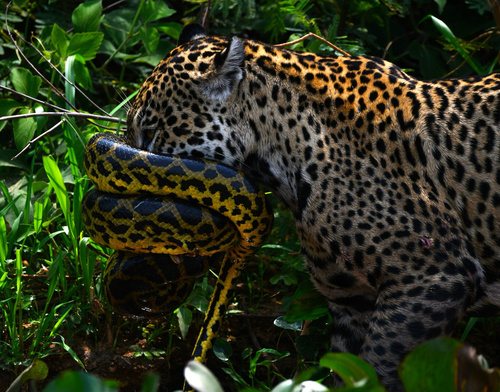
| Diet | Birds, caimans, turtles, fish, small mammals |
| Reproduction | Live birth, 4-82 young, about 40 on average |
| Conservation | IUCN Least Concern; locally declining |
How to identify a yellow anaconda
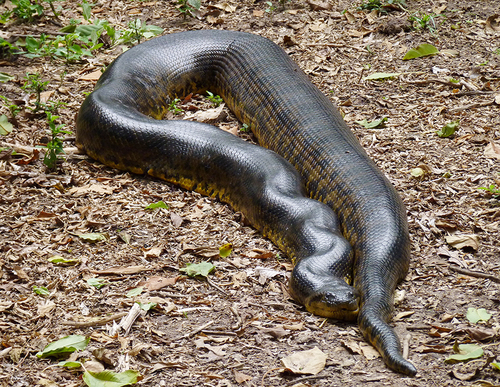
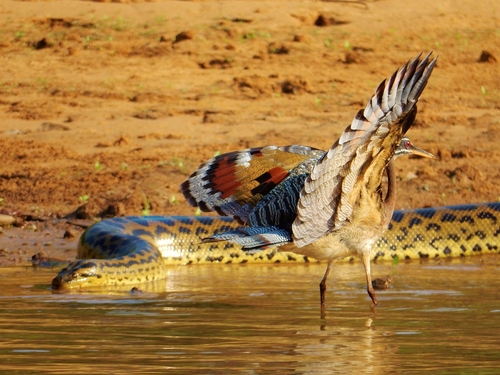
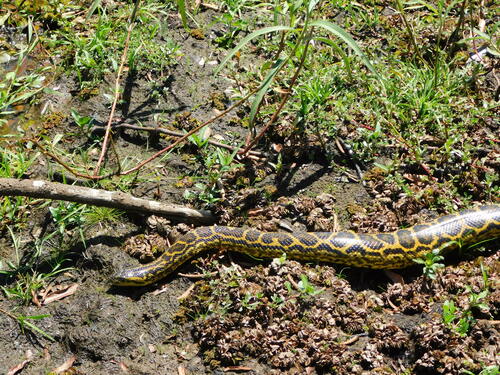
The yellow anaconda has the same thick, muscular build as other anacondas, but a brighter, patchier pattern that makes it easier to tell apart from the green anaconda at a glance.
- 1Color: yellow to olive green background, with large, irregular black or dark brown blotches and spots.
- 2Size: noticeably smaller and less bulky than a green anaconda of similar length.
- 3Head: narrow, barely wider than the neck, with eyes and nostrils set high for life at the waterline.
- 4Habitat: found in open wetlands and flooded grassland rather than deep rainforest, often visible from boats in the Pantanal.
- 5Range: south of the Amazon, in Paraguay, Bolivia, southern Brazil, Uruguay and northeastern Argentina, where the green anaconda does not occur.
How big does a yellow anaconda get?
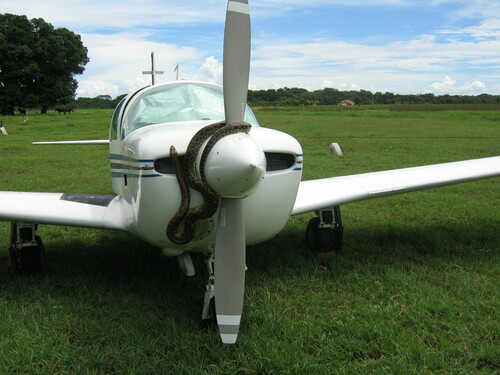
Short answer: adult yellow anacondas average about 7 to 13 ft (2.1 to 4 m), smaller than the green anaconda. Females grow larger than males, and the longest confirmed specimens reach close to 15 ft (4.6 m).
Animal Diversity Web puts the average adult length at about 12 ft (3.7 m), with males reaching up to 12 ft (3.7 m) and females up to 15 ft (4.6 m). Average weight is about 66 lb (30 kg), and the heaviest recorded specimens reach roughly 121 lb (55 kg). That makes the species markedly smaller and lighter than the green anaconda, whose largest verified female reached 214 lb (97.5 kg).
| Yellow anaconda | Length | Weight |
|---|---|---|
| Adult male | Up to about 12 ft (3.7 m) | Lighter than females |
| Adult female | Up to about 15 ft (4.6 m) | 55-77 lb (25-35 kg), up to 121 lb (55 kg) |
Where does the yellow anaconda live?
Short answer: the yellow anaconda lives in the Paraguay River drainage of south-central South America, mainly the Pantanal wetlands of Bolivia, Paraguay and Brazil, extending into northeastern Argentina and Uruguay.
This range sits mostly south and east of where the green anaconda lives, with little overlap. The Pantanal, the world's largest tropical wetland, holds the densest known populations and is a regular sight on wildlife safaris there. See the anaconda group page for how the species compares, and our world snake map for where every group lives.
Habitat
Yellow anacondas live in swamps, marshes, flooded grassland and slow waterways, especially the seasonally flooded Pantanal. During the dry season they retreat into burrows or dense cover; in the wet season they move into flooded, treeless areas to hunt.
Behavior
Yellow anacondas are solitary except when breeding, and they hunt mainly from June to November, the relatively dry part of the year in their range. They ambush prey from water or at the water's edge, gripping with their teeth and killing by constriction rather than venom.
They are strong swimmers but also come onto land to hunt and to mate. Outside the breeding season, an individual can go for long stretches without a meal, resting in cover near water.
What does the yellow anaconda eat?
| Prey group | Examples |
|---|---|
| Birds | Waterbirds, including eggs |
| Mammals | Small to medium mammals near water |
| Reptiles | Turtles, caimans |
| Fish | River and wetland fish |
Young yellow anacondas take mostly fish and small prey, while large adults can overpower caimans and sizable birds.
Is the yellow anaconda its own species?
Most references, including this guide, treat the yellow anaconda as a distinct species, Eunectes notaeus. A 2024 genetic study led by Jesus Rivas found it closely related to the smaller Bolivian anaconda and the rare De Schauensee's anaconda, and proposed that the three may eventually be classified as one species with several forms. That change has not been widely adopted, so the Reptile Database still lists all three separately.
Is the yellow anaconda venomous or dangerous?
No, the yellow anaconda is not venomous. It has no venom glands and relies on constriction to subdue prey. A bite from an adult can cause deep scratches from its curved teeth, so any bite should be cleaned and checked if deep.
It is smaller than the green anaconda and poses little threat to people. Most bites happen when someone tries to catch, corner or handle one. If you encounter one in the wild, keep your distance rather than approach it. Our snake safety FAQ covers what to do around any large snake.
Snakes confused with the yellow anaconda
The yellow anaconda overlaps in range with other large South American snakes, and its bright color sometimes leads to mix-ups.
Green anaconda
Eunectes murinus · Harmless
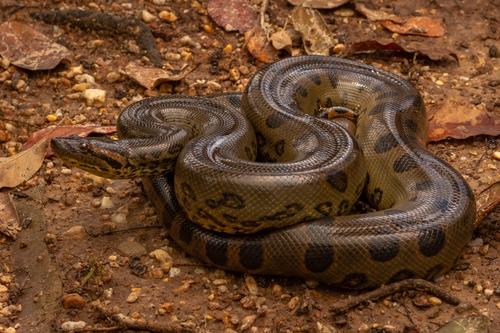
Larger and bulkier, olive green rather than yellow, and lives mainly in the Amazon and Orinoco basins farther north. See our green anaconda guide.
Boa constrictor
Boa constrictor · Harmless
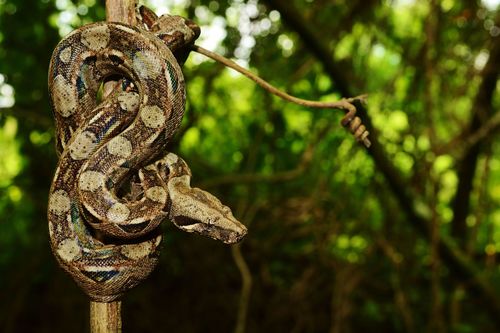
Tan body with dark saddles rather than yellow with blotches, and spends more time on land and in trees. See our boa guide.
Reproduction and lifespan
Yellow anacondas breed once a year, typically in April and May. Pregnancy lasts about six months, and females give birth to live young, usually 4 to 82 at a time, averaging around 40. Newborns can fend for themselves immediately. Sexual maturity is reached at 3 to 4 years.
Wild yellow anacondas probably live 15 to 20 years; captive individuals have reached about 23 years.
Conservation status
| Status | Detail |
|---|---|
| IUCN Red List | Least Concern |
| CITES | Appendix II: international trade in live snakes and skins needs permits |
| Local trends | Declining in some areas from hunting and wetland pollution |
The species is not globally threatened, according to the IUCN Red List, but hunting for its skin, once widespread, still happens illegally in parts of its range even though most South American countries now ban it.
Yellow anaconda FAQ
Is the yellow anaconda venomous?
No. The yellow anaconda has no venom glands and kills prey by constriction. A bite can cause deep scratches from its curved teeth, but there is no poison involved.
How big does a yellow anaconda get?
Most adults reach 7 to 13 ft (2.1 to 4 m). Females grow larger than males, and the longest confirmed specimens reach close to 15 ft (4.6 m), smaller than the green anaconda's record of over 17 ft.
Where does the yellow anaconda live?
In the Paraguay River basin of south-central South America, mainly the Pantanal wetlands of Bolivia, Paraguay and Brazil, extending into northeastern Argentina and Uruguay.
What is the difference between a yellow anaconda and a green anaconda?
The yellow anaconda is smaller, yellow to olive green with dark blotches, and lives in the Pantanal and Paraguay River basin. The green anaconda is larger and olive green, and lives in the Amazon and Orinoco basins farther north.
Is the yellow anaconda endangered?
No. The IUCN lists it as Least Concern. Some local populations have declined from illegal hunting for skins and from pollution of wetland habitat, but the species as a whole is not considered threatened.
What do yellow anacondas eat?
Birds, caimans, turtles, fish and small mammals near water. They hunt mainly from June to November and ambush prey from the water or its edge before constricting it.
How long do yellow anacondas live?
About 15 to 20 years in the wild. Captive individuals have been recorded living to around 23 years.