DARK-SPOTTEDANACONDA
Eunectes deschauenseei · Family Boidae
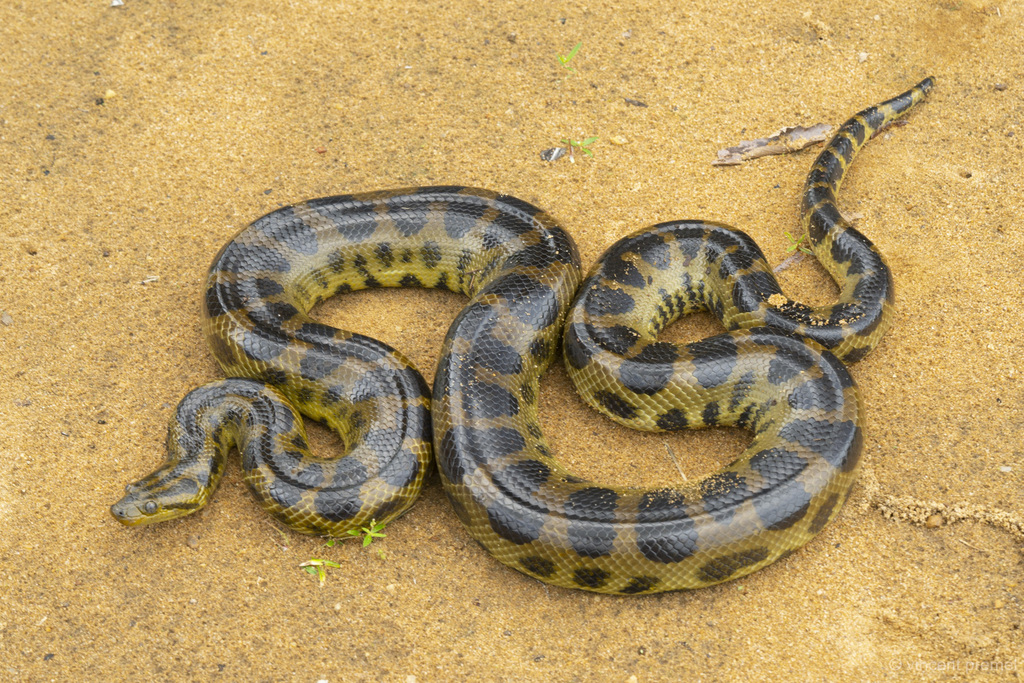
Photo: (c) Vincent Prémel, some rights reserved (CC BY-NC), uploaded by Vincent Prémel · via iNaturalist
KEY TAKEAWAYS
De Schauensee's anaconda (Eunectes deschauenseei), also called the dark-spotted anaconda, is a non-venomous constrictor and the smallest of the four widely recognized species in the anaconda group. It is known only from a small area around the mouth of the Amazon River and is one of the least studied large snakes in South America.
- It is not venomous. Like every anaconda, it kills prey by constriction.
- It was described in 1936 from a specimen collected on Marajo Island, Brazil, and named after Rodolphe Meyer de Schauensee, who donated that specimen to a zoo.
- Adults are small for an anaconda, typically 4 to 9 ft (1.2 to 2.8 m), far shorter than the green anaconda.
- The IUCN lists it as Data Deficient because so little fieldwork has been done on it.
De Schauensee's anaconda quick facts
| Common name | De Schauensee's anaconda (dark-spotted anaconda) |
|---|---|
| Scientific name | Eunectes deschauenseei Dunn and Conant, 1936 |
| Family | Boidae (boas) |
| Venomous | No, a constrictor |
| Adult length | 4-9 ft (1.2-2.8 m); males 4.3-6.9 ft, females 3.9-7.6 ft snout-to-vent |
| Range | Marajo Island and coastal Para and Amapa states, Brazil; French Guiana |
| Habitat | Seasonally flooded freshwater swamps below about 980 ft (300 m) elevation |
| Reproduction | Live birth, like other anacondas |
| Conservation | IUCN Data Deficient |
How to identify De Schauensee's anaconda
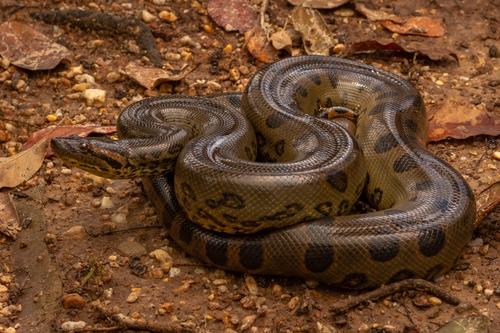
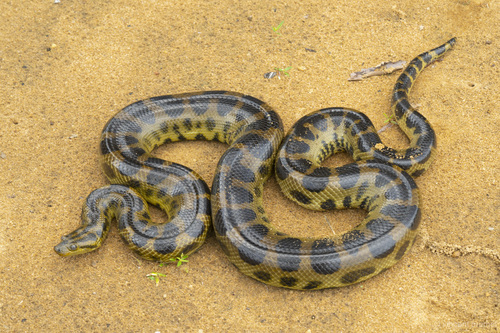
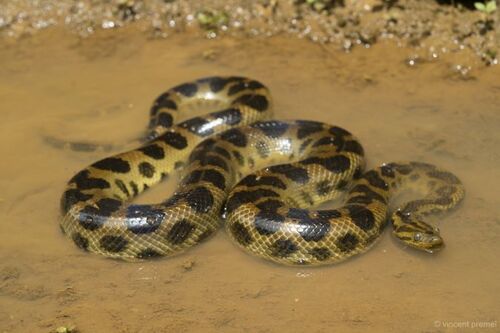
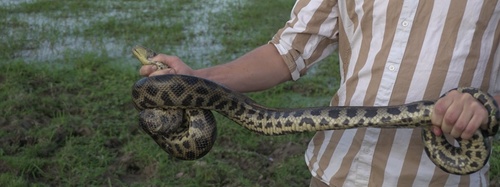
De Schauensee's anaconda has the typical anaconda build, thick-bodied with a narrow head and high-set eyes, but on a much smaller scale than the green or yellow anaconda. Its common name comes from the dark, closely spaced spots and blotches on an olive to brown background.
- 1Size: noticeably small for an anaconda, with adults rarely passing 9 ft, far shorter than a green anaconda.
- 2Pattern: dark brown to black spots and blotches on an olive or brownish body, giving it the name dark-spotted anaconda.
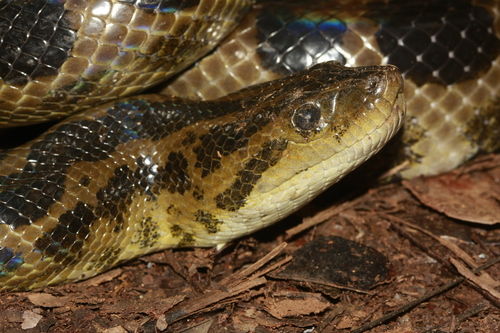
- 3Head: narrow, barely wider than the neck, with eyes and nostrils set high, as in every anaconda.
- 4Location: the most useful clue by far. A small anaconda-like snake on Marajo Island or the coastal swamps of Para, Amapa or French Guiana is likely this species, since the green and yellow anacondas are not known from this exact area.
How big does De Schauensee's anaconda get?
Short answer: De Schauensee's anaconda is the smallest of the four main anaconda species, with adults typically 4 to 9 ft (1.2 to 2.8 m) long, and large females reaching close to 10 ft (3 m).
Measurements are usually given as snout-to-vent length rather than total length, because so few complete specimens have been studied. The Catalogue of American Amphibians and Reptiles lists adult males at roughly 4.3 to 6.9 ft (130 to 211 cm) snout-to-vent, and females at 3.9 to 7.6 ft (120 to 231 cm), with total length somewhat longer once the tail is included. That makes it far smaller than the green anaconda, whose largest verified female measured 17 ft 1 in (5.21 m).
Where does De Schauensee's anaconda live?
Short answer: De Schauensee's anaconda is known only from Marajo Island and the nearby coast of Para and Amapa states in Brazil, plus French Guiana, right around the mouth of the Amazon River.
This is the most restricted range of any anaconda. The green anaconda and yellow anaconda both cover far larger areas of South America, while De Schauensee's anaconda has only ever been confirmed from this one coastal corner near the Amazon delta. See the anaconda group page for how all the species compare, and our world snake map for where every group lives.
Habitat
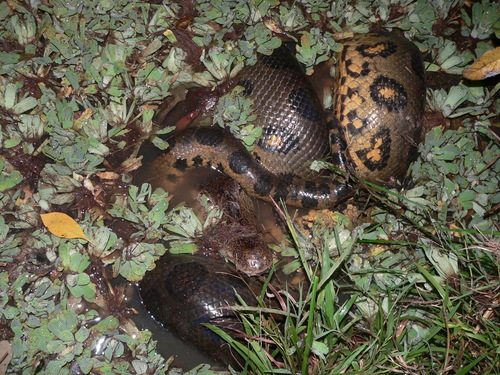
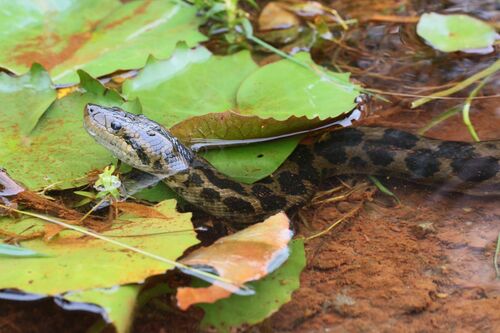
De Schauensee's anaconda lives in seasonally flooded freshwater swamps and marshes at low elevation, generally below about 980 ft (300 m). It is nocturnal and semi-aquatic, like other anacondas, spending most of its time in or near still or slow water.
How was De Schauensee's anaconda discovered?
The species was described in 1936 by herpetologists Emmett Reid Dunn and Roger Conant, based on a specimen probably collected on Marajo Island at the mouth of the Amazon. It is named for Rodolphe Meyer de Schauensee, who donated the holotype specimen to the Philadelphia Zoo in 1924, more than a decade before the species was formally recognized.
A 2024 genetic study led by Jesus Rivas found De Schauensee's anaconda closely related to the yellow and Bolivian anacondas, and proposed that the three might eventually be reclassified as one variable species. That change has not been widely adopted, and the Reptile Database still lists all three separately. Because so few specimens exist in museum collections, basic facts about its behavior and biology remain poorly documented.
Is De Schauensee's anaconda venomous or dangerous?
No, De Schauensee's anaconda is not venomous. Like every member of the anaconda group, it has no venom glands and kills prey by constriction.
Given its small size and very limited range, it poses essentially no danger to people and is rarely encountered outside its small home area. Our snake safety FAQ covers what to do around any wild snake you cannot identify.
Snakes confused with De Schauensee's anaconda
Because it is so rarely seen, De Schauensee's anaconda is more often confused with its better-known relatives in general descriptions than misidentified in the field.
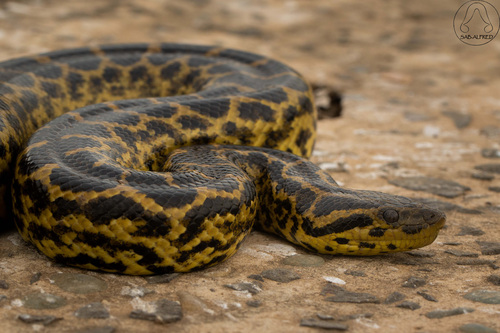
Yellow anaconda
Eunectes notaeus · Harmless
Larger and brighter yellow, and found in the Paraguay River basin far to the south rather than the Amazon delta. See our yellow anaconda guide.
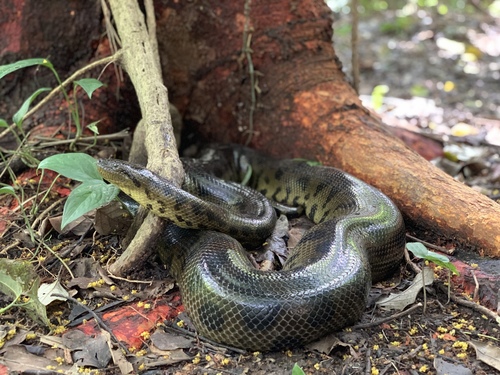
Bolivian anaconda
Eunectes beniensis · Harmless
Also small and poorly studied, but restricted to northern Bolivia rather than the Amazon's mouth. See our Bolivian anaconda guide.
Reproduction
Like other anacondas, De Schauensee's anaconda gives birth to live young rather than laying eggs. Detailed data on litter size, gestation length and lifespan have not been published for this species, since so few individuals have ever been studied in the wild or in captivity.
Conservation status
| Status | Detail |
|---|---|
| IUCN Red List | Data Deficient |
| Range | Smallest range of any anaconda species |
| Data | Very few specimens studied; basic biology poorly known |
A Data Deficient listing is not the same as Least Concern. It means scientists do not have enough information on the species' population size, trend or threats to assess its conservation status at all. Given its tiny known range around the Amazon delta, habitat loss there could affect it disproportionately even though no formal assessment has confirmed a decline.
De Schauensee's anaconda FAQ
Is De Schauensee's anaconda venomous?
No. Like every anaconda, it has no venom glands and kills prey by constriction, not poison.
Where does De Schauensee's anaconda live?
Only on Marajo Island and the nearby coast of Para and Amapa states in Brazil, plus French Guiana, right around the mouth of the Amazon River. This is the smallest known range of any anaconda.
How big is De Schauensee's anaconda?
It is the smallest anaconda species, with adults typically 4 to 9 ft (1.2 to 2.8 m) long, far shorter than the green anaconda, which can exceed 17 ft.
Why is it called the dark-spotted anaconda?
Because of the dark brown to black spots and blotches on its olive to brown body, a denser and less contrasting pattern than the green or yellow anaconda's blotches.
Is De Schauensee's anaconda endangered?
Its status is not known. The IUCN lists it as Data Deficient, meaning there is not enough research to assess whether it is threatened, rather than a finding that it is safe.
Who was De Schauensee?
Rodolphe Meyer de Schauensee donated the specimen that became the species' holotype to the Philadelphia Zoo in 1924. The species was named after him when it was formally described in 1936.