BOLIVIANANACONDA
Eunectes beniensis · Family Boidae
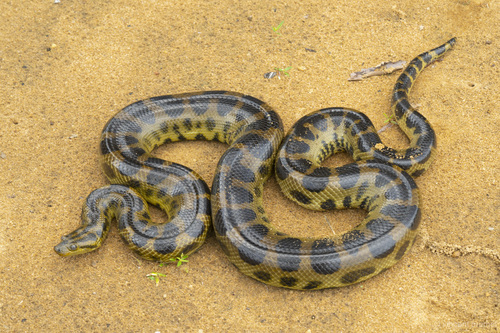
Photo: (c) Myke Clarkson, all rights reserved, uploaded by Myke Clarkson · via iNaturalist
KEY TAKEAWAYS
The Bolivian anaconda (Eunectes beniensis), also called the Beni anaconda, is a non-venomous constrictor described as a distinct species only in 2002. It is one of the rarest members of the anaconda group, known from a small part of northern Bolivia, and is far less studied than the green anaconda or yellow anaconda.
- It is not venomous. Like other anacondas, it kills prey by constriction.
- It was first described by German herpetologist Lutz Dirksen in 2002, making it one of the most recently recognized anaconda species.
- Adults reach roughly 7 to 14 ft (2.1 to 4.3 m), smaller than the green anaconda but similar in size to the yellow anaconda.
- It was once suspected to be a hybrid between the green and yellow anacondas, but genetic studies show it is a separate lineage.
Bolivian anaconda quick facts
| Common name | Bolivian anaconda (Beni anaconda) |
|---|---|
| Scientific name | Eunectes beniensis Dirksen, 2002 |
| Family | Boidae (boas) |
| Venomous | No, a constrictor |
| Adult length | 7-14 ft (2.1-4.3 m) |
| Weight | Up to about 77 lb (35 kg) |
| Range | Beni and Pando departments, northern Bolivia |
| Habitat | Flooded savanna and wetlands of the Bolivian Amazon |
| Reproduction | Live birth, like other anacondas |
| Conservation | IUCN Least Concern; very small known range |
How to identify a Bolivian anaconda
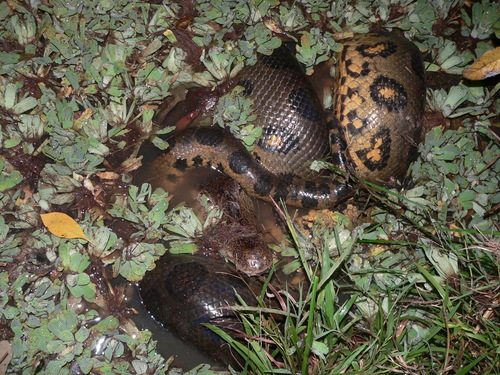
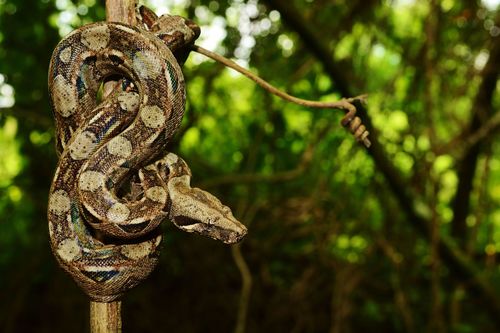
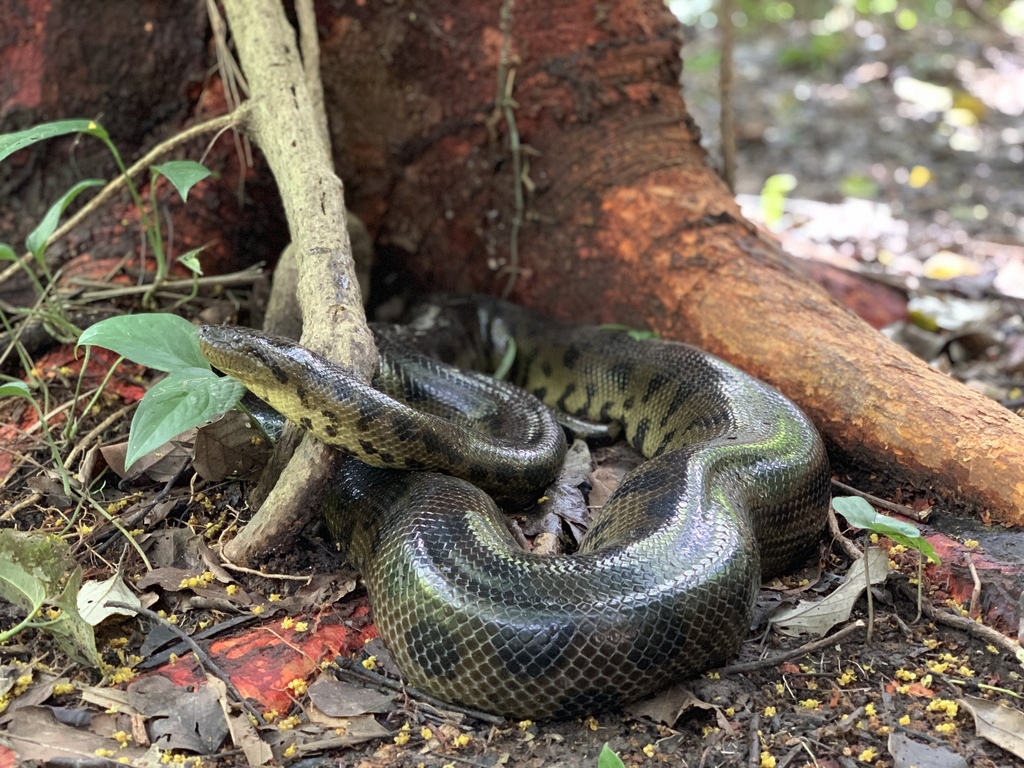
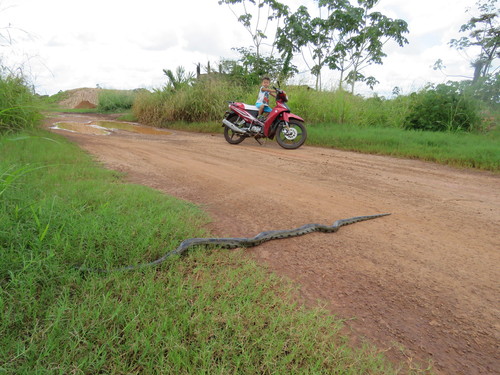
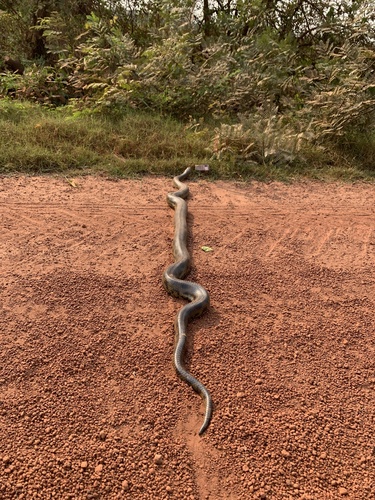
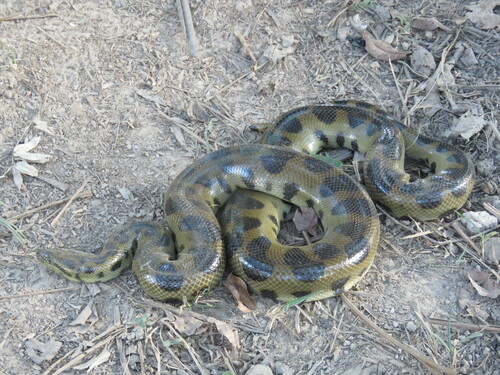
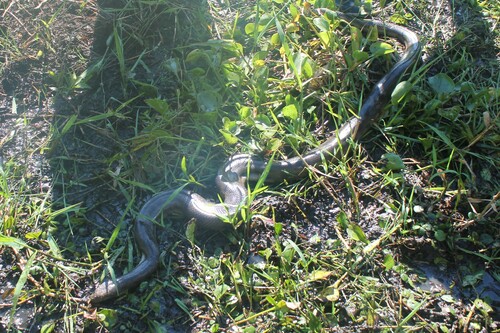
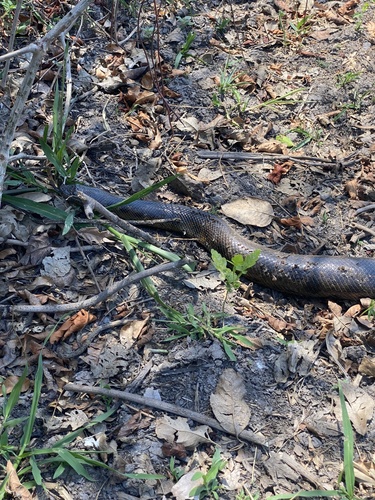
The Bolivian anaconda looks like a smaller, intermediate version of its better-known relatives. It shares the thick body and high-set eyes of every anaconda, but its pattern sits between the olive green of the green anaconda and the brighter yellow of the yellow anaconda.
- 1Body: thick and muscular, though less massive than a green anaconda.
- 2Color: olive brown to greenish, with dark blotches that are less contrasting than those of the yellow anaconda.
- 3Head: narrow, with eyes and nostrils set high on top, like other anacondas.
- 4Location: the single most reliable clue. Any anaconda-like snake found in the Beni or Pando departments of northern Bolivia, away from the core range of the green and yellow anacondas, is likely this species.
How big does a Bolivian anaconda get?
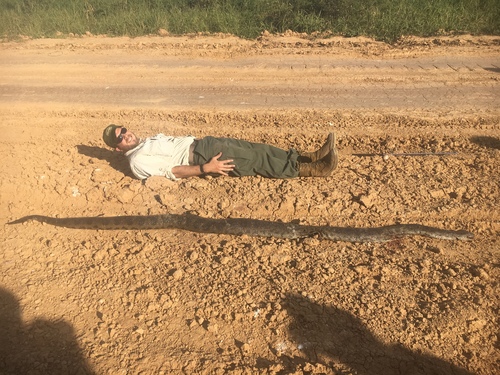
Short answer: adults typically reach 7 to 14 ft (2.1 to 4.3 m), placing it between the smaller sand boas and the much larger green anaconda in overall size. It can weigh up to about 77 lb (35 kg).
Because it was described so recently and is known from relatively few specimens, there is less long-term size data for the Bolivian anaconda than for the green anaconda or yellow anaconda. Researchers initially suspected it might simply be a hybrid of those two species, which would explain its intermediate size and pattern, but molecular studies instead place it as its own lineage within the anaconda group.
Where does the Bolivian anaconda live?
Short answer: the Bolivian anaconda is known only from the Beni and Pando departments of northern Bolivia, in the southwestern Amazon basin. Its full range has not been mapped in detail.
This is one of the smallest known ranges of any anaconda species. The green anaconda spans most of the Amazon and Orinoco basins, and the yellow anaconda covers the Paraguay River basin further south, but the Bolivian anaconda has so far turned up only in this one part of Bolivia. See the anaconda group page for how all the species compare, and our world snake map for every group's range.
Habitat
The Bolivian anaconda lives in flooded savanna and wetland habitat typical of the Bolivian Amazon, similar to the llanos used by the green anaconda farther north. It is tied to slow or seasonally flooded water, like every other anaconda.
How was the Bolivian anaconda discovered?
German herpetologist Lutz Dirksen described the Bolivian anaconda as a new species in 2002, in his book Anakondas, after finding snakes in the Beni region that did not match the green or yellow anaconda. The Reptile Database lists the type locality as Trinidad, in Bolivia's Beni department.
A 2023 survey published in the journal Check List updated the known specimen records and distribution for the species, confirming it is restricted to a small part of northern Bolivia. A 2024 genetic study led by Jesus Rivas found the Bolivian anaconda closely related to the yellow anaconda and the rare De Schauensee's anaconda, and proposed that the three might eventually be classified as one variable species. That change has not been widely adopted.
Behavior
Detailed behavioral studies of the Bolivian anaconda are limited compared with its relatives, since it was only recognized as a distinct species in 2002 and few researchers have studied it in the field. Based on its close relationship to the yellow anaconda, it is assumed to hunt the same way: ambushing prey from the water and killing by constriction rather than venom.
Its rarity in the scientific record is partly a matter of attention rather than true scarcity. Remote parts of the Bolivian Amazon are not well surveyed for snakes, so the species' full range and population size remain uncertain.
Is the Bolivian anaconda venomous or dangerous?
No, the Bolivian anaconda is not venomous. Like every member of the anaconda group, it has no venom glands and relies entirely on constriction to kill prey.
Because it is smaller than the green anaconda and rarely encountered by people, there are no notable records of dangerous encounters. As with any wild anaconda, keep your distance rather than attempt to handle one. Our snake safety FAQ covers what to do around any large snake you cannot identify.
Snakes confused with the Bolivian anaconda
The Bolivian anaconda is easily confused with its two better-known relatives, since its range overlaps loosely with both.
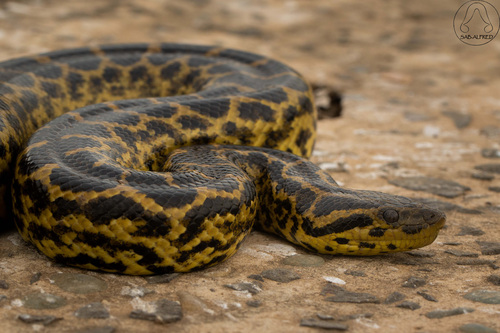
Yellow anaconda
Eunectes notaeus · Harmless
Brighter yellow with sharper black blotches, and found mainly in the Paraguay River basin farther south. See our yellow anaconda guide.
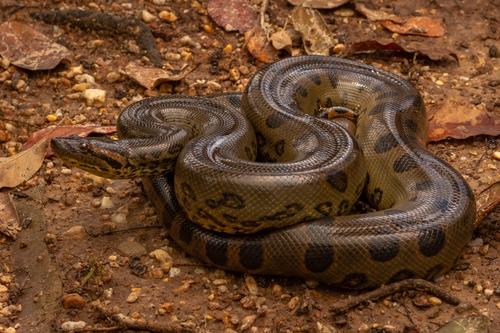
Green anaconda
Eunectes murinus · Harmless
Larger and darker olive green, and found mainly in the Amazon and Orinoco basins rather than this one part of Bolivia. See our green anaconda guide.
Reproduction
Like other anacondas, the Bolivian anaconda gives birth to live young rather than laying eggs. Specific data on litter size and gestation for this species are limited, since it has been studied for only about two decades, but its reproduction is assumed to follow the same pattern as its close relatives the yellow and green anacondas.
Conservation status
| Status | Detail |
|---|---|
| IUCN Red List | Least Concern |
| Range | Known only from a small part of northern Bolivia |
| Data | Limited field studies since its description in 2002 |
The IUCN lists the Bolivian anaconda as Least Concern, but that rating comes with a caveat: its small known range and the limited number of surveys mean its true population size and trend are not well understood. A species confined to one small region is more vulnerable to local habitat change than one spread across a continent.
Bolivian anaconda FAQ
Is the Bolivian anaconda venomous?
No. The Bolivian anaconda has no venom glands. Like every anaconda, it kills prey by constriction, not poison.
Where is the Bolivian anaconda found?
Only in the Beni and Pando departments of northern Bolivia, in the southwestern Amazon basin. It has the smallest known range of any anaconda species.
Is the Bolivian anaconda a hybrid?
No. It was initially suspected to be a hybrid of the green and yellow anacondas because of its intermediate size and color, but it was described as its own species, Eunectes beniensis, by Lutz Dirksen in 2002, and genetic studies have since supported that it is a distinct lineage.
How big does a Bolivian anaconda get?
Adults typically reach 7 to 14 ft (2.1 to 4.3 m) and can weigh up to about 77 lb (35 kg), making it smaller than the green anaconda and similar in size to the yellow anaconda.
What is the difference between a Bolivian anaconda and a yellow anaconda?
The Bolivian anaconda is duller in color, with less sharply defined blotches, and is known only from a small area of northern Bolivia. The yellow anaconda is brighter yellow and lives mainly in the Paraguay River basin farther south.
Is the Bolivian anaconda endangered?
The IUCN lists it as Least Concern, but it is one of the least studied anacondas, known only from a small part of Bolivia, so its true population trend is not well documented.